This guide is independent and contains no paid placement. If affiliate links are added later, they will be clearly marked and will not change our editorial checks.
Start on Paignton Green in the morning, use the pier and the promenade as your base, and plan beach time around the seasonal rules: Paignton Sands is closed to dogs from 1 May to 30 September, but Goodrington North Sands welcomes dogs all year, and the level coast path to Torquay takes about an hour.
A morning on Paignton Green
Arrive early and Paignton belongs to the dog walkers. The sun comes up over Tor Bay, the tide is usually low, and Paignton Green — the broad sweep of grass between the town and the seafront — fills with the regulars: spaniels doing their first circuits, terriers meeting their morning rivals, and owners standing in small groups with takeaway coffees while the dogs sort out the social order. This is the best hour of the day in Paignton, and it costs nothing. Let your dog settle here before you ask anything else of them, and the rest of the day goes more smoothly.
The Green is the centre of the town in a way that the beach is not. It sits between the shops of the town centre and the sea, so everything a dog day needs is within a few minutes: the promenade and the pier on one side, cafés and the high street on the other, and the harbour and Roundham Head a short walk to the south. There are bins dotted around the edges, drinking water is easy to find at the seafront cafés, and the open grass gives a nervous dog room to keep its distance while a confident one makes friends. The circular Green Mile, launched in 2010, runs from the harbour along the seafront and past the pier, with nine distance markers set 220 yards apart; one full loop is about a mile, which makes it a useful way to warm a dog up and judge how much energy it has before you commit to a longer walk.
Read the Green before you let your dog off the lead. On an ordinary weekday morning it is a relaxed, open space, but Paignton uses it hard: summer fairs, markets, funfairs and community events all set up here, and when the stalls and crowds arrive the mood changes completely. A dog that is fine on an empty green can be overwhelmed by a fairground, so check what is on before you travel and keep a lead handy even on quiet days. Children play ball games here, cyclists cross it, and the road along the seafront is busy in the season, so the habit that works best is a lead on the edges and a free run in the middle only when you can see clearly in every direction. If your dog is reactive, the early morning and the quieter northern end of the Green, towards Preston, are calmer than the stretch by the pier.
Use the morning to do the practical jobs. Walk the full length of the Green once, from the harbour end to Preston, and you will have seen the pier, the beach, the promenade and the start of the coast path, which means you can plan the rest of the day with your eyes open rather than from a map. Note where the shade falls — there is little of it on the Green itself at midday — and where the nearest water and toilets are. If you are staying for several days, this first circuit also teaches your dog the layout, and dogs that know where they are settle faster in the evenings. By the time the day-trippers arrive, you will already have had the best of Paignton, and your dog will be ready for a rest in the shade while the seafront gets busy.
The pier and the seafront
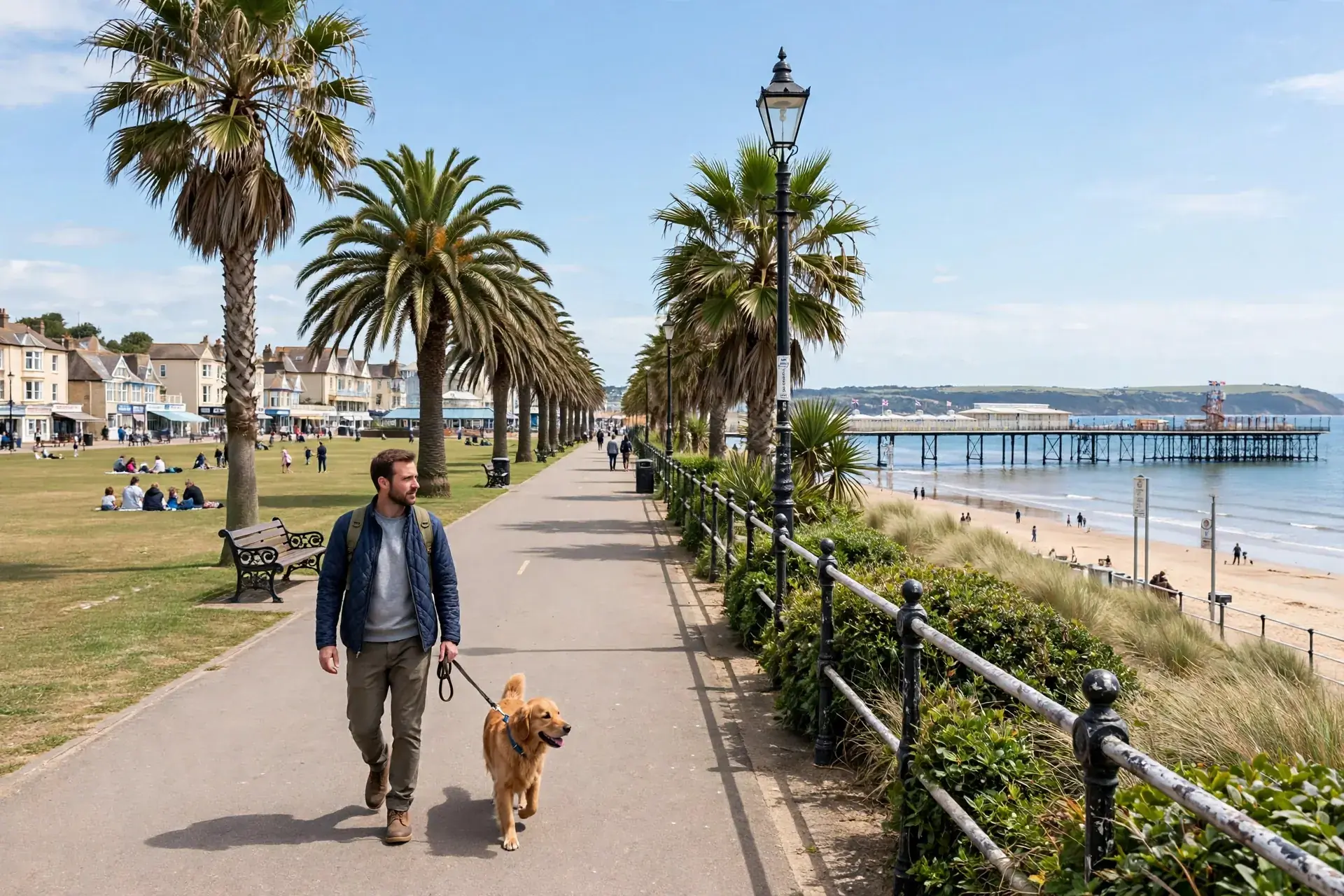
Paignton Pier is the landmark that organises the whole seafront. Built between 1878 and 1879 and stretching about 780 feet out into Tor Bay, it was commissioned by a local barrister and has been the town's centrepiece ever since. The pier today is a working seaside pier rather than a museum piece: amusements, games and snack stalls fill the deck, and the view back towards the town, with the Green in front of it and the red cliffs of the bay curving away on both sides, is one of the best in Torbay. Dogs on leads are a normal sight on the pier and the promenade, and the flat, level deck suits older dogs and puppies that are still building up their walking distance.
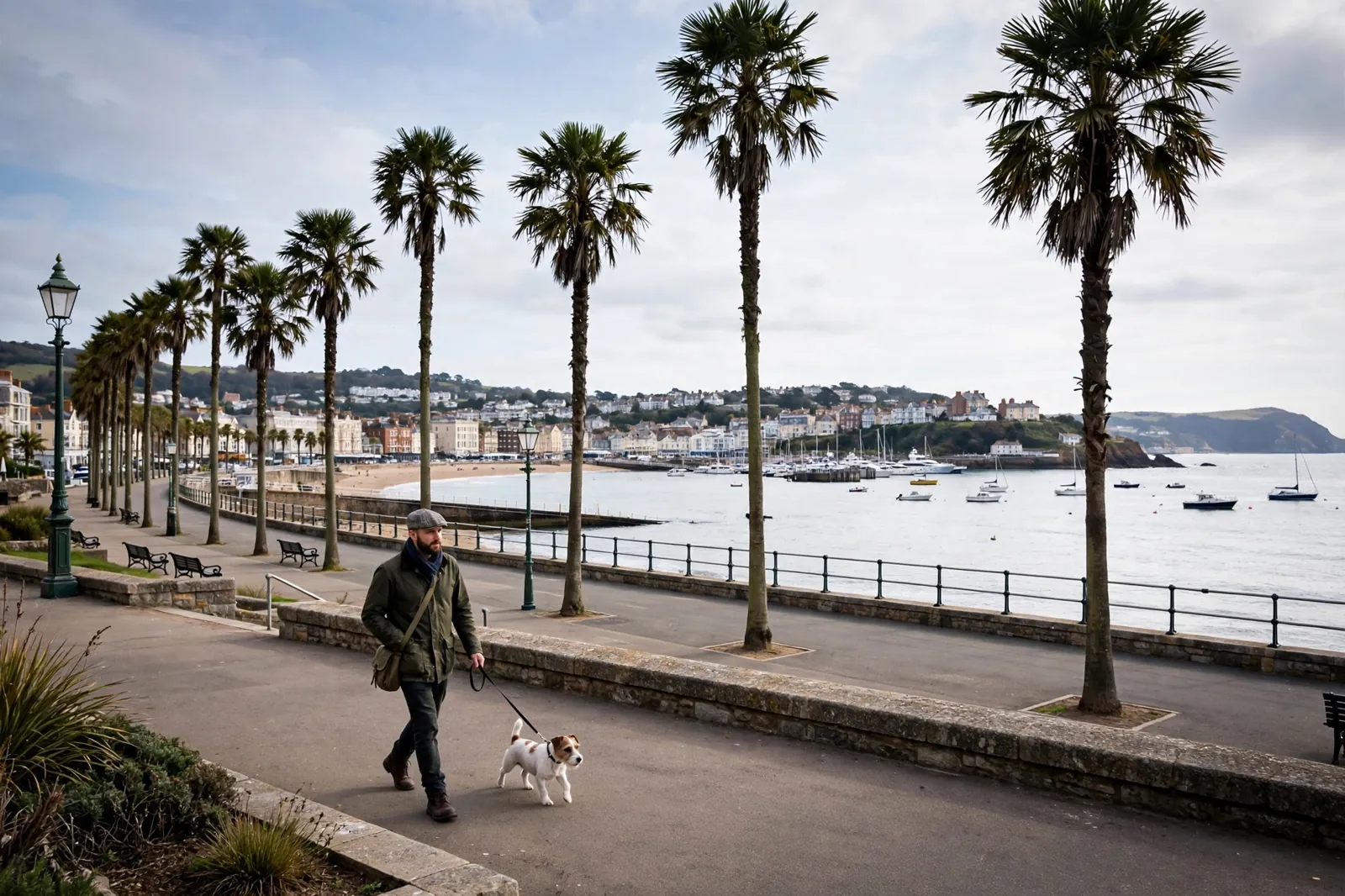
The seafront promenade runs in a long, gentle curve from the harbour in the south, past the pier and Paignton Green, then on past Preston Green and the beach huts towards Hollicombe in the north. It is wide, smooth tarmac throughout, with no gradients worth worrying about, which makes it one of the easiest seafront walks in Devon for a dog that struggles with steps or a owner pushing a pushchair. The sea wall along this stretch even holds fossils in places, a reminder that the whole of Torbay sits inside a UNESCO Global Geopark. Walk it slowly and you pass the full range of traditional seaside life: deckchairs and ice cream stalls, the colourful beach huts that stand along Marine Parade from April to October, children with buckets at the water's edge, and the steam railway running just behind the road.
The harbour end of the seafront is worth the short detour. Paignton Harbour is small and working, with fishing boats and pleasure craft moored side by side, and the path around Roundham Head gives you the first real climb of the day and a view back across the whole bay. From the headland you can see the sweep from Torquay in the north to Brixham in the south, and on a clear morning the far headlands stand out sharply against the water. Keep your dog on a lead around the harbour, where boats, ropes and slipways leave little room for error, and watch for dropped bait and fish scraps near the quayside, which are a magnet for scavenging dogs. The harbour is also the starting point for the coast path south towards Goodrington, which is covered in the quieter walks section below.
One practical note shapes every seafront walk in the summer months: when dogs are banned from the beach, they must be kept on a lead on the promenade beside it. That rule is easy to forget on a hot day when the sand looks inviting and every other dog seems to be off the lead, but it is enforced, and it is also simple good sense — the promenade in August is crowded with small children, pushchairs and ice creams at dog height. Treat the promenade as a lead walk all year, let your dog run on the Green or on the year-round beaches instead, and the seafront stays pleasant for everyone. In the cooler months the rule relaxes with the season, and the whole promenade becomes a long, sociable dog walk from one end of the bay to the other.
Paignton Sands and the seasonal dog rules
Paignton Sands is the beach most visitors picture when they think of Paignton: a long, flat stretch of golden sand that shelves gently into shallow water, with the pier at one end and the Green behind it. It is a superb family beach, and for half the year it is a superb dog beach too. The rule to build your whole trip around is simple. From 1 October to 30 April, dogs can go on all beaches in Torbay, including Paignton Sands. From 1 May to 30 September, dogs are not allowed on Paignton Sands at all, and dogs must be kept on a lead on the promenade beside the beach. Assistance dogs are allowed on all Torbay beaches all year round. The council can change the list, so check the official guidance before you travel — but those dates have been the pattern for years, and they are the reason the best dog visits to Paignton happen outside high summer.
A winter beach day in Paignton is a different experience from a summer one, and for most dogs it is the better of the two. The sand is empty, the tide goes out a long way and leaves firm, flat ground for running, and the shallow water is safe for paddling dogs that like to wade. There is room to throw a ball without worrying about the next family along, and the cafés on the seafront stay open through much of the winter, so you can warm up afterwards. The wind is the one thing to respect: Tor Bay faces east and south-east, and a cold wind off the water can chill a small or short-coated dog quickly, so bring a drying coat and do not let a wet dog stand around in it. In summer the same beach is a different place — busy, hot, and closed to dogs — so plan around it rather than against it.
When Paignton Sands is closed to dogs, the year-round beaches are the answer, and Paignton is well served by them. Goodrington North Sands, a short walk south past the harbour, welcomes dogs all year, and it is the most practical summer beach for a Paignton stay: sandy, sheltered, with cafés and facilities nearby. Hollicombe beach, at the northern end of the promenade walk, is also open to dogs all year, and its slipway gives step-free access to the sand. The small rocky cove at Fairy Cove, near Preston, is another year-round option, better for scrambling and rock-pooling than for a long run. Further south, Elberry Cove past Broadsands is open to dogs all year too, although it is a wilder, more uneven spot that suits confident dogs and sure-footed owners. Preston Sands and Goodrington South Sands follow the same seasonal pattern as Paignton Sands, so do not assume a beach is open just because it looks quiet — check the signs at the entrance, which the council puts up at every restricted beach.
A few beach habits make the difference between a good day and a stressful one. Read the signs at the top of the slipway before you step onto the sand, because the boundary between a restricted beach and an open one is sometimes a line of signs rather than a fence. Keep your dog on a lead until you are sure of the rules, and keep it on a lead on every promenade beside a restricted beach. Take water for the dog as well as for yourself: seawater is not a substitute, and dogs that drink it can be ill, so carry a bottle and a bowl and offer fresh water regularly. Watch the tide, especially at the coves, where a rising tide can cut off the way back faster than you expect. And pick up after your dog — the beaches that stay open to dogs all year stay open because dog owners look after them, and a single bad summer of mess is the sort of thing that gets a beach added to the restricted list.
The coast path walk to Torquay
The walk from Paignton to Torquay is the single best dog walk in the town, and it is also one of the easiest. The South West Coast Path, which runs for 630 miles around the south-west peninsula, follows the seafront all the way from Paignton Green to Torquay harbour, and the local stretch is about 3 miles — roughly an hour at a relaxed dog-walking pace, or a little longer if your dog stops to investigate every beach hut. Torbay Council describes it as mainly level and partly next to the road, and that is an accurate summary: this is a promenade and pavement walk with sea views the whole way, not a cliff scramble, so it suits older dogs, young dogs and anyone who wants a proper walk without a proper climb.
Start at the pier and follow the promenade north past Preston Green and the long row of beach huts, then on past Hollicombe, where the path crosses the railway bridge and the character of the walk changes. From here the route runs past Livermead Sands and Torre Abbey Sands, with the gardens of Torre Abbey on your inland side, and then into Torquay itself, past the marina and along the harbour to the town centre. The beaches you pass on the way follow the same seasonal pattern as Paignton Sands, so in summer keep your dog on the promenade and save the running for the year-round beaches at either end. At low tide you can walk much of the way along the sand instead, which most dogs prefer, but some stretches between Hollicombe and Livermead are impassable when the tide is in, so check tide times before you choose the beach route — the coast path itself is usable at any tide.
The return journey is part of the charm of this walk. The Riviera Line runs between Torquay and Paignton in a few minutes, so you can walk one way and ride back, which is the right call on a hot day or with a tired dog. Dogs are generally welcome on the train, but check the official guidance before you travel so you know the current conditions. Alternatively, the local bus runs along the seafront road between the two towns, and the walk back is no hardship if your dog still has energy — the views are different in the other direction, with the light falling on the bay from the south in the afternoon. Whichever way you return, stop in Torquay harbour for water and a rest before you set off; the marina is a busy place and a tired dog that is asked to walk another three miles without a break is a dog that will remember the day for the wrong reasons.
Our full guide to Torquay with a dog covers the harbour, the beaches at the Torquay end of the walk, and places to eat and stay once you arrive, so read it before you set out if you plan to spend the afternoon there. The walk also works in the other direction, of course: if you are staying in Torquay, Paignton Green and the pier make a natural turning point, and the Green is a better lunch stop for a dog than most of Torquay's busier pavements. Either way, this is a walk to do early in the day in summer, when the promenade is quiet and the sand is cool, and to do slowly in winter, when the light on the bay is at its best and you may have the whole path almost to yourself.
Quieter walks away from the crowds
Paignton is not only a seafront town. Turn inland or head south from the harbour and the crowds thin out quickly, which matters on the days when the promenade feels too busy for a nervous dog or when you simply want a change of scenery. The most useful quiet walk starts at the harbour and follows the coast path around Roundham Head to Goodrington, a distance of about a mile that Torbay Council estimates at thirty minutes. It is steeper than the Torquay walk, with steps and a climb over the headland, but the reward is a proper cliff-top path, views across the bay, and a much quieter stretch of coast. From Goodrington you can continue to Broadsands and on to Elberry Cove, where the path leaves the resort behind and runs through fields and woodland above a rocky shore. This is the walk to choose when your dog needs space and you want to hear the sea rather than the amusements.
Inland, the Clennon Valley lakes offer a completely different kind of walk. A short drive or a steady walk from the town centre brings you to a chain of lakes set in a wooded valley, with level paths, plenty of shade and water birds that will keep a spaniel's nose busy for an hour. Keep your dog on a lead here: the lakes are a nature reserve, the paths run close to the water, and the wildlife is the point of the place. The same applies to the country park at Cockington, a short distance north of Paignton towards Torquay, where wooded paths, open meadows and a village of thatched cottages make a gentle half-day out. Cockington's paths are mostly level and shaded, which makes them a good wet-weather or hot-day alternative to the open seafront, and the village green is a calm place for a dog to rest after the walk in.
Oldway Mansion, on the edge of the town centre, is another quiet option. The mansion itself is not open as a visitor attraction in the usual sense, but the gardens are a pleasant, sheltered place for a lead walk, with lawns, mature trees and a very different atmosphere from the seafront. Dogs on leads are welcome in the grounds, although you should check the official guidance before you travel, as access arrangements for the gardens can change. The town centre is also worth a short walk on a lead: Paignton's high street is compact, and a morning circuit past the shops is a useful bit of socialisation for a young dog that needs to get used to pavements, crossings and strangers. Keep it short, keep it calm, and finish with a walk on the Green so the dog ends on a good note.
The principle for all of these walks is the same: use the seafront for the sociable, open-air part of the day, and use the inland and headland walks when your dog needs quiet, shade or a change of surface. A dog that spends every walk on hot tarmac and sand will tire faster than one that gets grass, woodland and shade as well, and Paignton gives you all three within a mile of the pier. Carry water on the headland walks in particular, because there are no cafés between Goodrington and Elberry Cove, and the climb back over Roundham Head is harder than it looks on the way down.
Where to eat and drink with a dog
Paignton is an easy town to eat in with a dog, as long as you plan for the terrace rather than the dining room. The seafront cafés along the promenade are set up for exactly this: outdoor tables where a dog can lie under the table, water bowls by the door, and staff who are used to dogs settling down while their owners eat. The harbour end of the seafront is particularly good for this, with several cafés and pubs that look out over the boats and have space for a dog to rest out of the way of the foot traffic. The town centre has its own share of dog-welcoming cafés too, although the pavements are narrower there and a large dog can be in the way, so the seafront is usually the better choice for a relaxed meal.
Fish and chips is the meal that fits a dog day in Paignton best, and the town has plenty of choice along the seafront and in the town centre. Buy your food, find a bench on the Green or a spot on the promenade wall, and eat it with the dog beside you — this is the seaside done properly, and it avoids the whole question of whether a dog is welcome inside. If you do want to sit down properly, look for pubs with gardens or terraces rather than restaurants with small dining rooms. The pubs around the harbour and along Torbay Road are the most likely to have outdoor space and a tolerant attitude, and many of them put water bowls out in the summer. A quick phone call before you walk over saves a wasted trip: policies change, a pub that welcomed dogs last year may have changed hands, and a five-minute check is better than standing at the door with a hungry dog.
There are a few habits that make eating out with a dog work in a busy resort. Bring a mat or a blanket for your dog to lie on, because seafront paving and pub terraces are hard and hot, and a dog with its own spot settles faster than one that is trying to find a comfortable place on concrete. Bring a chew or a stuffed Kong to keep a young dog occupied while you eat, and keep the lead short and tucked under your foot rather than trailing across a walkway. Order at the bar or the counter where you can, so the dog is not left alone at a table, and be honest with yourself about your dog: a dog that barks at strangers or lunges at passing dogs will not enjoy a busy seafront café, and neither will anyone else. For that dog, a takeaway eaten on the Green is a kinder plan, and Paignton has enough takeaway choice to make it a good one.
Breakfast is the easiest meal of the day for a dog owner in Paignton. The seafront cafés open early, the morning crowd is mostly other dog walkers, and a dog that has just had a run on the Green will sleep through a slow breakfast without any trouble. Evening is the harder meal: the seafront gets busy, the light fades, and a tired dog is less tolerant than a fresh one. If you are eating out in the evening, choose somewhere close to where you are staying, go early, and keep it short. A dog that has had a full day of walking, swimming and meeting other dogs has earned a quiet evening, and a takeaway back at your accommodation is often the best end to the day.
Where to stay with a dog
Paignton gives you three kinds of stay with a dog, and the right one depends on your dog as much as on your budget. The caravan and holiday parks around Goodrington are the most straightforward option for a family with a dog: they are set up for pets, they have their own grounds and walks, and the beach at Goodrington North Sands is on the doorstep. When you book, ask the specific questions that matter: how many dogs are allowed per unit, what the pet fee is, whether the unit has an enclosed outdoor space, and whether dogs are allowed in the on-site bar and restaurant or only on the terrace. A park that is genuinely set up for dogs will answer all four without hesitating; a park that is merely tolerating dogs will be vague, and vagueness at booking time usually becomes a problem on arrival.
Self-catering cottages and apartments in the town are the second option, and they suit dogs that need a quiet base rather than a busy park. Look for ground-floor accommodation with direct access to a garden or to the street, because carrying a large dog up two flights of stairs after a wet walk is nobody's idea of a holiday. An enclosed garden is worth paying extra for, especially if your dog is used to one at home — it gives the dog a safe place to stretch its legs in the morning and a toilet area at night without a walk to the Green in the dark. Read the listing carefully for the dog rules: some owners welcome one dog and charge a small fee, others set a maximum of two, and a few restrict the size or breed of dog. Get the dog arrangement confirmed in writing with the booking, including the fee, so there is no argument at check-in.
Hotels, guest houses and bed and breakfasts near the seafront are the third option, and they suit short stays and couples better than families with dogs. A dog-friendly hotel in Paignton will usually have a small number of designated dog rooms, often on the ground floor and near an exit, and may charge a nightly fee. Ask whether the dog can be left alone in the room while you eat — many hotels do not allow it — and whether dogs are welcome in the breakfast room or only in the bar. If the answer to both is no, you will be eating every meal on a terrace or as a takeaway, which is fine for a night or two but wearing for a week. The hotels closest to the seafront have the advantage that the Green and the beach are minutes away, which matters for the early morning and late night toilet walks that frame every day of a dog holiday.
Wherever you stay, pack for the dog as carefully as you pack for yourself. Bring the dog's own bed, because a familiar smell helps a dog settle in a strange room, and bring twice as many towels as you think you will need: Paignton sand gets everywhere, and a wet dog in a holiday cottage is a problem that a stack of old towels solves. Bring a drying coat for winter stays, a water bowl for the car and the room, and the dog's usual food — changing food on holiday is a reliable way to ruin a day. And before you book anywhere, check the cancellation terms: a dog that falls ill or a family emergency can change plans quickly, and a booking that lets you move the dates is worth more than one that saves you twenty pounds.
Day trips: Brixham and Dartmouth
Paignton sits in the middle of the English Riviera, which makes it a natural base for day trips, and the two that matter most for a dog owner are Brixham and Dartmouth. Brixham is the closest: the coast path from Paignton to Brixham is about 5 miles and takes roughly two hours on foot, passing Goodrington, Broadsands and the wooded coast around Berry Head, but most people with a dog will take the bus or drive and save the walking for Brixham itself. The harbour is a working fishing port, and the Breakwater walk out into the bay is one of the great dog walks in Devon — flat, open, with the sea on both sides and the fishing boats coming and going below. Our guide to Brixham with a dog covers the harbour, the fish market and the cliff paths in detail, including where dogs are welcome and where they need to stay on a lead.
Dartmouth is the more ambitious day out, and it is also the more rewarding one. The Dartmouth Steam Railway runs from Paignton station to Kingswear, a journey of about thirty minutes through the Dart valley, and from Kingswear a passenger ferry crosses the River Dart to Dartmouth itself. Dogs are generally welcome on the steam railway and on the ferry, but check the official guidance before you travel so you know the current charges and conditions. Book the train in advance on busy days, because the steam railway is popular and the dog-friendly carriages fill up. Once in Dartmouth, the embankment walk along the river is the centrepiece: flat, scenic, and full of places to sit with a dog while the boats go past. Our guide to Dartmouth with a dog explains the castle, the ferries and the nearby beaches, and it is worth reading before you go, because the river makes Dartmouth's geography confusing the first time you visit.
Torquay, the third town of the bay, is the easiest day trip of all, because it is only an hour's walk or a few minutes by train from Paignton, and our guide to Torquay with a dog covers its beaches, the walk to Cockington and the harbour in detail. If you have a car, the wider area opens up further: the moorland edge of Dartmoor is about forty minutes away, with open walks that suit dogs that need to run, and the South Devon coast east of Torquay has quieter beaches and villages that are worth a drive. The one thing to avoid is trying to do too much. Paignton rewards a slow pace, and a day trip that leaves the dog exhausted is worse than a quiet day on the Green. Pick one destination, go early, and be back in Paignton in time for an evening walk on the promenade.
Seasons and wet weather
Paignton changes with the seasons more than most Devon resorts, because the beach rules change with them. From October to April the town is at its best for dogs: Paignton Sands is open to them, the seafront is quiet, the cafés are calm, and a dog can run on the beach without another soul in sight. The weather is the trade-off. Winter on the English Riviera is milder than in most of Britain, but the wind off the bay is cold, the rain comes in quickly, and a wet dog needs drying properly. Bring a drying coat, bring towels, and plan your walks for the middle of the day when the light is best and the temperature is highest. The winter light on Tor Bay is worth the effort: low sun, long shadows and empty beaches are the reward for visiting out of season.
Late spring and early autumn are the sweet spot for most visitors. In May the beach ban comes in, but the weather is warming up, the days are long, and the year-round beaches at Goodrington North Sands and Hollicombe are close enough that the ban barely matters. September and October are often the best weeks of the year: the crowds have gone, the sea is at its warmest, the beach huts come down and the town relaxes. If you can choose your dates freely, aim for the first two weeks of October, when the beach opens to dogs again and the autumn weather is usually still kind. That is also when the steam railway, the pier and the cafés are still running a full service before the winter timetable begins, so you get the summer attractions with the winter freedom.
Summer in Paignton is the full seaside experience, and it needs a plan. The beach ban means your dog's swimming happens at Goodrington North Sands or Hollicombe, so go early in the morning before those beaches fill up, and bring shade and water: there is little natural shade on any of the bay's beaches, and hot sand burns paws. The promenade and the Green are busy from late morning onwards, so do your long walk first, rest through the middle of the day, and come out again in the evening when the light softens and the crowds thin. Never leave a dog in a parked car in summer, even for a few minutes — the seafront car parks get hot quickly, and a dog in a hot car is an emergency, not an inconvenience. If you are staying in a caravan or a holiday park, a shaded pitch and a paddling pool for the dog are worth more than a sea view.
Wet weather in Paignton is not a wasted day, because the town has more covered options than most resorts its size. The pier's amusements give you an hour under cover, although dogs are not welcome inside every part of it, so check before you go in. The steam railway to Kingswear is a good rainy-day outing: the train is covered, the ferry crossing is short, and Dartmouth's pubs and cafés are used to wet dogs. The shops in the town centre give you a dry walk on a lead, and the cafés on the seafront are happy to have a damp dog under the table as long as it is not shaking water over everyone. The coast path is still walkable in the rain — the promenade drains well and the tarmac stays grippy — but the headland path around Roundham Head gets slippery, so save that one for a dry day. Whatever you do, dry the dog properly afterwards: a wet dog in a cold caravan or cottage is a miserable dog, and a damp bed is a smell that stays with a holiday.
Practical planning
Getting to Paignton with a dog is straightforward. The Riviera Line runs from Exeter St Davids through Torquay to Paignton station, which is a five-minute walk from the seafront, and dogs are generally welcome on the train. By car, the A380 from the M5 brings you into Torquay and then on to Paignton, and the seafront car parks — including the large car park by the harbour at Roundham — put you within a few minutes of the Green. Arrive early in summer: the seafront car parks fill up by late morning, and a dog that has to wait in a hot car while you look for a space is a bad start to the day. Check the official guidance before you travel for current parking charges and any seasonal restrictions, as both can change.
Before you travel, save the number of a local vet in your phone. The nearest practices are in the town and in Torquay, and a dog that cuts a paw on a rock at Fairy Cove or eats something it should not have on the harbour will need help faster than you can search for it. Bring your dog's vaccination record and any regular medication, and if your dog is on a special diet, bring enough food for the whole trip plus a day's spare — the supermarkets in Paignton stock the usual brands, but a specialist food may not be on the shelf. A basic first-aid kit is worth packing too: a tick remover, antiseptic wipes, a bandage and a spare lead cover most of the small emergencies that a seaside holiday produces.
Packing for a Paignton dog break is mostly about sand, water and weather. Two towels per dog per day is a reasonable rule, plus a drying coat for the cooler months. Bring a long lead for the beach and a short lead for the promenade and the town, and a harness if your dog pulls on a collar. Bring a water bottle and a collapsible bowl for every walk, because the cafés are not always open when you need them and seawater is not a substitute for fresh water. Bring poo bags — more than you think you will need — and use them: the beaches and the Green stay open to dogs because owners clean up, and the bins around the seafront are there for exactly this. A ball or a favourite toy is useful on the beach, but leave the expensive ones at home, because the sea keeps what it takes.
Finally, give the trip a shape before you arrive. A good Paignton weekend with a dog has a simple rhythm: a morning walk on the Green and the beach, a long lunch or a rest in the middle of the day, and an evening walk along the promenade when the light is good and the crowds have gone. A longer stay adds the coast path to Torquay one day, Brixham or Dartmouth the next, and a quiet inland walk in between. The town does not need to be rushed, and a dog that is given time to learn the layout, the smells and the routine will enjoy it far more than one that is dragged from attraction to attraction. Paignton is a resort that was built for slow days by the sea, and a dog is the best possible excuse to take it at exactly that pace.
Practical questions
Before you go
Can dogs go on Paignton beach in summer?
No. Dogs are not allowed on Paignton Sands from 1 May to 30 September, and dogs must be kept on a lead on the promenade beside the beach during those months. From 1 October to 30 April dogs can use the beach. If you visit in summer, head to Goodrington North Sands, Hollicombe or Fairy Cove, which welcome dogs all year. Check the official guidance before you travel, as beach rules can change.
How long is the walk from Paignton to Torquay with a dog?
About 3 miles, roughly an hour at a relaxed pace with a dog. The South West Coast Path follows the seafront from Paignton Green past Preston Sands and Hollicombe to Torquay harbour, and it is mainly level. At low tide you can walk much of the way along the sand, but some stretches are cut off when the tide comes in, so check tide times before you set off. The train back from Torquay to Paignton takes only a few minutes.
Where can my dog swim near Paignton all year round?
Goodrington North Sands, just south of Paignton harbour, welcomes dogs all year, as do Hollicombe beach and the small rocky cove at Fairy Cove near Preston. Elberry Cove, a short walk past Broadsands, is also open to dogs year-round. These are the reliable choices in the summer months when Paignton Sands, Preston Sands and Goodrington South Sands are closed to dogs. Watch the tide at the coves and keep your dog on a lead on the promenades.
Can I take my dog on the steam train from Paignton to Dartmouth?
Yes, dogs are generally welcome on the Dartmouth Steam Railway between Paignton and Kingswear, and on the passenger ferry across the River Dart to Dartmouth, but charges and conditions can change with the season. Book tickets in advance on busy days, keep your dog on a lead on platforms and on board, and check the official guidance before you travel so you know the current rules.
Is Paignton Green a good place for a dog?
Yes, the Green is the social heart of a dog day out in Paignton. It is a wide open stretch of grass between the town and the seafront where dogs meet, owners chat and children play, and the circular Green Mile gives you a measured loop of about a mile. Keep your dog under close control when events, fairs or markets are on, and use a lead near the road and the promenade. There are bins and water points around the seafront, and the beach is steps away in the cooler months.
When is the best time of year to visit Paignton with a dog?
October to April is the easiest season for dogs, because Paignton Sands itself is open to them and the seafront is quiet. Late spring and early autumn are a good balance: the weather is usually kind, the crowds have thinned and the year-round beaches are close at hand. Summer brings the full seaside atmosphere but also the beach ban on Paignton Sands, busy pavements and hot sand at midday, so plan early mornings, shade and water.