This guide was written independently, and no business paid to appear in it. If affiliate links are introduced later on, they will be marked as such, and they will not affect the checks we make on the route, the rules or the facilities.
The Peddars Way runs about 46 miles in a near-straight line from Knettishall Heath to Holme-next-the-Sea. It is flat, well waymarked and very dog-friendly, but water and shade are scarce on the Breckland heath, so carry plenty of water, plan around the villages, and keep your dog on a lead near livestock and nesting birds.
A Roman road, walked straight
The Peddars Way is one of the oldest walking routes in England, and its history is visible in every mile. The route follows a Roman road that was built nearly two thousand years ago to connect the Roman settlements of the region, and it runs in an almost straight line from Knettishall Heath, on the Norfolk-Suffolk border, to Holme-next-the-Sea on the north Norfolk coast. The Romans built their roads straight for a reason: a straight road is the shortest distance between two points, and it is easy to survey, easy to march along and hard to get lost on. Walkers today benefit from the same logic, because the Peddars Way is one of the easiest National Trails to navigate in Britain.
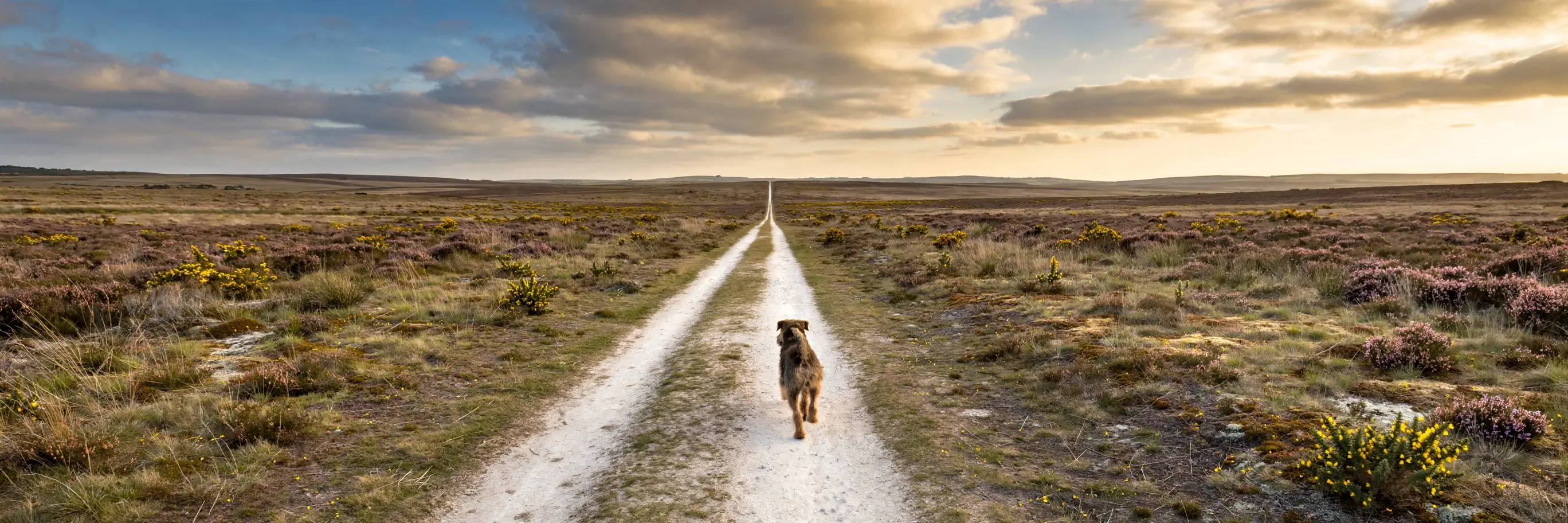
The name is thought to come from the Latin word "pedester", meaning on foot, which is fitting for a route that has been walked for centuries. After the Romans left, the road was used by pilgrims, drovers, traders and local people, and it became part of the network of tracks that crossed the Breckland heath. The route was designated a National Trail in the twentieth century, and it is now waymarked with the acorn symbol and maintained for walkers. The straightness is the trail's defining feature: for long stretches you can see the path running ahead of you to the horizon, a pale chalk track between hedgerows, heath and farmland, with nothing to distract you from the walking itself.
For a dog, a straight road has advantages and disadvantages. The navigation is simple, the surfaces are generally good, and there are few stiles, gates or steep climbs to negotiate. A dog that is used to winding woodland paths may find the straight, open heath less interesting at first, but the scents of the heath, the birds and the livestock soon make up for the lack of bends. The straightness also means there is nowhere to hide from the weather: the wind blows straight down the track, the sun beats down on the open heath, and the rain has nothing to stop it. A dog that is comfortable on open ground will enjoy the Peddars Way, but a dog that needs shade and shelter will need its owner to plan for both.
The history is not just in the line of the road. The route passes the remains of Roman settlements, medieval churches, ancient earthworks and the ruins of Castle Acre Priory, one of the finest monastic sites in England. The village of Castle Acre, with its priory, castle earthworks and medieval church, is one of the highlights of the trail, and it is worth an hour's stop even if you are walking a long day. The heath itself is a historic landscape, shaped by centuries of grazing, rabbit warrens and forestry, and the pine lines and shelter belts that cross it are part of that story. Walking the Peddars Way with a dog is a walk through two thousand years of history, and the dog will not care about the Romans, but it will enjoy every mile of the track they left behind.
The 46-mile route in sections
The Peddars Way runs about 46 miles, or roughly 74 kilometres, from Knettishall Heath in the south to Holme-next-the-Sea in the north. It is the western half of the Norfolk Coast Path National Trail, and it joins the Norfolk Coast Path at Holme, where walkers can continue along the coast in either direction. The route is divided into four main sections by the villages along the way, and most walkers take three to four days to complete it, walking eleven to fifteen miles a day. The terrain is almost entirely flat, with the only climbs being short rises over the heath and up to the villages, and the surfaces are a mix of chalk tracks, grassy paths, farm tracks and quiet lanes.
The southern section from Knettishall Heath to Little Cressingham runs across the Breckland heath and through Thetford Forest. Knettishall Heath is a large area of open heathland, with gorse, heather and grassland, and it is one of the wildest parts of the trail. The path from here is a straight chalk track that runs north through the heath, with wide views and few landmarks. Thetford Forest, which the path crosses further north, is a large conifer plantation with shaded trails and a visitor centre, and it is one of the few places on the southern section where a dog can find shade on a hot day. The villages of Little Cressingham and Great Cressingham are small and quiet, with a church and a few houses, and they make a good first night stop.
The middle section from Little Cressingham to Castle Acre is the most historic part of the trail. The path passes through the villages of Swaffham and Castle Acre, with the priory and castle at Castle Acre as the highlight. Swaffham is a market town with shops, cafes and a good choice of accommodation, and it is the largest settlement on the trail. Castle Acre is a smaller village with a priory, a castle and a church, and it is worth a longer stop. The walking on this section is a mix of heath, farmland and quiet lanes, with the River Nar crossing the path near Castle Acre, one of the few places where the dog can drink from a stream.
The northern section from Castle Acre to Holme-next-the-Sea runs through the villages of West Acre, Great Massingham, Harpley and Sedgeford, and across the farmland and heath of north-west Norfolk. The path here is a mix of farm tracks and quiet lanes, with hedgerows and fields on either side, and the views open up as you approach the coast. The final stretch from Sedgeford to Holme runs across the heath and down to the sea, with the dunes and marshes of Holme visible ahead. Holme-next-the-Sea is a small village with a beach, a bird reserve and a car park, and it is the end of the Peddars Way and the start of the Norfolk Coast Path.
Breckland heath: the hard middle
The Breckland is the landscape that defines the Peddars Way, and it is also the landscape that makes the trail hard work for a dog. The Breckland is a large area of heathland, grassland and conifer forest in the border country of Norfolk and Suffolk, and it is one of the driest and sunniest parts of Britain. The soil is sandy and free-draining, the vegetation is gorse, heather, bracken and grass, and the trees are mostly Scots pine in shelter belts and plantations. The heath is a beautiful and distinctive landscape, with wide skies, big views and a sense of openness that is rare in England, but it is also a landscape with very little shade and very little water.
For a dog, the Breckland heath presents three problems: heat, water and paws. The heath is exposed to the sun, and on a summer day the temperature on the open track can be several degrees higher than in a village or a wood. There is almost no shade on the heath itself, and the pine shelter belts are spaced out along the route. Water is scarce: there are no taps on the heath, the streams are seasonal and often dry in summer, and the ponds are few and far between. The surfaces are sandy, flinty and chalky, and they wear at paws, especially on a long day. A dog that is used to grass and pavements will need time to adapt, and a dog with sensitive paws may need boots on the flinty sections.
The heath is also an important wildlife habitat, and it needs to be treated with respect. The Breckland is home to rare birds such as the stone curlew, the nightjar and the woodlark, all of which nest on the ground in spring and summer. A dog running loose across the heath can destroy a nest without its owner ever seeing it, and the birds are easily disturbed by a dog that is off the lead. Keep your dog on a lead or a long line across the heath from April to August, and keep to the waymarked path. The gorse and heather are also home to adders, which bask on the sunny tracks in spring and summer, so keep your dog on the path and do not let it nose into the gorse.
The best way to walk the Breckland is to plan around it. Start early, carry extra water, and plan your day around the villages and the forest, where you can find shade and refill your bottles. Walk the heath in the cool of the morning, rest in the shade at midday, and walk the last few miles in the evening when the temperature has dropped. A lightweight waterproof coat helps a short-coated dog in rain and wind, and a cooling mat or a damp towel in the car helps after a hot walk. The Breckland is at its best in spring and autumn, when the heather is in flower and the temperatures are mild, and it is at its hardest in a summer heatwave, when the only sensible plan is to walk early, walk short and rest often.
Villages, water and supplies
The villages along the Peddars Way are small, spaced out and essential. Knettishall Heath has no village at all, just a car park and the heath, so the first day's walk starts with no facilities. Little Cressingham and Great Cressingham have churches and a few houses but no shops, and the nearest pub is a walk away. Swaffham is the first place with proper facilities: a market town with supermarkets, cafes, pubs and a good choice of accommodation, and it is the best place to restock food and water. Castle Acre has a pub, a village shop and a tea room, and it is a good lunch stop and an overnight stop. Great Massingham, Harpley and Sedgeford are small villages with pubs and churches, and Holme-next-the-Sea has a pub, a village hall and a car park.
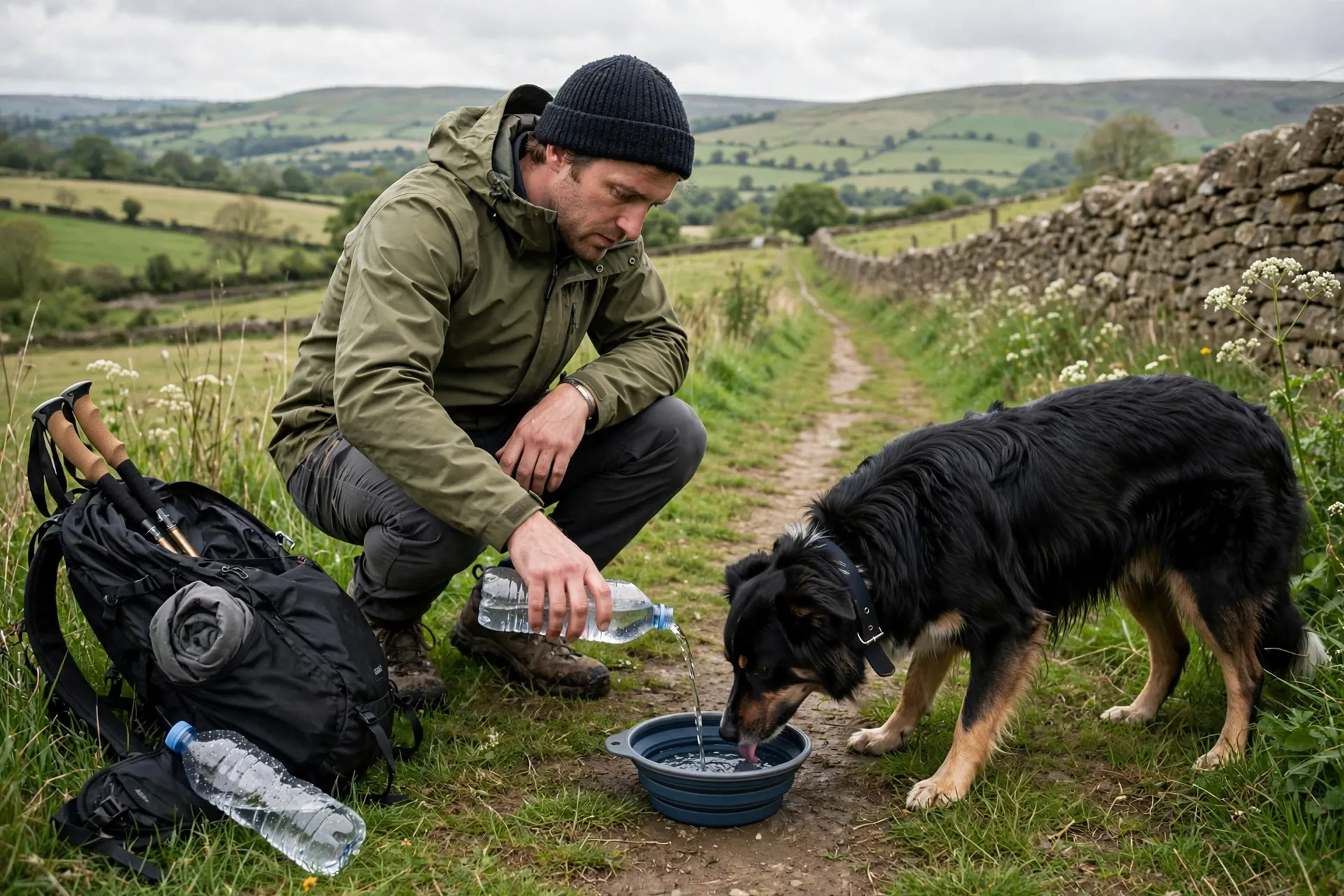
Water is the main planning problem on the Peddars Way, and the villages are the solution. Carry at least a litre of water per dog per half day, and more in summer, and refill at every opportunity. Pubs and cafes will usually refill a water bottle if you ask, and village churches often have a tap in the churchyard. The River Nar, near Castle Acre, is one of the few places where the dog can drink from a stream, but the water should be treated with caution, because it may contain agricultural runoff. Do not rely on finding water on the trail: the ponds and streams on the heath are seasonal, and the ditches beside the farm tracks are often dry or fenced off.
Food is the easy half of the planning, because it travels in your pack while water does not. Twelve miles of open heath takes far more out of a dog than twelve miles at home, so add a little extra to the evening meal instead of serving a big breakfast just before you set out, and keep a few high-value treats in your pocket for recall and for rewarding calm behaviour around livestock. A raw or special diet needs a plan of its own: the small village shops along the way may not stock what your dog eats, so buy what you need in Swaffham, Fakenham or King's Lynn before you start. Our guide to dog hydration on long walks covers how much water a dog needs by weight and temperature, how to keep a steady drinking rhythm, and the early signs of dehydration.
Supplies for the owner need planning too. There are few shops on the trail, and the pubs and cafes have limited opening hours outside the summer season. Carry lunch and snacks, and check in advance which pubs and cafes will be open on the day you walk through. Mobile signal is patchy on the heath and in the valleys, so download offline maps and save the accommodation and taxi numbers before you set out. A paper map is worth carrying as a backup, because the waymarks on the Peddars Way are generally good but can be sparse on the open heath and across farmland.
Joining the Norfolk Coast Path
Holme-next-the-Sea is the end of the Peddars Way and the start of the Norfolk Coast Path, and it is one of the best places on the north Norfolk coast to finish a walk. The village has a wide sandy beach, a bird reserve and a car park, and the coast path runs east from Holme towards Thornham, Brancaster and Wells-next-the-Sea, and west towards Hunstanton. Many walkers who finish the Peddars Way continue along the coast for a day or two, adding a beach and a sea view to the end of their walk, and the combination of the two trails is one of the best long-distance walks in England for dogs.
The coast at Holme is a nature reserve, and the rules for dogs are the same as on the rest of the north Norfolk coast: keep the dog on a lead through the dunes and the marsh, keep to the waymarked path, and keep away from the nesting birds in spring and summer. The beach at Holme is wide and sandy at low tide, and it is a good place for a dog to run after four days on the heath, provided the seasonal restrictions are respected. The dunes at Holme are a sensitive habitat for little terns and ringed plovers, so keep the dog on the path through the dunes and do not let it run through the marram grass.
If you continue east along the coast path, the walking changes completely. The flat, straight heath gives way to dunes, salt marsh, reed beds and wide sandy beaches, and the wildlife changes from heathland birds to waders, wildfowl and seals. The Coastliner bus runs along the coast from Hunstanton to Cromer, so you can walk a coastal section and take the bus back to Holme or to your base. Our guide to the Norfolk Coast Path with a dog covers the dunes, the salt marsh, the bird reserves and the seal colonies in detail, and it is the natural next read if you want to extend your walk beyond Holme.
For walkers who want a longer challenge, the Peddars Way and the Norfolk Coast Path together form a trail of about 130 miles from Knettishall Heath to Hopton-on-Sea, and the two trails are waymarked as a single National Trail. The combination takes ten to twelve days with a dog, and it gives you the heath, the farmland, the villages, the dunes, the marshes and the beaches in a single walk. It is a serious undertaking, but it is also one of the most varied and rewarding long-distance walks in England, and it is flatter and easier than the Coast to Coast walk, which crosses three national parks and climbs over the Pennines.
Buses, trains and getting back
Public transport on the Peddars Way is limited, and it needs to be planned in advance. The trail runs through rural Norfolk, and the villages are served by infrequent bus services that do not run on Sundays in some places. The nearest railway stations are at Thetford, in the south, and at King's Lynn, in the north-west, and both are a taxi or bus ride from the trail. Thetford station is on the line from Norwich to Cambridge, and King's Lynn station is on the line from London King's Cross via Cambridge. Dogs travel free on most UK trains if they are on a lead and do not occupy a seat, which makes the train a practical way to reach the trail.
For the walk itself, the simplest transport plan is to use two cars, one left at the start and one at the finish, or to arrange a lift with a local taxi firm. Taxis are available in Swaffham, Fakenham and King's Lynn, and some local firms will take dogs if you ask when you book. A taxi from Holme-next-the-Sea back to Knettishall Heath is a long and expensive journey, so it is better to plan the walk in sections and use a single base, or to walk the trail in two halves with a car move in the middle. Check the official guidance before you travel for current bus timetables, because the services change with the seasons and with school terms.
The Coastliner bus, which runs along the north Norfolk coast, is useful for the final day of the walk and for any coastal extension, because it connects Holme-next-the-Sea with Hunstanton, Wells-next-the-Sea, Sheringham and Cromer. Dogs are generally welcome on the bus, on a lead and on the floor, at the driver's discretion. The bus does not serve the inland villages on the Peddars Way, so it cannot be used for the middle sections of the trail. For those sections, a taxi or a second car is the only practical option, and it is worth booking the taxi in advance rather than hoping to find one in a small village.
A circular walk from one car park is often the kindest option on this trail, because you can cut it short if the weather turns or the dog starts to flag, and there are good loops around Castle Acre, Swaffham and Thetford Forest. If you do walk point to point, settle the way back before you set off, not when you arrive tired at the far end with a dog that has had enough. Save the taxi numbers offline on your phone, because the signal drops out on the heath, and leave enough slack that a late taxi or a missed bus does not turn into a forced extra few miles.
Where to base yourself
Accommodation on the Peddars Way is limited, and it needs to be booked in advance. Swaffham is the largest town on the trail and the best base, with hotels, bed and breakfasts, holiday cottages and a campsite, and it is roughly in the middle of the route. Castle Acre has a pub with rooms, a bed and breakfast and a campsite, and it is a good overnight stop for the middle section. Thetford, at the southern end, has hotels and a good choice of accommodation, and it is a useful base for the first day. King's Lynn, at the northern end, has hotels and a railway station, and it is a useful base for the last day and for the coast.
Ring the host before you book and ask about the dog, not the room. Is the garden fenced, and is there somewhere to wash muddy paws before the dog comes inside? Is there a porch or a boot room where wet coats and leads can drip? Where does the dog sleep, and is there a lit spot for a last toilet trip after dark? A cottage with a tiled floor and an enclosed garden beats a prettier place with pale carpets and no outside tap, and a host who welcomes dogs properly will answer without hesitating. Campsites work well for many walkers here, because they are cheap, flexible and close to the trail, although some only allow dogs on certain pitches or insist on a lead at all times.
If you are walking the full trail over four days, consider staying in three different places, one for each night, rather than trying to return to a single base. The distances between the overnight stops are manageable by taxi or by a second car, and moving each night is part of the experience of a long-distance walk. Luggage transfer services exist for the Peddars Way and the Norfolk Coast Path, but they need to be booked in advance, so check the official guidance before you travel if you want your bags moved for you. A luggage transfer service is worth the cost on a multi-day walk, because it means you and the dog can walk with just a day pack, water and food.
For walkers who prefer a single base, Swaffham is the best choice, with drives of thirty to forty minutes to the start and finish of each day's walk. Thetford Forest has a campsite and a visitor centre, and it is a good base for the southern section, with shaded trails and a cafe. The coast at Holme-next-the-Sea has a campsite and a pub, and it is a good base for the northern section and for any coastal extension. Whatever you choose, book ahead in school holidays and in summer, when dog-friendly accommodation in Norfolk sells out early, and confirm in winter that the property, the pub and the cafe you are counting on will actually be open.
Kit, water and paws
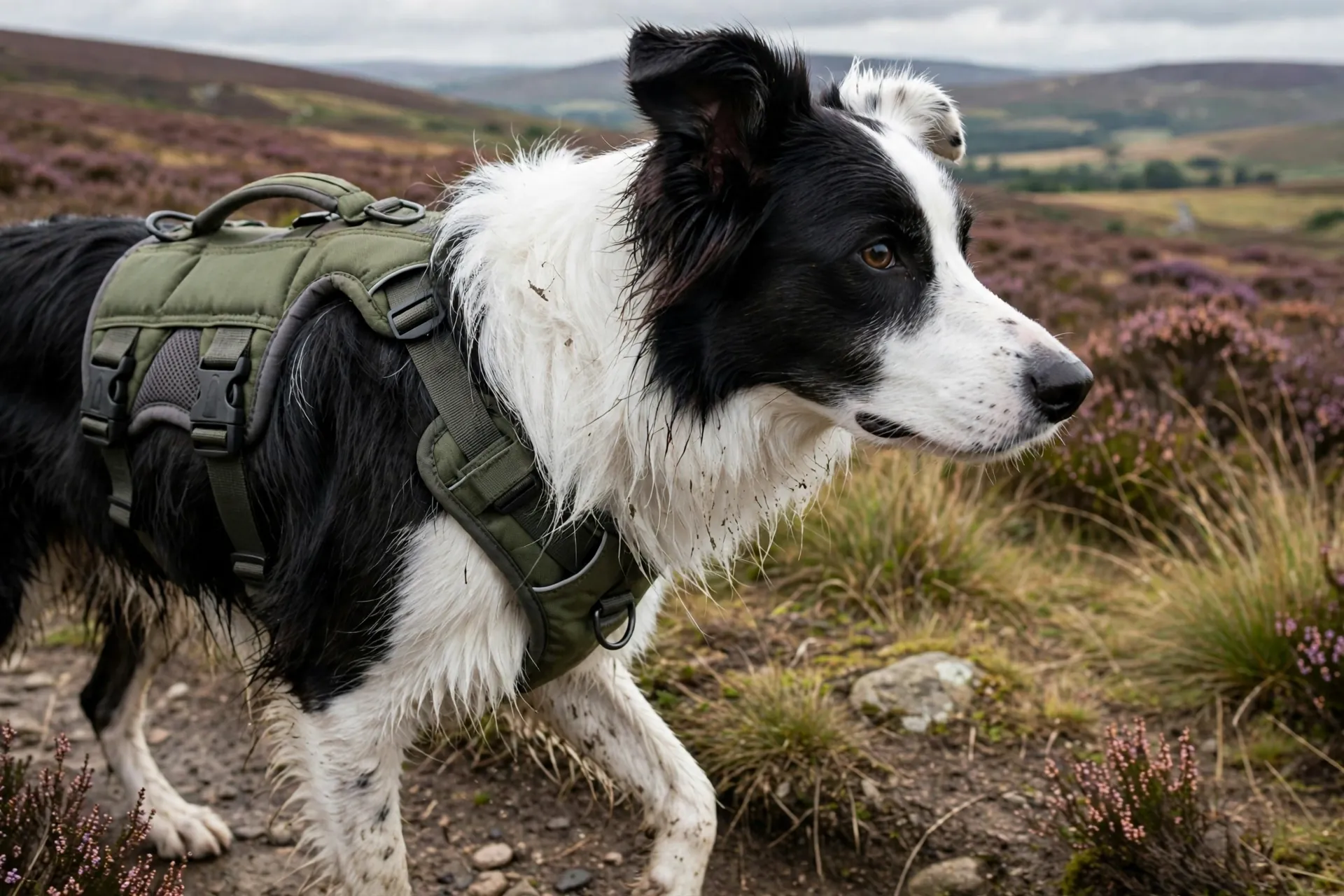
The kit for the Peddars Way is not complicated, but it needs to be right for a long, straight, exposed trail. A well-fitted harness is essential, because the dog will be on a lead for much of the walk, and a harness spreads the load better than a collar. Our guide to the best dog hiking harness in the UK covers fitting, sizing and preventing rubbing on long walks, and it is worth reading before you buy or fit a harness for a multi-day trail. A short lead for villages and livestock, and a longer lead or long line for the open heath, cover most situations, and a lead with a traffic handle gives you extra control near roads and livestock.
Water is the most important item in your pack on the Peddars Way. Carry at least a litre of water per dog per half day, and more in summer, and carry a collapsible bowl so the dog can drink easily. A water bottle with a built-in bowl is convenient, but a separate collapsible bowl is lighter and easier to clean. Carry water for yourself as well, because the same lack of taps and streams that affects the dog affects you, and dehydration is a risk for walkers as well as dogs. A small first-aid kit with saline, bandages, tweezers for ticks and thorns, and any medication your dog needs should be in your pack on every walk.
The same ground mile after mile is what wears a dog's feet out on this trail. Sand, flint and chalk load the same part of the pad again and again, with few changes of surface to spread the work around. Look at the paws every evening, trim the hair between the toes when it traps grit, and rub in a paw balm if the pads look dry or cracked. Boots can help a dog with tender feet, but they need fitting and wearing in at home before a multi-day walk, not trying for the first time on the trail. Limping, licking one paw over and over, or a dog that will not walk any further is the sign to stop, not to push on.
On a walk that lasts several days, food and treats do more work than they do on a day trip. A dog covering twelve miles of heath burns through far more energy than it does at home, and a tired, under-fed dog flags earlier and takes longer to recover. Put a little more in the evening bowl rather than a heavy breakfast before a long day, and carry high-value treats for recall and for rewarding steady behaviour near livestock and on the road. A light waterproof coat helps a short-coated or older dog when the rain and wind come in, and a drying coat or a couple of old towels makes the end of a wet walk far pleasanter. On a warm day, never leave a dog shut in a parked car, even with the windows open, because a car heats up far faster than most people expect.
Seasons and weather
April and May are when the Breckland wakes up. Gorse and heather come into flower, and the first stone curlews and nightjars arrive back on the heath, which is why spring is the best season to walk this trail with a dog: the days are long, the temperatures are mild, and the birds are back. Nesting season means dogs stay on a lead across the heath without exception, because the nests are on the ground and easy to destroy by accident. The ground can still be wet after winter, so pack waterproof boots for yourself and a towel for the dog, and expect the wind on the open heath to feel cold even on a sunny day.
Summer is the hardest season on this trail, because the heath gives you almost nothing to hide under. There is little shade, the temperatures climb, and water is scarce, so the whole day has to be planned around those three facts. Set out early, carry more water than you think you will need, and use the villages and the forest for shade and rest stops. Heat is a real danger for a dog here: watch for wobbling, confusion, drooling or heavy panting, and stop at once in the shade with water if you see any of them. The long evenings make up for it, and a walk after the heat has eased is often the best of the day.
Autumn is underrated on the Peddars Way. September and October bring quieter paths, cooler temperatures and the heather in flower, and the harvest in the fields means the hedgerows are full of blackberries and sloes. The light is softer, the birds are on the move, and the pubs and cafes are quieter. Winter is the quietest season of all, with frost on the heath, empty paths and big skies, but also with short days, strong winds and the risk of flooding on the low-lying sections. Winter walking suits experienced walkers with good waterproofs and a flexible plan, and it is not the season to attempt the full trail for the first time.
The Breckland is one of the driest and sunniest corners of Britain, and even so the weather can turn on you. A morning that starts clear can cloud over by lunchtime on the open heath, and the wind can be strong when the sun is shining. Look at the forecast the evening before, and look again over breakfast, carry waterproofs even when the day looks fine, and be ready to cut a walk short or trade a heath section for a forest walk at Thetford if the weather closes in. The Met Office forecast for Norfolk is a decent starting point, and a word with the landlord of a pub or the owner of a campsite is often more accurate about the next few hours than any national forecast.
A realistic four-day plan
A four-day plan for the Peddars Way might look like this: Knettishall Heath to Little Cressingham on day one, about eleven miles across the heath and through Thetford Forest; Little Cressingham to Castle Acre on day two, about thirteen miles through Swaffham and the farmland; Castle Acre to Great Massingham on day three, about twelve miles through the villages and the heath; and Great Massingham to Holme-next-the-Sea on day four, about ten miles through Sedgeford and across the heath to the coast. That is roughly eleven to thirteen miles a day, with no rest day, and it gives the dog a mix of heath, forest, farmland and coast. Add a rest day in Swaffham or Castle Acre if your dog is older or less experienced, and shorten any day that includes a long stretch of exposed heath in hot weather.
A long weekend plan is simpler and often more enjoyable. Walk the southern half from Knettishall Heath to Castle Acre over two days, with a night in Swaffham, and save the northern half for another trip. Or walk the northern half from Castle Acre to Holme-next-the-Sea over two days, with a night in Great Massingham or Sedgeford, and finish on the beach at Holme. A week gives you the whole trail plus a day or two on the coast, which is the best way to experience the Peddars Way and the Norfolk Coast Path together. Whatever plan you choose, book accommodation first and build the walking around it, because the best dog-friendly places on the trail are booked early in summer.
On the Breckland, the reason to start early is the sun on the open track. Set off before the heat builds, while the dog is fresh and the heath is quiet, and aim to be finished by mid-afternoon, so there is time to rest, eat and sleep before the evening. A short stroll to a pub garden or a village green rounds the day off better than a forced extra mile, and it lets the dog settle before night. If the weather turns, cut the day short without feeling guilty about it: the trail will still be there tomorrow, and a dog that enjoyed the walk will want to come back.
The Peddars Way is a National Trail, looked after for walkers, dogs included, and the straight road the Romans built is still there to come back to. If you find a damaged stile, a fallen waymark or a blocked path, tell the trail authority, and respect any temporary diversion, which is usually there because a path has become unsafe after a storm or a harvest. Walked slowly, with time to look at the heath, the churches and the priory, and with a dog that is enjoying every mile, the trail gives you far more than the number of miles on the map.
Practical questions
Before you go
How long is the Peddars Way and how many days does it take with a dog?
The Peddars Way is about 46 miles from Knettishall Heath to Holme-next-the-Sea, and most walkers take three to four days at 11 to 15 miles a day. With a dog, plan for four days with a rest day or a shorter first day, because the route is exposed, water is scarce in places, and the straight, flat walking is harder on legs and paws than it looks. Many dog owners walk it in two long weekends instead.
Is the Peddars Way suitable for dogs?
Yes, it is one of the most dog-friendly National Trails in England. The route is mostly flat, the surfaces are generally good, and there are few stiles or steep climbs. The challenges are the lack of shade and water on the Breckland heath, the long distances between villages, and the livestock that grazes beside the path. A fit, well-watered dog with a sensible daily distance will enjoy it, but it is not a trail to attempt in a heatwave.
Where does the Peddars Way join the Norfolk Coast Path?
The Peddars Way ends at Holme-next-the-Sea, on the north Norfolk coast, where it meets the Norfolk Coast Path. The two trails together form the Norfolk Coast Path National Trail, and many walkers continue from Holme along the coast to Hunstanton or east towards Wells-next-the-Sea. Holme has a car park, a beach and a bird reserve, and it is a good place to finish the Peddars Way or to start a coastal walk.
Is there water for dogs on the Peddars Way?
Water is the main planning problem on the Peddars Way. There are long stretches across the Breckland heath and farmland with no taps, streams or shops, and the streams that do exist are often seasonal or behind fences. Carry at least a litre of water per dog per half day, and more in summer, and plan your day around the villages where you can refill. Do not rely on finding water on the trail.
Do I need to keep my dog on a lead on the Peddars Way?
You should expect to use a lead for much of the walk. Sheep and cattle graze beside the path, ground-nesting birds use the heath in spring and summer, and the route crosses farmland where dogs must be kept under close control. A long line gives the dog more freedom on open heath while keeping it under control, but keep the dog on a short lead near livestock, through villages and wherever signs ask for it.
What is the hardest part of the Peddars Way for a dog?
The hardest part is the long, exposed stretch across the Breckland heath between Knettishall Heath and Castle Acre, where there is little shade, little water and few villages. The straight, unchanging track can also be mentally tiring for a dog, and the sandy, flinty surfaces wear at paws. Plan shorter days on this section, carry extra water, and build in a rest stop in the shade whenever you find it.