This guide is independent and contains no paid placement. If affiliate links are added later, they will be clearly marked and will not change our editorial checks.
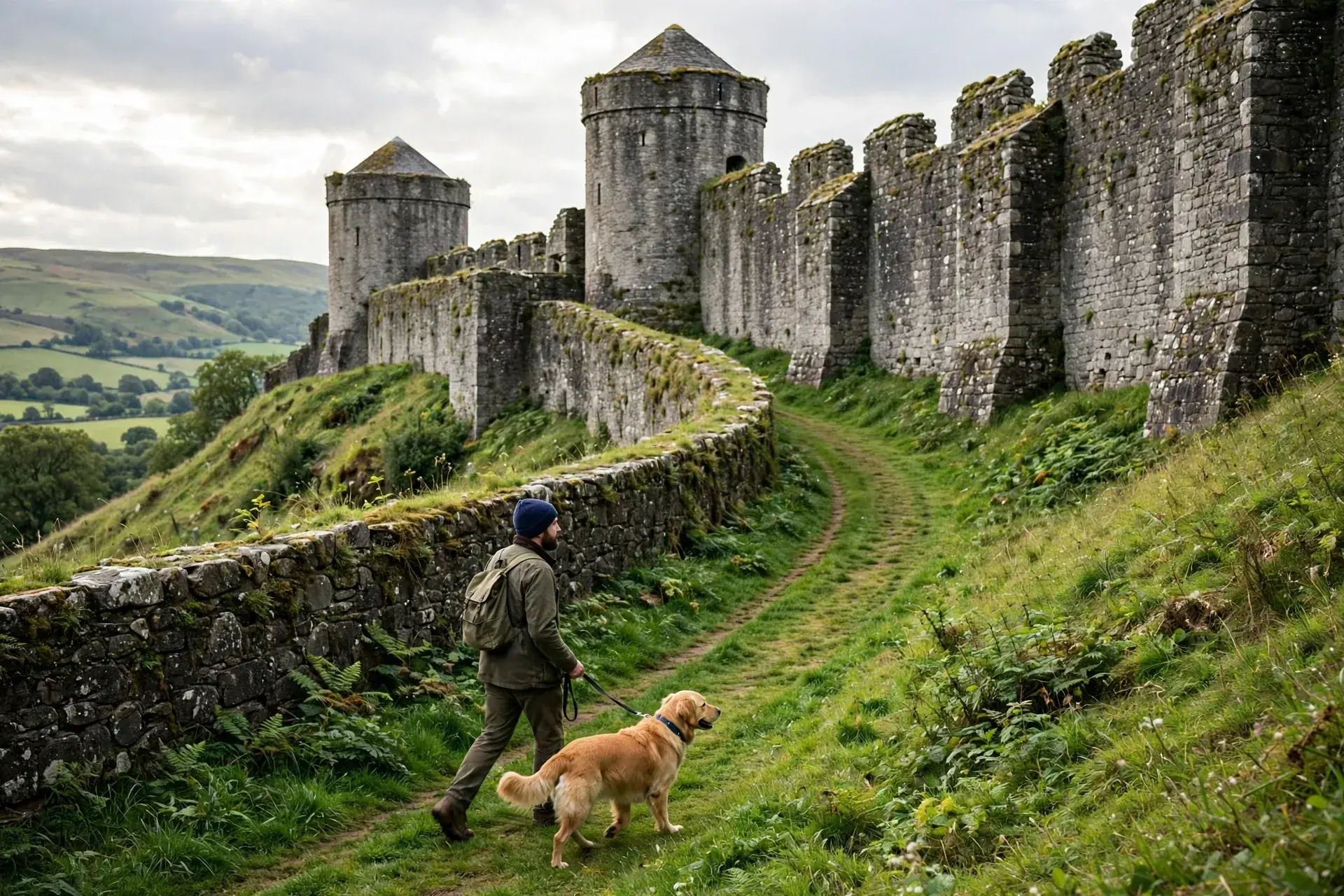
Pembroke works best as a castle-first day out with a dog. Dogs on leads are welcome in the castle grounds and around the mill pond, the old town is a short, level walk from the castle, and the wilder coast at Freshwater West, Angle and Castlemartin is a short drive away. Check the castle's dog rules and the beach signs before you travel, because both can change with events and the season.
Dogs at Pembroke Castle: the rules first
Pembroke Castle is the reason most visitors come to this small Pembrokeshire town, and it is also the first thing to sort out before you arrive with a dog. The castle is run by the Pembroke Castle Trust, and its dog policy is straightforward: dogs on leads are generally welcome in the castle grounds, while the castle buildings themselves are a different matter. Dogs are not usually allowed inside the tower, the exhibition spaces or the castle cafe, apart from assistance dogs. That is the pattern at most Welsh castles, and it is worth knowing before you pay for entry, because one person in your party will need to stay outside with the dog if you want to climb the tower or look around the interior.
The practical consequence is that a visit to Pembroke Castle with a dog is really a visit to the castle grounds, and the grounds are generous. There are grassy banks below the walls, open lawns inside the outer bailey, and views across the mill pond that cost nothing to enjoy from outside the ticketed area. If the castle interior is the main reason for your visit, plan for a split visit: one person explores inside while the other walks the dog around the pond, then swap. It is a much calmer arrangement than trying to rush through the tower with a dog waiting at the gate, and it gives the dog a proper walk rather than a long wait in a car park.
Check the official guidance before you travel. Castle rules can change for special events, re-enactments, weddings and seasonal exhibitions, and a busy event day can mean tighter controls on dogs in the grounds too. The castle's own website and the notice boards at the entrance are the reliable sources, and a quick check on the morning of your visit takes less than a minute. If you are planning a trip around a wider tour of Welsh castles, our guide to dog-friendly castles in Wales explains how the rules differ from site to site, so you can plan which castles your dog can properly enjoy and which ones are better saved for a dog-free day.
Inside the grounds, the rules that matter most are the obvious ones: keep the dog on a lead at all times, keep it off the flower beds and away from the cafe seating, and pick up after it. The grounds are popular with families, school groups and other dog owners, so a dog that lunges at children or other dogs will have a much harder time here than one that walks calmly on a short lead. If your dog is reactive, visit early in the morning or late in the afternoon, when the grounds are quieter and the light across the mill pond is at its best. A dog that barks at strangers in a confined space will also struggle on the narrow wall walk and the tower steps, which is another reason the grounds, rather than the interior, are the right part of the castle for most dogs.
Assistance dogs are treated separately from pet dogs at Pembroke Castle, as they are at almost every visitor attraction in Britain, and they are welcome in the buildings as well as the grounds. If you travel with an assistance dog, bring the usual identification and let staff know at the ticket desk so they can advise on the best route through the site. Water is not always easy to find inside the grounds on a hot day, so carry a bottle and a collapsible bowl, and use the shaded areas under the trees on the lower banks if the sun is strong. The stone walls throw back a surprising amount of heat in summer, and a dark-coated dog on a lead in full sun will need water and shade more often than you might expect.
The castle and the mill pond
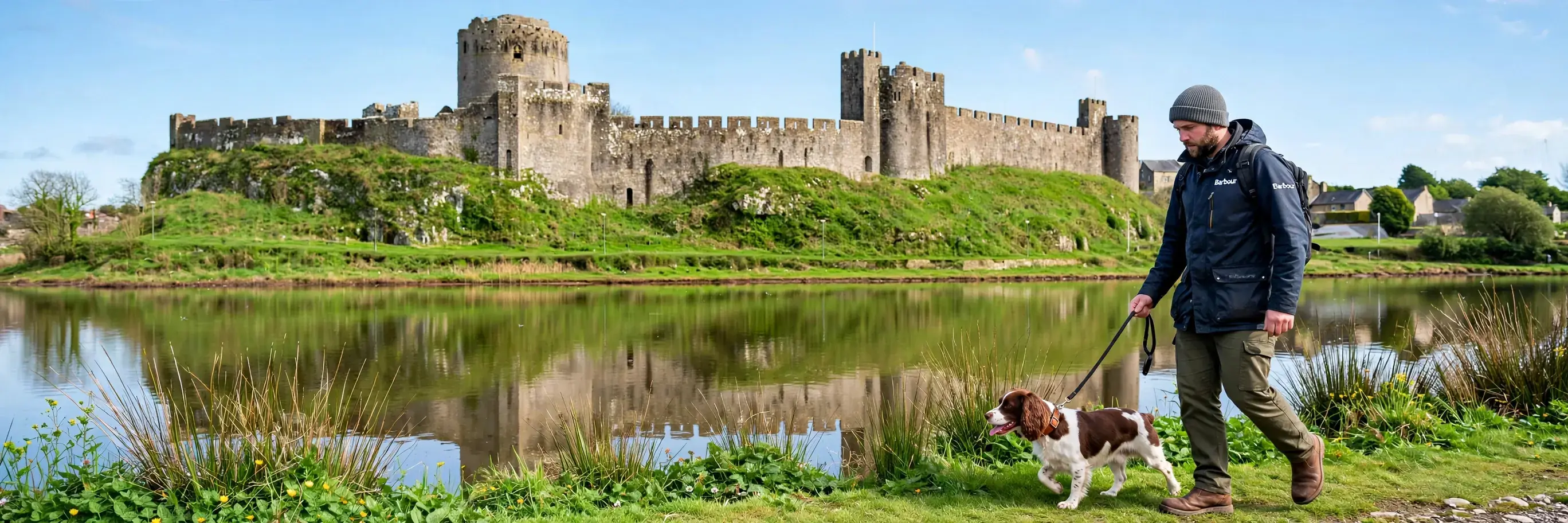
Stand on the grassy bank below the castle on a bright morning and Pembroke shows you its best side in a single view: the great round keep and the curtain walls rising above the water, the stone reflected in the mill pond, and a dog on a lead walking the path along the bank. The mill pond, also known as Castle Pond, is the wide stretch of water that wraps around the castle's southern and western sides, and it is what makes Pembroke feel different from every other castle town in Wales. The castle was built on a rocky ridge above the water for defence, and the pond that once powered the mill now gives the town its calmest walk.
The path around the pond is the natural first walk of the day, and it suits dogs well. It is mostly level, mostly grass or firm gravel, and it loops around the water so you can walk as far as your dog wants and turn back whenever you like. The full circuit is a gentle stroll rather than a hike, which makes it a good warm-up for an older dog or a puppy that is still building up its walking distance. Keep the dog on a lead along the water's edge, especially in spring when swans and ducks are nesting on the pond and moorhens are feeding among the reeds. The water is deep in places and the banks can be slippery after rain, so a dog that loves to swim should not be given free access here — the pond is not a dog swimming spot, and the steep stone edges make it hard for a dog to climb out.
The castle itself deserves a proper look from the outside even if you never go in. The great keep, built in the late twelfth and early thirteenth centuries, is one of the finest round keeps in Britain, and it dominates the skyline from every approach to the town. Henry VII was born in the castle in 1457, which is why Pembroke appears in so many history books, and the castle's long story — from Norman stronghold to the birthplace of a Tudor king — is told on information boards around the grounds. Dogs do not care about any of that, but the open grass below the walls gives them room to sniff and settle while you read, and the wide views across the pond give you a reason to linger rather than rush on.
Photography is best from the far bank of the pond in the morning, when the sun lights the castle walls and the reflection is sharpest. A dog sitting on the grass with the castle behind it makes a far better photograph than a dog dragged up the tower steps, and it is a kinder way to remember the visit. Early morning is also when the pond is at its quietest, with mist rising off the water in autumn and winter, and when the local dog walkers are out before the day visitors arrive. If you visit in summer, come before ten in the morning or after four in the afternoon to avoid the hottest part of the day and the busiest crowds around the castle entrance.
The walk around the pond also connects naturally to the rest of the town. From the western end of the pond you can follow the water toward the town centre, and from the eastern end the path leads toward the quieter residential streets and the lanes that climb gently away from the water. There are benches along the way where you can sit with the dog and watch the swans, and there are bins for dog waste at the main access points. Take a bag with you anyway, because the bins are not always where you expect them, and a walk around the pond with no bin in sight is a familiar frustration for dog owners everywhere. The pond walk is the spine of a Pembroke day: everything else in this guide radiates outward from it.
The old town around the castle
Walk away from the castle and you are in the old town within minutes. Pembroke's main street runs in a gentle curve from the castle toward the west, lined with the kind of independent shops, cafes and pubs that make a small Welsh town worth an unhurried hour. The street is level and the pavements are wide enough for a dog on a lead in most places, though they narrow near some of the older shopfronts, so keep the dog close to your side rather than letting the lead trail across the pavement. The town is compact enough that you can walk from the castle to the far end of Main Street and back in well under an hour, even at a dog's pace with plenty of sniffing stops.
The old town rewards slow walking. Look for the Georgian and Victorian shopfronts, the town hall, and the narrow lanes that run off Main Street toward the river and the older parts of the town. Pembroke was once a much more important place than its size suggests: it was the county town of Pembrokeshire, a busy port and a market town, and the street pattern still shows it. The market cross, the old houses with their slate roofs, and the occasional glimpse of the castle between the rooftops all add up to a town that is best explored on foot with a dog trotting alongside, rather than driven through on the way to somewhere else.
Shops in the old town vary in their attitude to dogs. Some welcome well-behaved dogs inside, others prefer dogs to wait outside, and a few have a water bowl by the door as a quiet signal that dogs are welcome. The polite approach is to ask before you go in, keep the dog on a short lead, and avoid taking a large or muddy dog into a small shop full of breakable stock. If your dog is nervous in busy indoor spaces, it is kinder to take turns going inside while the other person waits with the dog on the street. The town's cafes and pubs are covered in more detail below, but the general rule holds everywhere in Pembroke: a calm dog on a short lead is welcome in far more places than a dog that pulls, barks or jumps up at strangers.
Monkton, the village on the hill across the river from the castle, is worth the short walk if your dog is fit and the weather is fair. The climb is steady rather than steep, and the reward is a different view of the castle from the opposite bank, with the whole town spread out below. The lanes around Monkton are quieter than Main Street, with hedgerows, gardens and the occasional farm cat to watch for, and they give a dog a change of scenery after the busier town centre. Take care on the narrower lanes, where there is little pavement and cars pass close, and keep the dog on the pavement side of the road. The walk to Monkton and back adds perhaps forty minutes to the day, and it is a good way to tire out a dog that has not had enough exercise from the pond loop alone.
The old town also holds the practical services a dog owner needs on a day out: a pharmacy, a supermarket, a post office and a handful of places to buy a sandwich or a bottle of water. If you forgot the dog's water bowl or the poo bags, the town's shops will sort you out before you head for the coast. Parking is covered in detail below, but the short version is that the town centre car parks are a short walk from the castle, and the walk from the car park to the pond is itself a pleasant introduction to the town. Give yourself time to wander: Pembroke is a town that rewards an hour of aimless walking with a dog far more than a ten-minute dash between the car park and the castle gate.
The waterfront, quay and river walks
Pembroke's water is not just the mill pond. The town sits at the head of the Pembroke River, a tidal inlet that winds down toward the Cleddau estuary and the sea at Milford Haven, and the waterfront along the river gives the town a second, quieter face. The quay area, a short walk from the old town, is where the town's maritime past is most visible: small boats, muddy banks at low tide, and the wide sky that opens out over the estuary. It is a different kind of walk from the pond loop, flatter and more open, and it suits dogs that like to watch the water without the crowds of the castle grounds.
The river walk is best at low tide, when the mudflats are exposed and wading birds feed along the water's edge. Keep the dog on a lead here, and keep it out of the mud: estuary mud is deep, sticky and not a place for a dog to wade in. The birds — curlews, redshanks, egrets and shelducks among them — are easily disturbed by a loose dog, and the Pembroke River is an important feeding ground for them, especially in winter. A dog on a lead walking quietly along the bank can watch the birds without disturbing them, and the open views across the water make this one of the most peaceful walks in the town. Check the tide times before you go, because the river changes character completely between high and low water, and a path that is dry at low tide can be under water at high tide.
From the quay, the lanes and paths that follow the river downstream lead toward quieter countryside and the road to Pembroke Dock, the neighbouring town two miles down the estuary. Pembroke Dock is a separate town with its own character — a former naval dockyard, a ferry port for the crossing to Ireland, and a grid of streets that feels very different from Pembroke's medieval lanes — and the walk between the two towns is possible on foot, though it follows roads for much of the way and is better done by car with a dog. If you do drive to Pembroke Dock, the waterfront there has its own short walks and open spaces, and the view back up the estuary toward Pembroke is worth the detour.
Safety matters on any waterfront walk with a dog. Tidal rivers rise quickly, the mud is a genuine hazard, and the stone edges of the quay are slippery when wet. Never let a dog swim in the river, and never follow a dog onto the mudflats. Carry a towel in the car for a dog that has found a puddle or a muddy patch, and check the dog's paws after a riverside walk: estuary mud can irritate skin, and sharp shells and stones are common along the waterline. The waterfront is at its best in the early morning and the late evening, when the light is low over the water and the town is quiet, and a short stroll along the quay after dinner is a good way to end a Pembroke day.
Boats are part of the waterfront too, and dogs are sometimes welcome on the small pleasure boats and ferries that operate in the area, though policies vary and many require a dog to be on a lead and to stay on deck. The ferry from Pembroke Dock to Rosslare in Ireland is a separate matter, with its own rules for dogs travelling in vehicles or in kennels, and it is not something to arrange on a whim. For a day trip, the practical advice is simpler: enjoy the waterfront on foot, watch the boats from the quay, and save the ferry for a trip that has been planned properly. The river walk, the pond loop and the castle grounds together make a full day without ever needing to get on a boat.
Beyond the town: coast and countryside
Pembroke's greatest advantage is what lies beyond it. Within a twenty-minute drive you can reach some of the finest dog-walking coast in Britain, and the contrast between the quiet town and the open coast is what makes a Pembroke base so appealing. The Pembrokeshire Coast Path runs around the whole of the county's coastline, and the sections nearest Pembroke — from Freshwater West to Angle, and from Castlemartin to Bosherston — are among the most rewarding, with wide beaches, limestone cliffs, wildflower meadows and views across to the islands of Skomer and Skokholm on a clear day.
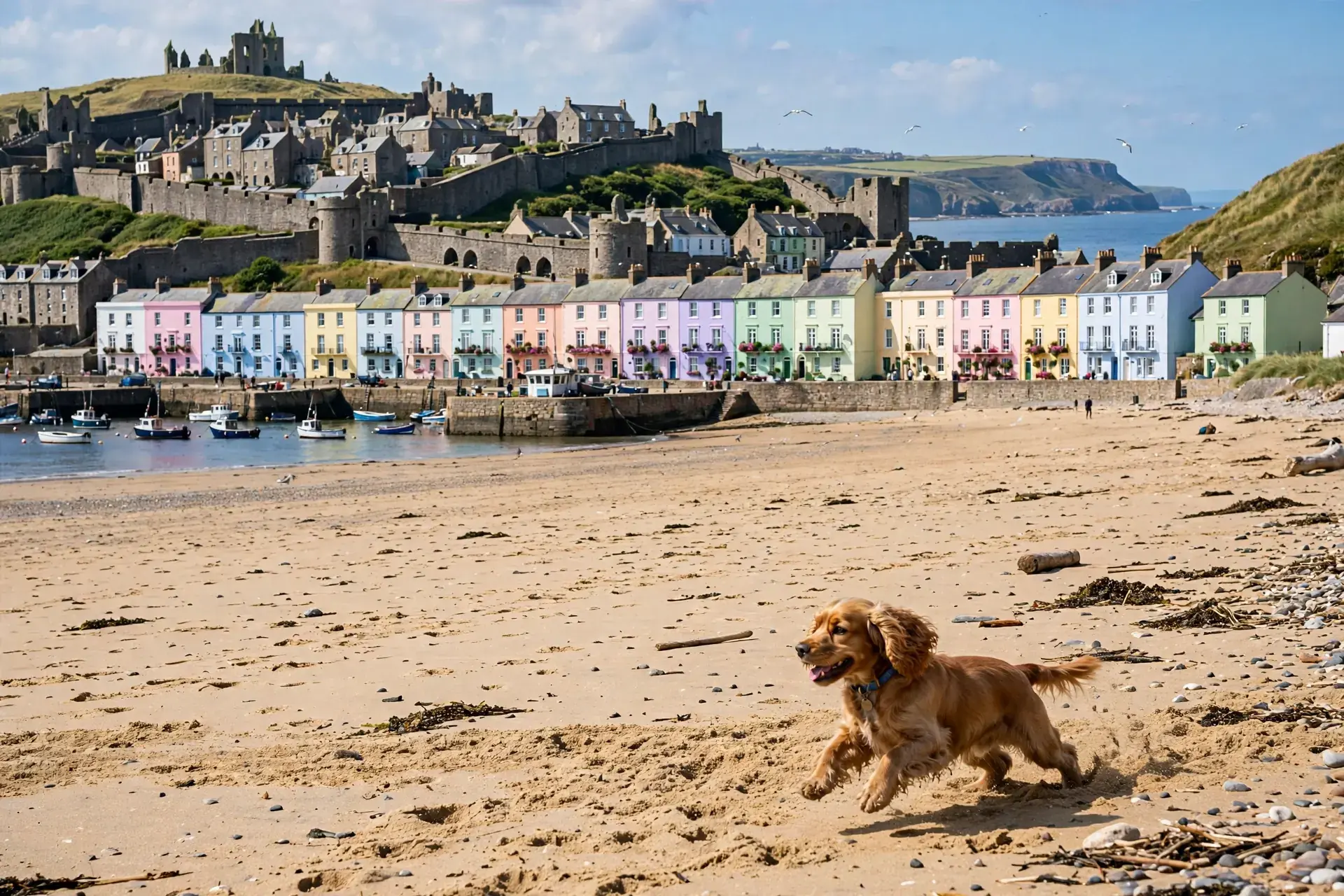
Freshwater West is the nearest big beach, a long sweep of sand backed by dunes, about fifteen minutes' drive southwest of the town. It is famous as a filming location and as a surfing beach, but for dog owners its appeal is simpler: a huge expanse of sand, a reliable breeze, and room for a dog to run without crowding anyone. The beach is exposed and the sea can be rough, so keep the dog out of the water on a windy day and be aware of strong currents. The dunes behind the beach are a haven for wildlife and are fenced in places, so keep the dog on a lead through the dune paths and only let it run on the open sand where it is safe. Check the beach signs for seasonal restrictions and check the official guidance before you travel, because dog rules on Pembrokeshire beaches change with the season.
Angle, a small village at the mouth of the Milford Haven waterway, offers a different kind of coast: a sheltered bay, a sandy beach at low tide, and a short walk to the lifeboat station and the point. The beach at Angle is smaller and more sheltered than Freshwater West, which makes it a better choice on a windy day or for a dog that is not confident in big waves. The village itself is quiet, with a pub and a handful of houses, and the walk around the point gives views back across the waterway toward the refineries and the distant hills. Keep the dog on a lead around the lifeboat station and the harbour, and watch for fishing boats and the occasional vehicle on the slipway.
Castlemartin and Bosherston, to the south of Pembroke, are where the coast turns wilder and more beautiful. The lily ponds at Bosherston, owned by the National Trust, are a famous beauty spot: still water covered in water lilies in summer, fringed by woodland, and leading down to the sheltered cove of Broadhaven South. Dogs are welcome on leads at Bosherston, but they must stay on the paths and out of the water, and the lily ponds are not a place for a dog to swim. The walk from the lily ponds to the beach is one of the prettiest short walks in Pembrokeshire, through woodland and open grassland, and it suits a dog that enjoys a varied walk with plenty of new smells. The coast path from here runs east toward St Twynn's Church and the cliffs of the Castlemartin range, but note that parts of the Castlemartin coast are within a military firing range, and access is restricted when the red flags are flying. Check the range access information before you set out, and do not ignore the warning signs.
Barafundle Bay, a short drive further east toward Stackpole, is often described as one of the most beautiful beaches in Britain, and it is worth the walk even with a dog. The bay is reached on foot from the car park at Stackpole Quay, along a path through woodland and over the dunes, and the reward is a sheltered curve of golden sand with clear water. The walk is about half an hour each way, which is enough to tire a small dog and to warm up a larger one, and the beach itself is a good place for a dog to run in the off-season. Summer restrictions apply, so check the signs and check the official guidance before you travel. Stackpole Quay itself is a lovely spot for a sit-down with a dog, with a small cafe, a lake, and walks through the wooded valley of the Stackpole estate.
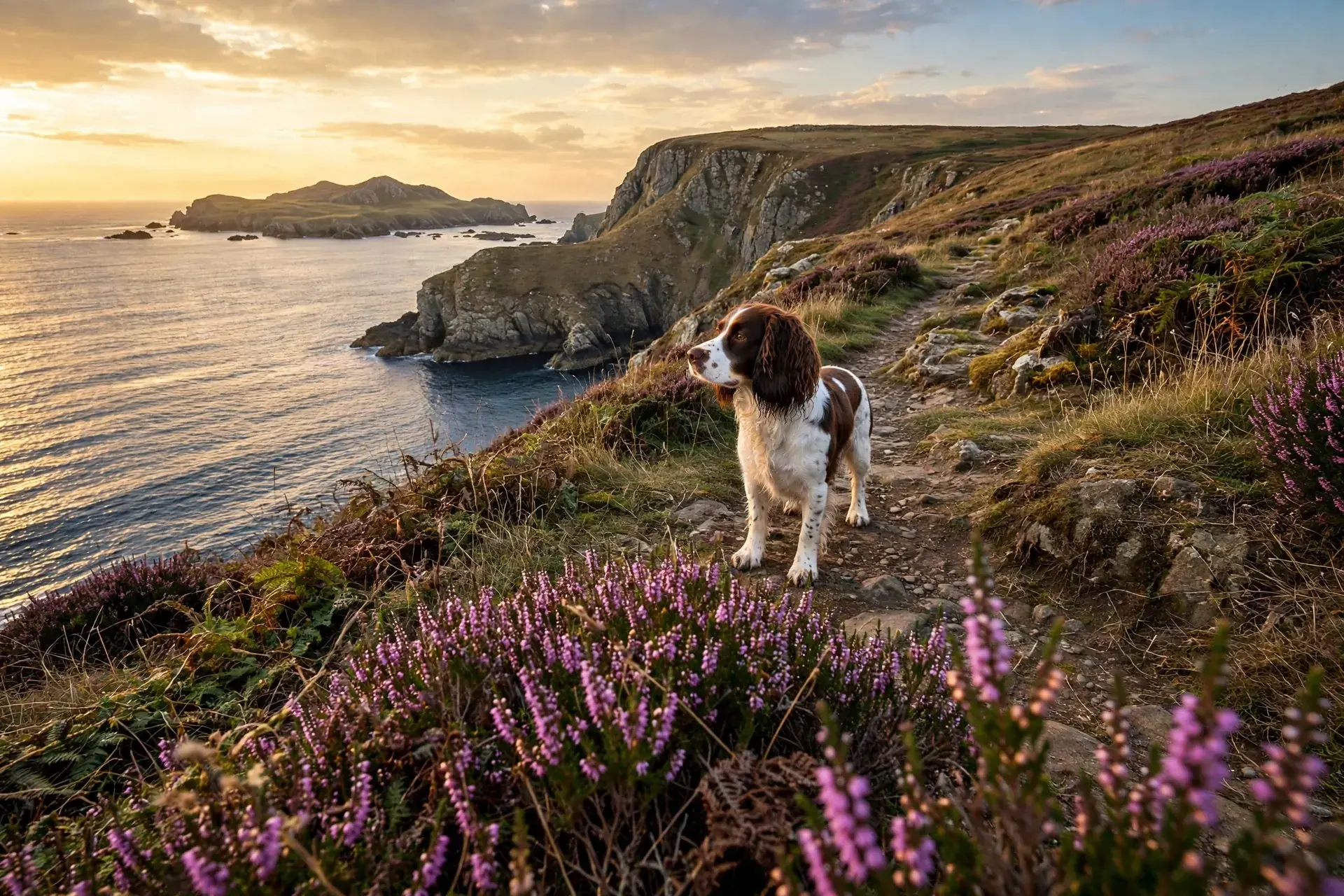
The Pembrokeshire Coast Path deserves a word of its own, because it is the thread that connects all of these places. The path is 186 miles long in total, and nobody walks it all in a day, but the sections near Pembroke are ideal for short out-and-back walks. Choose a section with easy parking, walk for half an hour in one direction, and turn back when the dog has had enough. The path is well waymarked with the acorn symbol, but it runs close to unfenced cliff edges in places, and it crosses farmland where sheep graze, so a lead is essential and a long line is not a substitute for a short lead near a cliff. Carry water, because there are no shops on the coast path, and carry a phone, because mobile signal can be patchy on the more remote sections. If you want a longer coastal base, Tenby with a dog covers the coast path east of Pembroke, and St Davids with a dog covers the wilder coast to the north, so the three towns together make a natural Pembrokeshire itinerary.
Inland, the countryside around Pembroke is gentler: rolling farmland, quiet lanes, small woodlands and the occasional village with a pub and a church. The lanes are good for short dog walks, especially in the early morning when there is little traffic, but they are working farm lanes, so expect tractors, sheep and the occasional herd of cattle being moved between fields. Keep the dog on a lead on farmland at all times, close gates behind you, and never let a dog chase livestock. The Countryside Code applies here as everywhere in Britain, and the farmers around Pembroke are more welcoming to dog walkers who follow it than to those who do not. A short lane walk after breakfast, before the heat of the day, is often the best walk of the day for a dog staying in the countryside around Pembroke.
Where to eat and drink with your dog
Pembroke's pubs and cafes are, on the whole, welcoming to dogs, and a dog-friendly lunch is one of the pleasures of a day in the town. The most reliable places are the pubs on and around Main Street, where dogs are usually welcome in the bar area and on outdoor seating, and the cafes near the castle, where a dog can settle under a table while you eat. Policies change with the season and with the management, so ask before you sit down, and bring a blanket or a mat for the dog to lie on: a dog that has its own place to settle is far more welcome than one that wanders between tables.
A few practical habits make eating out with a dog much easier. Feed the dog before you go in, or bring a stuffed Kong or a chew to keep it occupied while you eat. Order at the bar rather than waiting for table service if the dog is restless, and choose a table near the door or in a quiet corner rather than in the middle of the room. If the dog starts to whine or bark, take it outside for a short walk rather than trying to shush it at the table — other diners will forgive a brief exit far more readily than ten minutes of barking. And always ask for a bowl of water: most pubs will bring one without being asked, but it is better to ask than to let a thirsty dog drink from a puddle on the way home.
Outside the town, the village pubs around Castlemartin, Bosherston and Angle are often the most relaxed about dogs, with flagstone floors, open fires in winter, and regulars who expect to see a dog or two in the bar. These are the places where a muddy dog after a coast walk is not a problem, provided the dog is on a lead and under control. The cafes at Stackpole Quay and around the Bosherston lily ponds also welcome dogs on their outdoor terraces, and a coffee and a cake after a coast walk is a good way to end the morning. In summer, the outdoor seating fills up quickly, so arrive early or be prepared to wait, and remember that a dog in full sun on a paved terrace needs shade and water just as much as you do.
Takeaway food is a useful fallback on a busy day. The town has fish and chip shops, sandwich bars and a bakery, and a takeaway eaten on a bench by the mill pond or on the quay is often a better experience with a dog than a formal restaurant meal. Buy the food, find a quiet bench with a view of the water, and let the dog settle beside you while you eat. It is also the cheapest way to feed a family in Pembroke, and it avoids the question of whether a particular restaurant welcomes dogs at all. If you do want a proper restaurant meal, check in advance, book ahead in the summer, and be honest about the dog: a restaurant that knows a dog is coming is far more likely to find you a suitable table than one that discovers a large dog at the door.
Where to stay with your dog
Pembroke and the surrounding villages offer the full range of dog-friendly accommodation, from cottages and bed and breakfasts to campsites and caravan parks, and the right choice depends on the dog you have. A cottage with an enclosed garden is the best option for most dogs, because it gives the dog a safe place to toilet at night and a place to settle between walks. A bed and breakfast can work well for a calm, quiet dog, but a dog that barks at night or is unsettled in a strange house will be happier in a self-catering cottage where it has its own space. Campsites and caravan parks around Pembroke welcome dogs as a matter of course, and they suit dogs that are used to outdoor living and to other dogs nearby.
When you book, ask the questions that matter for your dog rather than the ones the listing answers. Is the garden genuinely enclosed, and how high is the fence? Are dogs allowed in the bedrooms, or only in the living areas? Is there a charge per dog, and is there a limit on the number of dogs? Where is the nearest place for a last walk at night, and is it lit? A cottage that looks perfect in photographs can be a poor fit if the garden has a gap in the hedge, the dog is not allowed upstairs, or the nearest toilet walk is a ten-minute drive. Get the answers in writing with the booking confirmation, and keep them with your other travel documents.
Location matters as much as the property itself. A cottage in the town centre puts you within walking distance of the castle, the pond and the pubs, which is convenient but can be noisy at night. A cottage in the countryside around Castlemartin or Bosherston gives you quiet lanes and coast walks from the door, but you will need the car for the town and for the supermarket. A campsite near the coast gives you the beach on your doorstep, but it can be exposed to wind and rain, and a dog that is nervous in a tent will not sleep well. Think about the dog's routine — where it toilets, where it sleeps, how it copes with noise — and choose the place that fits that routine rather than the prettiest listing.
Book early if you are travelling in the school holidays or over a bank holiday weekend. Pembrokeshire is one of the most popular holiday counties in Britain, and dog-friendly cottages in and around Pembroke sell out months ahead for the summer. Shoulder-season breaks in May, June, September and October are often better value and quieter, and the coast path and the beaches are at their best in the autumn light. If you are staying for a week, plan a mix of days: a town day around the castle and the pond, a coast day at Freshwater West or Barafundle, a quiet day in the countryside, and a day trip to Tenby or St Davids. A dog that has a different walk every day will be far happier than one that repeats the same loop for a week.
Parking, arrival and getting around
Arriving in Pembroke with a dog is straightforward, and the town is small enough that parking is never far from the castle. The main car parks are within a few minutes' walk of the castle and the mill pond, and the walk from the car park to the water is a good introduction to the town. Arrive early on a summer weekend, because the car parks fill up by late morning and the streets around the castle can be busy with coaches and day visitors. An early arrival also gives the dog a quieter first walk around the pond, before the crowds arrive, and a cooler car for the journey home.
Never leave a dog in a parked car on a warm day, even for a few minutes. Cars heat up far faster than most people expect, and a dog left in a car in Pembroke on a sunny day is at real risk. If you need to go inside the castle while the dog waits, take turns, as described above, or leave the dog with a member of your party outside. The same rule applies at the beach car parks: if the dog cannot come with you, do not leave it in the car. Plan your day so the dog is always either with you or in a safe, shaded place with water and ventilation.
Getting around Pembroke itself is best done on foot. The town is compact, the streets are level, and the castle, the pond, the old town and the quay are all within easy walking distance of each other. For the coast, you will need a car: Freshwater West, Angle, Bosherston and Stackpole are all a short drive from the town, and the bus services in this part of Pembrokeshire are infrequent. If you are travelling by public transport, check the bus times carefully before you set out, because the rural services do not run late and a missed bus can mean a long walk back. Dogs are generally welcome on local buses if they are on a lead and well behaved, but check the operator's policy before you travel.
Driving in the countryside around Pembroke needs care, especially on the narrow lanes that lead to the coast. The lanes are single-track in places, with passing places, high hedgerows and blind bends, and a dog in the car should be secured with a harness, a crate or a dog guard. Never let a dog travel loose in the car, and never let it put its head out of the window on a country lane: a branch or a passing vehicle can cause a serious injury. Keep a towel and a bottle of water in the car for the dog, and plan your route before you set out, because mobile signal is unreliable on the more remote coast roads and a satnav that loses its signal at the wrong moment is a familiar frustration in rural Pembrokeshire.
What to pack for a Pembroke day
A day in Pembroke with a dog does not need much specialist kit, but the few things that matter are worth packing properly. Start with the basics: a lead, a spare lead, poo bags, a water bottle and a collapsible bowl, and a towel for a muddy dog. Add a blanket or a mat for the dog to lie on in a pub or a cafe, and a long line for the beach or the open countryside, remembering that a long line is for open ground, not for cliff edges or livestock. A dog coat is worth packing in winter, when the wind off the coast can be bitter, and a drying coat is useful after a beach walk in any season.
Think about the ground your dog will walk on. The pond loop and the town streets are easy going, but the coast path is rocky and uneven, and the beaches are sandy and sometimes shelly. Check the dog's paws after a long coast walk, and carry a small first-aid kit with saline solution, a bandage and tweezers for thorns and ticks. Ticks are present in the Pembrokeshire countryside, especially in long grass and bracken, so check the dog after every walk and carry a tick remover. The same applies to adder country: adders are present in the coastal heathland and dunes of Pembrokeshire, and a dog that sniffs in the undergrowth can be bitten. Keep the dog on the path, watch where it puts its nose, and know where the nearest vet is before you need one.
Food and water deserve a word of their own. Carry enough water for the dog as well as for yourself, because there are no shops on the coast path and the cafes at the more remote beaches are not always open. A small bag of the dog's usual food, or a few treats, is useful for a long day, and a stuffed Kong or a chew can keep a dog occupied in the car or in a pub. Do not change the dog's food on holiday, and do not let it drink from the mill pond or the river: still water can carry bacteria and blue-green algae in warm weather, and a dog that drinks from the pond can be unwell the next day. Fresh water from a bottle is always the safer choice.
Finally, pack for the weather, because Pembrokeshire weather changes quickly. A sunny morning can turn into a wet afternoon, and a calm day on the coast can become windy in an hour. Pack a waterproof jacket for yourself and a towel for the dog, and be prepared to change your plans: if the coast path is too windy for a small dog, the pond loop and the old town are a perfectly good fallback, and if the rain sets in, the pubs and cafes of Pembroke are a warmer option than the beach. The best Pembroke days are the ones that follow the dog's lead — a shorter walk, a longer sit by the water, and a pub lunch when the weather turns.
Practical questions
Before you go
Can dogs go inside Pembroke Castle?
Dogs on leads are generally welcome in the castle grounds, but they are not usually allowed inside the castle buildings themselves, apart from assistance dogs. The grounds are the main draw for dog owners anyway, with grassy banks, walls and the mill pond to walk around. Check the official guidance before you travel, because rules for events and exhibitions can differ.
Are dogs allowed on the beaches near Pembroke?
It depends on the beach and the season. Several Pembrokeshire beaches restrict dogs during the summer months, typically from 1 May to 30 September, while others welcome dogs all year. Freshwater West and the wilder stretches of coast near Angle and Castlemartin are usually the most reliable choices outside the restricted beaches. Always check the signs at the beach entrance and the official guidance before you travel.
Is the Pembrokeshire Coast Path near Pembroke suitable for dogs?
Yes, for fit dogs on a lead. The path around the Pembroke coast is well walked and waymarked, but it runs close to unfenced cliff edges in places and crosses farmland with sheep, so dogs should stay on a lead and under close control. Choose a short out-and-back section rather than a full day's walk if your dog is older or unused to cliff paths, and carry water because there are long stretches with no shops or taps.
Where can dogs go off the lead near Pembroke?
There is no single designated off-lead area in the town centre, so most owners use quiet open spaces outside the town, such as the wider beaches in the off-season and open commons away from livestock, and only where the dog has a reliable recall. Keep dogs on a lead around the castle grounds, the mill pond, the quay, livestock and cliff edges. If in doubt, keep the lead on.
Are dogs welcome in Pembroke's pubs and cafes?
Several pubs and cafes in Pembroke and the surrounding villages welcome dogs, most reliably in bar areas and on outdoor terraces. Policies vary from place to place and can change with the season, so ask before you sit down and bring a blanket for your dog to settle on. The castle cafe and the town's pubs are a good place to start, and quieter village pubs around Castlemartin and Bosherston are often the most relaxed about dogs.