This guide is independent and contains no paid placement. If affiliate links are added later, they will be clearly marked and will not change our editorial checks.
St Davids is Britain's smallest city, and it is one of the easiest Welsh destinations to enjoy with a dog: the cathedral welcomes dogs on leads, Whitesands Bay is a superb beach outside the summer restrictions, the St Davids Head coast walk is a classic half-day loop, and Ramsey Island boat trips run from nearby St Justinians. The one firm limit is Ramsey itself — dogs cannot land on the island — so plan that as a dog-free excursion.
Britain's smallest city, built around a cathedral
St Davids is a city that does not look like one, and that is exactly the point. With roughly 1,600 residents it is the smallest city in Britain by population, and it holds city status only because of its cathedral. There are no tower blocks, no ring road and no shopping centre. Instead there is a single compact centre — Cross Square, the cathedral close, a handful of streets of painted cottages — and then, within a few minutes' walk in almost any direction, open farmland and the wild Pembrokeshire coast. For a dog owner that scale is a gift: almost everything worth doing is within walking distance, and the car can stay parked for most of the day.
The city sits on the far western tip of Wales, inside the Pembrokeshire Coast National Park, which means the landscape around it is protected and the coast path is maintained to a high standard. St David, the patron saint of Wales, is said to have founded a monastery here in the sixth century, and the present cathedral — built largely in the twelfth century from the purple sandstone of nearby Caerbwdi Bay — still dominates the low valley where the city sits. Pilgrims came here for centuries; in the Middle Ages two pilgrimages to St Davids were said to equal one to Rome. Today the visitors are walkers, surfers, birdwatchers and families with dogs, but the atmosphere has not changed much: this is a quiet, slightly remote place where the day is shaped by tides, weather and daylight rather than by opening hours.
That remoteness needs a little planning. St Davids is about 16 miles from Haverfordwest, the nearest large town, and the drive along the A487 takes you through small villages and narrow lanes. Buses do run — the coastal bus services link St Davids with Haverfordwest, Fishguard and, in summer, the beaches — but they are infrequent, and a car makes the trip far easier, especially with a dog and beach kit. If you arrive by public transport, check the official guidance before you travel, because timetables change seasonally and Sunday services are thin. Once you are here, though, the city rewards slow travel. Park once, walk everywhere, and let the dog set the pace.
Start at Cross Square, where the old market cross stands at the junction of the city's main streets. From here the cathedral is a five-minute walk downhill through the close, and the high street's cafes, pubs and small shops are all around you. The whole centre can be crossed on foot in ten minutes, which makes it easy to build a day around the dog: a morning walk on the headland, lunch in town, an afternoon on the beach, and an evening stroll back past the cathedral as the light fades. Few British cities offer that rhythm, and fewer still offer it with the sea never more than a mile away.
The best seasons for a dog trip are spring and autumn. In late spring the cliff tops are covered in wildflowers, the days are long and the summer crowds have not yet arrived. In September and October the sea is at its warmest, the beach restrictions lift, and the grey seal pupping season begins on Ramsey Island. Summer brings the warmest weather and the busiest beaches, but it also brings seasonal dog restrictions on Whitesands Bay and full car parks by mid-morning. Winter is quieter and moodier — the cathedral is at its most atmospheric in low light, and the coast path is empty — but the wind off the Atlantic is serious, and exposed cliff walks need a calm day. Whatever the season, pack for changeable weather: waterproofs, a windproof layer, a towel and a drying coat for the dog, and water for both of you, because there are long stretches of the coast path with no shops at all.
Getting to St Davids without a car is possible but slow, and it is worth understanding the trade-offs before you book. The nearest railway stations are at Haverfordwest and Fishguard, both about 16 miles away, and from either one the bus to St Davids takes around an hour, with services that thin out sharply on Sundays and in winter. The coastal bus that links the beaches and villages around the peninsula is a delight in summer — it stops at Whitesands Bay, St Justinians and the city centre, and it takes the pressure off parking — but it does not run to a turn-up-and-go frequency, so check the official guidance before you travel and plan your day around the timetable rather than the other way round. If you do arrive by bus, the city centre is compact enough to manage on foot, and the walk to Whitesands Bay takes about forty minutes along a quiet lane, which is a pleasant outing in itself for a fit dog.
One more thing to know before you set off: this is working farmland as well as a holiday destination. Sheep graze the cliff tops around St Davids Head, and cattle graze some of the inland fields the coast path crosses. Dogs must be on leads near livestock at all times — it is a legal requirement during lambing and a practical necessity all year — and a dog that chases sheep can be shot by a farmer under the law. Keep the lead on through the farmed sections, even if your dog has never shown interest in sheep, and only let them off where the ground is open, the cliffs are fenced or set well back, and you can see what is ahead.
The cathedral and the Bishops Palace: what dogs can do
St Davids Cathedral is the reason the city exists, and it is also one of the most dog-welcoming cathedrals in Britain. Well-behaved dogs on leads are welcome inside the cathedral itself, which is unusual enough to be worth planning your visit around. The building is worth an unhurried hour: a Norman nave with a remarkable wooden ceiling, a rood screen carved with biblical scenes, the shrine of St David restored in the last century, and the Treasury, which holds medieval and modern treasures including items associated with the saint. The purple stone gives the interior a warm, sombre colour that photographs cannot quite capture, and the low setting of the cathedral — tucked into a hollow so that it appears gradually as you walk down from the city — makes the first sight of it genuinely surprising.
Visit with a dog by keeping the practical rules in mind. Keep your dog on a short lead and close to your side, especially in the nave, where the stone floor is slippery and the aisles are narrow. Avoid visiting during services, when the building is full and a dog will be stressed by crowds and organ music; the quieter times are mid-morning and mid-afternoon on weekdays, outside school holidays. Bring a mat or blanket if your dog likes to settle, and be ready to step outside into the close if they become restless — the grassy grounds around the cathedral are a good place for a calm break, and the views back up to the city are worth the pause. If your dog barks at strangers or cannot settle indoors, one person can wait outside with the dog while the other looks around, then swap; there is no shame in that, and it is better than a rushed visit that neither of you enjoys.
There is no entry charge for the cathedral, although donations are welcomed and help with the upkeep of a building that costs a great deal to maintain. Guided tours and tower tours run at certain times, and these are not suitable for dogs — the tower climb involves narrow spiral stairs and confined spaces — so treat those as a dog-free activity if you want to do them. Photography is generally allowed for personal use, but check the notices at the door, and keep flash off. The cathedral shop and the cafe in the cloisters area are worth a look, though dogs are usually limited to the outdoor seating, so check the official guidance before you travel if you plan to eat there.
Next door to the cathedral, across the green, stand the ruins of the Bishops Palace. Built mainly in the thirteenth and fourteenth centuries, when the bishops of St Davids were powerful figures, the palace was once a grand residence with a great hall, private apartments and a chapel, and its most famous feature is the great wheel window in the east wall of the hall. Today it is a roofless ruin managed by Cadw, the Welsh heritage body, and it is one of the most atmospheric places in the city — particularly at golden hour, when the low sun lights up the stonework and the jackdaws circle the walls.
Dogs on leads are welcome in the grounds of the Bishops Palace, and the open grassy areas inside the ruin are a pleasant place to walk, but dogs are not allowed inside the roofed exhibition spaces or the small visitor facilities. The palace is an open-air site, so the experience is mostly about walking through the remains of the hall and the private wing and imagining the medieval household that lived there. It is also exposed to the weather, so on a wet or windy day the cathedral will be the better choice, and on a fine day the palace grounds are the better place for a dog that needs space. Admission is charged, and prices and opening times vary by season, so check the official guidance before you travel rather than assuming the palace will be open when you arrive.
Between the cathedral and the palace, take a few minutes in the cathedral close itself. The close is a walled green with old houses, the Deanery and the cathedral school, and it has a calm, enclosed feeling that dogs usually enjoy after the busier streets. It is also the starting point for the walk to St Non's Chapel and Well, about a mile south along the coast path — the traditional birthplace of St David, where his mother Non is said to have given birth during a storm. The chapel ruins and the holy well sit above a small rocky cove, and the walk there is a gentle introduction to the coast path. Dogs on leads are welcome on the path and around the ruins, and the spot is rarely crowded, which makes it a good choice for a quieter first walk with a nervous dog.
Whitesands Bay: surf, sand and the dog rules that matter
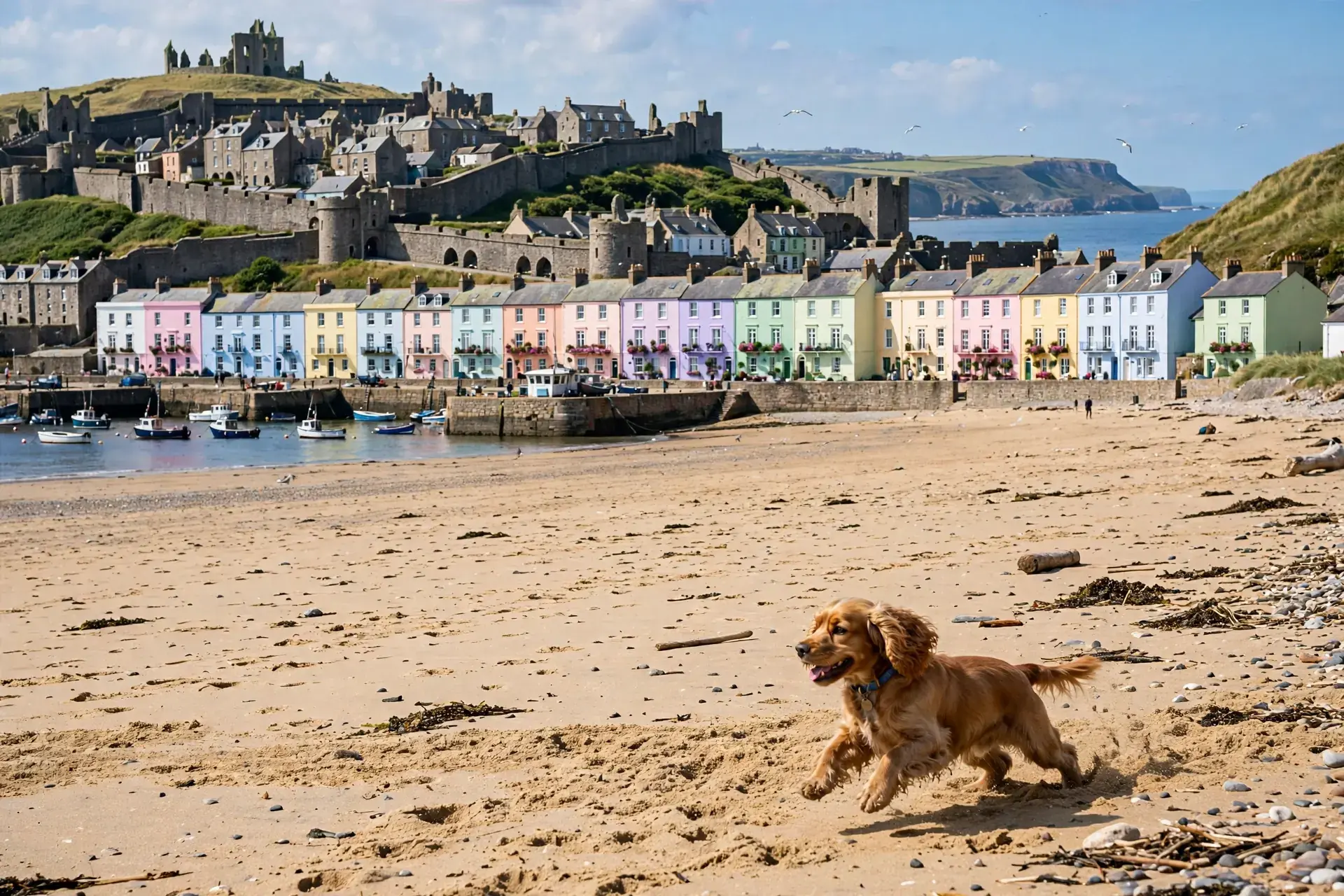
Whitesands Bay — Porth Mawr in Welsh — is the beach that defines a St Davids holiday. It is a wide, curving bay of pale sand about two miles north-west of the city, backed by dunes and low cliffs, facing the open Atlantic. On a calm summer day it is a classic family beach; on a windy day it is a wild, exhilarating place where the surf rolls in from thousands of miles of ocean and the spray blows across the sand. It is also one of the best surfing beaches in Wales, with consistent waves, a surf school and board hire in season, and a lifeguard service through the summer months. For dogs it is one of the great Welsh beaches — with one important condition, which is the seasonal restriction.
The dog rules at Whitesands Bay are set by Pembrokeshire County Council under a Public Spaces Protection Order, and they follow the pattern used on many Pembrokeshire beaches: dogs are restricted on the main beach during the summer season, and free to use the beach outside that season. The summer restriction typically runs from 1 May to 30 September, and during those months dogs are limited to a defined section of the beach rather than the whole bay. The exact dates and the boundary of the dog area are shown on signs at the car park and at the beach entrances, and they can change when the council renews the order — so check the official guidance before you travel, and read the signs when you arrive rather than relying on memory or on what a blog said last year. If you want the whole beach to yourselves, come between October and April, when the restrictions lift and a weekday morning can feel like a private beach. Our guide to dog-friendly beaches in the UK explains how seasonal bans and fines work in general, and it is worth reading before you plan a summer beach day anywhere in Britain.
Even outside the restricted season, a few practical points make the difference between a good beach day and a miserable one. The first is the tide. Whitesands is a big, flat beach at low tide, and the tide comes in fast across the sand; check tide times before you go, and keep an eye on the water if your dog is playing at the far end of the bay. The second is the surf. The waves here are real Atlantic surf, and the currents can be strong, especially on a big swell. Dogs that love to swim should be kept in the shallows, and dogs that are not strong swimmers should stay on the sand — the beach is big enough for a run without going in the water at all. The third is the wind. The bay faces west, and on a windy day sand blows hard across the beach; bring a windbreak or use the dunes for shelter, and carry fresh water, because the beach cafe is seasonal and there is no drinking water on the sand itself.
The facilities at Whitesands are straightforward. The car park is large but fills quickly on fine summer weekends, so arrive before 10am if you can; it is pay-and-display, and the walk from the car park to the beach is short and flat, which suits older dogs. There are toilets near the car park, a seasonal cafe and surf hire, and a National Trust information point in the summer. The dunes behind the beach are a Site of Special Scientific Interest, so keep dogs on the paths through the dunes and out of the fenced areas, where rare plants and nesting birds are protected. The dunes are also where adders live in warm weather, so keep dogs on the paths and out of the long grass on hot days, and know the signs of an adder bite — swelling and pain at the bite site — and the location of the nearest vet before you need it.
If the main beach is busy or restricted, the northern end of the bay, towards the rocky headland, is usually quieter, and the coast path from Whitesands climbs gently towards St Davids Head — the subject of the next section — so the beach and the headland walk combine naturally into a single outing. A good plan is to park at Whitesands, spend an hour on the beach with the dog, then walk the headland loop and return to the car for a late lunch in the city. In winter, when the cafe is closed and the lifeguards have gone home, the beach is at its wildest and emptiest, and a storm-watching walk along the top of the dunes — dog on a lead, well back from the edge — is one of the best free experiences in Pembrokeshire. Just check the weather forecast and the tide times first, and do not walk the beach at high tide in a storm, when the waves can reach the dunes.
St Davids Head: the coast walk with wildflower cliffs
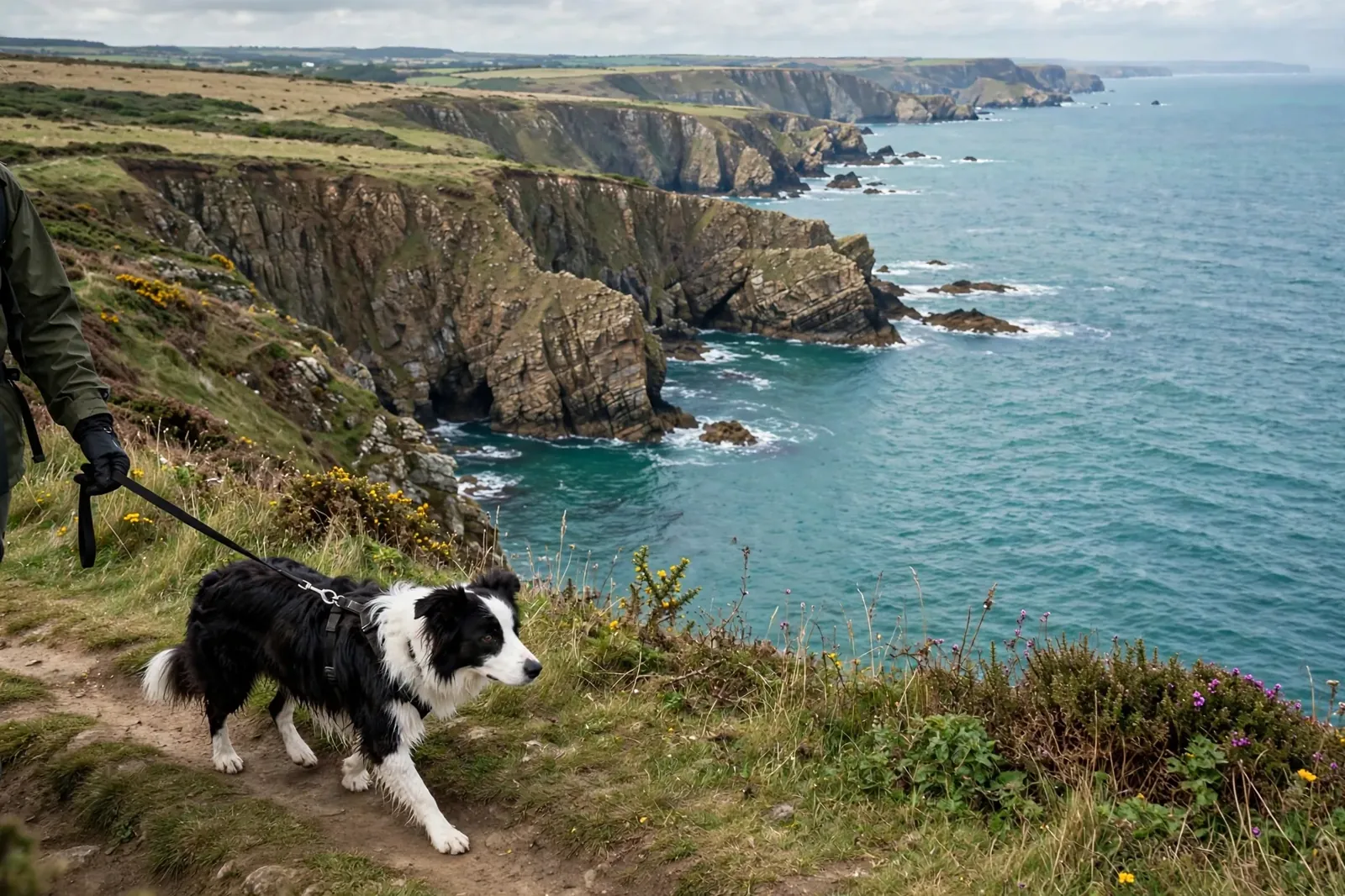
The walk from Whitesands Bay around St Davids Head is the finest half-day walk in the area, and it is the one to choose if you only have time for a single coast path outing. The circular route starts at the Whitesands car park, follows the coast path north and west around the headland, climbs gently to the rocky summit area, and returns across the open heathland of the peninsula. It takes about two to three hours at a comfortable pace with a dog, covering roughly three to four miles, and it rewards every step: on a clear day you can see across to Ramsey Island, along the coast towards Strumble Head, and inland to the Preseli Hills. The terrain is rough in places — rocky paths, uneven ground, a few short climbs — so wear proper walking boots and expect muddy sections after rain.
The headland is a place of deep history as well as scenery. St Davids Head is dotted with the remains of an Iron Age defended settlement, with ramparts and hut circles still visible in the turf, and near the path stands Coetan Arthur, a Neolithic burial chamber whose massive capstone is one of the most photographed prehistoric monuments in Wales. The name means Arthur's Quoit, and local legend links the stone to King Arthur. Dogs on leads are welcome along the whole route, and the open heathland between the monuments is a good place for a dog to stretch its legs — but only where the ground is open and the cliffs are set well back, because the path runs close to unfenced cliff edges in several places. A dog on a long line is a better choice than a dog off lead here, and a dog that pulls towards cliff edges should be kept on a short lead for the whole walk.
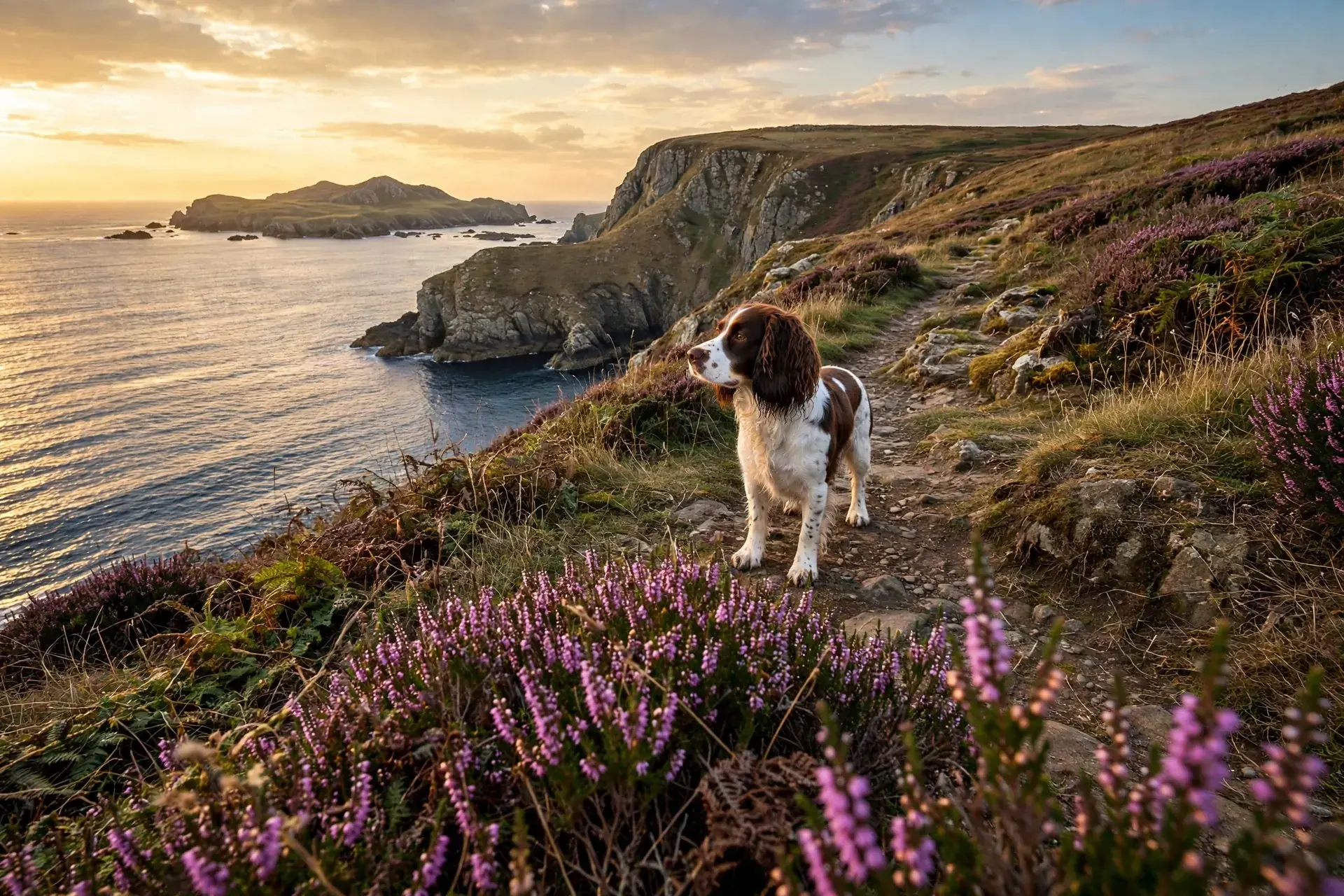
The wildflowers are the other reason to walk the headland, and they change completely with the seasons. In spring the cliff tops are covered in thrift — the pink sea-pink that grows in dense cushions along the edge — and spring squill, a small blue flower that appears in April and May. In summer the heather takes over, turning the heathland purple in August and September, and the gorse adds yellow to the mix. The flowers are not just decoration: the heathland is a protected habitat, and the National Trust, which owns much of the headland, asks walkers to keep to the paths and to keep dogs out of the most sensitive areas. The best time for flowers is late spring, when the thrift and squill are at their peak and the days are long, but the heather in late summer is the most dramatic sight of all, and it is when the cover photograph for this guide was taken.
Birdlife is everywhere on the headland, and it is worth bringing binoculars. Choughs — the red-billed, red-legged crows that are a symbol of Pembrokeshire — nest in the cliffs and can be seen tumbling in the wind above the headland for most of the year. Ravens, peregrines and kestrels hunt along the cliff edge, and in spring and summer the air is full of skylarks over the heathland. The seabirds are best seen from the cliff tops looking down: guillemots and razorbills on the ledges in spring, and gannets passing offshore, white against the blue water. Keep your dog close when birds are nesting on the ground — skylarks and stonechats nest in the heather — and never let a dog chase birds along the cliff edge, where a stumble can be fatal.
Practical points for the walk are simple but important. There is no water on the route, so carry enough for you and the dog, plus a collapsible bowl. The only facilities are at the Whitesands car park, so use them before you set off. The path is exposed to the wind, and the weather can change quickly — a sunny morning can turn into a wet, windy afternoon — so carry a waterproof layer and check the forecast before you go. If your dog is older or less fit, you can shorten the loop by walking out along the coast path as far as you like and returning the same way, rather than completing the full circle. And if you want a longer day, the coast path continues south from Whitesands towards St Non's and the city, or north towards Abereiddy and the Blue Lagoon — see our Pembrokeshire Coast Path guide for the full route and the sections that work best with a dog.
One more walk deserves a mention for dog owners who want something shorter and easier. The path from the city to St Non's Chapel and Well, about a mile along the coast, is a gentle, mostly flat walk that suits older dogs, puppies and anyone who wants a quiet hour rather than a half-day hike. The chapel ruins are small and peaceful, the well is said to have healing properties, and the little cove below the chapel is a good place to sit and watch the sea. It is also a good first walk for a dog that is new to the coast path, because the terrain is forgiving and the route is easy to cut short.
Ramsey Island by boat: seals, shearwaters and a dog-free day
Ramsey Island — Ynys Dewi in Welsh, the island of St David — sits about a mile off the St Davids peninsula, and it is one of the great wildlife spectacles in Britain. The island is a National Nature Reserve managed by the RSPB, and it is home to one of the largest grey seal colonies in the UK, a huge colony of Manx shearwaters, and breeding populations of puffins, razorbills, guillemots and choughs. On a good day the boat trip to Ramsey is the highlight of a St Davids holiday. It is also, honestly, the one major attraction in the area that does not work with a dog — and it is better to know that before you arrive than to discover it at the harbour.
Boats to Ramsey Island leave from St Justinians, a small harbour about two miles west of St Davids, where the RNLI lifeboat station stands on the cliff below the old chapel of St Justinian. The crossing takes about fifteen minutes in good conditions, but the tidal streams around Ramsey Sound are famously strong — the water between the island and the mainland runs fast, and the boat trip itself is part of the experience, with the chance of seeing seals, porpoises and seabirds on the way across. Several operators run trips from St Justinians, including wildlife cruises that circle the island without landing, and landing trips that allow a few hours ashore with an RSPB warden. Landing trips are limited in number and book up quickly in summer, so book ahead, and check the official guidance before you travel for the current timetable and prices.
Dogs are not allowed to land on Ramsey Island. The island is a nature reserve, and dogs would disturb the seals and the ground-nesting birds, so the rule is absolute and there are no exceptions. Most boat operators also do not carry dogs on the wildlife cruises, because the boats are small, the trips are focused on wildlife watching, and a dog on board would be stressed by the noise, the motion and the close quarters. If you are travelling with a dog, plan the Ramsey trip as a dog-free outing: one person can take the boat while the other walks the dog, or you can arrange a local dog sitter or a dog-friendly kennel for a few hours. The boat trip typically takes two to four hours including the crossing, so it is a half-day commitment rather than a whole day, and the dog will be happy with a long walk on Whitesands or the headland while you are away.
What you will see depends on the season. The grey seals are present all year, but the most dramatic time is the pupping season, from late August to November, when white-coated pups lie on the beaches and in the coves around the island, and the mothers haul out to feed them. The Manx shearwaters are the island's most famous birds: tens of thousands of them nest in burrows on Ramsey, and they return to the island at dusk in a spectacular, noisy arrival that is best seen on an evening boat trip. Puffins are present from April to July, and the cliffs are full of razorbills and guillemots in spring. Choughs are resident all year, and the island's wildflowers — including the rare, endemic Ramsey Island cabbage — make the landing trips worthwhile for botanists as well as birdwatchers.
If you cannot get a landing trip, the wildlife cruise around the island is still excellent, and it is often the better choice for families and for anyone who prefers not to walk on rough ground. The cruise gives you close views of the seal colonies and the seabird cliffs from the water, and the guides are knowledgeable about the island's wildlife and history. Bring binoculars, a windproof jacket and sun protection — the glare off the water is strong even on a cloudy day — and be prepared for the boat to move in the swell. If you are prone to seasickness, take precautions before you board, and check the weather forecast, because trips are cancelled in rough conditions and the operators will not sail if the sea is too rough for the crossing.
Photographers will want to plan around the light, because Ramsey Sound in low evening sun is one of the finest wildlife photography settings in Wales. The west-facing cliffs catch the last light, the shearwaters return to the island at dusk in late summer, and the seals haul out on the rocks at low tide — but the boat is moving, the light changes fast, and a long lens is hard to hold steady in a swell, so set a fast shutter speed, keep your gear in a dry bag, and accept that the best photographs often come from the cliff-top walk at St Justinians rather than from the boat itself. Dogs, of course, stay ashore for all of this, which is another reason to treat the boat trip as a planned dog-free outing rather than an afterthought.
St Justinians itself is worth a visit even if you do not take a boat. The lifeboat station is open to visitors at certain times, the cliff-top walk from the car park gives superb views across Ramsey Sound, and the little chapel of St Justinian is a peaceful place to sit. The car park at St Justinians is pay-and-display, and dogs on leads are welcome on the cliff-top paths, though the area is exposed and the drops are steep, so keep dogs well back from the edge. The walk from St Davids to St Justinians along the coast path is about two miles and makes a good half-day outing in itself, with the boat trip as the reward at the end.
Eating, staying and parking in the city
St Davids is small, but it eats well, and most of its cafes and pubs welcome dogs — which matters, because a dog that has spent the morning on the beach or the headland will not want to be left in the car while you eat. The city's pubs are the easiest option: the Farmers Arms and the Bishops are both traditional pubs with good food and a relaxed attitude to dogs, and on a fine day the outdoor seating fills up with walkers and their dogs. The cafes along the high street and around Cross Square are similarly welcoming, and many of them keep a water bowl by the door and a jar of dog biscuits on the counter. The rule of thumb is to ask before you sit down, to keep your dog on a lead under the table, and to bring a mat for them to settle on — a dog that lies quietly under the table is welcome almost everywhere, and a dog that wanders between tables is not.
For a quick lunch, the delis and takeaways in the city centre are a good choice: sandwiches, pasties and ice cream to eat on a bench in Cross Square or on the cathedral green, with the dog beside you. The food shop in the city centre stocks the essentials — dog food, treats, water, and the picnic supplies you will want for a beach day — but it is a small shop, so if your dog eats a specialist diet, bring enough food with you rather than relying on the local shelves. There is a larger supermarket in Haverfordwest if you need it, and the farm shops and delis on the road into St Davids are worth a stop for local cheese, bread and Welsh cakes.
Staying in St Davids with a dog is straightforward, because the city has a good range of dog-friendly accommodation and most of it is used to walkers and their dogs. The options include small hotels and guest houses in the city centre, bed and breakfasts on the edge of town, self-catering cottages, and campsites and caravan sites on the peninsula. The self-catering cottages are often the best choice for a dog holiday: they usually have an enclosed garden, a washing machine for muddy towels, and no shared corridors to negotiate with a wet dog. Campsites are a good budget option in summer, but check the site rules on dogs — some sites restrict dogs to certain pitches, and some charge a per-dog fee. Whatever you book, confirm the dog policy in writing before you pay, including the number of dogs allowed, the fee, and whether dogs can be left alone in the accommodation. Many places prohibit leaving dogs unattended, so plan your days around that: if you want to visit the cathedral, the palace or a boat trip, arrange for one person to stay with the dog or book a sitter.
Booking ahead is essential in school holidays and in the summer, when the best dog-friendly cottages and rooms sell out months in advance. In the quieter months — November to March, excluding Christmas — you can often find a place at short notice, and prices are lower, but some smaller guest houses and cafes close for the winter, so check that your first choice is open before you travel. If you are planning a longer stay, consider using St Davids as a base for the wider Pembrokeshire coast: Tenby is about an hour's drive to the south-east, and it makes an excellent second stop, as our guide to Tenby with a dog explains, with its own beaches, harbour and walled old town.
Parking in St Davids is simple but needs a little planning. The main car parks are at Whitesands Bay, at Oriel y Parc — the visitor centre near the cathedral, which has a cafe, a gallery and information about the national park — and at St Justinians for the Ramsey Island boats. There are also smaller car parks in the city centre, including one near the cathedral and one on the edge of town. All of them are pay-and-display, and charges vary by season and by length of stay, so check the official guidance before you travel for current prices. On a fine summer weekend, the Whitesands car park fills by mid-morning, and the city centre car parks fill by lunchtime, so arrive early or be prepared to walk in from the edge of town. Never leave a dog in a parked car on a warm day — even with the windows open, a car can overheat in minutes — and on a cold day, remember that a wet dog left in a car will get chilled quickly. The best plan is to park once, walk everywhere, and take the dog with you.
Oriel y Parc deserves a special mention, because it is the first stop most visitors should make. The visitor centre sits between the city centre and the cathedral, and it has exhibitions about the Pembrokeshire Coast National Park, a gallery of local art, a cafe, and a shop selling maps and guidebooks. Dogs on leads are welcome in the grounds and, usually, in the cafe's outdoor area, and the staff are a good source of up-to-date advice about the coast path, the beach restrictions and the boat trips. Pick up a tide table and a coast path map here, check the weather forecast on the noticeboard, and ask about any temporary path closures or livestock movements — the staff know the area better than any website, and a two-minute conversation can save you a wasted journey.
Winter in St Davids has its own character and its own rules. From November to March the city is quiet, the beaches are empty, the cathedral is at its most atmospheric, and the coast path belongs to the walkers who are out in all weathers. The trade-off is that some cafes, guest houses and the beach facilities close or reduce their hours, the boat trips to Ramsey stop running in rough weather, and the wind off the Atlantic can be strong enough to make the exposed cliff walks unpleasant — or unsafe — for a small dog. Check which places are open before you travel, pack an extra layer for the dog as well as yourself, and choose the sheltered inland paths on the worst days. The reward for the extra planning is a St Davids that feels entirely yours, with empty beaches, low light and a fire waiting in the pub at the end of the walk.
A final practical note: the nearest vet is in Haverfordwest, about half an hour's drive away, so save the number of an emergency vet before you need it, and carry a basic dog first-aid kit — tweezers for ticks, a bandage, and any medication your dog takes regularly. Mobile phone signal is patchy on the headland and on parts of the coast path, so download offline maps before you set out, and tell someone where you are going if you are walking alone. The coastguard and the RNLI cover this coast, and the lifeboat station at St Justinians is a reminder of how serious the sea can be: enjoy the wildness of the place, but respect it, and keep your dog on a lead near the cliffs and the water.
A dog-friendly day in St Davids: a sample plan
If you have a single full day in St Davids, the city rewards a simple rhythm: beach in the morning, cathedral at midday, headland in the afternoon. Start early at Whitesands Bay, arriving before 10am while the car park is quiet and the light is soft. Let the dog run on the sand, check the tide times the evening before, and keep the first session to an hour — a tired dog enjoys the rest of the day far more than a dog that has sprinted itself empty before lunch. If the summer dog restrictions apply, use the permitted section of the beach and save the long run for the headland paths, where the rules are different.
From the beach, drive or walk back into the city for late morning. Park at Oriel y Parc, pick up a tide table and a coast path map, and walk down to the cathedral for a quiet visit with the dog on a lead. Mid-morning on a weekday is the calmest time, and the low sun through the nave windows makes it the prettiest. Allow an hour for the cathedral and the Bishops Palace grounds, then cross to the palace ruins for a walk around the hall and the great wheel window. By now the dog will be ready for a rest, so find a pub or cafe with outdoor seating for lunch — the Farmers Arms and the Bishops are reliable choices — and let the dog settle under the table with a mat and a chew while you eat.
The afternoon belongs to the headland. Drive back to Whitesands and walk the circular route around St Davids Head, which takes two to three hours and is best in the softer light of late afternoon, when the heather glows and the sea turns silver. Carry water for both of you, keep the dog on a lead near the cliff edges and the sheep, and build in a stop at Coetan Arthur for a rest and a photograph. If the full loop is too much after a morning on the beach, walk out along the coast path for an hour and return the same way — you will still see the best of the cliffs and the wildflowers.
Finish the day with a gentle evening in the city. Walk the dog around the cathedral close as the light fades, when the crowds have gone and the building is at its most atmospheric, then eat in town or cook back at your cottage. If the weather turns, swap the headland walk for a longer cathedral visit, a slow lunch and a drive along the coast to Abereiddy, where the Blue Lagoon — the flooded remains of a slate quarry — makes a dramatic, sheltered stop in the rain. And if you have a second day, spend it on the coast path south towards St Non's and the city, or book the Ramsey Island boat trip as your dog-free morning while a sitter walks the dog on Whitesands.
What to pack for the day is worth a short list, because the coast path has no shops and the weather changes fast. Bring a lead and a long line, a collapsible water bowl and at least a litre of water for the dog, a towel and a drying coat, poo bags, a tick remover, and a basic first-aid kit with a bandage and any medication your dog takes. Add a windproof layer and waterproofs for yourself, sun protection for both of you, and a charged phone with offline maps downloaded, since the signal is patchy on the headland. A mat for the dog to settle on in cafes is the single most useful item after the lead itself, and a spare lead in the car has saved more than one day out.
Practical questions
Before you go
Can dogs go inside St Davids Cathedral?
Yes, well-behaved dogs on leads are welcome inside St Davids Cathedral. Keep your dog close, on a short lead, and be ready to step outside during services or busy moments. Rules can change, so check the official guidance before you travel.
When can dogs go on Whitesands Bay beach?
Whitesands Bay has seasonal dog restrictions in the summer months, when dogs are limited to part of the beach, and dogs can use the beach freely outside that season. The exact dates and zones are set by Pembrokeshire County Council and shown on signs at the car park, so check the official guidance before you travel.
Can I take my dog on a boat trip to Ramsey Island?
No. Dogs are not allowed to land on Ramsey Island, which is an RSPB nature reserve, and most boat operators do not carry dogs on wildlife trips either. Plan a boat trip as a dog-free outing and arrange a sitter or a dog-friendly walk for your dog while you are on the water.
How long is the St Davids Head walk and is it suitable for dogs?
The circular walk from Whitesands Bay car park around St Davids Head takes about two to three hours and covers roughly three to four miles. It is suitable for fit dogs on leads, with rough ground, steep drops and sheep grazing nearby, so it is not a good choice for dogs that pull hard or cannot be recalled reliably.
Where can I park with a dog in St Davids?
Use the Whitesands Bay car park for the beach and St Davids Head, the Oriel y Parc car park near the cathedral for the city centre, or the car park at St Justinians for Ramsey Island boat trips. All three are pay-and-display, so bring coins or a card and check the official guidance before you travel for current charges.