This guide is independent and contains no paid placement. If affiliate links are added later, they will be clearly marked and will not change our editorial checks.
The Pennine Way suits a fit, experienced dog and a walker who can navigate in fog. Walk it in sections, book every dog-friendly stay well ahead, carry water and food for the long gaps between villages, and never trust a clear morning on the moors: the weather turns fast.
The spine of England in numbers
The Pennine Way runs 268 miles from Edale in the Peak District to Kirk Yetholm just over the Scottish border, following the high ridge that forms the backbone of England. Opened in 1965, it was Britain's first National Trail, and it remains the most demanding of the long-distance routes in England: the total ascent is around 11,000 metres, the highest point is Cross Fell at 893 metres, and long stretches cross open moorland with no shelter, no shops and no mobile phone signal. For a dog owner, those facts set the terms of the whole trip. This is not a trail to improvise on, and it is not a trail to walk with a dog that has only ever done park laps and weekend rambles.
The route is usually divided into 16 or 17 stages, each between 12 and 19 miles, and most walkers take 16 to 19 days to complete it. With a dog, the slower end of that range is the sensible target, and many dog owners split the route into two or three separate holidays: the Peak District and Yorkshire Dales sections first, then the North Pennines, then the Cheviots. That approach has real advantages. It lets you walk each section in the best season for it, it spreads the cost, and it means the dog is never asked to walk for three weeks without a proper break. The Pennine Way will wait; a tired dog will not.
Each section has its own character, and the differences matter for dogs. The Peak District start climbs out of Edale over Kinder Scout, where the ground is rough and the weather is notoriously changeable. The Yorkshire Dales middle is gentler, with limestone pavements, dry-stone walls and villages that welcome walkers. The North Pennines section is the wildest, crossing high moorland between small villages that are miles apart. The Cheviots at the end are remote and featureless, with long days and few facilities. A dog that is comfortable in the Dales may find the Cheviots exhausting, so the section you choose should reflect the dog's experience as well as your own ambition.
One practical point is often missed: the Pennine Way is a linear trail with poor public transport at both ends and along much of its length. Edale has a railway station, and Kirk Yetholm is served by a bus to Kelso, but in between, transport is patchy. That makes the logistics of getting back to a car, or of reaching the next section's start, a genuine part of the planning. Luggage transfer services operate along the route, and they are worth using, because a dog that walks 15 miles a day does not need its owner carrying a heavy pack as well. Check the official guidance before you travel for the current state of the route, because the moorland sections are sometimes diverted for restoration work.
Moorland, bog and stone flags
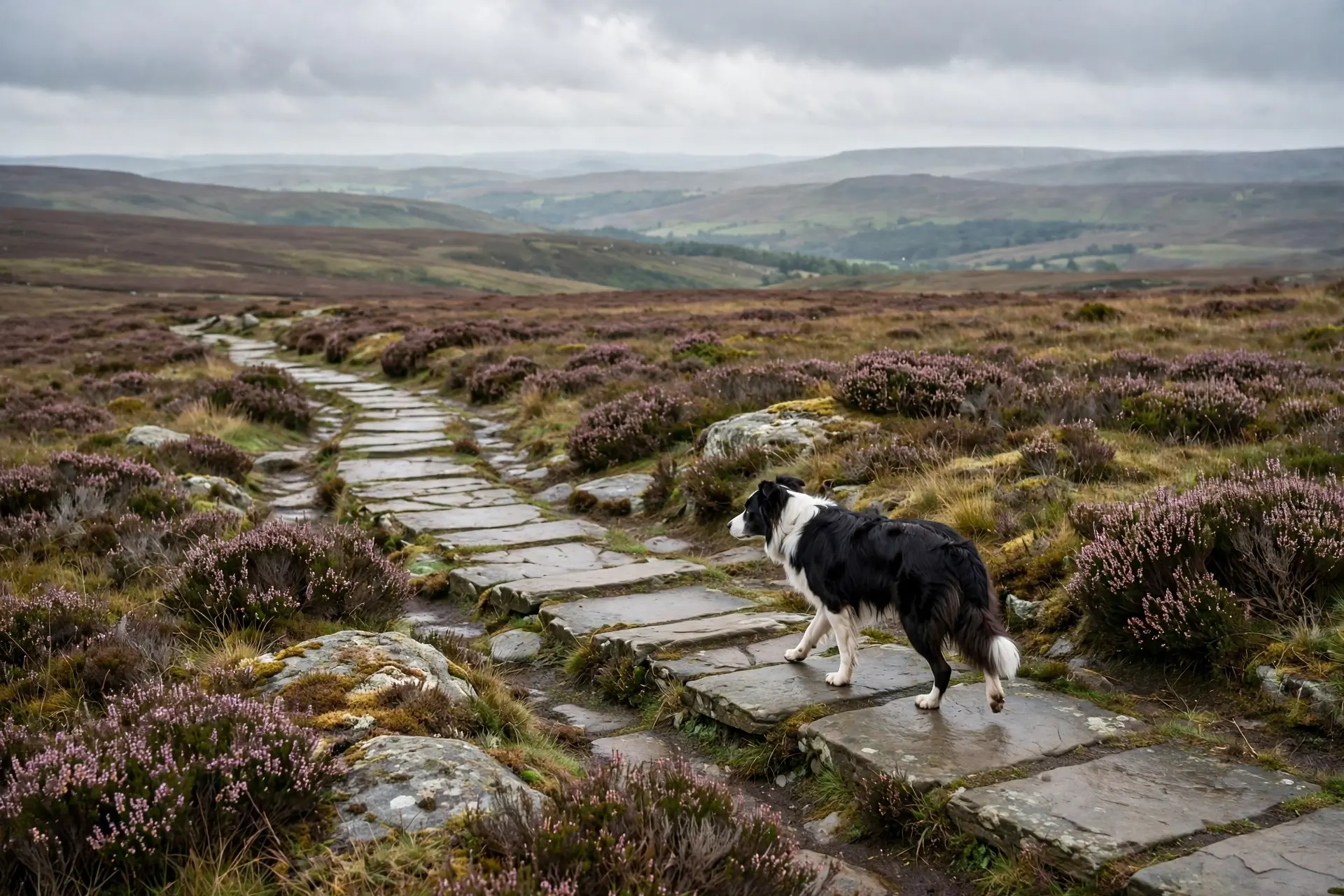
The ground underfoot on the Pennine Way is the trail's defining feature, and it is harder on dogs than most walkers expect. Large parts of the route cross peat moorland, where the path can be a quagmire after rain, and where the "path" is sometimes a line of stone flags laid across the bog. Those flags are a blessing in wet weather, because they keep you out of the peat, but they are hard and uneven under a dog's paws, and a dog that runs across them can slip or bruise a pad. On the flagged sections, keep the dog walking at a steady pace on a lead, rather than letting it race ahead and skid on the wet stone.
Bog is the other hazard, and it is not to be underestimated. Peat bogs can be waist-deep for a person and far worse for a dog, and a dog that runs off the path into a bog can become stuck and frightened very quickly. The rule on the moors is the same as on the cliffs: keep the dog close and on a lead where the ground is soft, and never let it chase across open moorland. Grouse moors add another layer: the heather is managed for shooting, and dogs must be kept under control during the shooting season, which runs from 12 August, and during the breeding season in spring, when ground-nesting birds are vulnerable.
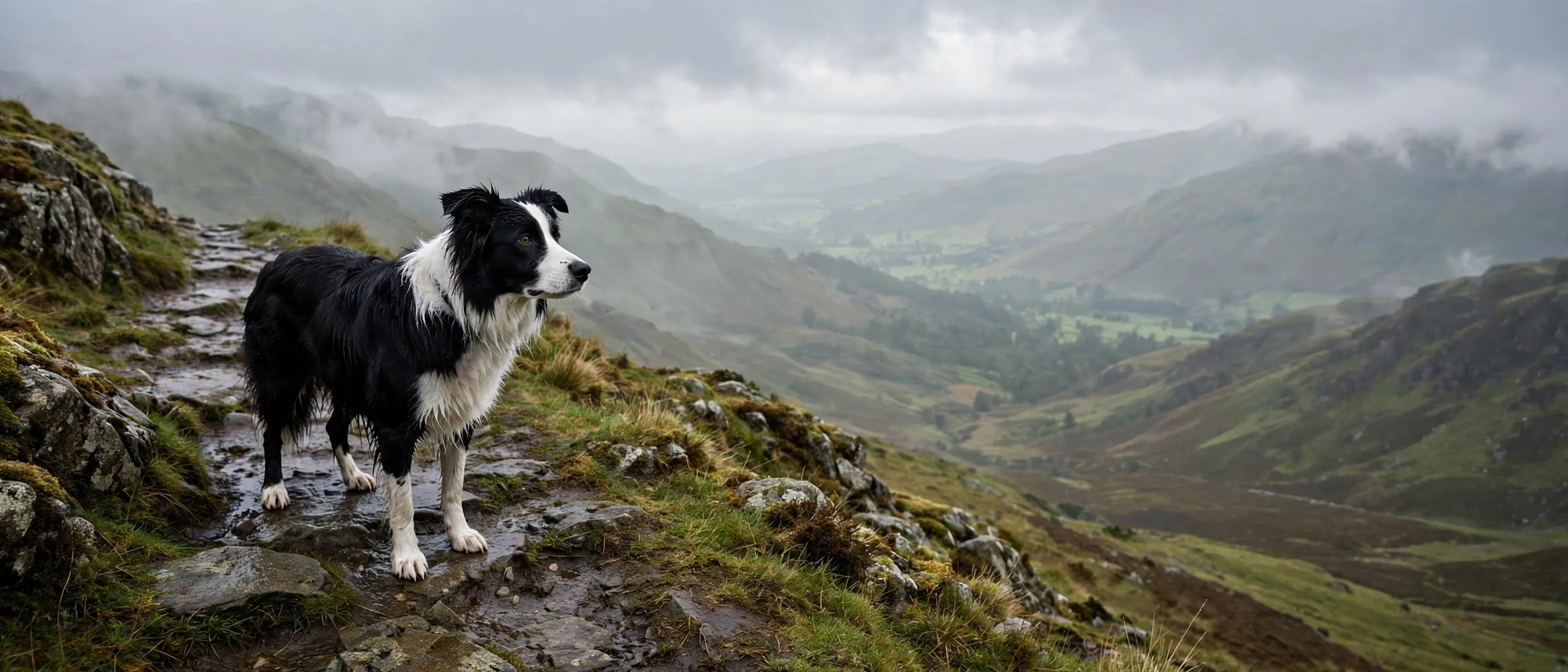
The good news is that the moorland walking is also the most rewarding part of the trail. On a clear day, the views from the high ridge stretch for miles, and the sense of space is unlike anything else in England. The heather in late summer turns the moors purple, the curlews call over the bogs in spring, and the stone flags lead you across landscapes that feel genuinely remote. A dog that has been trained to walk steadily on a lead and to settle at a break will enjoy these days as much as you will, provided it is fit enough and its paws are conditioned to the ground. Build up with moorland walks at home before you commit to a long section, and check the dog's paws after every day.
Water on the moor is a mixed blessing. There are streams and springs along much of the route, and a dog will drink from them readily, but moorland water can carry sheep droppings and, in warm weather, the risk of blue-green algae in still pools. Carry water for the dog and offer it first, and only let the dog drink from a fast-flowing stream if you have no alternative. If a stream looks stagnant or has a green scum on the surface, keep the dog out of it entirely.
Weather that changes in minutes
The Pennine Way has a well-earned reputation for weather that turns without warning. The high moors catch the wind and the rain, and a clear morning on Kinder Scout can become a whiteout by lunchtime. The trail's own statistics make the point: the Pennines are among the wettest and windiest parts of England, and snow has been recorded on Cross Fell in every month of the year. That does not mean the trail is unwalkable; it means the forecast is a starting point, not a promise, and the walker who plans for the worst weather is the one who enjoys the best.
For a dog, the combination of wind, rain and cold is the real risk. A wet dog on an exposed moor loses heat quickly, and a small or short-coated dog can become chilled even on a day that feels mild in the valley. Carry a dog coat from the start of the trip, not just in winter, and put it on at the first sign of rain or a cold wind rather than waiting for the dog to shiver. Carry extra food too, because a dog working hard in cold weather burns more energy, and a hungry dog is a cold dog. Offer water regularly, even in rain, because a dog that is panting from effort still needs to drink.
Fog is the weather feature that causes the most trouble on the Pennine Way, because it removes the landmarks and turns a familiar path into a puzzle. If fog closes in, slow down, keep the dog on a lead, and navigate by compass and map rather than by instinct. If the fog is thick and you are on high, exposed ground, the safest option is often to descend to a valley path or a road, even if that means abandoning the day's plan. A day cut short is not a failure; it is the decision that lets you walk again tomorrow.
The best months for the Pennine Way with a dog are usually May, June and September. May and June bring long days and the moors at their greenest, though the ground can still be boggy and the midges are active in sheltered spots. September brings cooler air, quieter paths and the heather in bloom, though the days are shorter and the first storms of autumn can arrive. July and August are the warmest months but also the busiest, and the heat on the exposed moors can be hard on dogs. Whatever month you choose, check the forecast every morning and check the official guidance before you travel for any weather-related warnings.
Where to stay when stays are scarce
Accommodation is the Pennine Way's hardest logistical problem, and it is worse for dog owners than for anyone else. The route passes through villages that are small and far apart, and the number of places that accept dogs is limited. In the northern half, between the Yorkshire Dales and the Scottish border, there are stretches where the nearest dog-friendly bed is several miles off the route, which adds walking at the end of an already long day. The only reliable answer is to book every night well in advance, confirm the dog in writing, and know the fallback for each night before you set off.
The types of stay along the route are varied: pubs with rooms, bed and breakfasts, bunkhouses, hostels, campsites and a few small hotels. Pubs with rooms are often the most welcoming for dog walkers, because they expect muddy boots and tired dogs, and many will let the dog into the bar. Bunkhouses and hostels are the cheapest option and often have drying rooms, but some do not accept dogs at all, and those that do may restrict them to certain rooms. Campsites are flexible and cheap, but on the high moors they can be exposed and cold, and a tent is a poor shelter for a wet dog in a gale.
When you book, ask the questions that separate a genuinely dog-friendly stay from one that merely tolerates dogs. Is there a charge per dog, and is there a limit on size or number? Can the dog stay in the room with you, or must it sleep elsewhere? Is there a secure place to leave the dog if you eat in the dining room, and is there an enclosed area for a last outing? Is there a tap or a hose for muddy paws, and somewhere to dry a wet dog and hang wet clothes? A host who answers these questions clearly has thought about dogs; a host who is vague probably has not.
Book the whole route before you leave, and do not assume you can find a bed on the night. In the school holidays and on summer weekends, the dog-friendly rooms along the Pennine Way sell out months ahead. If a night has no dog-friendly option on the route, plan a detour to the nearest town or arrange a taxi to a stay off the route, and factor the extra miles and cost into the plan. Our guide to Lake District vs Peak District with a dog covers the two national parks at the southern end of the trail, and it is a useful companion when you are choosing which section to walk first.
Eating on the moors: what to carry and where the gaps are
On the Pennine Way, the distance between one shop and the next is the number that decides how heavy your pack feels. Between the Dales villages and the Cheviot foothills there are days with no shop, no cafe and no pub at all, and a walker who has not counted those days will run short. Before you leave, sit down with the map and mark every place that sells food: Edale, Crowden's nearest shop, Marsden, Hebden Bridge, Haworth, Grassington, Kettlewell, Kirkby Stephen, Alston, Bellingham and the handful of village stores in between. Then count the days between them, and carry the food for the longest gap, plus a spare day. That is the whole method, and it works because the moors do not forgive optimism.
The dog's food is the heaviest single item in the pack, and it deserves its own plan. A walking dog eats roughly a third more than it does at home, and on a cold, wet moorland day that figure can rise further. Measure the food into one bag per day before you leave, and label the bags, so that a tired evening does not turn into guesswork. Keep the food the dog already knows: a new brand on a long walk is a reliable way to produce a bad stomach, and a bad stomach on a moor with no vet nearby is a problem you do not want. If you use a baggage courier, the food can ride in the transferred bag, but a full day's ration should always be in your own pack, in case the courier is delayed by weather or a closed road.
Water is a different kind of problem on the Pennines, because it is both plentiful and unreliable. There are streams and springs all along the moors, and a dog will drink from them eagerly, but moorland water can carry sheep droppings, and still pools in warm weather can carry blue-green algae. The practical approach is to carry a litre for the dog and a litre for yourself, and to refill at every pub, cafe, campsite and village tap you pass. Offer the carried water first, and only let the dog drink from a stream if it is fast, clear and running over stones. If a pool looks green or smells stale, keep the dog away from it entirely, and check the official guidance before you travel if you plan to rely on natural water for a whole day.
Mealtimes on a long trail are a routine worth protecting. Give the dog its main meal at least an hour before the morning start, and wait an hour after the day's walking before the evening meal, because a deep-chested dog that exercises on a full stomach is at risk of bloat. A handful of the dog's usual kibble at lunchtime, offered with water at a rest stop, keeps energy steady without loading the stomach. And remember that a dog that is fed on a steady routine, with water offered at every break rather than only when it looks thirsty, will walk further and recover faster than one fed in big, irregular meals at the end of the day.
Ticks, adders and sore paws
The Pennine Way's moorland and bracken are tick country, and the risk runs from spring to autumn. Ticks carry diseases that can affect dogs, including Lyme disease, so prevention is worth the effort: use a vet-recommended tick treatment before the trip, check the dog thoroughly every evening, and carry a tick remover. Pay particular attention to the ears, the armpits, the groin and between the toes, where ticks hide. If you find a tick, remove it with the tool, clean the bite, and watch for any swelling or lethargy over the following days. A dog that seems off colour after a tick bite should see a vet.
Adders are present on the moors and in the bracken, and they are most active on warm, sunny days. A dog that snuffles through long grass or pokes its nose into a rock pile can be bitten, and an adder bite is a veterinary emergency. The signs include sudden pain, swelling, and a dog that becomes quiet or distressed. Keep the dog out of deep bracken in summer, keep it on a lead where adders are likely, and if a bite happens, keep the dog still, carry it if you can, and get to a vet as quickly as possible. Do not try to suck out the venom or apply a tourniquet; the vet is the only answer.
Paws take a battering on the Pennine Way. The route mixes stone flags, rough moorland, tarmac lanes and boggy peat, and a dog that is used to pavements will feel the difference within a day. Before the trip, build up the dog's walking gradually over several weeks, including rough and hilly ground, and check the paws after every walk. Look for cracked pads, redness between the toes and small cuts, and carry a paw balm, a few booties and a small first-aid kit. A dog that is limping should not be walked further; rest it, check the paw, and if the problem persists, find a vet or a taxi to the next stay.
Other health risks are less dramatic but still worth knowing. Sheep worrying is a legal and ethical issue: a dog that chases sheep can be shot by a farmer, and the distress it causes is real. Keep the dog on a lead near livestock, always. Grass seeds in summer can lodge in ears and between toes, and a dog that shakes its head repeatedly or licks a paw obsessively after a walk through long grass should be checked. A basic first-aid kit, the number of the nearest vet for each night, and the habit of a thorough evening check will catch most problems early.
Building a moorland dog: training for peat, flags and long days
A dog that is going to walk the Pennine Way needs to be built for it, and the building takes weeks. The moors ask for a particular kind of fitness: the ability to keep going over soft, uneven ground, to climb steadily without tiring, and to recover overnight and do it again. Start at least two months before the trip, and build the distance slowly, adding a mile or two a week rather than jumping from a park walk to a 12-mile moorland day. Include rough ground from the start, because a dog whose paws have only ever met pavement will be sore within a day on peat and stone flags.
Hill work matters more than flat mileage. A dog that can walk 15 miles on a canal towpath may still struggle with a Pennine day that climbs 700 metres over rough ground, because the climbing uses different muscles and the descents punish the joints. Find a local hill and walk it regularly, with the dog on a lead, at a steady pace, and let the dog get used to the rhythm of climbing and descending. Add a loaded pack gradually, if the dog will carry one, and keep the load under a tenth of the dog's weight. A dog that trains with a pack will cope with it on the trail; a dog that meets a pack for the first time on day one will not.
Rest is part of training, not a break from it. A dog that walks hard every day without a rest day will go stale, just as a human will, and the signs are easy to miss: a dog that is slower to start in the morning, that lies down at every stop, or that stops pulling ahead and starts trailing behind. On the trail, plan a short day or a full rest after every three or four walking days, and on the training walks, do the same. A dog that arrives at the start of the Pennine Way fresh, fit and keen is worth far more than a dog that has been walked into the ground in the weeks before.
Finally, train the manners as well as the muscles. A dog that walks calmly on a lead past sheep, that settles under a pub table, and that comes back when called on open moorland will have a far better trip than a fit dog that does none of those things. Practise the lead work on narrow paths, practise recall where it is safe, and practise settling in busy places, because the Pennine Way will test all three. The fittest dog on the trail is not the one that runs the furthest; it is the one that walks steadily, rests well and is welcome wherever it stops.
A sample eight-day plan
A realistic first section of the Pennine Way with a dog might run from Edale to Gargrave, covering the Peak District and the start of the Yorkshire Dales in eight walking days with a rest day in the middle. Day one climbs out of Edale over Kinder Scout to Crowden, a short but demanding introduction with rough ground and big views. Day two continues to Standedge, crossing the high moors of the South Pennines. Day three drops to Marsden and then climbs again to the Calder Valley, where the walking eases for a day.
Day four is a rest day in the Calder Valley, and it should be treated as one: a short riverside stroll, a wash of muddy gear, a good meal and a proper sleep. Day five resumes with the climb to the moors above Haworth and on to the Dales, and day six takes you through the limestone country towards Malham, where the cove and the tarn are worth a slow morning. Day seven continues to Gargrave, and day eight is a short walk and the train home, with the dog tired but happy rather than exhausted.
This is a shape, not a prescription. A young, fit dog might add a few miles a day; an older dog might need the rest day earlier and shorter days throughout. The point is the pattern: a demanding start, a steady build, a rest, and a finish that leaves something in reserve. Book the stays first, then fit the walking to the stays, and leave a spare half-day at the end for transport delays or a day lost to fog. Check the official guidance before you travel for the current state of the route, because the moorland sections are sometimes diverted for restoration work, and a diversion can add miles to a day.
Before you commit to any itinerary, check the transport at both ends. Edale has a railway station, which makes the start easy, but the finish at Gargrave also has a station, which is why this section works so well as a first taste. Other sections end in villages with no public transport at all, and those need a taxi or a second car. The logistics are part of the walk, not an afterthought, and a section that is easy to reach and easy to leave is worth more than a section that looks better on the map.
Kit for the high moors: navigation first, comfort second
The first item on a Pennine Way kit list is not a boot or a jacket; it is a map and a compass, and the knowledge of how to use them. The moors have few landmarks, the path can vanish in fog, and a phone is a poor substitute when the battery dies or the signal goes. Carry the Ordnance Survey maps for the whole section, a compass you have practised with, and a guidebook with the stage descriptions. Keep the phone as a backup, with the maps downloaded and a power bank in a dry bag, but do not let it become the plan. A walker who can navigate in fog is a walker whose dog does not pay for a wrong turn in extra miles.
For the dog, the kit is built around the feet and the weather. A harness that fits well and does not rub, a short lead and a spare, a collapsible bowl, a litre of water, the day's food, poo bags, a towel and a coat for wind and rain. Add a paw balm for the end of the day, a few booties for a cut pad, a tick remover, and a small first-aid kit with bandages and antiseptic. Ticks are common in the bracken and the long grass from spring to autumn, so a vet-recommended treatment before the trip is worth arranging, and a thorough check of the ears, armpits and toes every evening is a habit worth keeping.
For the walker, the essentials are boots that have been broken in on rough ground, a waterproof jacket and trousers that actually keep the rain out, layers for the cold wind on the high moors, a hat and gloves even in summer, a head torch for the short days of autumn, and a walking pole for the boggy ground and the steep descents. A dry bag for the dog's food and your spare clothes is not a luxury on the Pennines; it is the difference between a dry evening and a miserable one. And a pair of light shoes for the evening, after a day in boots, is worth carrying even though it adds weight.
One thing that first-timers often forget is a way to carry a tired dog. A small dog that runs out of energy on the Cheviots cannot be left there, and a sling or a dog rucksack can turn a crisis into an inconvenience. For a bigger dog, the answer is different: know where the nearest road is on every day, so that a taxi can reach you if the dog cannot walk further. Either way, every day on the Pennine Way should have a way out, not just a way forward, and the kit list should include the phone numbers that make that way out work.
If the Pennine Way feels like a step too far for now, our guides to Grassington with a dog and Keswick with a dog cover gentler Dales and Lakes bases where you can build up the dog's hill fitness before tackling a long-distance trail.
Practical questions
Before you go
Can a dog walk the whole Pennine Way?
A healthy adult dog in good condition can manage the Pennine Way, either in sections or, for the fittest dogs, as a single two-to-three-week journey. Expect long days on open moor, very few facilities, soft boggy ground and weather that turns without warning. Young puppies, old dogs and flat-faced breeds are not suited to long stretches here. Increase the distance slowly over several weeks, and check the official guidance before you travel.
How long does the Pennine Way take with a dog?
The usual completion time is 16 to 19 days, at 14 to 17 miles a day. Dogs do best at the slower end of that range, with rest days added, because moorland ground is far tougher on paws than the mileage implies and the dog needs time to recover. A large share of dog owners split the walk across two or three holidays rather than attempting it in one go.
Are dogs allowed on the Pennine Way?
Yes. The trail follows public rights of way, and dogs are welcome throughout, provided they stay under close control. A lead is required near farm animals, on farmland and on moorland where ground-nesting birds are protected in spring. A small number of stays and pubs along the route do not take dogs, so confirm every stop before you book.
Where can I stay with a dog on the Pennine Way?
Beds are sparse in places, above all in the northern half between the Dales and the border. Pubs with rooms, bed and breakfasts, bunkhouses, hostels and campsites all appear along the route, yet the ones that take dogs are few and fill early. Reserve every night before departure, get the dog confirmed in writing, and work out a fallback for the stretches where the closest bed lies miles off the path.
Is the Pennine Way safe for dogs in bad weather?
The high moors are exposed, and conditions can shift within minutes: driving rain, thick fog, strong wind, and snow has been recorded in every month of the year. Wet and cold together drain a dog's warmth fast, and fog makes the walking itself harder. Look at the forecast each morning, pack a dog coat and spare food, and be willing to shorten the day or drop to a valley path. Check the official guidance before you travel for current warnings.
What is the hardest section of the Pennine Way for a dog?
Walkers usually name the Cheviots, near the end, as the toughest ground: mile after mile of featureless moor, almost no water and no facilities. Cross Fell runs it close, with high exposed ridges and long days between villages. Tackle both in settled weather, carry more water than you think you need, and have the night's bed booked long before you set out.