This guide is independent and contains no paid placement. If affiliate links are added later, they will be clearly marked and will not change our editorial checks.
Penrhyndeudraeth works best as a quiet base, not a checklist of attractions: dogs can ride the Ffestiniog Railway, walk the flat Dwyryd estuary paths, and stay in the village while you visit Portmeirion — where pet dogs are not admitted — on foot. Plan around the tide, the train timetable and the dog's energy, and the village does the rest.
Where the river meets the railway
Penrhyndeudraeth sits on the southern shore of the Dwyryd estuary in Gwynedd, roughly midway between Porthmadog and the mountains of Eryri, and its whole character comes from that position. The village is small — a main street, a church, a scattering of stone cottages, a station — yet it stands at a junction of three different kinds of travel: the river that once carried slate and timber to the sea, the narrow-gauge railway that still climbs from the harbour at Porthmadog towards Blaenau Ffestiniog, and the coastal road that bends around the estuary towards Portmeirion. For a dog owner, that junction is the point. You can arrive by car, leave it parked, and spend two or three days moving between water, rail and coast without ever needing a motorway or a long drive.
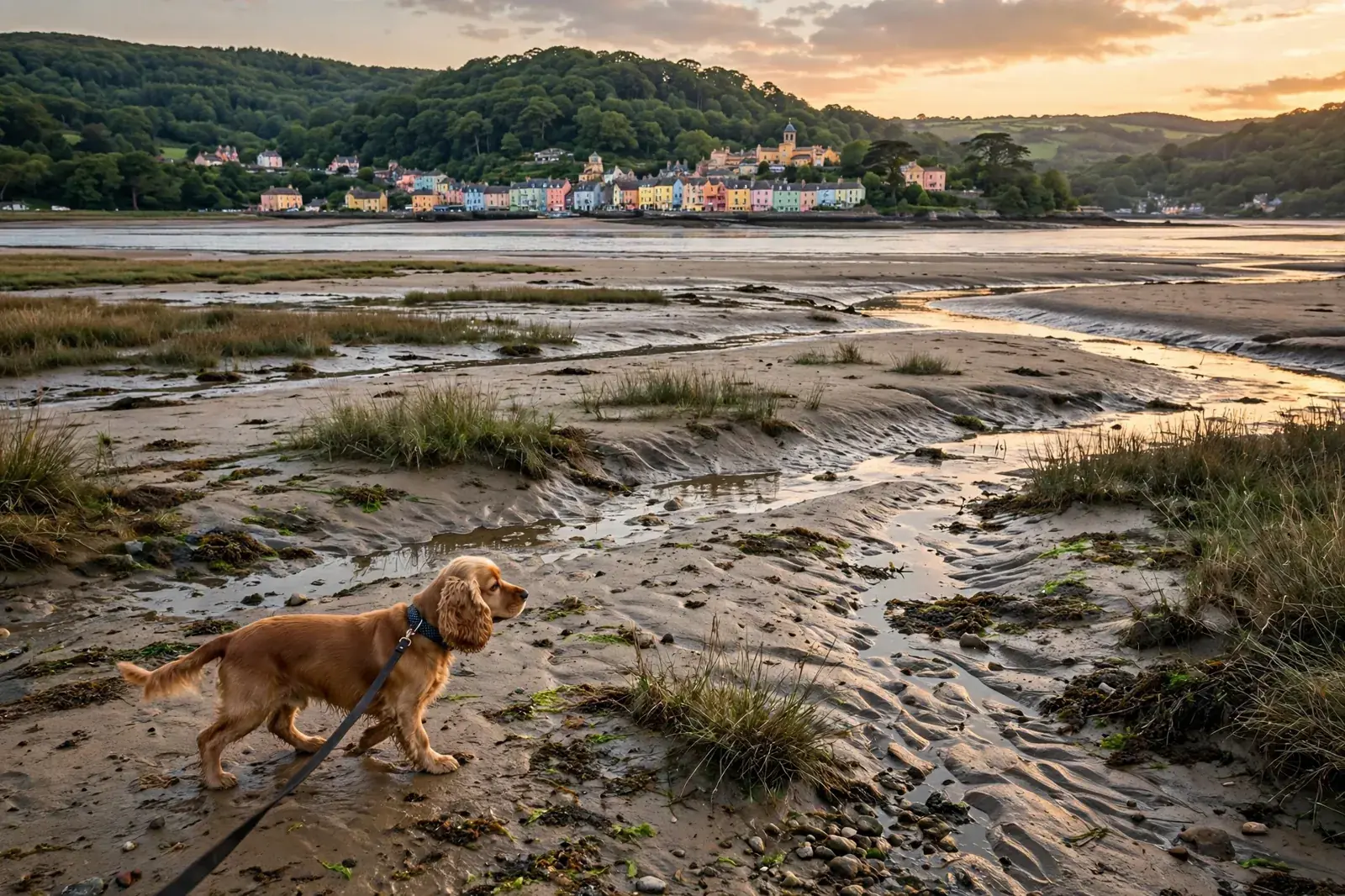
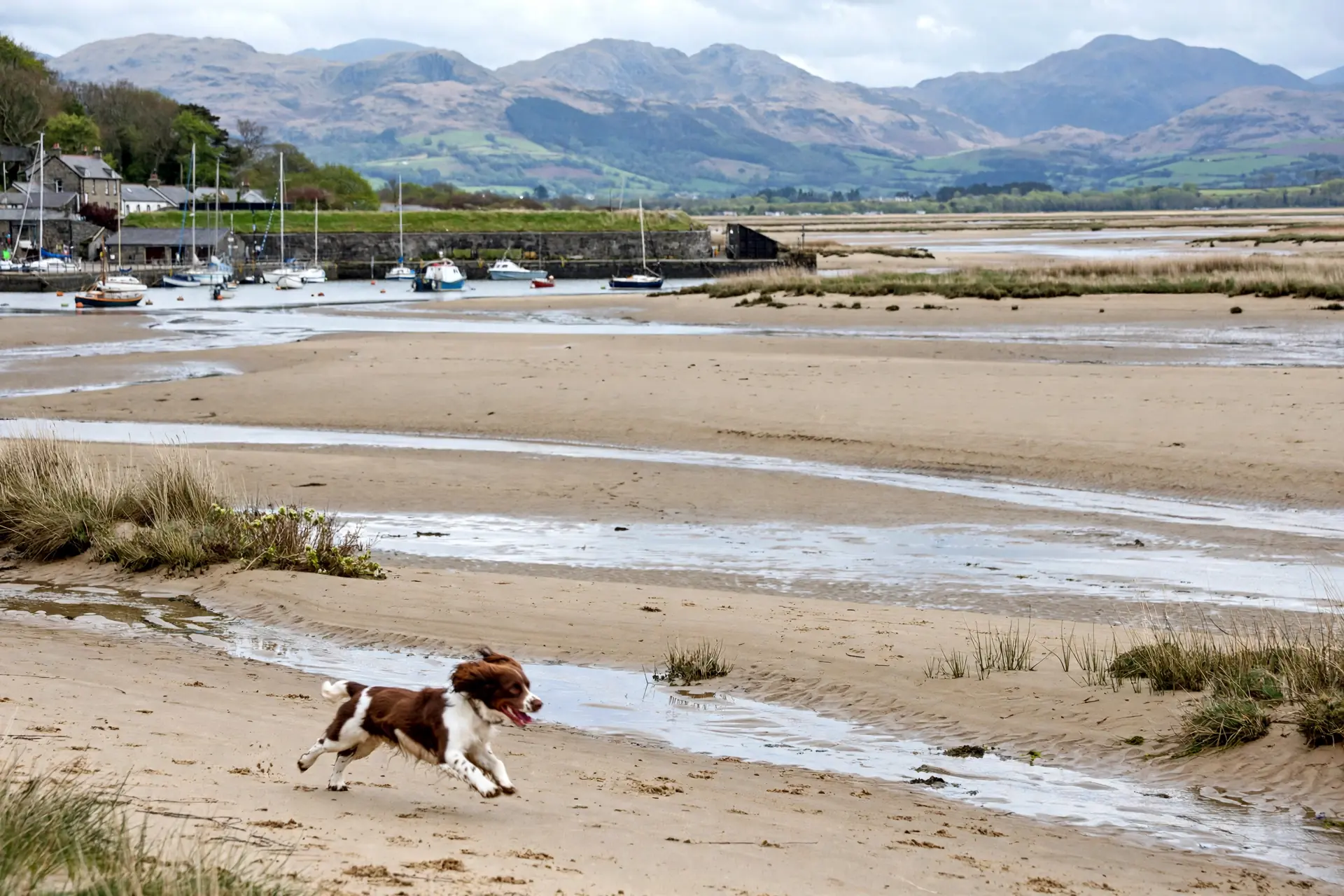
The estuary sets the pace of the village. Twice a day the tide pushes up the Dwyryd from Tremadog Bay, flooding the salt marshes and turning the mudflats into a wide sheet of silver water; twice a day it drains away, leaving winding channels, wading birds and a smell of salt and wet grass. Dogs notice the change before people do. A morning walk along the embankment smells of the sea; an evening walk smells of mud, reeds and the faint coal smoke of a passing steam train. Neither walk needs to be long. The flat paths beside the water suit older dogs, puppies finding their legs and owners who would rather watch the light change than climb a mountain.
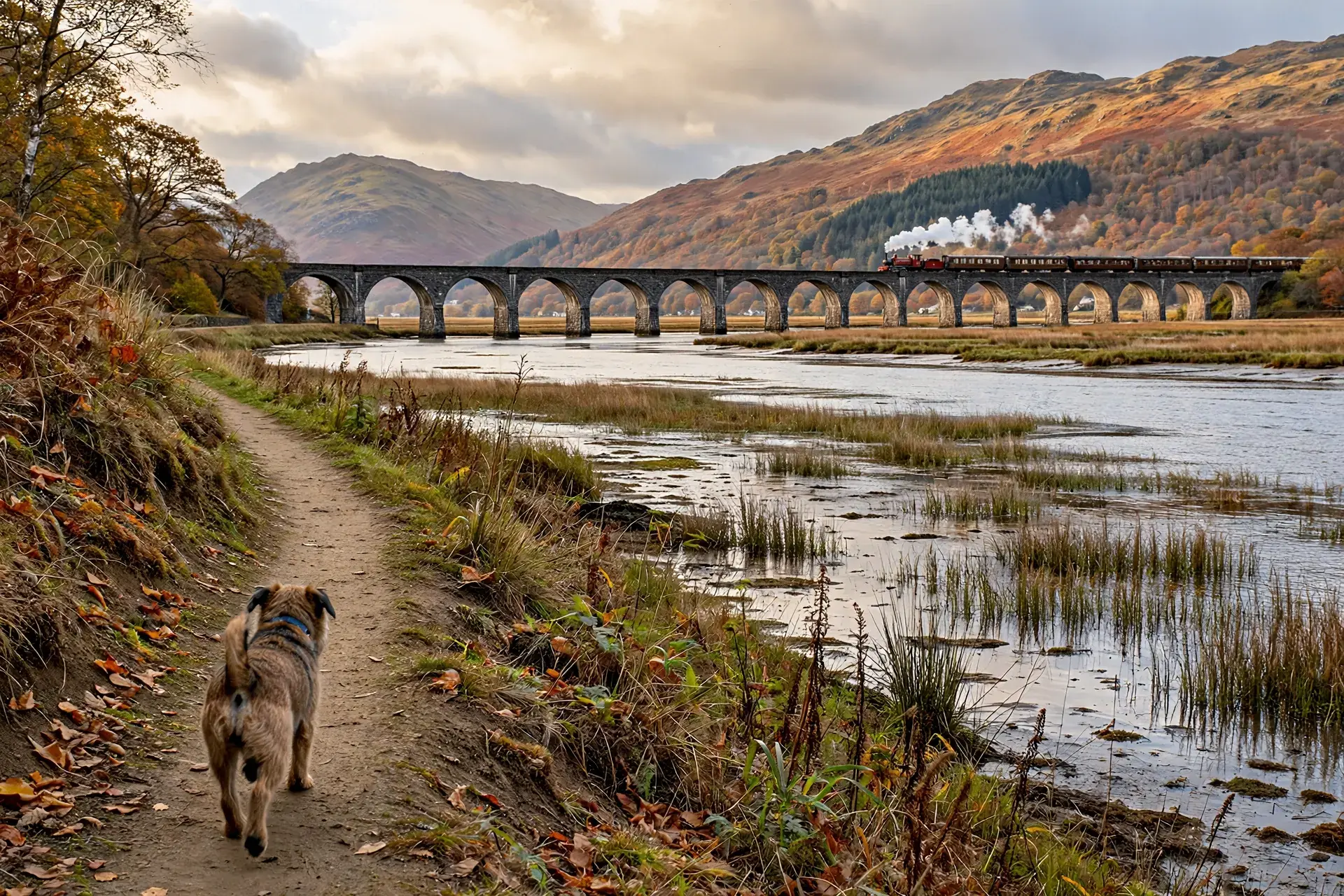
The railway is the village's other clock. The Ffestiniog Railway, one of the oldest narrow-gauge railways in the world, runs through Penrhyndeudraeth on its way between Porthmadog Harbour and Blaenau Ffestiniog, and the Welsh Highland Railway shares the harbour terminus for its longer run towards Caernarfon. On operating days you will hear the whistle before you see the train, and the small red locomotives crossing the viaduct over the estuary at Pont Briwet are one of the great small sights of Welsh travel. Dogs that are comfortable with noise usually settle quickly to the rhythm of it; dogs that are sound-sensitive need a little planning, which this guide covers in detail below.
What Penrhyndeudraeth does not do is also worth knowing before you book. It is not a resort town. There is no promenade, no amusement arcade and no long strip of shops. The village has the essentials — a shop, a pub, a cafe or two, a church and a station — and the pleasure of it is the quiet between those things: the estuary walk at dawn, the train passing while you eat breakfast, the short drive or train ride to somewhere busier when you want it. If your dog is happiest with space, routine and water to sniff, the village fits. If your dog needs constant stimulation and crowds, nearby Porthmadog will suit better as a base, with Penrhyndeudraeth as a half-day visit instead.
Use this guide in that spirit. It starts with the two things that make the village worth the trip — the railway and the estuary — then deals honestly with the one big exception every dog owner must plan around, Portmeirion, before covering the practical details of eating, sleeping and parking. Check the official guidance before you travel for train times, tide times and any access changes, because all three shift with the season.
Riding the Ffestiniog & Welsh Highland Railway with a dog
The Ffestiniog Railway is the reason many dog owners choose Penrhyndeudraeth over a dozen similar villages, and the good news is that dogs are generally welcome on its trains. The railway is run by the Ffestiniog & Welsh Highland Railways, and its published approach has long been that well-behaved dogs may travel with their owners. That is a genuine welcome rather than a grudging tolerance: heritage railways in Wales depend on visitors, and dogs are part of the family groups that fill the carriages on a summer Saturday. Even so, a narrow-gauge train is a very different environment from a mainline service, and a little preparation makes the difference between a dog that dozes through the climb to Blaenau Ffestiniog and one that spends an hour anxiously watching the door.
Start with the rules as they stand. Dogs should be kept on a lead at all times on stations and on board, and they travel on the floor rather than on the seats. Small dogs may ride on your lap. A fare may apply for dogs, so check the official guidance before you travel for the latest position and for any booking conditions. Assistance dogs travel free, as on other public transport. If your dog is reactive to other dogs, mention it when you book or when you arrive: staff can often suggest a quieter carriage or a quieter departure, and an early-morning or late-afternoon train is usually calmer than the midday service. Do not assume you can take a dog into the railway's cafes and shops in the same way you can take one onto a train; indoor spaces have their own policies, and the station tea rooms may ask dogs to wait outside or in a designated area.
The carriages themselves deserve a thought. Ffestiniog carriages are small, wooden and charming, with narrow doorways, bench seating and limited floor space. A large dog will fit, but a large dog plus a rucksack plus a picnic bag will not fit comfortably, so pack light and choose a compartment or a seat near the door where the dog can lie without blocking the aisle. Bring a mat or a familiar blanket so the dog has a defined place to settle, and a chew or a stuffed Kong for the longer stretches. The journey from Porthmadog to Blaenau Ffestiniog takes around an hour each way, climbing through wooded valleys and past reservoirs; the Welsh Highland run from Porthmadog towards Caernarfon is longer, so for a first trip with a nervous dog, choose the shorter Ffestiniog leg and build up from there.
Sound is the other factor. Steam locomotives whistle, hiss and clank, and the noise is loudest on the platform as the train arrives. If your dog is sound-sensitive, wait a little way back from the platform edge, let the train arrive and settle before you board, and sit away from the locomotive end of the train. Many dogs that flinch at the first whistle relax within minutes once the train is moving, because the rhythm of the wheels becomes predictable. A dog that panics at loud noises, however, will not enjoy the experience, and no view is worth a frightened animal; in that case, leave the dog resting at your accommodation and enjoy the train yourself, or choose the estuary walk instead.
Boarding from Penrhyndeudraeth station itself is part of the charm. The station is a small halt rather than a grand terminus, and trains stop on request or to timetable depending on the service, so check the timetable carefully and arrive a few minutes early. There is no ticket office bustle and no long platform to negotiate, which suits dogs that find big stations stressful. Stand well back from the edge, keep the lead short as the train pulls in, and lift a small dog aboard rather than expecting it to manage the step. On arrival at the other end, give the dog a proper walk before you explore: Blaenau Ffestiniog has slate-town streets and a different kind of walking, while the intermediate halts open onto woodland paths that are ideal for a leg stretch.
Two practical notes close the subject. First, the railway is seasonal and weather-dependent: services run most frequently from spring to autumn, with reduced timetables in winter and occasional closures for maintenance, so never plan a day around a train you have not checked that week. Second, the railway and the estuary pair naturally. A morning train to Tan-y-Bwlch or Blaenau Ffestiniog, a walk and lunch, and an afternoon return leaves the evening free for the flat estuary path beside the village, which is exactly the kind of day that suits most dogs: one exciting thing, one calm thing, and an early night.
The Dwyryd estuary on foot: paths, tides and birds
The Dwyryd estuary is the village's front garden, and the walking around it is flat, open and generous. The embankment paths that follow the shore give level going for almost any dog, with wide views across the water to the hills on the far side and, on a clear day, the mountains of Eryri rising behind them. The surface is mostly firm grass and gravel, though it softens after rain and the lower sections can be muddy in winter, so walking boots matter more than distance. Most visitors find that a loop of forty minutes to an hour, out along the embankment and back through the village lanes, is about right for a morning walk, with a shorter evening loop for the last toilet round.
Tides govern everything on an estuary, and a dog walk here needs a tide table more than a map. At high water the paths beside the shore feel like a coastal walk, with the water close and the birds pushed up onto the marsh. At low water the estuary becomes a maze of mud and channels, and the walking changes character entirely: the views open up, the wading birds spread out to feed, and the mud itself becomes the hazard. Never let a dog run onto soft estuary mud. It looks firm and is not, and dogs have been stuck in estuary mud around Britain's coasts. Keep the dog on the path or on a long lead, and if the dog does go in for a paddle, choose a firm sandy edge at the top of the beach rather than the glistening flats. Check the official guidance before you travel for tide times, and plan your longest walk for the two hours either side of high water, when the paths are at their best and the mud is covered.
The birdlife is the estuary's quiet reward. The Dwyryd is a wintering ground for waders and wildfowl, and even a casual walker will see oystercatchers piping on the shore, curlews probing the mud, redshanks feeding at the water's edge and herons standing motionless in the shallows. In spring and summer, the reed beds hold warblers and the sky fills with swallows and martins. Dogs must be kept on a lead near the birds, especially during the breeding season, and the reason is not only the law: a dog chasing waders can undo a morning's feeding in seconds, and ground-nesting birds abandon nests after repeated disturbance. Bring binoculars if you enjoy birds; the estuary repays a slow pace and a patient eye, and a dog that has learned to walk calmly past a heron is a dog that can go almost anywhere.
One of the best walks from the village follows the shore path towards Portmeirion, the Italianate village across the water. The path is level and scenic, and it gives you the famous view of Portmeirion's colourful buildings and towers from the estuary without needing to enter the village itself — which matters, because pet dogs cannot enter Portmeirion, as the next section explains. The walk also passes the Pont Briwet viaduct, where the road and the railway cross the Dwyryd together; the combination of a steam train on the bridge and the estuary below is the photograph most visitors take home. Keep the dog on a short lead near the road section of the crossing, and watch for cyclists on the shared path.
For a longer day, the estuary paths link towards Porthmadog and the wider network of coast and woodland walks around Tremadog Bay. The harbour town is a gentle walk or a short train ride away, and from there the options multiply: the shore at Black Rock Sands, the woodland trails above the town, and the long, flat sands that suit dogs that love to run. Our guide to Porthmadog with a dog covers those routes in detail, including the harbour walks and the seasonal rules that apply to the beaches. If you want to understand the beach rules before you set off, our guide to dog-friendly beaches in the UK explains the seasonal bans, the public space protection orders and the fines that apply on many British beaches.
Finally, a word about the practical side of estuary walking. There is little shade on the embankment, so on a hot day walk early or late and carry water for the dog. There are few bins on the quieter stretches, so carry bags and take them back to the village. Sheep graze some of the fields beside the paths, and the law requires dogs to be on a lead or under close control near livestock; a dog that chases sheep can be shot by a farmer, and the owner can be liable, so do not take chances. And after any walk that involves mud or salt water, rinse the dog's paws and dry them properly: salt dries the pads, and estuary mud hides sharp shells.
Portmeirion as a day trip: the dog policy, honestly explained
Portmeirion is the reason many people first hear of Penrhyndeudraeth, and it is the one place in this guide where the news for dog owners is unwelcome. The village is barely two miles from Penrhyndeudraeth, its towers and pastel buildings are visible across the estuary, and every visitor wants to walk its streets — but pet dogs cannot enter Portmeirion village or its grounds. Only guide and assistance dogs are admitted. That is not a seasonal restriction or a rule that can be negotiated at the gate; it is the village's standing policy, and it applies to the whole site, including the gardens and the woodland walks inside the boundary.
The honest response is to plan around the rule rather than to resent it. The usual pattern works well: leave the dog resting at your accommodation or with one member of your party, visit Portmeirion on foot for a couple of hours, and then collect the dog for the estuary walk that runs beside the village. If you are travelling as a couple, take turns: one person visits the village while the other walks the dog on the shore path, then swap. If you are travelling alone, ask your accommodation whether the dog can be left comfortably for a short period, or time your Portmeirion visit for a cool morning when the dog can rest in the car in shade with water — never in warm weather, and never for long. Our full guide to Portmeirion with a dog explains the policy in detail and lists the alternatives nearby, including the estuary viewpoints where you can see the village without entering it.
What is Portmeirion, for those who have not been? It is a village built in the twentieth century by the architect Clough Williams-Ellis, in an Italianate style that looks startling against the Welsh coast: pastel houses, a campanile, a piazza, fountains and gardens, all set in woodland above the estuary. It became famous as the filming location for the 1960s television series The Prisoner, and it remains a place people visit for the sheer visual pleasure of it. The village is privately owned and charges an admission fee, and visitors should expect it to be busy on summer weekends and during school holidays. Check the official guidance before you travel for opening times, admission prices and any changes to the policy.
For the dog, the consolation is real. The shore path from Penrhyndeudraeth towards Portmeirion gives the best views of the village from the outside, and the estuary at that point is at its widest and most beautiful. The dog gets a long, flat, interesting walk with birds, reeds and the railway viaduct, while the humans get their village visit in turn. It is a fair trade, and it is the pattern that regular visitors to the area settle into after their first trip.
One warning: do not try to smuggle a dog into Portmeirion in a bag or a carrier. Staff are used to the attempt, the village is small and the dog will be noticed, and being asked to leave with the whole party is a poor end to a day. The rule is clear, the alternatives are good, and the village will still be there for a dog-free visit on another trip.
Cafes, pubs and village life
Penrhyndeudraeth is a village for slow mornings. The day starts with the estuary walk, and the second act is breakfast or coffee somewhere the dog can settle. The village's cafes and pubs are small, local and generally welcoming to dogs, though the welcome usually means the bar area or an outdoor terrace rather than the main dining room, and policies change with the season and the landlord. The safest approach is to ask before you sit down, keep the dog on a lead under the table, and bring a mat and a water bowl so the dog has a reason to lie quietly. A dog that settles under a table is welcome almost everywhere; a dog that wanders between tables is not.
The pub is the village's social centre, and it is worth treating it as such. A proper village pub in Gwynedd serves local ales, straightforward food and a fire in winter, and the bar is where you will hear about the week's train times, the state of the estuary paths and which beach is best after rain. Dogs are usually welcome in the bar, and the regulars will expect a well-behaved dog to be part of the furniture. Arrive early if you want a corner table, and order at the bar rather than expecting table service for the dog's area. If the pub has a garden or terrace, that is often the best place for a dog on a warm evening, with room to lie down and less noise than the bar.
The village shop is a practical stop rather than a destination, but it matters on a dog break. It stocks the essentials — milk, bread, dog treats if you are lucky, and the local paper — and it is the place to ask for the kind of advice that does not appear on the internet: whether the path to the shore is muddy today, whether the steam trains are running, and whether the cafe across the road is open. Shops in small Welsh villages are also the place where Welsh is spoken as an everyday language. A greeting in Welsh — bore da for good morning, diolch for thank you — is appreciated even when the rest of the conversation is in English, and it marks you as a visitor who is paying attention.
Beyond food and drink, village life here is quiet in the best sense. The church, St Deudraeth's, stands above the village and is worth a look from the outside; the community hall hosts the events that hold a small place together; and the station forecourt is a meeting point on train days. Dogs are part of that life: you will see them on the estuary path at dawn, outside the shop while their owners buy the paper, and asleep under pub tables in the evening. The etiquette is simple and worth following. Keep dogs on leads on the main street, pick up after them everywhere, and do not let them run through gardens or onto the railway line. A village this small remembers a careless visitor.
One last habit makes a village break work: keep the same small routine every day. The same morning walk, the same cafe table, the same evening loop along the embankment. Dogs settle faster when the day has a shape they can predict, and a settled dog is a welcome guest in a pub, on a train and on a narrow village lane. Penrhyndeudraeth rewards that kind of patience more than most places, because the village itself runs on routine — the tide, the train, the light on the water — and a visitor who falls into step with it will find the break feels longer than the days it actually lasts.
For a wider choice of places to eat, Porthmadog is a short drive or train ride away, with harbourside cafes, a market and more pubs, and our guide to Porthmadog with a dog covers the town's dog-friendly eating in detail. Many visitors split the difference: quiet mornings and evenings in Penrhyndeudraeth, and a busier lunch or a market morning in Porthmadog. That rhythm suits dogs, too, because it alternates a calm home base with a livelier outing, and the dog never has to cope with crowds for a whole day.
Where to stay and where to park
Penrhyndeudraeth has a small range of places to stay, and the right choice depends on the dog you have. Self-catering cottages are the most common option, and they suit dogs because they give you a kitchen, a garden or yard, and no shared corridors to negotiate at midnight. When you book, ask the questions that matter for your dog rather than the ones on the listing: is the garden genuinely enclosed, and how high is the fence; is there a hard floor or a washable rug where a wet dog can dry; where is the nearest toilet walk after dark; and is there a charge per dog, and what does it cover. A cottage that accepts dogs but has an open garden onto a lane is a different stay from one with a walled yard, and the listing rarely makes the distinction clear.
Bed and breakfasts and small hotels in and around the village can also work well, particularly for a short stay. The pattern to look for is a ground-floor room with direct access to the outside, a host who is genuinely comfortable with dogs rather than merely tolerant, and a breakfast room where the dog can wait in the bedroom or join you on the terrace. Ask about the alone-in-room rule before you book: many small places ask that dogs are not left unattended in the room, which means your evenings are tied to the dog unless the pub takes dogs in the bar. That is manageable if you plan for it, and it is miserable if you discover it after you arrive.
For those who prefer a larger base, Porthmadog and the surrounding area offer holiday parks, touring sites and more cottages, and the short drive or train ride to Penrhyndeudraeth makes them practical. The trade-off is the loss of the village's quiet: a park gives you facilities and space, while the village gives you the estuary on your doorstep. If you are travelling with a reactive dog, the village cottage usually wins; if you are travelling with children and a bombproof family dog, a park with a play area and a pool may win instead.
Parking in Penrhyndeudraeth is straightforward but limited. Use the village car parks and marked bays rather than squeezing onto narrow lanes or blocking farm gates, and arrive early on summer weekends, when the spaces near the station and the estuary fill quickly. Never leave a dog in a parked car in warm weather, even with the windows open a crack; a car heats to dangerous temperatures in minutes, and a village car park in July is no exception. On arrival, the best routine is to park, walk the dog first, and explore second: a short toilet walk and a sniff around the embankment settles most dogs far better than being lifted straight out of the car into a busy street.
Two more practical points. First, mobile signal in the village is generally usable but can be patchy in the valleys and on the estuary path, so download maps, timetables and tide tables before you leave home rather than relying on a live connection. Second, find the nearest vet before you need one. The closest practices are in Porthmadog and the surrounding towns; save the number in your phone and note the opening hours, because rural practices close early and the nearest out-of-hours service may be a drive away. Pack the dog's vaccination record and any medication in the car, not in a suitcase you will not open until evening.
Two relaxed day plans
A good dog break is built from days that have one exciting thing and one calm thing, and Penrhyndeudraeth lends itself to exactly that shape. The two plans below are starting points, not schedules: adjust them for your dog's age, fitness and temperament, and do not be afraid to drop the exciting thing entirely on a wet or tired day.
The rail day starts with the estuary. Walk the embankment path for thirty minutes in the morning, letting the dog toilet, sniff and wake up properly, then catch a mid-morning train from Penrhyndeudraeth or Porthmadog Harbour towards Blaenau Ffestiniog. Sit near the door, settle the dog on its mat, and enjoy the climb through the woods. At the far end, walk the dog around the town or take a short woodland path, have lunch somewhere the dog can sit outside or in the bar, and catch an afternoon train home. The evening is the second estuary walk, shorter and slower, and an early night. The whole day has one journey, one walk at each end, and plenty of rest in between — which is about right for most dogs.
The estuary day is simpler and, for many dogs, better. Start with a long morning walk along the shore path towards Portmeirion, watching the birds and the trains on the viaduct, and carry a picnic rather than planning a cafe stop. Spend the middle of the day resting: the dog sleeps, you read, and the village goes quiet. In the afternoon, drive or take the train the short distance to Porthmadog for the harbour walk and an ice cream, or walk to Black Rock Sands if the tide and the season allow dogs on the beach. Finish with a pub supper in the village, the dog asleep under the table. A day with no timetable at all is often the day the dog enjoys most.
For a longer stay, add a third pattern: a mountain day for the humans and a rest day for the dog. Eryri is close, and the hills above the village offer serious walking, but a long mountain day is not a dog day unless your dog is fit, experienced and comfortable with steep ground and changeable weather. The kindest arrangement is often to walk the dog in the morning, leave it resting at the cottage while one or both of you walk the hills, and return for the evening estuary loop. Dogs do not keep score; they keep routines, and a familiar evening walk after a morning apart is worth more than a forced march up a mountain.
Seasons, tides and packing
Penrhyndeudraeth changes more with the seasons than most villages its size, because the estuary, the railway and the crowds all shift at once. Spring is the gentlest season for a dog break: the railway timetable builds up, the birds return to the estuary, the paths dry out, and the village is quiet outside school holidays. Lambs appear in the fields beside the paths, which means leads become non-negotiable, and the weather can turn quickly, so pack a waterproof for the dog as well as for yourself.
Summer is the busiest season and the one that needs the most planning. Trains book up, Portmeirion is crowded, parking fills early, and the embankment path has no shade at midday. Walk early or late, carry water for the dog, and check the beach rules before you drive to the coast: many of the popular beaches near Porthmadog restrict dogs during the summer months, and the restrictions are enforced. Our guide to dog-friendly beaches in the UK explains how the seasonal bans work and how to check a beach before you travel. Summer evenings, on the other hand, are the village at its best: long light on the estuary, swallows over the reeds, and a pub garden that stays warm until late.
Autumn is the connoisseur's season. The light on the estuary turns gold, the crowds thin, the railway runs through woods in full colour, and the walking is at its most comfortable. It is also the season when the paths are wettest and the tides are highest, so check the tide table and wear proper boots. Winter is quiet and beautiful in a different way: the village empties, the steam trains run a reduced timetable, and the estuary fills with wintering wildfowl. A winter break suits a settled, older dog and an owner who enjoys a fire and a book; it does not suit a young dog that needs hours of running, because the daylight is short and the ground is often wet.
Packing for Penrhyndeudraeth is packing for water, mud and trains. The list is short: a lead and a long line for the estuary, a harness the dog can wear comfortably for hours, a mat or blanket for the train and the pub, a drying coat and two towels, a water bottle and a collapsible bowl, poo bags and a spare roll, a torch for the dark lanes, and a small first-aid kit with paw balm and a tick remover. Add a copy of the train timetable, a tide table and the vet's number, all saved on paper as well as on your phone, because signal is patchy on the estuary path. And pack patience: the village rewards visitors who slow down, and a dog that is allowed to sniff the same stretch of embankment twice is a dog having a good holiday.
Arriving and getting around without a car
Penrhyndeudraeth is one of the easier Welsh villages to reach without driving, and for dog owners that matters more than it sounds. A car-free arrival means no parking hunt, no hot car to worry about, and a dog that steps off the train already in the village it will be exploring. The village sits on the A487, the main coastal road between Porthmadog and the north, and on the Ffestiniog Railway, so the two realistic approaches are the train and the bus, with the car as a third option for those who need it. Each has its own rhythm, and each suits a different kind of dog.
The railway arrival is the most memorable. If you travel by mainline train to the Cambrian Coast line, the natural interchange is at Porthmadog, where the Ffestiniog Railway's harbour station stands a short walk from the mainline station. From there the narrow-gauge train climbs through the woods to Penrhyndeudraeth in a matter of minutes, and the dog rides at your feet as described earlier in this guide. The connection needs planning: mainline and heritage timetables do not always dovetail neatly, and a missed connection can mean an hour on the platform at Porthmadog, which is not a bad place to wait — the harbour is close, and there is a short, level walk along the quay where the dog can stretch its legs. Check both timetables before you travel, and allow a generous margin between the two services rather than a tight one.
Buses serve the village on the coastal routes that run between Porthmadog, Blaenau Ffestiniog and the wider area, and they are a practical option for short hops once you are based in the village. Dogs are generally allowed on local buses at the driver's discretion, kept on a lead and on the floor, and small dogs in carriers are rarely a problem. Larger dogs on a busy summer bus can be a squeeze, so travel outside the school-run and shopping peaks where you can, and keep the dog close to your feet rather than stretched across the aisle. Bus times change with the season and the school calendar, so check the official guidance before you travel rather than trusting a timetable printed months earlier.
Arriving by car is straightforward, and the A487 approach from Porthmadog is one of the prettier short drives in Wales, curving around the estuary with views across the water to Portmeirion and the hills beyond. From the east, the road drops down from the mountains through Blaenau Ffestiniog and the Vale of Ffestiniog, which is a beautiful drive but a winding one: dogs that suffer from travel sickness should be given a break at a lay-by before the descent, and the car should be ventilated rather than sealed. If you arrive by car, plan to park once and walk for the rest of the stay. The village is small enough that everything in this guide is within a short walk of the centre, and the car is best used for the occasional trip to Porthmadog or to a beach further along the coast.
Once you are in the village, getting around is almost entirely on foot, which is the point of the place. The main street, the station, the estuary paths and the shore walk towards Portmeirion all connect without a car, and the walking is flat. For longer trips, the railway is the natural choice: Porthmadog in one direction, the woods and reservoirs towards Blaenau Ffestiniog in the other. Taxis are available from Porthmadog for the short hop if you arrive late or with heavy luggage, but book ahead rather than expecting to find one waiting at the station, and confirm when you book that the driver is happy to carry a dog. A dog that travels well in cars will be fine; a dog that is nervous in unfamiliar vehicles is better off walking the short distance from the station, which is only a few minutes in any case.
A short checklist before you leave home saves most of the trouble visitors run into. Confirm the train times and the dog rules for the railway on the day you travel, because timetables change with the season and engineering work can close the line at short notice. Save the tide times for the days of your stay, and mark the walks you want to do at high water rather than at low water, when the mud is exposed. Check the beach rules for any coast you plan to visit, since seasonal dog restrictions apply to several beaches near Porthmadog and the fines for breaking them are real. Pack the dog's usual food rather than relying on the village shop to stock it, and bring any medication in its original packaging with the prescription details. Tell your accommodation in advance that you are bringing a dog, including the breed and size, so there are no surprises at check-in. And finally, save the number of the nearest vet in Porthmadog in your phone before you set off, because the one moment you need it is never the moment you want to be searching for it.
Finally, a note on leaving. The last day of a dog break is the one most often rushed, and it is the one that most deserves a slow pace. Walk the dog on the estuary in the morning, let it toilet and sniff properly, and do not load the car or catch the train with a dog that has not had its proper walk. If you are taking the train home, arrive at the station early so the dog can settle on the platform before the locomotive arrives, and keep the lead short as the train pulls in. A calm departure sets the tone for the journey home, and the journey home is the last memory the dog takes from the trip.
Practical questions
Before you go
Can dogs ride the Ffestiniog Railway from Penrhyndeudraeth?
Yes, dogs are generally welcome on Ffestiniog & Welsh Highland Railway trains, kept on a lead and on the floor rather than on seats. Small dogs may travel on your lap. Check the official guidance before you travel for the latest rules and any fare that applies, and book ahead on busy days because the small carriages fill quickly.
Can my dog come with me to Portmeirion?
No. Pet dogs cannot enter Portmeirion village or its grounds; only guide and assistance dogs are admitted. The usual plan is to leave your dog resting at your accommodation or with a companion, visit Portmeirion on foot, and then walk the dog on the Dwyryd estuary paths nearby, which are open to dogs on leads.
Where can I walk my dog around the Dwyryd estuary?
The embankment paths and quiet lanes around Penrhyndeudraeth give level, scenic walking beside the estuary, and the shore path towards Portmeirion is a favourite. Keep your dog on a lead near grazing land and nesting birds, watch the tide times, and avoid soft mud at low water. Check the official guidance before you travel for current access and any seasonal restrictions.
Are dogs welcome in the cafes and pubs in Penrhyndeudraeth?
Several village cafes and pubs welcome dogs, often in a bar area or on an outdoor terrace rather than in the main dining room. Policies change with the season and the landlord, so check before you sit down, keep your dog on a lead under the table, and bring a mat and water bowl so the dog can settle quietly.
Where should I park when visiting Penrhyndeudraeth with a dog?
Use the village car parks and marked bays rather than blocking narrow lanes or farm gates. Arrive early on summer weekends, as spaces near the station and the estuary fill quickly. Never leave a dog in a parked car in warm weather, and keep the first walk short so the dog can toilet and settle before you explore.