This guide is independent and contains no paid placement. If affiliate links are added later, they will be clearly marked and will not change our editorial checks.
Plan Porthmadog around the tide. Walk the harbour and the Cob at low water, keep your dog off the mudflats, ride a heritage railway when the weather turns, and save Black Rock Sands for the long afternoon run. The town rewards a slow, tidal pace rather than a rushed checklist.
The tide sets the timetable
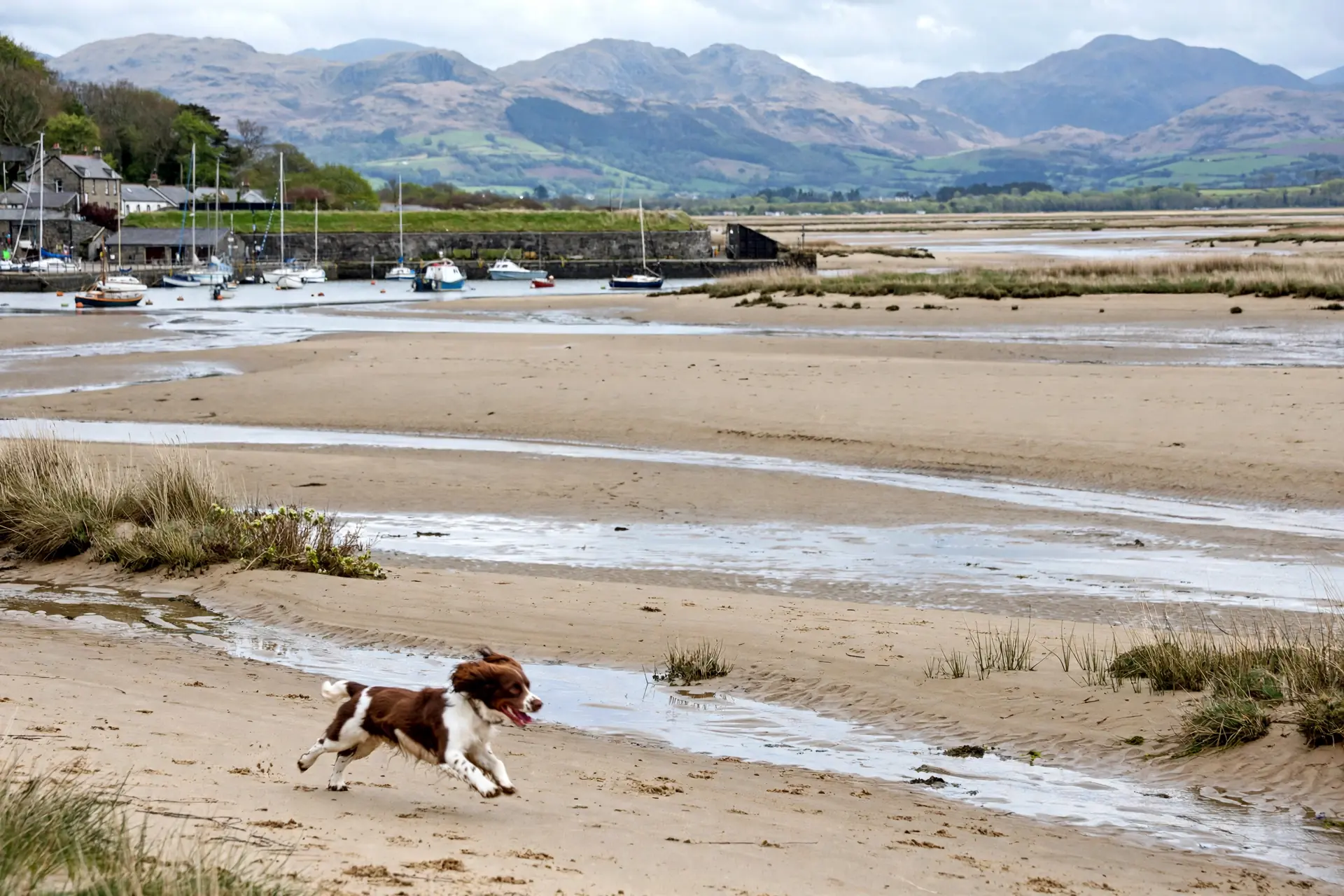
Porthmadog is a town that runs on water. The Afon Glaslyn reaches the sea here through a wide, shallow estuary, and twice a day the tide pours in across mudflats and salt marsh, fills the harbour basin, and then drains away again, leaving boats resting on the mud and wading birds picking over the exposed flats. For a dog owner, that rhythm is not background scenery. It decides when the harbour looks its best, when the quayside paths are quiet, when the beach at Black Rock Sands is at its widest, and when the estuary is dangerous. The first thing to do on arrival is not to unpack the car. It is to check the tide times.
Tide tables for Porthmadog are published online and posted locally, and the pattern is easy to read once you have seen it once. Low water exposes broad flats of dark mud and sand on both sides of the channel. High water brings the sea right up to the harbour walls, the quays and the foot of the Cob, and the whole estuary turns into a sheet of grey-green water with the mountains of Eryri behind it. The change between the two states takes roughly six hours, and the fastest water movement comes in the middle of the rising tide, when the channel fills quickly and side creeks that looked walkable minutes earlier become impassable. Dogs do not understand any of this. A spaniel chasing a scent across the mud will not notice the water creeping in behind it, and an owner wading out to fetch a dog can get into trouble just as fast. That is the single most important fact in this guide, and everything else in it is built around it.
A practical way to use the tide is to split the day in two. Use the hours around low water for the harbour and the Cob, when the estuary is at its most interesting and the paths are at their liveliest with birds. Use the hours around high water for the town, the cafes and the trains, when the water is up and the harbour looks like a postcard. Then, when the tide has turned and the beach at Black Rock Sands has opened up again, take the dog west for the long run. This is not a rigid schedule — weather, railway timetables and a tired dog will all bend it — but it is a better starting point than trying to fit a mountain-walking timetable onto a tidal town. Porthmadog rewards visitors who slow down to the pace of the water, and dogs, who live entirely in the present, tend to enjoy that pace very much.
One more thing about the tide: it changes the sound of the town. At high water the harbour is quiet, with ropes creaking and gulls overhead. At low water the estuary is noisy with curlews, oystercatchers and redshanks, and the mud itself seems to breathe. Dogs notice this. A dog that is calm on a busy street can become intensely focused on the estuary edge, nose down, tracking scents left by the retreating water. Keep the lead on near the mud, even if your dog has perfect recall on a beach, because the estuary is not a beach. The firm sand at Black Rock Sands is the place for off-lead running. The estuary is the place for watching, sniffing and walking on.
A slate port built on reclaimed land
Porthmadog did not grow slowly out of a fishing village. It was built, deliberately and quickly, to export slate. In the early nineteenth century the quarries around Blaenau Ffestiniog were producing roofing slate in enormous quantities, but getting it to the sea was the problem. The answer was a new harbour at the mouth of the Glaslyn, and the man behind it was William Madocks, a landowner and entrepreneur who also built the great embankment known as the Cob across the mouth of the estuary between 1808 and 1811. The Cob reclaimed a huge area of tidal land called Traeth Mawr, turned it into farmland, and gave the new port a sheltered basin. The town that grew around the harbour took the name Port Madoc, later Porthmadog, and for much of the nineteenth century its quays were piled high with slate waiting for ships bound for ports all over the world.
You can still read that history in the shape of the town. The harbour sits at the southern end of the High Street, and the streets around it are short, practical and built for work: warehouses, sail lofts, chandlers and chapels rather than grand civic buildings. The slate came down from the quarries on the Ffestiniog Railway, a narrow-gauge line opened in 1836 that carried slate wagons by gravity down to the harbour, where horses hauled the empty wagons back up. Ships loaded at the quays and sailed for Liverpool, Dublin, London and further afield. At its peak the port handled a substantial share of the world's roofing slate, and the town's prosperity, its chapels, its shops and its railway all date from that trade. The slate trade faded in the twentieth century as cheaper roofing materials spread and the quarries declined, but the harbour never lost its working character, and today it holds yachts, fishing boats and pleasure craft where slate schooners once moored.
For a dog walk, this history matters because it explains the ground under your feet. The quays are solid stone and slate, the paths are level and firm, and the whole harbour area is compact enough to explore on foot in under an hour. The Maritime Museum, housed in a former sail loft on the quayside, tells the story of the port and its ships, although dogs are not admitted inside, so plan for one person to wait outside with the dog. The old slate wharves, the harbourmaster's office and the rows of former warehouses are all worth a slow look, and they give a walk with a dog a sense of place that a generic seaside promenade never manages. If you have children with you, the harbour is also a good place to explain how a town can be built from scratch around a single trade, with the evidence still standing in front of them.
The Cob itself deserves a closer look, because it is the single most important piece of engineering in the town's story. Before the Cob was built, the tide flooded right up to the foot of the hills and Traeth Mawr was a vast tidal flat. After it, the land behind the embankment could be farmed, and the river was channelled through a narrow opening at the Porthmadog end. The Cob still carries the main road and the railway across the estuary, and walking it with a dog gives you the best view in town: the estuary on one side, the reclaimed fields on the other, and the mountains rising behind. It is a reminder that Porthmadog is a made landscape, built by people who wanted a port and were prepared to move the sea to get one.
Walking the harbour and quayside
The harbour walk is the natural first outing after arrival, and it is the one to repeat at different states of the tide. Start at the southern end of the High Street, where the road drops towards the water, and follow the quayside around the basin. The surface is mostly level tarmac and stone, which suits older dogs, puppies and anyone pushing a buggy, and there are benches where you can sit and watch the boats. Keep your dog on a short lead here. The quayside is a working area with moving vehicles, mooring ropes, bollards and the occasional forklift, and the edge of the quay drops straight into deep water at high tide. A dog that lunges at gulls or bolts after a cat could be over the edge before you can react, and the harbour water is cold and hard to climb out of.
Walk the full circuit of the basin if the tide allows and the gates are open, taking in the moored yachts, the fishing boats and the view back towards the town. The best light is early morning, when the sun comes up over the estuary and the harbour is quiet except for the gulls and the occasional early riser checking a boat. Evening is good too, when the water turns flat and the mountains go pink, but remember that the quayside has limited lighting in places and the ground can be slippery with algae near the waterline. A torch is worth carrying on a winter evening walk, and reflective gear helps if your dog is dark-coated.
From the harbour, the path continues towards the Maritime Museum and the old slate wharves, where the stone is rougher and the smell of the sea is stronger. This is a good sniffing stretch for dogs: rope, tar, salt and fish create a rich scent map, and a slow walk here will tire a dog out more effectively than a brisk march along a pavement. Let the dog set the pace. Stop at the benches, watch the boats, and let the dog work through the smells. A harbour walk is not a route march. It is a chance for the dog to read the town the way dogs read everything, through the nose, and Porthmadog harbour gives a nose plenty to read.
Two practical warnings belong here. First, keep your dog away from fishing gear, bait boxes and discarded line, which are common around working quays and can injure paws or be swallowed. Second, do not let your dog drink from the harbour. The water is brackish and can carry fuel residue and bacteria, and a dog that laps at it may be sick later. Carry fresh water and a bowl, even for a short harbour walk, and offer it at the end. These are small habits, but they prevent the most common harbour problems, which are cut paws, swallowed hooks and upset stomachs.
Mudflats, salt marsh and safety
The Glaslyn estuary at low water looks inviting. The mud glistens, the sandbars seem firm, and the distance to the far bank looks short. It is not inviting. It is one of the most dangerous landscapes in Britain for anyone on foot, and it deserves a section of its own. Estuary mud in this part of Wales is deep, soft and sticky. It can hold a person's boots fast, and it can hold a dog fast too. The tide returns across the flats not as a visible wall of water but as a creeping sheet that fills the low channels first, cutting off the way back to shore while the ground ahead still looks dry. Every year, people around the British coast get into difficulty on estuaries exactly like this one, and dogs that run out onto the mud are often the reason their owners follow them into trouble.
The rule for Porthmadog is simple: keep your dog off the mudflats and out of the salt marsh, at every state of the tide, in every season. Walk on the made paths, the quays, the Cob footpath and the firm sands of the beach. If your dog does run onto the mud, do not follow. Call the dog back from firm ground, and if the dog will not come, call the coastguard on 999 and ask for the coastguard rather than wading out yourself. This sounds dramatic, and it is meant to. The coastguard would rather be called early for a dog that comes back on its own than late for a person stuck in the mud with the tide rising. Put the number in your phone before you walk, and tell anyone walking the dog with you about the rule before you set out.
Salt marsh deserves its own caution. The marsh around the upper estuary is a maze of creeks, soft ground and deep channels hidden under grass, and it is also important wildlife habitat. Wading birds nest and feed there, and the marsh plants are fragile. Dogs running through the marsh disturb nesting birds in spring and summer, damage the vegetation, and can get stuck in a creek that looks like a shallow ditch until you are in it. The Wales Coast Path and the marked estuary paths keep you out of the marsh for good reason. Stay on them, keep the dog on a lead through marsh-edge sections, and use the long lead only where the path is wide and the ground is firm.
There is a positive side to all this caution. The estuary is one of the best places in north-west Wales to watch wildlife with a dog, precisely because you watch it from the path. Curlews, oystercatchers, redshanks, shelducks and little egrets feed on the flats at low water, and in the warmer months ospreys fish the estuary — the Glaslyn Osprey Project, based near Pont Croesor a short drive from town, has followed the return of these birds to the valley. Bring binoculars if you have them, and teach the dog that the estuary edge is a place to sit and watch rather than a place to chase. A dog that learns to settle on a bench while you watch the birds is a dog that can enjoy every estuary walk for years.
Crossing the Cob
The Cob is the walk that turns Porthmadog from a pleasant harbour town into a memorable one. The embankment runs across the mouth of the estuary, carrying the main road and the railway, with a footpath alongside that gives you water on one side and reclaimed farmland on the other. It is a straight, level walk, which makes it ideal for a dog that is still learning to walk nicely on a lead, for an older dog that cannot manage steep ground, and for a first walk of the day when you want views without effort. It is also, frankly, the best free viewpoint in town, and it costs nothing but the walk out and back.
Start from the harbour end and walk out along the footpath with the estuary on your left and the road on your right. Keep your dog on the estuary side of the path and on a short lead. The road carries lorries and coaches, and the gap between the path and the traffic is narrow in places. A dog that steps sideways into the road is in real danger, and a dog that lunges at a passing cyclist can cause an accident. The estuary side is no place for a long lead either, because the drop from the path to the mud is steep and the water below is tidal. Short lead, dog on the inside, eyes on the road at the crossing points: that is the whole technique, and it works.
Halfway across, stop and look back. From the middle of the Cob you can see the whole shape of the town: the harbour basin, the High Street climbing away from the water, the railway lines curving towards the station, and the bulk of the mountains behind. Turn the other way and you see the open estuary mouth, the sandbars, and on a clear day the sea beyond. This is the view that explains the town. The port, the railway, the reclaimed land and the mountains are all visible in a single sweep, and a dog sitting beside you on the embankment, ears up, watching the gulls, is part of the picture. Take the photograph here, not at the harbour, because the Cob gives you the context that a close-up of a boat cannot.
At the far end of the Cob the path meets the road junction towards Tremadog and the coast, and the sensible choice for most walkers is to turn back and retrace the route. The return walk is a different walk: the light has changed, the tide has moved, and the birds have shifted. If you have time and a fit dog, you can extend the outing by following the lanes towards Tremadog village, a quiet settlement with a church and a village green, but check the route before you go, because the lanes are narrow and have no pavements in places. For most visitors, the out-and-back Cob walk, about forty minutes at a dog's pace with stops, is enough, and it pairs well with a harbour loop to make a satisfying hour.
Two heritage railways, one harbour station
Porthmadog is unusual even by Welsh standards: two separate narrow-gauge heritage railways meet at the harbour station, and both welcome dogs. The Ffestiniog Railway climbs north-east from the harbour to Blaenau Ffestiniog, through the Vale of Ffestiniog and the forests above Tan-y-Bwlch, a journey of about thirteen and a half miles that takes a little over an hour each way. The Welsh Highland Railway runs in the other direction, south-west and then north through Beddgelert and the Aberglaslyn Pass to Caernarfon, a twenty-five-mile line that is the longest heritage railway in Britain. Together they form the Ffestiniog and Welsh Highland Railways, and for a dog owner they are the best bad-weather plan in town, because they turn a rainy day into a moving viewpoint with a warm carriage and a dry dog.
Booking a dog onto the trains is straightforward, but it rewards a little preparation. Dogs are welcome on both lines, and they usually travel free, although charges and carriage rules can change between seasons, so check the official guidance before you travel. Dogs normally ride on the floor beside their owner, stay on a lead for the whole journey, and should not sit on the seats. Some carriages are more suitable than others, and staff will usually advise you at the station if you ask. Book popular summer departures in advance, especially the mid-morning trains that fill first, and arrive at Harbour station early enough for the dog to have a toilet walk and a chance to settle on the platform before boarding. The station is at the harbour, so the pre-boarding walk is the harbour loop itself, which is a pleasant way to burn off energy before a long sit.
Which line to choose depends on the dog. The Ffestiniog line to Blaenau Ffestiniog is the gentler introduction: a steady climb through woodland and farmland, with stops at Tan-y-Bwlch and Dduallt where you can stretch legs, and a terminus town that is worth an hour on foot. The Welsh Highland line to Caernarfon is the more dramatic ride, with the narrow Aberglaslyn Pass, the village of Beddgelert, and long stretches of open moorland, but it is also longer, and a dog that cannot settle for two hours in a carriage will find it hard work. A good compromise is to ride the Welsh Highland as far as Beddgelert, get off, walk the dog around the village and the river, and catch a later train back, although this needs careful timetable planning because trains are not frequent. Whichever line you choose, bring water and a bowl for the dog, because heritage carriages can be warm in summer and there is no water on board.
Inside the carriage, the rules are the same as on any train with a dog: keep the lead short, keep the dog on the floor, keep it quiet, and be ready to move if another passenger is uncomfortable. Most fellow passengers on a heritage railway are delighted to see a dog, and staff are used to them, but a dog that barks at every tunnel or whines at every station will wear out its welcome. A chew, a familiar blanket and a settle command practised at home will do more than any amount of hoping. For nervous dogs, the Ffestiniog line's shorter journey is the better first test, and a midweek off-peak departure is kinder than a crowded summer Saturday. If the dog clearly hates the train, get off at the next stop and walk back or take a taxi — the dog's welfare matters more than the ticket price, and the railway staff will understand.
The mainline station is a separate matter. Porthmadog station on the Cambrian Coast Line, a short walk from the harbour, connects the town to Machynlleth, Shrewsbury and Birmingham in one direction and to Pwllheli in the other, and dogs travel on these services under the usual national rail rules. If you are arriving by train with a dog, the walk from the station to the harbour is short and level, and it is a good first impression of the town. For wider mountain walking from a railhead, our Snowdonia dog guide covers lead rules, livestock and the easier routes in Eryri, which is worth reading before you combine a train day with a mountain day.
Black Rock Sands and the coast path
Three miles west of Porthmadog, at Morfa Bychan, lies the beach that every local dog knows by name: Black Rock Sands. It is a vast, flat expanse of firm sand, backed by dunes and the dark rock outcrop that gives it its name, and it is one of the few beaches in the area where cars are allowed to drive onto the sand at certain times. That last fact is both a convenience and a warning. It means you can park on the beach itself and unload the dog a few steps from the water, which is a blessing for an older dog or a family with heavy bags. It also means you need to keep your dog under control around moving vehicles, because drivers on the sand do not always expect a dog to dart across their path.
Dogs are generally welcome on Black Rock Sands all year round, which sets it apart from several beaches further along the coast that apply seasonal bans in the summer months. Seasonal rules are set by the local council and can change, so check the official guidance before you travel, and watch for the signs at the beach entrances, which show the current rules for the section you are on. Even where dogs are welcome, the usual beach rules apply: keep the dog under control, pick up after it, and keep it away from other people's picnics and from children playing near the water. The beach is so large that this is rarely difficult. Walk five minutes from the car park and you will have space to yourself even on a busy August day.
The tide matters here just as much as it does in the estuary, but in a different way. At low water the beach is enormous, with firm sand stretching hundreds of metres to the sea, and it is the best off-lead running in the area. At high water the sand narrows sharply, the sea comes up to the dunes, and the space for a dog to run disappears. Plan your visit for a falling or low tide, and keep an eye on the water while the dog plays, because the tide here comes in fast across a flat beach and a dog chasing a ball near the waterline can find itself cut off from the car park by a creek. Bring fresh water and a bowl, because there is little shade on the sand and the nearest shop is back at Morfa Bychan village, and bring a towel for the car, because a dog that has rolled in the sand and paddled in the sea will bring half the beach home with it.
The Wales Coast Path runs through this stretch of coast, and the section from Porthmadog west to Black Rock Sands and on towards Criccieth makes a fine half-day walk for a fit dog. The path follows the coast through dunes, farmland and low cliffs, with views across Cardigan Bay to the Llyn Peninsula. It is a proper coast path, not a promenade: the surface is uneven in places, there are stiles and gates, and livestock graze some of the fields, so keep the dog on a lead through the farm sections and close gates behind you. The full walk to Criccieth is a long day and needs a bus or a taxi back, so most visitors walk out to the beach, enjoy the sand, and return the same way, which is still a satisfying outing of two to three hours. If you are building a longer trip around this coast, our North Wales road trip guide shows how Porthmadog fits into a driving loop that takes in the Conwy coast, the Eryri foothills and the Llyn Peninsula, with drive times and dog stops along the way.
One more beach note: the rocks at the western end of Black Rock Sands are sharp and slippery, and the pools between them can hide broken glass and fishing debris. Dogs that scramble over rocks can cut their pads, and the safest play area is the open sand. After the beach, check the dog's paws for cuts and sand between the toes, rinse them with fresh water if you can, and watch for limping on the walk back to the car. A small cut picked up on a rock can turn into a sore paw the next day if it is full of sand, and a quick check now saves a vet visit later.
High Street, market and cafes
Porthmadog High Street runs uphill from the harbour to the town centre, and it is the kind of street that rewards a slow walk with a dog: independent shops, a bookshop, outdoor clothing stores, a bakery, a butcher and a handful of cafes, all within a few hundred metres. The street is busy with traffic, so keep the dog on a short lead and on the inside of the pavement, away from the road. Most of the shops are small, and not all of them admit dogs, so the polite approach is to ask at the door or to leave one person outside with the dog while the other goes in. Outdoor shops in a walking town are usually relaxed about a well-behaved dog, but a wet spaniel shaking itself in a shop full of waterproof jackets is nobody's idea of a good visit, so dry the dog first.
The market is a Porthmadog institution worth timing a visit around. The town's market days bring stalls to the High Street and the market hall, selling local produce, Welsh cakes, crafts and second-hand finds, and the atmosphere is friendly and unhurried. Market days are also the busiest days in town, so a nervous or reactive dog may find the crowds and the food smells overwhelming. If your dog is not comfortable in crowds, visit the market early, before the stalls are at their busiest, or walk the dog first and come back alone. If your dog is comfortable, the market is a good socialisation outing: new people, new smells, new sounds, all in a controlled space where you can retreat to a quiet side street in a minute.
For food and drink with a dog, the harbour and the High Street offer the best options. Several cafes and pubs welcome dogs, usually in a bar area, on a terrace, or in a clearly signed dog-friendly section, and water bowls are common. Policies change with seasons and ownership, so look for the sign at the door or ask staff before you settle in, rather than assuming that a pub that welcomed dogs last year still does. Once inside, keep the dog on a lead and under the table, on a mat if you have one, and order at the bar rather than leaving the dog alone at the table. A dog that has had a good walk and a drink of water will usually settle quickly, and a settled dog is welcome back. A dog that barks at every passing waiter will not be, and no amount of apologising changes that.
Two town habits are worth adopting. First, carry a small mat or blanket for the dog in cafes and pubs. It gives the dog a clean, defined place to lie, keeps it off cold stone floors, and signals to staff that you are a considerate owner. Second, carry poo bags everywhere, including on the High Street, because the town is compact and a bin is never far away, but a bag is only useful if you have it with you. The harbour and the town centre are both well provided with bins, and the coast path has fewer, so take the bag with you and dispose of it at the next bin rather than leaving it by the path. These are small courtesies, but they are the reason Porthmadog stays welcoming to dogs, and every dog owner who visits benefits from the good behaviour of the ones who came before.
Staying the night
Porthmadog works well as an overnight base because it is compact, flat and well supplied, and because it sits at a crossroads: Snowdonia to the north-east, the Llyn Peninsula to the west, and the Cardigan Bay coast to the south. The town has hotels, guest houses, bed and breakfasts, self-catering cottages and a campsite or two within easy reach, and many of them accept dogs, although the terms vary widely. Some charge a per-dog per-night fee, some charge a flat cleaning fee, some accept only one dog, and some accept dogs only in certain rooms or in ground-floor accommodation. The only way to know is to ask before you book, and to get the answer in writing with the fee itemised, because a verbal promise at the booking stage is no help if the receptionist on arrival has a different list.
Self-catering is often the easiest option with a dog, because it gives you a kitchen, a garden or yard, and no shared dining room to negotiate. Cottages around Porthmadog range from terraced houses near the High Street to converted chapels and farmhouses in the surrounding villages, and the best ones for dogs have an enclosed garden, a hard floor in the living area, and a short walk to a field or a lane for the last outing of the night. Ask about the garden fence before you book: a low stone wall that a collie can jump, or a gate that a terrier can slip under, turns a holiday into a containment exercise. Ask about the flooring too, because a dog that sleeps on a cold slate floor will be stiff in the morning, and a spare blanket or a dog bed from home solves the problem.
Hotels and guest houses can work just as well if the dog is settled and quiet. The questions to ask are different: is the dog allowed in the bar and the breakfast room, or only in the bedroom? Is there a ground-floor room near an outside door for night-time toilet trips? Is there somewhere to dry a wet dog after a beach walk? A hotel that welcomes dogs in the bedroom but not in the dining room means one person eats alone while the other stays with the dog, which is a poor holiday. A hotel with a dog-friendly bar, a drying area and a garden is a different proposition entirely, and it is worth paying a little more for. If you are comparing several places, the deciding factor is rarely the price. It is whether the dog can be part of the stay or has to be managed around it.
Camping and touring pitches near Porthmadog suit dogs that are happy outdoors and owners who are happy to walk to the facilities in the dark. The same questions apply, with the addition of shade, drainage and the distance to the dog-walking field. A pitch under trees is cooler in summer but drips after rain, and a pitch on low ground can flood in a wet week. Whatever you choose, book early for school holidays and summer weekends, because the dog-friendly rooms and pitches are the first to sell out, and a last-minute search in August will leave you choosing between a place that does not take dogs and a long drive to the next town.
Parking, vets and seasons
Parking in Porthmadog is straightforward outside the summer peak and tight on fine weekends. There are car parks in the town centre, near the harbour and at Black Rock Sands, plus on-street parking on the approach roads. The harbour car park is the most convenient for the walks in this guide, but it fills early on a sunny day, and the town centre car parks are a short walk from the High Street. At Black Rock Sands there is a dedicated beach car park, and on some days vehicles are allowed onto the sand itself, which is convenient but needs care around dogs and children. Arrive before ten in the morning in summer and you will park easily. Arrive at midday and you will circle. Never leave a dog in a parked car on a warm day, even in the shade and even with the windows open, because the temperature inside a car climbs far faster than most people expect, and a dog can overheat in minutes.
Know where the nearest vet is before you need one. Porthmadog has veterinary practices in and around the town, and there are further practices in Pwllheli, Caernarfon and Blaenau Ffestiniog, but opening hours are limited at weekends and out-of-hours cover may be based in a neighbouring town. Save the number of the nearest practice in your phone on arrival, along with the number of the nearest out-of-hours service, and note the route to it. The most common dog problems on a Porthmadog break are cut paws from rocks and slate, upset stomachs from drinking harbour or sea water, and ticks picked up on coast path grass in the warmer months. A small first-aid kit — saline wash, bandage, tick remover, tweezers and the vet's number — fits in a jacket pocket and covers most of what you are likely to need.
Seasons change the town more than they change most Welsh resorts. Spring is the best all-round season for a dog trip: the estuary is full of returning birds, the railways are running, the beaches are quiet, and the weather is cool enough for a dog to walk all day. Summer brings the crowds, the warmest weather and the fullest railway timetables, but also the busiest car parks, the most expensive accommodation and the greatest need for shade and water. Autumn is the connoisseur's season: the light on the estuary is at its best, the crowds have gone, the beaches are empty, and a dog can run for an hour without meeting another soul. Winter is quiet and wild, with short days, strong winds and rain, but the harbour in a winter storm is a sight worth seeing from a dry cafe, and the town's pubs are at their most welcoming when the weather is at its worst. Whichever season you choose, pack for the one after it as well, because the weather on this coast changes fast and a sunny morning can turn into a wet afternoon.
Finally, a word about the Welsh language, because Porthmadog is a Welsh-speaking town and the signs, the place names and the railway announcements reflect that. Porthmadog is pronounced roughly port-MAD-og, the Afon Glaslyn is the river Glaslyn, and Eryri is the Welsh name for Snowdonia. You do not need to speak Welsh to enjoy the town, and everyone you meet will be happy to speak English, but learning a few place names and pronouncing them with a little care is a courtesy that locals notice and appreciate. The same goes for the dog: a lead, a bag and a little patience will take you further in Porthmadog than any amount of equipment, because this is a town that welcomes dogs that are under control and owners who respect the tide, the trains and the people who live here.
Practical questions
Before you go
Is it safe to let my dog on the Glaslyn estuary mudflats at Porthmadog?
No. Keep your dog off the mudflats and salt marsh at all times. The estuary mud is deep, soft and tidal, and the incoming tide can cut off anyone on the flats faster than it looks possible from the shore. Walk your dog on the harbour paths, the Cob footpath and the firm sands at Black Rock Sands instead, and check the tide times before you set out.
Can dogs travel on the Ffestiniog and Welsh Highland Railways?
Yes, dogs are welcome on both heritage railways from Porthmadog Harbour station, and they usually travel free, although charges and carriage rules can change, so check the official guidance before you travel. Dogs normally ride on the floor by their owner, need to stay on a lead, and should not sit on the seats. Book popular summer departures in advance and arrive early so a nervous dog can settle before boarding.
Are dogs allowed on Black Rock Sands all year round?
Black Rock Sands is one of the most dog-friendly beaches in the area and dogs are generally welcome there all year round, unlike several beaches further along the coast that apply seasonal bans. Seasonal rules are set by the local council and can change, so check the official guidance before you travel, keep your dog under control around vehicles on the beach, and stay clear of the tide line at high water.
Where can I walk my dog from Porthmadog town without driving?
You can walk straight from the town centre to the harbour quays, along the Cob footpath across the estuary, and onto sections of the Wales Coast Path without moving the car. The harbour loop and the Cob make a good first walk of around an hour, while the coast path west towards Black Rock Sands suits a longer half-day outing. For mountain walking, head into Eryri from Beddgelert or the Snowdonia foothills instead.
Are there dog-friendly cafes and pubs in Porthmadog?
Yes. Several cafes and pubs around the harbour and the High Street welcome dogs, usually in a bar area, on a terrace, or in a clearly signed dog-friendly section. Policies change with seasons and ownership, so look for the sign at the door or ask staff before you settle in, keep your dog on a lead and under the table, and carry a mat so the dog has somewhere clean to lie.
What should I pack for a dog trip to Porthmadog?
Pack for tides, mud and changeable weather: a long lead for estuary paths, a short lead for the harbour and the trains, towels and a drying coat for wet paws, drinking water and a bowl, and a lead and mat for cafes. Add a tide timetable, a torch for dark winter evenings, and the number of the nearest vet, and leave a spare towel in the car for the drive back from Black Rock Sands.