This guide is independent and contains no paid placement. If affiliate links are added later, they will be clearly marked and will not change our editorial checks.
Penzance earns its place as a base for the far west because the walking starts the moment you step out of the door: a flat seafront curve from the harbour to Newlyn, a tidal causeway across Mount's Bay, and the villages of the Penwith peninsula a short drive away. Get the tide right and the causeway crossing is the walk of the trip; get it wrong and the same bay is a wall of water. Plan the day around the sea, not the clock.
Start on the promenade, not in the car park
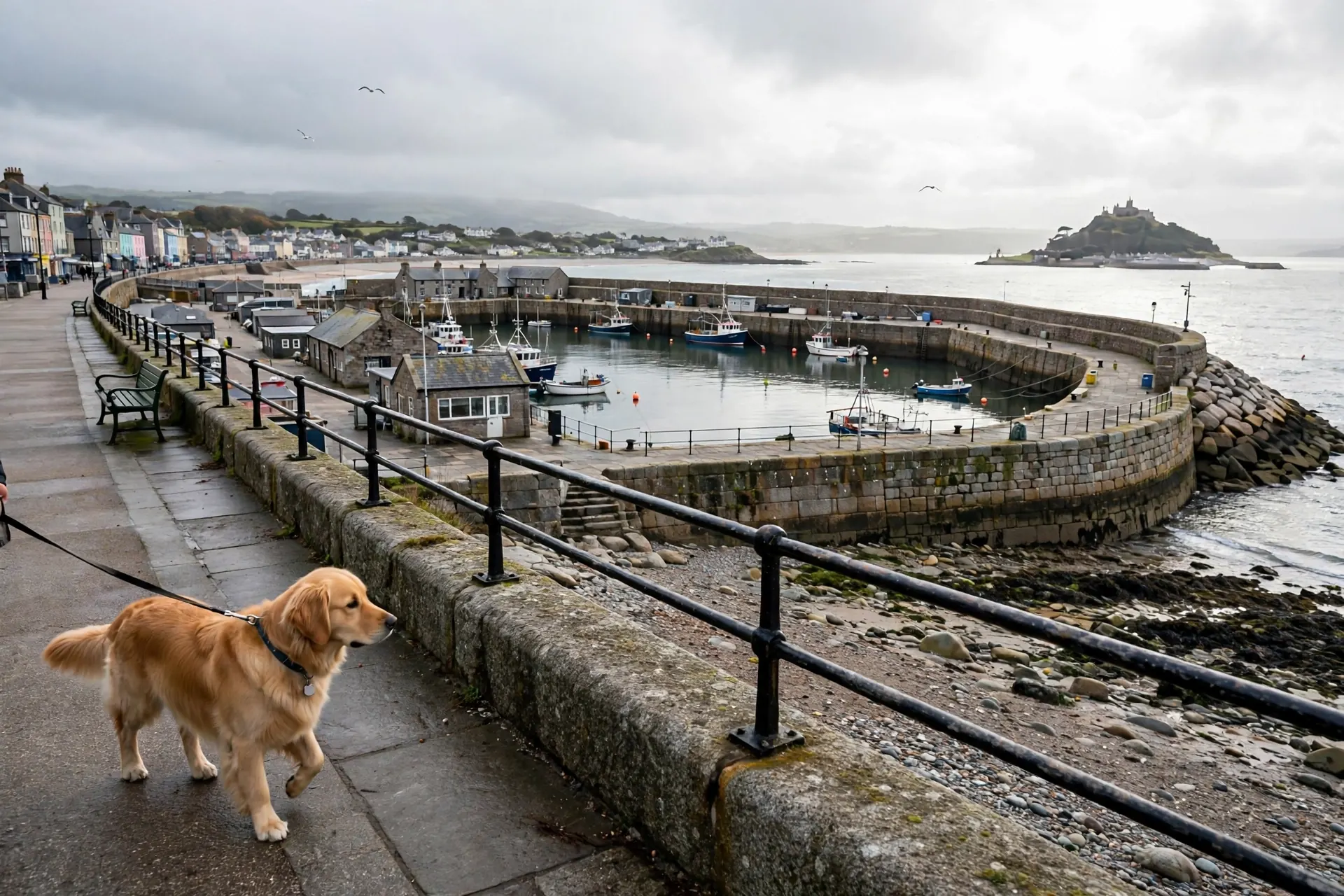
Walk down to the sea first and Penzance makes sense at once. The promenade bends in one long arc from the harbour and the Jubilee Pool at the eastern end, past the town's seafront gardens and the open bay, to the fishing port of Newlyn in the west, with St Michael's Mount sitting out in Mount's Bay for most of the way. Benches face the water along the whole curve, the wall is low enough for a dog to see over, and the view changes with the tide: at low water the bay is a wide sheet of sand and rock, at high water the sea comes right up to the wall. A clear morning shows the Mount sharp against the sky; a grey one swallows it whole, and the gulls and the ferry traffic are the only movement left.
What makes this stretch work for a dog is that it is level from end to end and has no traffic to dodge. Puppies, old dogs and three-legged dogs all manage it, and the walk stretches or shrinks to fit the dog in front of you: ten minutes out and back from the harbour, or the full sweep to Newlyn and back for a dog with energy to burn. The paving warms up fast under a summer sun, so press the back of your hand to it before setting off and use the grassy strips where the promenade meets the gardens. Shade is thin along the open seafront, which is why the early morning and the evening are the promenade's best hours — the light is low, the day visitors have gone, and the dogs have the paving to themselves.
The harbour end of the walk is the busiest part, and it is a working harbour rather than a picture-postcard one. The Scillonian ferry berths here, fishing boats unload a few yards from the pavement, and lorries, forklifts and crates move around the quays while gulls shout overhead. Dogs find it riveting, which is exactly why a short lead matters: the quay edge drops straight to the water in places, ropes and chains sit at ankle height, and fish scraps and bait turn up on the ground where a quick dog will hoover them up before you notice. Treat the harbour as a place to walk through and watch, not a place to let a dog wander, and keep well back from the edge when a boat is manoeuvring.
At the eastern end of the promenade the Jubilee Pool sits in the sea itself, a 1930s open-air lido of pale concrete and clean geometric lines, with the waves breaking against its outer wall whenever there is a swell running. Dogs do not swim in the pool, and the terrace around it is a place to pass through rather than settle for long with a dog, but the walk past it is worth doing: it is the most distinctive building on the seafront, and the paving around it is one of the quietest corners of the promenade at first light, when the only other people about are swimmers and dog walkers watching the sun come up over the bay.
One thing to get used to on this seafront is how quickly the weather changes between the town and the water. A still morning in the streets can be a stiff breeze on the open promenade, and a sea fret can roll in off the bay on a summer afternoon and take several degrees off the temperature in minutes. A short-coated dog that was comfortable in town can start shivering on the exposed wall, and a dog that loved the sun can hate driving rain with nowhere to shelter. Carry a coat for a small or thin-coated dog, keep a towel in the car for the inevitable wet dog, and be ready to cut the walk short — the town is only ever a few minutes away, and a short walk in good weather beats a long one in a storm.
St Michael's Mount and the causeway
The Mount is the reason many people come to this corner of Cornwall, and it is also the outing that most rewards a bit of homework. It is a tidal island: twice a day the sea pulls back and a causeway of granite setts appears across the sand from Marazion, and twice a day the water covers it again. The window is only a few hours around low water and it shifts every day, longer on spring tides and shorter on neaps, so look up the day's tide times before you leave Penzance and work backwards from them. A crossing planned for mid-afternoon can easily turn into a long wait on the Marazion shore if the tide has already turned, and the water comes back over the setts faster than most first-timers expect.
Crossing with a dog is straightforward as long as the lead stays on and the tide is respected. The setts are uneven and slick when wet, rock pools open on both sides of the causeway, and the sand beyond it is soft in places, so keep to the stones and keep the dog close rather than letting it range across the flats after birds. On the island itself, dogs on leads are welcome around the harbour and the village, but the castle and the gardens are closed to them, which shapes the visit: if someone in your party wants the castle tour, plan to take turns staying outside with the dog, or save the tour for a dog-free return. The crossing itself is the memorable part for a dog anyway — the castle rising ahead, the pools to sniff at, the open bay in every direction.
Marazion is where the crossing starts, a small village three miles east of Penzance with a long beach, a green that looks straight across at the Mount, and the boats that run to the island when the tide is in. The boat is the fallback when the causeway is under water, and dogs are generally welcome aboard, though it is worth confirming with the boatmen on the day since sailings depend on the weather and the season. The village beach is the place most visitors aim for first, but the main stretch has dog restrictions through the summer, so read the signs at the top of the slipway and walk on towards the quieter sand away from the village if the main beach is closed to dogs that day.
The Mount belongs to the National Trust, and its opening pattern shifts with the seasons, so the castle, the gardens and the island's facilities are not a given on every visit — a winter weekday can look very different from a summer Saturday. That is part of the place's character: it has been a priory, a fortress, a family home and a place of pilgrimage, and the subtropical planting in the gardens survives because the bay is so mild. A dog will not care about any of that, but the same mild climate that lets palms grow on a Cornish island is what makes the causeway walk pleasant in months when the rest of Britain is grey, and that is worth remembering when you are choosing when to come.
Time the crossing for the quiet hours and it is a different experience from the midday crush. Early morning, just as the causeway shows above the water, the rock pools are freshly exposed and the only other people on the stones are dog walkers and photographers; late afternoon brings low light and a causeway that empties as the day visitors head back to Marazion. Midday in summer is the crowded slot, with families, pushchairs and dogs moving in both directions and little room to let a dog walk properly. And if the weather turns while you are on the mainland, stay and watch: the waves breaking over a submerged causeway with the Mount standing out of a grey sea is one of the finest storm sights in Cornwall, and it costs nothing.
Chapel Street, the town and Morrab Gardens
Chapel Street is the oldest street in Penzance, and it climbs steeply from the harbour up towards the town in a single narrow lane of Georgian houses, small shops and old pubs, with the Egyptian House and its elaborate facade about halfway up. It is short but it is steep, so an older dog will feel it in the legs; take it slowly, keep the dog on the pavement side on the lead, and stop to look at the doorways, because the street is the town's history in miniature. At the top you are in the town centre, and at the bottom you are looking straight down to the harbour and the bay, which is why the street photographs so well in the evening light.
The town centre above Chapel Street is a compact grid, and it holds everything a dog trip actually needs within a few minutes' walk: food shops, a market hall, a library, chemists and the kind of independent traders that survive because local people use them every week. Market day is the liveliest time to be there, and also the hardest for a nervous dog, because the stalls narrow the pavements and the food smells pull every nose in the place. Go early if your dog is easily overwhelmed, keep the dog close around the food stalls, and accept that a dog that helps itself to a dropped sample is funny once and embarrassing twice. Away from market day the centre is calm enough for a slow wander, though the main roads carry real traffic, so keep the dog on the pavement side at the junctions.
Morrab Gardens sits just above the centre, and it is the green lung of the town: subtropical planting, palms and tree ferns, a pond, a bandstand and old trees that throw proper shade on a hot day. Dogs on leads are welcome, and the gardens are the best wet-weather and hot-weather walk in Penzance, cool under the canopy when the promenade is baking and sheltered when the rain comes in off the bay. The paths narrow in places and the planting is dense, so this is a calm walk on the lead rather than a run — keep to the paths, keep the dog out of the beds, and use the benches by the pond as a stopping point if the dog needs a rest on the way back down to the harbour.
Finding somewhere to eat with a dog in Penzance is rarely a problem, because the town is used to visitors arriving with one. The harbour side has places with terraces looking across the bay, the streets around Causewayhead have cafes with tables outside, and the pasty shops do a brisk trade in food eaten on the move. A dog is usually welcome outside and often welcome inside as well, but the rules change from place to place and with the season, so ask at the door rather than assuming. The details that matter are the same wherever you stop: feed the dog before you sit down, bring a water bowl and a mat so the dog has a place of its own, keep the lead short and tucked under your chair, and if the dog is having a bad day, take the food to a bench on the promenade instead — a pasty eaten looking at the Mount beats a stressed dog in a crowded room.
There is something fitting about Penzance being the end of the line. The railway from London stops here, the road to Land's End starts here, and the ferry to the Scillies leaves from the harbour, so the town feels like both a destination and a departure lounge. That suits a trip with a dog: arrive, walk the seafront, eat well, sleep, and set out again in the morning, rather than trying to cram the whole of the far west into a single afternoon. Give Penzance a full day of its own and it will repay you, and the far west will still be there tomorrow.
Newlyn, Mousehole and the fishing villages
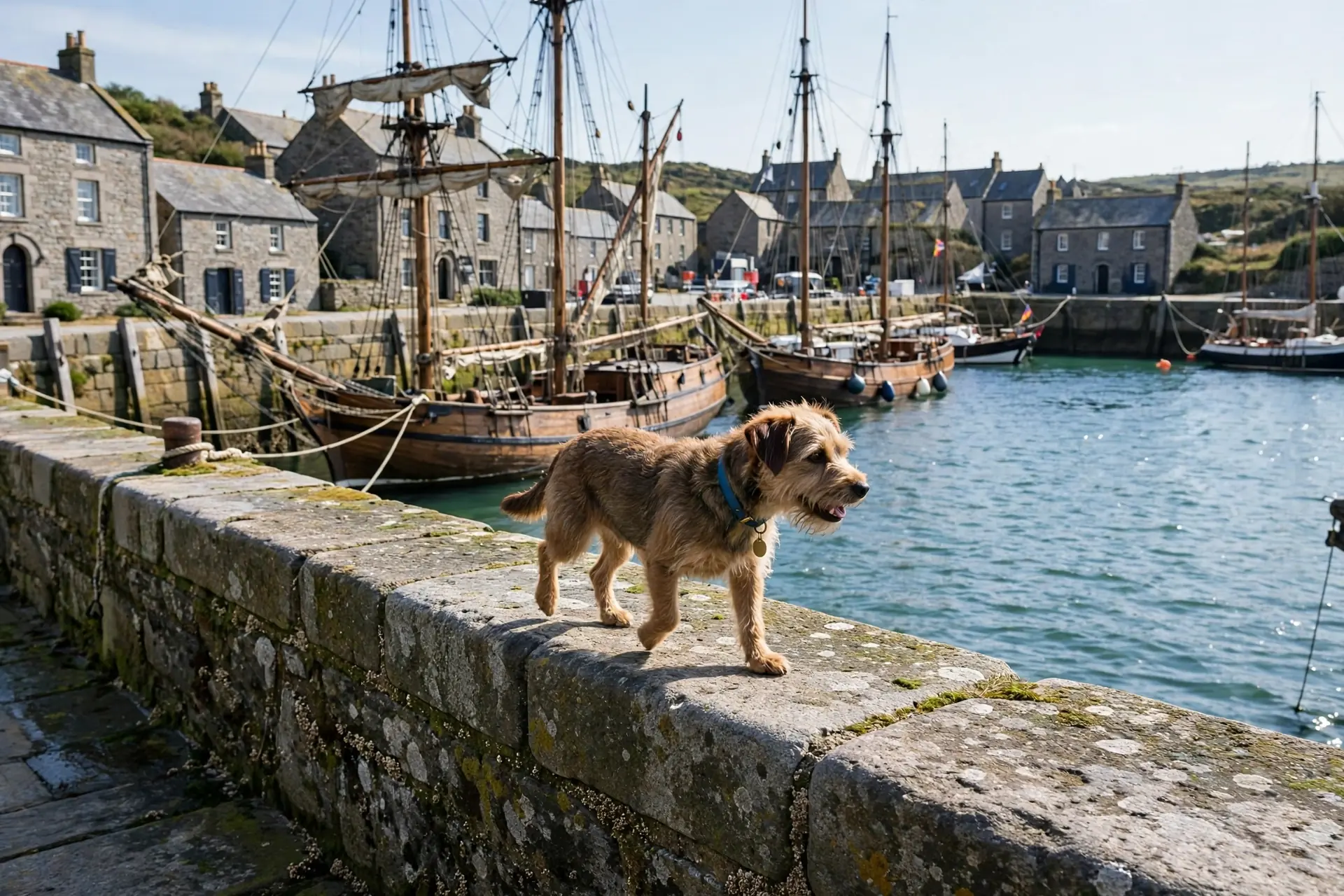
Keep walking west along the promenade from Penzance and in ten minutes you are in Newlyn, which is the fishing port Penzance is not. The harbour here is one of the biggest in England, and the quays are a working landscape of boats, crates, nets and gulls, with the fish market at its heart. Dogs are drawn to it for the same reason people are — the smells and the movement — and the same cautions apply as at the Penzance harbour, only more so: forklifts and lorries move around the market, ropes and chains cross the ground, and the quay edges are unfenced. Keep the dog on a short lead, steer clear of the edges, and do not let it eat anything it finds on the ground. The harbour is a place to walk and look, and the cafes around it are a good stopping point once you have had your fill of boats.
Mousehole, a few miles further on, is the prettiest of the villages and the one that fills up fastest. Its harbour is a small, sheltered curve of stone with whitewashed cottages crowded around it, narrow lanes running off in every direction, and a tiny beach tucked into the corner. In December the Christmas lights draw crowds from all over Cornwall; in summer the lanes do the same, and a nervous dog will find the squeeze stressful when the village is full. Come at first light or out of season and it is a different place: a harbour to sit beside, a coast path running south towards Lamorna, and cafes that are glad of a dog at an outside table. Parking in Mousehole is tight, so the walk in along the coast path from Newlyn is often the better plan, and it is a fine walk in its own right.
Lamorna, further south still, is the quiet one, and often the best of the three with a dog. The cove is rocky rather than sandy, with a small granite harbour, a cafe, and a coast path that runs in both directions through some of the finest walking on the Cornish coast — north back towards Mousehole, south towards Land's End. The light here is famously clear, which is why the painters of the Newlyn School worked here, and it is worth bringing a camera as well as a dog. The path is exposed in places with steep drops, so keep the dog on the lead near the cliff edges and do not let it wander near the unfenced sections, especially on a windy day when a gust can catch a small dog off balance.
All three villages run to the same rhythm, and it is worth shaping your day around it. Early morning belongs to the boats coming in and the harbours busy with fishermen; the middle of the day belongs to the visitors, and the lanes fill up; the evening belongs to the people who live there, when the day visitors have gone and the villages are quiet again. An early start, a long lunch and a slow evening walk will get you the best of them with the least friction, and your dog will enjoy the same hours you do — the cool of the morning, the shade of the afternoon, and the empty harbour at dusk.
Beach days: Marazion, Perranuthnoe and Prussia Cove
Penzance itself has no proper beach, but the sand starts three miles east at Marazion, and that is the beach most visitors head for first. It is a long, flat stretch with the Mount sitting offshore for the whole of its length, and at low tide it is enormous. The main section in front of the village is the one with summer restrictions, so dogs are kept off it during the day in the peak months; read the signs where you come down onto the sand, and if the main stretch is closed, walk on towards Long Rock, where the sand goes on and the crowds thin out. Out of season the whole beach opens up, and a winter or autumn morning at Marazion — empty sand, a dog running properly, the Mount changing colour with the light — is a different thing entirely from a summer afternoon there.
Long Rock, between Penzance and Marazion, is the dependable one. The railway runs behind it, there is no village and nothing to draw a crowd, and the beach itself is a long flat run of sand and shingle that stays open to dogs through the year. When the tide is out the sand goes on for a long way, which is what a restless dog wants after hours in the car. Come prepared, though: the car park is close but there is no cafe and no toilets, the wind off the bay can drive sand hard across the beach, and a windbreak and a coat for the dog earn their place if you are staying a while.
Perranuthnoe, a few miles east of Marazion, is the village beach the locals choose. It is a small sandy cove with a car park, a pub and a cafe, and it has a low-key, friendly feel that suits a dog day. The main beach has its own seasonal rules, so check the signs at the entrance, but the coast path in both directions is the real draw: west towards Marazion on a flat, easy stretch, and east towards Prussia Cove on a wilder, more exposed one. The village makes a good base for a longer stay too, quieter than Marazion and still only a few minutes from Penzance, with self-catering cottages, a shop and a pub all within a short walk of the sand.
Prussia Cove, further east again, is the wild card. It is a small, rocky cove with a smuggling past, a handful of cottages, and a beach of sand and rock pools that only shows itself at low tide. The way down is steep, the beach vanishes when the water comes back, and the dog rules follow the seasons, so it is best visited as part of a coast walk rather than as a destination on its own: walk in from Perranuthnoe, drop down to the cove while the tide is out, and walk back along the path. The seasonal rules differ from beach to beach around Mount's Bay, so before any summer trip read the site's guide to dog-friendly beaches in the UK — it sets out how the seasonal bans work and how to check a beach, and the fines for getting it wrong are real.
A beach day from Penzance is really a tide day. At high water Marazion shrinks to a narrow strip and Long Rock is mostly shingle; at low water both open out into wide sand. Get there two or three hours ahead of low water, when the sand is at its widest and the sea is still a long way off, and keep an eye on the wind as well as the tide — the bay can be rough on a day when the town feels calm, and a gusty beach is miserable for a small dog. Carry drinking water for the dog, because seawater makes dogs sick, and take a towel and a drying jacket for the drive back, because a wet dog in a car is nobody's idea of a good end to the day.
The Cornish coast is beautiful and it does not forgive carelessness, so a few habits are worth building into every beach day. Keep dogs away from the base of cliffs, where rock falls happen without warning, and away from cliff edges on the coast path. Do not let a dog swim near rocks or in a strong current, and watch the surf, which can be powerful even when the sea looks calm. Scan the sand for fishing hooks, broken glass and dead fish, and watch for the signs that a dog has swallowed too much seawater — sickness, loose bowels and a dog that suddenly goes flat all mean a vet, not a wait-and-see. Rinse the dog with fresh water afterwards, check the paws for cuts and the ears for sand, and dry it properly before the drive back to Penzance; a dog that sleeps all the way home has had a good day.
Getting there: the railway, the ferry and the far west
Arriving by train is one of the best ways to come to Penzance with a dog, and the journey is part of the pleasure. The Great Western service from London Paddington runs the length of Cornwall to the terminus here, and the last stretch from St Erth, along the edge of Mount's Bay with the sea on one side and the Mount on the other, is one of the prettiest railway journeys in Britain. Dogs travel free, and a dog that can settle on the floor or under a seat will be fine, but the journey from London is a long one, often five hours, so bring water, a mat for the dog to lie on, and a plan for toilet breaks at the bigger stations along the way. Book a seat in advance, pick a table seat if you can so the dog has room, and arrive in good time so you are not hurrying a nervous dog through a crowded station. The station itself sits right by the harbour, so the promenade is a few minutes' walk from the platform.
The other great departure from Penzance is the ferry to the Isles of Scilly. The Scillonian III sails from the harbour to St Mary's through the summer, and the crossing takes about two and three-quarter hours. Dogs are welcome on board, though they travel in the designated areas and cannot go into the passenger lounges, and the booking arrangements shift with the season, so confirm the details before you travel. The crossing can be rough, and a dog that gets seasick will not enjoy it, so if your dog is a poor sailor it is worth looking at the helicopter or the plane from Land's End instead. The Scillies themselves are superb for dogs — quiet, sandy and full of beaches — but that is a trip in its own right, and it needs its own planning.
Driving to Penzance is straightforward, but the far west is slower than the map suggests. The A30 runs down from the east, and the final stretch from Hayle is a dual carriageway that makes the approach easy, but once you are past Penzance the roads narrow fast: the lanes to Mousehole, Lamorna, Land's End and St Ives are single-track in places, with passing places and stone walls close to the car. Drive slowly, expect something coming the other way around every bend, and do not try to overtake a tractor on a narrow lane. The bus network in the far west is good by Cornish standards and dogs are welcome on board, which makes a bus useful for a one-way coast walk, with the bus back at the end of the day.
Basing yourself in Penzance puts the whole far west within an hour. Land's End is a headland of cliffs and sea with a coast path and a visitor centre, and dogs are welcome on the paths on the lead, though the site is busy in summer. St Ives is a harbour town of galleries, beaches and narrow streets, beautiful and crowded, so come early or out of season with a dog. The Lizard, the wild peninsula to the south with Kynance Cove and Lizard Point, is covered in our Helston guide, which pairs naturally with this one if you are exploring the whole far west. If the harbour starts to feel small, Truro is the city an hour east, and our Truro with a dog guide covers it.
The distances out here are short and the roads are slow, so the best days do one thing well rather than three things in a hurry. Fill a day with a promenade morning, a Mount crossing at low water and a Mousehole evening, and that is plenty; give Land's End, St Ives and the Lizard a day each across a week. Watch the dog for the moment the day is done — when it flops down and will not get up again, head back to the cottage without guilt. Slow down, and the far west opens up; Penzance is a good town to do it from.
Staying over, parking and vets
The case for sleeping in Penzance rather than in one of the villages is not the view, it is the morning routine. Step out of a seafront flat or a cottage in the streets behind the promenade and the dog is on its walk within minutes, with no car to load and no lane to reverse down. Shops, a supermarket, a chemist and the station are all close enough to reach on foot, so the day runs on foot: prom first thing, breakfast, then the car only when the plan needs it — the Mount, a beach, a village. For a dog that settles better with a routine, that rhythm matters more than any single attraction.
Whatever kind of place you book — a hotel room in town, a bed and breakfast, a cottage, a lodge on a park outside Penzance — ask the owner the questions that actually decide whether the stay works. Does the dog sleep in the room you are booking, or only somewhere on the property? How many dogs are allowed, and is the charge per animal or per stay? Is the garden fenced all the way round, and can a determined dog push the gate open? Can the dog be left alone while you go out for dinner, and for how long? And what is underfoot — hard floors that shrug off sand, or pale carpet that will show every paw print from Marazion? The answers matter more than the photographs.
A place with its own kitchen usually suits a dog trip here best, because the day runs on the dog's clock: early walks, a late breakfast, an afternoon when the dog sleeps and nobody minds. Look for a fenced patch of garden, a washing machine for sandy towels, and somewhere to hang a wet lead and a drying coat. Location counts for more than looks: a plain cottage a minute from the promenade will get used far more than a prettier one a drive away from every walk. On the parks and campsites around the town, ask the same questions about numbers, charges and leaving dogs alone, and in a caravan or lodge, test the steps — a dog that cannot manage them will need carrying every time it asks to go out.
For parking, head for the big car parks by the harbour and along the seafront first; they leave the promenade and the town centre both a short stroll away, and they are the easiest place to start the day. Smaller car parks sit dotted around the town, with on-street bays in places, and the prices and maximum stays in the main ones do change, so check them before you travel rather than guessing at the machine. In summer, on market days and on bank holidays, the harbour-side spaces are gone by mid-morning, so get in early. The same goes for the village car parks at Marazion and Mousehole, which are smaller still — before ten, or after four when the day visitors have drifted away, is the way to do it. And a car parked in summer sun heats up in minutes, so a dog never waits in one, however short the stop.
Before the trip, find the Penzance vet practice and put its number in your phone; there are other practices in Hayle and Helston, and an out-of-hours service covers the area, so a weekend problem is manageable as long as you are not hunting for a number at the time. Dog food is easy to replace — the pet shops and the supermarket both stock it — and the loos near the promenade cover the seafront, though they are not everywhere. Phone signal is fine in town but drops away on the remoter bits of the coast path, so save an offline map before setting out. In winter, check opening times: some cafes, pubs and attractions cut their hours outside summer, and after heavy rain the promenade can be wild and wet.
What goes in the bag is really a seafront kit and a beach kit in one. Two leads, in case one comes back full of sand, and a harness that fits properly. A bowl that folds flat and a bottle of water, because the promenade has long dry stretches for a dog. A big towel, a drying jacket, and something to protect the car seat. Poo bags — more than seems sensible — and something to carry them in. A coat for a thin-coated dog when the wind gets up, and sun cream for a pale nose on a bright day. The dog's usual food, any medication, the vet's number and the insurance details. And patience: the seafront is shared ground, the villages are busy in summer, and the best days out here are the slow ones.
A weekend here might run like this. Friday: arrive by train or car, drop the bags, and take the dog down to the promenade for a short evening leg-stretch so the new smells are familiar before dark. Saturday: an early walk out to Newlyn while the harbour is still working, lunch at a dog-friendly pub, then the causeway to the Mount on the falling tide. Sunday: a low-tide morning on the sand at Marazion, a wander round Mousehole harbour, and a last slow promenade walk as the light goes. Nothing in that plan needs more than twenty minutes of driving, and if the weather turns the pieces can be shuffled — a dry calm morning for the beach, a wet afternoon in Morrab Gardens, the town's cafes when the rain sets in. That flexibility is the whole point of basing the trip here: no single plan has to work for the weekend to work.
Practical questions
Before you go
Can dogs cross the causeway to St Michael's Mount?
Yes, on a lead and at low tide. Dogs can walk the granite causeway from Marazion and wander the harbour and village on the island, but the castle and the gardens are closed to them, so plan to take turns if someone wants the castle tour. The causeway only shows for a few hours around low water and the window moves every day, so look up the tide times before you set off, and never start across as the tide is coming in — the water covers the stones faster than you would expect.
Is Penzance promenade good for dogs in summer?
Yes, if you pick your hours. The promenade is level, wide and free of traffic, which suits dogs of every age, but the paving gets hot underfoot and there is very little shade along the open seafront. Walk early in the morning or in the evening, carry water for the dog, and use the grassy strips and the quieter paving around the Jubilee Pool end of the walk when the sun is high.
Which beaches near Penzance allow dogs all year?
Long Rock is the safest bet, a long flat beach between Penzance and Marazion that is generally open to dogs all year, and the quieter sand at the Marazion end away from the village is usually open too. The main beach at Marazion has dog restrictions through the summer months, so read the signs where you step onto the sand. Perranuthnoe and Prussia Cove each have their own seasonal rules, so check before you go.
Can I take my dog into cafes and pubs in Penzance?
Very often, yes. Penzance is used to visitors with dogs, and many cafes and pubs welcome them, particularly at outside tables and on terraces, with a good number allowing dogs inside as well. The rules change from place to place and with the season, so ask at the door or look at the venue's own listing before you settle in, and bring a water bowl and a mat so your dog has a place of its own.
Where is the best place to park in Penzance with a dog?
The long-stay car parks by the harbour and the promenade are the most useful choice, because they leave you a short walk from the seafront and the town centre alike. Arrive early in summer and on market days, when the spaces nearest the harbour fill by mid-morning, and check the current charges and maximum stays before you travel. A car in summer sun heats fast, so never leave a dog in a parked car.