This guide is written independently and contains no paid placement. Harbour rules, beach restrictions and dog policies at cafes and accommodation can change, so confirm the details that matter to your trip before you travel.
Start at the harbour on a lead, keep clear of working boats and nets, use the bay beach for the long run, save the lighthouse walk for a calmer day, and plan for wind: Peterhead rewards dog owners who respect the port and read the weather twice.
A working harbour first: how to behave around boats and nets
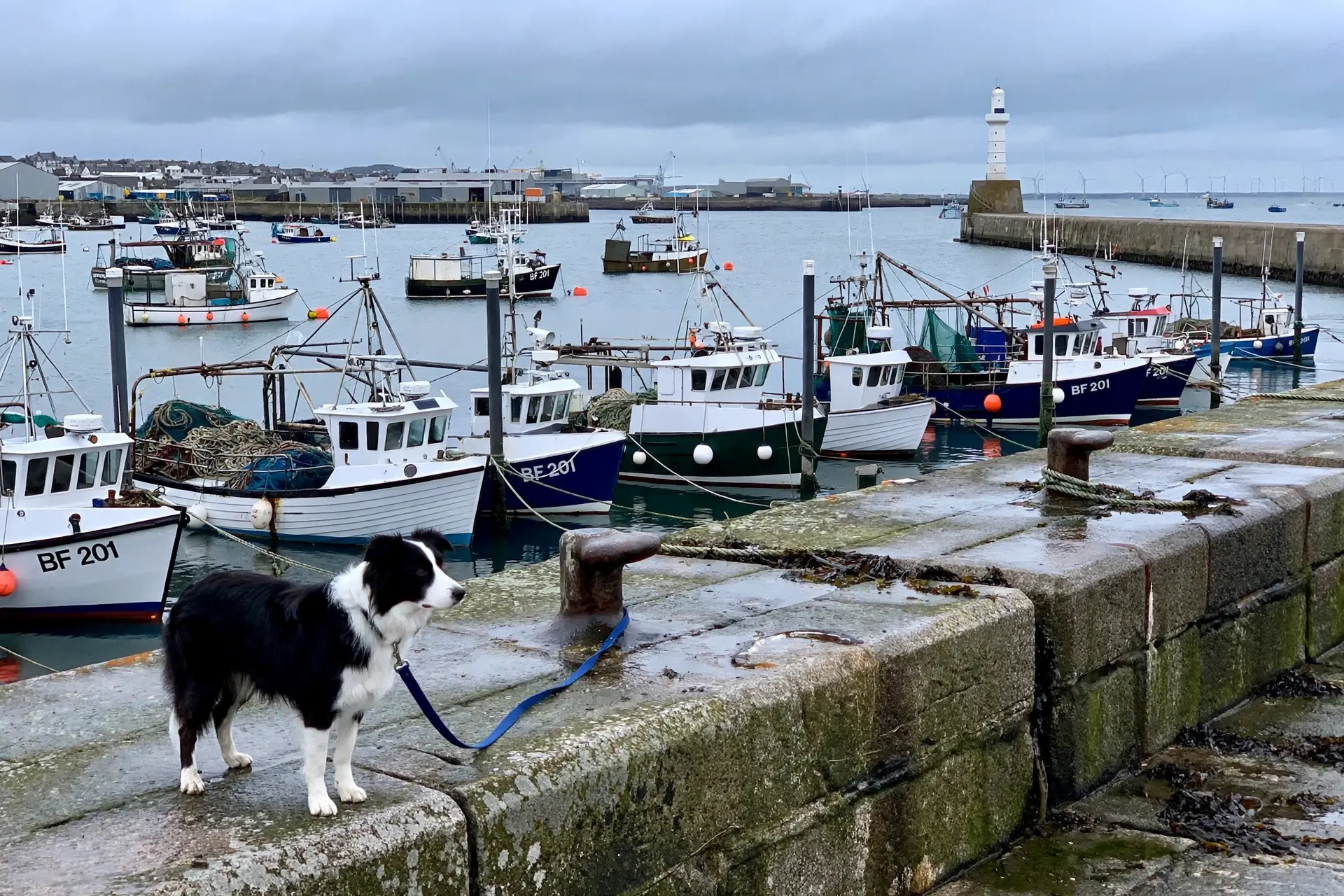
Peterhead is the largest fishing port in Scotland, and the harbour is not a backdrop. Boats land catches here through the night and into the early morning, lorries move between the quays, forklifts cross the piers, and crews work around ropes, nets and fish boxes in weather that most visitors would call a day off. A dog walk here is enjoyable precisely because the place is alive, but it only works when the dog stays on a lead, stays out of the way, and stays off the working surfaces. Treat the harbour as someone else's workplace that you are allowed to pass through, and the morning will go well.
The practical rules are simple, and they matter most in the first hours of the day. Keep your dog on a short lead along the quaysides, never a long line that can tangle around a bollard, a pallet or a passing worker's legs. Stay on the public walkways and out of fenced or gated working areas, and do not let your dog step onto a pier, a gangway or a boat. Fish boxes, netting, coiled rope and spilled ice are all hazards for paws and for noses: nets can snag a leg, hooks and fish spines can injure a mouth, and the smell of a fresh landing will pull even a steady dog towards a lorry. If a boat is unloading, give it a wide berth and wait for a clear gap before passing, rather than squeezing between the crew and the water.
Noise and movement are part of the harbour, so think about your dog before you set off. Gulls wheel and scream over the fish market, diesel engines start without warning, cranes swing loads overhead, and reversing vehicles beep behind you. A noise-sensitive dog will cope better on a quieter afternoon circuit than at the height of a landing, when the quays are at their busiest and loudest. A confident dog may still need a steady hand near the water's edge, because harbour walls drop straight into deep water and there is no beach to climb out on. Keep your dog on the landward side of the wall wherever possible, and never let them jump down onto a lower quay or a boat deck.
The harbour rewards a slow, observant walk. The North Harbour and South Harbour both have public stretches where you can watch the trawlers, the smaller inshore boats and the harbour tugs without getting in anyone's way, and the views across the bay to the breakwater are at their best in the low morning light. Look for the fish market buildings, the ice plant and the net stores, and you will start to read the port the way the people who work there do: a quiet quay means the fleet is out, a busy one means a landing is under way, and a line of lorries means the catch is already on its way south. Dogs that settle beside a bench and watch the world go by do well here; dogs that need to run should save their energy for the beach, which is a short walk away.
Before you go, check the official guidance before you travel on any harbour access that matters to your route, because working areas and public access can change with port operations. If you are visiting with children as well as a dog, hold the lead yourself and keep the dog close when vehicles are moving. Carry bags and pick up promptly, since fish waste and gull droppings already make the quays slippery enough without adding to the mess. And if a harbour worker asks you to move, move at once and without argument: they are keeping you and your dog safe in a place where a moment's inattention can end badly.
Peterhead Bay and the beach rules
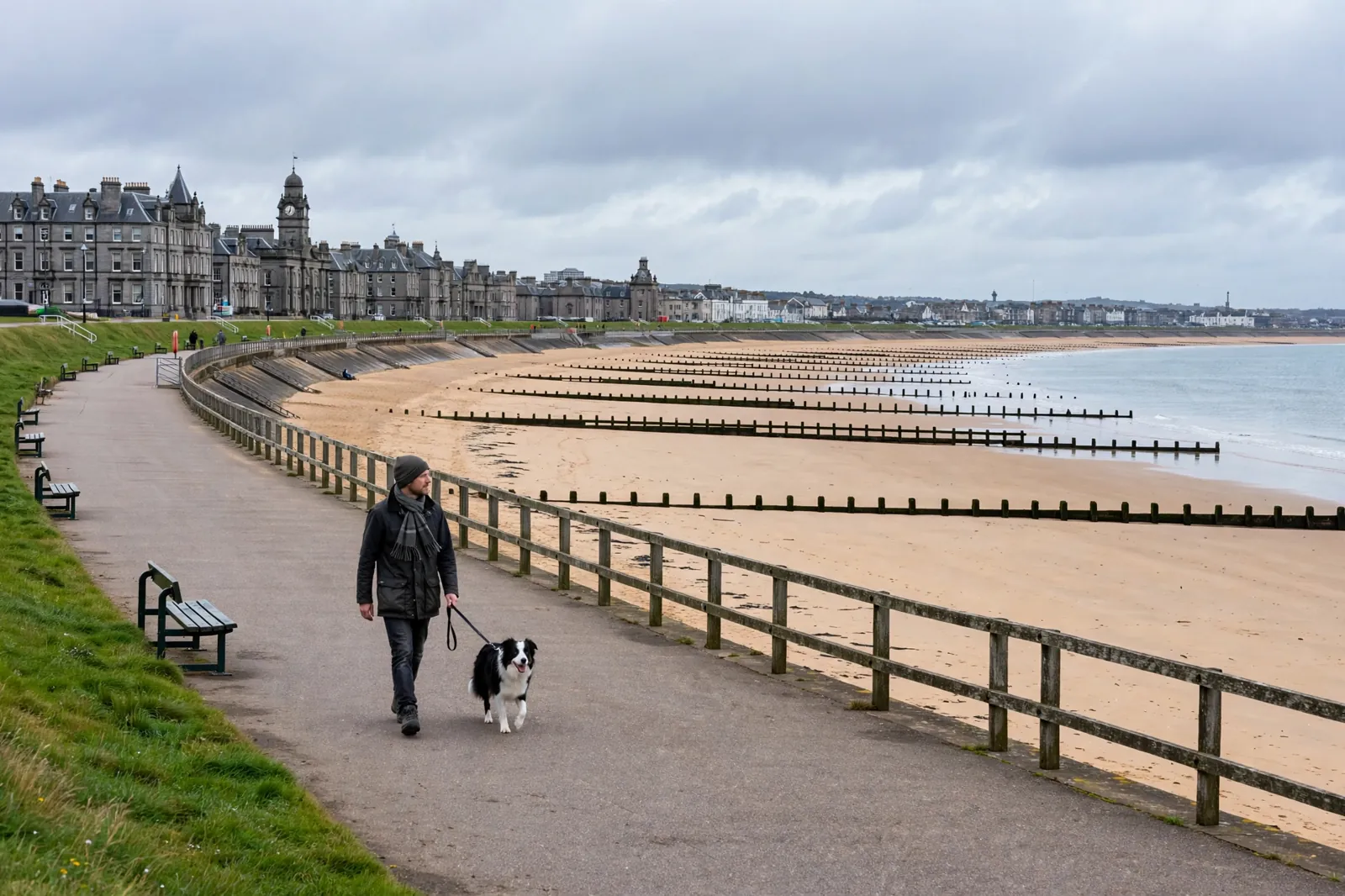
Peterhead Bay curves south from the harbour in a long sweep of sand, and it is the obvious place for a proper dog walk. The beach is wide, the sand is firm enough for a good run at low tide, and the walk from the harbour end towards Boddam gives you space that the quaysides never will. On a bright day the bay looks gentle, almost sheltered, but it is still a North Sea beach: the tide comes in faster than it looks, the water stays cold all year, and the wind that was a breeze on Broad Street can be a hard push by the time you reach the open sand.
Beach rules in Scotland are set locally, and the honest position is that restrictions can change with the season and with the signs on the ground. Read the notices at every access point you use, and check the official guidance before you travel if a dog ban or a seasonal restriction would change your plans. As a general pattern, dogs are walked on the bay beach throughout the year, but a lead is sensible near the harbour end, near other beach users, and whenever your dog's recall is not reliable in open space with gulls, other dogs and the smell of the sea. For a fuller picture of how beach rules work across the country, our guide to dog-friendly beaches and the rules behind them explains seasonal bans, local bylaws and the difference between a beach with no restriction and one with a lead-only stretch.
Time the tide, not just the clock. At low tide the bay opens up into a broad flat expanse where a dog can run in big arcs and paddle at the water's edge; at high tide the sand narrows and the walk becomes a thin strip between the dunes and the sea. Check a tide table for Peterhead before you set out, and plan to be off the lowest part of the beach well before the tide turns. Dogs that chase the waves can get into trouble quickly if they run out onto wet sand that is about to be covered, and a dog that swims in the North Sea needs to be watched for cold and for currents. Most dogs do best with a paddle and a run rather than a swim, and a towel and a drying coat in the car will make the drive home far more comfortable for everyone.
The beach also has its own hazards that are easy to miss. Fishing line, hooks and bait boxes wash up along the strandline, especially after rough weather, and a dog that scavenges along the tideline can pick up a hook or a piece of fish waste before you notice. Dead seabirds and seals can appear on the sand, and a dog should be kept away from them: they can carry disease, and a seal on the beach may be resting rather than stranded, in which case the right move is to leave it alone and keep your distance. Broken glass, sharp shells and the occasional piece of driftwood with a nail in it are all part of a working coastline, so a quick scan of the ground where your dog is sniffing is worth the effort.
Sharing the beach matters as much as using it. The bay is popular with families, runners, horse riders and other dog walkers, and a dog that charges up to strangers or other dogs will not be welcomed twice. Keep your dog under control at the access points, where paths narrow and dogs bunch together, and give horse riders a wide berth on a short lead. Pick up after your dog everywhere on the beach, including the dunes, and carry the bag to a bin rather than leaving it by a fence post. The dunes themselves are fragile: stick to the paths through them, keep your dog from digging into the dune face, and remember that the plants holding the sand together took years to grow.
The lighthouse walk and the South Breakwater
The lighthouse that most visitors picture when they think of Peterhead stands at Boddam, just south of the town, and the walk out towards it is one of the best dog walks on this stretch of the Buchan coast. The route follows the shore from the bay beach past the harbour's southern arm, with the sea on one side and open ground on the other, and on a clear day you can see the full sweep of the bay behind you and the North Sea stretching away to the horizon. It is a walk of views rather than of shelter: there is almost nowhere to hide from the wind, and that is exactly what makes it feel like the edge of Scotland.
Start by deciding which version of the walk suits your dog. The shorter option is a there-and-back stroll from the southern end of the bay towards Boddam, turning around when you have had enough of the wind or when the dog starts to flag. The longer option continues around the point to the lighthouse itself, where the ground rises and the path narrows, and then returns the same way. Either way, keep your dog on a lead near the cliff edges and on the breakwater, where the drops are steep, the stone is uneven, and a slip could be serious. The South Breakwater is a massive stone arm built to shelter the harbour, and it is impressive to walk, but it is not a place for a dog off the lead: the blocks are rough underfoot, the gaps between them are deep, and the wind funnels along its length.
Underfoot conditions change with the weather. In dry weather the paths are firm and easy, but after rain the grassy sections turn slick, and after a storm the shore path can be strewn with seaweed and debris. Wear boots with grip, and think about your dog's paws on the rough stone of the breakwater: a dog that is used to grass and sand may find the blockwork hard going, and a short-legged or older dog may struggle with the steps and the uneven surface. Carry water for the dog, because there is no reliable drinking water along the shore, and carry a lead even if you plan to let the dog run on the beach, since the lighthouse end of the walk is a lead-on place.
The lighthouse itself is a working aid to navigation, so treat the buildings around it with respect and keep your dog away from the walls and the fenced areas. The best views are from the path, looking back towards the town and the harbour, and looking out to sea where the water changes colour over the shallows. On a calm day you may see fishing boats working close inshore and gulls following them; on a rough day the waves break against the breakwater in bursts of spray that can soak a dog standing too close to the edge. Either way, keep the dog on the landward side of the path when the sea is up, and do not let them climb down onto the rocks below.
If the wind is strong, shorten the walk without regret. A dog that is being pushed sideways by gusts is not enjoying itself, and a small dog can be genuinely frightened on an exposed headland. The walk will still be there on a calmer day, and a shorter loop back along the bay beach is a better use of a wild afternoon than a battle against the weather. For a longer coastal day, the same Buchan coastline continues north towards Fraserburgh and south towards Aberdeen, and our guide to Aberdeen with a dog covers the Granite City's beach and parks if you are heading south along the A90.
Birds, seals and the North Sea wind
Peterhead is a birdwatcher's town even if you never set out to watch birds. Gulls are the constant soundtrack, from the herring gulls that patrol the harbour to the smaller black-headed gulls that work the bay at low tide. Fulmars glide along the cliffs near Boddam, kittiwakes nest on ledges along the coast, and in the right season you may see gannets diving offshore, their white wings folding as they plunge into the sea. Waders pick along the tideline at low water, and in winter the bay can hold ducks and divers that have come south to escape harsher weather further north. A dog that watches birds will be busy here; a dog that chases them needs a lead and a firm recall.
Seals are the other wildlife to expect. Grey seals haul out on rocks and quiet stretches of shore along the Aberdeenshire coast, and a seal resting on the beach is a normal sight rather than an emergency. The rule is distance: keep your dog on a lead, keep well back, and never let the dog approach, bark at or swim towards a seal. A seal that feels threatened will slide back into the water, which is bad for the seal and can be dangerous for a dog that follows it in. If you think a seal is injured or in distress, do not touch it and do not let your dog near it; note the location and contact the relevant local wildlife or rescue organisation for advice.
The wind is the factor that shapes everything else about a dog day in Peterhead. The town faces the North Sea with almost no shelter, so a forecast that looks mild inland can still mean a brisk breeze on the breakwater and a wind chill that makes a short-coated dog shiver. Haar, the sea fog that rolls in off the North Sea, can cut visibility to a few metres in minutes, especially in spring and early summer, and it can make a familiar path feel strange. Check the forecast twice: once when you plan the day, and again on the morning itself, paying attention to wind speed and direction rather than just the temperature and the rain symbol.
Pack for the wind rather than for the cold alone. A drying coat or a windproof layer for the dog is worth carrying if your dog is short-coated, older, or small, and a towel in the car is useful even on a dry day, because sea spray and wet sand find their way onto every dog. For the humans, a windproof jacket matters more than a heavy coat, and a hat that stays on in a gust is worth more than an umbrella, which will be useless on the breakwater. If the wind is strong enough to make walking uncomfortable, move the walk inland: the streets around the town centre are far more sheltered, and a loop through the residential areas and back along the bay can still give a dog a decent outing.
Wildlife etiquette is simple and worth repeating: watch from a distance, keep the dog close, and leave the place as you found it. Do not feed the gulls, do not let your dog chase waders or terns, and do not let them disturb nesting birds on the cliffs or in the dunes. The Buchan coast is also home to puffins and other seabirds at the Bullers of Buchan, a short drive south of Peterhead, where the cliffs and sea stacks are spectacular and the birds are the point of the visit. If you go there with a dog, keep the dog on a lead at all times near the cliff edges, stay behind the fences and the marked paths, and remember that a single loose dog can scatter a whole colony.
The town centre: streets, shops and a warm stop
Peterhead's town centre is compact and walkable, and it is the natural place to warm up after a windy walk. Broad Street runs through the heart of the town, with Marischal Street, Merchant Street and Queen Street branching off it, and the streets around Drummers Corner are where you will find the shops, the cafes and the everyday life of the town. The centre is not a polished tourist quarter, and that is part of its charm: it is a real working town, with a fishmonger, a baker, a butcher and the kind of small shops that have served the fishing community for generations.
A town-centre loop with a dog is best done on a lead and at a steady pace. The pavements are wide enough in most places, but delivery vans and buses use the same streets, and a dog that darts across the road after a smell can cause trouble quickly. Keep the dog on the inside of the pavement, away from the traffic, and be ready for the other dogs that live in the town: Peterhead has plenty of local dog walkers, and a town-centre walk is a social one. If your dog is reactive, choose a quieter side street for the return leg rather than the busiest stretch of Broad Street at lunchtime.
Shops vary in their dog policies, so ask at the door rather than assuming. Some of the smaller independent shops welcome a well-behaved dog inside, while the larger stores and supermarkets generally do not, and the rules can differ from one branch to another. A dog that will wait quietly outside with one person while the other pops in is useful in a town like this, but never tie a dog up and leave them unattended for long, and never leave a dog in a car on a warm day. If you need supplies, the town has pet shops and supermarkets where you can pick up food, treats and the extra bag of kibble you forgot to pack.
The Arbuthnot Museum on St Peter Street is worth a look for the human side of the visit, although dogs are not generally allowed inside museums, so plan to take turns if one of you wants to go in. The museum covers the town's history, from its fishing heritage to its time as a whaling port, and it gives context to the harbour you have just walked around. Peterhead Prison Museum, a short walk from the centre, is another piece of the town's story, and the same take-turns rule applies. Both are good wet-weather options for the humans while the dog rests in the car or in dog-friendly accommodation, provided the weather and the dog's comfort allow it.
For a warm stop, look for a cafe with a dog-friendly corner rather than a formal restaurant, and expect the welcome to be practical rather than fussy: a bowl of water by the door, a mat under the table, and a staff member who knows the regular dogs by name. The town centre also has benches and sheltered spots where you can sit with a takeaway coffee and a dog that has earned a rest, and on a cold day the simple pleasure of being out of the wind for half an hour should not be underestimated. If you are staying overnight, the town centre is also where you will find the banks, the pharmacy and the vet practices, so a loop through the streets doubles as a useful bit of trip admin.
Eating out with a dog in Peterhead
Eating out with a dog in Peterhead is a matter of asking, not assuming. Several cafes and pubs in and around the town centre welcome dogs, usually in a particular area, on an outdoor terrace, or in the bar rather than the main dining room, and the welcome can change with the season, the time of day and the number of dogs already inside. Phone ahead where you can, or ask at the door before you sit down, and be ready to choose somewhere else if the answer is no. A polite question at the door is always better than a dog settled under a table in a room where dogs are not allowed.
Fish and chips is the obvious meal in a fishing port, and Peterhead has chippies where you can order a takeaway and eat it on a bench with the dog beside you, which is often the simplest solution of all. If you would rather sit inside, look for a cafe on Broad Street or Queen Street that advertises itself as dog-friendly, and expect the usual courtesies: a water bowl, a place to settle the dog out of the walkway, and a staff member who is happy to see a calm dog but will not welcome one that barks at every customer. Bring a mat or a blanket for the dog to lie on, keep the lead short and under your foot, and bring a chew or a stuffed toy to keep the dog occupied while you eat.
Pubs are often the most reliable option for a dog owner in a Scottish town, and Peterhead is no exception. A traditional pub with a bar area and a fire is a good place for a dog to settle after a long walk, and many pubs in the town welcome dogs in the bar, especially at quieter times of day. Order at the bar, settle the dog first, and keep the visit to a length that suits the dog rather than the humans: an hour of calm settling is a good outing, while three hours of a bored dog under a table is not. If your dog is not used to pubs, start with a short coffee stop and build up, rather than making the first pub visit a long evening meal.
Think about timing as well as place. Lunchtime is the busiest period in most cafes, and a dog that is nervous around crowds will cope better with an early lunch or a late afternoon tea. If you are eating with a group, book ahead and mention the dog when you book, so the staff can put you at a table with space for the dog to lie down rather than in a narrow gap between other diners. And if the weather is good, an outdoor table is often the easiest option of all: the dog has fresh air and space, you have a view of the street, and nobody has to worry about a dog in a crowded room.
Finally, keep the dog's own meals in mind. A long day of walking, wind and cold water burns more energy than a day at home, so a slightly larger evening meal and fresh water after the walk are sensible. Do not feed the dog from your plate in a cafe, and do not let them scavenge dropped food from the floor, since a fishing town's cafes can have fish bones and other hazards under the tables. Carry your own treats, keep the dog's routine as close to home as possible, and save the celebration meal for a place where the dog can genuinely relax.
Where to stay near Peterhead
Peterhead has a small number of hotels, guest houses and bed and breakfasts in the town itself, and a wider choice of self-catering cottages, farm stays and caravan sites in the surrounding Buchan countryside. The town-centre options are convenient for the harbour, the bay and the shops, and they suit a short stay where you want to walk everywhere. The countryside options give you a garden, a quieter night and more space for a dog that needs room, and they suit a longer stay where the town is a base for exploring the coast. Decide which matters more before you book, because the two kinds of stay feel very different.
Whatever you choose, confirm the dog policy in writing before you pay. Ask how many dogs are allowed, whether there is a charge per dog or per stay, whether dogs can be left alone in the room or the cottage, and whether there are rooms or units where dogs are not accepted. Some hotels accept dogs only in specific ground-floor rooms, some guest houses accept one small dog but not two large ones, and some self-catering cottages have an enclosed garden while others have an open one that a determined terrier can escape from. Get the answers by email and keep them with your booking confirmation, so there is no argument at check-in.
Self-catering is often the easiest choice for a dog owner in this part of Aberdeenshire. A cottage with an enclosed garden, a hard floor that is easy to clean, and a walk straight from the door gives the dog a routine that feels close to home, and it removes the question of where the dog goes while you eat out. Look for cottages around Boddam, Stirling Village, Cruden Bay and the villages between Peterhead and Fraserburgh, where the coast is close and the lanes are quiet. Check the garden fence properly on arrival, walk the boundary with the dog before letting them off the lead, and ask the owner where the nearest practical toilet walk is after dark. If you prefer a site with more facilities, our guide to dog-friendly holiday parks explains pet fees, boundaries and the questions that separate a genuinely dog-friendly park from one that simply accepts a fee.
Hotels and guest houses need a different set of questions. Ask whether the dog can come into the bar or the breakfast room, whether there is a place to dry a wet dog after a beach walk, and whether the room has a hard floor or a carpet that will show every muddy paw print. Bring your own dog bed, a towel and a throw for the furniture, and settle the dog in the room before you go down to dinner. If the hotel does not allow dogs to be left alone in the room, plan your meals around the dog: eat in the bar where the dog is welcome, order room service if it is available, or take turns with your travelling companion.
Booking ahead matters in this part of Scotland. Peterhead is not a big tourist town, so the number of genuinely dog-friendly rooms is small, and the best cottages book up early for the summer months and for the long weekends. If you are visiting in July or August, book as early as you can, and if you are visiting in winter, confirm that the heating is included and that the property is open at all, since some smaller guest houses and cottages close for the quietest months. Keep a list of the nearest vet practice and an out-of-hours number with your booking, and save the accommodation's phone number in your own phone, so a late arrival or a problem with the dog can be sorted with a quick call rather than a search in the dark.
Getting here: the A90 and the bus
Peterhead sits at the end of the road network rather than in the middle of it, and that is part of its character. The A90 runs north from Aberdeen through Ellon to Peterhead, and the drive from Aberdeen takes around an hour in normal traffic, passing through farmland and the small towns of the Buchan coast. The A952 runs north to Fraserburgh, and the A950 runs west towards New Pitsligo and the interior, so the town is well connected by road even though it feels remote. If you are driving, fill up before you leave Aberdeen or Ellon, since the petrol stations thin out as you head north, and plan a stop for the dog somewhere sheltered rather than on the exposed coast road.
Parking in Peterhead is straightforward compared with a city. There are car parks near the town centre and along the harbour, and on-street parking is available on many of the residential streets a short walk from the bay. Check the signs at each car park for time limits and charges, since the rules vary, and park with the dog in mind: a shaded spot in summer, a sheltered spot in winter, and a space close to a walk rather than a long haul across town with a dog that needs a toilet break. Never leave a dog in a parked car on a warm day, even with the windows open, and never leave a dog in a car in an exposed car park in a gale, when the wind can rock the vehicle and frighten the dog.
Without a car, the bus is the way in. Stagecoach Bluebird runs services linking Peterhead with Aberdeen, Fraserburgh, Ellon and the surrounding villages, and the bus station in the town centre is the natural starting point for a walk. Dogs are normally allowed on buses at the driver's discretion, usually on a lead, kept off the seats, and kept clear of the gangway, but the policy can vary and the driver has the final say, so check the official guidance before you travel. Allow extra time for the journey, and be ready for a long ride: Peterhead is a long way from Aberdeen by bus, and the route stops at several villages along the way.
The nearest railway station is Aberdeen, around 32 miles to the south, which means a rail-and-bus combination is the realistic option for anyone arriving by train. Dogs travel on trains in the UK without a fare, usually on a lead and kept off the seats, and the change at Aberdeen onto a bus to Peterhead is straightforward if you allow enough time between the two. If you are coming from further afield, the train to Aberdeen followed by the bus is a long day, so consider breaking the journey with a night in Aberdeen and a morning bus north. Our guide to Aberdeen with a dog covers the Granite City's beach and parks if you build in that stopover.
Whatever way you arrive, plan the last mile. The walk from the bus station to the harbour is short and flat, and the walk from the harbour to the bay beach is shorter still, so a dog that has spent an hour on a bus can be on the sand within minutes of arriving. If you are staying in a cottage outside the town, arrange a taxi or a lift in advance, since taxis in a small town can be busy at peak times and not every taxi will take a dog. Mention the dog when you book the taxi, bring a blanket for the seat, and keep the dog on a lead for the short walk from the taxi to the front door.
A day in Peterhead with a dog
A good dog day in Peterhead starts early and follows the weather rather than fighting it. Begin with a harbour loop while the town is waking up: walk the quaysides on a lead, watch the boats and the gulls, and let the dog take in the smells and sounds of a working port before the day gets busy. Keep it short if the harbour is in full landing mode, and save the running for the beach. Then head for the bay at low tide, when the sand is at its widest, and give the dog a proper run, a paddle and a game, with time to sniff along the tideline and burn off the energy that the harbour loop only stirred up.
By late morning, head into the town centre for a warm stop. Walk Broad Street and the streets around Drummers Corner, pick up anything you need, and find a dog-friendly cafe for a coffee and a rest. This is the moment to dry the dog, check their paws for sand and salt, and give them water and a quiet half hour under the table. If the dog is still full of energy, a second, shorter loop through the residential streets will settle them; if the dog is tired, a slow wander back towards the harbour is enough. The middle of the day is also the best time for the lighthouse walk if the wind has dropped, since the light is at its best and the path is at its busiest, which means other walkers and dogs to pass politely.
The afternoon is for the lighthouse walk or for a drive along the coast. If the wind is calm, walk out towards Boddam and the lighthouse, keeping the dog on a lead near the edges and taking your time over the views back across the bay. If the wind is up, skip the headland and drive south towards Cruden Bay or the Bullers of Buchan instead, where the cliffs and the sea stacks give you a shorter, more sheltered walk with the dog on a lead throughout. Either way, finish the afternoon back at the bay for a final run at low tide, and then head for a pub or a cafe where the dog is welcome, for a meal that the dog can sleep through under the table.
Evening in Peterhead is quiet, and that suits a tired dog. A last toilet walk around the block, a check of the paws for salt and sand, and a brush to get the worst of the beach out of the coat will set the dog up for a good night. If you are staying in a cottage with a garden, a final garden visit is the easiest option; if you are in a hotel, a short loop to a lit street near the accommodation is better than a long walk in the dark. Keep the evening routine close to home: same feeding time, same bed, same last outing, and the dog will settle quickly after a day that asked a lot of them.
If you have a second day, use it to explore further afield. The coast north to Fraserburgh has wide beaches and a quieter feel, the coast south to Cruden Bay has cliffs and a famous ruined castle on the headland, and inland Aberdeenshire has the castles, the rivers and the farmland that make the county worth a longer stay. A second day also gives you a spare morning for the lighthouse walk if the wind spoiled the first attempt, which is a better plan than forcing an exposed walk in bad weather. Peterhead works best as a base for a slow coastal break, not as a place to rush through, and the dogs that enjoy it most are the ones whose owners let the wind and the tide set the schedule.
Practical questions
Before you go
Can dogs go on Peterhead Bay beach?
Dogs are generally walked on the bay beach, but rules can change with the season and with local signage, so read the notices at the access points and check the official guidance before you travel. Keep your dog on a lead near the harbour end, pick up after them, and give other beach users and any wildlife a wide berth.
Is the lighthouse walk at Peterhead suitable for dogs?
The walk out towards the lighthouse at Boddam is a popular dog walk on a clear day, with open sea views and firm paths, but it is exposed to the North Sea wind and there are steep drops and uneven ground in places. Keep your dog on a lead near cliff edges and the breakwater, carry water, and turn back if the wind is too strong for your dog.
Can I walk my dog around Peterhead harbour?
Yes, you can walk the public quaysides with your dog on a lead, but the harbour is a working port, so stay out of fenced working areas, keep clear of moving vehicles, cranes and unloading boats, and never let your dog wander onto a pier or among the nets and fish boxes. Early mornings are the busiest time for landings.
Where can I eat with a dog in Peterhead?
Several cafes and pubs in the town centre welcome dogs, usually in a specific area or on an outdoor terrace, and policies can change, so phone ahead or ask at the door before settling in. Bring a mat for your dog, keep them settled under the table, and carry water and a chew for longer stops.
What is the weather like for dogs in Peterhead?
Peterhead is exposed to the North Sea, so wind is the main factor: a calm forecast in Aberdeen can still mean a sharp breeze on the breakwater, and sea fog known as haar can roll in quickly and cut visibility. Dress for wind rather than cold alone, pack a drying coat and a windproof layer for your dog if they feel the cold, and check the forecast again on the morning of your walk.
How do I get to Peterhead with a dog without a car?
Stagecoach Bluebird buses link Peterhead with Aberdeen, Fraserburgh and Ellon, and dogs are normally allowed on board at the driver's discretion, usually on a lead and kept off the seats. Check the current timetable and the operator's dog policy before you travel, and allow extra time because the town is a long way from the nearest railway station at Aberdeen.