This guide is independent and contains no paid placement. If affiliate links are added later, they will be clearly marked and will not change our editorial checks.
Petersfield is a market town on the edge of the South Downs where the dog walk starts in the middle of town: the Heath and its pond sit a few minutes from the station, the market fills The Square on Wednesdays and Saturdays, and Queen Elizabeth Country Park and Butser Hill lie a short drive or a long walk to the south.
Gateway to the South Downs
Petersfield sits where Hampshire market-town life meets the South Downs. The town stands just north of the national park boundary, on the A3 between London and Portsmouth, with its own station on the Portsmouth Direct Line — about seventy minutes from London Waterloo and roughly half an hour from Portsmouth Harbour. That position is the whole point of coming here with a dog: you can arrive by train, walk to a proper heath within minutes, and be on chalk downland before lunch, without needing a car at all.
The town works as a base precisely because it is not a resort. It is a working market town of around fifteen thousand people, the main town of East Hampshire, and it has the things a dog trip actually runs on: a station, a supermarket, a vet practice, a handful of pubs, a farmers’ market, and a large piece of open ground — the Heath — at the eastern end of the High Street. You do not have to drive anywhere to give a dog a good day here. The walks start from the pavement outside your front door, which matters more than any single attraction when you are travelling with a dog that needs three outings a day.
Orientation is simple once you have walked it once. The station sits at the southern end of town, off Station Road. The Square — the old market place, with St Peter’s Church on one side — is the centre, and the High Street runs east from it towards the Heath, which opens up at the end of Heath Road. Queen Elizabeth Country Park lies to the south, past Buriton, and the South Downs Way runs east to west across the high ground south of the town. The villages around Petersfield — Sheet to the south-east, Steep to the north-east, Buriton to the south, East Meon further west — are all within walking distance on footpaths, which is why the town makes such a good hub for a longer stay: each day can head in a different direction.
The seasons change the town’s character more than its facilities do. In spring the Heath fills with birdsong and the downland above Buriton turns green; in summer the pond becomes the social centre of the town for dogs and their owners; in autumn the beech hangers above Steep and the woodland at Queen Elizabeth Country Park put on the best colour in Hampshire; and in winter the town is quiet, the market is smaller, and the chalk paths drain well enough that a walk is still worth doing after rain. The one season to plan around is the height of summer on the open downland, where there is almost no shade and no water, so the early-morning walks matter and the pond matters even more.
Arriving by train is straightforward, and it is worth doing. Petersfield station has direct trains to London Waterloo, Portsmouth Harbour and, via Havant, Southampton, and dogs travel free on trains in the UK, so a dog that is comfortable on a train can come along without a car. From the station it is a ten to fifteen minute walk through the town centre to the Heath, on pavements all the way. If you arrive by car, the main town-centre car parks are the Central car park off Chapel Street and the station car park, with smaller car parks scattered around the town; Queen Elizabeth Country Park has its own large car park, and on a hot day the shaded parking there is the better choice. Check the official guidance before you travel for current parking charges and time limits, as these change.
One thing worth knowing before you plan is that Petersfield is a town to walk slowly rather than tick off. There is no single headline attraction for a dog here — no castle, no beach, no pier — and that is exactly why it suits a dog trip. The pleasure is the rhythm of it: the Heath in the morning, the market square at midday, a pub garden in the afternoon, and the downland at dusk. The rest of this guide follows that rhythm, starting with the place every local dog owner knows first.
The Heath and its pond
The Heath is the heart of Petersfield for dog owners, and it is unusual: a piece of lowland heath, roughly twenty-three hectares of open grassland, heather, gorse and scattered trees, sitting at the edge of a town centre rather than miles out in the countryside. It is common land, looked after by the town, and it is where Petersfield’s dogs are walked every day of the year. From the end of Heath Road the ground opens out suddenly — the town stops, the sky gets bigger, and a dog that has been on a lead through the streets can finally stretch its legs.
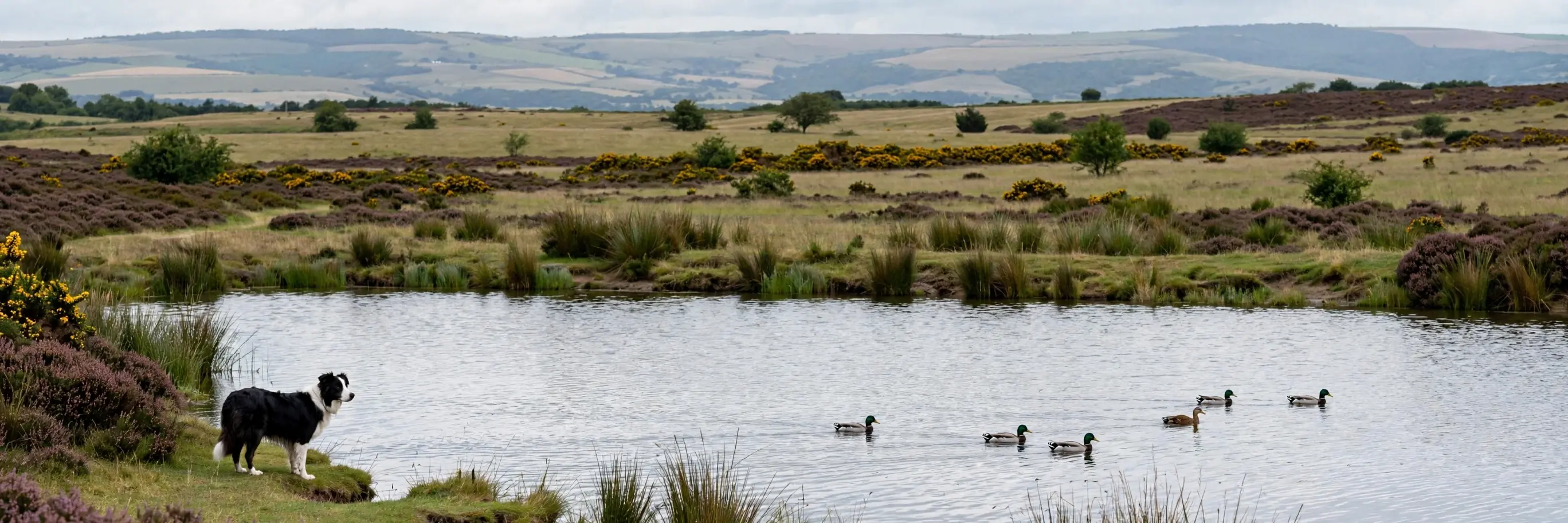
The pond is the centrepiece. It covers around six acres at the western end of the Heath, edged with reeds and overhung in places by willows, and it is home to ducks, moorhens, coots and a pair of mute swans that most regulars know by sight. Dogs paddle and swim in it, especially at the shallow, gravelly edges near the path, and on a summer evening the pond is the busiest place in town: spaniels in the water, terriers at the water’s edge, owners comparing notes on the bank. It is not a managed swimming area, so treat it as you would any natural water — check it before letting your dog in, and keep them out if the water looks discoloured or scummy, because blue-green algae can appear in warm weather. Anglers fish the pond too, so keep your dog clear of lines, rods and hooks, and watch for discarded tackle at the water’s edge.
The Heath has a history that is easy to miss while a dog is pulling towards the water. More than twenty Bronze Age burial mounds — barrows — survive on the Heath, making it one of the largest barrow cemeteries in Hampshire, and they are the low, grassy bumps you notice once you start looking for them. The war memorial stands at the western end, looking out across the pond, and the town gathers there each November. The Heath was once grazed and worked, and its heather and gorse are still managed for wildlife; in summer the heather flowers purple across the drier ground, and in winter the bare gorse and the big skies make it feel much wilder than a town-edge green has any right to.
For dogs, the practicalities are generous. There are paths around the pond and across the open ground, and a full circuit of the Heath and pond takes most people about forty-five minutes at a dog’s pace, with the pond loop alone closer to twenty. Dogs can run off the lead across much of the open ground, but the pond area is shared with waterfowl, small children and the play area, so keep your dog under close control near the water’s edge, especially in spring when ducklings and cygnets are about. Cattle are sometimes used for conservation grazing on the Heath, so if you see them, put your dog on a lead and give the animals a wide berth. There are bins for dog waste around the edges of the Heath, and a tap near the car park end for rinsing muddy paws — useful after the pond.
The seasons matter here. In spring, keep dogs out of the reed beds and away from nesting birds; the swans in particular are protective of their cygnets and will not hesitate to say so. In summer, the open heath has little shade at midday, so walk early or late, carry water, and let the pond do the cooling. Ticks are present in the rough grass and bracken, so check your dog after a walk, especially around the ears, armpits and belly. Adders live on dry heathland in this part of Hampshire, and Petersfield Heath is exactly the sort of place they favour, so keep dogs on the paths and out of dense bracken in warm weather, and know the signs of a bite — sudden pain, swelling and distress — and where the nearest vet is. In autumn the bracken turns copper and the Heath is at its most beautiful; in winter, after frost, the pond mists over and the whole place feels quiet and far from town.
The Heath is also the social heart of the town’s dog life. Regulars walk the same circuit at the same hour, dogs learn each other’s names before their owners do, and a visitor’s dog will be greeted, sniffed and assessed within minutes. If your dog is nervous or reactive, choose the quieter hours — early morning and late evening — and stick to the wider paths on the eastern side of the Heath, where there is more room to step aside. If your dog is sociable, the pond loop is the place to be: it is where the town’s dogs meet, and where you will pick up the local knowledge — which pub has the best dog biscuits, which field has sheep this week — faster than any guide can give it to you.
Queen Elizabeth Country Park
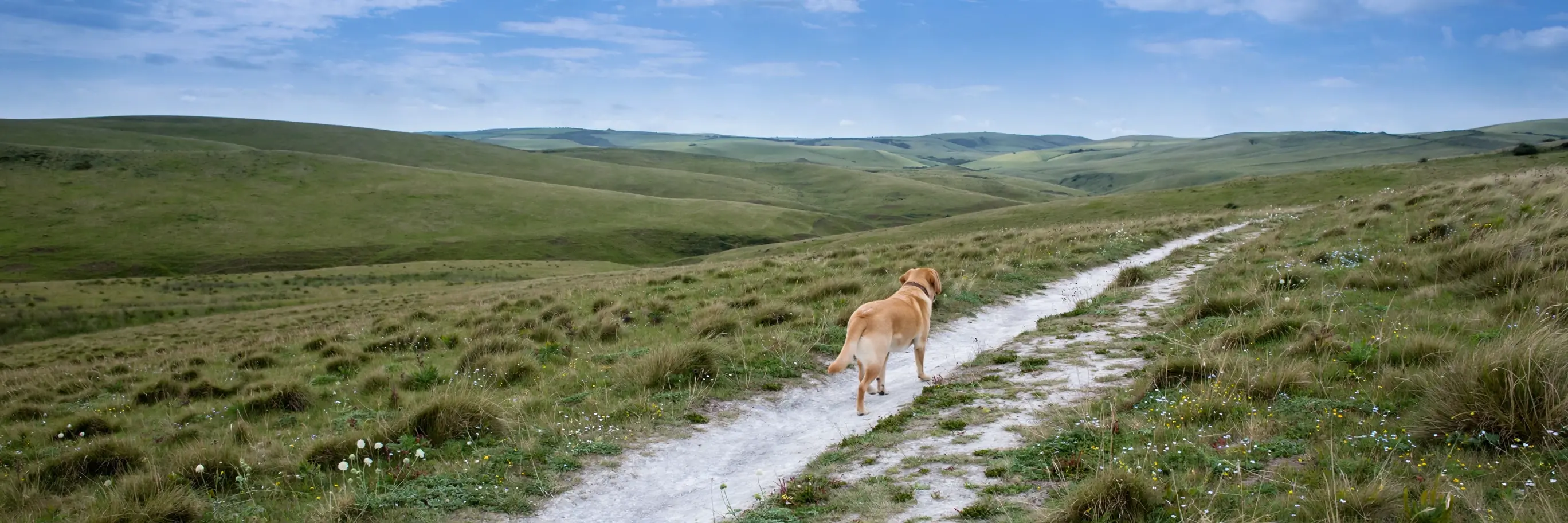
South of Petersfield, past Buriton and just off the A3, lies Queen Elizabeth Country Park — fourteen hundred acres of downland, woodland and chalk grassland inside the South Downs National Park, and the second half of any dog trip to Petersfield. The park’s visitor centre sits in a valley between the wooded slopes, with a café, a shop, toilets and a children’s play area, and from there the ground rises in every direction: through beech and ash woodland on the lower slopes, out onto open chalk grassland, and up to Butser Hill, at 271 metres the highest point on the South Downs, with views that on a clear day reach the Isle of Wight.
Butser Hill is the walk to do. From the visitor centre, the climb is steady rather than steep, following a well-made path up through the trees and then out onto the open hill, and it takes most people about forty-five minutes to an hour with a dog that keeps stopping to sniff. The top is a broad, grassy summit with a trig point and a panorama that runs from the Hampshire downs in the west to the Sussex coast in the east, and on a clear winter day you can pick out the ships in the Solent. It is exposed — there is no shelter and no water up there — so on a hot day go early, carry water for the dog, and do not linger at midday. In wind and rain it is equally exposed, and a dog that dislikes weather will want the woodland paths instead.
The woodland is the park’s other face, and in many ways the better one for dogs. The lower slopes are mixed woodland with surfaced paths that stay usable in wet weather, and the shade makes them the right choice on a summer afternoon when the open downland is too hot. There are waymarked trails of different lengths — a short loop around the visitor centre that takes about half an hour, and longer routes that climb through the woods to the downland edge — and the paths are well signed, with colour-coded markers at the junctions. The South Downs Way crosses the park, running east to west along the ridge, so a longer walk can follow it in either direction: west towards Winchester or east towards Eastbourne, with the South Downs Way itself offering a hundred miles of chalk ridge to plan around. The Hangers Way, a twenty-one-mile trail from the park to Alton, also starts here, heading north through the beech hangers above Buriton and Steep.
Dogs are welcome at the park, and the rules are the usual South Downs ones: dogs can run off the lead on much of the woodland and downland, but they must be on a lead around the visitor centre, the car parks, the picnic areas and the play area, and anywhere livestock is grazing. Sheep and cattle graze parts of the park as part of its conservation management, and the downland is open, so a dog that chases needs a lead on sight of animals — the law on worrying livestock applies here, and the consequences are serious. The park’s rangers ask owners to keep dogs under close control near the barbecue areas and the children’s play area, and to use the dog waste bins provided at the car parks and trail heads.
The practical details are worth getting right. The park’s car park is large and charges apply, so check the official guidance before you travel for current prices and opening times; the visitor centre has its own opening hours, and the café is a useful stop for coffee and a rest before the climb. Cycle hire is available at the park in season, which can be a way to cover more ground, though a dog that runs beside a bike needs to be well trained for it. There are picnic tables and barbecue areas near the visitor centre, and a dog that can settle under a table will be fine there, but a dog that barks at passing cyclists will be happier on a quieter woodland path. The park also hosts events through the year — guided walks, school holiday activities, and the occasional trail run — so check what is on before you go, and expect the car park to fill up on sunny weekends and school holidays.
Wildlife is part of the experience here, and it is worth a paragraph of its own. The chalk grassland of Butser Hill is one of the richest habitats in the park, with butterflies — including chalkhill blues and marbled whites in high summer — orchids in June, and skylarks singing over the open ground from spring onwards. Adders live on the dry slopes, as they do on the Heath, so keep dogs on paths in warm weather and out of dense bracken and long grass. Deer move through the woodland at dawn and dusk, and a dog with a strong chase instinct should be on a lead at those hours. And the views, when the light is right, are the reason to come: the late-afternoon sun across the downs from Butser Hill, with the Isle of Wight on the horizon, is one of the finest sights in southern England, and it is all the better for having a dog beside you.
The town centre and the market
Petersfield’s town centre is compact, flat and easy to walk with a dog, and it rewards a slow morning rather than a quick pass through. The Square is the centre of it — a broad, open market place, paved and ringed with shops, cafés and pubs, with St Peter’s Church on its eastern side. The church is a Norman building, parts of it dating to the twelfth century, and its churchyard is a quiet green space where a dog on a lead can pause in the shade. Around the Square, the streets fan out: High Street runs east towards the Heath, Chapel Street runs south towards the station, and Dragon Street heads north past the old coaching inns and the town’s independent shops.
Market day is when the town shows its best side. Petersfield holds a regular market on The Square on Wednesdays and Saturdays, with stalls selling fruit and vegetables, bread, cheese, meat, fish, flowers and plants, and a farmers’ market on the first Sunday of the month, when local producers take over the Square with Hampshire cheese, charcuterie, honey, cakes and cut flowers. Dates and times can change, so check the official guidance before you travel. Dogs on a lead are a normal sight at the market, weaving between the stalls with their owners, and most stallholders are used to them — but keep your dog close in the crowds, watch for food dropped at nose height, and remember that some stallholders keep dogs of their own behind the counter. Saturday is the busiest day, and a nervous dog will find Wednesday easier; the first hour of the market, when it is setting up and the crowds are thin, is the calmest time to browse.
Beyond the market, the town centre has the kind of shops that make a dog trip work. There is a good butcher, a baker, a greengrocer, a pet shop, and a clutch of independent cafés and delis along the High Street and Chapel Street, several of which put water bowls outside for passing dogs and welcome dogs inside or at the outdoor tables. The charity shops on Dragon Street and the High Street are worth a browse, and the town’s bookshops and antique shops are the sort of places where a well-behaved dog on a lead is usually welcome — though it is always worth asking first, and a dog that cannot settle is better left outside with one of the party. Petersfield Museum and Art Gallery, on St Peter’s Road just off The Square, tells the story of the town and the surrounding downs, including the Heath’s Bronze Age barrows and the local wool and market history; check the official guidance before you travel for its dog policy, as museums vary and the rules can change.
The town’s streets are also worth walking for their own sake. College Street and the lanes around St Peter’s Church have some of the oldest houses in town, with timber frames and flint walls, and the walk from The Square down Chapel Street to the station passes the town’s older coaching inns and the former market hall. There is a pleasant, level loop from The Square along the High Street to the Heath, around the pond, and back through the quieter residential streets — about an hour at a dog’s pace, and a good way to learn the town on your first morning. For a longer town walk, the footpath along the River Rother towards Sheet runs south-east from the town, and the lanes north towards Steep climb gently through beech woodland; both are described in the circular route at the end of this guide.
Practical matters in the town centre are simple. There are public toilets near The Square, and the town’s cafés and pubs are the fallback when they are closed. Water for dogs is available at several cafés and outside the pet shop on the High Street, but carrying a bottle and a collapsible bowl is still the safer bet on a hot day. The town is flat, the pavements are wide on the main streets, and the only real hazard for a dog is traffic on the A3 approaches and the busy junction at the bottom of the High Street, where the road narrows and the pavements are thin — keep your dog on a short lead there. If you are staying in the town, the vet practice and the pet shop are both within a few minutes’ walk of The Square, which is reassuring if your dog eats something it should not have at the market.
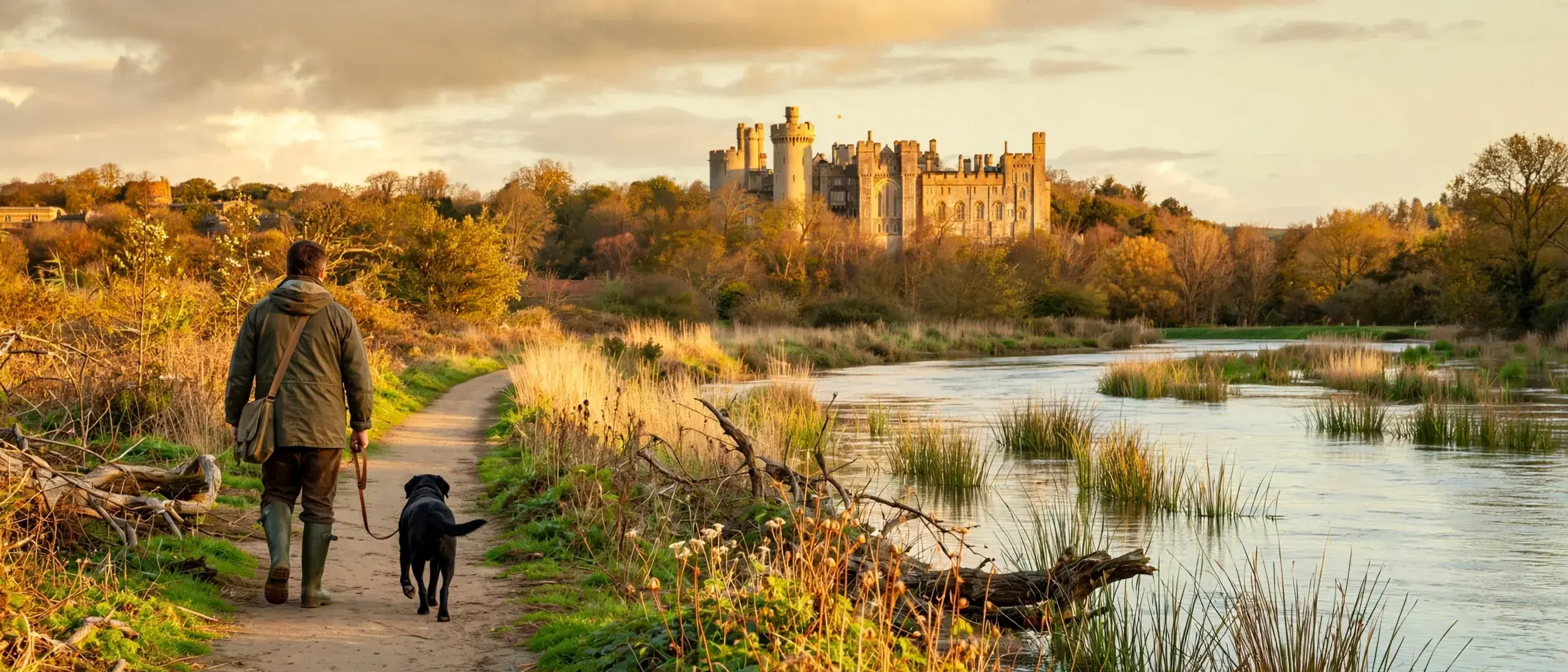
Petersfield is also a useful base for other towns in the South Downs, and a day trip is easy by train. Arundel, with its castle, river walks and Swanbourne Lake, is a straightforward journey south, and the coast at Portsmouth and Chichester is within half an hour by train. But there is no need to rush away: the town centre, the market and the Heath will fill a day on their own, and the downland to the south will fill the next one.
Pubs and stays
Petersfield’s pubs are dog-friendly in the way that Hampshire market-town pubs tend to be: dogs are welcome in the bar and the garden, water bowls appear without asking, and a dog that settles under the table is part of the furniture. The Plump Duck, on The Square itself, is the town’s most convenient dog pub — a traditional town-centre pub with a bar that welcomes dogs and a spot outside on the Square where you can sit with a dog and watch the market. The Square Brewery, also on The Square, is a small micropub pouring local and regional beers, with a plain, unfussy room where dogs are welcome and the conversation is the entertainment. Both are worth a visit on a market day, when the Square is full and the pubs are at their liveliest, and both are the kind of places where the bar staff will know the local dogs by name.
Further out, the pubs in the villages around Petersfield are worth the walk. The Good Intent, on West Street in the town, is a friendly local with a garden and a reputation for welcoming dogs, and the village pubs in Sheet, Steep and Buriton — all within a walk or a short drive — tend to welcome dogs in the bar and the garden, with the usual caveat that policies change and it is always worth checking before you travel. The Cricketers in Steep, a village pub at the foot of the beech hangers, is a good target for the end of a walk through the woods, and the pubs in Buriton, at the foot of Queen Elizabeth Country Park, are the natural stop after Butser Hill. The rule for all of them is the same: a dog that can settle under a table, stay off the furniture and not bark at other dogs will be welcome almost everywhere; a dog that cannot do those things yet is better off in the garden, or on a shorter visit.
For food, the town’s pubs serve the usual Hampshire fare — pies, ploughman’s, Sunday roasts — and several of the cafés on the High Street and Chapel Street welcome dogs at the outdoor tables and, in some cases, inside. The farmers’ market on the first Sunday of the month is the best place to stock up for a self-catering stay: Hampshire cheese, bread, charcuterie, cakes and local honey, all within a few yards of The Square. If you are eating out with a dog, the practical advice is to book ahead on market days and at weekends, to ask about the dog policy when you book rather than on arrival, and to bring a mat or a blanket for your dog to lie on — a dog with its own spot settles faster and stays calmer, and the staff will notice.
Staying in Petersfield with a dog is straightforward, though the town is small and the dog-friendly rooms go quickly at weekends and in the school holidays. The town centre has a handful of bed and breakfasts and small hotels within walking distance of the Heath, and the villages around the town — Sheet, Steep, Buriton and East Meon — have self-catering cottages and farm stays where a dog has a garden of its own. When you book, ask the questions that matter: how many dogs are allowed and what the pet fee is, whether dogs can be left alone in the room or cottage, whether there is a secure garden or a nearby field for the last outing of the night, and what the floor is — a cottage with hard floors and a dog that sheds will be easier to leave tidy than one with pale carpets. The answers vary widely, and the cheapest room is not always the best one for a dog.
A few practical points make the stay easier. Bring your dog’s own bed and a familiar blanket, because a dog that sleeps in its own spot settles faster in a strange room. Bring a towel for the pond — the Heath is five minutes from the town centre, and a wet dog in a bed and breakfast is nobody’s idea of a good time. Check where the nearest vet is before you need one, and keep the number in your phone; Petersfield has a vet practice in the town, and there are out-of-hours services in the wider area. And if you are staying in a village cottage, remember that the lanes are narrow, dark and without pavements after dusk, so a torch and a reflective lead are worth packing for the last outing of the night.
One last point on stays: Petersfield is a good base for a longer trip, not just a single night. A week here gives you the Heath, the market, Queen Elizabeth Country Park, the South Downs Way in both directions, and the villages of Sheet, Steep, Buriton and East Meon, all without a long drive. If you are planning that sort of stay, book the accommodation first and the walks second — the dog-friendly cottages with enclosed gardens are the ones that go first, and the walks will still be there when you arrive.
A circular route from the town
The best way to see Petersfield with a dog is to walk a loop that starts and ends on The Square, taking in the Heath, the pond and the River Rother, and returning through the quieter streets. The full loop is about five miles and takes most people two and a half to three hours with a dog that stops to sniff, and it can be shortened to the pond circuit alone — about forty-five minutes — or extended south to Queen Elizabeth Country Park for a full day out. The route is mostly flat, with one gentle climb at the start of the Rother path, and it is on a mix of pavements, surfaced paths and field-edge footpaths, so it is walkable in most weather, though the Rother path can be muddy after rain.
Start on The Square, outside St Peter’s Church, and walk east along the High Street. The street is flat and the pavements are wide, and the shopfronts give a dog plenty to sniff on the way. At the end of the High Street, turn left onto Heath Road and follow it to the end, where the town stops and the Heath opens out. Turn right onto the path around the pond, and follow it clockwise: past the reed beds at the western end, where the ducks and moorhens feed, along the northern edge where the water is shallowest and dogs paddle, and around the eastern end, where the path rises slightly and gives a view back across the pond to the town. This is the part of the walk where a sociable dog will meet half the town’s dogs, and where a nervous dog should be kept on a lead and given room.
From the eastern end of the Heath, leave the pond path and take the footpath south-east towards Sheet, following the edge of the heath and then dropping down towards the River Rother. The path here is narrower and can be muddy, and it crosses a couple of small wooden footbridges over ditches and streams, so keep a close eye on a dog that likes to jump in. The Rother is a small, clear chalk stream at this point, running through meadows and alder carr, and it is a good place for a dog to drink and cool off — though the banks are soft and a dog that scrambles in will come out muddy. Follow the river downstream towards Sheet, where the path passes the village green and the old mill buildings, and where there is a pub for a stop if you want one.
From Sheet, the return to Petersfield follows the lanes back into town. Walk north from the village green along the lane towards the town, past the houses and gardens of Sheet, and back into Petersfield via Dragon Street, which brings you out at the top of the town near The Square. The lanes are quiet and mostly traffic-free, but they have no pavements, so keep your dog on a lead and walk on the right-hand side facing oncoming traffic. The whole loop ends where it started, on The Square, and the pubs and cafés there are the obvious place to finish — a dog that has walked five miles will be ready to lie under a table and sleep, and you will have earned the same.
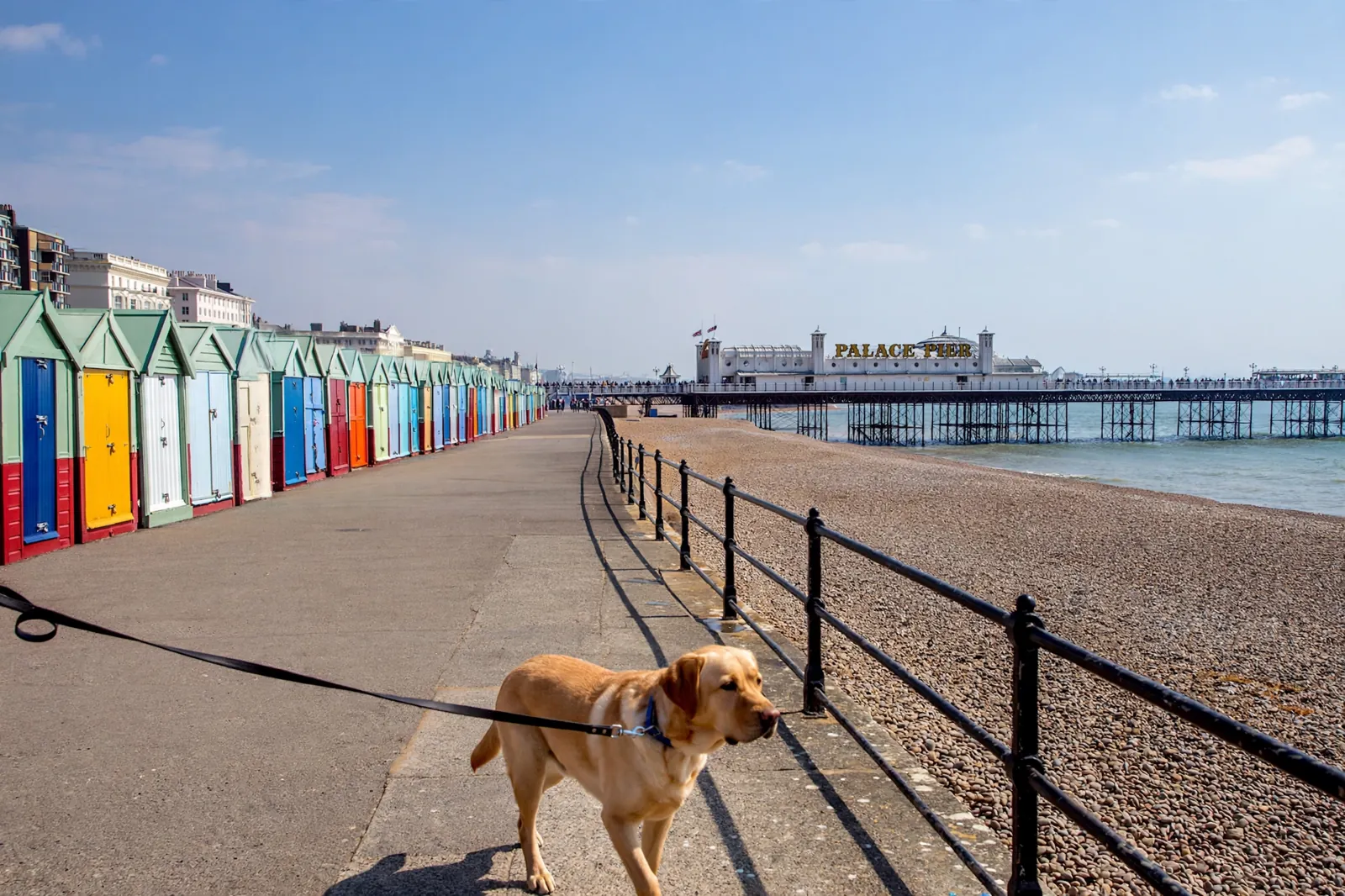
For a longer day, the loop can be extended south from Sheet or from the Heath to Queen Elizabeth Country Park. From the Heath, follow the Serpent Trail south through the fields towards Buriton, a walk of about three miles that joins the park’s northern edge, and then climb to Butser Hill before returning the same way or by the road. That extension turns the walk into a full day of eight or nine miles, and it is worth doing on a clear day when the views from Butser Hill are at their best. Alternatively, a longer day out by train is easy: Petersfield station has direct trains to Portsmouth and to the coast, and our guide to Brighton with a dog covers the pebble beach, the promenade rules and the South Downs walks at the other end of the line.
A few notes on doing the loop well. Go early in summer, when the Heath is quiet and the pond is at its best, and the Rother path is shaded by the alders. Carry water, because there is none on the Heath or along the river path, and a collapsible bowl is lighter than it looks. Check the ground after rain: the Rother path floods in places after heavy rain, and the field-edge paths can be deep in mud, so waterproof boots and a towel for the dog are worth packing from October to March. And keep an eye out for livestock — the fields between the Heath and Sheet are sometimes grazed, and the rule is the same as everywhere else in the South Downs: see animals, put the dog on a lead, and give them a wide berth.
Practical questions
Before you go
Can dogs swim in the pond on Petersfield Heath?
Dogs do paddle and swim in the pond, and many local dogs treat it as their regular swimming spot, but it is not a managed swimming area. The water is shallow at the edges and deeper in the middle, and blue-green algae can appear in warm weather, so check the water before letting your dog in and keep them out if it looks discoloured or scummy. Anglers fish the pond too, so keep your dog away from lines and hooks, and towel them off before heading into town.
Is the Heath safe for dogs in summer?
Yes, with the usual hot-weather care. The pond gives dogs a place to cool off, but the open heath has little shade at midday, so walk early or late on hot days and carry water. Ticks are present in the rough grass and bracken, so check your dog after a walk, especially around the ears and belly. Adders live on dry heathland in this part of Hampshire, so keep dogs on paths and out of dense bracken in warm weather.
Are dogs allowed off the lead at Queen Elizabeth Country Park?
Dogs are welcome at Queen Elizabeth Country Park and can run off the lead on much of the woodland and downland, but they must be on a lead around the visitor centre, the car parks, the picnic areas and anywhere livestock is grazing. Sheep and cattle graze parts of the park, and the South Downs Way crosses open downland where livestock may be present, so carry a lead and use it when you see animals. Dogs should also stay under close control near the play area and the barbecue spots.
When is Petersfield market, and can dogs go?
Petersfield holds a regular market on The Square on Wednesdays and Saturdays, and a farmers' market on the first Sunday of the month, though dates and times can change, so check the official guidance before you travel. Dogs on a lead are a normal sight at the market, weaving between the stalls with their owners. Keep your dog close in the crowds, watch for food dropped at nose height, and remember that some stallholders keep dogs of their own behind the counter.
How long is the walk from Petersfield station to the Heath?
It is about ten to fifteen minutes on foot from Petersfield station to the Heath, depending on your route and your dog's pace. From the station, head through the town centre past The Square and along Heath Road, and the open ground of the Heath appears at the end of the street. The route is on pavements all the way, so it works in any weather, and there are places to stop for water and a rest on the way.
Where can I park in Petersfield with a dog in the car?
The main town-centre car parks are the Central car park off Chapel Street and the station car park, with several smaller car parks around the town, and Queen Elizabeth Country Park has its own large car park south of Petersfield. On hot days, do not leave a dog in a parked car: the Heath and the country park are both a short walk from shaded parking, and the town centre is compact enough to park once and walk everywhere. Check the official guidance before you travel for current charges and time limits.