This guide is independent and contains no paid placement. If affiliate links are added later, they will be clearly marked and will not change our editorial checks.
A Pointer holiday needs three things that a generic dog holiday does not: daily access to open ground for a real gallop, an owner who understands and respects the point, and a working knowledge of the countryside calendar, so the dog is not loose among game or ground-nesting birds at the wrong time. Add a whistle, a paw-check routine and a warm bed, and the breed's famous indoor calm does the rest.
The point, explained for non-shooting owners
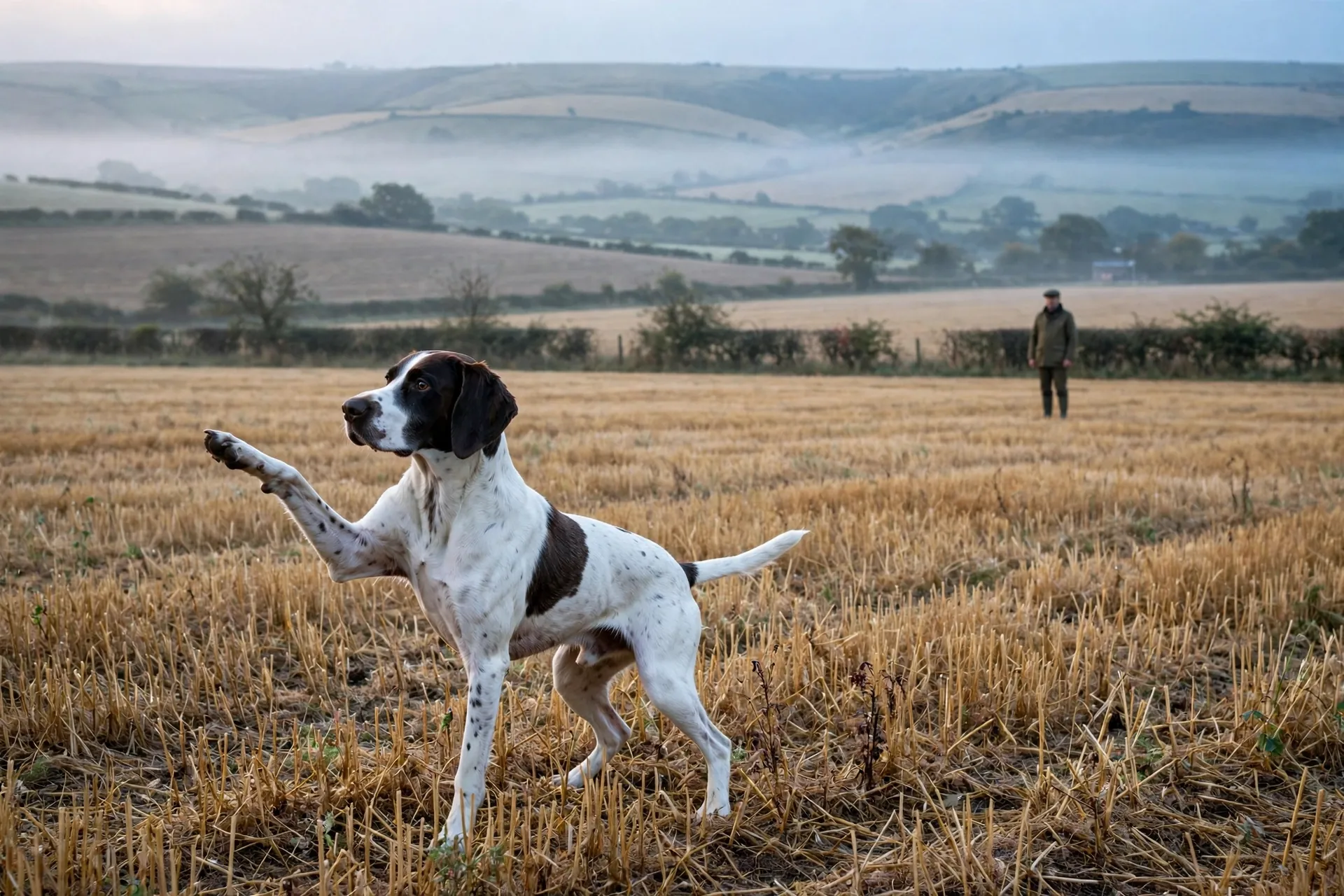
Most people who travel with a Pointer do not shoot, and many have never seen a point explained properly, which is a pity, because the point is the key to understanding the whole dog. When a Pointer scents game birds, it stops dead, body rigid, one foreleg often raised, nose pointing at the source, tail held still. This is not a trick, and it is not the dog being stubborn or disobedient. It is an instinctive pause that allows a hunter to approach, and it is one of the most impressive pieces of behaviour any dog breed displays. On a walk, a point usually happens at a hedgerow, a field margin or a patch of rough grass, and the correct response is simple: stop, admire it, walk up calmly, praise the stillness quietly, and then call the dog on with a release word. Dragging the dog away, scolding it or letting it flush the bird all teach the dog that pointing is either pointless or punishable, and both lessons damage the partnership.
Understanding the point also explains why a Pointer can seem to switch off its ears on a walk. When the dog is working scent, its attention narrows to the source, and a voice command that would work in the garden may not register at all. This is not defiance, and it is not a training failure in the simple sense: it is a dog doing the job its brain was built for. The practical consequence is that recall must be trained with scent as the distraction, starting in low-scent places and building up, and that a whistle, which cuts through wind and distance, is worth more than shouting. Owners who learn to read the point, the sudden stillness, the raised head, the intense focus, also learn to predict it, and can call the dog back before it locks on, or keep it on a lead through the most scent-rich ground. The point is not an obstacle to a Pointer holiday. It is the holiday, if you know how to watch it.
The gallop: why space is not optional
A Pointer does not merely run: it gallops, covering ground in long, sweeping casts that can take it hundreds of metres from its owner in seconds, and it needs to do this regularly to stay sane. A week of lead-only pavement walks, however long, will leave most Pointers frustrated, restless and destructive, because the breed's need is not just for movement but for open, galloping movement with scent to work. The solution is to plan daily access to genuinely open ground: a secure dog field hired by the hour, an open beach outside the summer restrictions, a large enclosed garden, or a stretch of moorland or common where the dog can legally run free and no livestock or game is present. One good gallop a day, followed by a sniffy walk and a settled evening, is worth more than three frustrated lead walks.
Choosing that ground requires care. Open ground is not automatically safe ground, and the places that look most inviting, a sweeping moor, a golden stubble field, a quiet headland, are often working farmland, shooting estates or nesting habitat. Check who owns the land, whether dogs are welcome off the lead, and whether livestock, game or ground-nesting birds are present, and respect the answer even when it is disappointing. Secure dog fields are the most reliable solution, and they are now available across much of the UK, often with fencing high enough for a Pointer and with a water supply and a shelter. Use them for the gallop, and use lead walks for the rest of the day's exercise, and the dog gets both the freedom it needs and the safety it deserves. A Pointer that has galloped is a different dog from one that has not, and the difference is visible within an hour of returning to the cottage.
Scent, recall and the disappearing dog
Recall is the hardest skill to train in a Pointer, and the most important, because a dog that disappears over a hill after a scent is a dog in danger from roads, cliffs, livestock and other people's land. Train recall from the beginning with scent as the central distraction, using high-value rewards that the dog only gets for recall, and practising in progressively more scent-rich environments, from a quiet garden to a field margin to a woodland edge. Never punish a dog for returning, however long it took, because a dog that is scolded for coming back will hesitate next time, and hesitation at a distance is how a Pointer gets lost. If the dog does not return, do not chase it, which turns the situation into a game the dog will win: instead, move to a visible position, use the whistle, and wait, because most Pointers will circle back to the last place they saw you if they are not chased further away.
Technology can help, but it cannot replace training. A GPS tracker on the collar gives peace of mind on open ground and helps you find a dog that has gone further than expected, but it does not stop the dog from going, and it does not work in every landscape, so treat it as a backup rather than a licence. A long line is a more honest tool: it gives the dog freedom to run and scent while keeping it connected to you, and it is the right choice on any ground where you are unsure about livestock, game, roads or cliffs. Learn the signs that a chase is about to happen, the sudden head turn, the stiffening body, the acceleration towards a hedgerow, and call the dog before it commits, because a recall given before the chase starts is ten times easier than one given during it. The best Pointer recall is built on a partnership in which the dog wants to return, and that partnership is built by rewarding returns lavishly, every time, without exception.
The countryside calendar: game and nesting seasons
Travelling with a Pointer means learning the countryside calendar, because the breed's instincts interact with it directly. In spring, roughly March to July, many ground-nesting birds are breeding, and a dog running free through moorland, heathland or rough grass can destroy nests and disturb chicks without ever being seen to do anything dramatic. During this period, keep the dog on a lead or a short line on moorland, heath and coastal grassland, and follow local signs, which often specify the dates and the areas where dogs must be on leads. This is not an anti-dog rule: it is the reason those landscapes still have birds in them, and a Pointer owner who respects it is protecting the countryside the dog enjoys.
The game shooting season adds a second layer. Pheasant shooting generally runs from October to February, grouse from August to December, and partridge from September to February, with exact dates varying, so check the official guidance before you travel to a shooting area. During shooting days, keep the dog on a lead near drives and beating lines, never let it run through a wood where a shoot is taking place, and respect any temporary closures or signs, because a loose dog on a shoot day is dangerous for the dog, disruptive for the shoot and damaging for the reputation of all dog owners. Outside these seasons, the same ground may be perfectly suitable for a gallop, which is why the calendar matters: the same field can be a paradise in March and a no-go area in November, and the owner who knows the difference is the one who can use the countryside all year. When in doubt, ask a local, check a noticeboard, or choose a secure field, and never assume that because a place was open last month it is open today.
Whistle training for wide-open ground
A whistle is the single most useful tool for a Pointer owner, and it is worth training properly before a holiday on open ground. A pea whistle or an Acme-style whistle carries further than a voice, cuts through wind, and gives a consistent cue that does not change with the owner's mood or tiredness. Train it at home first: pair a specific whistle pattern with a recall, reward lavishly every time, and practise at increasing distances in increasingly distracting places, until the whistle means, without exception, return now for something wonderful. On the trip, carry the whistle on every walk, on a lanyard so it is always to hand, and use it sparingly, so it never becomes background noise that the dog learns to ignore.
Whistle training also gives you a stop whistle, which is the second most valuable cue for a pointing breed. A stop whistle, trained as a sit or a stand at a distance, allows you to halt a dog that is about to chase, cross a road or enter a dangerous area, without needing to be close to it. Train the stop in the garden first, then on a long line, then at a distance, always rewarding the stop generously, and never using it to punish or to end a game, because a stop that means the fun is over will be obeyed reluctantly. Together, the recall whistle and the stop whistle give a Pointer owner a way to manage a dog at a distance that a voice alone cannot match, and they are the difference between a dog that can be trusted on open ground and one that cannot. The time spent training them before the trip is repaid on every single walk.
The quiet indoors half of the dog
People who meet a Pointer only at full gallop are often astonished by how calm the breed is indoors, and that calm is one of its great travel virtues. A Pointer that has galloped, worked its nose and had a proper meal will often sleep for hours, curled on a sofa or a dog bed, and will settle in a pub, a cafe or a hotel room with minimal fuss, provided it has had its exercise. This is not a contradiction: it is the breed's design, a dog built to explode into action and then to rest completely, and it makes a Pointer an excellent companion for the indoor parts of a holiday, from long lunches to quiet evenings in a cottage. The mistake is to expect the calm without the gallop, which produces the opposite: a restless, pacing, destructive dog that cannot settle because its body is still full of unspent energy.
To make the most of the indoor calm, give the dog a clear resting place in every new location: its own bed, in a quiet corner, with a blanket that smells of home, and a chew for the transition period when the household is still active. Keep the evening routine consistent, with the last outing, the last meal and the bedtime in the same order as at home, because a dog that knows what happens next settles faster than one improvising in a strange place. In pubs and cafes, arrive after exercise, choose a quiet corner, and give the dog a chew or a food toy while you eat, so the first twenty minutes pass calmly. A Pointer that is calm indoors is not a dog that has been trained to be quiet: it is a dog that has been given the exercise it needs, and the calm is the reward for that planning.
Body care: paws, ears, tail and thin skin
A Pointer's body needs regular attention on a holiday, because the breed combines a lean frame, a short coat and a habit of running hard through rough ground. Paws take the most punishment: check them after every long run or gallop for cuts, thorns, blisters and mud packed between the toes, and clean and dry them before the dog comes indoors. On rocky or stony ground, consider whether the route is suitable at all, because a Pointer that runs hard over sharp stone can cut its pads badly, and a cut pad can end a week's walking. In winter, rinse paws after walks on gritted pavements, and in summer, test hot surfaces with your hand before a long pavement walk, because a short-coated, lean dog has little protection against heat radiating from the ground.
Ears need checking after wet walks and swimming, because moisture trapped in the ear canal can lead to infection, and the signs, head shaking, scratching, a smell from the ear, should prompt a vet visit rather than a wait-and-see approach. The tail, which is often carried high and wagged vigorously, can be injured on fences, gates and furniture, and a condition known as happy tail, where the tip splits and bleeds from repeated wagging against hard surfaces, is worth knowing about, because it can be messy and slow to heal in a holiday rental. The short coat itself needs little grooming, but it offers little protection from cold, wind and sun, so a coat for cold weather and shade and water for hot weather are both part of the body-care routine. A Pointer that is checked daily, paws, ears, tail and coat, is a dog whose small problems are caught before they become trip-ending ones.
Cars, mud and the journey home
Car travel with a Pointer is usually straightforward, because the breed travels well once it understands that the car is a resting place, but the details matter. Restrain the dog with a crash-tested harness or a secured crate, never loose, and protect the car with a boot liner and a washable throw, because a Pointer that has galloped through mud will bring a significant portion of the field home with it. Towel the dog down before it gets in the car, and keep a stack of microfibre towels in the boot for the return journey, because a muddy dog in a car is a miserable start to the next day's walk. Break long journeys every couple of hours for toilet, water and a short walk, and never leave the dog in a parked car on a warm day.
The journey home deserves the same care as the journey out. A Pointer that has run hard all week may be stiff, tired or carrying a small injury that only becomes apparent when it stops moving, so check the dog over before the final journey, and plan a gentle last day rather than a final epic gallop that leaves the dog exhausted for the drive. Our guide to dog car safety compares harnesses and crates for medium and large dogs, including boot setups that work for a Pointer's size. On arrival home, give the dog a rest day, a proper wash and a check-over, and note any issues for the vet, because a holiday that ends with a healthy, rested dog is a holiday that can be repeated next year.
Fuelling a galloping dog
A Pointer that gallops daily on holiday needs more food than it does at home, but the increase should be gradual and based on the dog's usual diet, not on rich extras. Bring the dog's usual food from home in measured portions, increase the amount slightly on the hardest days, and split the daily total into two meals if the dog is working hard, so the stomach is never overloaded. Avoid feeding a large meal immediately before a gallop, and wait at least an hour after hard exercise before feeding, because exercising on a full stomach increases the risk of stomach problems, including bloat, which is a serious emergency in deep-chested breeds. Keep treats small, familiar and budgeted into the daily allowance, rather than added on top, because a Pointer that is given treats by everyone it meets will quickly exceed its needs.
Water is as important as food for a galloping dog. Carry water on every walk, offer it regularly rather than waiting for the dog to ask, and watch for signs of dehydration, including dry gums, loss of skin elasticity and lethargy, which should prompt a rest in the shade and a vet call if they do not improve. After a long gallop, let the dog cool down gradually before offering a large drink, because gulping cold water when overheated can cause stomach upset. If the dog has a known dietary sensitivity, carry a short written summary for any vet you might visit, and check the official guidance before you travel if you are unsure about any new food or supplement. A well-fuelled Pointer is a dog with steady energy, a settled stomach and the condition to gallop again tomorrow, which is the whole point of the trip.
Bases and routes for a Pointer week
The best Pointer bases in Britain offer open ground, a secure field nearby and a warm, comfortable cottage for the evenings. The Yorkshire Wolds, with their rolling chalk hills, open fields and quiet lanes, are superb Pointer country, provided the dog is kept on a lead during nesting and shooting seasons and given its gallop in a secure field or on suitable open ground. The Norfolk coast offers flat, open beaches out of season and long, straight trails, though the dog's stamina will mean it covers more ground than you expect, so plan distances accordingly. The moors of Northumberland and the hills of the Scottish Borders offer dramatic open ground, but they demand careful route choice to avoid livestock and game, and a local secure field is often the most practical daily gallop.
When you plan the week, build it around the gallop rather than around a list of attractions. A typical good day might start with a morning gallop in a secure field or on suitable open ground, continue with a sniffy lead walk through woodland or along a river, include a pub lunch where the dog can settle, and end with a short evening walk and a settled night. Book accommodation first, then find the nearest secure field and the nearest vet, and check that each planned route has a short version and a wet-weather alternative. Our guide to dog-friendly holiday parks covers the accommodation questions that matter for a large, active breed, including garden security and pet fees. A Pointer week done this way is not a compromise: it is a week in which the dog's gallop, its point and its indoor calm all get their proper place, and the owner gets to see Britain through the eyes of a dog that was bred for exactly this landscape. Our guide to finding an emergency vet on holiday is worth reading before travelling to a remote base, where the nearest practice may be a long drive away.
Practical questions
Before you go
What is pointing, and should I stop my Pointer doing it?
Pointing is the breed's natural freeze on scenting game, with the body still and the nose directed at the source. Do not punish it: praise the stillness, walk up calmly and then call the dog on. Punishing a point confuses the dog and damages the trust that recall depends on.
How much space does a Pointer need on holiday?
Pointers need regular access to open ground where they can gallop, ideally daily. A secure dog field, an open beach out of season or a large enclosed garden helps enormously. A week of lead-only pavement walks will leave most Pointers frustrated and restless.
When should I keep a Pointer on a lead in the countryside?
Keep the dog on a lead near livestock, roads, cliffs, ground-nesting birds in spring and during the game shooting season on estates where shooting is taking place. Check local signs and the official guidance before you travel, because access rules and seasons vary.
Do Pointers need a coat in British weather?
Often yes in cold, wet or windy weather, because the short coat offers little insulation and the breed is lean. Pack a waterproof coat and a warm layer, dry the dog after wet walks, and give it a warm, draught-free bed.
Are Pointers calm indoors after a gallop?
Many are, and this surprises people who only see the gallop. A Pointer that has run hard and worked its nose will often sleep for hours indoors. The calm is earned by the gallop, not a substitute for it, so plan both parts of the day.