No business named here has paid for its mention, and this page was put together independently of any of them. If a link that earns a commission is ever added to this guide, it will be labelled in plain sight, and the labelling will have no bearing on the checks described in the text.
Polperro rewards dogs that arrive ready to walk: leave the car in the big car park above the rooftops, drop down the lane to the harbour with the lead already on, wander the quays and the stepped side lanes, then choose between the cliff path west towards Talland Bay and the longer cliff walk east towards Looe. The return climb to the car park, the summer squeeze in the lanes, the state of the tide and the seasonal position on the beaches nearby are the four things to work around.
Arriving on foot: the car-free village
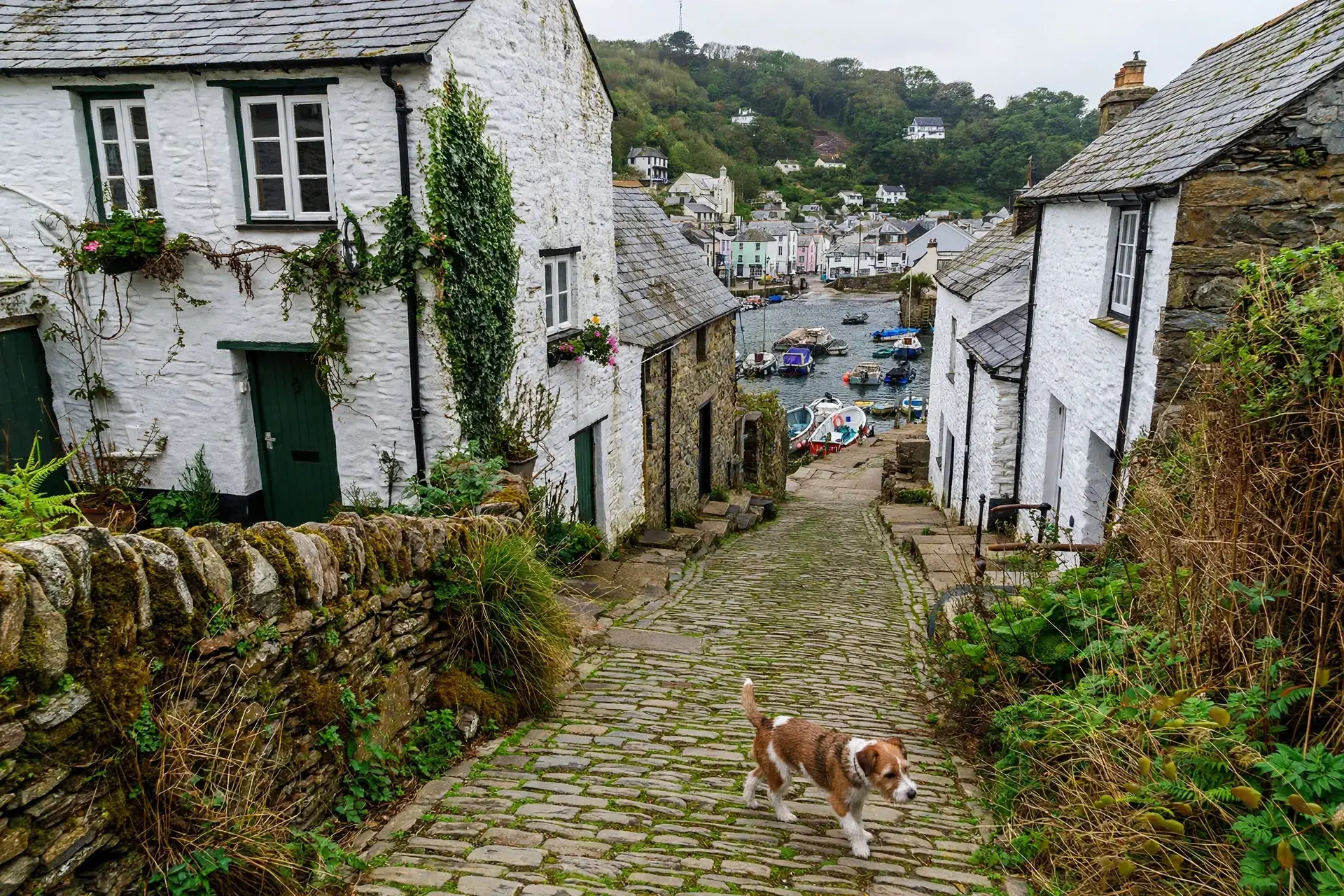
Polperro begins, for a visitor with a dog, at the top of the hill rather than at the water. Cars belonging to day visitors stop at the main car park on the village edge, and from there the only way in is on foot, down a lane that narrows between whitewashed cottages until the roofs give way to open sky above the harbour. Ten minutes of downhill walking does the job, and the descent itself sets the tone: washing lines and window boxes overhead, the River Pol chuckling somewhere below the road surface, gulls circling the masts, and the smell shifting from cut grass to tarred rope to brine as the gradient steepens. Dogs tend to read the village through their noses, and on this slope the scent changes every few yards, which is why so many of them pull forward eagerly even before the boats come into view.
Downhill is the easy half, and anyone planning the day should treat the uphill return as a separate event. The same lane that felt like a gentle amble on the way down becomes a long, steady pull on the way back, with the car park sitting well above the harbour and no shortcut to soften it. Stiff-legged dogs, elderly dogs and dogs still rebuilding fitness after an operation will feel it most, as will an owner carrying a tired terrier in one arm and a bag of damp towels in the other. Build pauses into the climb, let the dog choose the shady side of the lane, and offer water at the top rather than halfway, where the dog is still working. Visitors staying overnight in the lanes can dodge the worst of it by picking a cottage near the quays, while day visitors do better to leave the harbour while the dog still has something in reserve instead of waiting until the animal is flagging.
With visitor traffic held at the edge of the village, the centre of Polperro behaves differently from most Cornish resorts. The lanes belong to walkers, prams, delivery trolleys and dogs, and the usual seaside soundtrack of engines and reversing bleepers simply is not there for much of the day. That quiet makes a lead walk pleasanter and lets an owner actually look at the cottages, the slate roofs and the painted signs instead of checking over a shoulder for traffic at every bend. It does not make the lanes empty. In July and August the same narrow passages carry a slow two-way tide of holidaymakers, so a short lead and a willingness to tuck into a doorway matters more than it would on a wide promenade. Local vans and tradesmen still need access at certain hours, moving slowly and expecting pedestrians to give way, so the village is best described as largely free of cars rather than free of every vehicle.
Because the car sits a ten-minute climb away, the day bag has to be packed once and packed properly before the descent. Water and a folding bowl, more poo bags than seems reasonable, a towel for wet paws, the lead and harness already fitted, the dog's own food for a pub lunch, any medication, and a spare lead in case the first one gets soaked on the slipway: all of it goes down in one trip. Polperro has shops, so a forgotten packet of treats is no disaster, but a forgotten water bowl means a climb back up the hill that nobody wants in the middle of a hot afternoon. Pack at the car, check the bag twice, and treat the walk down as a one-way commitment until evening.
The car park itself is generous in size and still manages to fill early on fine summer days, on bank-holiday weekends and whenever the sun brings out the whole of south-east Cornwall at once. A nine-o-clock arrival usually finds a space without drama; an eleven-o-clock arrival on a Saturday in August often does not. Charges apply and the tariff board at the entrance is the authority on the day, so read it before walking away from the machine rather than guessing from memory of a previous summer. There is effectively no visitor parking inside the village itself, and the lanes are far too tight for hopeful kerbside parking, so the car park at the top is the plan rather than a fallback. Dogs must never be left in a parked car in warm weather, and leaving one behind while the owner strolls down to the harbour means a long, lonely wait at the top of a hill, which is not a kindness to the animal.
The harbour and the lanes
The harbour is compact enough to cross in a few minutes and layered enough to fill an hour. Stone piers shelter a narrow inner basin where fishing boats lie close together, their ropes and fenders almost touching the quay, while the cottages climb the valley sides on both flanks so steeply that the water seems to sit at the bottom of a bowl. A slow circuit of the quays takes roughly twenty minutes without stopping, and stopping is the point: a boat returning with its catch, a fisherman splicing a rope in the sun, a heron standing motionless on a mooring post. For a dog the quay is a library of smells — fish scales on damp stone, seaweed drying in the sun, diesel, tar, gull droppings — and a patient dog will work its way along the harbour wall nose-down for far longer than its owner expects.
Away from the water, the lanes do the exploring. They rise from the harbour in steps and slopes, twisting between cottages whose front doors open straight onto the pavement and whose upper windows lean out over the lane. Some passages are barely a person's width, and the turns are blind enough that a dog on a long lead will be round the corner before its owner. Keep the lead short here, keep the dog on the wall side, and be ready to step into a doorway when a group comes the other way. The cottages look plain and workmanlike rather than dressed up for photographs: thick walls, small panes, slate roofs, and doors that were once wide enough for barrels to pass through. Galleries and small shops occupy the ground floors of several of them, and a dog may be welcome in one and asked to wait outside the next, so a second person turns a browsing stop from a negotiation into a pleasure.
Tucked beside the inner harbour is Polperro's own small beach, a strip of shingle and sand that appears and vanishes with the tide. At low water it gives a puppy its first paddle and a nervous swimmer a gentle introduction, with shallow water and no surf to speak of. At high water it is gone altogether, the sea reclaiming the strip right up to the harbour wall. It is not a destination for a full beach day — there is no room for one, and the working boats are only yards away — but it works as a cooling stop between lanes and lunch. Read the board by the slipway for the current position on dogs, keep the lead on near the boats, and remember that a harbour beach is a workplace edge as much as a playground.
The quays demand a particular kind of attention from dog owners. Stone that has been splashed by the tide is treacherous under paws, the quay wall stands well above the water in the basin, and mooring chains, ropes and bollards sit exactly at dog height. Puddles on a working quay can hold fuel, fish waste and cleaning chemicals, so a thirsty dog should be steered to its own bowl rather than allowed to drink from the ground. A dog must not be allowed to jump into the basin: the water below is deep, the wall above it is high, boats move without warning, and hauling a sodden, panicking animal back up onto the quay is a far harder job than it looks from the edge. Fish boxes and bait tubs can hide hooks and sharp shell fragments, and the gulls that crowd a fishing harbour will lure a chasing dog towards the water in seconds. Give the fishermen and their gear a wide berth and the harbour stays a pleasure rather than a hazard.
Polperro runs on a daily rhythm, and a visit with a dog works better when it follows that rhythm instead of fighting it. Dawn belongs to the fishermen, the gulls and the early dog walkers, when the lanes are empty and the harbour light is at its softest. By mid-morning the day visitors arrive and the quays fill, and lunchtime is the busiest stretch, with terraces full and the lanes moving in both directions at a shuffle. Late afternoon thins the crowds out again and hands the village back to its residents, with warm light on the harbour and space to walk a dog without constantly stepping aside. Shape the day around that arc — an early wander, a cliff walk, a long lunch, an unhurried evening circuit — and both dog and owner get the village at its best.
Smugglers, fishermen and the village past
The smuggling stories that cling to Polperro are not decoration; they explain why the village is shaped the way it is. In the eighteenth and early nineteenth centuries this was one of Cornwall's most notorious smuggling harbours, and the tangle of lanes, the cellars under the cottages, the caves in the cliffs and a harbour mouth that could be watched from above were all part of the trade. Brandy, tea and tobacco came ashore after dark, vanished into hiding places beneath the floors, and were carried inland over the hills before the revenue officers could act. Zephaniah Job, the village's best-known smuggling figure, is remembered in the museum and in the stories still repeated around the harbour, and his name turns up whenever the village explains itself to visitors. A dog will not care about any of this, but an owner who knows it will understand why the lanes twist, why cottages back onto one another, and why the harbour feels built for watching.
Smuggling was only ever half the livelihood; fishing was the other half, and fishing is the half that still goes on. Polperro's boats work for shellfish and day-caught fish, landing the catch on the quay where it is handled in the open, and the harbour still functions as a workplace rather than a stage set. The fleet is smaller than it once was, and the pilchard days are long gone, but the boats go out, the catch comes in, and the village still earns part of its keep from the sea. The harbour museum — the Polperro Heritage Museum of Smuggling and Fishing, a short stroll from the quays — covers both halves of that story with photographs, objects and accounts from village families. Dogs are not normally admitted inside, so plan for one person to wait with the dog by the harbour while the other looks round; the museum is small and a visit is short, so it fits around a dog walk rather than displacing one.
The past is written into the buildings for anyone who looks closely. Cottages near the water were built for work: thick stone walls, tiny windows that keep out the weather, and doors sized for barrels rather than for show. The lanes were built for secrecy as much as for access, with sudden turns, dead ends and passages that a stranger cannot read at a glance. Harbour walls, old warehouse fronts and the limekiln carry the same story in stone, and the information boards around the quays fill in the details for anyone willing to stand and read them with a dog sitting patiently at their feet. Knowing a little of this changes the walk: the village stops being a pretty backdrop and starts looking like a place that was designed, over centuries, to keep its business out of sight.
One caution follows directly from that hidden-coast history. The cliffs around Polperro are cut with caves and small coves, and the coast path passes several of them, but the caves are not places for dogs to investigate. The tide floods them quickly, the rock inside is slick, and a dog that ducks into a cave mouth can find the way out cut off before its owner realises what has happened. Keep the dog on the marked path, keep it leashed near cliff edges, and enjoy the caves from the clifftop. The little coves below the path are the same story in miniature: beautiful, steep to reach, without facilities, and liable to be cut off by a rising tide, so they suit a brief look at low water rather than a settled afternoon.
Polperro has long drawn painters and photographers, and that artistic pull is part of the village's modern character. Galleries sit in the lanes among the cottages, and the light on the harbour — low sun on whitewash and wet slate — is famous enough that tripods appear on the quays in every season. Dogs are welcome in some gallery doorways and not in others, and a browsing owner does best with a companion to hold the lead outside. The same popularity means the quays can be crowded with people framing the same harbour view, particularly on summer weekends, so a dog that dislikes crowds will be happier at first light, when the village is quiet and the light is at its best, or in the evening once the coaches and day-trippers have gone.
Coast path to Talland Bay
Westward from the harbour, the cliff path to Talland Bay is the short, satisfying walk to pick when time is limited but a proper coast walk is wanted. The route climbs out of Polperro, crosses the headland above the village, and drops into a sandy cove about two miles away, a journey most walkers cover in an hour to an hour and a half each way, with stops. It is waymarked as part of the South West Coast Path, and it behaves like a real cliff path rather than a promenade: steep pulls, stone steps, uneven turf, and stretches where the ground falls away to the sea with no fence between path and drop.
On this stretch the lead stays on for the whole walk, and that is not a suggestion to weigh against the view. Drops beside the path are unfenced in places, the track narrows without warning, and grazing animals work the coastal fields beside it, so a dog that ranges free is a risk to itself and to livestock. A longer lead is pleasant on the flat, grassy sections, but it should be shortened to arm's length at every stile, every descent and every place where the track runs near a drop. After rain the descents into Talland Bay turn slick, so boots with a proper tread matter more than speed, and in high summer the open clifftop offers almost no shade, which means water for the dog, water for the walker, and an eye on heavy panting, drooling or a sudden wish to lie down in the nearest patch of shadow. Early starts and late afternoons suit this path far better than midday.
The walk unfolds as a series of views rather than a single panorama. Climbing out of Polperro, the path looks back over the harbour and the village packed into its valley, boats and cottages reduced to a model below, and that backward glance is worth a pause before the real climbing begins. Then the coast opens out: sea on one side, hedged fields on the other, the path dipping through small valleys and rising again, with places to sit and places where a dog can snuffle along a hedgerow while its owner watches the water. Talland Bay arrives suddenly, a sweep of pale sand between two headlands, and the descent into it is the steepest part of the whole outing. At the bottom there is a beach, a cafe, a car park and toilets, which makes the bay a natural turning point. Walkers with energy to spare can carry on along the coast beyond Talland, but that turns a morning out into a full day, and it deserves its own plan and its own weather window.
Talland Bay itself is a south-facing sandy cove, and it behaves very differently from the harbour beach back in Polperro. At low tide the sand runs wide and a dog can run properly for the first time all day; the water shelves gently, which suits swimmers, and families spread out across the beach without crowding one another. The position on dogs can change with the season, so the board at the beach entrance is the authority, and the council's current published list is worth a look before setting out from Polperro. The cafe at the bay is a useful stop for a drink and a sit-down before the climb back, and the beach gives a hot dog a chance to cool off in the shallows before the return leg begins.
Coming back, the same cliffs look different, because the light has moved and the village is now the destination rather than the starting point. The climbs that felt gentle on the way out bite harder on tired legs, so the return deserves the same unhurried allowance as the outward walk, with Talland Bay as a natural halfway rest. A dog that is flagging should set the pace, with frequent stops and no embarrassment about cutting the day short: an outing that ends with a happy animal beats one that ends with a sore, exhausted one. Cliff falls and maintenance work can close sections of the coast path at short notice, so a glance at the latest local notices before leaving the village is sensible, and a diversion, when one is in place, is usually longer than the stretch it replaces.
Coast path to Looe
Eastward, the coast path to Looe is the full-day option, and it asks considerably more of dog and walker than the Talland Bay stroll. Roughly five miles each way, it takes about two to two and a half hours in one direction, depending on stops, and it runs along the clifftop with the sea below and the fields inland, climbing and dipping through a sequence of small valleys. The views repay the effort — back over Polperro, forward to the headlands beyond Talland, and finally the roofs of Looe appearing as the path rounds the last headland — and Looe at the far end offers pubs, cafes, shops and a harbour to explore, which makes a proper destination of the walk rather than a mere there-and-back.
The same lead discipline applies on the Looe leg as on the Talland leg, and for the same reasons: unfenced drops, narrow stretches, grazing stock in the fields beside the path, and ground that turns to slick mud after rain. A long lead is fine where the path is broad and flat, but it should be gathered in at every stile, every descent and every exposed edge. Summer sun beats down on the open clifftop with little cover, so carry a bottle for the walker and a bowl of water for the dog, and watch for the early signs of overheating — heavy panting, thick drool, a dog that suddenly wants to stop and lie flat. This is a long walk for most dogs, so build the distance up over several shorter outings first, and be ready to turn around at Talland Bay if the dog's energy is fading rather than pushing on to Looe on principle.
Leaving Polperro eastwards, the path climbs above the harbour for a last look back at the village, then settles into its rhythm along the clifftop: sea to one side, hedgerows to the other, the ground rising and falling through folds in the land. Small coves and pocket beaches appear below, each reached by a steep track and none of them a place to plan a swim around, and the coast changes character as the walk goes on, from Polperro's tight valley to more open headlands. Talland Bay marks roughly the halfway point, a natural rest stop with its beach and cafe, and beyond it the path continues towards Looe with the town's roofs and harbour gradually coming into view. Dropping down into Looe from the coast path is one of the pleasanter arrivals in south Cornwall: the streets narrow, the river opens out, and the boats, the bridge and the two halves of the town are suddenly all there at once.
Looe itself is a twin town, split by its river into East Looe and West Looe and joined by a bridge, with a harbour, a beach, and pubs and cafes that take dogs in their outdoor areas and, in many cases, inside the bar. It is a good place to eat, drink and let a dog rest before the walk back to Polperro, and it is covered in full in our guide to Looe with a dog, which is worth reading before setting out, since it covers the town's beaches, food and staying in detail. A bus runs between Looe and Polperro, which sounds like a way to dodge the return walk, but its usefulness with a dog varies, so treat it as a bonus rather than a plan and be prepared to walk back along the cliffs if it does not work out. Allow as much time for the return as for the outward leg.
Wildlife is part of what makes the Looe leg memorable. Fulmars, kittiwakes and cormorants work the cliffs and the water below, gulls follow the fishing boats in and out of both harbours, and on calm days dolphins and porpoises are sometimes visible from the clifftops, most often spotted by walkers who stop, sit and watch the water for a while instead of marching on. Ground-nesting birds on the cliff tops are vulnerable in the breeding season, so keep the dog leashed and away from the nests, and keep it from chasing seabirds, which endangers the birds and risks the dog near an edge. In spring and summer the hedgerows along the path are thick with wildflowers, and the light in the late afternoon turns the whole coast gold, which is the best time to be out here with a dog that still has energy to spare.
Beaches and the seasonal rules
Polperro's own beach is small and tidal, so a beach day from here usually means Talland Bay on foot or the beaches around Looe by car, and the rules on each of them need checking properly rather than assumed. Talland Bay, reached by the cliff path described above, is the nearest proper stretch of sand, with a cafe and a car park, and it suits a dog that wants space to run and shallow water to swim in. Around Looe there is East Looe beach, Millendreath and a scatter of smaller coves, each with its own seasonal position, and the three options feel very different from one another, which is the point: a sandy cove one day, a town beach the next, and the harbour beach at Polperro in between for a quick paddle.
Across Cornwall the summer pattern on beaches is broadly the same, though the details shift from place to place. Popular resort sands commonly keep dogs off during daytime hours through the summer, often from around Easter or the start of May until the end of September, with the restriction usually covering the main stretch while quieter ends or neighbouring coves stay open. Exact dates, hours and areas are set locally and can change from one summer to the next, so a beach that welcomed dogs last year may not do so this year. How these seasonal orders work, and how to verify a beach before travelling, is set out in the separate guide to dog-friendly beaches in the UK, which is worth a look before any summer beach trip from Polperro, because the rules are not uniform and the fines for ignoring them are real. The reliable method is simple: read the board at the beach entrance, and cross-check against the council's current published list.
Further along the south Cornish coast there is more choice for a driving day. Downderry and Seaton, a short drive east past Looe, are long, open beaches that draw dog walkers in numbers and are generally welcoming to dogs, though their seasonal position should still be checked at the entrance. Whitsand Bay, further east towards Plymouth, is a vast sweep of sand that dogs love, but the access down to it is steep and the beach is exposed to the weather, so it suits a confident walker on a settled day rather than a casual stop. As a rule of thumb on this coast, busy sands tend to carry summer restrictions while the quiet little coves tend to stay open to dogs through the year. From a base in Polperro, the sensible approach is to plan beach days around the tide and the season, check the board every single time, and keep a fallback in mind — the coast path, the harbour, the village lanes — for the day the chosen beach is closed to dogs.
Around Polperro the beach hazards are specific to a working harbour coast rather than generic seaside advice. The harbour slipway and the steps down to the sand grow a slick coat of weed at low water, and a dog bounding down them can slip badly, so slow the animal down on wet stone and weed. Discarded fishing line, hooks and broken shell litter the sand near the harbour, and gulls drop fish remains that a scavenging dog will swallow whole. Currents run strongly past the harbour mouth and along the Talland shore, and surf can pull hard even when the surface looks calm, so swimming is best kept to the shallow, sheltered water at Talland and away from rocks and the harbour entrance. A dog that comes back from the water vomiting, scouring or suddenly dull has probably swallowed too much salt water and needs a vet without delay. Once back at the car, rinse the dog with fresh water, pick sand from between its toes, check its ears, and dry it off before the climb, because a wet dog cools fast on a Cornish evening.
Tide times shape every beach plan from Polperro, because the sands here are small and the rise and fall is large. At low water Talland Bay opens into a broad beach and the strip beside Polperro harbour becomes a proper place to paddle; at high water both shrink to almost nothing, and the sea crosses the flat sand faster than a walker expects. Look up the tide tables the evening before, and plan to reach the sand well ahead of low water rather than arriving as it turns. Keep a ball game on dry sand, away from the water's edge, and never let a dog follow a ball into deep water or across water that is already rising over the sand. With the tide timed and the board read, the beaches within reach of Polperro are among the easiest in Cornwall to enjoy with a dog.
Eating and drinking in the village
Eating in Polperro means eating beside the water, and the harbour's pubs and cafes are the village's dining rooms. A handful of places serve food and drink within sight of the boats, and several of them welcome dogs, most reliably in outdoor seating and on the terraces above the water. The practical result is that a dog owner can have a proper lunch, a decent coffee and an evening drink without once leaving the dog in the car or tying it up outside a door. That is not true of every Cornish village, and it is worth appreciating while it lasts.
The harbour pubs are the natural first stop after a coast walk, and the two best-known names on the quays, the Blue Peter Inn and the Three Pilchards, anchor the harbourside drinking scene. A garden or a terrace is the easiest place to settle a larger dog, so look for one of those first, and ask about the bar area when the weather turns — many pubs take dogs in the bar while keeping the restaurant dog-free, and the arrangement can differ between lunch and dinner service. Bring a blanket from home for the dog to lie on, and choose a table where the animal can tuck itself out of the way; a dog that settles quietly under a table is a dog that gets welcomed back. Pub dog policies shift, especially in peak season, so check the venue's own current notice or ask at the door rather than relying on a previous visit.
The cafes deserve a proper look as well, and the difference between a cafe that genuinely welcomes dogs and one that merely tolerates them shows in the details. A water bowl by the door is usually a reliable signal, as is a jar of treats on the counter and staff who make a fuss of the dog before they take the order. Outdoor seating is the easiest option in summer, and the harbour has several terraces that work well with a dog lying at its owner's feet. Inside, a table in a quiet corner lets the dog settle on a mat brought from home, and ordering promptly gives the animal something to look forward to. Walk the cliff path before lunch rather than after it: a dog that has just come back from Talland Bay will usually sleep through the meal, while one that has been waiting in the car all morning will fidget through it. And if the dog is unsettled, a takeaway eaten on a bench by the harbour is a perfectly good lunch, with a better view than most dining rooms.
For a longer stay, food becomes a real reason to base a break in Polperro rather than pass through it. The village shops sell enough local produce for self-catering, so over several days the pattern that works is a mix: a pub dinner one evening, a home-cooked meal the next, and a drive out for a change of scene after that. Liskeard with a dog covers the nearest market town, with its moor edge, market and valley walks, and it pairs naturally with this guide for a week-long stay. Feed the dog before you go out, carry water and a portable bowl, and bring a mat so the dog has a defined place to lie; a takeaway eaten on the harbour wall counts as a perfectly good dinner here. Anyone weighing a park stay instead of a cottage will find the practical differences set out in the guide to dog-friendly holiday parks in Cornwall.
Staying over and parking
Polperro works well as a base for a longer stay for a reason that has little to do with scenery: it is practical. Shops, places to eat, a harbour to walk around and a pharmacy are all within a few minutes of each other, which makes a self-catering break here easy in a way that a stay in a smaller coastal hamlet is not. Arrive, park the car, walk to the shops, cook dinner, take the dog round the harbour in the evening, and repeat the next day without ever needing to drive far. For dog owners, that compactness is worth as much as any view, and it is what turns a weekend into a restful one instead of a logistical exercise.
Staying in Polperro means staying in a village of steep stairs, narrow lanes and no parking at the door, so the questions worth asking before booking are different from the ones that matter in a flat seaside town. Start with the building itself: how many steps lead to the front door, how steep is the staircase inside, and is there a ground-floor room for a dog that no longer manages stairs? Then the practicalities of the stay: whether dogs are accepted in the exact room or cottage on offer, how many animals the host will take, what the charge is and whether it is levied per animal or per booking, and whether any size or breed conditions are attached. The outside space matters just as much: is there a yard, is it walled or fenced all round, how high does the boundary run, and could a determined dog push the gate open? And finally the question that decides whether an evening meal out is possible at all — may the dog be left alone in the place, and if so, for how long? A cottage with hard floors will forgive a muddy cliff walk far more readily than one with pale carpets, and that alone can decide between two otherwise similar listings.
A cottage of your own usually suits a Polperro break better than a hotel room, and the reasons are specific to this village. Mornings run on the dog's timetable here: out to the harbour before breakfast, back for a wash-down in the yard, then a late start on the coast path, with no breakfast service or checkout hour to work around. The right cottage has a place to hang wet leads, a hard floor by the door for sandy paws, and a machine for washing muddy towels — small things that matter far more after a wet walk to Talland Bay than a sea view does. Position matters too: a cottage down by the quays puts the harbour on the doorstep, while one up the valley means a climb at the start of every walk, and that climb, repeated three times a day, is the difference between a restful break and a tiring one. Parks and campsites in the countryside around the village suit families well, and caravans and lodges can work, but the same checks apply there — how the dog is housed at night, what happens when it needs to go out in the dark, and whether the steps and decking are safe for stiff legs.
Parking in Polperro needs a plan, and it is the one part of a visit that catches people out. The village centre is largely car-free, the lanes are narrow, and there is effectively no visitor parking inside the village at all. The practical answer is the main car park on the village edge, a ten-minute walk downhill from the harbour, with charges and time limits that change, so the tariff board on the day is the authority and the price should be checked before walking away. A fine summer day fills the car park early, and bank-holiday weekends fill it earlier still, so an early start is the only reliable strategy. Anyone staying overnight should ask the accommodation about parking before booking, because a cottage with a space attached is a different proposition from one without, and in a village as tight as Polperro that difference matters more than it would almost anywhere else. A car in summer sun is no place for a dog, however short the errand, so the animal comes down to the harbour with its owner or the trip waits.
A few last practical points round out the picture. The nearest veterinary practices are in Looe and in Liskeard, so find the closest one on arrival and save its number, together with the number of the nearest emergency out-of-hours service, before either is needed. Dog food is available from shops a short drive away, so running out of kibble is an inconvenience rather than a crisis. Phone signal is generally good among the cottages but fades on the more remote stretches of the coast path, so an offline map downloaded before setting out is a sensible precaution. Outside the summer season, check that the places you want to visit are actually open, because some cafes, pubs and attractions shorten their hours in winter, and the coast path can be quiet and muddy after heavy rain. What goes down the hill in the rucksack matters: water and a folding bowl, a towel, a spare lead, poo bags, a drying coat and a blanket for the car, a coat for a short-coated dog, and the dog's normal food and medication. A little planning goes a long way here, and Polperro rewards the visitor who plans around the tide, the harbour and the coast path in that order.
Three days in Polperro can take three different shapes. A Friday arrival works best as a gentle introduction: park at the top, walk down as the light fades, and let the dog learn the harbour by scent before dark, with supper in a harbourside pub. Saturday is the day for the cliff path west to Talland Bay, setting out early, lunching at the bay, and returning in the afternoon when the path has emptied. Sunday can be the Looe day: east along the cliffs for a low-tide beach morning, then back to Polperro for lunch and a last unhurried circuit of the quays before the climb to the car. That gives the dog a cliff walk, a beach morning and a harbour evening, and gives the owner a different kind of scenery each day without ever driving more than a few miles. Rain need not spoil the plan: the lanes are a pleasure in wet weather, the harbour cafes offer a dry hour with a view, and the coast path is still walkable in a shower for anyone dressed for it. The charm of basing a break here is that everything is close at hand and no single day carries the whole trip, which is the kind of slack a break with a dog needs.
Practical questions
Before you go
Can I drive into Polperro with a dog?
No. Visitor cars stop at the main car park on the village edge, and the centre down by the harbour is largely car-free, so the last stretch is a walk of about ten minutes downhill with the dog on a lead. Read the tariff board at the car park for the current charges, and check the latest local notices for any seasonal traffic arrangements before setting out.
Are dogs allowed on Polperro beach?
Polperro has a small shingle beach beside the inner harbour, and dogs are usually welcome on it outside the busiest part of the year, but it is a small, tidal strip that disappears at high water and sits next to working boats. The nearest larger beaches for a proper dog-friendly day are Talland Bay, reached on foot along the coast path, and the beaches around Looe. Read the board at each beach entrance for the current position.
Can I walk the coast path from Polperro with a dog?
Yes. The South West Coast Path passes through Polperro in both directions, west to Talland Bay in about an hour to an hour and a half, and east to Looe in about two to two and a half hours. Both directions are cliff walks with steep sections, stone steps and unfenced drops, so keep the dog leashed near edges and livestock, carry water for the dog, and look at the latest local notices for closures or diversions before setting out.
Is Polperro suitable for older dogs or dogs that struggle with steps?
Only in part. The harbour quays and the main lane through the village are relatively flat and manageable, but the side lanes climb steeply, the coast path is full of steps and sharp gradients, and the walk from the car park is downhill on arrival and uphill on departure. An older dog or one with joint trouble can enjoy the harbour and a short stroll, but the longer walks are demanding, so plan short outings and build in plenty of rests.
Where should I park in Polperro with a dog?
Use the main car park on the edge of the village, since the centre is largely car-free and the lanes are too narrow for visitor parking. From there it is about ten minutes downhill to the harbour. Arrive early in summer, when the car park fills quickly, read the tariff board for the current charges, and never leave a dog waiting in a parked car on a warm day.