This guide is independent and contains no paid placement. We name types of kit, not brands, so the advice still holds when models change. If affiliate links are added later, they will be clearly marked.
A portable dog shower is a low-pressure, controlled rinse you carry to the dog — not the dog to a tap. For most UK campers, a pump-action pressurised model of 7–10 litres is the sweet spot: enough for one muddy medium dog, no batteries, and a fraction of the water a bucket wastes. Rinse paws first, work in sections, keep it lukewarm in winter, and dispose of greywater away from streams.
The scene: why a bucket is not enough
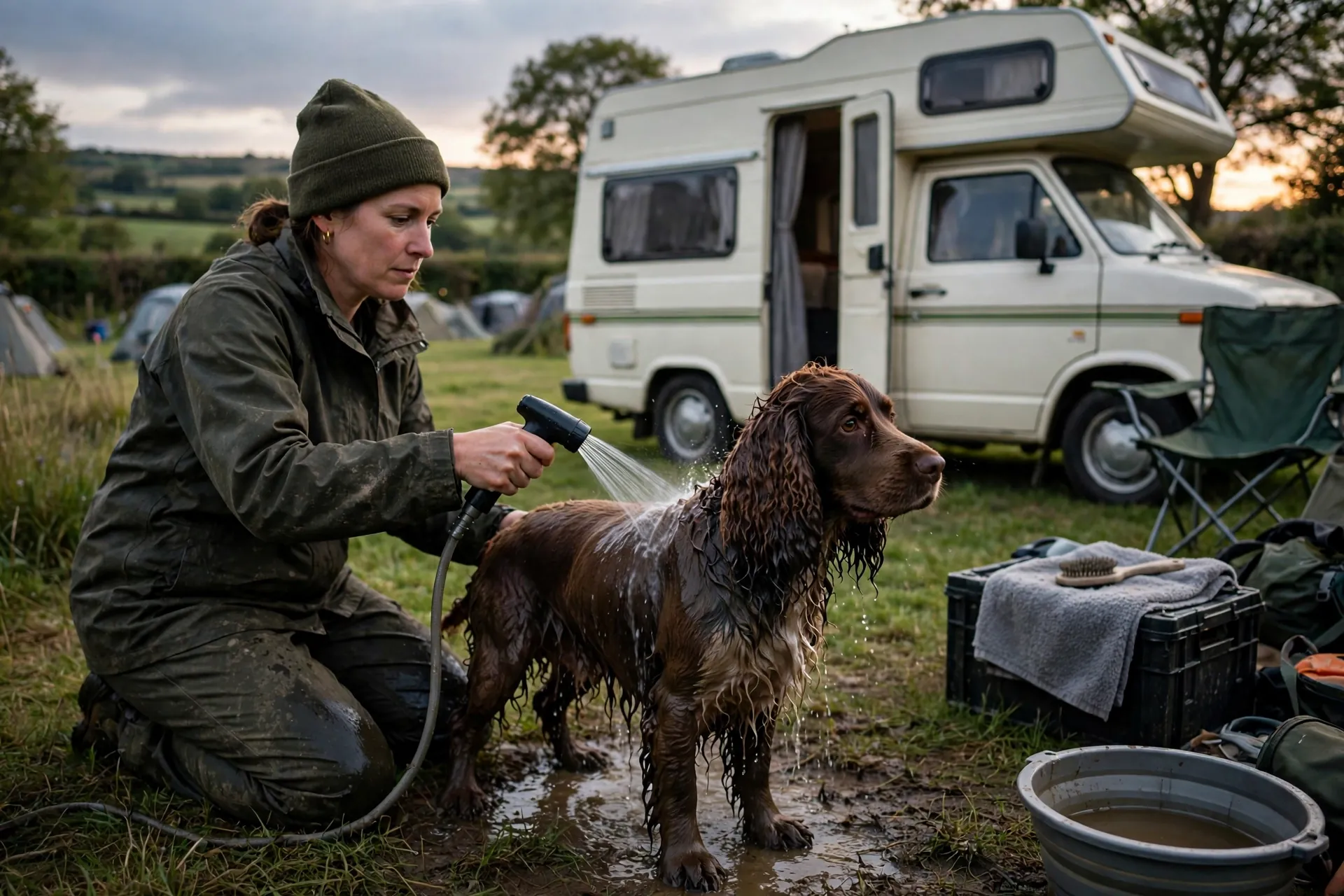
Picture the last evening of an October half-term trip. The site is a grass field two minutes from a Norfolk beach. Your spaniel has spent forty minutes in salt-mud, seaweed and the kind of wet sand that dries like concrete. The nearest standpipe is fifty metres from your pitch, it is 6pm, the light is going, and the dog is already shaking grit across the awning carpet. This is the exact moment the bucket method falls apart, and it falls apart in the same three ways every time.
First, a bucket has no pressure, and pressure is what moves grit out of a coat. Pouring water over a double-coated dog mostly wets the surface; the sand trapped against the skin, especially on the thighs, chest and between the toes, stays where it is. You end up using three buckets to achieve what a controlled low-pressure spray does in one pass, because the spray lifts and the pour just soaks. Spaniels, labradors and collies — the breeds that fill British campsites — all have coats engineered to hold on to debris.
Second, the water is wrong. Standpipe water in October can be single digits in Celsius, and a tired dog standing in cold dregs while you walk back for the third bucketful is not drying, it is chilling. A portable shower lets you carry warm-mixed water to the dog in one trip and apply it in a continuous, controlled flow. The dog stands still for two minutes instead of shivering for fifteen, which also means you are not towelling a dog that is already shaking with cold rather than wet.
Third, the logistics defeat you. Every bucket trip is a chance for the dog to roll, to bolt toward the tent, or to drink the muddy water you are trying to wash off. Muddy paw prints across the pitch multiply with each refill. A portable shower reverses the flow: the water comes to the dog at the car, the dog gets rinsed before crossing your clean line, and the whole operation happens once, at the spot you chose, with the drying kit already staged beside you.
None of this requires expensive kit. It requires a different idea: rinsing is a controlled process, not a quantity of water thrown at a dog. If you are new to taking a dog under canvas at all, read our beginner’s guide to camping with a dog in the UK first, then come back and add this to the packing list. The rest of this guide compares the three types of portable shower honestly, tells you what actually matters when buying, and walks through the field routine that makes it work.
The three types, honestly compared
Every portable dog shower on the market is a variation of one of three ideas: pump-action pressurised, gravity-fed, or electric pump. They differ in pressure, capacity, weight and fuss, and each suits a different kind of trip. Here is how they actually behave in the field, not on the packaging.
Pump-action pressurised: the garden-sprayer style
This is the most common type and the default recommendation for car campers. You fill a rigid tank of five to twelve litres, pump a handle to build roughly two to three bar of pressure, and squeeze a trigger on a lance or shower head. The spray is strong enough to lift sand from an undercoat but gentle enough for legs and belly if you keep the nozzle at a distance. Expect to pay roughly £15–£40.
The honest trade-offs: pressure fades as the tank empties, so the last litre is a dribble and you will re-pump once or twice per rinse. A full eight-litre tank weighs eight kilos, which matters if you have to carry it across a field. There are no batteries to charge and almost nothing to break, which is why this type survives years in a car boot. Look for a model with a proper shower head rather than a jet lance, because a jet is for patios, not dogs.
Gravity-fed: the hanging bag
The simplest option is a black bag or container of ten to twenty litres that you hang a metre and a half to two metres up — from a tree branch, an awning rail or a roof bar — and let gravity do the work. The black material warms the water in sunshine, which is genuinely pleasant on a summer pitch. These cost roughly £8–£20 and pack flat.
The honest trade-offs: the pressure is a dribble, not a shower, and it depends entirely on height. No tree and no height means no rinse, which rules it out for open pitches. On a grey November day there is no solar warming at all, and twenty litres of cold water arriving slowly is the worst of all worlds. Gravity-fed suits lightweight tent campers who rinse in summer and pack small; it is a poor choice as your only winter rinse.
Electric pump: the USB submersible
The newest type is a small rechargeable pump you drop into any container — a bucket, a collapsible jerrycan, a water carrier — with a hose and shower head on the end. Flow is consistent from the first litre to the last, many have adjustable flow, and the pump itself packs down to the size of a drinks can. Runtimes of 45–90 minutes per charge are typical, which is several days of rinses.
The honest trade-offs: you are now managing two things, the pump and its container, and the pump is useless with a dead battery. Cold weather noticeably shortens battery life, so charge from the car and keep the pump somewhere warm overnight. Total cost is higher — pump plus a decent container — but the flexibility is unmatched: the same pump rinses one terrier from a five-litre can or two muddy labradors from a twenty-litre carrier. For van lifers and frequent campers, this is usually the long-term answer.
| Type | Typical capacity | Pressure | Best for | Watch out for |
|---|---|---|---|---|
| Pump-action pressurised | 5–12 litres | Good, fades as tank empties | Car campers, one or two dogs | Weight when full; re-pumping |
| Gravity-fed bag | 10–20 litres | Weak, needs height | Summer tent camping, light packers | Needs a tree or rail; cold in winter |
| Electric pump | Whatever container you bring | Steady, adjustable | Vans, frequent trips, multi-dog | Battery charging; cold reduces runtime |
A short decision rule: if you camp from a car a few times a year, buy a pump-action pressurised model and stop thinking about it. If you hike in with a tent in summer, a gravity bag earns its place. If you live half your weekends in a van or run two or more dogs, the electric pump pays for itself in convenience within a season. Whatever type you choose, pair it with the water-awareness in our dog water safety guide — a dog that swims needs a rinse plan, not just a swim plan.
What to check before you spend a penny
Forget the marketing photos of gleaming vans. The five things that decide whether a portable shower actually gets used on your trips are capacity, nozzle, weight, power and cleanability — in that order.
Capacity: the per-dog maths
A useful rule of thumb: one proper rinse takes roughly five to eight litres for a medium-coated dog, three to four for a small terrier-type, and ten to twelve for a large or long-coated breed. A genuinely muddy walk usually needs two passes, so double those figures. Two muddy labradors on a wet February walk can therefore drink through a full twenty litres without trying. This is the single most common buying error: people buy the smallest tank to save boot space, then spend the trip queuing at the standpipe in the rain. A seven to ten-litre pressurised tank covers one medium dog with margin; multi-dog households should look at twelve litres or an electric pump fed from a separate jerrycan, which scales without carrying a heavier tank.
Nozzle and hose: gentle wins
You want a wide, soft spray pattern and a hose of at least one and a half to two metres, so the tank can sit on the ground while you work around the dog. An adjustable head that goes from mist to shower is ideal; a fixed jet is a red flag. Never use a pressure-washer-style setting on a dog — eyes, ears and groin need a cloth, not a jet, and even the belly prefers a soft flow. If the product photos show it blasting patio slabs, assume the nozzle is wrong for animals unless a proper shower head is included.
Weight when full, not when empty
Specifications quote the empty weight, but you carry it full. A litre of water is a kilo, so an eight-litre tank is eight kilos plus the tank itself — check the handle and whether you can lift it onto a tailgate or into a boot one-handed while holding a lead in the other. Collapsible containers win on pack size but lose on stability; rigid tanks win on durability but commit boot space. For electric pump users, the pump weighs almost nothing and the container choice is yours — a ten-litre rigid jerrycan is the practical middle ground.
Power, charging and the cold
Electric pumps usually charge over USB, and stated runtimes of 45–90 minutes are best-case figures measured in warm conditions with a new battery. Treat them as optimistic by a third, keep a car charger or power bank in the kit, and store the pump somewhere warm overnight — lithium batteries lose noticeable capacity in the cold, and a pump left in a freezing car may give you half its summer runtime. Pump-action and gravity models have no power worries at all, which is part of their appeal for simple trips.
Cleaning, shampoo and winter water
A wide mouth for filling and scrubbing matters more than it sounds, because tanks grow biofilm if you leave water sitting in them. Only add shampoo to a unit designed for it — on many pump-action models, residue coats the seals and clogs the trigger valve. The safer routine, covered below, is shampoo by hand and rinse by shower. For winter, the question is how you get lukewarm water: mix kettle water into the cold tank, stir thoroughly, and test on the inside of your wrist before it touches the dog. Never pour boiling water straight in, and check the official guidance before you travel if you are unsure about a site’s rules on warm-water washing or greywater disposal — policies vary, and a quick check at reception beats an argument with a warden.
The campsite and beach rinse, step by step
Kit is only half the system. The routine is what keeps mud out of the tent, and it works best when you set it up before the walk, not after. Stage everything at the car or at the edge of your pitch: the filled shower, a wash mat or old towel as the standing spot, two dry towels, a drying coat, and a lidded bag for the muddy lead and collar.
The clean line
Decide where mud stops. For most pitches that is the car boot or the awning entrance — the dog gets rinsed there, before crossing into the living space. The classic failure is letting an excited dog run to the tent first “just for a second”, because that second deposits the mud you then sleep beside. Rinse at the boundary, dry at the boundary, and only then let the dog in. On beach days, the same principle applies at the car: a full rinse in the car park beats a sandy back seat, and it is kinder than making the dog sit in salt-damp grit for the drive. Our guide to UK beach rules, bans and fines is worth reading before you plan the beach half of the trip, since seasonal restrictions decide which beaches are even an option.
Paws first, then work upward in sections
Start with the paws, because that is where salt, grit and mud concentrate — spread the toes gently and rinse between them, where irritation starts. Then do the legs, the belly and the chest, and only then the back and sides. Work with the lay of the coat and massage the water through with your free hand; on double coats, lift the top layer on the thighs and rump so the water reaches the undercoat instead of beading off the top. Keep the nozzle moving and keep the flow off the face entirely — eyes and ears get a damp cloth, never a spray, because water forced into an ear canal is how infections start.
Saltwater needs a full rinse, not a paw wash
After a swim or a beach run, dried saltwater irritates skin and stiffens coats, and sand works its way deep into feathering. This is a full-body job: rinse until the water runs clear, then rinse once more. Pay attention to the armpits, the groin and behind the ears, where salt hides. If the dog has been in the sea, this rinse matters more than any other in this guide — a dog left salty overnight will scratch, and the sand ends up in your sleeping bag. Rinse collars, harnesses and leads too; saltwater corrodes metal fittings faster than most owners expect.
Shampoo: only when needed, rinsed completely
Most rinses need no shampoo at all — water and massage shift mud and sand perfectly well. Save shampoo for genuinely filthy coats, fox-related incidents, or oily road grime. When you do use it, use a dog-specific shampoo diluted as directed, work it through by hand, and then rinse far longer than feels necessary: leftover residue is one of the commonest causes of itchy skin after trips. Never use human shampoo or conditioner; the pH is wrong for dog skin. Keep the dog’s drinking bowl well away from the rinse area so nobody drinks the runoff.
Dry properly, especially in winter
A rinse without a dry is half a job. Towel-squeeze the coat — press, don’t rub, on long hair — then put on a drying coat for fifteen to thirty minutes while you sort the rest of the kit. In winter, a damp dog should not lie on cold ground or in a cold tent; dry fully, and in freezing weather consider whether the walk itself was sensible. Finally, deal with the greywater: scatter it on grass well away from pitches, play areas and watercourses, never into a stream or ditch. If the site provides a dog-wash station or a sluice, use it. This small courtesy is what keeps sites tolerant of dog owners in general — check the official guidance before you travel if the site’s rules are unclear.
Winter water and the water-saving technique
Winter changes the equation. Cold water on a tired, wet dog in January is not bracing, it is miserable, and carrying twenty litres across an icy field is nobody’s idea of a holiday. The winter system has three parts: warm the water, use less of it, and protect the kit from frost.
Lukewarm, not hot
Dogs tolerate cool water far better than hot. The safe target is lukewarm — roughly skin temperature — made by mixing kettle water into the cold tank and stirring well. Always test on the inside of your wrist, the same way you would for a baby’s bottle, and re-test after the tank has sat for a while, because water stratifies. Never pour boiling or near-boiling water directly into the tank and hope it evens out, and be especially careful with black solar bags that have sat in strong low winter sun; they can surprise you. When in doubt, cooler is safer than hotter.
The two-pass water-saving method
You can cut water use dramatically with technique rather than kit. Pass one is a light mist over the whole dog, then massage the damp coat with your hands to loosen mud and sand — the mechanical action does the work, not the water. Pass two is the actual rinse, working in sections with the trigger off between sections. Cupping your hand loosely over the nozzle softens the spray and spreads it, which rinses faster than a narrow jet. Most people find this halves their water use compared with hosing continuously, which means a smaller tank, fewer refills, and less weight to carry. It also means the dog stands in the cold for less time, which matters most on winter evenings.
Frost-proofing the kit
Water expands when it freezes, and ice splits tank seams, cracks pump housings and ruins seals. In freezing weather, never leave a full tank or a pump in the car overnight — bring them into the tent porch, the caravan or the accommodation. Drain the hose and pump after the last rinse of the day, because a frozen hose is useless at 7am when the dog needs out. Carry only what you need for the morning rinse, and on truly bitter days consider rinsing paws only and saving the full wash for when the day warms. A collapsible jerrycan as the reservoir for an electric pump is the lightest winter setup: small to carry, easy to drain, and it lives inside the vehicle overnight.
Seven mistakes almost everyone makes once
Learn these from reading rather than from experience. Each one is common, each one is avoidable, and most of them happen on the first trip with new kit.
- Blasting the face. The shower head feels gentle on your hand and harsh in an eye. Face, eyes and ears always get a damp cloth, never the spray — and keep water out of ear canals, especially in floppy-eared breeds.
- Water too hot. Kettle water straight into the tank, no stirring, no wrist test. Burns happen faster than owners expect, and a dog cannot tell you the water is scalding until it is too late. Lukewarm and tested, every time.
- Letting the dog drink the rinse water. Dogs will drink anything at paw level, including runoff laced with shampoo or road grime. Keep a separate clean water bowl up and away from the rinse spot.
- Assuming every site allows it. Most pitches are fine, but some sites ban washing on grass, restrict water use, or ask you to use their wash station. Ask at reception on arrival — it takes thirty seconds and avoids the awkward conversation later.
- Buying the smallest tank to save space. The two kilos you save in the boot cost you three standpipe trips in the rain at 10pm. Size for your actual dogs and your actual mud, not for the tidiest packing photo.
- Leaving a full tank in a freezing car. Ice expands and splits seams, and a cracked tank leaks its entire contents across your boot on the drive home. Drain it or bring it inside.
- Skipping the dry. A rinsed-but-wet dog in a cold tent makes everything damp — bedding, clothes, the dog’s mood. The drying coat is not optional kit; it is the second half of the rinse.
Get these right and the portable shower becomes one of those pieces of kit you wonder how you camped without — like the windbreak, the headtorch and the second towel you always meant to pack.
Practical questions
Before you buy
How much water does a portable dog shower need per dog?
As a rule of thumb, a medium-coated dog needs roughly five to eight litres for one proper rinse. Small dogs manage on three to four litres, while large or long-coated breeds can need ten to twelve. A genuinely muddy walk usually means two passes, so double those figures or plan a refill. Electric pump models fed from a separate jerrycan are the easiest to scale up for multi-dog households.
Can I use a portable dog shower at any UK campsite?
On your own pitch, in most cases, yes, as long as you keep the rinsing contained and dispose of greywater sensibly. Some sites ban washing on grass pitches, near water points or during hosepipe-style restrictions, so ask at reception on arrival. Where a site provides a dedicated dog-wash station, use it first and keep your portable shower as the backup for remote pitches and wild-beach days.
Is warm water safe for rinsing dogs outdoors?
Yes, provided it is only lukewarm. Mix kettle water into the cold tank, stir well and test on the inside of your wrist before it touches the dog. Never pour in boiling or near-boiling water directly, and never trust the temperature of a black solar bag that has sat in strong sun all afternoon without testing it first. If in doubt, cooler is safer than hotter.
Do portable dog showers work for long-coated breeds?
They are arguably most useful for long and double-coated breeds, because those coats trap the sand and grit that a bucket rinse leaves behind. Work in sections with the lay of the coat, lift the top layer on thighs and chest, and massage the water through rather than just wetting the surface. Long coats take longer to dry, so pair the rinse with a drying coat and check between the toes where salt and sand collect.
Can I add dog shampoo to a pressurised dog shower?
Only if the unit is specifically designed to take additives. On many pump-action models, shampoo residue coats the seals and clogs the trigger valve, which shortens the life of the shower. The safer routine is to apply diluted dog shampoo by hand, work it through the coat, then rinse thoroughly with the shower. Whatever you use, rinse until the water runs clear, because leftover residue is a common cause of itchy skin after trips.