This guide is independent and contains no paid placement. If affiliate links are added later, they will be clearly marked and will not change our editorial checks.
Prestatyn works best as a walking base: start at the Offa's Dyke Path marker on the hillside, drop down to the beach and dunes, and finish with a flat promenade stroll past the Nova Centre. Dogs are welcome year-round on the quieter eastern beach towards Gronant, while the central beach has summer restrictions — check the official guidance before you travel.
A trailhead town, not just a resort
Most visitors arrive in Prestatyn for the beach. Dog owners have a better reason to come: this small Denbighshire seaside town is the northern terminus of the Offa's Dyke Path, the 177-mile National Trail that follows the Welsh-English border south to Chepstow. The trail does not begin on the sand or at the railway station, but up on Prestatyn Hillside, where a modest waymarker stands at the edge of the Clwydian Range. Standing there with a dog on a lead, looking back over the rooftops to the Irish Sea, you are at the start of one of Britain's great long-distance walks — and the first few miles of it make an excellent day walk in their own right.
That dual identity shapes everything in this guide. Prestatyn is a resort town with a promenade, arcades and a leisure centre, and it is also a hill town, with sheep-grazed slopes rising directly behind the high street. A dog holiday here can therefore be two different trips depending on the hour: a flat, easy seafront morning and a steep, scent-rich hillside afternoon. The trick is to plan around the dog you actually have. An older dog or a puppy will be happiest on the promenade and the firm sand at low tide; a fit adult dog will get far more from the climb to the trailhead and the first section of the path towards Bodfari. Neither is the wrong choice, but they need different routes, different kit and different expectations about distance.
Prestatyn sits on the North Wales coast between Rhyl to the west and the Dee Estuary to the east, with the A55 expressway running just inland. It is an easy drive from Chester, Liverpool and Manchester, which makes it a natural first stop on a longer North Wales trip — and a practical one, because the town has supermarkets, vets, pet supplies and plenty of parking within a short walk of the beach. The railway station is on the North Wales Coast Line, with services to Chester, Holyhead and Llandudno Junction; dogs travel free on trains in the UK when kept on a lead, which makes a car-free visit perfectly feasible if you choose accommodation near the seafront.
The town's layout is simple enough to learn in an hour. The seafront runs east to west along a broad sandy beach, backed by a promenade and the Nova Centre at its eastern end. Behind the seafront, the high street runs roughly parallel to the coast, and behind that the ground rises steeply towards Prestatyn Hillside and the Clwydian Range Area of Outstanding Natural Beauty. The dunes lie to the east, running from Barkby Beach towards Gronant and the Dee Estuary, and they are the quietest part of the coast — the place to head when the central beach is busy. Knowing these three bands — hillside, town, shore — is the whole geography of a dog trip here.
One thing worth saying early: Prestatyn is not a showpiece town. It is a working seaside resort that has seen better decades, and some visitors arrive expecting a polished Victorian promenade and find something plainer. For dog owners that plainness is mostly an advantage. The beach is wide and uncrowded outside peak summer weekends, the walks are free, and nobody minds a muddy spaniel on the promenade. Come for the walking and the space, not for boutique shopping, and the town delivers exactly what it promises.
Season matters more here than in many coastal towns. In winter the beach belongs to dog walkers, the wind is sharp off the Irish Sea, and the hillside paths can be muddy after rain. In summer the central beach fills with families, the seasonal dog restrictions apply, and the dunes become a haven for ground-nesting birds. Spring and autumn are the sweet spots: the restrictions lift or have not yet started, the light on the estuary is at its best, and the Offa's Dyke path is firm underfoot. This guide explains the rules for each season so you can plan around them rather than discovering them at a signpost.
The beach and the dunes: where dogs can go
Prestatyn beach is a long, flat stretch of sand that runs for roughly three miles from the town centre eastwards towards Gronant and the Dee Estuary, with the Wales Coast Path following the shore the whole way. At low tide the sand is enormous — firm, pale and excellent for dogs that like to run — while at high tide the water comes right up to the sea defences and the beach narrows to a strip. The tide matters for planning: check tide times before you set out, because a beach walk planned at high tide can turn into a promenade walk with no sand at all, and the return route along the dunes is the safer option when the tide is rising.
The dog rules are the part most visitors get wrong, because they are not the same along the whole beach. Denbighshire County Council applies seasonal dog restrictions to the busiest central section of Prestatyn beach during the summer months, typically from 1 May to 30 September, and dogs found in the restricted zone during those months can attract a fixed penalty under the Public Spaces Protection Order. The restricted area is signposted at the main beach access points, and it covers the central stretch in front of the town and the Nova Centre. The exact boundary and dates can change, so check the official guidance before you travel rather than relying on memory or on what another website said last year.
Outside the restricted zone, dogs are welcome on the beach all year. The practical answer for most dog owners is to walk east, towards Barkby Beach and Gronant, where the beach stays open to dogs even in high summer. Barkby Beach is the quieter continuation of Prestatyn's sands beyond the central section, backed by dunes rather than buildings, and it is where local dog walkers go when the main beach is busy. The sand there is just as good, the crowds thin out within a few hundred metres, and the walk east along the shore becomes a proper coastal walk rather than a resort beach visit.
Even where dogs are allowed, a few rules apply everywhere and are worth observing rather than testing. Dogs must be under control at all times, which in practice means a lead on in busy areas and a reliable recall off lead in quiet ones. Fouling must be picked up and bagged — bins are provided at the main access points, but the eastern end has fewer of them, so carry spare bags and take them home if a bin is full. Dogs should not be allowed to chase or disturb wildlife on the shore, which matters here more than on most beaches because the Dee Estuary is an internationally important site for wading birds, especially in winter when thousands of birds feed on the mudflats.
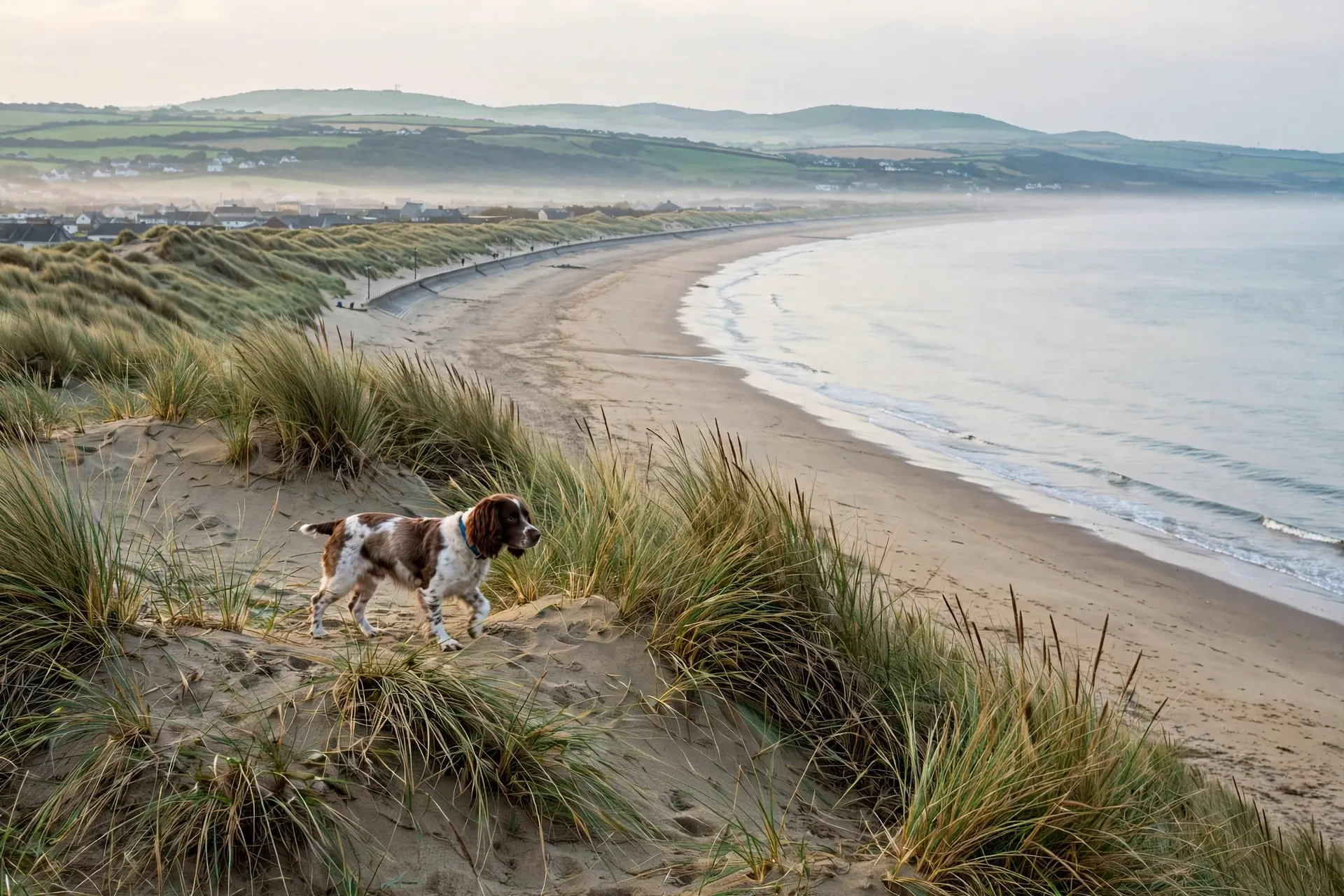
The dunes behind the beach deserve as much attention as the sand. The dune system between Prestatyn and Gronant is a fragile habitat of marram grass, sandy hollows and low scrub, and it is easy to damage without meaning to. Stick to the established paths through the dunes rather than cutting new routes across the grass, and keep dogs on a lead or close to heel where the paths narrow. The dunes are also where the ground-nesting birds are, and the section on Gronant below explains why that matters in the breeding season. In winter the dunes are quieter and the paths are firm enough for a good walk; in summer they are hot, dry and full of adders in some areas, so keep dogs on paths and watch where they put their noses into the grass.
Swimming is a question that comes up often, and the honest answer is that it depends on the dog and the day. The sea at Prestatyn is shallow a long way out at low tide, which makes paddling safe for most dogs, but the tide comes in fast across the flat sand and the water can be cold even in summer. Strong swimmers may enjoy a dip on a calm day, but never let a dog swim near the groynes or the harbour structures, and never let one chase a ball into deep water. After a swim, rinse the dog with fresh water if you can — salt and sand irritate skin and paws, and a quick rinse at the accommodation saves a lot of scratching later. Our wider guide to dog-friendly beaches in the UK explains the national rules, seasonal bans and fines in more detail, and is worth reading before any beach trip, not just this one.
A final practical point about the beach: the sand is deceptive about distance. A walk that looks like a gentle mile along the shore can turn into a two-hour round trip once the dog has run back and forth, investigated every rock pool and rolled in something unidentifiable. Carry water for the dog even on a short beach walk — there are no taps on the sand — and bring a towel and a spare lead. Wet sand gets everywhere, and a dog that has just swum in the Irish Sea will want to shake itself dry against the nearest person, which is usually you.
Walking the Offa's Dyke start
The Offa's Dyke Path begins, or ends, on Prestatyn Hillside. The northern terminus is marked by a waymarker at the top of the hill, and the first section of the trail runs south from there towards Bodfari, climbing through the Clwydian Range with views back over the coast. For most dog owners the sensible ambition is not the whole 177 miles but the first stretch: a there-and-back walk from the hillside to a natural turning point, or a linear walk to Bodfari with a taxi or a second car at the far end. Either way, the opening miles are some of the best dog walking in North Wales, and they start within a mile of the seafront.
Getting to the trailhead is the first decision. From the town centre you can walk up through the residential streets to the foot of the hillside, which takes twenty to thirty minutes and is steep in places, or drive to the car park at the base of the hill and start the climb from there. The climb itself is short but sharp: a well-used path rises through gorse and bracken to the ridge, where the waymarker stands. Fit dogs will take it in their stride; older dogs and puppies should be given time, water and a pause halfway, and anyone with a dog that pulls on the lead should use a harness rather than a collar on the steep sections.
Once on the ridge, the path is a different world from the seafront. The ground is open grassland and heather, the views stretch from the Dee Estuary to the mountains of Snowdonia on a clear day, and the walking is on a clear, well-marked trail. The first few miles towards Bodfari are undulating rather than steep, with a mix of grassy track, stony path and short climbs over the shoulders of the hills. This is proper hill walking, not a promenade stroll, so wear boots, carry water and a map, and do not rely on phone signal — coverage is patchy on the ridge and disappears entirely in some of the dips.
Sheep are the single most important thing to understand on this section. The hillside and the Clwydian Range are grazed by sheep year-round, and dogs must be on a lead wherever livestock are present — not just as a courtesy, but because the law on livestock worrying is strict and farmers can act against a dog that chases sheep. Keep the lead short when sheep are in sight, and keep it on even when they are not, because sheep can appear over a rise without warning. A dog with a strong chase instinct should stay on a lead for the whole hillside section, no matter how empty the path looks. If you want the wider background, our guide to Wye Valley walks with a dog covers the southern end of Offa's Dyke country and the same livestock rules in border country.
The wildlife is worth the lead discipline. The Clwydian Range is home to red grouse, skylarks, curlews and ravens, and the ridge is one of the best places in North Wales to hear a skylark in spring. Adders live in the gorse and bracken on warm days, so keep dogs on the path in summer and watch for the distinctive zigzag pattern if your dog is nosing through the undergrowth. Ticks are also present in the bracken from spring to autumn; check your dog thoroughly after the walk, especially around the ears, armpits and groin, and carry a tick remover.
How far should you go? A good first outing is the out-and-back from the trailhead to the first major viewpoint and back, which is roughly three to four miles and takes two to three hours with a dog. A more ambitious day is the linear walk from Prestatyn to Bodfari, about seven miles, which needs transport at the far end or a very long day. The full day's walk to the next major settlement is for experienced walkers only, and it is worth remembering that the path is exposed to wind and rain with little shelter — a fine day on the seafront can be a hard day on the ridge, so check the forecast and be ready to turn back.
What to pack for the hillside is different from what you need on the beach. Bring more water than you think the dog will need, because there is no reliable water source on the ridge, and a collapsible bowl. Bring a long lead for the open sections where no sheep are visible, and a short lead for the grazed stretches. Bring a first-aid kit with a tick remover and paw balm, because the stony sections can be hard on paws and the gorse can scratch legs. And bring a layer for yourself: the wind on the ridge is a different creature from the breeze on the promenade, and a dog that is happy to run in it will still need you to be warm enough to enjoy the walk.
The promenade and the Nova Centre
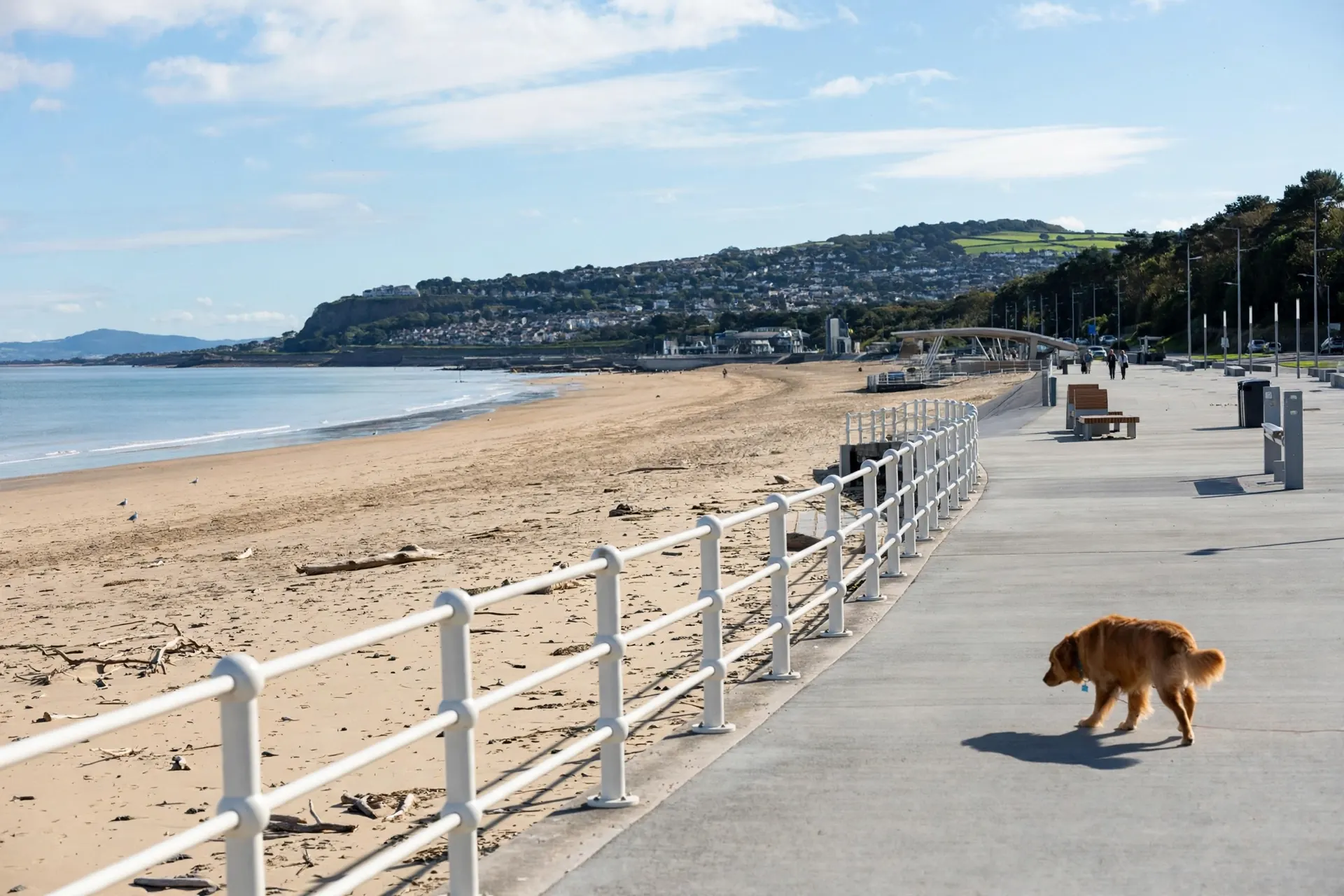
Not every walk needs to be a hill climb. Prestatyn's promenade is a flat, surfaced path running along the seafront, and it is the best option in the town for older dogs, puppies, dogs recovering from injury, and anyone who wants a walk that does not involve mud, stiles or sheep. Dogs are welcome on the promenade on leads all year, and the route is simple: start at the Nova Centre end and walk west towards Rhyl, or east towards Barkby Beach, and turn back whenever the dog has had enough.
The promenade itself is wide and well maintained, with benches, bins and beach access points at intervals. On a quiet weekday morning it can feel almost empty, with just a few dog walkers and joggers sharing the space; on a summer weekend it is busier, with families, cyclists and children on scooters, so keep the lead short and the dog close. Cyclists use the promenade too, and they can approach quietly from behind, so a dog that wanders across the path is a hazard — train a reliable "close" or "heel" before you rely on the promenade in busy periods.
The Nova Centre is the anchor of the eastern end of the promenade and the most useful building for a dog owner in Prestatyn. It is a leisure centre with a swimming pool, sports hall and café, and it has outdoor seating where dogs are welcome. The centre is also a practical base: toilets, drinking water, a car park and a beach access point are all within a few metres of each other, which makes it a good starting point for a walk and a good place to finish one. The café's dog policy for indoor seating can change, so ask on the day rather than assuming — outdoor seating is the safe option, and on a fine day it is the better one anyway.
From the promenade, several short detours are worth knowing about. The path through the dunes at Barkby Beach gives a quieter alternative to the promenade for the return leg, and the Wales Coast Path continues west towards Rhyl for anyone who wants a longer flat walk — the stretch to Rhyl is about four miles each way and is entirely flat, which makes it a good option for a fit dog on a cool day. If you are heading further along the coast, our guide to Colwyn Bay with a dog covers the next stretch of the North Wales coast in the same practical style, including its promenade, beach rules and tides.
Eating and drinking with a dog in Prestatyn is straightforward rather than spectacular. Several cafés and pubs along the seafront and high street welcome dogs, usually in outdoor seating areas or in a designated dog-friendly section indoors. Policies change with seasons and ownership, so the practical approach is to look for the water bowl by the door — it is the most reliable sign that a place genuinely welcomes dogs — and to ask before settling in with a wet, sandy dog. The high street has the usual mix of cafés, takeaways and a supermarket, which is useful for topping up dog food, treats and poo bags mid-trip.
One warning about the promenade in summer: the surface can get hot underfoot on a sunny day, and the sea defences reflect heat. Check the pavement with the back of your hand before setting out, and if it is too hot for your hand it is too hot for paws. Walk early or late in the day in a heatwave, stick to the sand or the grass where possible, and carry water. The promenade is at its best in the early morning, when the light is soft, the tide is often out, and the only other users are dog walkers.
Gronant dunes and the little terns
East of Prestatyn, past Barkby Beach, the coast changes character. The buildings stop, the dunes widen, and the beach becomes part of the Dee Estuary — a vast tidal landscape of sand, mud and saltmarsh that is one of the most important bird sites in Britain. Gronant is the small village at the eastern end of this stretch, and its dunes hold something special: one of the few little tern colonies in Wales, a small, delicate seabird that nests on the ground in a fenced area of the beach each summer.
The little terns arrive in late spring, usually May, and nest through the summer until August. The nesting area is roped off and wardened, with signs explaining the colony and asking visitors to keep out of the fenced ground. This is not a suggestion to be negotiated: ground-nesting birds abandon their nests if disturbed, and a single loose dog running through the colony can destroy a season's breeding effort. Dogs must be kept on a lead near the fenced area and kept out of it entirely, and the same applies to the paths through the dunes, where other ground-nesting birds such as skylarks and meadow pipits also nest in summer.
Outside the breeding season, Gronant is a quieter and more open place. The beach and dunes are excellent for a long, unhurried walk with a dog, and the birdlife is the main attraction: in winter the estuary fills with waders — oystercatchers, redshank, dunlin and curlew — feeding on the mudflats, while in spring and autumn the skies fill with migrating birds. Bring binoculars if you have them, and keep the dog on a lead when birds are feeding close to the shore, because a dog running at a flock of waders costs the birds energy they need for migration.
The walk from Prestatyn to Gronant is one of the best flat coastal walks in North Wales, and it is worth doing in full at least once. From the Nova Centre, follow the Wales Coast Path east along the beach and through the dunes; the round trip to Gronant and back is roughly six miles, and the path is mostly firm sand and surfaced track. There is a car park at Gronant for anyone who wants to drive there and walk back towards Prestatyn instead, which gives the same scenery with less distance. Either way, the route is exposed to the wind, so check the forecast and dress for the estuary rather than for the town.
The dunes themselves need a word of care. They look like a playground for dogs, with sandy hollows and grassy ridges to run through, but they are a protected habitat and the marram grass that holds them together is easily damaged. Stick to the marked paths, keep dogs from digging in the dune faces, and remember that the dunes are also home to adders in warm weather. The safest approach is to let the dog run on the open beach, where there is nothing to damage, and to keep it on a lead or close to heel through the dune paths themselves.
Gronant also has a practical side. The village has a small car park and a pub, and the beach access is straightforward. It is a good alternative base if Prestatyn itself is busy, and a good destination for a half-day walk that ends with a drink rather than a climb. In the breeding season, check the notice boards at the car park for the latest information about the tern colony and any temporary path closures — wardens update these regularly, and the colony's exact location can shift slightly from year to year.
Stays, parking and practical details
Prestatyn has a good range of dog-friendly accommodation for a town of its size, from caravan parks and holiday lets to guesthouses and a handful of hotels. The caravan parks on the edge of town are the most established option, and many accept dogs in selected units with a pet fee; the holiday lets in the residential streets behind the seafront are often more flexible about the number and size of dogs, and a fenced garden is worth asking for specifically if your dog needs one. Whatever you book, confirm the dog policy in writing before paying: the number of dogs allowed, the pet fee, whether dogs can be left alone in the unit, and whether there are any breed or size conditions.
Location matters more than luxury for a dog stay in Prestatyn. A property near the seafront saves a car journey for every beach walk, which adds up to several extra walks a day over a week; a property near the foot of the hillside saves the climb to the Offa's Dyke trailhead. A property in the middle of town gives you neither, but puts you closest to the shops and the station. Think about the walks you will actually do each day, then choose the location that makes those walks easiest — and check the route from the front door to the first patch of grass, because the after-dark toilet walk is the one that matters most.
Parking is straightforward in Prestatyn, with several car parks close to the seafront and the hillside. The car parks near the Nova Centre and at the Barkby Beach end are the most useful for beach walks, and the car park at the foot of Prestatyn Hillside is the best starting point for the Offa's Dyke Path. Charges and time limits vary by season and by car park, so read the signs on arrival and check whether a ticket is needed — the council's parking pages carry the current tariffs, and the machines take card payments. Blue Badge holders should check the designated bays at each car park, which are usually close to the beach access points.
A few practical details are worth sorting before you arrive. The nearest vet practices are in Prestatyn itself and in Rhyl, so save the number of the closest one to your accommodation before you need it, and note the out-of-hours emergency number as well. The nearest pet shop is on the high street, and the supermarkets stock a basic range of dog food and treats if you run out. The beach has no fresh-water taps, so carry water on every walk, and the hillside has no water either — a collapsible bowl and a litre bottle are the minimum for a half-day walk.
Weather is the other practical detail that catches people out. Prestatyn faces north-west into the Irish Sea, so the wind is a constant, and the weather on the hillside can be several degrees colder and much windier than on the seafront. Pack a windproof layer for yourself and a drying coat for the dog, and check the forecast for the hills separately from the forecast for the town. Rain is frequent and often arrives quickly from the sea, so a waterproof is worth carrying even on a day that starts sunny — and a dog that has been rained on twice will need drying twice, so bring more towels than you think you will need.
Finally, a note on travelling to Prestatyn with a dog. The A55 is the main road in, and it is fast and straightforward, but the last few miles through the town can be slow in summer. The railway station is a ten-minute walk from the seafront, and dogs travel free on trains when kept on a lead, which makes a car-free trip realistic if you book near the beach. If you are driving, remember that the car will get hot quickly in summer even with the windows open, and never leave a dog in a parked car on a warm day — the seafront car parks have no shade, and the temperature inside a car can rise dangerously in minutes.
A sensible one-day plan with a dog
A good day in Prestatyn starts early. Begin with the beach at low tide, when the sand is firm and the crowds have not yet arrived, and let the dog run off lead in the quiet eastern stretch towards Barkby Beach. An hour on the sand, with a swim for the dogs that like one and a rinse afterwards, sets up the rest of the day better than any amount of planning. Finish the beach session with a short walk along the promenade back towards the Nova Centre, where you can sit outside with a coffee while the dog dries off.
Midday is for the hillside, but only if the weather is kind and the dog is fit. Drive or walk to the foot of Prestatyn Hillside, climb to the Offa's Dyke waymarker, and walk the first section of the trail south for an hour before turning back. Keep the dog on a lead for the whole hillside section because of the sheep, carry water, and take the climb slowly — the views are the point, not the speed. If the dog is older or the weather has turned, skip the hillside and walk the dunes to Gronant instead; the birdlife is a fair exchange for the views, and the walking is flat.
The afternoon is for the quieter things. Walk the promenade west towards Rhyl for an hour, or explore the dunes at Gronant with binoculars and a lead. This is the time for the slow, sniff-heavy walking that tires a dog out more effectively than running, and for the café stop that makes a holiday feel like a holiday. If the dog is tired, a short loop around the town and a rest at the accommodation is a better choice than pushing on — a tired dog that is made to walk further is a dog that will be stiff the next morning.
The evening routine matters as much as the daytime plan. Feed the dog at the usual time, give it a last toilet walk on a familiar route close to the accommodation, and check its paws for sand, grit and ticks before settling in. A dog that has had a beach swim, a hill climb and a promenade walk in one day has had a full day, and a quiet evening is the right reward. Save the longer Offa's Dyke section for the next day, when the dog is rested and the weather has had a chance to change.
Practical questions
Before you go
Can my dog go on Prestatyn beach all year?
Yes, but not everywhere. Prestatyn's main beach has seasonal dog restrictions in the busiest central stretch during the summer months, while the beach towards Barkby and Gronant stays open to dogs. The exact restricted area and dates are set by Denbighshire County Council, so check the official guidance before you travel, and use the quieter eastern end if you visit in high summer.
Where does the Offa's Dyke Path start in Prestatyn?
The northern end of the Offa's Dyke Path National Trail is on Prestatyn Hillside, above the town, and is marked by a waymarker. From the seafront you can walk up through the town and climb onto the hillside, where the trail heads south towards Bodfari and the Clwydian Range. Dogs should be on a lead on the hillside because sheep graze there.
Are dogs allowed at Gronant dunes?
Yes, dogs are welcome on the beach and dunes at Gronant, but they must be kept under control and on a lead near the fenced little tern nesting area in the breeding season, roughly May to August. The colony is one of the few in Wales, and wardens rope off the nesting ground; keep dogs out of the fenced area and stick to the marked paths through the dunes.
Is the Prestatyn promenade dog-friendly?
Yes. The promenade along Prestatyn seafront is open to dogs on leads all year, and it is one of the easiest flat walks in the town for older dogs and puppies. The Nova Centre at the eastern end of the promenade has outdoor seating where dogs are welcome, and the beach is a short step down from the prom at several access points.
Where can I park with a dog in Prestatyn?
The most useful car parks for dog owners are the seafront car parks near the Nova Centre and the Barkby Beach end, and the car park at the foot of Prestatyn Hillside for walkers heading up to the Offa's Dyke Path. Charges and time limits vary by season, so check the signs on arrival, and never leave a dog in a parked car on a warm day.