We wrote this guide ourselves and took no payment for any mention in it. Should we ever add affiliate links, we will label them plainly, and they will not affect what we recommend or how we check it.
Preston is a river city with a ready-made dog route: the 21-mile Guild Wheel circles the whole place, Avenham and Miller Parks give you shaded riverside walking minutes from the centre, and Brockholes Nature Reserve adds wetlands and lakes a short drive east. Walk the Wheel in sections, keep dogs on a lead beside the Ribble and on shared paths, and use the parks for off-lead time where the rules allow it.
Start on the Guild Wheel: a 21-mile loop in bite-size pieces
Preston has something most British cities do not: a complete, signposted, mostly traffic-free ring route around the whole city. The Guild Wheel is a 21-mile loop built for the Preston Guild celebrations of 2012, and it works just as well on foot with a dog as it does on a bike. It runs on a mix of riverside paths, old railway lines, park edges and quiet lanes, and it passes through or beside Avenham Park, the River Ribble, the Lancaster Canal, Moor Park, Haslam Park and the docks at Riversway. You do not need to walk the whole thing. The sensible approach is to treat it as a menu of out-and-back sections, each with its own character, and to pick the piece that suits your dog that day.
The southern stretch is the one most visitors meet first. From Avenham Park the Wheel follows the Ribble east past the city centre, crosses the river, and runs through the green corridor towards Brockholes. This is flat, mostly surfaced walking with long views across the water, and it suits older dogs and puppies still building stamina. The western side of the loop is different: it drops towards the docks and the River Ribble at Riversway, where the path runs beside the marina and the old dock basin. Here the ground is open and the wind comes straight off the estuary, which excites some dogs and unsettles others, so watch how yours reacts before committing to a long stretch. The northern arc is the quietest part of the Wheel. It threads through residential streets around Fulwood and Ingol, crosses the Lancaster Canal, and passes Haslam Park, where there is open grass for a breather and a chance to let a dog stretch its legs properly.
Shared-use etiquette matters more here than on a normal footpath, because the Wheel is genuinely busy with cyclists, including commuters and families with children on bikes. Keep your dog on a short lead on every tarmac section, keep to the left, and never let a long line trail across the path. At junctions, bridges and anywhere the route crosses a road — notably around the docks and the crossings near the M6 corridor — clip the lead short and check both ways before stepping out. Dogs that chase wheels need particular care here: if yours fixates on bikes, start with a quiet weekday morning on the northern arc rather than a sunny Saturday on the riverside, and reward calm behaviour every time a cyclist passes.
Navigation is straightforward but not foolproof. The route is signposted with Guild Wheel markers, yet signs are easiest to miss where the loop leaves a park and joins a road, for example around Fulwood and near the canal crossings. Download or print the route before you set off, and agree a bail-out point in advance: the loop passes the city centre, the railway station, the bus station and several car parks, so you are rarely far from a road or a bus stop. Carry water even on short sections, because there are stretches of the northern and eastern arcs with no shops, no taps and no shade. A collapsible bowl weighs nothing and turns a dry two-hour loop into a comfortable one.
For a first visit, three sections give you the best return for the least effort. The Avenham to Brockholes stretch is the prettiest and the flattest. The docks loop from Riversway is the most open and the best for dogs that like big skies and long sightlines. The Haslam Park to canal section in the north is the calmest, and it is the one to choose if your dog is nervous around bikes or crowds. Walk one section well rather than grinding through the full 21 miles, and save the complete loop for a dry day when you have a support car or a bus ticket for the way home.
Avenham and Miller Parks: the Ribble at its best
Avenham Park and Miller Park sit side by side on the south bank of the River Ribble, just below the city centre, and together they are the best dog walk in central Preston. Avenham is the larger of the two, a Grade II listed Victorian park laid out on terraces above the river, with mature trees, sweeping lawns, a Japanese garden and wide paths that stay walkable in most weather. Miller Park is smaller and more formal, with flower beds, a fountain and views across to the railway viaduct, and it feels more like a garden than a park. The two are connected, so a single visit covers both, and the walk down from Fishergate Hill through the park gates to the riverside takes only a few minutes from the city centre.
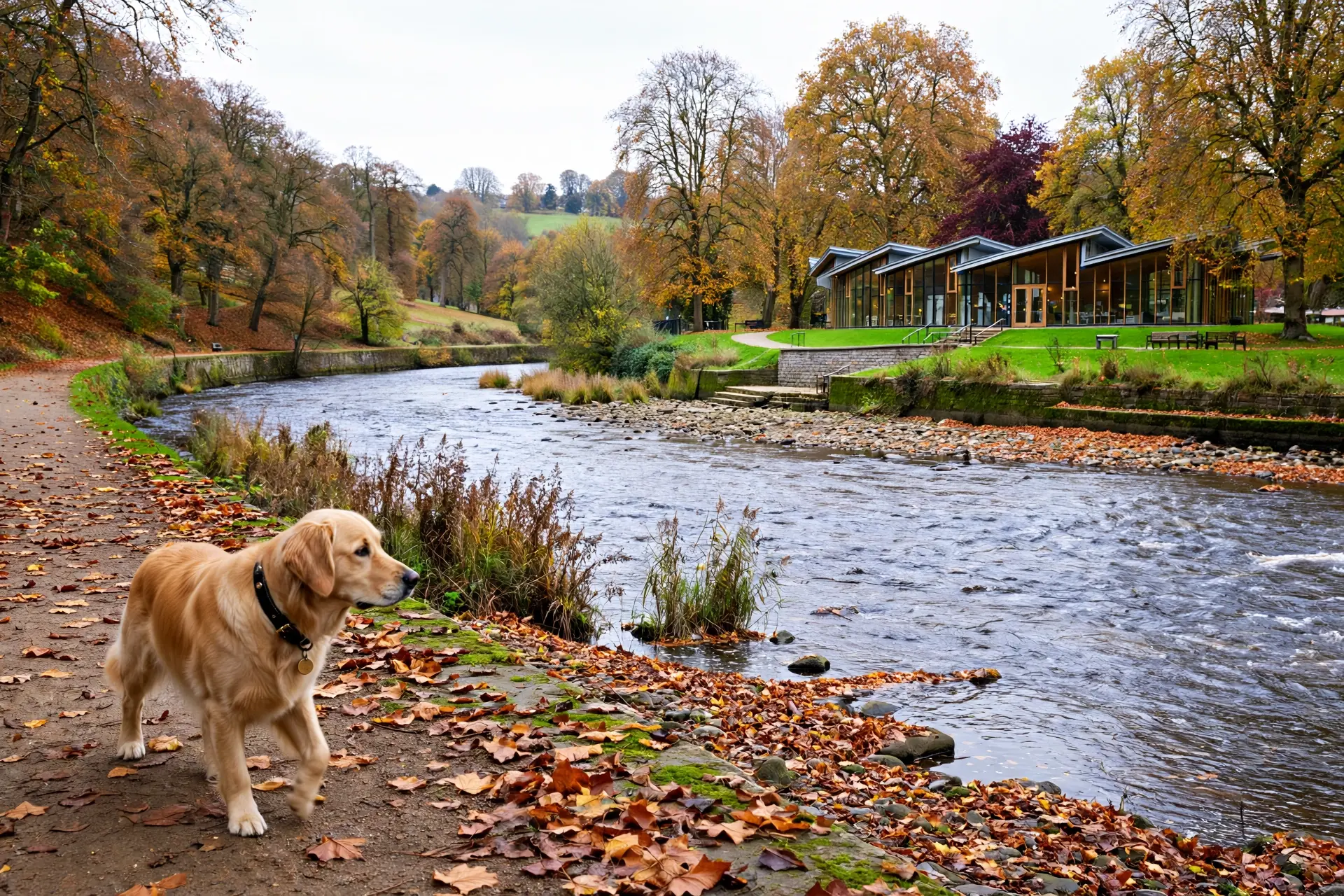
The riverside path is the heart of the walk. It runs along the Ribble below the park terraces, past the old tram bridge and towards the weir, and it is the stretch where dogs settle into a proper rhythm: flat ground, long sightlines, ducks and herons on the water, and the sound of the river under the road bridges. Keep dogs on a lead here. The bank drops steeply in places, the path narrows near the bridges, and the Ribble is tidal below Preston, which means the current and the water level change faster than they look. After heavy rain the river rises quickly and the lower paths can flood, so if the water is high or the ground is saturated, stay on the upper terraces and check the official guidance before you travel.
The upper terraces are where the parks earn their reputation. The lawns and tree-lined paths of Avenham are broad enough for a dog to walk calmly beside you without tangling with other visitors, and the Japanese garden is a quiet pocket that suits a nervous dog that needs a low-stimulus corner. The park hosts events through the year, including food festivals and open-air gatherings on the main lawn, and on event days the atmosphere changes completely: more people, more food smells, more noise. If your dog struggles with crowds, check what is on before you go and choose a weekday morning instead. The pavilion café at the top of the park is a useful landmark and a natural halfway stop, and the benches along the terrace are well placed for a rest with a view down to the river.
Practical details make the visit easier. The Avenham car park off Avenham Lane is the closest place to leave a car, and it puts you a short walk from the park entrance and the riverside paths. From Preston railway station the walk is about fifteen minutes downhill through the city centre and down Fishergate Hill, which is manageable with a fit dog but steep on the way back, so allow extra time for the climb. Bins are placed around the main paths, but they are sparse on the lower riverside stretch, so carry bags and be prepared to hold them until the next bin. The parks are popular with local dog walkers, especially early in the morning, which is good news for social dogs and something to manage carefully if yours is reactive: the wide paths give you room to pass at a distance, and the side paths through the trees offer quieter alternatives.
If you want to extend the walk, the parks connect naturally to the Guild Wheel and to the riverside route east towards Brockholes. Head east along the Ribble and the city thins out quickly into fields and floodplain, with the river on your right and open sky overhead. Turn back at the point that suits your dog rather than pushing on to a fixed destination, and remember that the return leg is the same ground, so a two-hour walk out is a four-hour day. For most dogs, an hour in the parks plus a short riverside stretch is the sweet spot, and it leaves energy for the city centre afterwards.
The Harris, the Flag Market and a quiet city centre
Preston city centre is compact, flat and easier with a dog than most visitors expect, provided you plan around the buildings rather than through them. The natural centrepiece is the Flag Market, the paved square in front of the Harris Museum, Art Gallery and Library on Market Square. The Harris is a grand neoclassical building with a columned frontage, and the square in front of it is the city's meeting point: markets, fairs and seasonal events fill it through the year, and on a quiet weekday it is simply a wide open space where a dog can walk on a lead without dodging traffic. Dogs are not admitted inside the Harris except for assistance dogs, so treat the building as something to admire from the steps and plan a split visit if one of your party wants to go in.
The streets around the square reward a slow loop. Fishergate is the main shopping street, running west from the Flag Market towards the railway station, and it is pedestrianised in parts, which makes it calmer than a normal high street. Friargate runs north from the square towards the university, and it has a different feel: independent shops, takeaways and cafés, with students coming and going in term time. Winckley Square, a short walk south-west of the Flag Market, is the city's quiet gem — a Georgian square of green lawns and mature trees surrounded by offices and townhouses, with benches and a calm atmosphere that suits a dog that needs a breather from the busier streets. It is the place to aim for when the Flag Market is crowded or an event is setting up.
Market days change the rhythm of the centre. Preston's covered market and the outdoor market stalls on Market Square bring produce, flowers and street food, and the smells alone can pull a dog in every direction at once. That is part of the fun for a steady dog, but a reactive or food-obsessed dog will find it hard work, so keep the lead short, walk the edges of the market rather than through the middle, and skip the stalls selling hot food if your dog lunges. The Miller Arcade, the Victorian shopping arcade off Fishergate, is worth a look from the outside, but its narrow interior and tiled floor are not a comfortable place for most dogs, so admire the facade and move on.
St George's Shopping Centre and the Fishergate Shopping Centre cover the indoor shopping, and neither is a dog destination: dogs are not generally welcome inside shopping centres, so plan your route so that any indoor browsing happens while someone else walks the dog around Winckley Square or the Flag Market. The covered market hall is the same story — look, decide what you want, and send one person in while the other waits outside with the dog. This split-and-swap approach sounds fiddly, but it is how most city-centre dog visits actually work, and Preston's compact layout makes it easy: nothing in the centre is more than ten minutes' walk from anything else.
Church Street and the streets around the parish church, St John's Minster, are quieter than Fishergate and worth including in a loop. The Minster churchyard is a small green pocket in the middle of the city, and the lanes around it feel older and calmer than the shopping streets. The university quarter around Adelphi Street and the UCLan campus is lively in term time and very quiet in the holidays, which makes the holidays a good time to walk there with a dog. Whatever route you choose, remember that Preston is a working city rather than a tourist town: the centre is at its busiest at lunchtime and on Saturdays, and at its calmest on weekday mornings and Sunday afternoons.
Where the Ribble widens: Brockholes and the road east
East of Preston the River Ribble widens into a landscape of lakes, wetlands and wet woodland, and Brockholes Nature Reserve is the best place to see it. Brockholes sits just off the M6 at junction 31, about ten minutes' drive from the city centre, and it is run as a nature reserve on the site of a former quarry. The centrepiece is the floating visitor village, a cluster of buildings on pontoons in the middle of a lake, reached by a footbridge. Dogs are welcome on the reserve's paths and trails, but the rules are tighter than in a city park: dogs must be kept on a lead throughout the reserve, because the lakes and reedbeds are home to ground-nesting birds, and the paths run close to open water.
The trails at Brockholes are the main attraction. The shortest loop around the main lake takes under an hour and gives you water, reedbeds, woodland and open meadow in quick succession, with hides and viewpoints where you can stop and watch birds without disturbing them. Longer trails head out across the reserve towards the Ribble itself, where the river runs wide and slow and the floodplain opens up. The ground is flat, which suits most dogs, but the paths can be muddy after rain and the boardwalk sections can be slippery, so take care with an older dog or one that rushes ahead. Bring binoculars if you have them: the reserve is known for wildfowl, waders and, in the right season, ospreys passing through, and the hides are genuinely worth the stop.
The visitor village has a café and toilets, and it is a natural break point halfway through a walk, but check the current dog policy for the café and the indoor spaces before you assume your dog can come in — policies for nature reserve cafés change, and the outdoor seating is usually the safer bet. The car park is large and charges apply, so check the official guidance before you travel for current prices and opening times. Arrive early on a sunny weekend, because the car park fills up and the main lake loop gets busy with families, which changes the atmosphere for a dog that prefers space. Weekday mornings are quieter, and winter visits have a different reward: the reserve is stark and beautiful when the reeds are bare and the light is low, and the birdlife is often at its most concentrated.
Beyond Brockholes, the road east opens up the Ribble Valley, and it is worth knowing what lies in that direction even if you only have a day. The villages of the valley — Longridge, Chipping, and further on towards Clitheroe — sit in rolling farmland with public footpaths that cross fields and climb towards the Forest of Bowland. These are proper countryside walks rather than park walks, with stiles, livestock and uneven ground, so they suit a fit dog and a confident navigator, and they need a map rather than a phone signal. Beacon Fell, the hill country park north-east of Preston near Goosnargh, is a good middle step: wooded trails, open moorland views and a car park at the top, with shorter loops that work well for a first countryside outing. For coastal walks further west, our guide to UK dog-friendly beach rules explains seasonal restrictions and the checks worth making before you drive to the Lancashire coast.
The Ribble itself deserves respect on this eastern stretch. The river is wide, the banks are soft and muddy, and the current is stronger than it looks from the path. Dogs should not be allowed to swim here: the water is cold, the bed is uneven, and the tidal influence reaches further upstream than many visitors realise. If your dog is a keen swimmer, the lakes at Brockholes are also out of bounds for swimming — they are wildlife habitat — so plan water play for a controlled venue rather than the river. The reward for that restraint is a walk through one of Lancashire's best wetland landscapes, with the city left behind and the river doing what rivers do best: slowing everything down.
Rain, mud and the Preston wind: what to pack
Preston sits on the western edge of Lancashire, open to weather coming in from the Irish Sea, and the city's climate is best described as changeable rather than extreme. Rain arrives quickly and clears quickly, the wind off the Ribble estuary is a constant presence on the open stretches of the Guild Wheel and at the docks, and the riverside paths turn muddy after a day or two of steady rain. None of this should stop a visit, but it should shape what you pack and how you plan the day.
The packing list starts with mud management. The paths in Avenham Park and on the Guild Wheel are mostly surfaced, but the riverside stretch below the park terraces, the Brockholes trails and the field paths east of the city are not, and Lancashire clay holds water for days. Pack a drying coat or at least two large towels, a spare lead, and a waterproof blanket for the car boot or the back seat. A portable paw washer or a bottle of clean water and a cloth will save your car's upholstery and your accommodation's floors. If you are staying overnight, ask your accommodation whether there is a hose, an outdoor tap or a drying area before you arrive, because drying a wet spaniel in a hotel bathroom is a miserable way to end a walk.
Wind is the second factor, and it matters more than the temperature. The open sections of the Guild Wheel around Riversway and the docks, the exposed parts of Moor Park, and the higher ground at Beacon Fell all catch the wind, which can be strong enough to make a small dog reluctant and to turn a drying coat into a sail. A snug-fitting coat that fastens securely is worth more than a loose one, and a lead with a comfortable grip helps when a gust hits. On very windy days, choose the sheltered routes instead: the tree-lined paths of Avenham Park, the wooded trails at Brockholes, and the streets around Winckley Square all offer protection.
Footwear and paws need the same attention. The Guild Wheel is kind to paws, but the towpaths and field edges east of the city can be stony, and the boardwalks at Brockholes are hard on nails when wet. Check your dog's paws after a long walk, especially between the toes, where mud and grit collect, and carry a small first-aid kit with saline, tweezers and a bandage. In winter, the paths in the parks can ice over on cold mornings, and the city centre pavements are gritted but the park paths are not always, so take care on the slopes down to the river.
Finally, plan for the daylight. In midwinter Preston gets around seven and a half hours of daylight, which means a 21-mile loop is out of the question and even a modest riverside walk needs an early start. Carry a light and a reflective lead or harness from October onwards, and build in a buffer: the walk back from Brockholes to the city centre takes longer than the walk out when the light is fading and the dog is tired. Summer is the opposite problem, with long evenings that tempt you to walk late, but shade is thin on the open stretches of the Wheel, so carry water and walk early on hot days. Whatever the season, the rule that saves most Preston dog days is simple: check the forecast, pack for rain even when it looks fine, and have a shorter route in mind before you need it.
Eating and drinking with a dog in Preston
Preston's dog-friendly eating scene is concentrated in a few places, and knowing where they are saves a lot of wandering with a hungry dog. The most reliable area is the riverside and the docks. The Continental, the pub on South Meadow Lane beside the river at the western edge of the city centre, has long been one of Preston's best-known dog-friendly pubs, with a large beer garden running down towards the Ribble and a relaxed attitude to dogs inside and out. It is a useful landmark in another way too: it sits on the Guild Wheel, so it makes a natural stopping point on a loop walk. Arrive by the riverside path rather than by car if you can, because the garden fills up on sunny afternoons and the car park is small.
The city centre has its own options, and they cluster around the streets where independent cafés have taken root. Friargate and the streets around Winckley Square have several cafés that welcome dogs, particularly those with pavement seating in the warmer months, and the square itself is a good place to sit with a takeaway coffee while the dog rests on the grass. Fishergate has the chain cafés, where policies vary by branch and by day, so do not assume a dog is welcome inside — ask at the door, and be ready to take your coffee to a bench on the Flag Market instead. The covered market hall is worth a visit for food shopping, but it is not a place to sit and eat with a dog, so buy what you need and eat it outside.
The rules of dog-friendly eating apply here as they do everywhere, and Preston's compact centre makes them easy to follow. Always ask before bringing a dog inside, even at a place that welcomed dogs last year, because policies change with new management. Keep the dog on a lead and settled under the table rather than wandering between tables, and bring a mat or blanket for the dog to lie on, especially on tiled or wooden floors. Order water for the dog as well as for yourself, and carry treats so the dog has something to do while you eat. If your dog barks at strangers or begs from neighbouring tables, choose outdoor seating or a takeaway instead — a relaxed meal in a beer garden beats a tense one indoors.
Further out, the villages around Preston have pubs that are worth knowing about if you are driving. The pubs around Longridge, Goosnargh and Chipping tend to be more consistently dog-friendly than city-centre venues, with flagstone floors, open fires and gardens, and they make a good end to a Beacon Fell or Ribble Valley walk. The same ask-first rule applies, and it is worth checking whether dogs are welcome in the bar area only or in the dining room too, because the distinction matters if you plan to eat a full meal. Sunday lunchtimes are the busiest time in these pubs, so a weekday or an early-evening visit is calmer for the dog.
For self-catering visitors, the practical side matters as much as the pubs. Preston has supermarkets around the ring road and at the Capitol Centre, and the covered market on Market Square sells meat, cheese, bread and produce from local stalls, which is useful if you are staying in a cottage or a holiday let east of the city. Buy dog food before you head out to the countryside, because the village shops around Longridge and Chipping are small and may not stock your dog's usual brand. And if you are staying in the city centre, remember that most cafés and pubs stop serving food well before closing time, so eat earlier than you would at home rather than hoping for a late kitchen.
Sleeping over: dog-friendly stays around Preston
Preston works well as an overnight base because it sits at the junction of the M6, the M55 and the M61, and the dog-friendly stays cluster in three distinct areas, each suiting a different kind of trip. The city centre has the chain hotels and serviced apartments around the railway station, Fishergate and the docks, which suit a short stay where you want to walk to the parks and the Flag Market. The villages east of the city — Longridge, Goosnargh and the edge of the Ribble Valley — have cottages, farm stays and small bed and breakfasts that suit a longer, quieter break with countryside walks from the door. And the coast road west towards Lytham and Blackpool has larger hotels and holiday parks that suit a combined city-and-coast trip, with the beach rules worth checking before you book. For the wider picture on choosing a base, our guide to dog-friendly holiday parks in the UK covers the fees, boundaries and questions that matter wherever you stay.
Whatever area you choose, the questions to ask are the same, and they are worth asking before you pay. Ask whether dogs are allowed in the room or only in designated dog-friendly rooms, because the dog-friendly rooms in a hotel are often fewer and in less convenient locations. Ask the exact pet charge and whether it is per night or per stay, whether there is a limit on the number or size of dogs, and whether dogs can be left alone in the room while you eat — most places say no, so plan your evenings around that. Ask about the ground floor: a room on the ground floor with a door to the outside makes night-time toilet trips far easier than a third-floor room with a lift, especially for an older dog.
City-centre hotels deserve a specific warning about noise. Preston is a university city, and the streets around the campus and the main nightlife areas around Friargate and the Adelphi quarter can be loud on Friday and Saturday nights. A noise-sensitive dog will sleep better in a hotel on the quieter side of the centre, towards Winckley Square or the docks, than in one above a late bar. If you are booking a cottage east of the city, ask the opposite questions: how enclosed is the garden, how high is the fence, and is there livestock in the neighbouring fields. A garden that looks secure in photographs can have a gap under the gate that a terrier will find in minutes, so ask for the fence height and the gate arrangement in writing.
For a longer stay, self-catering has real advantages. A cottage with a washing machine, a drying area and a garden means muddy walks stop being a problem, and a kitchen means you can feed the dog on its normal schedule rather than around restaurant hours. The villages around Longridge and the Ribble Valley have the best choice of cottages, and many of them sit directly on public footpaths, so the morning walk starts at the front door. Book early for school holidays and for the Guild events that bring visitors to the city, because the dog-friendly cottages are the first to go.
Before you arrive, sort out the practical details that make the first evening smooth. Find the nearest vet and save the number — Preston has veterinary practices around the city, including near the Capitol Centre and on the roads out towards Fulwood, and an out-of-hours service covers the area, but check the official guidance before you travel for the nearest practice to your stay. Pack the dog's bed, its usual food, and a familiar blanket, because a new room smells strange and a familiar bed is the fastest way to settle a dog. On arrival, walk the dog around the block or the garden before you unpack, let it sniff the room thoroughly, and keep the first evening quiet. A calm first night is worth more than any amount of sightseeing.
Getting here and getting around
Preston is one of the easiest Lancashire towns to reach with a dog, because it sits on the West Coast Main Line and at the junction of three motorways. By train, Preston station is served by direct services from London Euston, Birmingham, Manchester, Liverpool, Glasgow and Edinburgh, and dogs travel free on most UK trains provided they are on a lead or in a carrier and do not occupy a seat. The station is a ten-minute walk from the Flag Market and about fifteen minutes from Avenham Park, and the walk from the station to the parks runs downhill through the city centre, which is pleasant on arrival and a proper climb on the way home. If you are coming from the north, our Edinburgh with a dog guide and our Glasgow with a dog guide cover the same West Coast Main Line from the other end, and the journey between the two cities passes through Preston itself.
By car, the M6 runs past the eastern edge of the city, with junction 31 serving Brockholes and the east, junction 31a serving the north, and junction 32 connecting to the M55 towards Blackpool. The M61 joins from the south-east near Bamber Bridge. Traffic around the city centre can be slow at rush hour, particularly on the ring road and around the Capitol Centre, so allow extra time if you are arriving on a Friday evening. Parking is straightforward once you know the main car parks: the Avenham car park off Avenham Lane for the parks, the Fishergate Centre and St George's car parks for the city centre, and the Capitol Centre car park for the shopping area east of the centre. Check charges and opening hours before you travel, as they change, and never leave a dog in a parked car — even on a mild day, a car heats up fast, and Preston's car parks are not shaded.
Once you are in Preston, the bus network is useful for dog owners. Preston Bus runs services across the city and out to Longridge, Leyland, Chorley and the surrounding villages, and dogs are generally allowed on buses at the driver's discretion, on a lead and on the floor rather than on a seat. The bus station on Tithebarn Street is one of the largest in Europe and a useful landmark, though its concrete bulk is more impressive than beautiful. Buses are the practical way to do a one-way Guild Wheel walk: ride out to one point on the loop and walk back, or walk out and catch a bus home when the dog is tired. Check the official guidance before you travel for the latest rules on dogs on buses, because they vary by operator.
Walking is the best way to see the centre, and cycling the Guild Wheel is the other obvious option — though a dog and a bike do not mix on a shared path unless the dog is trained to run beside a bike and you have a proper attachment. If you do cycle with a dog, use the quieter northern arc, keep the speed low, and stop often. Taxis are available from the rank outside the station and around the Flag Market, but not every taxi takes dogs, so ask when you book and be ready to wait for a dog-friendly driver. For trips further afield, the train to Lancaster takes about twenty minutes, and the train to Blackpool takes about half an hour, which makes both easy day trips if you want a change of scene.
A one-day plan that actually works
Here is a day that uses Preston's best features in the right order, with enough slack built in that a slow dog, a muddy path or a long lunch will not wreck it. Start at Avenham Park. Arrive around nine in the morning, park at the Avenham car park, and walk the upper terraces and the riverside path for an hour to ninety minutes. The light is good, the park is quiet, and the dog gets its main exercise done before the day warms up or the crowds arrive. If the dog still has energy, extend east along the Guild Wheel towards the river crossing for another half hour, then turn back — the return leg is the same ground, so do not over-commit.
From the parks, walk up Fishergate Hill into the city centre for a late-morning wander. Cross the Flag Market, look at the Harris from the steps, and loop through Winckley Square for a quieter breather. This is the part of the day to do any shopping, because the dog is already exercised and will settle more easily while you browse. If the market is on, walk the edges rather than through the middle, and keep the lead short. Allow about an hour for the centre, and do not try to fit in the covered market, the shopping centres and the Minster in a single morning — pick one and save the rest for another visit.
Lunch is the hinge of the day. Head for the Continental on South Meadow Lane, or for one of the dog-friendly cafés around Friargate and Winckley Square, and give the dog a proper rest while you eat. A mat under the table, a bowl of water and a chew will keep most dogs settled for an hour, and the break matters: a dog that has walked for two hours and then been dragged around shops without a rest will be tired and fractious by the afternoon. If the weather is good, the beer garden at the Continental is the better choice; if it is raining, pick a café with indoor dog space and call ahead to confirm.
The afternoon belongs to Brockholes. Drive east on the M6 to junction 31, or take the bus if you are without a car, and walk the main lake loop for an hour. The change of scene — from city park to wetland reserve — keeps the day interesting, and the hides and viewpoints give you natural stopping points. Keep the dog on a lead throughout, as the reserve requires, and watch the time: the car park and the visitor village have opening hours, and the light fades fast in winter. If the dog is tired after the morning, skip Brockholes and spend the afternoon on a shorter walk around Moor Park instead, which is closer to the centre and has open grass for a gentler finish.
End the day the way it started: quietly. Walk the dog around the block near your stay, feed it on its normal schedule, and let it sleep. If you are staying overnight, this is the evening to check the next day's weather and to lay out the drying coat and towels for the morning. If you are driving home, allow time for a final toilet stop before the motorway, and remember that the M6 around Preston is busy on Sunday evenings. A good Preston day is not a long list of sights ticked off — it is a river walk in the morning, a calm city centre at midday, and a wetland reserve in the afternoon, with the dog comfortable at every step.
Practical questions
Before you go
Can dogs go off lead on the Guild Wheel?
Only in the right places. The Guild Wheel is a shared-use path, so dogs should stay on a short lead on the tarmac sections, especially where cyclists pass and where the route runs beside roads. Use the parks and open green spaces it connects, such as Avenham Park, Moor Park and Haslam Park, for off-lead time where local rules allow it, and always recall before junctions, bridges and livestock fields.
Is Avenham Park dog-friendly all year round?
Yes, Avenham Park and neighbouring Miller Park are open to dogs all year, and the riverside paths beside the Ribble are walkable in every season. The paths can get muddy after rain, and the river rises quickly after heavy rainfall, so keep dogs on a lead near the bank in wet weather and check the official guidance before you travel if conditions look rough.
Where is the best place to park near Avenham Park with a dog?
The Avenham car park off Avenham Lane puts you a short walk from the park entrance and the riverside paths. The Capitol Centre and St George's Shopping Centre car parks in the city centre are alternatives if you want to combine the parks with the Flag Market and the Harris. Check the official guidance before you travel, as charges and opening hours change.
Can dogs swim in the River Ribble at Preston?
It is not a good idea. The Ribble is tidal below Preston, the current is strong, the banks are steep and muddy in places, and water quality varies after rain. Dogs are better exercised on the park paths and in Brockholes, where the lakes and wetlands are for wildlife rather than swimming. If your dog loves water, look for a controlled dog-swimming venue instead.
Are dogs allowed inside the Harris Museum?
No, dogs are not admitted inside the Harris Museum, Art Gallery and Library except for assistance dogs. Plan a split visit instead: one person looks around the Harris while the other walks the dog around the Flag Market and Winckley Square, then swap. The outside of the building, the square and the surrounding streets are all pleasant to walk with a dog on a lead.
What is the best time of year to visit Preston with a dog?
Late spring and early autumn are usually the easiest: the Guild Wheel and the Ribble paths are drier, Brockholes is at its liveliest for birds, and the city centre is calmer outside the university term rush. Summer works well too if you walk early and carry water, since shade is patchy on the open stretches of the Wheel. Winter walks are still rewarding, but expect mud on the riverside paths and short daylight, so pack a light and a drying coat.