This guide is independent and contains no paid placement. If affiliate links are added later, they will be clearly marked and will not change our editorial checks.
Pwllheli works best as a harbour-first visit: walk the marina and the old harbour on the lead, then choose your beach by the season and the tide. South Beach is the wide family bay with a seasonal dog exclusion on the main bathing stretch; Glan y Don is the quieter sand most dog walkers use. From here the whole Llŷn Peninsula opens up — Abersoch is a short drive east, and the coast path runs in both directions.
A marina town at the gateway to Llyn
Pwllheli is not a resort that happens to have a harbour. It is a working harbour town that happens to be a good place to stay, and that difference shapes every part of a visit with a dog. The town sits at the southern edge of the Llŷn Peninsula in Gwynedd, where the Afon Erch meets the sea, and it has grown around boats for centuries: fishing boats, ferries, pleasure craft and, in the modern era, one of the largest marinas in Wales. The masts of Hafan Pwllheli marina rise above the rooftops long before you reach the seafront, and they are the first thing most visitors see. For a dog owner, that matters, because the marina gives the town a flat, firm, endlessly interesting walk right in the centre of things — no car, no climb, no muddy track required before the dog has had a proper stretch.
The town also works as a base in a way that smaller Llyn villages cannot. Pwllheli has a market, supermarkets, a railway station, cafes, pubs, a choice of accommodation and two beaches within walking distance of the centre. That combination is genuinely useful when you are travelling with a dog, because the small frictions of a trip — where to buy food, where to fill the water bottle, where to find a vet, where to park — are all answered within a few streets. Villages further along the peninsula are prettier in photographs and quieter on a Tuesday, but they ask more of you: longer drives for supplies, fewer places to sit down with a dog, and beaches that are harder to reach without a car. Pwllheli lets you keep the dog close to the centre of the day rather than planning the whole trip around a single car park.
Geography helps too. The Llŷn Peninsula runs roughly from Bangor in the north-east to the tip at Aberdaron in the south-west, and Pwllheli sits near the southern coast, roughly halfway along the peninsula's length. From here, the coastal road runs east towards Abersoch and the sheltered bays of the southern shore, and west towards Aberdaron and the wild end of the peninsula. Inland, quiet lanes climb towards the villages and hills of central Llyn. That position means a dog owner staying in Pwllheli can reach a different beach or a different stretch of coast path every day without a long drive, and can swap plans at short notice when the wind changes, the tide turns, or a seasonal beach rule makes one bay a better choice than another. Few towns on the peninsula offer that flexibility, and it is the main reason Pwllheli deserves more than a quick stop on the way to somewhere else.
The other thing to understand before you arrive is that Pwllheli has two distinct characters, and your dog will experience both. The marina side is modern, open and flat: pontoons, boardwalks, a sailing academy, and wide views across Cardigan Bay. The old town side, around the harbour and the market square, is older and closer-grained: narrow streets, stone buildings, a weekly market and the kind of shops that have served the town for decades. The beaches sit between and beyond these two centres, and the coast path threads them together. A good visit uses all three — marina in the morning when the light is bright and the boats are moving, old town for lunch and supplies, beach in the afternoon when the tide is right — rather than treating the town as a single stop.
The marina and harbour walk
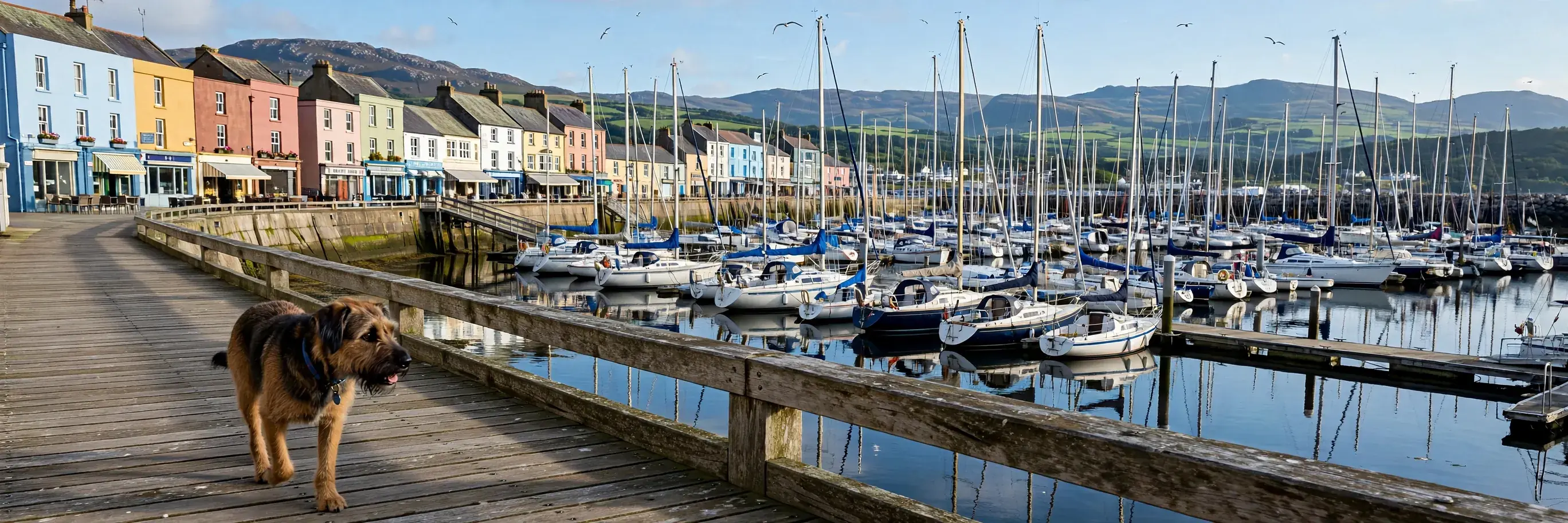
Hafan Pwllheli marina is the obvious place to start, and it is also the most forgiving walk in town for a dog that has just come out of the car. The marina is large — it holds several hundred berths — and the public walkways around it are wide, flat and surfaced, which suits older dogs, dogs that struggle with steps, and anyone pushing a buggy alongside a lead. The circuit around the marina basin takes in the pontoons, the boat hoist, the sailing academy buildings and, on a fair day, a steady coming and going of yachts and small motorboats. Dogs stay on the lead here: there are ropes, trailers, moving vehicles and open water on every side, and the pontoons themselves are private, so the walk is along the public quays and boardwalks rather than out among the boats.
What makes the marina walk worth doing rather than just a way to stretch legs is the sensory variety. For a dog, a working harbour is a dense patch of new smells: salt water, diesel, rope, fish, wet wood, gulls, and the people who work with boats. For the humans, the changing light across the water and the forest of masts make it the most photographed corner of the town, and the walk rewards going slowly rather than marching around it. Look for the sailing academy, which runs courses through the season and brings a stream of small dinghies in and out of the water on busy days. Watch for the lifeboat station and the harbourmaster's office, which anchor the working end of the harbour. On a calm evening the water in the basin goes flat and the reflections of the masts double the whole scene, which is the best time for a slow, quiet circuit after the day's boats have settled.
From the marina, the walk continues naturally into the old harbour. The harbour sits where the river meets the sea, and the walk along the quay passes fishing boats, small workboats and the slipway where boats are launched and recovered. This is the part of town where you need the most care with a dog: the quayside has no barriers in places, the slipway can be slippery, and vehicles towing trailers reverse across the walkway. Keep the lead short, keep the dog on the landward side, and do not let a curious dog investigate ropes, nets or fish boxes. The same common sense applies to the breakwater and the sea wall. The views from the outer end are excellent — across the bay towards the mountains of Eryri on a clear day — but the wind is stronger there and the drop to the water is direct, so a short lead and a steady hand matter more than the photograph.
Timing the harbour walk is worth a little thought. Early morning is the quietest time, when the town is still waking up and the gulls outnumber the people; it suits dogs that are nervous around crowds or reactive to other dogs. Mid-morning brings more life — boats moving, people working, cafes opening — and is the best time if your dog enjoys watching the world go by. Late afternoon and early evening are the calmest again, and the light on the water is at its best. If your dog is unsettled by noise, avoid the busiest launching times on summer weekends, when trailers, engines and reversing alarms stack up around the slipway. And if it is raining, the marina walk still works: the surfaces are firm, there is shelter under the academy buildings and the canopies near the cafes, and a wet dog dries faster after a flat quayside walk than after a muddy cliff path.
Practical details for the harbour walk are simple but worth getting right. There are bins for dog waste around the marina and the seafront — use them, and carry spare bags, because the walk is longer than it looks and the bins are spaced out. Water is available at cafes and from public taps, but carrying your own bottle and bowl is easier, especially in summer. The ground is mostly flat, but there are kerbs, steps down to the pontoons and uneven cobbles in the old harbour, so dogs with sore joints or poor eyesight need a slower pace and a hand on the lead at the transitions. Finally, remember that the marina is a working place rather than a park: dogs are welcome on the public walkways, but they are not welcome to roam, swim in the basin, or investigate boats, and keeping to that line is what keeps the walk open to everyone.
Two beaches, two sets of rules
Pwllheli has two main beaches, and they are different enough that choosing between them is the single most useful decision you will make on any visit. South Beach is the wide, sandy bay that most visitors picture when they think of Pwllheli: a long stretch of sand curving away from the town towards the south, with views across Cardigan Bay and room to spread out. Glan y Don is the quieter beach to the north-east of the harbour, a broad expanse of sand and shingle that feels more open and less managed. Both are worth visiting, but they are governed by different rules, they behave differently with the tide, and they suit different kinds of dog on different days. Understanding the split before you go saves the familiar frustration of arriving at a beach only to discover the dog is not allowed on the part you are standing on.
South Beach is the family beach, and that status comes with seasonal restrictions. Gwynedd Council operates dog-control rules on many of its beaches, and the main bathing stretch at South Beach is covered by a seasonal dog exclusion that commonly runs from 1 May to 30 September. During those months, dogs are not permitted on the signed exclusion zone, and the boundaries are marked on signs at the beach entrances — check the official guidance before you travel, because the zoned areas can change from year to year and the signs on the ground are the authority. Outside the exclusion period, from October to April, the beach opens up and dogs can enjoy the full sweep of sand, which is why autumn and winter visits to Pwllheli feel so much more generous for dog owners. In summer, the practical answer is to use the parts of the beach outside the exclusion zone, or to walk the promenade and the dunes with the dog on the lead and save the off-lead running for elsewhere.
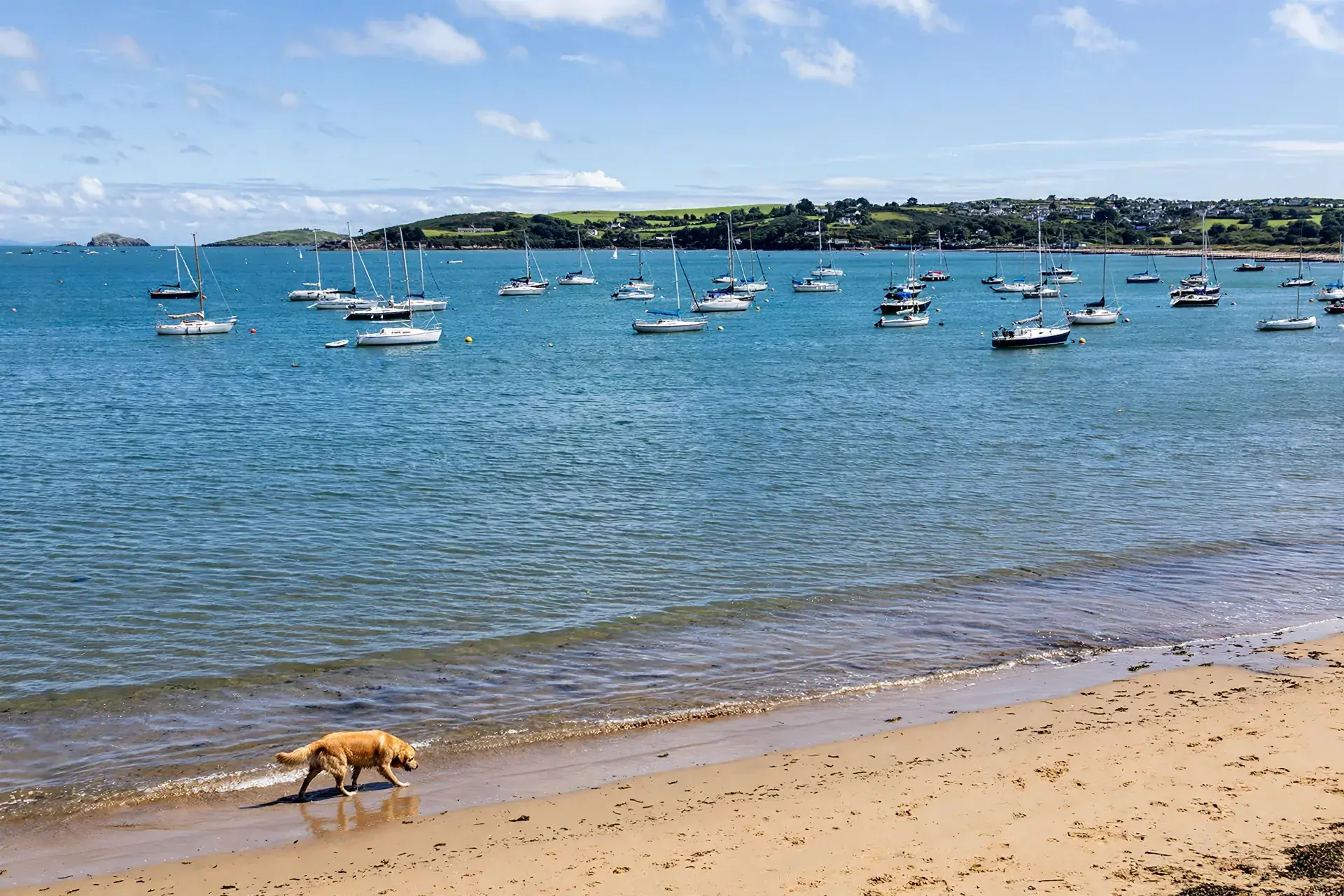
What South Beach offers in return is space and sand. At low tide the beach is very wide, with firm wet sand near the waterline that is kind to paws and good for a steady run, and the shallow slope means the water stays shallow a long way out. That is a genuine advantage for dogs that love to paddle but are not strong swimmers, and for owners who want to keep a dog in sight across open ground. The dunes behind the beach add a second landscape: grassy hollows, sandy paths and shelter from the wind, which suit sniffy, meandering walks and give reactive dogs room to arc around other people. But the dunes are also a protected habitat, so keep to the paths, keep dogs out of the fenced restoration areas, and remember that adders have been recorded in dune systems around the Welsh coast — a real if uncommon hazard worth knowing about if your dog roots around in long grass on a warm day.
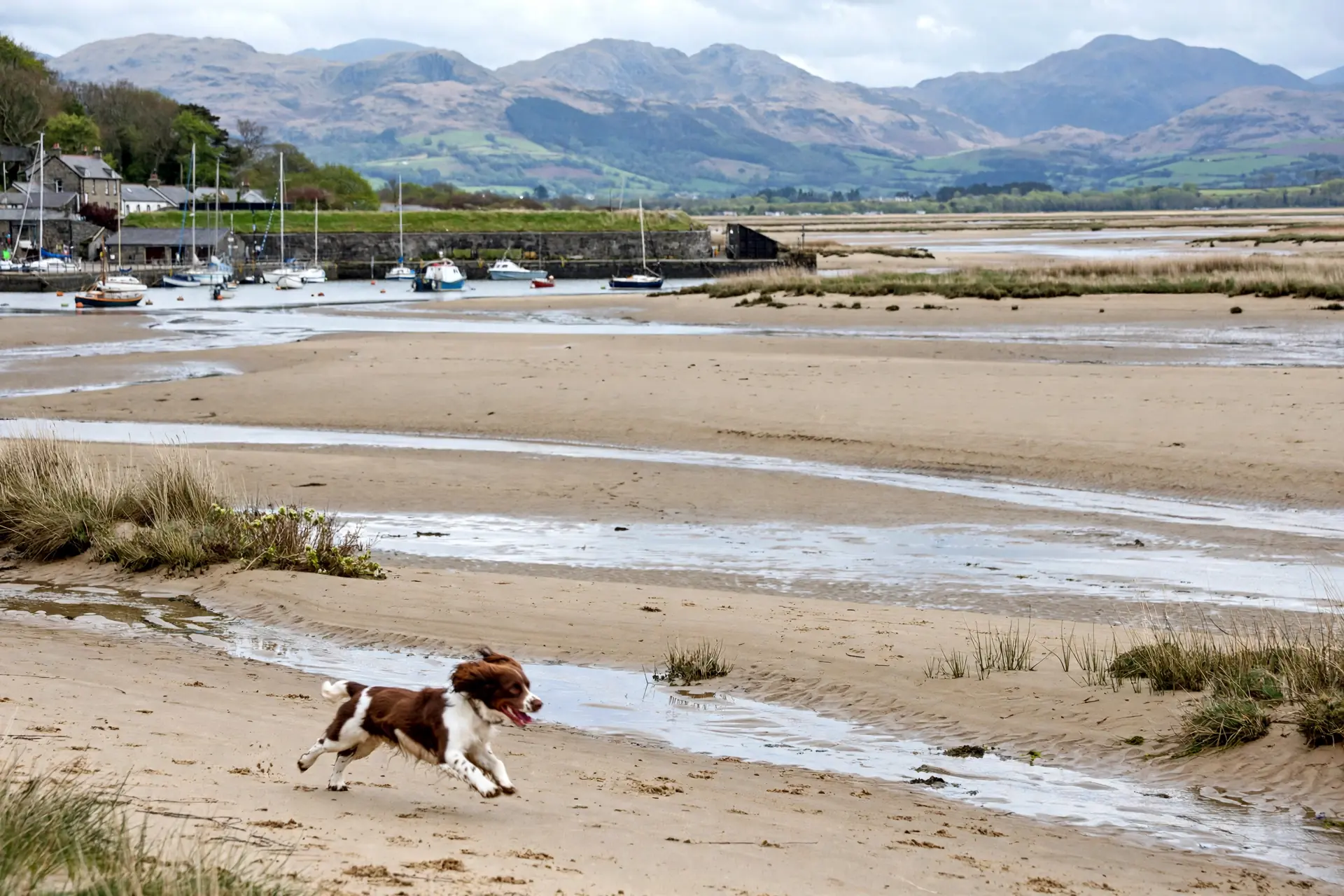
Glan y Don, by contrast, is the beach most local dog walkers use, and it feels like a different place entirely. It lies on the far side of the harbour from South Beach, a broad sweep of sand that runs towards the north-east and, at low water, seems to go on for a very long way. There are no arcades, no crowds of bucket-and-spade families and no seasonal exclusion in the same way as the main bathing beach, which is why dog walkers gravitate here — but that does not mean there are no rules. Local dog-control orders still apply, dogs must be under control, and waste must be picked up and binned. The beach is also exposed to the weather: when the wind comes from the north or the east, there is little shelter, and the sand blows across the flat expanse in a way that can sting eyes and discourage a long stay. On a calm day, though, it is one of the best dog beaches on the southern Llyn coast: firm sand, shallow water, huge skies, and enough space for even a high-energy dog to run properly.
Choosing between the two beaches is mostly a matter of season, tide and temperament. In summer, Glan y Don is usually the simpler choice, because the dog can stay on the sand without worrying about exclusion boundaries. In winter, South Beach comes into its own, with the full bay open and the dunes to explore. For a nervous or reactive dog, Glan y Don's open space is easier than South Beach's busier family stretch, because there is room to keep distance. For a dog that needs a short, easy walk from the car, South Beach has the more convenient access and the promenade. And for a dog that loves to swim, both beaches are shallow and sandy, but neither is a safe place to let a dog swim far out — the currents in Cardigan Bay are real, the water is cold even in summer, and a dog that chases a ball into deep water can get into trouble faster than its owner expects. Our guide to dog-friendly beaches in the UK explains how seasonal bans, public space protection orders and fines work across the country, and it is worth reading alongside the local signs before you let a dog off the lead anywhere new.
Tides, seasons and staying safe
The tide is the single most important safety factor on both Pwllheli beaches, and it catches out more visitors than any other feature of the town. Both beaches are wide and flat, which means the water comes in fast across a large area, and a beach that felt enormous an hour ago can narrow to a thin strip against the sea wall or the dunes while you are still walking. The practical rule is simple: check the tide times before you set out, plan to be walking back well before high water, and never let a dog run so far ahead that you cannot call it back to the exit route. Free tide tables are published for Pwllheli, and the harbourmaster's office and local cafes will also know the day's times — but the reliable habit is to look them up the night before and again in the morning, because a plan built on yesterday's tide is a plan built on the wrong sea.
The risk is not theoretical. Flat sandy beaches create the classic conditions for being cut off: a dog runs out to the waterline, the owner follows, the tide turns, and the route back along the beach is suddenly under water or blocked by rocks and the sea wall. The safe way to walk a wide beach is to stay within sight of a known exit — a slipway, a set of steps, a gap in the dunes — and to keep the dog within recall distance of that exit rather than letting it range to the far end of the sand. If the tide is rising, walk with the sea on your right on the way out and on your left on the way back, or simply keep the walk short and close to the access point. If you are unsure, ask someone local: harbour staff, lifeguards in season, and other dog walkers all know which parts of the beach flood first, and a two-minute conversation can save a very wet and frightening hour.
Seasons change the beaches as much as the tide does. In summer, the main bathing beach is busy, the seasonal dog exclusion applies, and the car parks fill early; the trade-off is warm weather, open cafes, and a town that is fully awake. In autumn, the crowds thin, the exclusion lifts, and the beaches open to dogs just as the light turns golden — for many dog owners, October is the best month in Pwllheli. Winter brings big skies, empty sand and strong winds, and the town quiets down; some cafes and attractions reduce their hours, so check opening times before you travel rather than assuming summer hours apply. Spring is the wildcard: the beaches are quiet, the dunes come alive with flowers, and the weather can swing from sunshine to a sharp shower in an hour, so pack layers and a waterproof for the dog as well as for yourself.
There are a few other hazards worth knowing about before you let a dog loose on a Pwllheli beach. After storms, the sand can hide driftwood, broken glass and fishing debris, so a quick scan of the ground before an off-lead run is worth the minute it takes. Dead fish, crabs and jellyfish wash up regularly, and many dogs will roll in them or try to eat them — jellyfish stings can irritate a dog's mouth and paws, and some washed-up fish can be harmful if eaten, so keep an eye on what the dog is investigating. In hot weather, sand can burn paws, and the walk from the car park across dry sand to the waterline is longer than it looks; test the sand with your own hand, carry water, and give the dog shade and rest. And in any season, never leave a dog unattended on a beach, and never tie a lead to a fixed object near the water — a rising tide and a tethered dog is a combination to avoid entirely.
Finally, a note on the rules themselves. Beach dog rules in Gwynedd are set by the council through public space protection orders, and they are enforced with fines, so it is worth treating the signs as instructions rather than suggestions. The exclusion zones, the dates and the penalties can all change, and the signs at the beach entrances are the definitive statement of what applies on the day you visit — check the official guidance before you travel, and read the signs again when you arrive. If you are in any doubt about where the exclusion zone ends, ask at the harbour office or in a local shop; people who live in Pwllheli know the boundaries by heart and are generally happy to point you to the right stretch of sand. Getting this right matters not just for your own day, but for the dogs who come after you: beaches stay open to dogs when dog owners follow the rules, and they close when they do not.
Day trips around the Llyn Peninsula
One of the best reasons to base a dog trip in Pwllheli is that the peninsula unfolds in every direction, and a different day trip is possible without a long drive. The classic first outing is east along the coast to Abersoch, the peninsula's best-known sailing village, about twenty minutes by road. Abersoch has its own main beach with seasonal dog rules, a harbour full of boats, and a village centre with cafes that welcome dogs outside — and the drive there is itself part of the pleasure, running along the coast past bays and headlands with views across to the mountains. Our guide to Abersoch with a dog covers the beach rules, the coast walks and the village in detail, and it is the natural companion piece to this one. If you go, plan around the tide and the season in the same way as in Pwllheli, and remember that Abersoch in high summer is much busier than Pwllheli, so an early start or a weekday visit makes the whole day easier with a dog.
West from Pwllheli, the coast road runs towards Aberdaron, the village at the tip of the peninsula, and the landscape changes as you go: the sheltered bays give way to open cliffs, wide skies and the sense of reaching the end of the land. Aberdaron has a beach, a harbour and a famous pilgrim history — it was the last stop for medieval pilgrims heading to Bardsey Island — and the coastal walking around it is some of the most dramatic on the peninsula. The Wales Coast Path runs through the village, and the stretch towards the headlands is a proper cliff walk: spectacular, exposed, and not a place for a dog that pulls on the lead or cannot be trusted near a cliff edge. If your dog is steady on the lead and you are comfortable with heights, it is a superb walk; if not, stay on the beach and the village lanes, and save the cliff sections for a day when the dog can stay with someone at the accommodation. Either way, check the official guidance before you travel, because cliff path diversions after storms and landslips are common along this coast.
Inland, the peninsula offers a quieter kind of day. The villages of central Llyn — places like Llithfaen, Pistyll and the lanes around the foot of Yr Eifl — are reached by narrow roads and small car parks, and the walking there is on farm tracks, field paths and the lower slopes of the hills. This is the Llyn that most visitors never see: dry-stone walls, sheep, small chapels, and views back across the peninsula to the sea on both sides. Dogs need to be on the lead around livestock at all times — this is working farmland, and the law is clear that a dog worrying sheep can be shot by the farmer — so inland walks are best for dogs with reliable recall and owners who are comfortable reading a map and following public rights of way. The reward is solitude: on a weekday in spring or autumn you can walk for an hour in central Llyn and meet nobody at all, which is a rare thing on a British peninsula in the twenty-first century.
The Wales Coast Path is the thread that ties all of these day trips together, and it is worth understanding how it works in practice. The path runs around the entire Welsh coast, and the Llyn section passes through Pwllheli, Abersoch, Aberdaron and every bay in between. You do not need to walk the whole thing — almost nobody does — but you can use it as a series of short linear walks, parking at one end and walking to the next village, or as a circular route by combining a stretch of coast path with a lane or a beach back to the start. The practical detail is transport: the coastal bus services along the peninsula are limited, especially outside summer, and many buses do not accept dogs, so a linear walk often means a car at each end or a walk out and back along the same path. Check bus times and dog policies before you travel rather than assuming you can hop on with a wet spaniel.
A final note on day trips: the weather on a peninsula is local. It can be raining in Pwllheli and sunny in Abersoch, or calm on the southern shore and wild on the northern cliffs, all on the same morning. That is another reason Pwllheli makes a good base — you can look out of the window, check the forecast for two or three different parts of the peninsula, and choose the day's direction accordingly. A flexible plan beats a fixed itinerary on Llyn, and the dog will be happier for it: a sheltered bay on a windy day, a wooded inland walk in the rain, a long open beach when the sun comes out. The peninsula rewards the dog owner who is willing to change plans at breakfast, and punishes the one who insists on the original route whatever the sky is doing.
Market, cafes and seafood
Pwllheli's market is one of the town's oldest institutions and one of the best reasons to plan a visit around a particular day of the week. The market has been held in the town for centuries, and the modern version brings traders to the market square and the surrounding streets with stalls selling food, plants, clothes, household goods and local produce. Market day is the busiest day in the town centre, and it is also the most interesting for a dog owner who enjoys a bit of bustle — but it needs a little management. The streets are crowded, the stalls narrow the pavements, and a dog on a long lead can easily tangle with a shopper or a stall leg. Keep the lead short, keep the dog on your inside away from the stalls, and consider doing the market early, before the biggest crowds arrive, or late, when the traders are packing up and the streets open out again.
What the market offers in return is the chance to buy the ingredients for a proper dog-friendly day: fresh bread, local cheese, fruit, vegetables, and the kind of picnic food that turns a beach walk into a proper outing. Many of the food stalls are happy to chat about where their produce comes from, and the market is a good place to ask about local suppliers, farm shops and the best places to buy dog treats — the town has pet shops and a number of shops that stock dog food and supplies, and the market traders will usually know where to find what you need. If you are staying in self-catering accommodation, a market-morning shop sets you up for the week far better than a supermarket run, and it supports the local economy that keeps the town's dog-friendly businesses going.
Cafes are the other half of the town-centre picture, and Pwllheli does them well. The town has a spread of cafes around the market square, the harbour and the seafront, and many of them welcome dogs — typically outside on a terrace, sometimes inside in a designated area, and almost always with a water bowl if you ask. The pattern is the familiar one across Britain: the more relaxed the cafe, the more likely the dog is welcome, and the best way to find out is to look for the signs at the door or simply ask. A few practical tips make cafe stops smoother: settle the dog on a mat or a blanket rather than on a bare floor, order at the counter before sitting down if the dog is unsettled by people coming and going, and keep the lead under the table leg rather than trailing across a walkway. A dog that can settle for half an hour in a cafe is a dog that can enjoy a town-centre day; a dog that cannot is better off with a takeaway coffee and a bench on the seafront, which is a perfectly good alternative in Pwllheli.
Seafood is the town's signature food, and it deserves a paragraph of its own. Pwllheli's harbour has landed fish and shellfish for generations, and the town's fishmongers, cafes and restaurants make the most of it — fresh fish, crab, mussels and the local catch of the day, depending on the season and the boats. For the humans, the best approach is to ask what is fresh that day rather than ordering from habit: the harbour's catch changes with the weather and the tides, and the fishmonger will tell you what came in that morning. For the dog, the rule is the usual one: cooked, plain fish in small amounts is fine for most dogs, but raw fish, fish bones, shellfish shells and anything seasoned, buttered or battered is not dog food, and the scraps that fall from a harbour cafe table are not a safe treat. Keep the dog away from fish boxes, discarded bait and the guts bins around the harbour, and carry a small bag of the dog's own treats so it has something to look forward to while you eat.
There is also a quieter food scene worth discovering in the town's pubs and restaurants. Several of Pwllheli's pubs welcome dogs in the bar area, which matters on a wet evening when the alternative is eating alone in the accommodation while the dog waits outside. The pattern varies from place to place — some pubs welcome dogs throughout, some restrict them to a particular room, and some allow them only outside — so the reliable method is to phone ahead or check the pub's own website before you set out, and to ask on arrival where the dog is welcome to sit. A pub that welcomes dogs properly will have a water bowl, a mat or a quiet corner, and staff who are comfortable with a dog under the table. A pub that tolerates dogs grudgingly will make the evening harder than it needs to be, and it is better to find out before you order than after the food arrives.
Where to stay and where to park
Accommodation in Pwllheli covers the usual range for a Welsh harbour town: self-catering cottages and apartments, bed and breakfasts, small hotels, caravan and camping sites, and a handful of holiday parks on the edge of town. The choice that matters most for a dog owner is not the style of accommodation but the specifics of its dog policy, and the questions to ask are the same ones that apply anywhere in Britain: how many dogs are allowed, what is the pet fee, are dogs allowed in all rooms or only designated ones, is there an enclosed garden or a safe area for the dog, and what happens if the dog is left alone in the room. Get the answers in writing before you pay, and be honest about your dog — a booking that is made on an honest description of a large or lively dog is a booking that will not be cancelled on arrival.
Location within the town is the second question, and it is worth more thought than it usually gets. A cottage near the marina puts the harbour walk on your doorstep and makes the morning and evening walks easy, but it can be busier and noisier, especially in summer. A place on the edge of town towards the dunes is quieter and closer to South Beach, but it means a longer walk to the market and the cafes. A place in the old town puts you among the shops and pubs but may have less parking and no garden. There is no single right answer — it depends on your dog. A reactive dog is better on the quiet edge of town; a sociable dog that loves watching people is better near the harbour; an older dog that needs short, flat walks is better somewhere flat with a garden. Think about the dog's day, not just your own, and the right location usually becomes obvious.
Self-catering is the most popular choice for dog owners in Pwllheli, and it has real advantages: your own front door, your own kitchen, no shared dining room to negotiate, and the freedom to set the dog's routine exactly as it is at home. The trade-offs are the usual ones: you do the cleaning, you do the cooking, and the property's rules about dogs on furniture, in bedrooms and left alone still apply. Bed and breakfasts and small hotels can be more welcoming than their reputation suggests — many have a designated dog-friendly room, a garden or a drying area, and owners who are dog people themselves — but they are less predictable, so phone and ask rather than relying on a booking-site filter. Caravan and camping sites on the edge of town suit owners who want outdoor space and a low-key base, and they are often the best value in peak season, but check the site's rules on leads, noise and the number of dogs per pitch before you book.
Parking in Pwllheli is straightforward but seasonal. The main car parks are near the beach and the marina, with on-street parking around the town centre and additional parking near the harbour. On a sunny weekend or a school holiday, the beach car parks fill early — often by mid-morning — and the marina car park follows. The practical answer is to arrive before mid-morning, or to plan a later afternoon visit when the morning crowd has gone. Check the tariff boards for charges, time limits and payment methods, because machines and rules change, and some car parks use pay-by-phone systems that need a signal. For a dog owner, the other parking rule matters more than the tariff: never leave a dog in a parked car on a warm day, even with the windows open and even for a few minutes. A car in the Welsh sun heats up fast, and a dog in a hot car is in danger within minutes — if you need to go into a shop, take the dog with you or leave someone with the dog outside.
A final practical point: vets and emergencies. Before you travel, save the number of a local veterinary practice in Pwllheli and the number of the nearest out-of-hours emergency vet, and note the location of the nearest pharmacy. Most trips need none of this, but a cut paw on a beach, a swallowed fish hook, or a stomach upset from something eaten on the sand are all more likely on a coastal holiday than at home, and the ten minutes you spend saving a number before you go is worth an hour of searching when you actually need it. If your dog has a long-term condition or takes regular medication, bring the prescription details and enough medication for the whole trip plus a day spare, and keep the medication in the accommodation rather than in a hot car. Pwllheli is well served for a town of its size, but it is still a small town on a peninsula, and the nearest emergency cover at night may be a drive away — plan for that rather than discovering it.
A practical day plan with a dog
Putting the pieces together, here is a shape for a day in Pwllheli that works for most dogs and most weather, and that you can adapt to the season and the tide. Start early with the marina walk, before the town wakes up properly. A slow circuit of the harbour and the marina on the lead, with time for the dog to sniff the quayside and watch the boats, is a calm way to begin the day and it uses the flat, firm surfaces that suit every dog. Follow it with breakfast — either at the accommodation or at a dog-friendly cafe — and then a short rest. Dogs, like people, do better with a pause between the morning walk and the next outing, and a dog that has had a chance to settle will enjoy the beach far more than one that has been marched from one activity to the next without a break.
Late morning is the time for the beach, and the choice of beach should follow the tide table and the season. In summer, head for Glan y Don or the unrestricted stretches of South Beach; in winter, the whole of South Beach is open and the dunes are at their best. Keep the beach visit to an hour or two rather than a whole day: dogs tire faster on sand than on a path, the sun and wind take more out of them than they appear to, and a dog that has had a proper run and a paddle is a happier dog than one that has been kept on a beach until it is exhausted. Bring water and a bowl, a towel for the car, and a long line if your dog's recall is not reliable in open space — a long line gives the dog freedom to run while keeping you in control near other people, other dogs and the water.
Lunch in the old town is the natural middle of the day. Pick a cafe with an outside terrace or a dog-friendly inside area, settle the dog on its mat, and take the time to eat properly rather than grabbing something on the move. After lunch, the afternoon is for the slower pleasures: the market if it is market day, a browse around the shops, a second short walk along the seafront or the coast path in one direction, or a drive to Abersoch or a village inland if the weather and the dog's energy allow. The key is to keep the afternoon loose. A dog that has had a good morning does not need a second big walk, and an afternoon of gentle pottering — with a nap in the car or at the accommodation in between — is often the best use of the time.
Evening in Pwllheli is best spent quietly. A last walk around the marina as the light fades, a drink or a meal at a dog-friendly pub, and an early night all suit a dog that has had a full day. If you are staying for several days, resist the temptation to fill every day with a different destination: the peninsula rewards a slower pace, and a day that repeats the morning marina walk and an afternoon on a different beach is a day well spent. Dogs do not need novelty every hour; they need routine, rest, food, water and the company of their people, with new smells and new ground in between. Pwllheli gives you all of that within a few streets, and that is the real measure of a good dog town — not how many attractions it has, but how easy it makes the ordinary business of a day with a dog.
For a longer stay, the same shape repeats with variations: one day to Abersoch and the eastern bays, one day west towards Aberdaron and the cliff path, one day inland among the villages and hills, and one day that stays in Pwllheli itself — market, harbour, beach, and nothing else. That rhythm gives the dog a different landscape each day without a long drive or a rushed schedule, and it gives you time to learn the town properly: which cafe has the best dog biscuits, which stretch of Glan y Don is quietest at low tide, which car park empties first in the afternoon. By the third day, Pwllheli stops feeling like a place you are visiting and starts feeling like a place you know, and that is when a harbour town earns its keep as a base for the whole peninsula. Our guide to Porthmadog with a dog is the natural next read if you want to extend the trip north towards the Glaslyn estuary and the mountains of Eryri.
Practical questions
Before you go
Can dogs go on Pwllheli South Beach in summer?
Parts of the main bathing beach are covered by a seasonal dog exclusion that commonly runs from 1 May to 30 September, so in summer you should use the stretches outside the signed exclusion zone or head for Glan y Don. The exact boundaries are set by Gwynedd Council and shown on signs at the beach entrances, so check the official guidance before you travel and read the signs when you arrive, because the zoned areas can change.
Is Glan y Don beach dog friendly all year?
Glan y Don is the stretch most dog walkers in Pwllheli use, and it is generally open to dogs outside the main seasonal exclusion area, but it is still covered by local dog-control rules, so dogs must be under control and waste must be picked up. Tides matter here: the beach is wide at low water and narrows quickly as the tide comes in, so check tide times before a long walk and keep an eye on your exit route.
Can my dog walk around Pwllheli marina?
Yes, the public walkways around the marina and harbour are good on-lead walking, with firm surfaces, views across the pontoons and plenty of space to pass other people. Keep your dog on a lead near the water and the boat-launching areas, watch for ropes, trailers and moving vehicles, and do not let dogs wander onto private pontoons or boats.
Where can I park in Pwllheli with a dog?
The main options are the car parks near the beach and the marina, plus on-street parking around the town centre. Beach car parks fill early on sunny weekends and school holidays, so arrive before mid-morning or plan a later afternoon visit. Check the tariff boards for charges and time limits, and never leave a dog in a parked car on a warm day.
Is Pwllheli a good base for exploring the Llyn Peninsula with a dog?
Yes, it is one of the most practical bases on the peninsula: it has the largest marina in Wales, two beaches, a market town with cafes and shops, and road links along the coast towards Abersoch and inland towards the villages of central Llyn. From Pwllheli you can reach a different beach or coastal walk within a short drive each day, which makes it easy to work around tides, wind and seasonal beach rules.