This guide is independent and contains no paid placement. If affiliate links are added later, they will be clearly marked and will not change our editorial checks.
Build a rainy day from two or three indoor or covered stops, with a short wet walk between them, a drying kit in the car, and a cafe as the anchor. Check each venue's dog policy in advance, because rain does not change the rules, and have a backup venue for every stop.
Read the forecast like a dog owner
A rainy forecast is not a single condition, and reading it like a dog owner means looking past the rain symbol to the details that actually affect a dog: intensity, duration, wind, temperature, lightning and flooding. Light, steady drizzle for a few hours is a very different day from heavy, showery rain with strong winds, and a forecast of “rain all day” may still include dry breaks, especially in showery conditions where a radar map shows gaps between showers. Check the hourly forecast, not just the daily summary, and check wind speed and gusts, because wind drives rain sideways, makes umbrellas useless, chills a wet dog quickly, and can make a woodland walk unsafe with falling branches.
Temperature matters as much as rain, because a wet dog in cold wind loses heat fast, while a wet dog in mild, humid rain may be comfortable for an hour but develop a chill if it then sits in a draughty cafe or a cold car. A forecast of 8 degrees with wind and rain is a coat, towel and short-walk day, while a forecast of 16 degrees with light rain is a longer, more relaxed day, provided the dog is dried regularly. Lightning is a hard stop: if thunder is forecast, plan an indoor day or stay home, because a dog outdoors in a thunderstorm is at risk and will almost certainly be frightened, and a frightened dog on a lead near traffic or water is a hazard. Flooding is another hard stop for riverside, coastal and low-lying walks, where paths can become dangerous quickly and water can hide hazards.
Use the forecast to choose the day's shape, not just to decide whether to go out. A morning of heavy rain followed by a dry afternoon suggests an indoor morning, with markets and cafes, and a walk in the afternoon, while a dry morning followed by afternoon rain suggests a walk first and indoor stops later. A day of intermittent showers suggests a route with frequent shelters, such as a town with arcades, markets and cafes, rather than a remote moorland walk with no shelter for miles. A day of continuous heavy rain suggests a fully indoor plan, with a short toilet walk at the start and end, rather than a long outdoor walk that will leave dog and owner soaked, cold and miserable. The forecast is a planning tool, not a verdict, and a well-planned rainy day can be better than a poorly planned dry day.
Finally, check local conditions, not just the national forecast, because rain in the UK is famously local. A forecast for a county may hide a dry town ten miles away, a coastal town may be drier than an inland hill, and a valley may be sheltered while a hilltop is battered. Check a local weather station, a radar map and, if you are travelling, the forecast for the destination rather than home, and be ready to adapt on the day, because a forecast that was accurate at breakfast may be wrong by lunchtime. A flexible plan, with indoor and outdoor options, is the best response to British weather, and it is far better than a rigid plan that fails at the first shower.
Indoor markets: the rainy-day staple
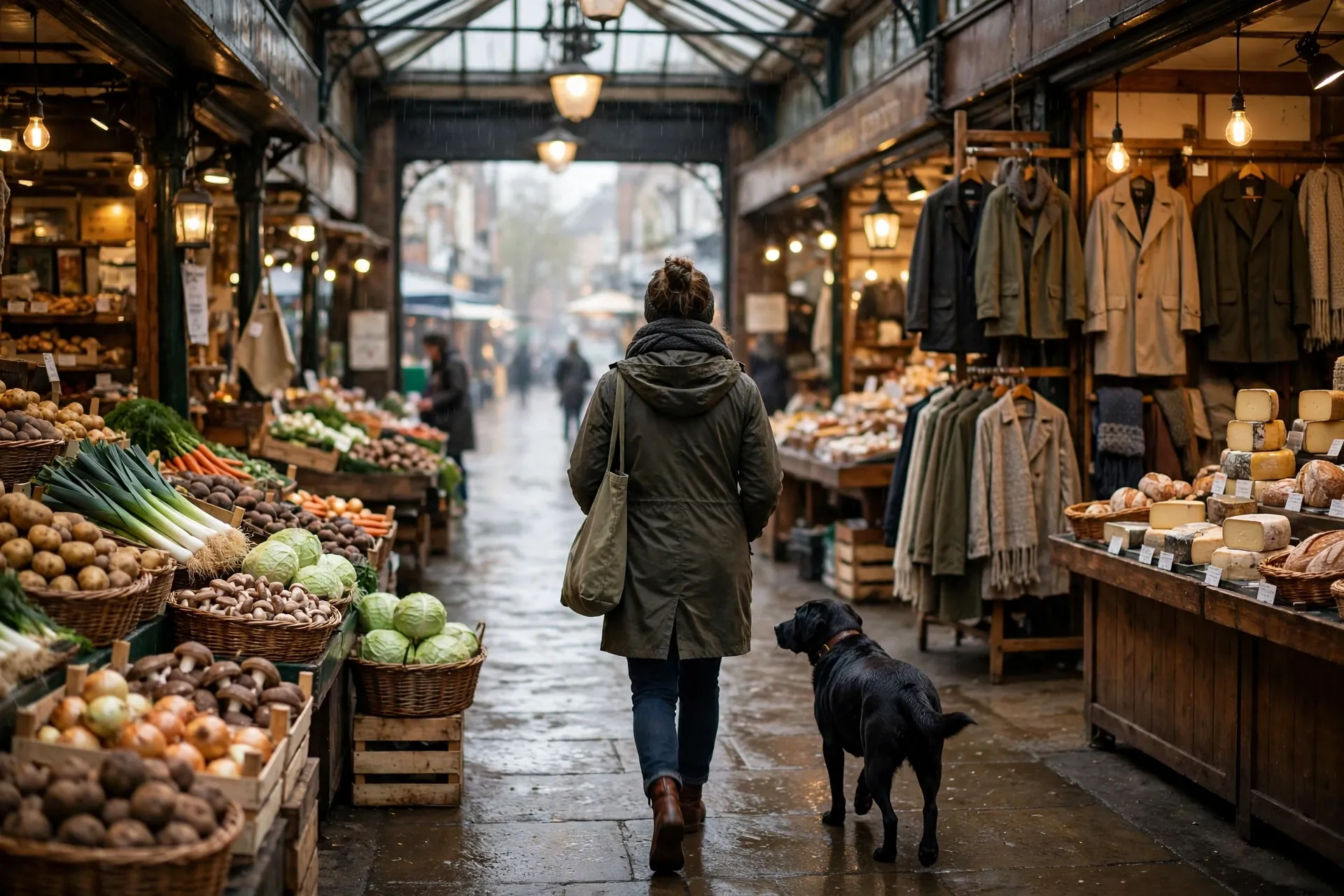
Indoor markets are the unsung heroes of rainy dog days out, because they combine shelter, stimulation, food, shopping and people-watching in a single, dog-friendly, covered space. A large covered market, with fruit, vegetables, cheese, bread, crafts, flowers and hot food stalls, offers a dog a rich sensory experience: new smells, new people, new sounds and new surfaces, all without getting wet. Markets are also social places, where stallholders often welcome dogs, offer treats, and chat, and where a dog that is calm and well-behaved will be fussed over and remembered. The key is to choose a market that genuinely welcomes dogs, not one that tolerates them reluctantly, and to visit at a quieter time, such as a weekday morning, rather than a crowded Saturday lunchtime.
Market manners matter more than in a park, because the space is enclosed, the aisles are narrow, and the stalls are full of food at dog-nose height. Keep the dog on a short lead, keep the dog close to your leg, and avoid letting the dog sniff food stalls, lick produce or beg from stallholders, because a dog that steals food or knocks over a display will not be welcome again. Bring a mat or a blanket for the dog to lie on while you browse, offer water regularly, and be ready to move if the market becomes too crowded, too noisy or too hot, because a market with a low roof and many people can become stuffy, even in rain. Dog-friendly markets covers market types, stall etiquette and indoor versus outdoor markets in more detail, and it is worth reading before a market-focused rainy day.
Different markets suit different dogs. A large, modern indoor market with wide aisles, high ceilings and a food hall is easier for a large or nervous dog than a small, cramped, historic market with narrow passages and low beams, where a dog may feel trapped. A market with a cafe or a seating area gives you a rest point, a chance to dry the dog and a place to wait out a heavy shower, while a market without seating may be a shorter visit, followed by a cafe stop. A market that is part of a larger covered complex, with arcades, shops and a station nearby, gives you a full rainy-day route without going outside, while a standalone market may be one stop in a day that also includes a cafe, a garden centre and a covered walk.
Food safety and hygiene are part of market etiquette, and they protect the market's dog-friendly status. Do not feed the dog from food stalls without permission, do not let the dog drink from shared bowls that may be intended for other dogs, and clean up any accident immediately and discreetly, because a market that has to clean up after dogs will soon restrict them. If the market has a food hall where dogs are not allowed, respect the boundary, even if the rest of the market welcomes dogs, and use the food hall as a human-only stop while a companion stays with the dog, or choose a market where the whole space is dog-friendly. A market visit that ends with a clean floor, a happy stallholder and a calm dog is a visit that keeps markets open to dogs.
Museums, heritage sites and covered grounds
Museums are the most misunderstood rainy-day option, because the common assumption that museums ban dogs is only partly true. Most large, indoor, national museums allow assistance dogs only, and they do so for conservation, security and visitor experience reasons that are unlikely to change, but many smaller museums, local history museums, open-air museums, heritage railways, castles with grounds, and historic houses with gardens do welcome dogs, often on leads, in grounds, courtyards and sometimes in specific indoor areas. The distinction is between the building and the grounds: a museum that bans dogs indoors may still welcome dogs in its gardens, courtyards, cafes and shops, which can be enough for a rainy day if the grounds have covered areas, arcades or sheltered walks.
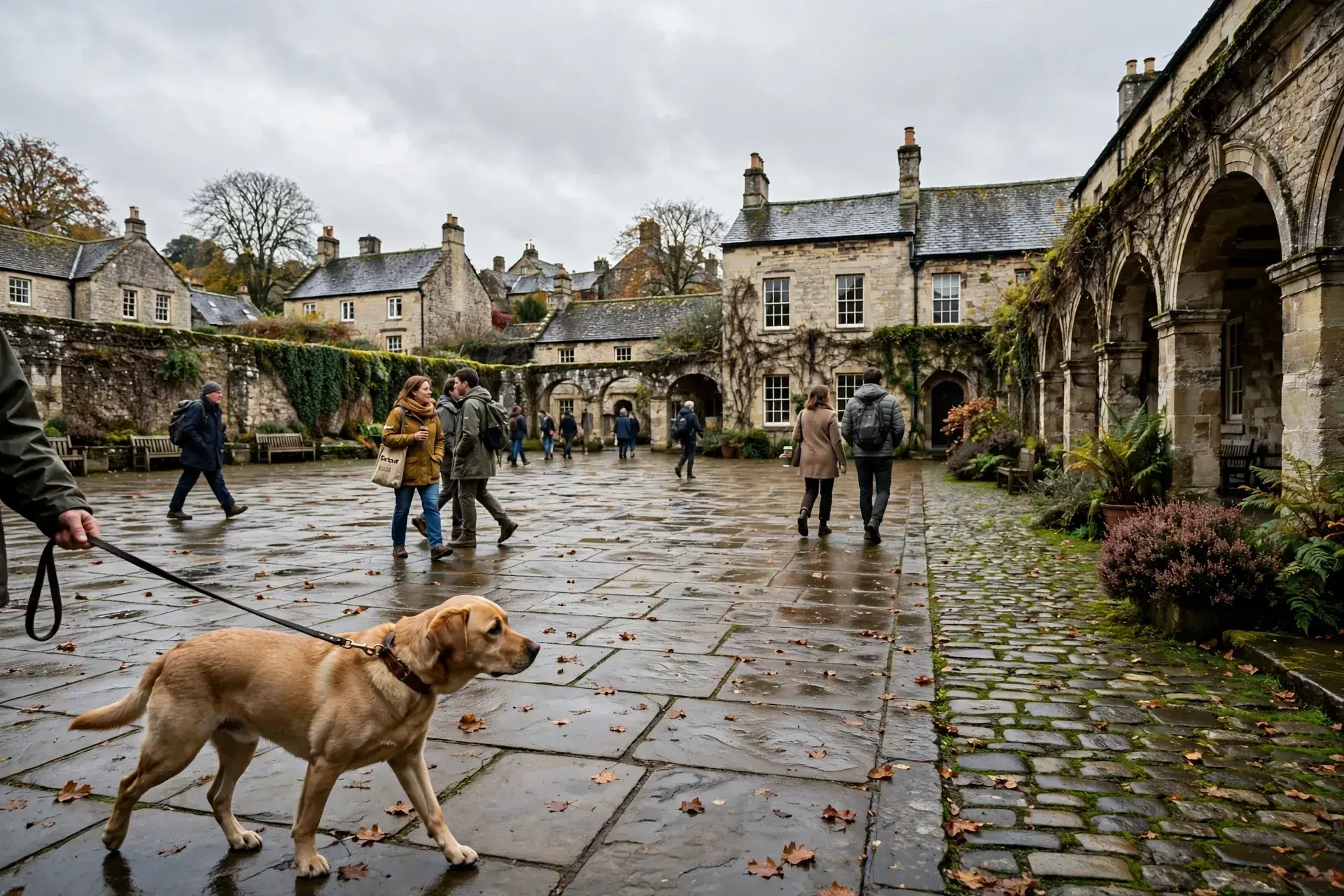
Open-air museums are particularly good in rain, because they combine indoor exhibits, such as cottages, workshops and shops that you can duck into, with outdoor streets, gardens and farm areas that are still enjoyable in drizzle, provided you have a coat and a towel. A heritage site with a covered courtyard, a cloister, a barn or a stable block offers shelter without being a fully indoor museum, and a castle with a covered gatehouse, a shop and a cafe can be a rainy-day outing even if the battlements are closed. Dogs in UK museums explains the rules, the exceptions and a rainy-day plan in detail, including which types of site are most likely to welcome dogs, and it is the best starting point for museum planning.
Planning a museum day in rain requires checking each venue individually, because policies vary by site, by season and by exhibition, and a site that welcomed dogs last year may have changed its policy for a special exhibition. Check the venue's website, call ahead if the policy is unclear, and ask specific questions: are dogs allowed in the grounds, in the cafe, in the shop, in any indoor galleries, and are there covered areas where a wet dog can dry. Ask about the route: is there a covered walk from the car park to the entrance, is there a place to leave a wet coat and a towel, and is there a dog toilet area that is usable in rain, rather than a distant field that becomes a mud bath. A venue that answers these questions clearly is likely to be well prepared for rainy dog visitors.
Behaviour in a museum or heritage site needs more care than in a park, because the space is quieter, the exhibits are fragile, and other visitors may not expect a dog. Keep the dog on a short lead, keep the dog away from exhibits, ropes, cases and low displays, and be ready to leave a gallery if the dog becomes restless, vocal or interested in an exhibit, because a museum is not a place to train a dog to settle, but a place to enjoy with a dog that can already settle. If the dog cannot settle in a quiet indoor space, choose a site with extensive grounds and covered outdoor areas, rather than a small indoor museum, because a dog that paces in a gallery will disturb other visitors and may damage an exhibit. A museum day that works is a day where the dog is calm, the owner is relaxed, and the exhibits are untouched.
Cafes as destinations, not just stops
On a rainy day, a cafe stops being a pit stop and becomes a destination in its own right, and choosing cafes as destinations changes how you plan. A dog-friendly cafe with comfortable seating, a fireplace or a stove, a view of the rain, a bookable table, and a menu that makes a long stay worthwhile can anchor a whole morning or afternoon, with the dog settled on a mat, a blanket and a chew, while you read, work, chat or simply watch the rain. A cafe that welcomes dogs indoors, not just on a terrace, is essential in rain, and a cafe that provides water bowls, treats, blankets and a dog menu is signalling that dogs are guests, not an inconvenience. Dog-friendly cafes explains how to find cafes that genuinely welcome dogs indoors, what indoor etiquette looks like, and what assistance dog rights mean in a cafe setting.
Choosing a cafe for a rainy day involves different criteria from choosing a cafe on a dry day. Look for space: a cafe with room between tables, a quiet corner, and a floor that is easy to clean is better than a cramped cafe where a wet dog is underfoot and a lead is a trip hazard. Look for warmth: a cafe with heating, a stove or a sheltered corner is better than a draughty cafe with a door that opens every few minutes, because a wet dog chills quickly in a draught. Look for duration: a cafe that welcomes lingering, with comfortable chairs, Wi-Fi, books or games, is better than a cafe that expects a quick turnover, because a rainy day cafe visit may last two hours, not twenty minutes, and a cafe that rushes you will make the dog restless too.
Cafe etiquette on a rainy day starts with drying the dog before you go in. Shake off rain outside, towel dry paws, belly and coat, and use a drying coat if you have one, because a cafe does not want a trail of water, mud and wet dog smell through the seating area, and a dog that arrives dry is far more welcome than a dog that arrives dripping. Bring a mat or a blanket for the dog to lie on, keep the lead short and tucked away, and clean up any mud or water promptly, because a cafe that has to mop after every dog will soon restrict dogs. Order for the dog as well as yourself if the cafe has a dog menu, or bring a familiar treat, and keep the dog's food and water contained, so that other customers are not disturbed by crumbs, smells or spills.
A cafe crawl, visiting two or three cafes in a day, can be a rainy-day itinerary in itself, especially in a town with a good cafe scene, a covered market and arcades to walk between. Keep each cafe stop to a comfortable length, walk between cafes in the rain with a coat and a towel, and use the walks as toilet and exercise opportunities, so that the dog is not confined indoors all day. A cafe crawl works best when the cafes are close together, the walks are short and sheltered, and each cafe offers something different: a breakfast cafe, a lunch cafe with a fireplace, and an afternoon tea cafe with cakes, for example. A rainy day spent moving between warm, welcoming cafes, with a dog settled at your feet, can be one of the most enjoyable dog days out, precisely because the rain makes the warmth and shelter feel earned.
Covered walks: arcades, stations and garden centres
Covered walks are the connective tissue of a rainy dog day, because they let you move, explore and exercise without being fully exposed to rain, and they turn a town into a rainy-day route. Victorian shopping arcades, with their glass roofs, tiled floors and independent shops, are ideal: they are sheltered, interesting, dog-friendly in many cases, and they offer a walk that feels like an outing, not just a dash between cafes. Railway stations, especially large, historic stations with concourses, shops and cafes, can be part of a covered walk, although station dog policies and crowding need checking, and a station is a transit space, not a destination, so it should be a link in a route, not the whole day.
Garden centres are another covered-walk staple, because they combine large, covered plant areas, cafes, shops and often a pet section, with a car park that is easy to access in rain, and many garden centres welcome dogs on leads throughout, including in the cafe. A garden centre visit can be a full morning: browse plants under cover, visit the cafe, buy supplies, and let the dog sniff and explore, all without getting soaked, although a garden centre with an outdoor plant area will still involve some rain, so bring a coat and a towel. Other covered walks include indoor shopping centres, where dog policies vary widely and need checking, covered markets, as discussed above, and historic covered passages, cloisters and courtyards, which offer shelter and interest in a compact area.
Planning a covered walk means checking dog policies for each link in the chain, because a route that is dog-friendly in the arcade may not be dog-friendly in the shopping centre, and a garden centre that welcomes dogs in the plant area may not welcome them in the restaurant. Call ahead, check websites, and have a backup route, because a single closed link can break a covered walk and leave you in the rain. Keep the dog on a short lead in covered walks, because the spaces are often crowded, with trolleys, pushchairs, other dogs and children, and a dog that is allowed to wander will quickly become a hazard. Bring a mat for rest stops, water for the dog, and cleaning supplies, because a covered walk is still a public space, and a clean, calm dog is a welcome dog.
Covered walks also offer training opportunities that a rainy day otherwise lacks. A walk through an arcade, a market and a garden centre, with stops, sits, waits and settles, is a rich socialisation and training experience for a dog, provided it is graded to the dog's ability and not forced. A puppy or a nervous dog may need a short, quiet covered walk, with frequent breaks and a quick exit, while a confident, well-socialised dog may enjoy a longer, busier route. Use covered walks to practise lead manners, settling in cafes, ignoring other dogs and people, and walking on different surfaces, such as tiles, wood, carpet and gravel, all of which are useful skills for any dog, and all of which can be practised in rain without a long, wet, outdoor walk.
Wet walks done well
A rainy day does not have to mean no walk at all, and in fact many dogs love rain, puddles, mud and the smells that rain brings out, so a wet walk, done well, can be the highlight of a rainy day. The key is to choose the right walk, the right duration and the right gear, rather than attempting a long, exposed, muddy hike in heavy rain and expecting the dog to enjoy it. A short, sheltered walk, such as a woodland path with tree cover, a riverside path with a cafe at the end, a park with a pavilion or a shelter, or a beach in light rain with a cafe nearby, can be wonderful, because the rain keeps other walkers away, the smells are rich, and the dog can run, sniff and play without overheating.
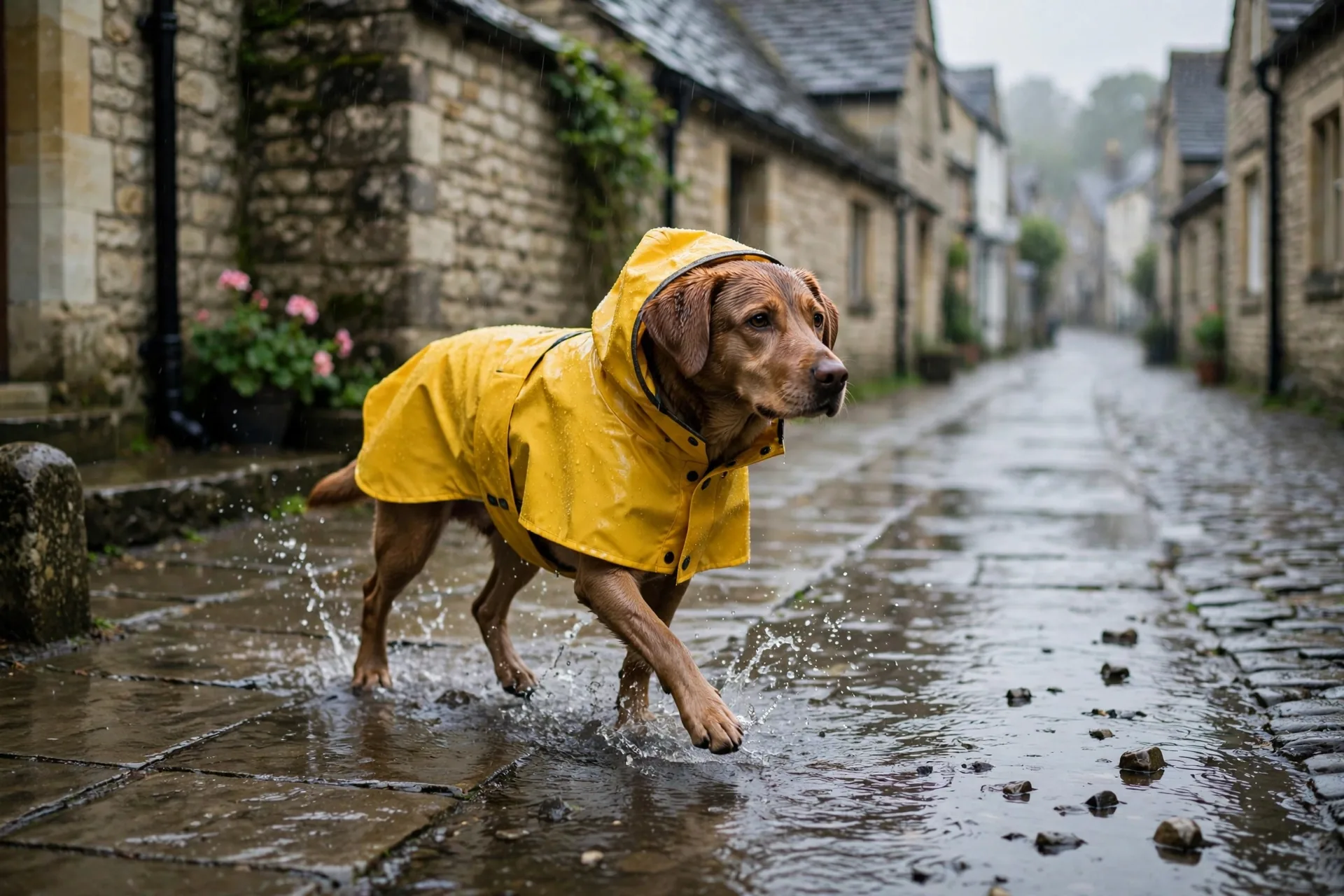
Gear makes a wet walk comfortable rather than miserable. A dog rain coat, fitted at home and introduced gradually, keeps the core dry and reduces the drying time afterwards, although not every dog likes a coat, and a dog that freezes or panics in a coat should not be forced to wear one. A harness with a handle, a non-slip lead, and a towel in a waterproof bag are essentials, as are poo bags, water and a phone in a waterproof case. For the owner, waterproof trousers, wellies or waterproof boots, a waterproof jacket with a hood, and a change of socks in the car make the difference between a walk that is fun and a walk that is endured. Rainy-day dog gear covers coats, measuring, waterproofing, belly coverage, paw care and drying routines in detail, and it is worth reading before investing in wet-weather kit.
Route choice for a wet walk needs care. Avoid riverside paths that flood, coastal paths that become slippery or dangerous in wind, woodland paths with falling branches in storms, and fields with livestock that may be stressed by weather, because rain changes hazards that are invisible on a dry day. Choose paths with good drainage, such as surfaced trails, forestry tracks, park paths and canal towpaths, which stay usable in rain, rather than clay paths, chalk paths and unpaved farm tracks, which become slippery, muddy and impassable. Check for blue-green algae in standing water, ponds and slow rivers after rain, because algae blooms can be toxic to dogs, and do not let the dog drink from puddles, troughs or flooded fields, which may contain pollutants, chemicals or animal waste.
Duration and aftercare complete a wet walk. A wet walk should be shorter than a dry walk, because a wet dog cools faster, tires faster and needs drying sooner, and a walk that is fun for twenty minutes may become miserable after an hour in heavy rain. Watch for shivering, reluctance to continue, lifting paws, or seeking shelter, which are signs to turn back, and end the walk at a cafe, a car or home where the dog can be dried promptly, rather than extending the walk because the owner is enjoying it. A wet walk that ends with a towel, a warm bed and a treat is a walk the dog will want to repeat, while a wet walk that ends with a cold, wet, miserable dog in a cold car is a walk that teaches the dog to dread rain.
The drying routine that saves the evening
Drying is not an afterthought on a rainy day, but the routine that determines whether the evening is comfortable or miserable, for dog and owner alike. A wet dog left to dry naturally in a cold house, a damp car or a draughty cafe will chill, develop a damp smell, and transfer mud and water to furniture, bedding and car seats, while a dog that is dried promptly, thoroughly and warmly will settle happily, sleep well and be ready for the next day. The routine starts at the car or the door, not in the living room: shake off excess water outside, towel dry paws, legs, belly and ears, and use a second towel or a drying coat for the main coat, paying attention to armpits, groin and behind the ears, where moisture lingers and skin can become sore.
Tools make drying faster and more thorough. Microfibre towels absorb more water than cotton towels and are lighter to carry, a drying coat, worn for twenty to thirty minutes after a walk, continues to absorb moisture while the dog rests, and a warm, draught-free room with a blanket helps the dog dry fully without chilling. A hair dryer on a low, cool setting can help a long-coated dog, but it must be introduced gradually, kept at a distance, and never used on a high, hot setting, which can burn skin and frighten the dog. Check paws carefully during drying: remove grit, stones, salt and mud, check for cuts, cracks or soreness between toes, and apply paw balm if the paws are dry or cracked, because wet, gritty paws are prone to infection and soreness.
Car drying deserves special attention, because a rainy day often involves a car journey home with a wet dog, and a wet car is a miserable car. Line the boot or back seat with a waterproof cover, a towel or an old blanket, keep a spare towel and a plastic bag for wet items in the car, and dry the dog as much as possible before loading, rather than loading a dripping dog and hoping the car will dry it. Ventilate the car on the journey home, if possible, to reduce condensation, and clean the car promptly after the trip, because mud, water and wet dog smell become harder to remove with time. A car that is prepared for wet dogs is a car that will be used for wet days, while a car that is not prepared will discourage rainy outings.
Home drying completes the routine. Wash bedding if it becomes damp, ventilate the room where the dog sleeps, and check the dog's coat, ears and skin over the next day or two for signs of irritation, infection or a hotspot, which can develop after prolonged dampness, especially in thick-coated, wrinkled or floppy-eared breeds. A dog that is dried well, fed, watered and settled in a warm, dry bed will sleep soundly after a rainy day, and will wake ready for the next day, whatever the weather. A dog that is left damp, cold and muddy will be restless, uncomfortable and more prone to skin problems, and the owner will spend the evening cleaning, rather than relaxing. Drying is care, not housework, and it is the part of a rainy day that most rewards attention.
Rainy days with children and several dogs
Rainy days with children add energy, noise and excitement to a dog day out, and they need planning that balances children's needs, dogs' needs and adults' patience. Children on a rainy day are often disappointed that a planned outdoor activity is cancelled, and a dog day out that includes children needs to be fun for children too, not just a dog walk in rain with children dragged along. Choose venues that interest children as well as dogs: a market with food stalls, a museum with interactive exhibits and grounds, a garden centre with animals or a play area, or a cafe with cakes and games, all give children something to enjoy while the dog settles nearby. Keep the day shorter than a dry day, with frequent breaks, snacks and changes of scene, because children, like dogs, tire faster in rain and cold.
Safety with children and dogs in rain needs extra attention, because wet surfaces are slippery, leads tangle more easily, and children may run, slip or drop food that a dog will snatch. Keep dogs on short leads, keep children close, and agree rules in advance: children do not hold the lead in crowded or slippery areas unless they are capable and supervised, children do not approach other dogs without permission, and children do not feed the dog from stalls or cafes without checking. A rainy day with children and dogs works best when each child has a role, such as holding the map, choosing the next cafe, or carrying the towel, because a child with a role is engaged, while a child without a role is bored and disruptive.
Several dogs on a rainy day multiply the logistics: more leads, more towels, more water, more drying, more space in cafes and markets, and more potential for conflict between dogs in confined indoor spaces. Keep the group small, keep dogs that get on well together, and avoid combining a reactive dog with several unfamiliar dogs in a small indoor space, because a rainy day is not the time to socialise reactive dogs. Use separate mats, separate bowls and separate resting spots in cafes, keep leads short and untangled, and be ready to split the group if one dog needs to go home early, because a group that insists on staying together when one dog is struggling will have a worse day for all dogs. A rainy day with several dogs should be planned as a series of short, calm stops, not as a long, ambitious itinerary.
Group dynamics for adults also matter on a rainy day, because rain, cold and wet dogs test patience, and a group that is cheerful on a dry day may become fractious on a wet day. Agree the plan in advance, including the venues, the timing, the backup plans and who is responsible for each dog, and build in flexibility, so that the group can shorten the day, change venue or go home early without argument. Bring extra towels, extra clothes and extra patience, and end the day while it is still enjoyable, rather than pushing on until everyone is wet, cold and fed up. A rainy day with children and dogs that ends with a warm cafe, a dry dog and a happy child is a success, however short the day was, and it is a day that children and dogs will want to repeat.
A sample rainy day, hour by hour
A sample rainy day helps turn general advice into a concrete plan, and the day below, for a town with a market, cafes and a garden centre, shows how indoor and outdoor stops can fit together. The day assumes steady rain, a temperature of around 12 degrees, a single, well-socialised adult dog, and an owner who wants a full day out without getting soaked. Adjust the timings, venues and distances for your town, your dog and your weather, but keep the structure: a short outdoor start, indoor anchors, short walks between stops, and a drying routine at the end, because that structure is what makes a rainy day work.
Start at 9:30 with a short, sheltered walk and a toilet break near the car park or station, using a woodland path, a park path or a riverside path with tree cover, for twenty to thirty minutes, with a coat if the dog wears one, and a towel ready in the car. At 10:15, move indoors to a covered market, spending forty-five minutes browsing stalls, chatting to stallholders and letting the dog sniff and settle, with a mat for rest stops and water available. At 11:15, walk, under cover where possible, to a dog-friendly cafe for coffee and a cake, settling the dog on a mat, drying paws on arrival, and staying for an hour, until 12:15, while the heaviest rain passes. The morning has given the dog exercise, stimulation, socialisation and rest, without a long, soaking walk.
After lunch, at 12:30, take a short walk to a garden centre, museum grounds or heritage site with covered areas, spending an hour browsing, walking covered paths and visiting a shop or an exhibit, with a toilet break and water. At 1:45, return to a second cafe, or to the same cafe if it is particularly welcoming, for lunch or a light meal, settling the dog again, drying paws, and staying until 2:45, while the afternoon rain is at its heaviest. At 3:00, take a final short walk, using a covered arcade or a sheltered park path, for twenty minutes, with a toilet break, before returning to the car at 3:30, drying the dog thoroughly with towels, and driving home. The day has lasted six hours, with only about an hour outdoors in rain, and the dog has had exercise, stimulation, rest and socialisation, without being soaked, chilled or exhausted.
The sample day can be adapted in many ways: a coastal town might replace the garden centre with a harbour arcade and a fish market, a city might replace the market with a shopping arcade and a museum, and a village might replace cafes with a pub and a farm shop, but the principles remain: start outdoors briefly, anchor indoors, move in short, sheltered hops, dry regularly, and end early enough for a proper drying routine at home. A rainy day that follows this pattern will feel like a day out, not like a day endured, and the dog will return home tired, happy and dry, which is the best possible outcome for a wet day. Keep a note of what worked, which venues welcomed the dog, and what you would change, because a rainy-day route that works can be reused all winter.
When to cancel and stay home
Cancelling a rainy day out is not a failure, but a responsible decision, and there are days when staying home is the best, safest and most enjoyable option for a dog. Cancel or postpone if there is lightning, strong winds with falling branches, flooding on your route, a weather warning for your area, or a combination of heavy rain, cold and wind that would leave a small, older, ill or brachycephalic dog chilled and distressed. Cancel if the dog is ill, injured, recovering from surgery, or showing signs of stress, anxiety or reluctance to go out, because a dog that does not want to go out in rain should not be forced, and a dog that is unwell needs rest, not stimulation. Check the official guidance before you travel if a weather warning is in force for your area, because warnings are issued for a reason and should not be ignored for a leisure trip.
Staying home on a rainy day can still be a dog day out, in the sense of a day that is enriching, enjoyable and tiring for the dog, even without leaving the house. Indoor enrichment, such as puzzle feeders, snuffle mats, scent games, training sessions, chew toys and gentle play, can tire a dog mentally and physically, and a short garden toilet break, with a coat and a towel, gives the dog fresh air without a long, soaking walk. A home day can include a grooming session, a bath if needed, a new toy, a training challenge, or a calm afternoon with the owner, all of which are valuable for a dog, especially a dog that is usually busy outdoors. A home day is not a wasted day, and a dog that has a good home day will be happier than a dog that has a miserable, forced outing.
If you do stay home, make the day structured, not just a day of the dog sleeping while the owner works or watches television, because a dog that is bored indoors in rain can become restless, destructive or anxious. Plan a few short activities through the day: a morning training session, a midday puzzle feeder, an afternoon scent game, and an evening chew, with toilet breaks and short garden visits in between, so that the dog has a routine, even indoors. Use the rainy day to practise skills that are useful outdoors, such as settling on a mat, waiting at a door, walking on a lead indoors, or coming when called, because these skills, practised indoors, transfer outdoors when the weather improves. A rainy home day that is structured and enriching is a training day, not a lost day.
Finally, know when to seek help. If a dog becomes ill after a rainy day, with vomiting, diarrhoea, coughing, lethargy, skin irritation or a reluctance to walk, contact your vet and mention the rainy outing, because water exposure, cold, algae, pollutants and exertion in bad weather can all cause illness that needs veterinary assessment. If a dog is frightened by thunder, fireworks or a storm during a rainy day, note the triggers and discuss them with your vet or a behaviourist, because storm phobia can worsen over time and may need a management plan. A rainy day out should be fun, not harmful, and a dog that returns home unwell or distressed is a sign to change the plan next time, not to push through with the same plan again.
Practical questions
Before you go
Are indoor markets dog-friendly on rainy days?
Many covered markets welcome dogs on leads, but policies vary by market, stall and day, and some food halls restrict dogs. Check the market's policy before you travel, keep the dog on a short lead, and avoid food stalls where dogs are not allowed.
Can I take my dog into a museum if it is raining?
Rain does not change a museum's dog policy. Most indoor museums allow assistance dogs only, while open-air museums, heritage sites and some smaller museums welcome dogs on leads. Check the specific museum before you go, and have a cafe or covered walk as a backup.
How do I dry my dog after a rainy day out?
Towel dry thoroughly, paying attention to paws, belly, ears and armpits, use a drying coat if you have one, and dry the coat fully before the dog settles for the night. Check paws for cuts, grit and salt, clean muddy paws with warm water, and wash bedding if it becomes damp.
Should I still walk my dog in heavy rain?
A short, sheltered walk is usually fine and often enjoyable for a dog, but heavy rain with strong wind, lightning, flooding or fast-flowing water is a reason to stay indoors or choose a covered walk. Keep walks shorter in bad weather, use a coat and a lead, and watch for cold, shivering or reluctance to continue.
What should I pack for a rainy dog day out?
Pack a dog rain coat, towels, a spare lead, poo bags, water and a bowl, a mat for indoor stops, cleaning cloths, and a change of clothes for yourself. A waterproof bag for wet items, a torch for dark afternoons, and a phone charger are also useful, because rainy days often run longer than planned.