This guide is independent and contains no paid placement. If affiliate links are added later, they will be clearly marked and will not change our editorial checks.
Walk a full loop of the Royal Harbour first: it settles the dog, shows you the wind, the crowds and the tide, and tells you whether to head for the beach, the cliff top or a quiet pub. Ramsgate Main Sands has seasonal dog restrictions in the summer, so check the official guidance before you travel, and use the cliff path to Broadstairs for the best long walk of the day.
Walk the harbour first
On a clear morning in Ramsgate, the day starts before the town does. Gulls call over the marina, ropes tap against masts, fishing boats come and go, and the first walkers are already out along the harbour arms with dogs that know the route by heart. That sound is the best orientation a dog owner can ask for, because Ramsgate is a town built around its harbour, and the harbour is where every decision about the day should be made. Do not rush to the beach, the cliff path or a cafe. Walk a full loop of the harbour first, let the dog sniff the morning into shape, and then decide where to go next.
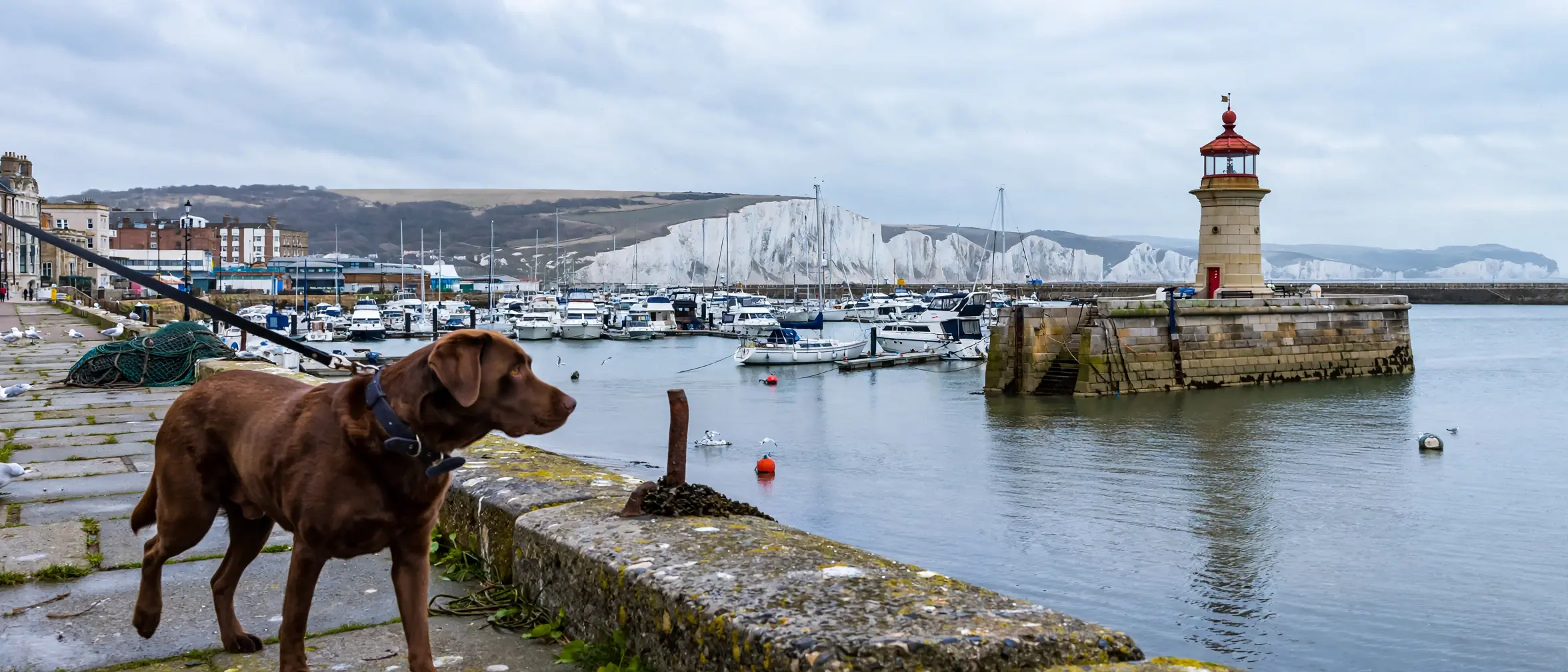
The Royal Harbour is the centre of the town in every practical sense. It is the only Royal Harbour in the United Kingdom, a title granted after King George IV sailed from Ramsgate in 1821, and its curved arms still shelter one of the largest marinas on the English south coast. For a dog, that history matters less than the layout: wide paved walkways, long sightlines, plenty of places to stop, and a steady stream of boats, people and smells to watch without ever needing to cross a busy road. The harbour loop works in either direction, and it works at almost any pace. A slow circuit with a sniffy dog takes about thirty to forty minutes. A brisk circuit with a fit dog takes about twenty. Either way, it is the right first walk.
Start at the harbour end of the seafront, near the clock house and the marina, and follow the inner harbour wall around the basin. The inner side is the working side: fishing boats, trip boats, the lifeboat station and the harbour office, with fishermen mending gear and crews loading supplies. Keep the dog on a short lead here. There are bollards, ropes, coiled hoses, fish boxes and wet patches underfoot, and a dog that lunges at a gull or a passing trolley can be in trouble in a second. The outer side, along the harbour arms towards the lighthouse, is more open. The wind is stronger, the views are wider, and the path is shared with cyclists, runners and families, so keep to one side and keep the lead short when the path narrows near the pier head.
The lighthouse at the end of the West Pier is a natural turning point. It is a good place to stop, give the dog water, and look back across the marina towards the town and the cliffs. On a calm day the water is flat and the boats sit still enough to reflect the sky. On a windy day the same view is all movement: white caps, flapping sails and gulls leaning into the wind. Both are worth seeing, but they ask different things of a dog. A nervous dog may prefer the sheltered inner harbour on a windy morning, where the town and the harbour wall cut the worst of the breeze. A confident dog will enjoy the open pier, where the smells change with every gust and there is always something new to watch.
Use the harbour loop as a test walk, not just a warm-up. Watch how the dog copes with the surfaces, the noise and the other dogs. The harbour walkways are paved and mostly level, which suits older dogs and dogs that struggle with steps, but they can be slippery after rain and hot underfoot on a sunny afternoon. Watch how the dog reacts to the boats: some dogs are fascinated by the movement and the shouting of the crews, while others find the engine noise and the smell of diesel unsettling. Watch the wind, too. Ramsgate faces east and south-east, so a wind off the sea can feel cold even on a bright day, and a dog that is fine for twenty minutes in shelter may start to shiver on the exposed pier. If the dog is unsettled after one loop, the answer is a shorter beach walk or a quiet cafe, not a longer cliff walk.
The seafront promenade extends the harbour loop without changing its character. From the harbour, the promenade runs along the front of the town towards the beach and the cliff paths, with benches, shelters, cafes and ice-cream kiosks along the way. It is the easiest flat walk in Ramsgate, and it is the one to choose for a first visit, for a puppy, for an older dog, or for any dog that is still learning to walk calmly past other dogs. The promenade is also where the town shows its seaside side: families with buckets and spades, anglers on the pier, joggers, and dogs of every size and temperament. Keep the lead short, give other dogs space at the pinch points near the steps and the kiosks, and remember that a dog on a long lead across a busy promenade is a trip hazard for everyone.
Early morning and late afternoon are the best times for the harbour. The light is softer, the crowds are thinner, and the dogs that are out tend to be local dogs on their regular routes, which usually means calmer encounters. Midday in summer is the busiest and the hottest time, and it is also when the harbour is at its most stimulating: boat trips loading, cafes spilling onto the pavement, children running between the benches, and gulls circling for dropped food. If you are visiting in July or August, plan the harbour loop for the morning, rest the dog through the middle of the day, and come back for a second, shorter loop in the evening when the light turns gold and the marina quiets down.
Practical details make the harbour loop easier. Bring water and a portable bowl, because there is no guarantee of a dog bowl at every cafe, and the harbour walk has long stretches with no shade. Bring poo bags and use the bins provided along the promenade and the harbour arms; the harbour is a working waterfront and a marina, and waste left on the walkways is a hazard for crews as well as for other walkers. Bring a towel in the car for wet days, because sea spray on the outer pier can soak a small dog in minutes. And bring a lead you can shorten quickly. A long line has its place on the beach and on the cliff top, but on the harbour arms, among boats, bollards and cyclists, a short lead is the safer choice.
The beach and the seasonal rules
Ramsgate Main Sands is the town beach: a wide curve of sand below the cliffs, with the harbour at one end and the cliff paths at the other. At low tide it is one of the broadest beaches on this stretch of the Kent coast, with firm sand for running, rock pools to investigate and room to spread out even on a busy day. At high tide the sand narrows to a strip, the steps down from the promenade become the main access point, and the beach feels like a different place altogether. The tide, not the clock, decides what kind of beach day you get in Ramsgate, so check the tide times before you travel and plan the beach around them.
The seasonal dog rules are the part of Ramsgate that catches visitors out. Dogs are welcome on Ramsgate Main Sands for much of the year, but seasonal restrictions apply during the busiest summer months, when dogs are excluded from the main beach area. The exact dates, times and boundaries change, and they are set by Thanet District Council under a Public Spaces Protection Order, so check the official guidance before you travel rather than relying on a guide, a sign remembered from a previous year, or advice from another dog owner. The signs at each beach entrance show the current rules for that beach, and they are the rules that count on the day. Our guide to dog-friendly beaches in the UK explains how seasonal bans, restricted zones and fines work in general, and why the same beach can be dog-friendly in October and off-limits in July.
When the seasonal restriction is in force, the beach is not the end of the walk. The promenade above the beach stays open, the harbour loop stays open, and the cliff paths stay open, so a summer visit still has plenty of walking. The restriction also has a practical logic: the main beach in high summer is crowded with families, sunbathers, windbreaks, picnics and small children, and a dog running free through that mix is a risk to everyone, including the dog. Use the restricted months for the harbour and the cliffs, and save the long beach run for the autumn, winter and spring, when the sand is emptier, the air is cooler and the dog can run without weaving between towels.
Outside the restricted season, Ramsgate Main Sands is a generous beach for dogs. The sand is mostly firm and flat at low tide, which suits dogs that like to run in straight lines, and the rock pools at the edges give sniffy dogs something to work on for an hour. The beach is sheltered by the harbour arm and the cliffs, so it is often calmer than the open beaches further along the coast, but the wind can still pick up quickly, and the sand can sting on a blustery day. Bring a windbreak or a beach shelter if you plan to sit for a while, and bring a long line for a dog whose recall is not yet reliable in open space. A beach is the worst place to discover that recall fails at a hundred metres.
Other beaches near Ramsgate have their own rules, and they are worth knowing before you drive. Winterstoke Gardens and the smaller coves along the coast towards Broadstairs are reached by the cliff paths, and each has its own access, its own seasonal rules and its own character at different tides. Pegwell Bay, to the south-west of Ramsgate towards Sandwich, is a nature reserve and a very different kind of shore: mudflats, salt marsh and wading birds, with strict rules about where dogs can go and when. It is a wonderful place for a quiet on-lead walk and for birdwatching, but it is not a beach for off-lead running or for swimming, and dogs must be kept under close control to protect the wildlife. Check the official guidance before you travel for Pegwell Bay, and treat the reserve signs as instructions, not suggestions.
Beach safety in Ramsgate is mostly about the tide and the ground underfoot. The sand looks flat and safe, but the tide comes in around the headlands and the harbour arm faster than it looks from the middle of the beach, and a dog that has run out to the waterline can find its route back cut off by a rising tide. Stay where you can see a clear way back to the steps, the slipway or the promenade, and keep an eye on the waterline rather than assuming it will stay where it is. Rock pools are slippery, broken shells can cut paws, and fishing lines, bait and discarded food wash up on every beach. Check paws after a beach walk, rinse off salt water if the dog has been swimming, and watch for the signs of salt-water drinking: vomiting, diarrhoea and lethargy after a swim all need a vet, not a wait-and-see.
Swimming needs a separate decision. Some dogs swim happily in the sea at Ramsgate, especially on a calm day at low tide, when the water is shallow and the current is gentle. Others are put off by the waves, the cold or the noise, and should never be pushed in. Never throw a ball far into the sea for a dog that is already tired, and never let a dog swim near the harbour entrance, the pier or any boats. The water around a working harbour has currents, ropes and propellers that a swimming dog cannot see, and the harbour mouth is not a swimming spot. If the dog does swim, keep the session short, dry the dog off afterwards, and offer fresh water so the dog does not drink seawater to quench its thirst.
What to pack for the beach is simple, but it makes the difference between a good hour and a miserable one. Water and a bowl, a long line and a short lead, poo bags, a towel, a drying coat in colder months, and a mat or blanket for the dog to settle on if you plan to sit. Sun protection matters in summer: pale-coated dogs and dogs with thin fur can burn on the nose and ears, and a dog that has been running on hot sand can overheat quickly. Offer shade and water often, and watch for heavy panting, drooling or a dog that suddenly wants to lie down and not move. Those are signs to get the dog into the shade, cool the paws and belly with water, and seek veterinary advice if the dog does not recover quickly.
Cliff walks and sea views
The best long walk from Ramsgate does not stay in Ramsgate at all. It follows the cliff top north-east towards Broadstairs, along a stretch of the Viking Coastal Trail that links the towns of the Isle of Thanet. The walk is about two miles each way, depending on the exact route and any diversions, and it is the walk to choose when the dog has already had a harbour loop, the tide is wrong for the beach, and you want a proper stretch of the legs with a view the whole way. Allow at least an hour each way at a relaxed dog-walking pace, plus time for stops, and treat the return journey as part of the walk, not an afterthought: the light changes, the wind shifts, and the same cliffs look different coming back.
The cliff path starts from the seafront at the northern end of Ramsgate Main Sands, where steps and ramps lead up from the promenade to the cliff top. The first stretch runs above the beach and the harbour, with views back across the marina and out to sea. The path is surfaced for much of the way, which makes it practical for most dogs, but it is exposed to the wind and the sun, with little shade and few places to shelter. On a hot day, carry water and plan the walk for the morning or the evening. On a windy day, keep the dog on a short lead near the cliff edge, even if the dog is normally reliable off the lead. The cliffs here are chalk, and chalk crumbles. The edge is not a place for a dog to run, chase a ball or peer over at the beach below.
Keep the dog away from the cliff edge at all times, and keep children and dogs together on the inland side of the path where the path runs close to the drop. The path is set back from the edge in most places, with grass and fencing in some stretches, but there are sections where the edge is closer than it looks, and a dog that lunges at a gull or a passing dog can cover the distance in a second. A short lead, a harness rather than a collar for a strong puller, and a habit of walking on the landward side are the simple rules that make the cliff walk safe. If the dog is reactive to other dogs, the cliff path can be a challenge: it is a popular route, it narrows in places, and there is not always room to step aside. Go early, go on a weekday if you can, and be ready to turn the dog around and wait at a wider spot rather than forcing a close pass.
The walk to Broadstairs passes a string of small bays and beaches that are worth knowing by name. Each has its own steps down from the cliff, its own seasonal dog rules and its own character. Some are sandy and sheltered at low tide, others are rocky and best left to the gulls. The cliff-top path gives you the view of all of them without committing to any of them, which is part of its charm: you can look down, judge the tide and the crowds, and decide whether to descend or to keep walking. If you do go down to a bay, check the tide times first, note the time of the last safe return, and do not assume that a beach that is accessible at mid-tide will still be accessible an hour later. The chalk cliffs and the rising tide have caught out walkers who were only planning a short stop.
Broadstairs itself is a reward at the end of the walk. It is a smaller, quieter seaside town than Ramsgate, with a sandy bay, a harbour, cafes and pubs, and a promenade that suits a tired dog. The walk back can be done on foot along the same cliff path, or by bus or train if the dog is tired and the legs are done. Check the bus and train rules for dogs before you travel: most local buses and trains accept dogs, but the rules vary by operator, and a large dog on a crowded summer bus is a different proposition from a small dog on a quiet weekday train. If you plan to use public transport for the return, carry a lead, a muzzle if your dog needs one for crowded spaces, and water for the wait at the stop.
The cliff walk in the other direction, south-west from Ramsgate towards Pegwell Bay and Sandwich, is a different kind of walk. It is flatter, quieter and more about the nature reserve, the marshes and the wide skies than about cliffs and bays. The route towards Pegwell Bay Country Park follows the coast and the cycle path, with views across the bay and the mudflats, and it suits a calm on-lead walk with a dog that likes to watch birds and sniff the marsh air. Dogs must be kept under control in the reserve, and some areas are sensitive for ground-nesting birds and wading birds, so follow the signs, keep the dog on a lead where asked, and do not let the dog chase birds or run across the mudflats. The mud at Pegwell Bay is deep and sticky, and a dog that runs onto it can get stuck or cut its paws on hidden debris.
Shorter cliff and coast walks suit dogs that cannot manage the full two miles to Broadstairs. A walk from the harbour to the cliff top and back, with a stop at a bench overlooking the sea, gives an older dog the views and the smells without the distance. A walk along the promenade to the northern end of the beach and back gives a puppy the socialisation and the surfaces without the exposure. And a walk around the harbour and the marina, followed by a rest in a cafe, gives a nervous dog a complete morning without ever leaving the flat. Ramsgate rewards dogs that walk at their own pace, and the town is small enough that a short walk is never a wasted walk.
Season changes the cliff walk more than it changes the harbour. In spring, the cliff-top grass is green, the wildflowers are out, and the path is at its best for a long walk. In summer, the path is hot, bright and exposed, and the early morning is the only comfortable time for a long stretch. In autumn, the light is low and golden, the crowds have gone, and the path belongs to local walkers and their dogs again. In winter, the wind is the main factor: a still winter day on the cliff top can be beautiful, with clear views across the Channel, while a stormy day can be dangerous, with spray, slippery surfaces and gusts that catch a small dog off balance. Check the forecast, check the official guidance before you travel for any path closures or diversions, and do not walk the cliff top in high winds or during a storm warning.
The Old Town, pubs and cafes
Away from the seafront, Ramsgate Old Town is the part of the town that rewards a slow wander with a dog. Its narrow streets, Georgian and Regency buildings, independent shops and small squares feel a world away from the open harbour, and they suit a dog that likes to sniff doorways, watch people and take its time. The Old Town is not a long walk: an hour of wandering, with stops, covers most of it. That is its strength. It is a walk that fits between the harbour loop and lunch, or between lunch and the cliff path, without tiring the dog out.
The streets of the Old Town are mostly quiet, but they are still town streets, with cars, delivery vans, cyclists and pedestrians sharing narrow pavements. Keep the dog on a short lead, keep to the pavement, and be ready for the sudden appearance of a cat, another dog or a child on a scooter around a corner. The pavements can be uneven, with kerbs, steps and cobbles in places, so watch the footing for an older dog or a dog with sore paws. The shops are worth a look from the outside, but most are small and not all welcome dogs inside, so check before you go in, and do not leave the dog tied up outside a shop while you browse. A dog left alone on a busy street is a target for theft and a source of stress for the dog.
Ramsgate has a good range of pubs and cafes that welcome dogs, particularly around the harbour, the seafront and the Old Town. Many welcome dogs on the terrace in summer and in a bar area in winter, and some provide water bowls and dog treats without being asked. Policies change by season, by venue and by the time of day, so check the official guidance before you travel, look for the signs at the door, and ask a member of staff before you settle in. A pub that welcomes dogs at lunchtime on a quiet Tuesday may have a different policy on a crowded Saturday evening, and a cafe that welcomes dogs on the terrace may not welcome them inside when it rains.
Eating out with a dog works best when the dog has already had a walk. A dog that has had a harbour loop and a beach run is far more likely to settle under a table than a dog that has been in the car for two hours and is bursting with energy. Bring a mat or a blanket for the dog to lie on, a chew or a stuffed Kong to keep the dog occupied while you eat, and water in a portable bowl. Choose a table at the edge of the room or on the terrace, where the dog is out of the main walkway and less likely to be tripped over or to trip someone else. And keep the lead short and under your foot, so the dog cannot wander to the next table or investigate the kitchen door.
If the dog cannot settle in a pub or a cafe, do not force it. Some dogs find the noise, the smells and the close quarters of a busy pub overwhelming, and a dog that is panting, pacing or whining is telling you that it wants to leave. Take the food to go, find a bench on the promenade or a quiet spot in the harbour, and eat outside where the dog has space and fresh air. Ramsgate has plenty of takeaway options around the harbour and the seafront, and a fish and chips eaten on a bench with a dog at your feet is as much a part of the town as any pub lunch.
The Old Town also has practical stops that dog owners need. Pet shops, vets and pharmacies are in and around the town centre, and it is worth knowing where the nearest vet is before you need one, especially if you are staying for a few days. Save the number in your phone, note the opening hours, and check whether there is an out-of-hours vet nearby. The same applies to a pharmacy for basic supplies and to a shop that sells dog food if you run out. Ramsgate is a working town, not just a resort, so most everyday needs are covered within a short walk of the harbour, and that makes a longer stay much easier to manage.
Boats and nearby towns
Seeing Ramsgate from the water changes the town completely. The harbour, the cliffs and the beach look different from a boat, and a short trip out to sea is a memorable part of a visit for many people. Whether a dog can come along depends on the boat, the trip and the weather. Some harbour and coastal trips welcome well-behaved dogs, while others do not allow dogs at all, for safety and for the comfort of other passengers. Check the official guidance before you travel, ask the operator directly before you book, and be honest about the size and temperament of your dog. A dog that is calm on a boat is a pleasure; a dog that is anxious, seasick or likely to bark at every wave is not.
If the dog does go on a boat, preparation matters. Bring a life jacket for the dog if the operator recommends one, and keep the dog on a lead and close to you at all times. Boats move, decks are slippery, and a dog that is not used to the motion can panic and slip. Bring water, because sea air and excitement make dogs thirsty, and bring a towel for the return to shore. Do not let the dog drink seawater, and watch for signs of seasickness: drooling, restlessness and vomiting are all possible, and a dog that is sick on a boat needs fresh air and a calm voice, not a scolding. If in doubt, leave the dog with a sitter or in the accommodation and enjoy the boat trip on your own.
Ramsgate is also a good base for day trips to other Kent towns, and the dog can come along for most of them. Broadstairs, reached on foot along the cliff path or by a short bus or train ride, is the easiest day trip, with its own harbour, beach and cafes. Margate, a little further along the coast, has a larger seafront, an old town and a harbour arm, and it suits a longer day out with a dog that is comfortable in a busier town. Both have their own seasonal beach rules, so check the official guidance before you travel for each beach you plan to visit, and do not assume that the rules in Ramsgate apply in Broadstairs or Margate.
Inland, Canterbury with a dog is a rewarding day trip from Ramsgate, about an hour away by train or car. The city has medieval lanes, riverside walks and dog-friendly pubs, but the cathedral precincts have their own rules for dogs, and the city centre is busier and more built-up than Ramsgate. Our Canterbury guide explains the precinct rules, the best walking routes and where to park, and it is worth reading before you go rather than discovering the rules at the cathedral gate. A day in Canterbury followed by a quiet evening back in Ramsgate, with a harbour walk and a rest, is a good balance for a dog that can manage a city morning but needs a calm evening.
Sandwich and Deal, to the south of Ramsgate, offer a quieter kind of day trip. Sandwich is a medieval Cinque Ports town with narrow streets, a riverside walk and a nature reserve nearby, while Deal has a seafront, a pier and a castle, with a long promenade that suits a steady on-lead walk. Both are smaller and calmer than Margate, and both suit dogs that prefer a quiet town to a busy resort. The drive to either is short, the parking is generally easier than in Ramsgate on a summer weekend, and the walks are flat and practical. Check the official guidance before you travel for the beach and reserve rules in each place, because the rules change from town to town along this coast.
Day trips work best when they are planned around the dog, not around a checklist of towns. One town a day is enough. Two towns in a day means two car journeys, two new sets of smells and noises, and a dog that is tired before lunch. Choose one destination, plan one good walk there, find one place to eat or rest, and then come back to Ramsgate for the evening harbour loop. The dog will remember the walk and the rest far better than the number of towns visited, and you will enjoy the day far more if you are not rushing from one car park to the next.
Getting there, parking and staying over
Ramsgate is in the far east of Kent, on the Isle of Thanet, and it is reached by train, by car and, for some visitors, by a combination of the two. The train station is about a mile from the harbour, up a hill that feels longer with a dog and luggage on a hot day. If you arrive by train, plan the walk from the station to the harbour or to your accommodation, and allow time for the dog to settle after the journey. Trains to Ramsgate run from London and from other Kent towns, and most accept dogs, but check the operator rules before you travel, especially for a large dog or a busy peak-time train. A dog that travels well in a car may find a crowded train stressful, and a dog that is calm on a train may still need a quiet walk on arrival.
Driving to Ramsgate is straightforward, with the A299 and the A256 linking the town to Canterbury, Dover and the wider Kent road network. The drive from London takes about two hours in good traffic, longer on a summer weekend, and the last stretch into Ramsgate can be slow when the seafront is busy. Plan the journey with the dog in mind: stop for a toilet break and water on the way, keep the car cool, and never leave a dog in a parked car on a warm day, even for a few minutes. Cars heat up far faster than most people expect, and a dog left in a hot car can overheat and die in a very short time. If you need to stop in Ramsgate before you can check in, choose a shaded car park, park in the shade if you can, and take the dog with you for a harbour walk rather than leaving the dog in the car.
Parking in Ramsgate is centred on the harbour and the seafront. Harbour and seafront car parks put you close to the promenade, the beach and the cliff paths, and they are the most convenient for a day visit with a dog. Town-centre car parks suit the Old Town and the shops, and they are often quieter than the seafront on a busy day. On sunny weekends and during school holidays, the seafront car parks fill early, and the best advice is to arrive before ten in the morning or to park a little further out and walk in. Check the tariff board before you leave the car, note the maximum stay and the payment method, and keep the ticket or the payment confirmation with you. Parking rules and charges change, so check the official guidance before you travel rather than relying on a remembered tariff.
Staying over in Ramsgate with a dog is easier than in many seaside towns, because the town has a mix of hotels, guest houses, bed and breakfasts, self-catering cottages and flats, and many of them welcome dogs. The key is to check the dog policy for the specific room or property, not just for the business in general. Some places welcome dogs in selected rooms only, some charge a pet fee per night or per stay, some have a limit on the number or size of dogs, and some welcome dogs in the bar or the garden but not in the dining room. Ask for the policy in writing before you book, and confirm the fee, the limit and any rules about leaving the dog alone in the room. A dog left alone in an unfamiliar room is likely to bark, scratch or chew, and many places prohibit it outright.
Choose accommodation by its location as much as by its price. A place near the harbour or the seafront puts the morning walk on your doorstep and makes the last toilet walk of the day a short, lit stroll rather than a drive. A place in the Old Town puts the pubs and cafes close by, but may mean steps, narrow streets and a longer walk to the beach. A place on the edge of town may be quieter and have a garden, but may need a car for every walk. Think about the dog first: a garden with a secure fence, a ground-floor room with easy access to outside, a nearby green space for the morning toilet walk, and a quiet room away from the bar or the road are all worth more than a sea view.
For a longer stay, a self-catering cottage or flat often works better than a hotel room, because it gives the dog space to settle, a kitchen for preparing food, and a routine closer to home. Check the garden fencing, the stairs, the flooring and the rules about dogs on the furniture before you book. Bring the dog's bed, bowls, food, medication and a familiar blanket or toy, so the accommodation smells like home from the first night. And plan the first evening carefully: a short harbour walk, a quiet meal, and an early night will do more for the dog than a long evening in a busy pub. The dog needs to learn that the new place is safe, and that learning happens faster when the first hours are calm.
What to pack for a stay in Ramsgate depends on the season, but the list is the same in outline all year. Food and treats for the whole stay, plus a little extra in case of delays. Medication and the vet's number. A lead, a long line, a harness and a spare lead. Poo bags, a towel, a drying coat and a blanket. A portable water bowl and a bottle of water for the car and the walks. A first-aid kit for the dog, including a tick remover, antiseptic and any medication the dog needs. And a copy of the dog's vaccination record, in case the accommodation or a kennel asks for it. Pack the dog's bag first, before your own, so nothing essential is left behind in the rush to leave.
Tides, weather and dog safety
The tide is the single most important safety factor in Ramsgate, and it is also the easiest to overlook. The beach, the harbour, the cliff paths and the bays all change with the tide, and a walk that is safe at low tide can be dangerous at high tide. Check the tide times before you travel, and check them again on the day, because the times shift by about fifty minutes each day and a tide table from last week is no use this week. The Royal National Lifeboat Institution and the local tide tables publish the times for Ramsgate, and the harbour office and the beach signs also carry the information. Make a habit of checking the tide before every beach or cliff walk, not just the first one.
Never let a dog swim or walk on the beach without knowing the state of the tide and the direction it is moving. An incoming tide can cut off a beach, a bay or a stretch of the cliff path faster than a dog can run back, and the water around the harbour mouth and the pier has currents that are not visible from the shore. If you are unsure, stay on the promenade or the harbour, where the tide cannot trap you, and save the beach for a time when you are certain of the tide and the route back. If the dog does get cut off by the tide, do not try to swim after it. Call the coastguard on 999 and ask for the coastguard, and keep the dog in sight if you can. Dogs are often better swimmers than their owners expect, and a rescue attempt by a person can end in two casualties instead of one.
Weather in Ramsgate is changeable, as it is everywhere on the English coast, and the forecast for the town can be different from the forecast for inland Kent. A sunny morning can turn into a windy afternoon, and a calm evening can be followed by a wet night. Check the forecast before you travel, and check it again in the morning, because the wind and the rain matter more for a dog walk than the temperature. A dog that is comfortable in a light drizzle may be miserable in a driving rain with a wind off the sea, and a dog that is fine on a still winter day may be cold on a windy one. Dress for the weather you will actually walk in, not the weather you hope for, and bring a drying coat and a towel for the dog.
Heat is a risk in Ramsgate in summer, even on days that do not feel hot to a person. Dogs cannot sweat, and they cool themselves by panting, which is inefficient in humid sea air. A dog that has been running on the beach or walking the cliff top in the midday sun can overheat quickly, and the signs are easy to miss until the dog is in trouble: heavy panting, drooling, a bright red tongue, wobbliness, vomiting or collapse. If you see those signs, move the dog into the shade, offer cool water, wet the paws, belly and ears, and seek veterinary advice immediately. Do not use ice-cold water, and do not force the dog to drink. Prevention is better than treatment: walk early or late, carry water, offer shade, and never exercise a dog hard in the heat of the day.
Cold is a risk in winter, especially for small dogs, short-coated dogs, puppies and older dogs. A wet dog on a windy cliff top loses heat fast, and a dog that has been swimming in cold water needs to be dried and warmed quickly. Bring a drying coat, keep walks shorter on the coldest days, and watch for shivering, reluctance to walk, or a dog that holds a paw up. Those are signs to head back to the car or the accommodation, dry the dog off, and warm the dog up. Salt water, sand and grit can also irritate paws in winter, so check the paws after every walk, and rinse them with fresh water if the dog has been on the beach.
Other hazards in Ramsgate are the same as on any British coast, but they are worth naming because they are easy to miss. Fishing lines and hooks wash up on the beach and around the harbour, and a dog that picks up a hook can need emergency veterinary treatment. Bait, dead fish and rotting seaweed can make a dog very ill if eaten, and some seaweed can expand in the stomach and cause a blockage. Broken glass, sharp shells and litter are a risk on any beach, and the harbour area has ropes, nets and boat gear that can tangle a dog. Keep the dog on a lead where the ground is littered, check the mouth and paws after a beach walk, and teach a reliable leave-it command before the trip if you can.
Finally, know where to get help. Save the number of the nearest vet and the out-of-hours vet before you travel, and note the location of the nearest pharmacy and the nearest hospital for people. The coastguard can be reached on 999, and the harbour office and the lifeboat station are staffed by people who know the local tides and currents. If the dog is injured, ill or missing, act quickly and ask for help: the harbour, the beach and the cliff paths are all places where local knowledge matters, and the people who work there are used to helping visitors. A calm, prepared dog owner is the best safety equipment a dog can have in Ramsgate, and preparation starts before you leave home, not on the beach.
Planning a longer Kent trip? Our guide to weekend breaks with dogs in the UK covers how to build a calm two-day plan around one base, one anchor walk and a weather backup, which suits Ramsgate well. And if you are heading to the beach in another season, the beach rules guide linked above is worth a second read before you set off.
Practical questions
Before you go
Are dogs allowed on Ramsgate Main Sands?
Dogs are welcome on Ramsgate Main Sands outside the summer seasonal restriction, and other nearby beaches have their own rules. Seasonal restrictions usually apply during the busiest summer months, so check the official guidance before you travel, look for the signs at each beach entrance, and keep your dog on a lead where the signs ask for it.
Can dogs walk around Ramsgate Royal Harbour?
Yes. The harbour arms, the marina walkways and the seafront promenade are good on-lead walks for most dogs. Keep dogs on a short lead near the water, the harbour edge, moored boats and fishing gear, and watch for cyclists and other walkers on the busiest stretches.
How long is the cliff walk from Ramsgate to Broadstairs?
The coastal walk from Ramsgate to Broadstairs is roughly two miles each way along the cliff top and the Viking Coastal Trail, depending on the exact route and diversions. Allow at least an hour each way at a relaxed dog-walking pace, plus time for stops, and check the official guidance before you travel for any path closures.
Where can I park in Ramsgate with a dog?
Harbour and seafront car parks put you close to the promenade, the beach and the cliff paths, while town-centre car parks suit the Old Town and the shops. Arrive early on sunny weekends and school holidays, check the tariff board before you leave the car, and leave shade, water and ventilation in mind if your dog waits in the car for even a short stop.
Are there dog-friendly pubs and cafes in Ramsgate?
Ramsgate has several pubs and cafes around the harbour, the seafront and the Old Town that welcome dogs, often on the terrace or in a bar area. Policies change by season and by venue, so check the official guidance before you travel, ask before you settle in, and bring a mat and water so your dog can settle quietly.
Is Ramsgate safe for dogs at low tide?
Low tide opens up wide firm sand, but it also brings mud, rock pools, slippery surfaces and a tide that returns faster than it looks. Check the tide times before you travel, stay where you can see a clear route back to the steps or the promenade, and keep your dog away from fishing lines, bait, broken shell and any dead fish or seaweed that could make a dog ill.