This guide is independent and contains no paid placement. If affiliate links are added later, they will be clearly marked and will not change our editorial checks.
Ravenglass rewards dog owners who plan around the tide. Walk the firm sands near the village, keep dogs close to tidal channels and soft mud, ride the narrow-gauge railway to Dalegarth for a valley day out, and use Muncaster Castle grounds and the quiet village lanes for a calmer second walk. Check the official guidance before you travel for current railway, castle and beach rules, because all three can change by season.
First, read the tide: an estuary before it is a beach
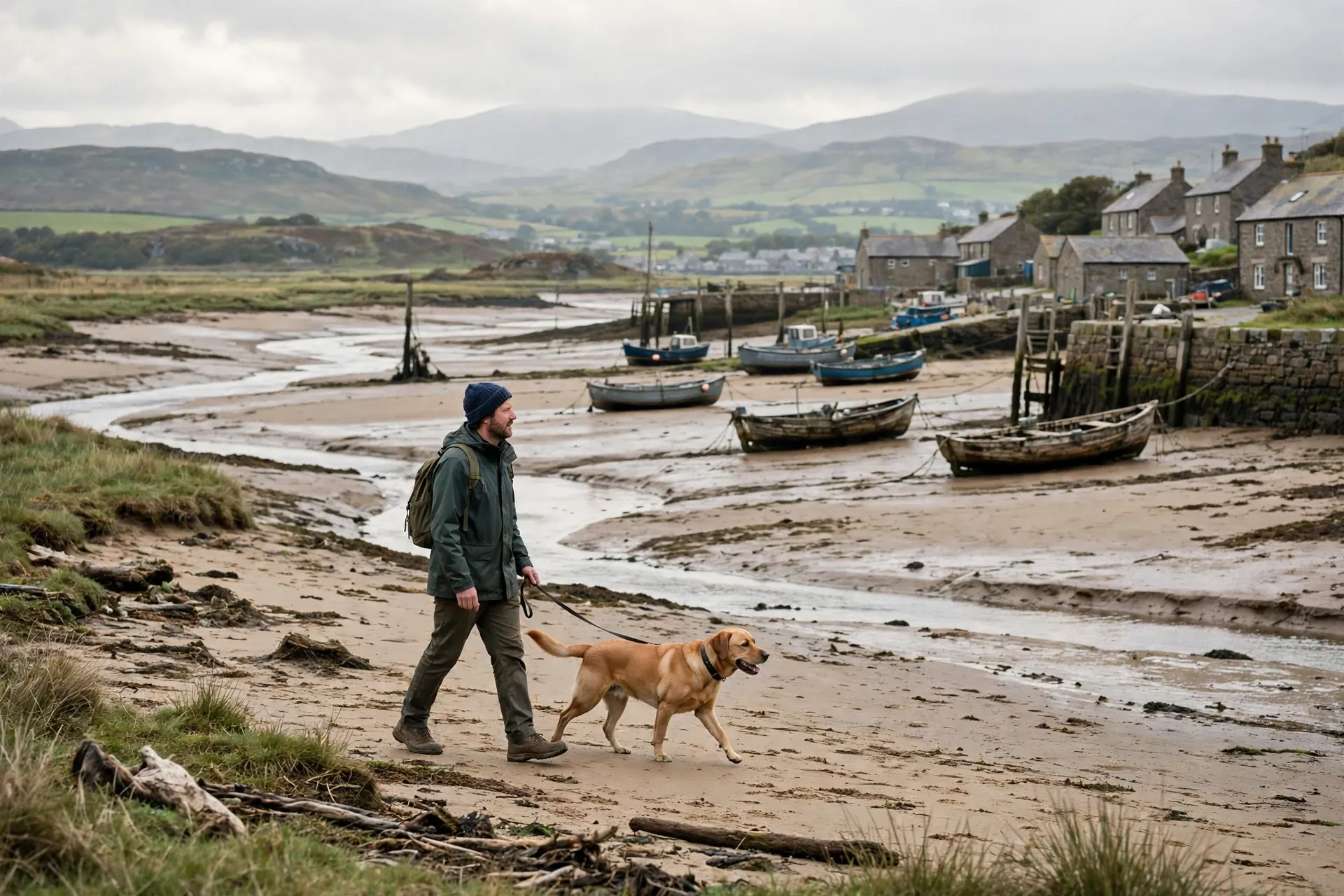
Ravenglass does not behave like an ordinary seaside village, and that is exactly what makes it interesting. Here the rivers Esk, Mite and Irt come together before they reach the Irish Sea, spreading out into a broad, shallow estuary of sandbanks, winding channels and mudflats. At high water the village feels almost like an island edge, with water close under the railway embankment and along the shore. At low water the same place opens into a vast, flat landscape that seems to invite a very long walk, and that invitation needs careful handling. The tide, not the clock, decides how far a dog walk can safely go, how much firm ground will be available, and when it is time to turn back.
The first practical step, before unpacking the car or choosing a cafe, is therefore to find the tide times for Ravenglass for that day and to read them alongside the weather. A falling tide gives a widening margin of sand and a clearer view of where the channels run. A rising tide does the opposite, and it can move faster than it looks, especially where a shallow channel deepens behind a sandbank and cuts off the way back. Dogs do not read tide tables, and a dog that is happily chasing a scent across flat sand may not notice that the water behind it has changed. The owner has to be the tide-watcher for both of them, checking the time at the start of the walk, setting a firm turn-back time, and keeping that limit even when the dog is still full of energy.
That discipline matters because estuary ground is not uniform. Firm, rippled sand near the village and along the main shore can feel solid underfoot, while a few steps to one side the ground may turn to soft, grey mud that grips boots and paws. Mudflats are not simply messy; they can be deep, they can hide channels, and a struggling dog can panic, which makes rescue harder. The safest habit is simple and worth repeating on every visit: stay where the ground is firm, stay where you can see the whole route back, keep the dog on a lead or under close control near channels, and never let a dog run out of sight across mud. If a dog does get into difficulty, do not wade in after it, because the same ground that trapped the dog can trap a person. Call for help, keep talking calmly to the dog, and let trained rescuers take over.
Seasonal light changes the estuary character too. In summer, evening light can make the water look calm and the sands look endless, which tempts walkers to stay out too long. In winter, a low sun over wet sand is beautiful but daylight is short, and a walk that starts comfortably can end in dusk with a rising tide. In all seasons, wind matters: a strong onshore wind can push water in earlier and make the shore colder and noisier for a nervous dog, while a cold offshore wind can dry the sand quickly but chill a small or short-coated dog that has been paddling. Pack a drying coat or towel even on a fine day, because estuary walks almost always end with wet paws, and a dog that has been in shallow channels will need drying before a car ride or a railway carriage.
None of this should put a careful owner off Ravenglass. It should simply put the estuary first in the plan. Choose the beach walk for the window around low water, choose the railway or the castle grounds for the hours when the tide is high, and treat the tide timetable as part of the itinerary rather than an afterthought. Owners who do that get the best of the village: wide, quiet sands, big skies, and a dog that is tired in the good way, from sniffing, paddling and exploring, rather than stressed by a rushed retreat from rising water.
The estuary and beach walk: sands, channels and safe lines
The most rewarding dog walk at Ravenglass is also the simplest: start in the village, follow the shore towards the open sand, and let the shape of the estuary set the route. The village itself is small and quiet, with narrow lanes, stone cottages and a railway station that sits close to the water, so the walk begins almost as soon as the car is parked. From the village edge, the ground opens to a wide expanse where the three rivers have already joined and the water spreads thinly over sand. Gulls, waders and oystercatchers work the shoreline, and on a calm day the far hills of the Lake District frame the view inland while the Irish Sea lies beyond the estuary mouth. For a dog, the interest is immediate: new smells on every breeze, shallow water to paddle in, and long, straight stretches of sand for a steady trot.
Walk the firm line, not the tempting shortcut. The channels that drain the estuary cut through the sand in curves that shift after storms and high tides, so a route that was firm last year may have a soft edge this year. Keep to sand that feels hard underfoot, avoid dark, glossy mud, and treat any ground that sucks at boots as ground to leave alone. A long lead is useful here: it gives a keen dog room to explore and sniff without letting it sprint across a channel or out onto a distant bank. Dogs that love to swim need extra care, because estuary water can be cold, fast in a channel, and difficult to exit where the bank is muddy. A short paddle in shallow, still water near the shore is very different from a swim across a flowing channel, and the second should not be encouraged.
The Cumbria Coastal Way passes through this area, and it gives the Ravenglass walk a useful structure for owners who like a marked route rather than an open wander. Following a waymarked coastal path helps keep the walk on ground that is walked regularly and known to local walkers, and it connects the village to the wider coast in both directions. To the north, the coast leads towards Drigg and the long, quiet beaches beyond, while to the south the route heads towards the headland and cliff country. Do not assume that a long-distance path means a long day for the dog: the sensible Ravenglass version is a there-and-back stretch timed to the tide, with the option to turn at any point. The same path that looks inviting in sunshine can be exposed in wind, so a dog that is sensitive to noise or spray may prefer the sheltered village lanes and the railway-side paths on a blustery day.
Wildlife deserves the same calm attention as the tide. The estuary is a working habitat for wading birds, and dogs chasing birds across mudflats can disturb feeding flocks and put themselves in danger at the same time. Keeping a dog under control near birds is not only good manners; it is part of keeping the dog on firm ground. The same applies to livestock on nearby fields and to other dogs on the beach: Ravenglass is quiet enough that encounters are usually unhurried, but a narrow lane or a gate can suddenly bring two dogs face to face, so a lead ready in hand, rather than buried in a pocket, makes those moments easy. Waste bags, water and a spare lead belong in the same pocket every time, because there is no shop on the sand to supply them.
After the walk, the routine matters as much as the route. Rinse sandy paws if fresh water is available, check between toes for grit and small stones, and dry the belly and legs of a low-slung dog before it settles in the car. Sand in a car, mud on a pub floor and a wet dog on a train seat are all avoidable with ten minutes of care at the end of the walk. If the dog has been in estuary water, watch for coughing, limping or unusual tiredness afterwards, and seek veterinary advice promptly if anything seems wrong. A calm, well-timed estuary walk should end with a dog that is contentedly tired, not exhausted, and with an owner who knows exactly when the tide will allow the next one.
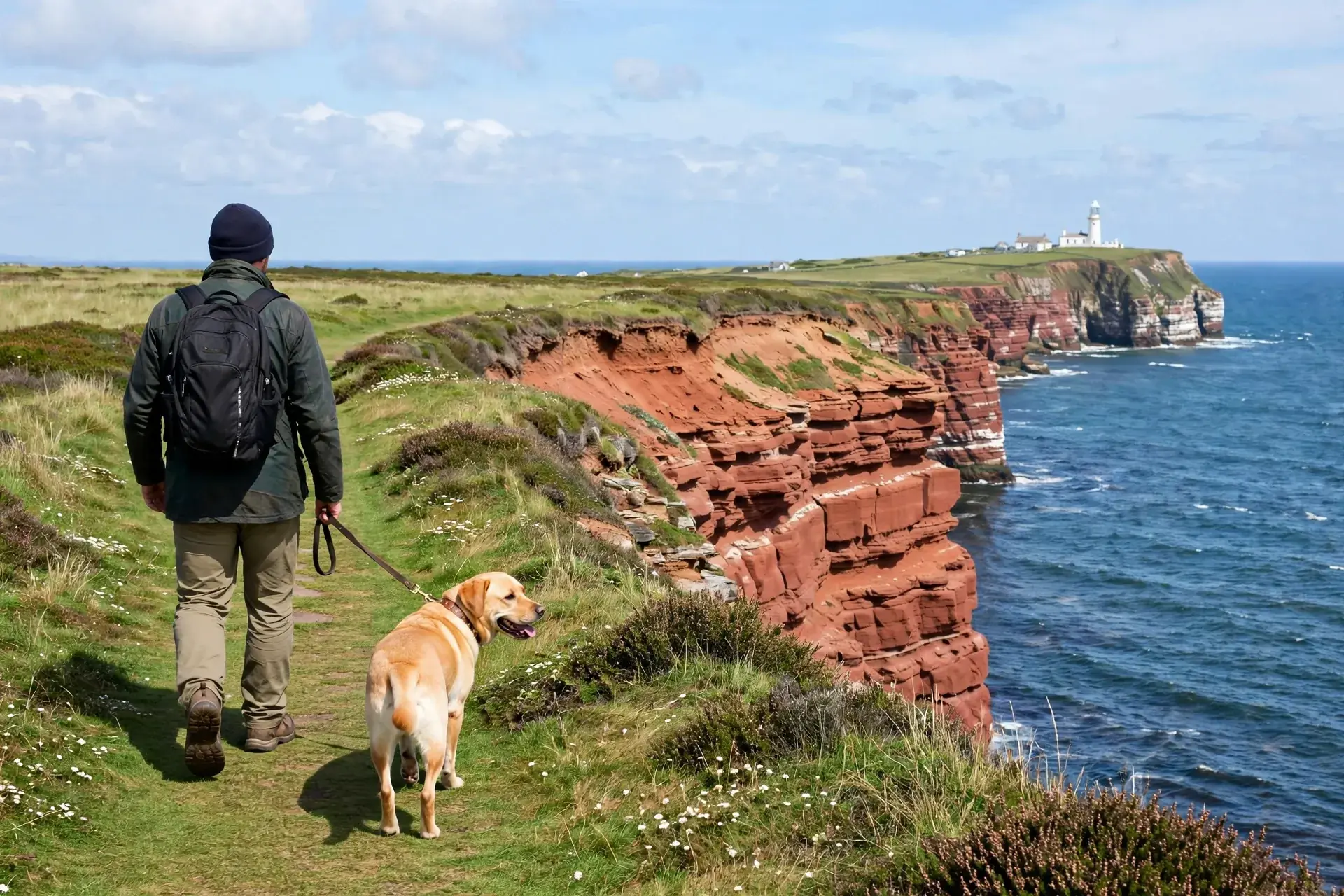
For a different kind of Cumbrian coast, the headland and beach walks at St Bees with a dog show how cliffs, a lighthouse path and a more exposed beach change the same basic safety rules: there the height and the wind matter more, while at Ravenglass the tide and the mud matter most. Comparing the two helps an owner choose the right coast for the dog in front of them, rather than assuming every Cumbrian beach works the same way.
A railway day out: the Ravenglass & Eskdale line to Dalegarth
If the estuary gives Ravenglass its setting, the narrow-gauge railway gives it its best day out. The Ravenglass and Eskdale Railway, known locally as La'al Ratty, runs inland from Ravenglass station up the Esk valley to Dalegarth for Boot, a journey of about seven miles through woodland, beside the river and into the lower fells. The trains are small, the gauge is narrow, the carriages are close to the ground, and the whole experience feels deliberately old-fashioned in a way that suits dogs surprisingly well. A dog that can settle on a mat at its owner's feet will usually enjoy the gentle pace, the open windows in summer, and the steady rhythm of the ride, while an anxious dog benefits from the fact that the journey is short enough to plan around, with a clear destination and a return train to aim for.
Planning the railway day starts with the timetable, not the ticket queue. Services run seasonally, with more trains in summer and a reduced service in winter, and special events can change the pattern on a given day, so check the official guidance before you travel for the current timetable, dog rules and any charges that apply. Arrive at Ravenglass station in good time, give the dog a toilet walk before boarding, and let it sniff the platform calmly rather than rushing straight to a carriage. Platforms on a small heritage railway are working places: steam, whistles, moving stock and other passengers with dogs all happen in a small space, so a short lead, a calm voice and a clear space beside a bench are worth more than any amount of fussing. If the dog is nervous about noise, choose a quieter service, sit away from the locomotive if that is possible, and bring a familiar blanket that smells of home.
On board, the rules of good railway manners are simple. Keep the dog on the floor, on its mat, under the seat or at the owner's feet, and do not let it climb onto seats or block the aisle. Bring water, but offer it in small amounts during the ride rather than a large bowl that will spill on the first curve. A chew or a long-lasting treat can help a settled dog stay settled, provided it does not disturb other passengers, while a dog that barks at every whistle may be happier with a shorter plan: ride one way and walk part of the return, or simply ride to an intermediate stop and come back, rather than committing to the full line in both directions. Owners who know their dog's limits will enjoy the railway far more than owners who try to squeeze a full day out of a dog that has already told them it has had enough.
Dalegarth, at the end of the line, is a good turning point for a dog walk. The station sits near the village of Boot, at the foot of the Esk valley, with riverside paths, woodland walks and a quieter, more inland landscape than the estuary. A short, level walk from the station, a paddle in a safe shallow stretch of river where the current is gentle and the bank is firm, and a rest before the return train make a satisfying middle to the day. Longer walks from Dalegarth climb towards the fells and are not suitable for every dog, especially in heat, rain or poor visibility, so choose the valley walk that matches the dog's fitness and the weather on the day. The return journey then becomes a rest, not a test: a tired dog on a mat, a window view for the owner, and the estuary coming back into sight as the train descends towards Ravenglass.
Two practical points complete the railway plan. First, think about the car: parking at Ravenglass for a full railway day means leaving the car for several hours, so park in a signed area, leave nothing tempting in view, and never leave the dog in the car while riding the train, even on a cool day. Second, think about the weather at both ends of the line. The valley can be cooler and wetter than the coast, or warmer and more sheltered, depending on wind and cloud, so pack a waterproof coat for the dog walk at Dalegarth even if Ravenglass looks fine at departure. A railway day that is planned around the dog, with toilet stops, water, shade and a clear return time, turns a heritage attraction into a genuinely dog-friendly outing rather than a long sit in a small carriage.
Muncaster, the castle grounds and the village itself
A short distance from Ravenglass station, Muncaster Castle and its grounds offer the calmer, greener half of a Ravenglass stay. The castle, with its long history and its gardens, woodland walks and open lawns, is a place to stroll rather than to rush, and that pace suits dogs that prefer sniffing and shade to open running. The grounds change with the seasons in a way the estuary does not: spring brings woodland flowers and fresh leaf cover, summer brings deep shade and busy garden paths, autumn brings colour and fallen leaves to chase, and winter brings quiet lawns and a clearer view of the castle itself. Dogs are generally welcomed in the gardens and grounds on leads, while indoor rooms and some attractions may have different rules, so check the official guidance before you travel and plan the visit around the areas where the dog is welcome.
The walk from Ravenglass to Muncaster is part of the pleasure, provided it is done at a dog's pace. Quiet lanes, field edges and woodland paths connect the village to the castle estate, and the route rewards a slow approach: hedgerows to sniff, gates to wait at patiently, and shade on a warm day. Keep the dog on a lead where the path passes livestock, gardens or other visitors, and be ready for the sudden appearance of other dogs around a corner or a gate. Inside the grounds, the same habits apply: a lead in hand, waste bags ready, water available, and respect for planted beds, lawns that are kept for visitors, and wildlife that lives in the woodland. A dog that is calm on a lead around other people will find Muncaster easy; a dog that pulls towards every new smell will need a shorter loop and more pauses, which is no failure, simply a different way to enjoy the same gardens.
Back in the village, Ravenglass itself is worth an unhurried hour. It is a small place, and that smallness is its charm: a handful of streets, a station, a church, cottages that have watched the estuary for generations, and views that change every hour with the tide. A village walk with a dog should be slow by design, with time to stand and look at the water, to let the dog sniff a wall or a gatepost, and to notice how the light moves across the sand. The Roman bath-house remains near the village are a reminder that Ravenglass has been a coastal settlement for a very long time, first as a Roman port and fort site, and later as a fishing and railway village. The remains are modest in scale, which makes them easy to visit with a dog on a lead, provided the dog is kept under control and the site rules on the day are followed. Do not expect a large visitor centre or a long trail here; expect a quiet, historic corner that adds depth to a walk, and check the official guidance before you travel if opening details matter to the plan.
The village also teaches a useful lesson about scale. In a large resort, a dog owner can hide a mistake: a missed toilet stop, a forgotten water bottle, a walk that runs too long. In Ravenglass, the scale is human and the distances are short, so good planning shows and poor planning shows too. That is an advantage, not a problem. A short walk, a rest, a second short walk and a quiet evening suit most dogs better than one very long expedition, and Ravenglass makes that pattern natural. The estuary walk in the morning, the railway or the castle grounds in the middle of the day, and a short lane walk in the evening give a dog variety without exhaustion, and give the owner time to enjoy the village rather than simply passing through it.
Owners who want a contrasting inland day will find the riverside town of Cockermouth with a dog useful for comparison: there two rivers meet in a busy market town, with flood-aware path checks and town-centre stops, while Ravenglass offers the quieter meeting of three rivers at the sea. The contrast helps explain why Ravenglass feels so different: it is not a town with a beach attached, but a coastal village where the rivers, the railway and the castle all meet within a short walk.
Practical planning: parking, pubs, vets and wet weather
Parking in Ravenglass is straightforward if it is treated as a single decision rather than a series of small ones. Use the signed village and station parking areas, arrive early on summer weekends and school holidays, and read the signs and payment instructions on the day, because charges, time limits and payment methods can change. Park once and walk from the car to the beach, the station and the village lanes, rather than driving between each stop in a village where lanes are narrow and turning space is limited. If the dog must wait in the car at any point, keep that wait very short, only in cool conditions, with shade and ventilation, and never as a routine part of the day. The better habit is to take the dog everywhere the rules allow, and to plan the day so that the car is simply the start and end point.
Pubs and places to eat in and around Ravenglass follow the same principle as the castle and the railway: check the official guidance before you travel, and do not assume that a dog-friendly village means every room welcomes dogs. Many village pubs and cafes welcome well-behaved dogs in at least one area, often a bar area, a porch or an outdoor terrace, while a formal dining room may be different. The practical approach is to ask on arrival, choose the area where the dog can settle on a mat under the table, and keep the visit short if the dog is restless. Bring the dog's own water bowl, order food that can be eaten without a long wait, and avoid peak lunch hours if the dog struggles with crowds, children and other dogs in a small space. A quiet drink and a rest after a beach walk are often more enjoyable for the dog than a long meal in a busy room.
Accommodation needs the same care. Ravenglass and the surrounding Esk valley offer cottages, small hotels, guest houses and campsites, but dog policies vary by property, by room and by season, and a general claim of dog-friendliness does not guarantee a suitable stay for a particular dog. Ask about the number of dogs allowed, any size or breed conditions, whether the dog can be left alone in the room, where the nearest toilet area is after dark, and whether there is a secure garden or an enclosed area. A ground-floor room with a door to the outside suits most dogs better than a long corridor and a staircase, and a property near the village lanes suits a dog that needs frequent short outings better than a remote cottage at the end of a long drive. Book the property that fits the dog, not simply the prettiest photograph, and get the dog policy in writing with the booking.
Veterinary planning is a quiet but essential part of any trip to a small coastal village. Ravenglass itself is small, so the nearest veterinary practices will be in larger nearby towns, and opening hours, emergency cover and travel time all need to be known before they are needed. Before the trip, save the details of the nearest vet and an emergency vet, note the drive time from the accommodation, and carry the dog's vaccination record and any medication in the same bag as the lead and water bottle. On the walk, watch for the problems that estuary and coastal trips commonly cause: cuts from shells or stones, sore paws from long walks on hard sand, stomach upsets from drinking estuary water or eating something found on the beach, and ticks after woodland walks around Muncaster and the Esk valley. A quick check of paws, ears and coat after each walk catches most problems early, and a prompt call to a vet is always better than waiting to see if a problem settles on its own.
Wet weather in Ravenglass is not a reason to cancel; it is a reason to change the order of the day. The estuary in rain can be wild and beautiful, but wet sand, wind and a rising tide make a long beach walk harder, especially for a small dog or a dog that dislikes spray. On a wet day, start with the railway, which gives shelter and a seated journey, or with the woodland paths at Muncaster, where tree cover softens the rain, and save a short, firm-sand beach walk for a drier window. Pack two towels rather than one, a drying coat for the dog, a waterproof lead that does not become heavy when wet, and a change of socks for the owner, because a wet walk that ends with a dry dog and a dry car feels like a success, while the same walk without drying equipment feels like a chore. Muddy lanes after rain also mean muddy paws, so a towel by the car door and a washable mat in the boot are worth their weight on every Ravenglass trip, in every season.
A seasonal calendar for Ravenglass with a dog
Spring is often the kindest season for a first visit to Ravenglass with a dog. Daylight lengthens, the Esk valley turns green, woodland paths around Muncaster come alive with birdsong, and the railway timetable builds towards its busier summer pattern. The estuary in spring can still be cold and windy, and the sand may be wet after winter storms, but the village is quieter, parking is easier, and a dog can enjoy long, unhurried walks without the crowds of high summer. Spring also brings nesting birds to the coast and lambs to nearby fields, so leads matter even more: keep dogs under close control near wildlife and livestock, stick to marked paths, and give ground-nesting birds a wide berth on the shore and the dunes.
Summer is the fullest season, and it needs the most planning. The railway runs its busiest timetable, the castle grounds are at their greenest, and the village has its most visitors, which means early starts pay off. Walk the estuary in the morning or the evening, when the sand is cooler and the light is softer, and use the middle of the day for the railway, the shaded castle grounds or a rest in the accommodation. Heat is a real consideration for dogs on sand: hot sand burns paws, and a dog that has been running on a beach in strong sun needs shade, water and rest, not another hour of play. Never leave a dog in a parked car in summer, even for a short time, and carry more water than seems necessary, because there is no shop on the sand and the nearest water point may be back in the village.
Autumn brings a different reward: colour in the valley, quieter trains, and a village that feels local again after the summer visitors have gone. The light over the estuary in autumn is often the best of the year, low and golden across wet sand, and a dog walk timed to a late-afternoon low tide can be memorable. Autumn also brings wetter weather, shorter days and softer ground, so waterproofs, a torch for lane walks after dusk, and a firm turn-back time become essential. Fireworks around early November can unsettle noise-sensitive dogs, so check whether local events are planned during the stay, keep evening walks short and familiar during firework season, and create a calm indoor routine for the night itself.
Winter in Ravenglass is quiet, stark and, for the right dog and owner, deeply enjoyable. The village is at its most peaceful, the estuary skies are huge, and a short walk followed by a warm pub or a cosy cottage feels like a proper break. Winter also brings the shortest days, the coldest wind off the sea, and the most mud, so walks should be shorter, better timed and better equipped. A short-coated dog may need a coat for a winter beach walk, an older dog may need a ramp or a shorter route, and every dog will need drying afterwards. The railway and the castle may run reduced winter hours, so check the official guidance before you travel rather than assuming summer opening times apply. A winter visit that is planned around daylight, tide and shelter is a pleasure; a winter visit planned as if it were summer will feel like a test.
Across all four seasons, one rule holds the calendar together: let the tide choose the beach walk, let the dog choose the length, and let the railway and the castle fill the hours in between. Ravenglass is not a place to rush through in a single afternoon, and it is not a place where a dog owner needs to fill every hour with an attraction. A tide-timed walk, a railway ride, a garden stroll and a quiet evening in the village add up to a complete day, and repeating that pattern with small variations across two or three days gives a dog the routine it enjoys and an owner the unhurried break that a small Cumbrian coastal village does best.
Practical questions
Before you go
Is Ravenglass beach safe for dogs at low tide?
Low tide opens up wide sands, but it also exposes soft mudflats and deep tidal channels, so it is not a place for an off-lead free-for-all. Stay on firm sand near the village, keep your dog in sight, watch the incoming tide from the start, and turn back well before the water returns. If the ground feels soft or your dog starts to sink, move back to firmer ground at once and check the official guidance before you travel.
Can dogs travel on the Ravenglass and Eskdale Railway?
Dogs are commonly carried on this narrow-gauge line, but carriages, charges and any restrictions can change by season and by service, so check the official guidance before you travel. Book the journey that suits your dog, keep the dog on a lead on platforms and in stations, bring water and a mat for the carriage floor, and plan a toilet stop before boarding because the ride to Dalegarth takes time.
Are dogs allowed in the grounds at Muncaster Castle?
Dogs on leads are generally welcomed in the castle gardens and grounds, while indoor areas and some attractions may have different rules. Check the official guidance before you travel, because access can vary by event, season and area. Keep the dog on a lead around other visitors, wildlife and garden beds, and carry water and waste bags for the walk between the castle and the village.
Where can I park in Ravenglass with a dog?
Ravenglass is small, so use the signed village and station parking areas rather than blocking narrow lanes or residential access. Arrive early on summer weekends and school holidays, read the signs and payment instructions on the day, and leave the car in shade with ventilation if you must leave the dog briefly, which should only ever be for a very short time in cool conditions. The best plan is to park once, walk from the car, and avoid moving the car between the beach, the station and the castle.
Is the estuary mud dangerous for dogs?
Yes, it can be. Estuary mud can be soft, deep and deceptive, and a dog that runs ahead can get stuck or panic in a channel that fills quickly as the tide turns. Never let a dog chase across mudflats, never follow a dog into soft mud yourself, and call for help rather than wading in if the dog becomes stuck. Firm sand, a lead near channels, and a tide timetable are the three things that keep an estuary walk safe.
When is the best time of year to visit Ravenglass with a dog?
Late spring and early autumn often give the best balance: longer daylight, quieter paths, and fewer crowds than high summer, with the railway and castle grounds in full season. Summer brings the busiest trains and warmest sand, winter brings big skies and very quiet lanes but shorter days and more mud. Whatever the season, the tide timetable matters more than the calendar, so plan the beach walk around the tide first and the rest of the day second.