This guide is independent and contains no paid placement. River levels, path closures and individual business rules change, so check the official guidance before you travel.
Start with the rivers. Cockermouth sits where the River Cocker meets the River Derwent, and its best dog walks follow that water: short, level riverside stretches in town, longer out-and-back paths along the banks, and easy onward routes towards the northern and western Lake District. After rain, check flood warnings and path conditions first, keep dogs on a lead near roads, bridges and fast water, and let the river on the day decide whether swimming is sensible at all.
Two rivers, one town
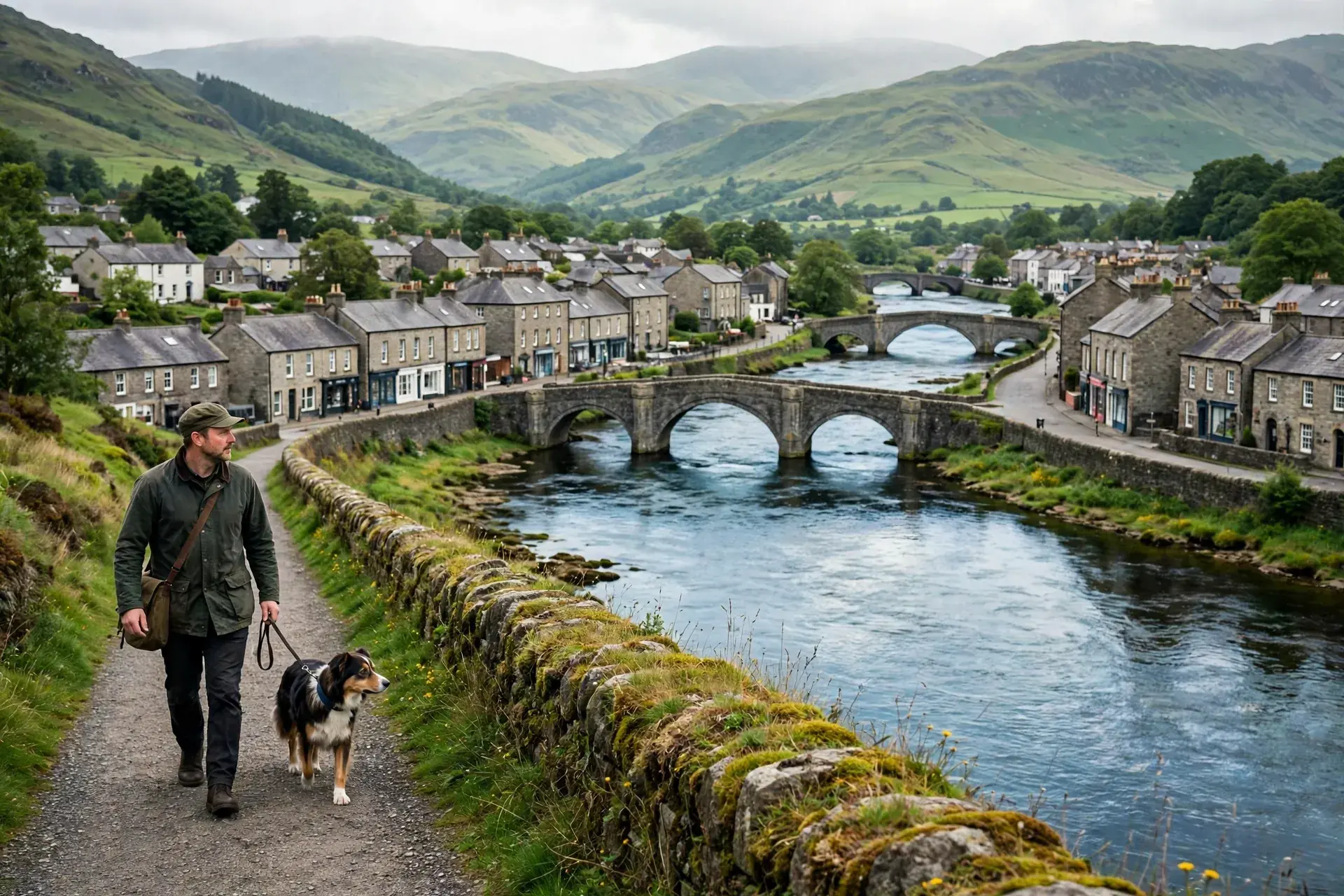
Cockermouth makes sense once you understand its rivers. The town stands in western Cumbria, just outside the Lake District National Park, at the meeting of two very different waterways. The River Cocker runs down from the fells to the south, a lively, stony river that has carved a narrow valley on its way to town. The River Derwent is the bigger partner: it drains Derwentwater and the Borrowdale valley, flows through Keswick, and then continues west past Cockermouth towards the Solway coast. Where they meet, the town gains a riverside character that shapes almost every pleasant dog walk in the area. Pavements give way to bankside paths, the sound of water follows you between streets, and the hills that feed both rivers sit on the horizon as a reminder of where the water came from.
For a dog owner, that geography is a gift, provided it is read correctly. Rivers give a walk its structure: a clear line to follow, regular places to stop, and a natural turning point when the path ends or the dog has had enough. They also demand respect. A riverside path is not the same as a park path. Banks can be steep, narrow or slippery; water levels change quickly after rain in the fells; and a river that looks inviting on a calm summer morning can be an entirely different river after a wet night. The best way to enjoy Cockermouth with a dog is therefore to treat the rivers as the plan and the weather as the editor of that plan. Choose the walk that suits the water you can see, not the walk you imagined at breakfast.
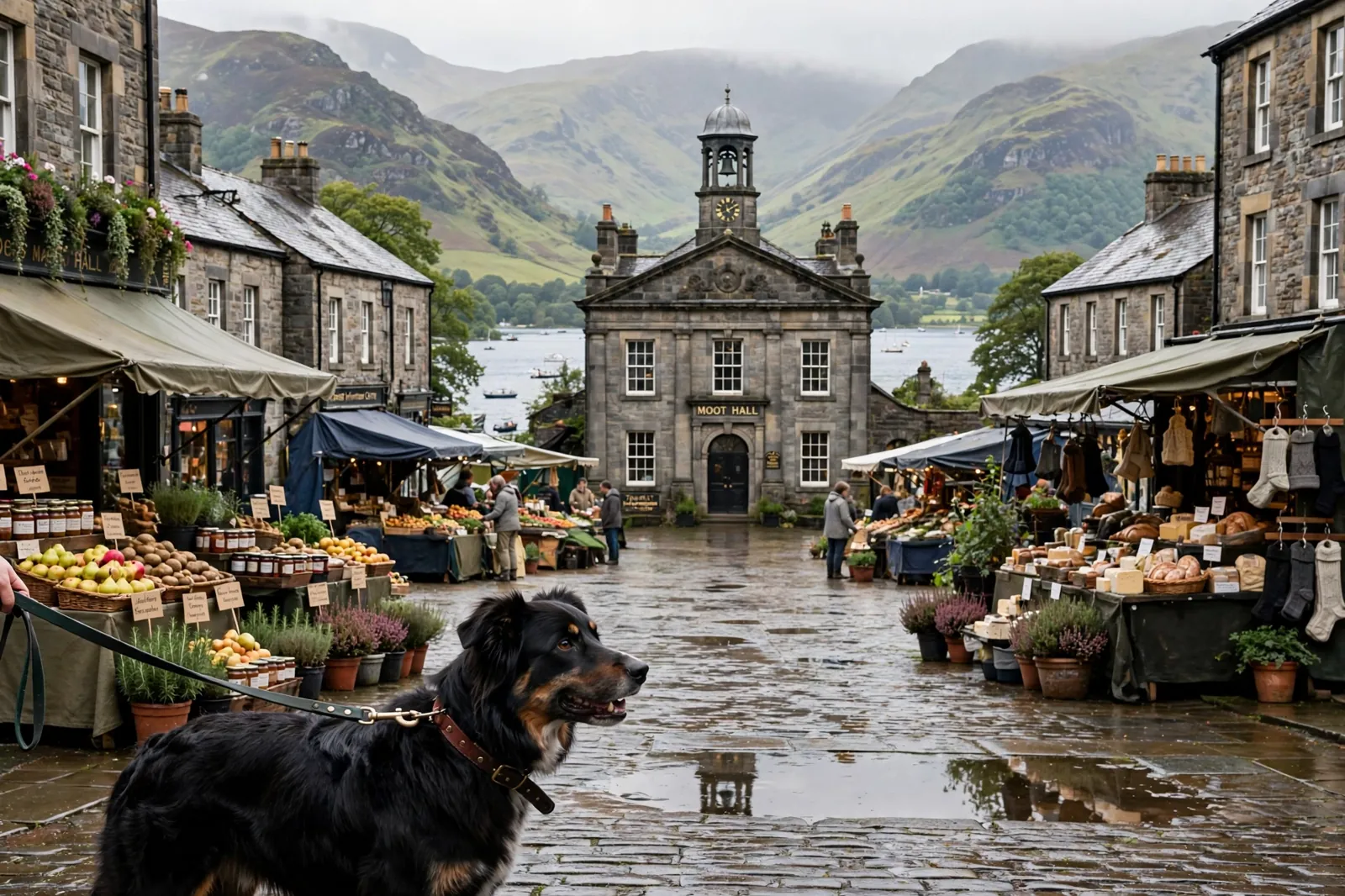
The town itself rewards this slow, water-led approach. Cockermouth is a working market town rather than a purpose-built resort, with a broad main street, independent shops, cafes and pubs, and handsome stone buildings that speak to its history as a market and milling town. The castle, standing above the rivers, is a landmark to look at from the banks rather than a place to plan a dog walk around, and visitors should check the official guidance before you travel for any access information. The pleasure here is not ticking off attractions. It is the simple rhythm of a town walk that moves from street to riverside and back again: a coffee stop, a stretch of bankside grass for sniffing, a bridge crossing, and a quiet return along the other bank.
That rhythm also makes Cockermouth a good first stop in Cumbria for dogs that are still learning to travel. A nervous dog can do a short riverside loop, practise passing people, cyclists, ducks and other dogs in a contained setting, and be back at the car or the accommodation without a long drive. A confident, energetic dog can use the same start point for a longer out-and-back walk, then burn off remaining energy with training games on a quiet stretch of grass away from the water. Older dogs benefit most of all: the flattest riverside ground in town is far kinder than a fell path, and a short, level walk beside water is often the difference between a good day and an over-tired evening.
It helps to think of Cockermouth in three layers. The first layer is the town centre itself, where dogs stay on leads on pavements and the rivers appear between buildings and at bridge crossings. The second layer is the immediate riverside: bankside paths, riverside greens and the confluence area, where the walking is still easy but the dog needs closer supervision near water, livestock fencing and other path users. The third layer is the wider countryside beyond town, where riverside paths join lanes, woodland and the lower edges of the fells. Most visitors will use the first two layers on arrival day and save the third for a second day, when they know how their dog has settled. That progression keeps the trip calm and gives the dog time to learn the smells, sounds and routines of a new place before the walks get longer.
Riverside walks, step by step
Begin with a short orientation loop rather than a long march. Park or arrive in the town centre, settle the dog with a toilet stop and a drink, and walk towards the nearest riverside path on a lead. Let the dog sniff the first hundred metres properly. That slow start is not wasted time: it tells you how busy the path is, whether the ground is muddy or firm, how your dog is reacting to water, ducks, joggers and other dogs, and whether the river is high, fast or calm. If anything feels wrong — a swollen river, a closed section, a dog that is already over-excited — you are still close enough to town to change the plan without drama.
A good riverside routine has four stages. First, the lead walk from town to the bank, where pavements, road crossings and bridge parapets need full attention. Keep the lead short here, keep the dog on the side away from traffic, and pause before every bridge so the dog is not pulled onto a narrow crossing while meeting another dog head-on. Second, the bankside stretch itself, where the pace can relax but the lead decision still matters. Use a long line rather than a fully off-lead run if the bank is unfenced, if the path is narrow, or if your dog's recall near water is untested. Third, a planned pause: a wide, flat spot away from the water's edge where the dog can drink, rest and watch the river without standing on a slippery bank. Fourth, the return, which should be treated as part of the walk rather than a race back to the car. Dogs that are tired make poorer decisions near water, so keep the lead on for the final stretch, even if the outward walk felt easy.
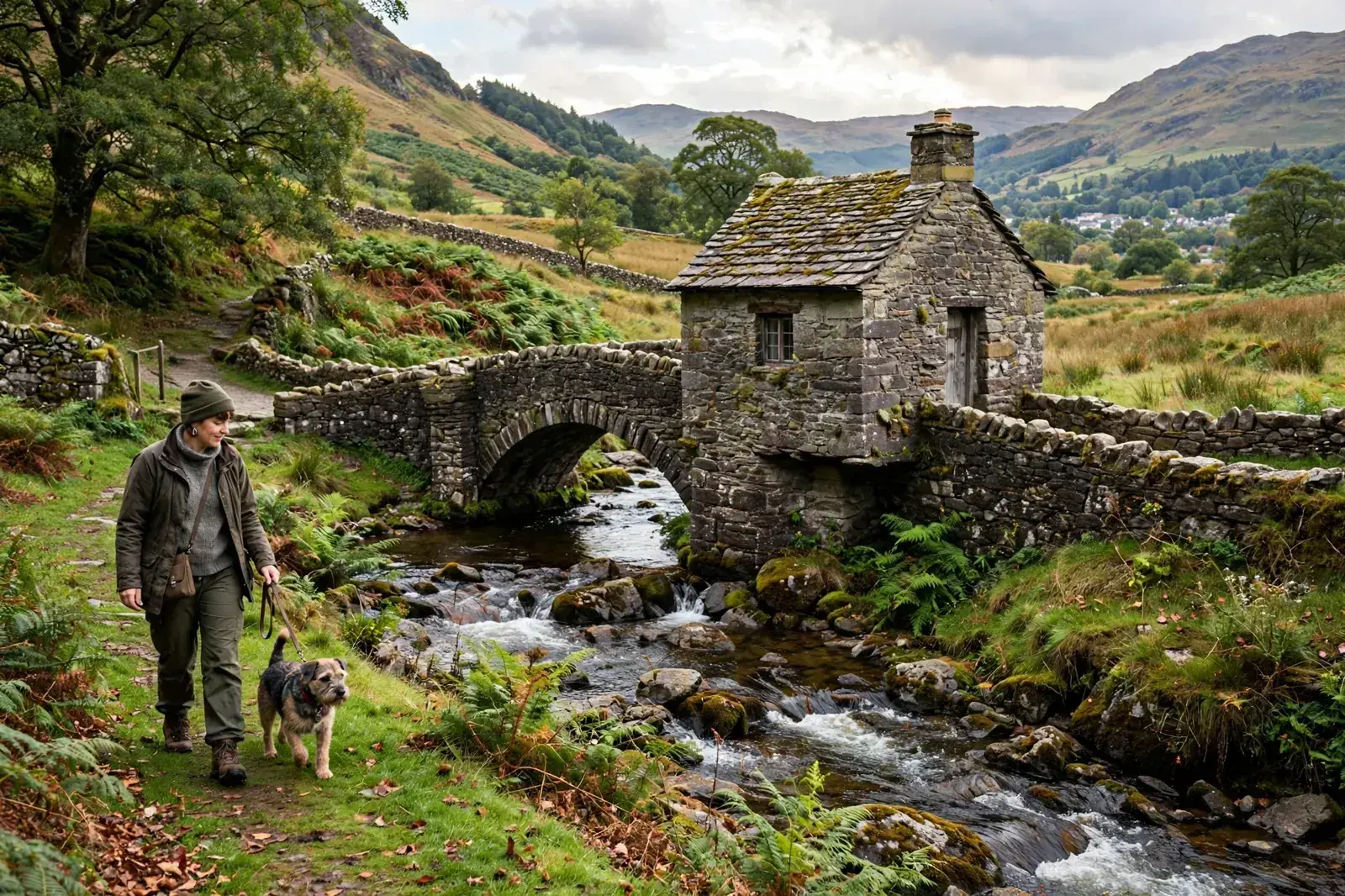
For a longer walk, the simplest safe pattern is an out-and-back route along one bank. This has three advantages for dog owners. You always know the way home, so there is no need to navigate an unfamiliar lane with a tired dog. You can turn back at any point — at a bridge, a muddy section, a field of livestock, or simply when the dog's energy drops — without being committed to a full circuit. And you see the same river twice, which helps you notice changes: a path that was firm on the way out may be churned by the return, or a group of swans that was distant may have moved closer to the bank. On a narrow riverside path, step aside for other users, keep the dog close when cyclists approach from behind, and call the dog in before a blind bend rather than after it.
Loop walks are tempting, but they need a little more checking in Cockermouth than a simple out-and-back. A loop usually means crossing from one bank to the other, which means a bridge, and it may also mean a stretch of lane, a field edge or a housing estate between the two riverside sections. Before committing, ask three questions. Is there a safe, dog-friendly bridge crossing at the far end, without a long stretch of fast road? Does the connecting section stay off busy traffic and away from livestock? And is the total distance realistic for this dog, on this ground, in this weather? If the answer to any of those is uncertain, the out-and-back version of the same walk is the better walk. A shorter walk done well beats a longer walk that ends with a stressed dog, a muddy car and a long road walk home.
Watch the ground underfoot as carefully as the river itself. Riverside paths in Cumbria mix tarmac, compacted gravel, grass and bare earth, and the same path can change surface several times in a few hundred metres. After rain, grass banks become slick, earth sections turn to mud, and stone steps beside bridges can be treacherous for dogs that rush. Dogs with short legs, older joints or long coats will struggle more in deep mud, and a dog that slips on a bank can panic into the water. Slow down on descents, keep the dog on a lead on steep or muddy banks, and carry a towel and a drying coat even on a day that starts dry. The towel is not just for comfort: a wet, muddy dog in a car will chill quickly on the drive to the next stop, and a quick rub-down at the path end is part of responsible riverside walking.
Other path users deserve the same planning. Riversides attract walkers, runners, cyclists, anglers and families, and a dog that dashes across a path to greet every passer-by will quickly become a problem. Train a simple, reliable behaviour before the trip — a recall, a wait at a gate, and a close heel past other dogs — and use it every time, not only when you remember. Keep the dog on the side of the path away from the water when passing anglers, whose lines and hooks are a hazard, and give horses, livestock and wildlife a wide berth. A dog that can walk calmly past a duck, a jogger and another dog on a narrow bank is a dog that will be welcome on every riverside path in town.
Finally, remember that riverside walking is also about what you do not do. Do not let a dog drink from a fast or discoloured river without thinking, do not throw a ball into deep or fast water, and do not assume that because one dog is swimming safely, yours will be too. Young dogs, older dogs, brachycephalic breeds and dogs that have never swum in a river need a much more cautious introduction than a confident spaniel. The riverside is at its best when it is treated as a place to walk beside water, with swimming as an occasional, carefully chosen extra rather than the point of the outing.
After rain: flood and path checks
Cockermouth's riverside charm comes with a serious companion: flooding. The town has experienced severe floods, most notably when the Cocker and the Derwent rose together and overwhelmed defences, and that history is part of why careful visitors check conditions rather than assuming a path will be passable. This is not a reason to avoid Cockermouth. It is a reason to build a five-minute check into every riverside plan, especially after rain, in autumn and winter, and whenever the fells above the town have had heavy or prolonged rainfall.
Start with the official picture before you leave your accommodation. Check current flood warnings and river levels for the Cocker and the Derwent, look for any local path or road closures, and read the weather forecast for the catchment, not just for the town. Rain that falls on the fells around Derwentwater and Borrowdale reaches Cockermouth downstream, so a dry morning in town does not guarantee a calm river. If a flood warning is in force for the area, do not treat a riverside walk as a normal outing. Choose higher, inland ground instead, keep dogs on leads, and check the official guidance before you travel for the latest advice. Flood water is not ordinary river water: it can hide drains, debris and damaged banks, it can move with surprising force even when it looks shallow, and it can carry sewage and pollutants that are dangerous for dogs that drink or swim in it.
Even without a formal warning, learn to read the river when you arrive. A healthy riverside walk has a river that is clear or slightly coloured, flowing at a steady pace, with a visible bank and a dry path beside it. Warning signs are a river that is brown and turbid, carrying branches or debris, lapping at the top of the bank, or flowing fast enough that you cannot see the bed through the surface. Listen as well as look: a river in spate is louder, and the sound changes from a gentle flow to a constant roar. If the path itself is under water, even shallowly, turn back. Do not walk a dog through flood water to reach a dry section beyond it, and do not let a dog paddle in water that has overtopped the bank. The path beyond may be damaged, the water may deepen suddenly, and the return route may be worse than the outward one.
Banks and bridges need the same post-rain inspection. After a flood or a period of high water, banks can be undercut, meaning the grass edge overhangs a hollow beneath it and can collapse under a dog's weight. Fences may be damaged, gates may be jammed with debris, and stone steps may be coated in silt that makes them slippery for days. Bridges should be crossed with care: check that the approach is not washed out, keep the dog on a short lead, and do not stop in the middle of a narrow bridge to admire the view if other users are waiting. If a section of path has been closed with signs or barriers, respect the closure even if the path looks passable. Closures are put in place because of a risk that is not visible from the path entrance, such as a weakened bank further along.
Build a wet-weather fallback into every day, and decide it before you need it. A good fallback for Cockermouth is a town-centre walk combined with a short, higher-ground loop away from the rivers, or a drive to a nearby town with surfaced, inland paths. If you are staying for several days, use a wet day for a shorter outing and save the longer riverside walk for a drier day, rather than forcing the riverside walk in poor conditions because it was on the itinerary. Dogs do not mind a changed plan, but they do mind being cold, wet and tired on a path that has become a hazard. A calm, shorter walk followed by a warm, dry rest is a better day for a dog than a long, muddy struggle beside a swollen river.
After the walk, do a flood-season health check that takes two minutes and prevents most problems. Rinse muddy paws and legs with clean water, check between the toes for grit and small cuts, and dry the dog thoroughly, especially around the ears and belly. Watch for signs that the dog has drunk river water it should not have: vomiting, diarrhoea or unusual lethargy in the hours after a walk are reasons to contact a vet promptly and to say exactly where the dog walked and what water it may have drunk. Keep the vet's number saved before the trip, because rural practices may have limited hours and the nearest emergency service may be in a neighbouring town. Prevention is simpler than treatment, and most riverside problems are prevented by the decision made before the walk, not by anything done during it.
Town centre with a dog
A riverside town is only useful if the town itself works for dogs, and Cockermouth scores well on the practical tests. The centre is compact and walkable, which means a dog does not need a car journey between a walk, a coffee stop and a shop. That compactness also means pavements can be busy at market times and on Saturdays, so the town-centre rules are simple: lead on, dog close, and no blocking a pavement while you browse a window. A dog that can walk calmly on a short lead past shoppers, pushchairs and other dogs will find Cockermouth easy. A dog that lunges at every passing dog will find the same streets stressful, and for that dog, an early-morning or late-afternoon town walk, when the streets are quieter, is a kinder choice than a midday visit.
Plan town-centre stops around the dog, not around the itinerary. Before entering any shop, cafe or pub, ask whether dogs are welcome and, if so, where they should sit. Policies vary by business and can change with staffing, season or a refurbishment, so a recommendation from a website or a previous visitor is not a guarantee. Look for the signs that a business has genuinely thought about dogs: a water bowl by the door, a clear area away from the main thoroughfare, staff who greet the dog calmly rather than fussing over it. If a business says dogs are welcome only in a garden or on a terrace, plan for the weather: a terrace that is pleasant in sunshine can be cold and exposed in wind or rain, and a dog that is shivering on a terrace is not enjoying the stop, even if the humans are.
Toilet stops in town need forethought. Do not rely on finding a grass verge at the exact moment you need one. Give the dog a proper toilet walk on riverside grass before entering shops, carry bags and a small bottle of water for rinsing, and clean up immediately, including on riverside paths where other walkers will follow. Dog fouling is not a minor detail on a riverside path: it spoils the walk for everyone, it can contaminate water if left near a bank, and it is the fastest way for dog owners to lose goodwill in a small town. Bag it, bin it, and if a bin is full or missing, carry the bag until you find one. That single habit does more for dog-friendly access than any campaign.
Shopping with a dog works best in short bursts. Take it in turns if you are travelling as a pair, so one person can stay outside with the dog while the other browses, and keep the dog's time in a busy shop brief. If you are travelling alone, choose the shops that matter most, leave the longer browsing for a day when the dog can stay in comfortable accommodation, and never leave a dog tied up outside a shop for a long period or in a car on a warm day. A dog left outside a busy shop is a theft risk, a stress risk and a hazard to passers-by, and a car can overheat far faster than most people expect, even on a mild day. The town-centre walk should feel like a shared outing, not a series of waits for the dog.
Finally, use the town centre as a weather gauge and a recovery point. If the riverside path is too muddy, too busy or too high, the town offers a dignified alternative: a pavement walk, a quiet side street, a look at the castle from a distance, and a warm stop. If the dog is tired after a longer walk, the town offers water, shade or shelter, and a short, flat route back to the car. Thinking of the town centre as part of the walk, rather than as a separate errand, is what makes a Cockermouth day feel relaxed instead of rushed.
From town to the Lake District edge
Cockermouth's position on the edge of the Lakes is its strategic advantage. From town, the northern Lakes are a short drive away, and the western fells are closer still. That means a visitor can base in a quieter, less crowded town, enjoy riverside walking on arrival day, and then choose a different kind of day for the second day: a lakeside walk, a low fell, or a woodland route. The key is to match the onward walk to the dog that did the riverside walk, rather than assuming that a dog that enjoyed a flat riverside hour will automatically enjoy a steep fell climb.
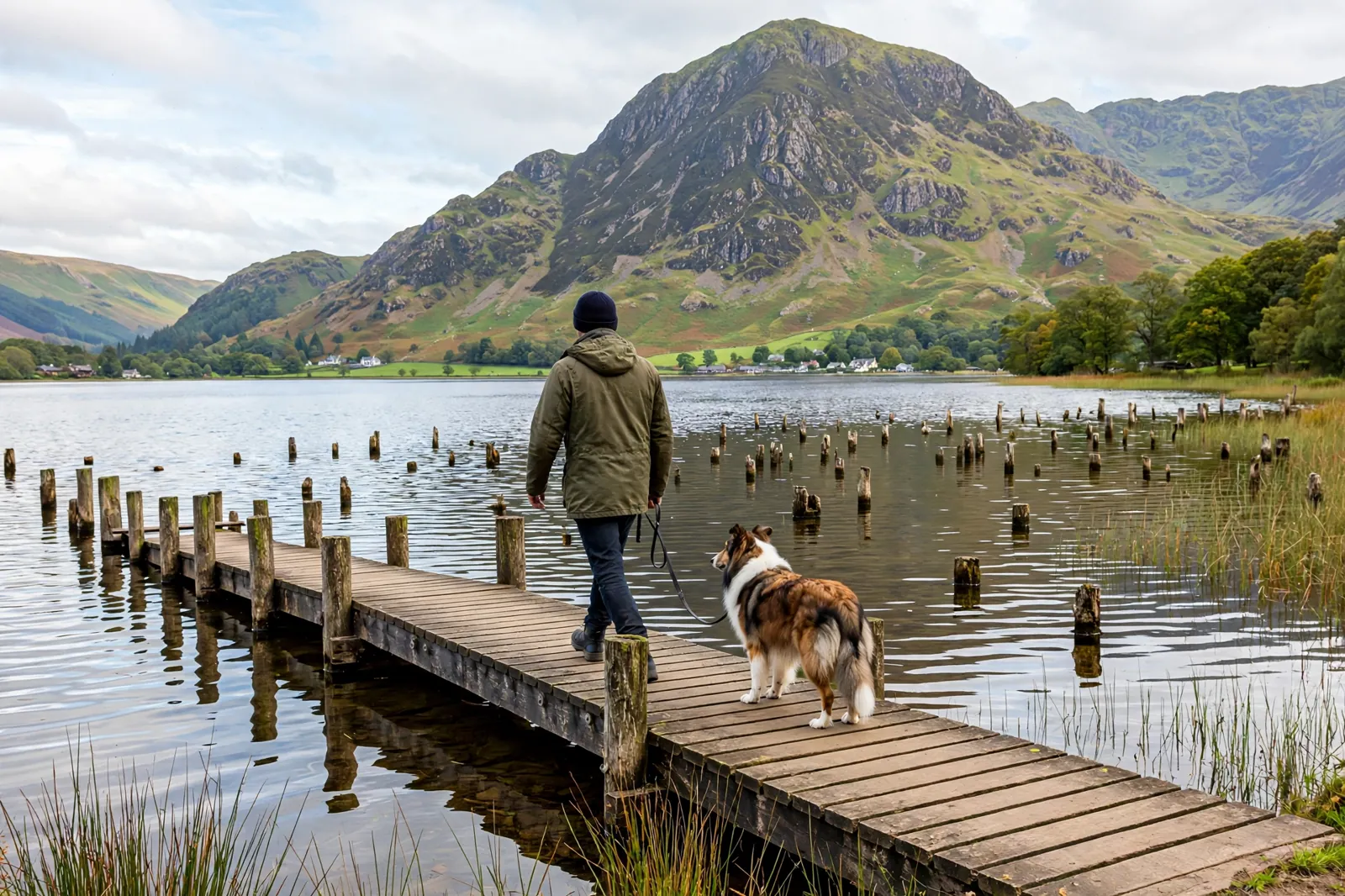
Keswick is the natural next step for many Cockermouth visitors. The drive follows the Derwent upstream to Derwentwater, and the walking changes character completely: open lake shores, launch jetties, market-town streets and, for fit dogs, fell paths such as the lower slopes above the lake. A dog that coped well with Cockermouth's riverside paths, other dogs and busy bridges will usually cope well with Keswick's shore paths, but the distances, the exposure and the number of other visitors are all greater. Start with a shore walk rather than a fell, keep the dog on a lead near the launch and the town centre, and treat a fell walk as a separate, planned outing with proper kit, not as an extension of a lakeside stroll.
Ambleside and the central Lakes offer a different flavour: a busier, more visitor-focused town at the head of Windermere, with waterfalls, woodland and fell paths that start close to the centre. For a Cockermouth-based visitor, Ambleside is a full-day excursion rather than a casual add-on, and it works best when the dog is already settled into the trip routine. The same logic applies to Coniston, where lake, woodland and fell walking meet in a quieter setting. Both towns reward an early start, a planned parking stop and a walk chosen for the dog's fitness on the day, not for the photograph at the summit. If the Cockermouth riverside day revealed that your dog tires after an hour, a long central Lakes fell day is the wrong next step, however attractive it looks in a guidebook.
The western Lakes and the coast offer a gentler alternative that many dog owners overlook. Low-level woodland, old railway lines converted to paths, and quiet lanes can give a dog a long, interesting walk without steep climbs or exposed ridges. These routes suit older dogs, puppies that are still building stamina, and dogs that are reactive on narrow fell paths, because there is usually room to step aside and let others pass. Check the official guidance before you travel for any seasonal restrictions, livestock on the route and parking arrangements, and remember that a woodland or lane walk still needs the same basics: water, a lead, bags, a towel and a plan for getting back to the car without a long road walk.
Driving between Cockermouth and the Lakes also needs dog planning. Keep the dog secure in the car with a guard, crate or harness, stop for a toilet and water break on a longer drive, and never leave a dog in a parked car on a warm day while you visit a shop or attraction. On arrival at a busier Lake District town, give the dog ten minutes of calm pavement and grass walking before starting the main walk, just as you did in Cockermouth. That settling time prevents the classic mistake of arriving at a busy honeypot, immediately joining a crowded path, and spending the first half-hour managing an over-excited dog.
Accommodation choice shapes this edge-of-the-Lakes strategy. A base in or near Cockermouth gives quieter evenings, easier parking and a riverside walk on the doorstep, but it means a drive to every Lake District walk. A base inside the National Park gives walking from the door but brings busier evenings and tighter parking. There is no universally right answer; there is only the answer that fits your dog. A dog that settles well in a car and sleeps well after a drive will thrive on a Cockermouth base. A dog that becomes anxious in the car, or that needs a garden toilet break at night, may be better in a base where the first walk needs no driving at all. Decide the base by the dog's needs, and let the itinerary follow.
River swimming: a careful decision
River swimming looks like the natural reward for a riverside walk, and for some dogs, in the right place, on the right day, it is. But rivers are not swimming pools, and the Cocker and the Derwent are not places to assume safety. The decision should be made fresh every time, at the water's edge, after looking at the river, not made in advance at home. If any part of the checklist below fails, the answer is a paddle on the lead, a drink from a bottle, or no water contact at all — and the dog will not consider that a wasted walk.
Start with current and depth. A safe swimming spot for a dog has slow, shallow water at the entry, a gently sloping bank that the dog can walk out of without scrambling, and no fast channel a few metres downstream. Avoid weirs, bridges with strong flows underneath, and any place where the water suddenly deepens or quickens. After rain, even a familiar spot can change: the entry that was a gentle slope last summer may now be a steep, muddy bank above fast water. If you cannot see the bed, if debris is moving downstream, or if you would not wade in yourself without holding onto something, do not send a dog in. Dogs are strong swimmers in a pool and surprisingly vulnerable in a current, because they cannot judge a downstream hazard or climb a steep, slippery bank when they are tired.
Water quality matters as much as current. Do not let a dog swim or drink where the water is discoloured, foamy in an unusual way, or covered in a visible film or algal bloom. Blue-green algae, in particular, can be dangerous for dogs, and the risk is not always obvious from the bank. If you are unsure, check the official guidance before you travel and ask locally about current conditions. After any swim, rinse the dog with clean water, dry the ears gently, and watch for vomiting, diarrhoea, excessive drooling or lethargy. Our wider guide to dog swimming safety in the UK covers entry points, currents, cold water and post-swim checks in more detail, and it is worth reading before a first river swim of the season.
Breed, age and experience change the risk dramatically. A fit adult spaniel or Labrador that swims regularly in still water still needs a cautious first river swim, with a short session, a lead or long line for the first entry, and a clear exit. A puppy, an older dog, a dog with arthritis or heart disease, a brachycephalic breed with breathing difficulties, or a dog that has never swum should not be introduced to a river as a first swim. Cold water is a separate hazard: even in summer, Cumbrian rivers can be cold enough to tire a dog quickly, and a dog that swims for too long can become cold, stiff and disoriented on the bank. Keep river swims short, keep a towel and a drying coat ready, and end the swim while the dog is still enthusiastic, not when it is exhausted.
Other users and wildlife also affect the swimming decision. Do not let a dog swim near anglers, near nesting birds or swans with young, or in a spot where other dogs are already swimming in a crowded, excited group. A dog that charges into the water to join a group can collide with another dog, chase wildlife, or be swept into a hazard it did not see. Choose a quiet spot, keep the session brief, and recall the dog out before it decides to swim further downstream. The best river swim is a boring one: a short, controlled paddle and swim in slow, shallow, clear water, followed by a happy, dry dog walking on.
Finally, think about what happens after the swim. A wet dog needs drying before a car journey, a muddy bank needs a towel at the car, and a dog that has swum in a river needs a check for cuts, ticks and debris between the toes. If the dog has swallowed river water, watch its appetite and stools for the rest of the day. A river swim that ends with a clean, dry, settled dog is a success. A river swim that ends with a shivering dog, a muddy car and a worried evening is a sign that the next swim needs a different spot, a shorter session, or no swim at all.
Seasons on the riverside
Spring is the season when Cockermouth's riverside feels most alive, and also the season when care matters most. New growth softens the banks, birds are nesting, and lambs may be in fields near riverside paths. Keep dogs on leads near livestock and nesting areas, even if the dog has ignored sheep all winter, because spring changes animal behaviour and a single chase can cause serious harm. Paths that were firm in winter may be soft and muddy as the ground thaws, and spring rain can raise river levels quickly. The reward for that care is a walk full of interest: bright green banks, busy birdsong, and a dog that can sniff a whole winter's worth of new smells without the summer crowds.
Summer brings the longest days and the busiest riversides. Early morning and late evening are the best times for a dog walk in summer: the paths are quieter, the ground is cooler, and the light on the water is at its best. Midday walks need shade, water and a realistic distance, because a dog in a thick coat can overheat on a humid riverside path even when the air temperature feels mild to a human. Never leave a dog in a car in summer, even for a short stop, and carry more water than you think you need. Summer is also the season when river swimming is most tempting and most in need of caution, because low, clear water can hide a fast channel, and warm, still pools can develop algal problems. Check conditions on the day, keep swims short, and choose shade for rest stops.
Autumn is, for many dog owners, the best riverside season in Cockermouth. The crowds thin, the light turns golden, and the rivers run clear after the first rains. It is also the season when leaves cover paths and hide mud, holes and slippery stones, so slow down on descents and keep dogs on leads on leaf-covered banks. Autumn storms can raise river levels with little warning, and fallen branches can block a path overnight, so the flood check becomes a daily habit rather than an occasional one. Fireworks season, around early November, needs separate planning: a dog that is noise-sensitive should have a quiet, indoor evening routine, a safe den, and a toilet walk timed before displays begin, rather than a riverside walk during a display.
Winter riverside walking is quiet, stark and beautiful, but it is not a casual outing. Short daylight, cold water, icy banks and muddy paths all shorten the sensible distance for most dogs. Dress for the dog as well as yourself: a drying coat, a towel and, for short-coated or older dogs, a warm coat for the walk itself. Keep the dog on a lead near icy banks and fast water, because a slip into cold water in winter is a far more serious incident than the same slip in summer. Check daylight times before you set out, carry a phone and a torch, and plan to be back in town well before dark. A short, crisp winter riverside walk, followed by a warm pub or a warm home, is a perfect Cumbrian day for a dog. A long, cold, muddy walk that ends in darkness is not.
Whatever the season, pack for the river, not for the forecast alone. A forecast that says dry can still mean a muddy bank, a forecast that says light rain can still mean a swollen river if the fells had heavy rain overnight, and a forecast that says warm can still mean cold water. The kit list that works year-round is short: lead and long line, water and a collapsible bowl, bags, a towel and a drying coat, a phone with vet numbers saved, and a change of footwear for yourself if the path is muddy. Add season-specific items — a warm coat in winter, extra water and shade planning in summer, a torch in the short days — and you will rarely be caught out by a riverside walk that turns out different from the one you planned.
Practical planning for dogs
Good riverside planning starts the night before, not at the path entrance. Check the weather forecast for the catchment and the town, check flood warnings and river levels, and choose two walks: the walk you hope to do and the fallback walk you will do if the river or the path says no. Tell someone where you are going if you are walking alone, especially for a longer out-and-back route, and make sure your phone is charged. Save the numbers for a local vet and an emergency vet before you need them, and keep them in the phone under names you can find quickly when you are wet, muddy and worried.
Parking and arrival deserve the same care. Choose a start that avoids a busy road crossing with an excited dog, and give the dog a settling walk before the main walk begins. A dog that arrives at a riverside path straight from a car journey, without a toilet stop and a few minutes of sniffing, will pull, bark and rush the first section. A dog that has had ten minutes to settle will walk the same path calmly. If you are using public transport, check the official guidance before you travel for dog rules on the service you plan to use, and plan the walk from the stop so that the dog is not faced with a long, busy road walk before reaching the riverside.
Lead choices make a real difference on riverside paths. A short lead is right for pavements, bridges, busy sections and anywhere near livestock or roads. A long line is right for open, well-sighted bankside grass where recall is still being trained, provided the line cannot tangle around another walker, a cyclist or a fence. A retractable lead is a poor choice on a narrow riverside path, because it gives the dog sudden range at exactly the moment another user appears around a bend. Whatever you use, practise the transitions before the trip: short lead to long line and back again should be smooth, not a wrestling match at a gate.
Food, water and rest need planning on a longer walk. Carry water for the dog even on a riverside walk, because river water is not a reliable drink, and offer it at planned pauses rather than waiting until the dog is panting heavily. Do not feed a large meal immediately before a long walk or a swim, and allow a rest after eating before vigorous exercise. On a longer day, plan a mid-walk rest in shade or shelter, especially for older dogs and puppies, and watch for signs of tiredness that are easy to miss on a riverside path: slowing pace, lagging behind, excessive panting, or a dog that stops sniffing and simply plods. Tiredness near water is a safety issue, not just a comfort issue, so turn back when you see it, not an hour later.
Health and safety basics complete the plan. Keep vaccinations, flea and tick treatment and worming up to date before a Cumbrian trip, because riverside grass, woodland and livestock areas all carry parasites. Check for ticks after every walk, especially around ears, armpits and groin, and remove them correctly. Carry a small first-aid kit with a bandage, antiseptic wipes and tweezers, and know how to use it. If your dog has a medical condition, carry any medication, tell your walking companion where it is, and choose walks that keep you within reasonable reach of help. A riverside walk is a low-risk outing when it is planned, and a high-stress outing when it is improvised with an unwell dog far from the car.
Finally, leave the riverside better than you found it. Take all litter and bags home or to a bin, keep dogs away from ground-nesting birds and livestock, close gates behind you, and report a damaged path, a broken fence or a blocked bridge to the relevant authority rather than climbing around it. Small-town riversides survive on goodwill: landowners, anglers, walkers and dog owners share the same narrow banks, and the dog owners who are welcome back are the ones who left no trace, kept their dogs under control, and made the path pleasant for the next person.
A river-led day in Cockermouth
A good Cockermouth day does not need to be complicated. It needs a river, a pause, a town stop and a flexible ending. The plan below is a template, not a timetable: shorten it for an older dog, lengthen the riverside section for an energetic dog, and swap the afternoon for a Lake District excursion on a second day if the first day goes well.
Start in the morning with a short town and riverside loop. Walk from the centre to the nearest bank on a lead, let the dog settle with sniffing and a toilet stop, and follow the bank for a comfortable distance before turning back on the same path. This first walk tells you everything you need for the rest of the day: how the dog is feeling, how busy the paths are, whether the river is high or calm, and whether the ground is muddy enough to need a towel change. Return to town for water, a rest and a coffee stop, and let the dog lie down properly rather than rushing straight into the next activity.
Use the middle of the day for the town itself. Browse shops in short bursts, visit a dog-friendly cafe or pub garden if the weather suits, and give the dog a quiet rest in shade or indoors. This is also the time to check the afternoon plan: look again at river levels if rain is forecast, decide whether a longer riverside walk or a drive to a nearby town is sensible, and prepare the car with towels and water if you are heading out. A dog that has rested properly at midday will enjoy an afternoon walk far more than a dog that has been dragged from one activity to the next without a break.
In the afternoon, choose one longer activity, not two. Either a longer out-and-back riverside walk, with a planned pause and a turn-back point, or a drive to a nearby Lake District town for a shore or woodland walk, with a settling walk on arrival. Do not try to combine a long riverside walk, a fell walk and a busy town visit in one day; the dog will be tired, the humans will be tired, and the last activity will be the one that goes wrong. End the afternoon with a proper wind-down: a short, flat walk, a drink, a towel-down if needed, and a quiet evening routine that mirrors home as closely as possible.
Evening in Cockermouth should be calm. Give the dog a final, short toilet walk on a familiar, well-lit route, avoiding fast water and unlit banks after dark. Riverside paths that are pleasant in daylight can be hazardous after dark, with uneven ground, unguarded water and poor visibility for other users. A pavement or well-lit town walk is a better last outing than a riverside path in darkness. Then settle the dog with the same bed, feeding time and routine it knows from home. A dog that sleeps well after a river day is a dog that will be ready for another river day tomorrow, and that, more than any single walk, is the measure of a successful Cockermouth trip.
If you have a second day, use it to change the water, not just the distance. A first day on the Cocker and Derwent in town, followed by a second day on a lake shore or a different river valley, gives a dog new smells and new ground without repeating the same path. If you have a third day, use it for the quietest option: a short riverside walk in the morning and a long, lazy afternoon in town. The best Cumbrian dog trips are not the ones with the longest walks. They are the ones where the dog was comfortable, the humans were relaxed, and the rivers were enjoyed on their own terms, day after day.
Practical questions
Before you go
Can dogs walk off lead along the rivers in Cockermouth?
Only where it is safe and lawful to do so. Keep your dog on a lead near roads, bridges, livestock and fast or high water, and use off-lead time only on open, well-sighted ground where recall is reliable and no other users are crowded into the path.
What should I check after heavy rain before a riverside walk?
Check river levels, flood warnings, path closures and the condition of banks and bridges before you set out, and be ready to change plans. After heavy rain, water can be faster and deeper than it looks, banks can be slippery or undercut, and debris can block a path that was clear the day before.
Is Cockermouth a good base for Lake District walks with a dog?
Yes, for visitors who prefer a quieter market town on the edge of the Lakes. Cockermouth gives you riverside walking from the town centre, easy road access to the northern and western fells, and a calmer place to return to after a fell or lakeside day.
Can my dog swim in the River Cocker or the River Derwent?
Treat river swimming as a decision to make on the day, not a promise. Check the current, depth, water clarity and bank access first, keep the session short, and skip it after heavy rain, in spate conditions, or where the water looks discoloured or carries debris.
Where can I park and start a riverside walk in Cockermouth?
Start from the town centre, where riverside paths are within a short walk of the main shopping streets. Check the official guidance before you travel for current parking locations, charges and any restrictions, and choose a start that avoids a busy road crossing with your dog.
Are dogs welcome in Cockermouth town centre?
Cockermouth is a practical, walkable market town for dog owners, but individual shops, cafes and pubs set their own rules. Ask before entering, keep your dog on a lead on pavements, and carry water and bags so a town-centre stop stays easy for everyone.