This guide is independent and contains no paid placement. Beach rules, tide times, path closures and business opening hours can change, so check the official guidance before you travel.
St Bees works best as a headland-first day: start with the clifftop walk to the lighthouse with your dog on a lead, drop to the beach only when the tide allows a safe margin, and treat the cliff edge as a no-go zone rather than a viewpoint. If the tide, wind or path conditions look doubtful, the village and the inland lanes give you a calmer plan B without losing the trip.
Planning the day in the right order
St Bees is a small Cumbrian village on the Irish Sea coast, a short distance south of Whitehaven. Its appeal for dog owners is not one single attraction but a combination that fits together well: a sandy beach, a prominent sandstone headland, a working lighthouse, a railway station in the village, and the western starting point of the Coast to Coast long-distance route. That combination also explains why planning order matters. The headland walk, the beach walk and a long-distance first stage are not interchangeable. Each one depends on different conditions, and the safest day usually puts the least tide-dependent activity first.
Begin by checking three things before you leave home: the tide table for St Bees, the weather forecast including wind speed and direction, and any current path or beach notices. Tide times are the deciding factor for the beach. Weather decides whether the exposed headland will be enjoyable or merely exhausting, especially for a small dog, an older dog or a dog that dislikes strong wind. Path notices matter because coastal paths can be diverted after cliff falls, heavy rain or conservation work, and a diversion that looks minor on a map can add a steep climb or a road section that changes the walk completely. If any of these three checks is unclear, check the official guidance before you travel rather than assuming the route will be passable.
Next, decide what kind of day your dog actually needs. A young, fit dog that loves open running may enjoy a long headland loop followed by a beach run at low tide. An older dog, a short-legged breed or a dog recovering from an injury will usually do better with a shorter clifftop out-and-back, a gentle beach stroll and plenty of rest in the village. A nervous or reactive dog may prefer an early start, when the beach and the headland are quieter, and a route that avoids narrow pinch points where dogs meet head-on. There is no single correct St Bees walk. The right walk is the one that matches the dog in front of you, the tide on the day and the wind on the headland.
A practical order for a first visit is to arrive, settle the dog with a short toilet walk in the village, walk the headland while energy and daylight are on your side, and then judge the beach by the tide. If low tide is in the middle of the day, reverse that order only if you can be certain of getting off the sand with a comfortable margin. Never plan a beach walk that finishes exactly at high tide, and never assume you can simply climb a cliff path if the tide comes in faster than expected. Cliff paths are not emergency exits. They can be steep, slippery and, in places, closed or unsafe, and they should never be treated as a fallback for a misjudged tide.
Transport planning deserves the same care. Drivers should allow time to find parking and to walk from the car to the beach or headland without rushing a dog that has just spent time in a vehicle. Rail travellers benefit from St Bees station being in the village, but they should check train times for the return journey before setting out on a long walk, because a missed connection after a tiring headland loop is a poor end to the day. If you are starting a multi-day walk, confirm accommodation, luggage transfer or onward transport in advance, and carry enough water and food for the dog even on a short first stage, because shops and cafes on a coastal route are not guaranteed to be open.
Finally, keep the day flexible. St Bees rewards walkers who are willing to shorten a route, turn back at a sensible point or swap the beach for the headland. A dog does not measure a day by distance covered. A calm hour on a safe path, a paddle at the waterline at low tide and a quiet rest afterwards will usually be remembered, by the dog at least, as a better day than a forced march in a gale. Build in a rest stop, a water break and a shaded or sheltered pause, and let the dog set the pace on the way back.
The lighthouse and the headland walk
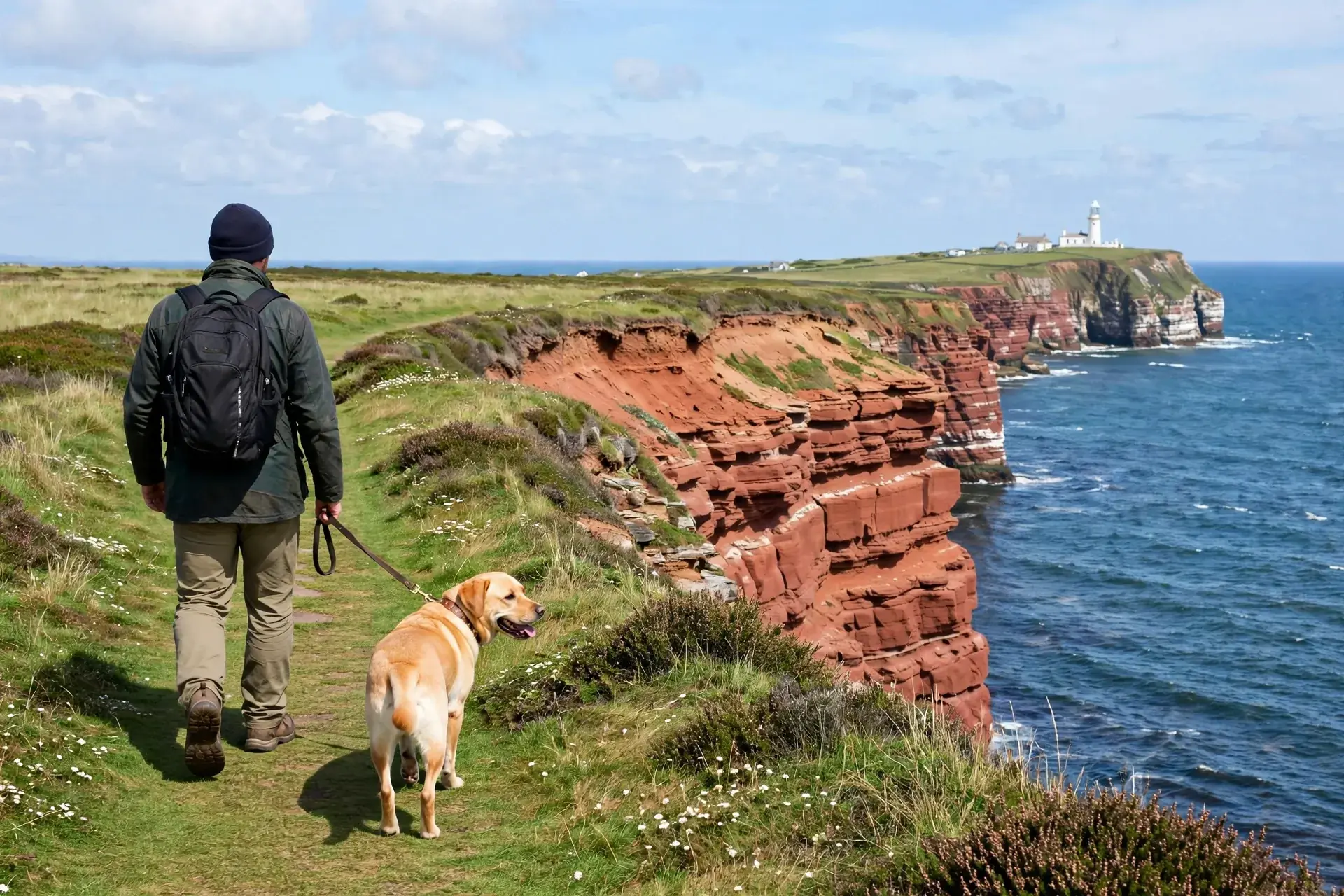
St Bees Head is the most distinctive feature of the village. The headland rises above the beach in red sandstone cliffs, and the lighthouse stands on the clifftop as a clear landmark for walkers. The classic dog walk here is a clifftop route that gives wide views over the Irish Sea, across to the Isle of Man on a clear day, and back along the Cumbrian coast. It is an open, exposed walk rather than a sheltered woodland stroll, and that openness is both its attraction and its main challenge.
Keep your dog on a lead for the whole headland section. This is not a suggestion to be relaxed when the path looks empty. Cliff edges on a headland can be undercut, crumbly or hidden by long grass, and a dog chasing a bird, a rabbit or another dog can reach the edge in seconds. A short lead, rather than a long line, gives you real control near drops, gates and other walkers. If your dog is reliable off lead in a field, that reliability does not automatically transfer to a clifftop where wind, seabirds and sheer drops change the calculation completely. Walk on the inland side of the path where possible, keep the dog between you and the land rather than between you and the edge, and stop well back from any viewpoint fence or boundary.
Start the headland walk from the village end and treat the lighthouse as a turning point rather than a destination that must be reached at any cost. The path climbs, the ground can be uneven, and the wind on the top is often much stronger than in the village. Dogs with short coats may need a coat in cold wind, and all dogs need water, because there is no reliable drinking water on an exposed clifftop. Carry a collapsible bowl and offer water little and often, especially on a warm day when the dog is panting from the climb as well as the wind. If the dog starts to lag, lie down or seek shelter behind a wall, that is information, not disobedience. Turn back or find a lower, sheltered route.
Seabirds are a central part of the headland, and they deserve distance as well as admiration. St Bees Head is known for its bird colonies, and during the breeding season birds can be defensive around nests on ledges and grassy slopes. Keep dogs away from colony areas, do not let a dog flush birds from the ground, and respect any seasonal signs or fenced areas. A dog that is kept on a lead and kept back from the edge is doing two jobs at once: staying safe and leaving wildlife undisturbed. If you want to watch birds, stop, keep the dog settled beside you, and use binoculars rather than walking closer.
Grazing animals may also be present on parts of the headland and on nearby farmland. Sheep and cattle are working animals, not scenery, and a dog that chases livestock can cause serious harm and create a legal problem for its owner. Keep the dog on a lead around livestock, give animals a wide berth, and close every gate behind you. If cattle are on the path and look agitated, especially with calves, do not try to push through with a dog. Retrace your steps or take an alternative route, and check the official guidance before you travel if you are unsure about current grazing arrangements.
The lighthouse itself is a working aid to navigation, not a visitor attraction with a dog-friendly cafe attached, so do not plan the walk around going inside. Enjoy it as a landmark, a photo stop from a safe distance and a natural halfway point. Photographs are best taken with the dog on a lead, well back from the edge, and with the sea and cliffs in the background rather than with the dog posed near a drop. A good headland photograph shows the scale of the place without putting anyone at risk to get it.
On the return leg, watch for fatigue. The way back can feel longer because the wind may now be in the dog's face, the climb may be in the opposite direction, and a dog that ran happily on the outward leg may be tired. Shorten the route if needed, offer water again, and check paws for grit, grass seeds or soreness from rough ground. A headland walk that ends with a calm dog, a drink and a rest in the village is a successful walk, even if you turned back before the furthest point you had in mind.
The beach, the tide and the shore walk
St Bees beach is a broad stretch of sand backed by cliffs and the village, and at low tide it can feel wonderfully open for a dog. At high tide, however, the usable sand narrows considerably, and the sea reaches the base of the cliffs in places. That change is the single most important fact about the beach, and it should shape every decision you make on the shore. A beach that is perfect at mid-morning can be unsuitable by early afternoon, not because of a rule change but because the tide has done its ordinary work.
Check the tide table before you travel, and write down three times: low water, high water and the time you plan to leave the beach. Aim to be off the lower beach at least an hour before high water, and earlier if the sea is rough, the wind is pushing water onshore or you are walking with children, an older dog or a slow walker. Do not rely on memory or on how the beach looked when you arrived. Tide tables are published for a reason, and coastal rescue services regularly deal with people and dogs caught out by a tide that was entirely predictable. If you cannot find a reliable tide table for the day, choose the clifftop path instead of the shore.
On the beach itself, keep the dog under close control, especially near the waterline, other dogs and families. Many dogs love the sea, but not every dog can judge waves, currents or deep water, and a dog that swims well in a lake may struggle in surf. Do not encourage a dog to swim in rough conditions, near rocks or where the current is visibly strong. If your dog goes in, watch for exhaustion, cold and disorientation, and call the dog back before it gets into difficulty rather than after. A dog that is shivering, reluctant to move or coughing after swimming needs warmth, rest and veterinary advice if symptoms persist.
Sand, salt and seaweed all affect paws and coats. Sand can hide sharp shells, broken glass and fishing debris, so scan the ground ahead and check paws during the walk. Salt water can irritate skin and, if drunk in quantity, can upset a dog's stomach, so carry fresh water and discourage drinking from the sea. Seaweed, dead fish and other washed-up material can tempt a scavenging dog, and some of it may be harmful, so keep a close eye on what the dog picks up and use a lead or a muzzle if your dog is a persistent scavenger. For a fuller routine, our guide to dog paw care after the beach covers rinsing, checking between the toes and spotting small cuts early.
Beach rules can vary by season and by section, and signs at access points are the authority on the day. St Bees is widely described as dog-friendly, but that does not mean every nearby beach has the same rules, and it does not guarantee that a particular stretch will be unrestricted on your visit. Read the signs, respect any seasonal restrictions, and keep your dog on a lead where signs require it. For the wider picture, including how seasonal bans and public space protection orders work, see our guide to UK beach rules, bans and fines. If a sign and a website disagree, follow the sign and check the official guidance before you travel on your next visit.
Cleaning up is part of beach etiquette, not an optional extra. Carry more bags than you think you will need, pick up promptly, and use the bins provided or take bags home if bins are full. On a busy beach, a single missed mess can sour the visit for other families and can contribute to tighter restrictions in future. The same principle applies to litter: a dog that eats discarded food packaging or fishing line can be seriously harmed, so keep the dog away from bins, picnic spots and washed-up debris.
When the tide, wind or crowds make the beach unsuitable, do not force it. A short paddle at the waterline on a quiet low tide, a game on the upper sand and a walk back through the village can be a complete beach visit. Dogs do not need to cover the whole beach to enjoy it, and a visit that ends before the tide turns is always better than a visit that ends with a hurried scramble up a cliff path.
The Coast to Coast first stage
St Bees is the traditional starting point of the Coast to Coast walk, the long-distance route across northern England to the east coast. For many walkers, dipping a boot or a paw in the Irish Sea at St Bees is the ceremonial start, and the first stage heads inland from the coast towards the Lake District. Dog owners do not need to attempt the whole route to enjoy this connection. A short first section, walked as a day walk with a return by train or a planned pick-up, gives a taste of the trail without committing a dog to a multi-day expedition.
If you are planning only the first few miles, treat it as a normal countryside walk with extra logistics. Check the route description for the day, note where the path leaves the coast and joins lanes, fields and farmland, and plan water and rest stops in advance. The first stage includes climbs, stiles and farm tracks, and it is not a flat coastal promenade. A dog that is fit for a two-hour beach walk may not be fit for a five-hour inland stage with stiles, livestock and road sections, so build distance gradually and be honest about your dog's current fitness.
Stiles, gates and livestock are the practical tests of a long-distance first stage. Some stiles are dog-friendly with a gap or a gate beside them, but others require lifting the dog over or finding an alternative. Practice at home if your dog is large, elderly or nervous about being lifted, and never force a dog over a stile that looks unsafe. Around livestock, the rules from the headland apply again: lead on, wide berth, gates closed, and no chasing. If the route crosses a field with cattle and calves, consider an alternative or turn back rather than risking a confrontation.
For a multi-day Coast to Coast attempt with a dog, the planning multiplies. Accommodation must be booked in advance and confirmed as dog-friendly for the specific room or unit, not merely for the property in general. Transport between stages, luggage arrangements and veterinary cover along the route all need thought, and rest days are not a luxury. A dog walking long distances day after day can develop sore paws, muscle stiffness and exhaustion that only becomes obvious on the third or fourth day. If you are considering the full route, read specialist long-distance guidance, talk to your vet about fitness and paw care, and consider a trial weekend of consecutive long walks before committing.
A simpler and often more enjoyable option is to use St Bees as a base for a single Coast to Coast taster. Walk the first section out and back, or walk one way and return by train or taxi, and spend the rest of the day on the beach or in the village. This gives you the sense of starting a famous trail, the photographs at the coast, and a dog that is still happy at the end of the day. It also leaves the longer route for a future trip when you and your dog are ready for it.
Whatever length you choose, leave a clear plan with someone who knows your route and expected return time, carry a charged phone, and pack for a change in weather. Inland sections can be muddy, exposed or surprisingly warm, and a dog that was comfortable on the coast may need shade, water or a coat within an hour of heading inland. The Coast to Coast is a wonderful ambition, but a dog's welfare on the first stage matters more than reaching a particular village by a particular time.
Village, parking, pubs and places to stay
St Bees village is compact, and that compactness is an advantage for dog owners. The station, the beach access, the headland paths and the village facilities are all within a short walk of each other, which means less driving, less loading and unloading, and more time on foot. The village has a historic priory church, a small selection of shops and cafes, and pubs that have long served walkers, including those starting the Coast to Coast. Opening hours, however, can be seasonal, and a cafe that is busy in August may be closed on a winter weekday, so check before you travel if a particular stop matters to your plan.
Parking is available in the village and near the beach, but spaces can fill on fine weekends and during school holidays. Arrive early if you can, park considerately, and never leave a dog in a parked car in warm weather, even for a short stop. A car parked in sunshine can heat dangerously quickly, and a dog left alone in a vehicle is at risk even with a window open. If you need to pop into a shop, take the dog with you or leave one person with the dog in the shade. Plan your arrival so that the dog's first experience of St Bees is a walk, not a wait in a car.
Pubs and cafes vary in their dog policies, and the only reliable rule is to ask before you sit down. Some welcome dogs throughout, some allow dogs in a bar area or on a terrace but not in a restaurant, and some change their policy by season or by time of day. A dog that is tired, wet or muddy after a beach walk may be welcome in one place and not in another, so carry a towel and a mat, settle the dog under the table, and keep the lead short. If a pub is full or the dog is restless, a takeaway and a bench outside can be a calmer option for everyone.
For an overnight stay, book early if you are visiting in peak season or at the start of a walking holiday, and confirm the dog details in writing: how many dogs, any size or breed conditions, any pet charge, whether dogs can be left alone in the room, and where the nearest toilet walk is after dark. A room near a garden or an easy exit is worth more than a room with a view if you will be taking a dog out late at night. For walkers heading inland the next day, the Lake District towns make natural next stops. Our guides to Keswick with a dog and Windermere with a dog cover fell safety, lake shores, boats and market-town stays that pair well with a St Bees start.
Facilities for dogs in the village itself are small-scale. Bring your own water, bowl, bags and towel rather than assuming a dog-wash station or a shop selling pet supplies will be open. A portable water bottle and a spare lead weigh little and prevent most small emergencies. If you are travelling by train, the same principle applies: pack food, water and a familiar blanket for the journey, and give the dog a toilet break before boarding and after arriving.
Respect for the village matters as well. St Bees is a living community, not a theme park, and residents use the same beach paths, lanes and churchyard. Keep dogs off private gardens, keep noise down in the early morning, and pick up everywhere, including on lanes and headland paths where it is easy to assume nobody will notice. A village that welcomes walkers and their dogs will keep doing so if visitors behave as guests.
Cliff-edge safety for dogs
Cliff safety at St Bees deserves its own section, because it is the risk that is easiest to underestimate on a beautiful day. Cliffs look solid, paths look wide, and a dog looks confident, but sandstone cliffs can be unstable, edges can be undercut, and loose material can fall without warning. Stay well back from the edge at all times, keep your dog on a lead on the clifftop, and do not approach the edge for a photograph, a better view or to look for a bird. The view from a few metres back is almost as good, and it is incomparably safer.
Check the official guidance before you travel for any current cliff warnings, path closures or rockfall notices, and check tide tables and official coastal path information on the day as well. If a path is closed, fenced or diverted, follow the diversion even if the closed section looks passable. Closures are put in place because of a risk that may not be visible from the path, such as a crack in the cliff top, a landslip below or a weakened fence. Do not climb over fences, do not walk on closed sections, and do not let a dog run ahead onto a section you have not checked.
Wind is a cliff hazard in its own right. A gust that is merely bracing in the village can be strong enough on an exposed headland to unbalance a small dog, blow a lead from a hand or push a loose dog towards the edge. If the wind is strong, shorten the lead, keep the dog close to your leg, and consider a lower route. Rain makes cliff paths slippery, especially on grass, mud and rock steps, so wear boots with grip, slow down on descents and avoid cliff paths in icy or very wet conditions if you have a safer alternative.
Children and dogs together near cliffs need extra attention. A child who runs ahead and a dog who follows can both reach an edge quickly, and an adult trying to manage both may be distracted at exactly the wrong moment. Keep children and dogs on leads or close at hand near the headland, agree a stopping point before you reach a viewpoint, and make the rule simple: nobody goes past the fence, the wall or the agreed line, for any reason. If a ball, a toy or a hat blows towards the edge, let it go. No object is worth a rescue.
If a dog does get too close to the edge, stay calm, stay back from the edge yourself, and call the dog in a steady voice without shouting or running towards it. Sudden movement can startle a dog into running. If the dog is stuck, injured or in danger, or if any person is in danger, call the emergency services and follow their instructions. Do not climb down a cliff, do not enter the water to reach a dog in difficulty, and do not attempt a rescue that puts you at risk. Coastguard and rescue teams are trained and equipped for cliff and sea rescues, and calling them early gives a dog the best chance.
Finally, teach the cliff rule before the walk, not during it. If your dog is not used to a short lead, practise on local paths first. If your dog pulls strongly, use a harness and a lead combination that gives you control without hurting the dog, and consider a headland walk at a quieter time for the first visit. A dog that walks calmly on a short lead in a park will walk calmly on a headland, but a dog that has never walked on a short lead should not learn that lesson for the first time beside a cliff.
Seasons, weather and wildlife
St Bees changes with the seasons, and each season suits a different kind of dog day. Spring brings longer days, nesting seabirds and paths that can still be muddy after winter rain. Summer brings the busiest beach, the warmest sea and the most visitors, which means earlier starts are more rewarding and shade and water become essential. Autumn brings quieter paths, dramatic light and often strong winds, while winter brings solitude, short days and the need for warm clothing, waterproofs and a careful eye on daylight for the return walk.
Summer heat deserves particular care. Dogs do not sweat like people, and a dog exercised hard on a hot, exposed headland can overheat quickly. Walk in the cooler parts of the day, offer water frequently, watch for excessive panting, drooling or reluctance to move, and never leave a dog in a car. Sand can also become hot enough to hurt paws, so test the surface with your hand and choose grass or a shaded path if the sand is uncomfortable. If your dog is brachycephalic, elderly or overweight, summer headland walks should be shorter and earlier, with a beach paddle rather than a long climb.
Winter and stormy weather bring a different set of checks. Daylight is short, so plan a route that finishes well before dusk, carry a torch, and wear reflective clothing for both you and the dog. High winds and rough seas can throw spray and debris onto lower paths, and cliff paths can be closed after storms. Check the forecast and any official notices before you travel, and be prepared to swap a headland walk for a village and lane walk if conditions deteriorate. A wet, windy day can still be enjoyable if the route is sheltered and the dog is dried and warmed afterwards.
Wildlife changes through the year as well. Seabird colonies are most sensitive during breeding season, when disturbance can cause birds to abandon nests or chicks to fall. Keep dogs on leads, keep your distance, and follow any seasonal guidance. Outside breeding season, the headland is quieter for birds but may still host grazing animals, so the lead rule around livestock does not change with the calendar. Washed-up wildlife, including dead birds and marine animals, should be kept away from dogs, and any unusual finds should be reported to the relevant authority rather than handled.
Sea conditions also vary. A calm summer day can still have a strong undertow, and a winter sea can be dangerous even when it looks flat from the clifftop. Do not let a dog swim in conditions you would not swim in yourself, and remember that cold water saps strength quickly. If your dog loves swimming, choose a sheltered, shallow entry at low tide on a calm day, keep sessions short, and dry and warm the dog afterwards.
Packing, paws and after the beach
Packing for St Bees is straightforward if you pack for the headland and the beach together, not for one or the other. The essentials are a short lead and a harness, a collapsible bowl and fresh water, poo bags, a towel, a drying coat or an old towel for the car, and a basic first-aid kit for the dog. Add a coat for the dog in cold or wet weather, a spare lead in case one breaks, and a familiar blanket for rest stops. A long line can be useful on the beach at low tide, but it is not a substitute for a short lead on the headland, so carry both if you plan to use both.
Footwear and clothing for the walker matter as much as kit for the dog. Cliff and coastal paths can be muddy, uneven and slippery, so wear boots with grip rather than trainers designed for pavements. A waterproof jacket, a windproof layer and a hat will make a headland walk comfortable in weather that would otherwise cut it short. Carry a phone, a map or a downloaded route, and a torch in winter. If you are walking the first Coast to Coast stage, add food, extra water and a plan for getting back.
After the beach, rinse paws with fresh water, check between the toes for sand, grit and small cuts, and dry the coat thoroughly, especially around the ears and belly where sand and salt collect. Dogs that swim should be rinsed if possible, because salt can dry the coat and irritate skin, and ears should be checked after swimming for redness or discomfort. If you notice limping, persistent licking of a paw or a cut that bleeds, seek veterinary advice rather than waiting to see if it improves. Small problems caught early are usually simple to treat, while problems ignored after a beach day can become infected.
Back at home or at your accommodation, wash towels and bedding promptly, check the car for sand and wet leads, and give the dog a quiet evening after a long coastal day. A tired dog that sleeps soundly after St Bees has had a good day, even if the walk was shorter than planned. Note what worked: which route suited the dog, what time the tide allowed, which cafe welcomed the dog, and where parking was easiest. Those notes turn a first visit into a reliable second visit, and they are worth more than any photograph.
St Bees rewards preparation, patience and a respect for tide and cliff that never goes out of season. Walk the headland on a lead, choose the beach by the tide table, start the Coast to Coast gently if you start it at all, and let the dog's comfort decide when to turn back. Done that way, a small Cumbrian village gives you three kinds of day in one: a lighthouse walk, a beach at low water and the first steps of a famous trail, all with the dog beside you and safely back from the edge.
Further up the Cumbria coast
Ravenglass, at the meeting of three rivers, makes a quieter second stop on this coast. Its new guide covers estuary tides, the narrow-gauge railway and castle grounds.
Practical questions
Before you go
Is St Bees beach dog-friendly all year?
St Bees is generally known as a dog-friendly beach, but local rules can change and seasonal controls do apply on some nearby beaches. Check the official guidance before you travel, look for signs at the beach access points, and keep your dog under close control in busy areas.
Do dogs need to be on a lead on the St Bees headland?
Yes, keep your dog on a lead on the clifftop paths and near the cliff edge at all times. The headland has steep drops, strong winds and grazing livestock in places, and a short lead is the simplest way to keep a dog safe while still enjoying the walk.
How do tides affect a dog walk at St Bees?
At high tide the sand narrows and some stretches below the cliffs can be cut off, so check the tide table before you travel and plan to be off the lower beach well before high water. If you are unsure, choose the clifftop path instead of the shore.
Can I start the Coast to Coast walk at St Bees with a dog?
Yes, St Bees is the traditional western start of the Coast to Coast route, and many walkers begin with a short first section rather than a full day. Plan transport, water, rest stops and an overnight stay in advance, and build up distance gradually if your dog is not used to long days.
What should I do if my dog gets cut off by the tide or too close to the edge?
Do not climb down a cliff or enter deep water to reach your dog. Stay back from the edge, call calmly, keep other people and dogs clear, and call the emergency services if anyone is in danger. Prevention is far better than rescue: check tides, use a lead, and turn back early.
Where can I park and find facilities in St Bees with a dog?
There is parking in the village and near the beach, with the railway station in the village for walkers arriving by train. Facilities are small-scale, so bring water, bags and a towel, and check opening times for cafes and pubs before you travel, especially outside summer.