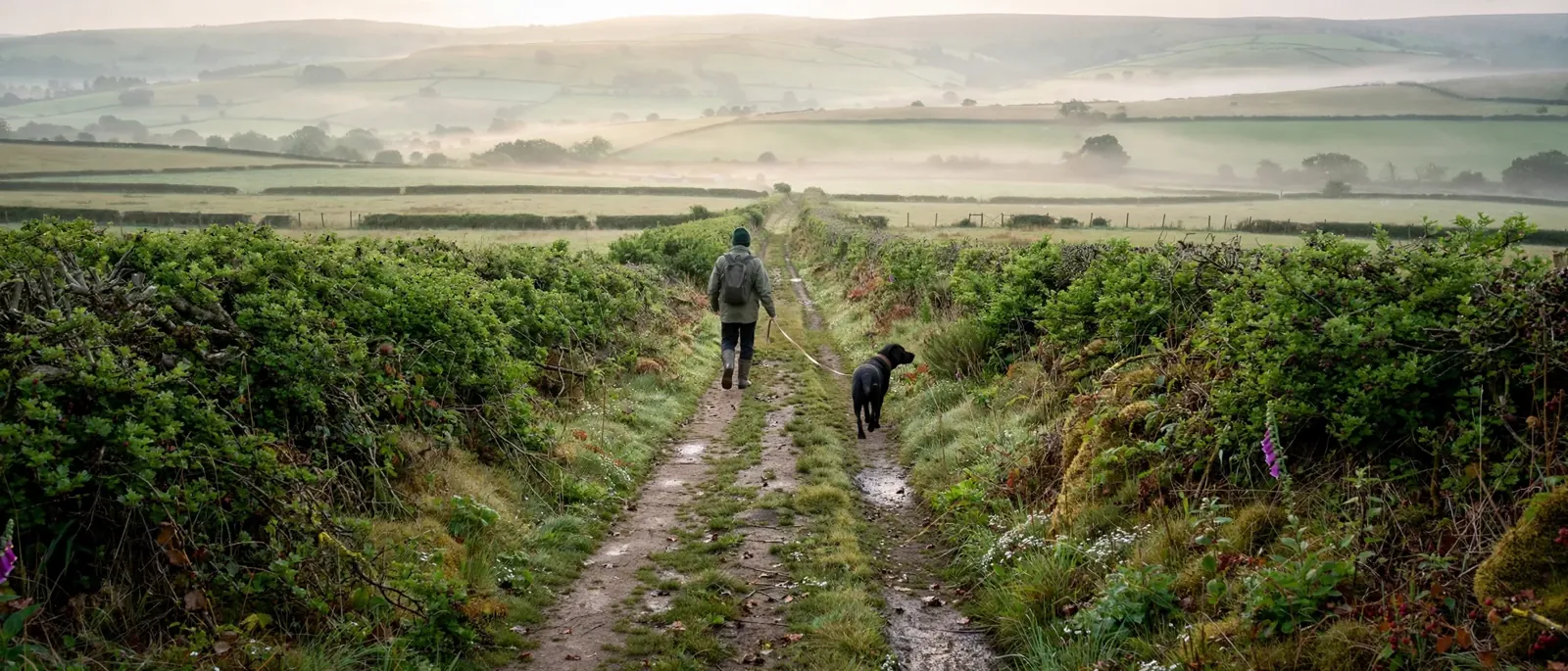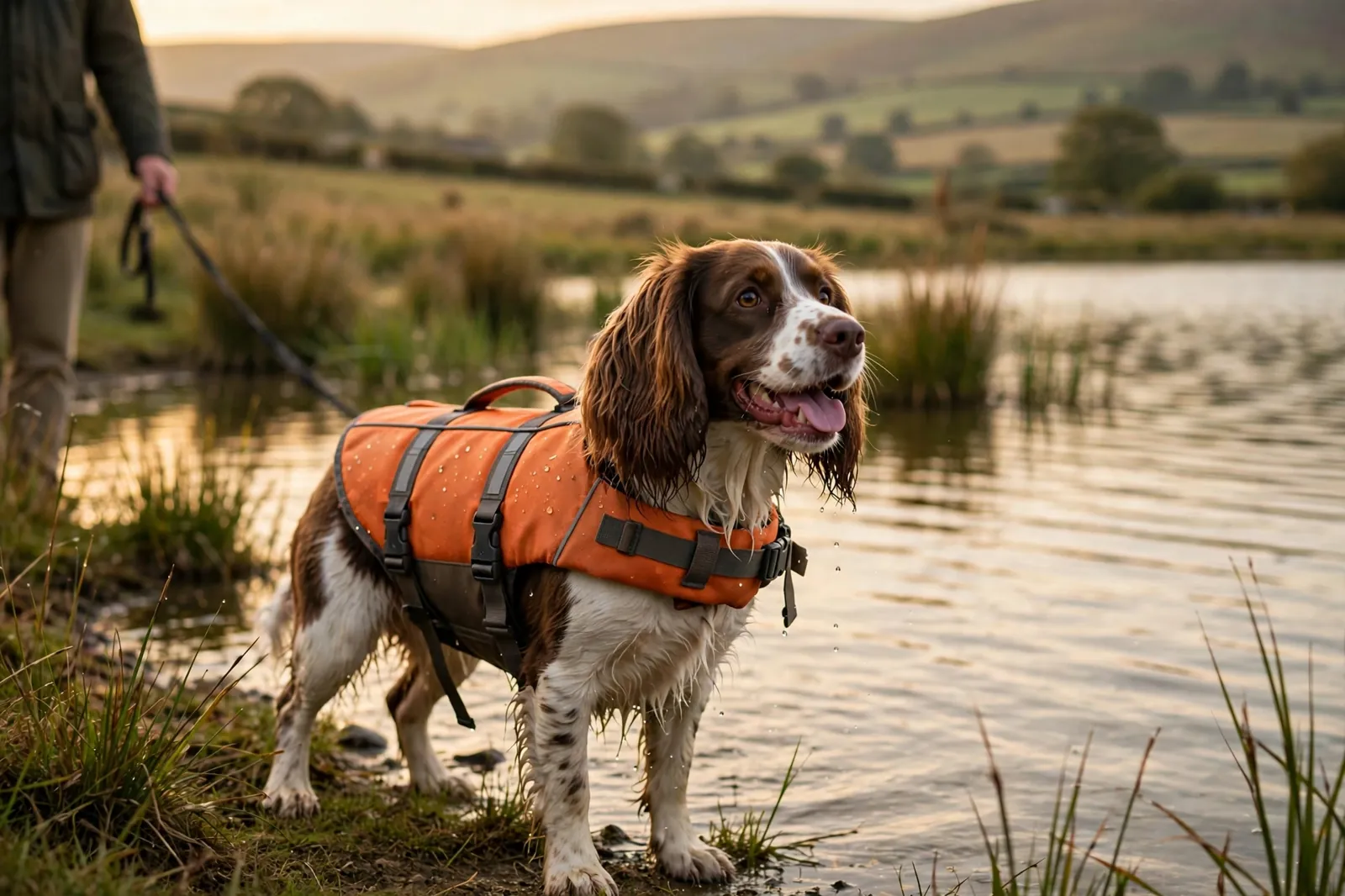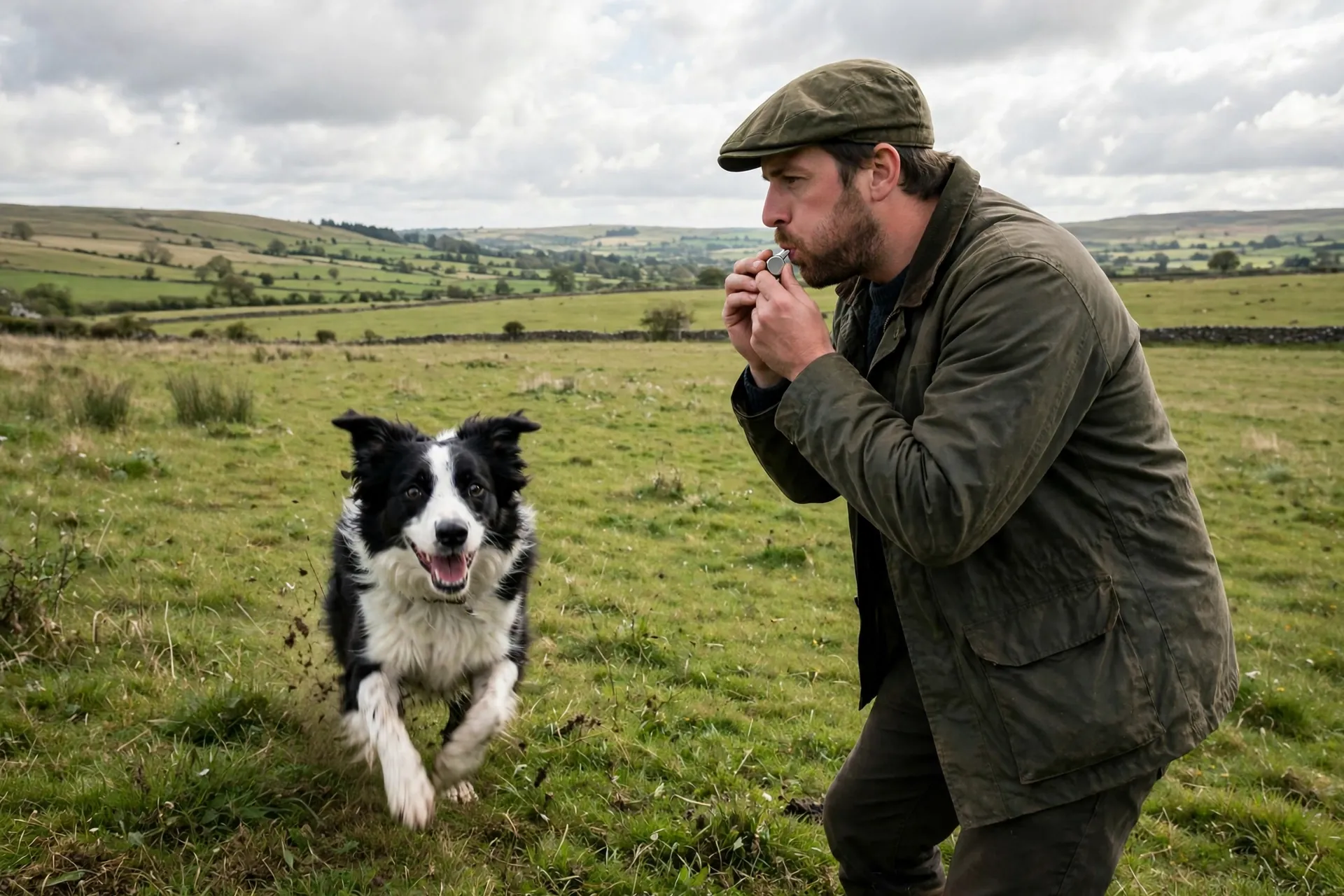
This guide is independent and contains no paid placement. If affiliate links are added later, they will be clearly marked and will not change our editorial checks.
Recall is the single skill that decides how much freedom your dog gets on holiday. Train one consistent cue, proof it gradually against real distractions, and take a long line as your safety net. A dog that recalls in the garden but not on a beach is not ready to be off lead there yet, and that is a planning fact, not a failure.
Why recall matters more on holiday
At home, recall is forgiving. The garden is enclosed, the local park is familiar, and you know where the roads, the reactive dog behind the fence and the neighbour's cat are. On holiday, every one of those certainties disappears at once. The beach has a tide timetable you have not read, the woodland path crosses a bridleway used by horses, the field that looks empty has sheep over the next rise, and the dog that appears around a corner is a stranger to both of you. Recall is the only tool that lets you interrupt all of that from a distance, before a good day becomes a vet visit, a farmer's complaint or a lost dog.
The stakes are also legal and practical, not just behavioural. In England and Wales, a dog that worries livestock can lead to serious consequences for the owner, and farmers have legal powers in certain circumstances, so recall near farmland is not a nice extra. On many beaches, seasonal dog restrictions are enforced through Public Spaces Protection Orders, and a dog that will not come back cannot be moved quickly off a restricted stretch. A reliable recall does not just make walks more pleasant; it keeps you inside the rules that govern the places you want to enjoy. If you are heading to the coast, read our guide to dog-friendly beaches in the UK before you travel, and check the official guidance before you travel for the specific beach and season you have booked.
There is a second, quieter benefit. Dogs that can be recalled get more of the holiday, not less. They get the off-lead run on the quiet morning beach, the swim in the safe cove, the long sniff through the dunes, because their owner is not spending the whole walk managing risk with a short lead and a tight grip. Dogs that cannot be recalled spend the same week on a short lead watching other dogs run, or worse, being let off anyway and practising the habit of ignoring their owner. Training before the holiday is therefore not homework that delays the fun; it is the thing that buys the freedom.
It also changes how you choose accommodation and walks. With a solid recall you can sensibly consider a cottage with an unfenced garden if you manage arrivals carefully, a campsite near open access land, or a coastal path with off-lead sections. Without one, you need enclosed gardens, fenced exercise fields and on-lead routes, and you should book those deliberately rather than discovering the mismatch on arrival. Neither choice is wrong, but the choice should be made before you pay, with the dog you actually have in mind.
Start with an honest recall audit
Before you plan a single training session, spend a week watching what your dog actually does, not what you hope they do. Keep a simple note on your phone for every walk: where you were, what the distraction was, how far away the dog was, and whether they came back on the first call, the third call, or not at all. Most owners discover a pattern within a few days. The dog recalls perfectly from the kitchen, well on a quiet field path, poorly when another dog appears at fifty metres, and not at all when a rabbit runs. That pattern is your training plan, and it is far more useful than a generic claim that recall is good or bad.
Score the audit honestly across five situations: indoors with no distractions, in the garden, on a familiar quiet walk, on a walk with other dogs in sight, and around wildlife, livestock or water. Give each a simple mark: reliable, shaky or absent. A dog that is reliable in the first three and shaky in the last two is a normal holiday dog with a clear job to do. A dog that is absent in the garden needs a different starting point, probably a new cue and much higher-value rewards, before any talk of beaches. A dog that is reliable everywhere except around one trigger, such as sheep or squirrels, needs targeted proofing for that trigger, not more general practice.
Also audit the human half of the recall. Do you repeat the cue three or four times before the dog moves? Do you only call the dog when it is time to go home, to be bathed, or to leave the park, so recall predicts the end of fun? Do you shout the cue in a rising, worried voice that sounds nothing like the calm voice you used in training? Do you chase the dog when it does not come, turning recall into a game of keep-away? All of these are common, all of them are fixable, and all of them matter more than the brand of whistle you buy. Write down your own habits alongside the dog's, because the holiday will expose both.
Finally, audit health and equipment. A dog in pain, with an ear infection, or with age-related hearing loss will not recall like a healthy dog, and no amount of practise will fix that until the vet has looked. A harness that rubs, a lead that tangles, or a whistle you cannot blow consistently in wind are practical problems, not training failures. Sort the vet check, the harness fit and the whistle choice in the first week, while there is still time to change them.
Whistle or voice: choosing one cue
For most holiday dogs, a whistle wins on purely practical grounds. It sounds identical every time, which matters because dogs learn sounds, not intentions, and your voice changes when you are tired, cold, worried or shouting into wind. A whistle carries further across a beach or a hillside, cuts through the noise of waves and other dogs, and can be heard by a dog that has run well beyond comfortable shouting distance. It also gives you a clean break from a voice cue that may already be poisoned: if you have spent two years saying your dog's name followed by come, and the dog has learned that sequence means maybe, a fresh whistle sound starts with no history at all.
That does not mean your voice becomes useless. Use your voice for close work, for praise, and for the everyday check-ins that keep a dog connected on a walk. A good system is often a whistle for the formal recall from distance, a name or a kiss sound for attention at close range, and a cheerful voice for praise when the dog arrives. What matters is that each sound has one job and is used consistently by everyone who walks the dog. If one family member uses the whistle for recall, another uses it to call the dog in from the garden for dinner, and a third blows it to stop barking, the whistle will mean nothing very quickly.
If you choose a whistle, choose a pattern and stick to it. A common choice is three short peeps, or one long blast followed by two short peeps. Practise blowing it until the pattern is automatic, including with cold hands and in wind, and keep the whistle on a lanyard or clipped to your coat so it is always in the same place. If you choose voice, choose a single word, said in a single tone, and rehearse it the same way. Do not use the dog's name as the recall cue on its own, because the name gets used all day for other things and loses its power. Use the name to get attention, then the recall word to call the dog in.
Whatever cue you pick, protect it from now on. Never use it to scold, never use it to call a dog for something unpleasant if you can avoid it, and never repeat it five times while the dog ignores you. One cue, one chance, and then you go and collect the dog calmly or use the long line. This discipline feels strict in the first week and completely natural by the fourth, and it is the difference between a cue the dog respects and background noise the dog filters out.
An eight-week plan that fits real life
Eight weeks sounds like a lot, but it breaks down into small, repeatable sessions that fit around normal walks. The principle throughout is simple: make coming back the best deal on the walk, make it easy at first, and only make it harder when the dog is succeeding. Three short sessions a week, of five to ten minutes each, will do more than one long weekend session that leaves both of you frustrated.
Weeks one and two are about charging the cue. Indoors and in the garden, with no distractions, pair the new whistle pattern or recall word with something excellent, and do it many times a day in tiny doses. Call the dog from the next room, from the garden gate, from behind a door, and reward every single arrival with a jackpot: several small treats delivered one at a time, plus praise and a brief game. Do not ask the dog to sit, stay or do anything else on arrival at this stage; arrival itself is the whole job. End each session while the dog still wants more, and never practise when you are in a rush, because rushing teaches the dog that recall is a hurried, unrewarding interruption.
Weeks three and four move the same game to a quiet outdoor place: a familiar field, an empty corner of a park, a friend's enclosed garden. Keep distances short at first, ten to twenty metres, and keep the rewards just as good. Introduce a little movement: call the dog while you are walking away, while you are crouched down, while you are standing still. Vary your position, because a dog that only recalls when you are facing them on a path has not learned recall, they have learned a parlour trick. If success drops sharply in a new place, you have moved too fast; go back to an easier place, rebuild success, and try again in smaller steps.
Weeks five and six add mild distractions: a friend walking at a distance, a ball rolled gently, another dog far away on a lead, a jogger passing on a path. Work at a distance where your dog notices the distraction but can still turn to you, and reward that turn generously. This is the stage where most holiday plans are won or lost, because it is tempting to jump straight to the beach or the busy park and call it proofing. Resist that. A dog that succeeds at fifty metres from a calm dog will, with repetition, succeed at thirty metres, then twenty, and eventually at a normal passing distance. A dog that fails repeatedly at five metres learns only that recall does not work when it matters.
Weeks seven and eight are for real-world rehearsal in holiday-like places: a quiet beach at low tide on a weekday, a woodland trail early in the morning, a hillside with sheep visible far across a valley. Use a long line for safety, keep sessions short, and choose your moments. Call the dog when they are already turning towards you, when the distraction is fading, or when you have a high-value reward ready, rather than calling into the teeth of a chase. Finish every session with a successful recall followed by something the dog loves, so the last memory of the session is a win. If you have less than eight weeks, compress the plan but do not skip the order: charge the cue, practise in quiet places, then add distractions gradually, and accept that the long line will do more of the work on the actual holiday.
Proofing for beaches, woods and livestock
Proofing is a technical word for a simple idea: practising recall in the places and around the things that will actually tempt your dog on holiday, at a difficulty level the dog can handle. Each holiday distraction needs its own plan, because a dog that recalls past a jogger may still lose all sense at the sight of a rabbit, and a dog that ignores sheep may still chase a deer in woodland.
For beaches, the distractions are space, water, other dogs and smells. Start on a quiet beach or a wide, empty stretch of sand at a time when few people are around. Let the dog explore on a long line, and practise recall when the dog is sniffing rather than sprinting, then gradually when the dog is trotting, then when another dog is visible far away. Reward recalls on the beach with something better than the beach itself is hard, so use the highest-value food you have, a favourite toy, or a brief game, and sometimes reward recall by letting the dog go back to playing, which teaches the dog that coming back does not always end the fun. Before any beach trip, check seasonal restrictions and tides, and check the official guidance before you travel for that specific beach, because a recall that works is still no use if the dog is not allowed on that stretch at that time.
For woodland and hills, the distractions are scent trails, wildlife and distance. Dogs can be hundreds of metres away before you realise they have gone, especially in bracken or dense trees, so practise recall before the dog disappears around a bend, not after. Use the whistle early, reward check-ins that happen without being asked, and consider a bell or a bright vest so you can track the dog by sound and sight. If your dog has a strong chase drive, a long line in woodland is not over-caution; it is the responsible choice until the recall is proven around deer and squirrels, and many experienced owners keep one for the first holiday even with a good dog.
For livestock, the rules are stricter and the margin for error is smaller. Never practise recall by letting a dog approach sheep, cattle or horses and then calling them back; that is not proofing, it is putting livestock, the dog and your legal position at risk. Instead, work at a distance where the dog can see livestock but can still respond, reward calm attention and turning away, and shorten the distance only over many sessions and only while the dog stays calm. Keep the dog on a lead on farmland unless you are certain of the rules and the recall, and read our guide to reactive dog holidays if your dog gets over-excited by animals or other dogs, because the distance and calm-arrival techniques there transfer directly to livestock work. If in doubt on a farm walk, keep the lead on and enjoy the walk anyway; a lead is not a punishment, it is a management tool.
For other dogs, proofing means controlled greetings, not free-for-all play. Arrange practise with a calm, known dog at a distance, reward your dog for checking in with you instead of rushing over, and end the session before excitement peaks. On holiday, the same rule applies: recall your dog before they reach an unknown dog, not after they are already playing, because recalling out of play is one of the hardest recalls a dog will ever be asked to do. If your dog struggles with other dogs, plan walks at quiet times, choose wide paths with escape routes, and accept that some days are long-line days. That honesty protects your dog, other dogs, and the holiday itself.
Using a long line without ruining the holiday
A long line is a 10 to 15 metre line attached to a harness, never to a collar, that gives a dog freedom to run, sniff and explore while you keep a safety connection. It is the single most useful piece of holiday kit for a dog whose recall is still in training, and it is also useful for a good dog in a new place, on a first beach, or near livestock. The stigma around long lines is misplaced: a dog on a long line on a beach is having a better holiday than a dog on a short lead, and a much safer one than a dog off lead with no recall.
Technique matters. Wear gloves if the line is thin, because a sprinting dog can burn your hands, and learn to gather and release the line smoothly so it does not tangle around your legs or the dog's. Let the line drag in open space when it is safe, so the dog feels free, and pick it up when you approach other dogs, roads, livestock or water. Never tie the line to yourself in a way you cannot release quickly, and never use a retractable lead as a substitute, because retractable leads give poor control, tangle easily, and teach a dog to pull to get more length. Practise with the long line at home before the holiday, so handling it becomes automatic rather than a fiddly new skill on a windy beach.
Use the long line as a training tool, not just a restraint. Call the dog while they are on the line, reward the recall, and sometimes let them go back to exploring, so the line becomes associated with freedom and success rather than restriction. Gradually, in safe places, let the line drag, then drop it while you stay close, then practise short off-lead periods in enclosed areas. This graduated approach is how many dogs earn full off-lead freedom: not by a sudden leap of faith on holiday, but by a series of small, successful steps that build the owner's confidence as much as the dog's.
Pack for the line: a spare line, because they get muddy and tangled, a harness that fits well, gloves, and a bag to carry a wet, muddy line home. After a beach day, rinse the line in fresh water so sand does not wear it out, and check it for fraying before the next walk. A long line that snaps at the wrong moment is worse than no line at all, because it gives false confidence, so inspect it as carefully as you would a lead.
When recall fails: the calm recovery
Even good recalls fail sometimes, especially on holiday, and the recovery matters as much as the training. The first rule is to stay calm, because panic, shouting and chasing all make a dog run further. Stop, lower your body, turn slightly sideways, and make yourself interesting: crouch, rustle a treat bag, squeak a toy, or run playfully away from the dog, which often triggers a chase instinct in your direction. If there are other people nearby, ask them calmly to help by blocking a path or crouching down, rather than shouting or grabbing at the dog.
Do not punish the dog when it finally comes back, even if you are furious and relieved in equal measure. A dog that is scolded for returning will be slower to return next time, which is the opposite of what you want. Praise the return warmly, clip the lead on calmly, and then analyse what happened later, when everyone is safe: was the distraction too hard, was the distance too great, were you tired and late with the cue, had the dog already been off lead too long without a check-in? That analysis, done calmly, is what prevents the next failure. Blame, in the moment, prevents nothing.
Have a lost-dog plan before you need it. Make sure the dog's collar tag and microchip details are up to date with your mobile number, and consider whether the holiday accommodation number should also be on the tag for the week. Save the number of the nearest vet, the local dog warden, and any local lost-dog social media groups before you arrive, and take a recent photo of your dog each morning of the holiday, so you have an accurate picture if you need to ask for help. If your dog does go missing, stay in the area where they were last seen, because many dogs circle back, and contact the vet, the warden and local groups quickly rather than searching silently for hours.
Also plan for the specific risks of the place you are visiting. Near water, know where the safe exit points are and whether the tide is coming in, and read our guide to dog swimming safety before letting a dog near rivers, lakes or the sea. Near roads, keep the dog on a lead until you are well inside a safe area, even if the dog seems calm. Near livestock, move away promptly and do not try to retrieve a dog by running through a field of sheep. A calm recovery is not just about the dog; it is about keeping the whole situation, including other people and animals, as safe as possible.
The holiday-day recall routine
On the holiday itself, recall is maintained by routine, not by heroics. Start each day with a short, easy recall session in a safe place: a few calls in the garden, on the beach car park, or on a quiet path, rewarded generously. This warms up the cue, reminds the dog that recall pays, and gives you a quick read on how the dog is feeling that day. A dog that recalls eagerly in the morning is a different proposition from a dog that is already over-aroused, and you can plan the day's walks accordingly.
Build check-ins into every walk. Reward the dog, without being asked, for glancing back at you, for slowing down when you slow down, or for returning voluntarily for a few seconds. These unprompted check-ins are the backbone of a real-world recall, because they mean the dog is keeping you in mind even when no cue has been given. A dog that checks in every minute or two is a dog you can recall from almost anything; a dog that has not looked at you for twenty minutes is a dog that has mentally left the walk, and you should shorten the distance, change direction, or clip the long line on before the next distraction arrives.
Manage the day's difficulty like a budget. Do not spend all of it in the morning on the busiest beach, then expect a perfect recall on a livestock walk in the afternoon. Alternate hard and easy walks, give the dog rest and sniffing time, and end each walk with a successful recall rather than a struggle. Keep treats accessible in a pocket or a treat bag, not buried in a rucksack, because a recall reward that arrives thirty seconds late is a different lesson from one that arrives immediately. And keep the whistle in the same place every day, so you are not fumbling for it when it matters.
Finally, review each evening. What worked, what was too hard, what should change tomorrow? Maybe the morning beach was perfect but the afternoon woodland was too exciting, so tomorrow you swap the order. Maybe the dog recalled well from other dogs but not from water, so tomorrow you choose a walk without a river. This daily review, done over dinner, is how a week's holiday becomes a training success rather than a series of near misses, and it is also how you come home with a dog whose recall is genuinely better than when you left. That improvement, more than any single walk, is the real souvenir of a well-planned dog holiday.
Practical questions
Before you go
How long before a holiday should I start recall training?
Start at least eight weeks before you travel if you can, and treat the last two weeks as proofing rather than teaching. A dog that only recalls in the garden is not ready for a beach or a forest trail. If your holiday is sooner than that, plan around a long line and enclosed walks instead of hoping a new cue will suddenly work in a high-distraction place.
Should I use a whistle or my voice for recall?
A whistle is usually the better holiday tool because it sounds the same every time, carries further in wind, and does not rise in pitch when you are worried. Your voice still matters for close work and praise, but a whistle gives you one clean, consistent cue. Whichever you choose, use it only for recall, never to scold, and always follow it with something worth coming back for.
What should I do if my dog ignores recall on a beach?
Do not repeat the cue over and over, chase the dog, or shout louder, because all three teach the dog that recall is optional and that coming back ends the fun. Stay calm, move away from the distraction, crouch and make yourself interesting, and use a long line next time until the recall is reliable again. If the dog is heading toward a road, water or livestock, get help from people nearby and keep the situation as calm as possible.
Is a long line enough if my dog has no recall at all?
Yes, a long line is a legitimate holiday solution, not a failure. A 10 to 15 metre line on a harness gives most dogs a real run, a proper sniff and a swim in shallow water while you keep a safety net. It is far better than keeping a dog on a short lead all week or letting a dog off lead before the recall is ready. Use it alongside training, and treat every successful recall on the line as progress.
How do I proof recall around livestock and other dogs?
Work at a distance where your dog can still think and respond, and only close that distance gradually over many sessions. Start with sheep or other dogs far away across a field, reward checking in, and end the session before the dog gets over-excited. Never practise by letting a dog run up to livestock or charge at another dog, and check the official guidance before you travel if you are unsure about lead rules on farmland.
Can an older dog still learn a reliable recall?
Yes, older dogs can learn recall, and many improve quickly because they are less frantic than puppies. The work is the same: short sessions, high-value rewards, gradual distractions and no punishment for a slow return. Hearing loss, arthritis and pain can all affect response, so if an older dog suddenly stops recalling, ask your vet to check hearing and mobility before assuming the training has failed.