This guide is independent and contains no paid placement. If affiliate links are added later, they will be clearly marked and will not change our editorial checks.
Redmire suits dogs that like woodland: shady paths, leaf litter, ferns and quiet lanes, with Redmire Force below the village and longer valley walks to Leyburn and Castle Bolton. Keep dogs on a lead near livestock and the river, expect mud after rain, and plan meals and supplies around Leyburn.
Start in the wood, not the village
Most Wensleydale villages are best understood from their market square or their church green. Redmire is different. The village is small, quiet and easy to walk through in a few minutes, and its real character sits just beyond the last cottage, where the ground drops away into Redmire Wood. Tall trees close over the paths, ferns crowd the banks, and the sound of the village fades within a few dozen steps. For a dog, that change of atmosphere is the whole point: one minute the walk is a lane with stone walls and farm gates, the next it is leaf litter, tree roots, dappled light and a hundred smells that were not there a moment ago.
This guide is therefore written woodland-first. It treats the village as the threshold and the wood as the destination, and it works best if you plan your day the same way. Arrive, let the dog settle on a short lane loop, and then head for the trees. The wood rewards slow walking: the paths are not long, the climbs are short and sharp rather than sustained, and the interest comes from what is growing, moving and rotting around you rather than from distance covered. A dog that is allowed to sniff its way along a woodland ride for forty minutes will come back far more satisfied than one that has been marched for two hours along an open road.
Redmire sits in Wensleydale, the broad, green valley of the River Ure in the Yorkshire Dales National Park, a few miles west of Leyburn. The valley here is gentler than the high fells to the north and west, which is part of its appeal for dog owners: the walking is real walking, with hills, mud and weather, but the routes from Redmire are mostly valley-floor and woodland paths rather than exposed moorland crossings. That makes the village a good base for older dogs, for puppies on their first proper holiday, for reactive dogs that need space rather than crowds, and for anyone who wants the Dales without the car parks full of coach parties.
One warning is worth giving at the start. Redmire is quiet because it is small, and small in the Dales means limited facilities. There is no shop to fall back on, no cafe to shelter in when the rain sets in, and no stream of other walkers to follow if you lose the path. That is the trade for the quiet. Come self-sufficient: water for the dog, a lead and a long line, a towel, a tick remover, a charged phone, and a plan for lunch that does not depend on the village providing one. The nearest proper hub is Leyburn, a short drive or a good walk to the east, and most of the practical advice in this guide assumes you will use it.
The village itself
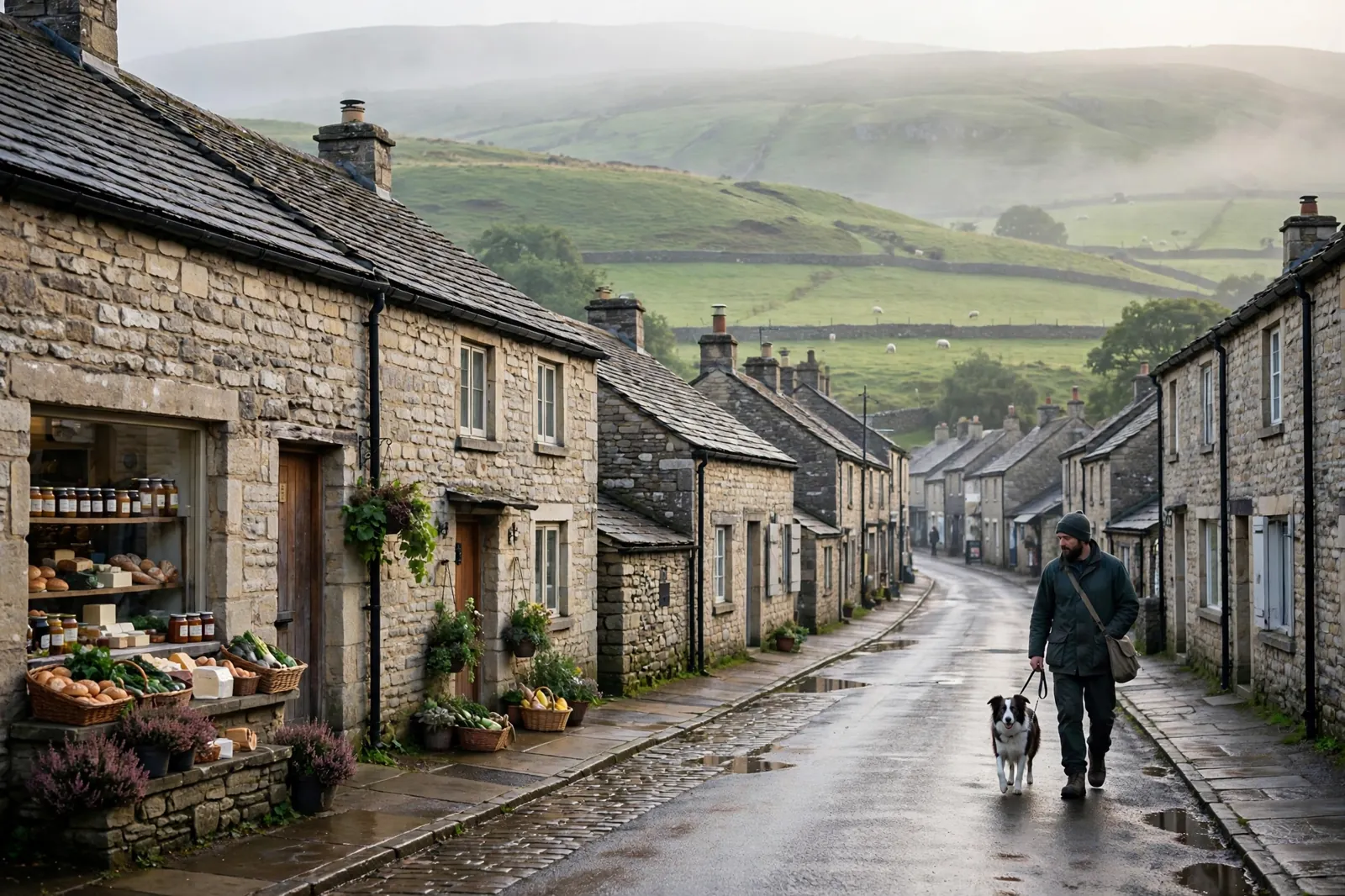
Redmire is a linear village of stone cottages and farm buildings strung along quiet lanes above the River Ure, with the wood rising and falling around it. There is no centre in the market-town sense: no square, no parade of shops, no obvious place where the village announces itself. That is exactly what makes it restful. The lanes are narrow, the traffic is light, and the soundtrack is birdsong, farm sounds and the wind in the trees rather than engines. Dogs on leads do well here, because the lanes are short, the sightlines are good, and there is very little to overstimulate a nervous animal.
Walk the village slowly on your first morning, before you head for the wood. It takes perhaps twenty minutes to cover the main lanes at a dog's pace, and that short loop does three useful jobs. First, it lets the dog learn the new smells of the place — the farmyard, the hedgerows, the stone walls — without the intensity of a woodland full of squirrels. Second, it shows you where the footpaths leave the village, which gates are farm gates, and which lanes carry the occasional vehicle. Third, it gives you a calm baseline: if the dog is unsettled on the lane, they will not be happier in the wood, and a second quiet loop beats pushing on.
The stone cottages deserve a look in their own right. Redmire's buildings are typical Wensleydale vernacular: local stone, slate roofs, small windows, and gardens that run to dry-stone walls and hedges. Keep dogs out of private gardens and off doorsteps, and remember that a cottage garden is someone's home, not part of the walk. The same applies to farmyards: walk past on the public lane or footpath, keep the dog close, and do not let them investigate machinery, feed stores or working dogs. Farm dogs in the Dales are working animals with jobs to do, and a loose pet dog in a farmyard is a problem for everyone.
Redmire's position in the valley matters for planning. It sits on the northern side of Wensleydale, with the River Ure below it to the south and the higher ground of the dale rising behind it. Leyburn lies to the east, Castle Bolton to the south-west across the river, and Hawes further west up the valley. That geography gives you options: short woodland walks from the door, a half-day walk to Leyburn, or a drive west into the upper dale. Our guide to Leyburn with a dog covers the market town, its waterfall walks and its dog-friendly pubs in detail, and it is the natural companion to this one if you are staying in the area for more than a night.
Because the village is small, other walkers and dog owners you meet will mostly be locals or people staying nearby, not day-trippers in large groups. That is good news for reactive dogs, but it also means good manners matter more, not less. Keep your dog under control on the lanes, pick up after them every time, and give other walkers and their dogs space. In a village of this size, the dog that barks at every gate quickly becomes known, and the dog that walks quietly past is welcomed back.
Redmire Wood: the paths and the wildlife
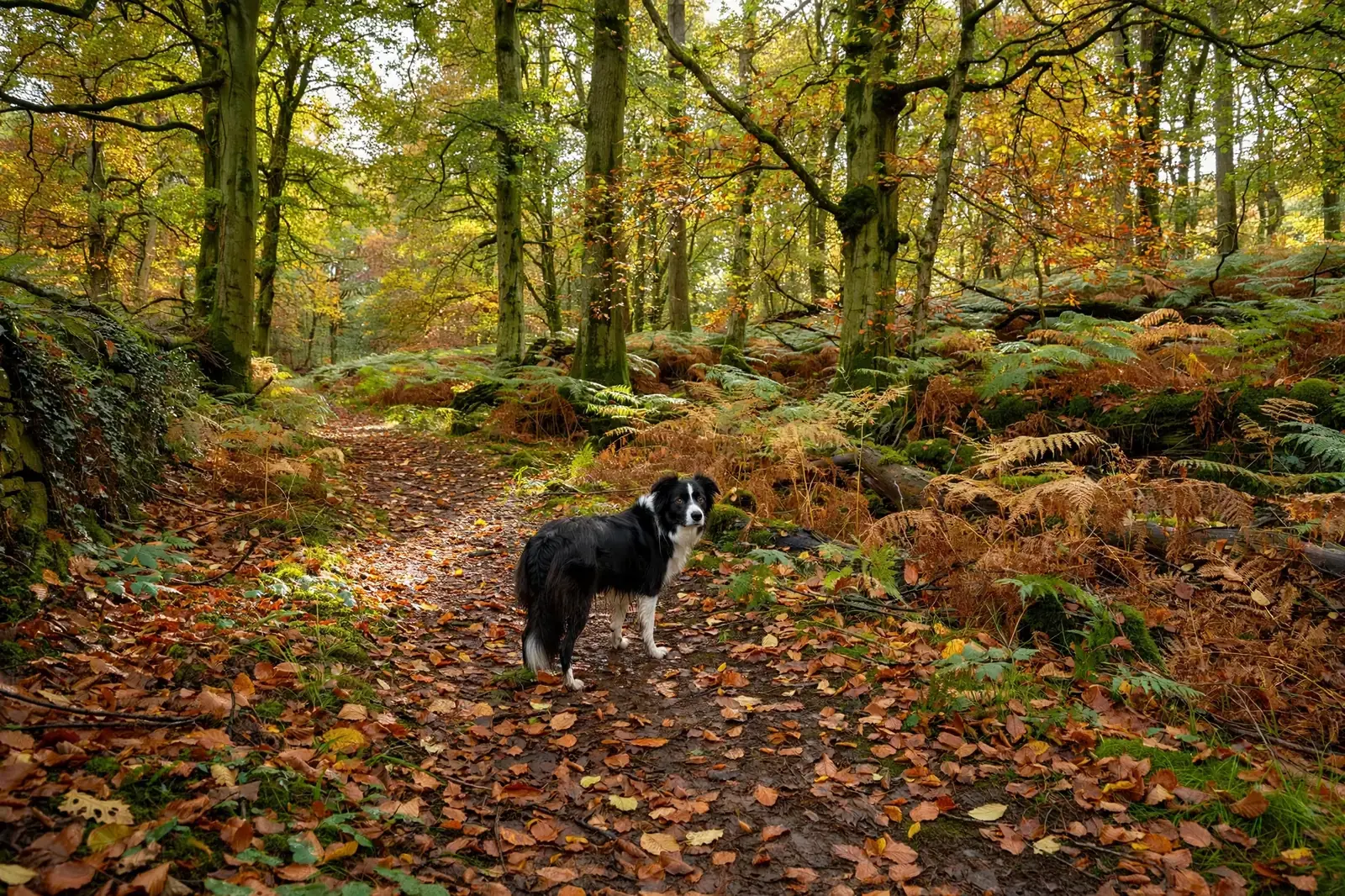
Redmire Wood is the heart of this guide, and it is worth understanding what kind of wood it is before you set foot in it. This is not a manicured country-park wood with surfaced paths, signposts at every junction and a tea room at the end. It is a working Dales wood: tall trees, dense undergrowth, ferns, fallen timber, and paths that are sometimes clear rides and sometimes little more than a trodden line through the leaf litter. That wildness is the attraction, and it is also the reason to walk it with care. Paths can be muddy and slippery after rain, tree roots cross the trail at ankle height, and after a storm there may be fallen branches to step over or walk around.
The main pleasure of the wood is the layering. At canopy level, tall trees filter the light into shifting patches of sun and shade, so the same path looks different at nine in the morning and at four in the afternoon. At eye level, ferns, brambles and saplings crowd the banks, giving dogs a hundred places to sniff and a hundred reasons to pause. At ground level, leaf litter, moss, fungi and fallen branches make a surface that changes with every step and every season. Dogs experience all of this at nose height, which is why a short woodland walk can tire a dog out more thoroughly than a long road walk: the sensory load is enormous, and a dog that has worked its way through it needs rest afterwards.
Wildlife is the wood's other great draw and its main management challenge. Squirrels are common and fast, and a dog with a chase instinct will test every lead you own within the first ten minutes. Roe deer move through the wood at dawn and dusk, and they are easily startled, so keep dogs close at those hours and never let them give chase. Birds are everywhere: woodpeckers, nuthatches, treecreepers, jays and the full chorus of smaller woodland birds, with ground-nesting species in spring that need particular respect. Rabbits and the occasional fox add to the mix. The rule that covers all of it is simple: if you cannot see what your dog is about to meet, your dog should be on a lead.
Walking the wood well is a matter of rhythm rather than route-finding. Start on the wider rides where you can see ahead, let the dog work the scent along the path edges, and stop often. Dogs do not need you to keep up a brisk pace; they need you to let them investigate. Carry a long line for the open stretches and a short lead for the narrow, blind sections. When another walker appears, call the dog in early and step to the side of the path — in a wood, two dogs meeting head-on around a blind bend is the most common cause of a scuffle, and it is easily avoided with a little anticipation.
The wood's ground deserves respect after rain. Leaf litter hides tree roots, and the clay soils of the valley hold water, so paths that were firm in August can be slick and deep in November. Dogs with short legs will come back muddy to the belly, and long-coated dogs will pick up leaves and twigs that need combing out. A towel and a drying coat are not optional extras here; they are part of the walk. Check paws after every woodland outing for thorns, splinters and ticks, and rinse muddy paws before the dog gets back into the car or the cottage, or you will be cleaning both for the rest of the stay.
One more practical point: phone signal in and around the wood can be patchy, and the tree canopy makes it worse. Download your map and save the route before you leave the cottage, and do not rely on a live signal to find your way back. The wood is not large and the village is never far, but a dog owner who has wandered off the path following a squirrel is a common enough sight, and a downloaded map turns a minor detour into a non-event. Check the official guidance before you travel for any current access information or temporary closures, because woodland work and storm damage can close paths at short notice.
Redmire Force and the river
Below the village, the River Ure drops over Redmire Force, a waterfall that is modest in height and generous in atmosphere. The water comes down through the trees, over dark rock, into a pool that looks calm from above and is anything but calm underneath. It is one of those Dales waterfalls that rewards a short detour rather than a full day: the walk down is steep, the ground is often wet, and the best views are from the bank rather than from the water's edge. For dogs, it is a place to visit on a lead, look at, and leave, not a place to swim.
The descent to the Force needs care. The path drops from the village lanes through the wood towards the river, and the combination of tree roots, leaf litter and a steep gradient makes it slippery in all but the driest weather. After heavy rain the river runs high and fast, the rocks at the water's edge are treacherous, and the sensible choice is to admire the fall from a safe distance and turn back. Dogs that are allowed to scramble on wet rock near a waterfall are at real risk of a fall or of being swept into fast water, and no photograph is worth it. Keep the lead short, keep the dog behind you on the descent, and allow twice as long for the climb back as you think you will need.
The riverbank below the fall is a good place to pause. The Ure here is a proper Dales river: clear, cold and quick, with deep pools, gravel bars and overhanging trees. In summer, dogs can paddle at the shallow edges where the current is slow and the bank is gentle, but always check the water first — after rain, what looks like a shallow edge can hide a strong current, and in spate the river is no place for any dog. Never let a dog drink from fast-moving water after heavy rain, when the river carries silt and farm run-off, and never let them swim above a weir or a fall. If in doubt, the dog can drink from the bottle you brought, which is always the safer choice.
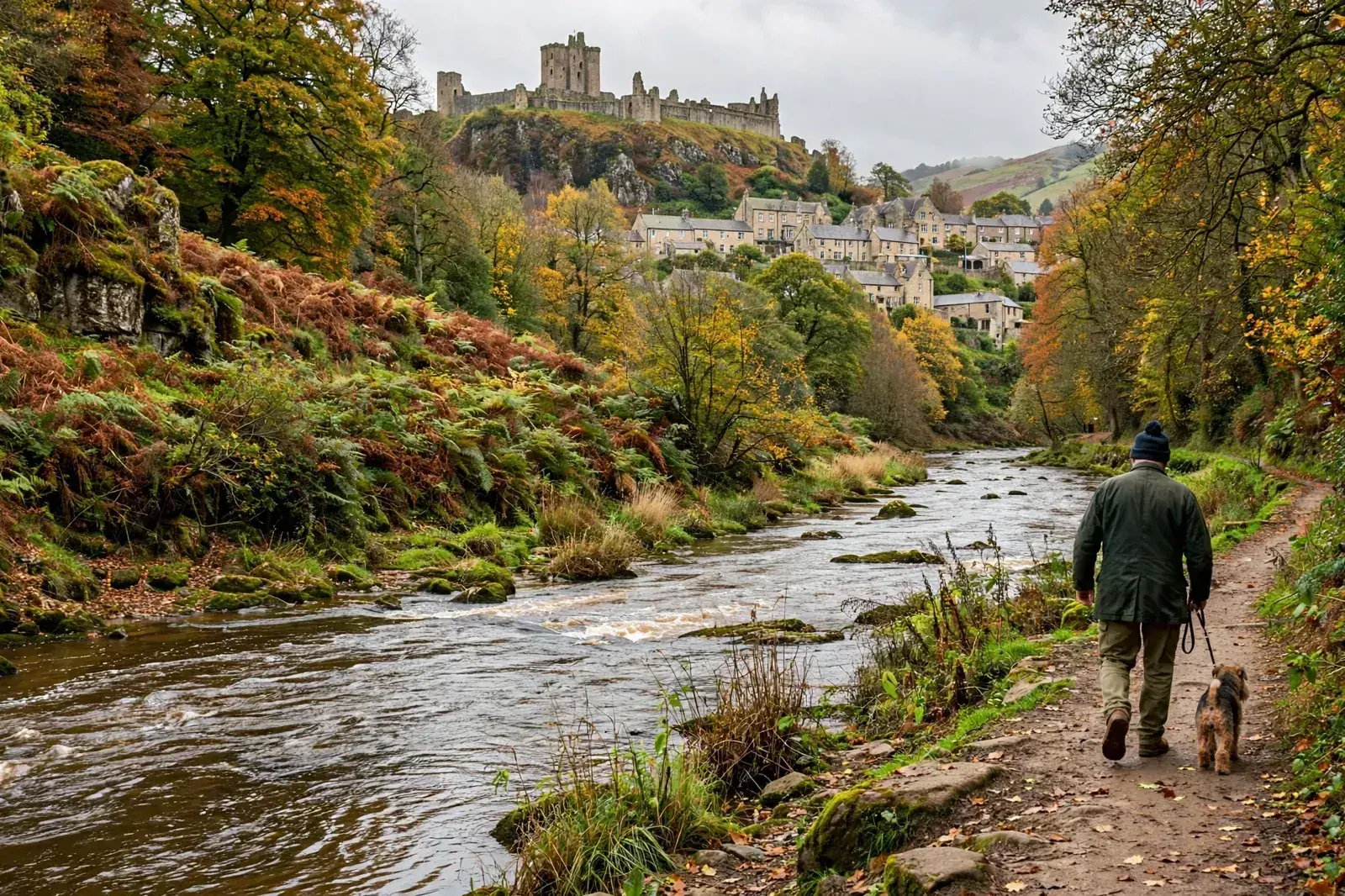
From the Force, the riverside paths connect into the wider valley network, and this is where Redmire stops being a woodland walk and starts being a Dales walk. The River Ure runs east through Wensleydale towards Leyburn and on to Middleham, and its banks offer some of the most satisfying dog walking in the valley: flat or gently undulating ground, water to paddle in, open views across the meadows, and a steady supply of new smells. The contrast with the wood is part of the pleasure — an hour in the trees followed by an hour beside the river gives a dog two completely different walks in one morning.
The river also brings its own rules. The banks are farmland, and the fields beside the Ure are grazed, so the lead goes back on whenever livestock are in sight. The river is also a fishing river, and anglers have a right to quiet water; give them a wide berth, keep the dog out of the water near them, and do not let a dog splash through a pool someone is fishing. In summer, watch for blue-green algae in slow, warm stretches of still water — it is toxic to dogs, and if the water looks green and soupy, keep the dog out entirely and check the official guidance before you travel for current advice.
Longer loops from Redmire
Redmire works as a base precisely because it sits between larger destinations. The most useful longer walk is east to Leyburn, a few miles along lanes and valley footpaths that cross the meadows and climb gently towards the market town. Allow two to three hours one way at a dog's pace, and treat it as a half-day outing rather than a quick there-and-back. The reward is Leyburn itself: a proper market town with shops, cafes, dog-friendly pubs and the Leyburn Shawl, the limestone escarpment above the town with views across the whole valley. Our guide to Leyburn with a dog covers the town's walks, its waterfall paths and its practicalities in full, and it is worth reading before you set out.
South-west across the river lies Castle Bolton, the great fourteenth-century castle that dominates the southern side of the valley. The walk from Redmire to Castle Bolton crosses the Ure and climbs through farmland to the village, and it is a walk of two halves: the quiet riverside start, then the climb and the castle. Dogs are welcome on the paths, but the castle itself has its own access rules, so check the official guidance before you travel if you plan to go inside. Even from the outside, the castle is worth the walk: it is one of the most complete medieval castles in the country, and the village around it has a pub and a tea room that make a natural turning point.
West up the valley, Hawes is the next market town, and it makes a good driving day out rather than a walking destination from Redmire. Hawes is the home of Wensleydale cheese, the start of the Pennine Way's Yorkshire stretch, and the gateway to the waterfalls of the upper dale. Our guide to Hawes with a dog covers the town, the nearby falls and the practicalities of visiting with a dog, including the lead rules around the waterfalls. If your dog is fit and you want a bigger day, the upper dale around Hawes offers the kind of open fell walking that Redmire itself does not, and the two make a good pair across a week.
Further afield, Richmond in Swaledale is an easy drive east and a completely different kind of day out: a Georgian market town with a Norman castle, the River Swale running beneath it, and Easby Abbey a short walk along the river. Our guide to Richmond in Yorkshire with a dog covers the castle, the riverside walks and the town's dog-friendly spots. Richmond is worth the drive on a wet day in particular, because the town has more indoor options than the smaller Dales villages, and a dog that has had enough of rain can still enjoy a wander around the market square.
When you plan any of these longer walks, build the day around the dog, not the destination. That means starting early in summer so the dog is not walking in the heat of the day, carrying water and a collapsible bowl on every walk, and planning a rest stop halfway where the dog can lie down in shade. It also means having a plan B: if the dog is tired, the weather turns, or the path is blocked, turn back without a second thought. The Dales will still be there tomorrow, and a dog that has had a good short walk is happier than a dog that has been dragged through a long bad one.
Seasons in the wood
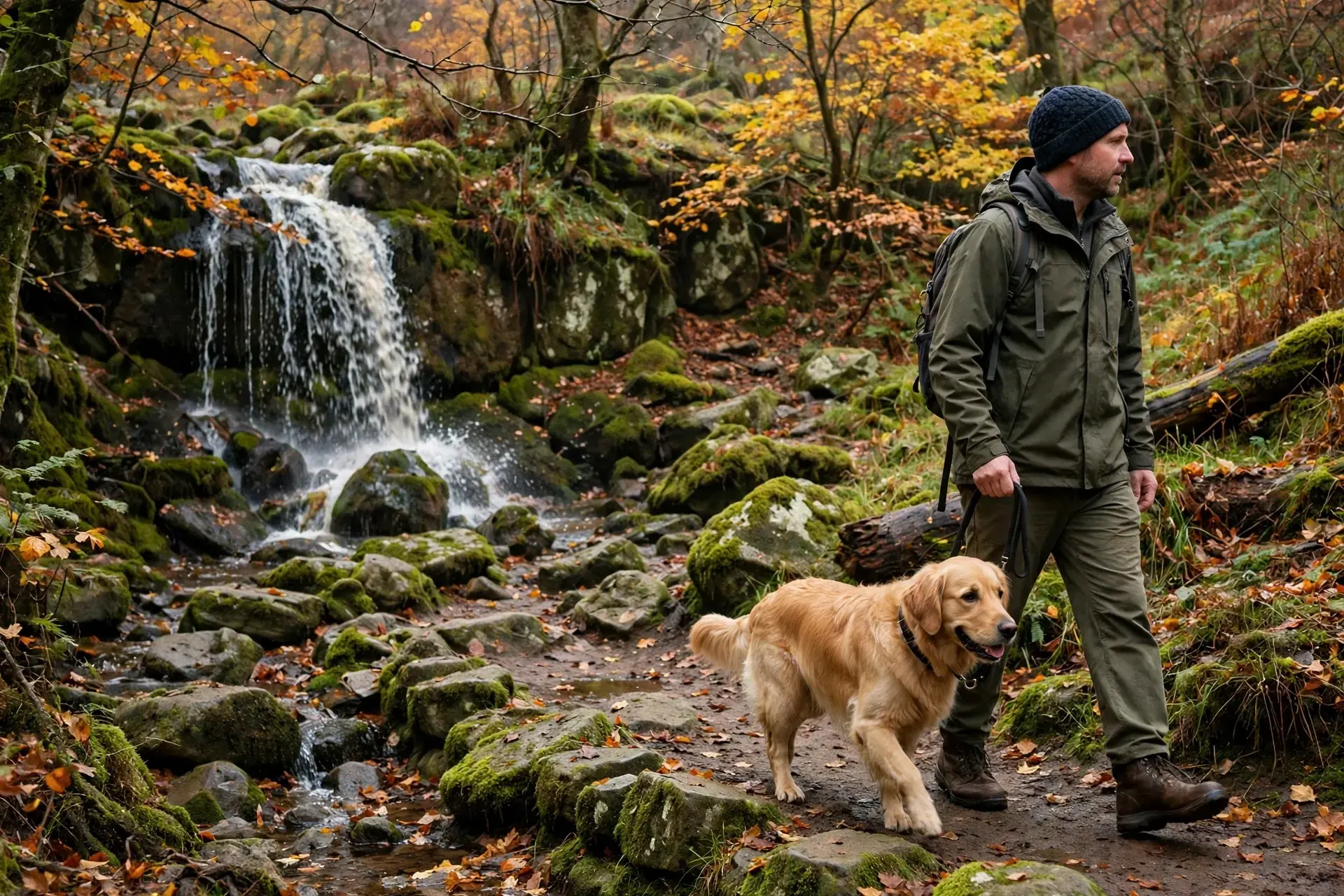
Redmire Wood changes so much through the year that it is almost four different walks, and the best season for your dog depends on what your dog likes and what they struggle with. Autumn is the wood at its most theatrical. The canopy turns gold, copper and russet, ferns flame and then collapse, and the ground becomes a deep carpet of leaves that dogs love to plunge through. It is the season of the cover photograph, and it is also the season of mud: leaves hide puddles and roots, paths turn slick, and long-coated dogs will need a proper groom after every walk. Autumn is also the season of falling branches, so avoid the wood in high winds and after storms until the paths have been checked.
Spring in the wood is quieter and more delicate. Bluebells and wild garlic carpet the woodland floor, the canopy is still thin enough to let light through, and the birdsong is at its loudest. It is a beautiful season and a demanding one for dog owners, because spring is also the season of ground-nesting birds, new lambs in the surrounding fields, and the first ticks. Keep dogs on the paths, keep them out of the bluebell banks, and check them thoroughly for ticks after every walk. The wood in spring is a place for a short lead and a careful eye, not for a dog charging through the undergrowth.
Summer is the wood's most forgiving season. The canopy closes over and the wood becomes a cool, shaded refuge from the heat of the open valley, which makes it the best place in the area to walk a dog on a hot day. The paths are usually at their driest, the ferns are at their tallest, and the light is green and filtered. The trade-offs are midges and flies in still, humid air, and the risk of heat exhaustion on the walk to and from the wood, so go early or late in the day, carry water, and never leave a dog in a car. Summer is also the season when the wood is busiest with other walkers, so expect to meet more people and dogs than in winter.
Winter strips the wood back to its bones. The leaves are gone, the ferns have collapsed, and the structure of the trees stands out against the sky. It is the quietest season, the coldest, and in some ways the most atmospheric: frost on the ferns, mist in the valley, and the sound of your own boots on frozen ground. Dogs love the cold, but the paths can be icy, and the short days mean you need to plan around the light. Carry a torch for late-afternoon walks, put a coat on a short-coated or older dog, and remember that a wet dog in winter cools fast — dry them properly before the drive home.
Dog rules, livestock and ticks
The rules for dogs around Redmire are not complicated, but they are worth stating plainly, because the wood and the fields around it are working countryside, not a dog park. The first rule is the lead. Use it on the village lanes, on any path where you cannot see ahead, near the river, near livestock, and whenever another walker or dog is close. Use a long line on the wide woodland rides where you can see clearly and nothing else is around. The second rule is livestock: sheep and cattle are on the fields around Redmire for most of the year, and dogs must be kept on a short lead through any field with animals in it. Chasing or worrying livestock is not a minor offence in the countryside; it is a serious matter for the farmer, and it can end very badly for the dog.
The third rule is about what the dog eats and drinks. Woodland floors are full of things dogs should not eat: fungi, acorns, conkers, rotting wood and the remains of dead animals. Teach a reliable leave-it before you come, and watch the dog in autumn in particular, when acorns and fungi are everywhere. River water is usually fine in the upper dale, but avoid stagnant pools, avoid water that looks green or smells odd, and carry fresh water so the dog does not need to drink from the river at all. A dog that has eaten something suspicious in the wood should be watched closely, and a vet should be called early rather than late.
Ticks are the wood's most persistent hazard, and they deserve a section of their own. Redmire Wood, like most British woodland, has ticks from spring through autumn, and they are most active in warm, humid weather. They wait on ferns and long grass at exactly the height of a dog's belly and legs, and they attach while the dog is pushing through the undergrowth. Check your dog after every woodland walk: run your fingers through the coat, check the ears, the armpits, the groin and between the toes, and remove any tick promptly with a tick remover, twisting gently rather than pulling. Speak to your vet before you travel about tick prevention, and keep the remover in your walking kit, not in the cottage.
The fourth rule is about noise and other people. Redmire is quiet, and the people who live there and walk there value the quiet. A dog that barks at every squirrel, every walker and every farm gate will not enjoy the wood, and will not be enjoyed by anyone else either. If your dog is reactive, the wood can still work, but only with planning: walk early, choose the wider rides, keep distance from other dogs, and be ready to step off the path and let others pass. The wood's quiet is a resource, and the dogs that do best in it are the ones that can be quiet in it too.
Finally, the practical rules: pick up after your dog on every path, including the woodland paths where some owners are tempted to leave it. Bag it and carry it out, or use a proper bin — do not hang bags from trees, which is a common and rightly despised habit in the Dales. Keep the dog out of the river near anglers, out of crops, and out of the bluebells. And if the dog is unwell, injured or simply exhausted, stop. The wood will still be there tomorrow, and the best walk is the one the dog enjoyed, not the one you planned.
Where to stay and eat nearby
Redmire itself has very few places to stay, and most visitors base themselves in the village in a holiday cottage or stay in Leyburn and visit Redmire for the day. Both approaches work, and the choice depends on what your dog needs. A cottage in or near Redmire gives you the wood on your doorstep and the quiet of the village in the evening, which suits dogs that settle quickly and owners who like to cook. A base in Leyburn gives you shops, pubs and cafes within walking distance, which suits owners who want to eat out and dogs that are happy in a busier town. Either way, book early: dog-friendly cottages in Wensleydale are in demand, and the best ones go months ahead for school holidays and bank-holiday weekends.
When you book a cottage, ask the questions that matter for a woodland stay. Is there a secure garden or yard where the dog can be let out last thing at night? Is there an outdoor tap or a hose for washing muddy paws? Is there somewhere to dry a wet dog — a utility room, a porch, a boot room — rather than the living-room carpet? Is the cottage near a road, and is the garden genuinely enclosed? And what is the rule about leaving the dog alone in the cottage, because a dog that cannot be left will need to come to every meal with you, which changes your plans. Get the answers in writing, and pack as if the answers are no: a crate, a familiar bed, a drying coat and a towel will cover most gaps.
Eating out with a dog in this part of Wensleydale means Leyburn and Castle Bolton, and the pubs there are the natural places to head after a walk. Dog-friendly pubs in the Dales are generally welcoming, but the welcome has conditions: dogs are usually expected on the floor rather than on the furniture, on a lead, and settled rather than wandering between tables. Bring a mat or a blanket for the dog to lie on, order food that does not need to be eaten in a rush, and be ready to take the dog outside if they become restless. Our guide to Leyburn with a dog has the detail on the town's pubs and cafes, and it is worth checking before you go, because opening hours and dog policies change with the season.
For supplies, Leyburn is the place. The town has shops for food, a butcher, a bakery, and the everyday things a self-catering stay needs, including dog food and treats if you run short. Buy before you head back to Redmire, because the village has no shop to fall back on, and a forgotten bag of dog food means a drive back to town in the dark. If you are staying for a week, do a proper shop on arrival day and then top up as needed, and keep the dog's food in a sealed container away from the cottage's cupboards, because a dog that finds the food bag at three in the morning will not be popular.
Getting there and parking
Redmire is reached by road through Leyburn, and for most visitors that means driving. From the east, the A684 runs through Wensleydale from the A1(M), and Leyburn is the turn-off for Redmire. From the west, the same road comes down the valley from Hawes. The roads are good by Dales standards, but they are narrow in places, with stone walls close to the carriageway and the occasional tractor or sheep to negotiate, so drive slowly and expect to pull into passing places. Satnav will get you to the village, but it will not always pick the best route for a dog in the car, so allow extra time and plan a stop for the dog on the way.
Parking is the part of the visit that needs the most planning, because Redmire has no public car park and very limited space on the lanes. The honest advice is this: do not expect to park in the village itself at a busy time, and do not block gates, driveways, passing places or field entrances, even for a few minutes. Farmers need those gates, residents need those driveways, and a car parked badly in a small village is remembered. If you are staying in the village, your cottage will have parking, and that solves the problem. If you are visiting for the day, the practical options are to park considerately on a wide part of the lane where you are clearly not causing an obstruction, or to park in Leyburn and walk or drive in only when you need to.
Public transport to Redmire is limited, and this is a trip that works best by car. Buses serve Leyburn and the main valley road, but services are infrequent, and the walk from the nearest bus stop to the village is along lanes with no pavement. The Wensleydale Railway, the heritage line that runs through the valley, has its western terminus at Redmire station, which is a charming detail and a reminder of the village's railway history — but check the official guidance before you travel, because the railway runs on selected days and its timetable changes with the season, and it is not a reliable way to get to the village for a walk.
For the drive itself, think about the dog. A long drive through the Dales is tiring for a dog, especially in summer, so stop every couple of hours, offer water, and let the dog stretch its legs somewhere safe before you arrive. Never leave a dog in a parked car in warm weather, even for a few minutes, and be aware that a car parked in the sun at a Dales viewpoint can heat up fast. On arrival, give the dog a short, calm walk on the lanes before you unpack, so the new place is associated with a pleasant walk rather than with the stress of the journey.
What to pack for a woodland stay
A woodland stay in Redmire needs a slightly different packing list from a coastal or a town break, and the differences are all about mud, ticks and trees. Start with the dog's walking kit: a lead, a long line, a harness that fits well and does not rub when wet, a collapsible water bowl and a bottle of water, poo bags, a tick remover, and a small first-aid kit with saline, bandages and a paw balm. Add a drying coat and two towels, because a dog that has been through Redmire Wood in autumn will need both, and a brush or comb for getting leaves and twigs out of a long coat.
For the cottage, pack the dog's own bed or blanket, so they have a familiar place to sleep, and a crate if the dog uses one at home. Bring the dog's usual food and a few extra days' worth, in case you cannot get to a shop, and keep it in a sealed container. Bring any medication the dog needs, with the prescription and the vet's phone number saved in your phone, and know where the nearest vet is before you need one — the nearest practices are in Leyburn and the surrounding towns, and rural practices can be some distance away and close early, so save the number and the address in advance.
For yourself, pack for the wood: waterproof boots with good grip, because the paths are muddy and the roots are slippery; waterproof trousers for wet days; layers, because the wood is cool even in summer and the wind on the open valley is cold even in spring; and a hat and gloves for winter. A head torch is useful in the short days of winter, and a phone charger and a power bank are worth their weight, because the signal is patchy and the phone will work hard searching for it. A paper map of the valley is a good backup, and a small rucksack for water, snacks and the dog's kit will make every walk easier.
Finally, pack for the unexpected. A spare lead, in case one breaks in the wood; a spare towel, because one will not be enough; a roll of poo bags, because you will use more than you think; and a plastic bag for muddy boots and wet kit on the drive home. The best-prepared dog owners in the Dales are not the ones with the most expensive gear, but the ones who have thought about what happens when the dog comes back muddy, tired and happy, and have a plan for that dog, that car and that cottage. Pack for the dog you have, not the dog you wish you had, and the wood will do the rest.
Practical questions
Before you go
Can dogs go off lead in Redmire Wood?
Sometimes, but not everywhere and not at every time of year. The wood is a working landscape with wildlife, ground-nesting birds in spring and livestock in the surrounding fields, so keep your dog on a lead on the approach lanes and on any path where you cannot see well ahead. Use a long line on the wider woodland rides where sightlines are clear and no other walkers, dogs or livestock are close, and clip the lead back on before gates, stiles and field edges. If your dog has a strong chase instinct, treat the whole wood as a lead walk.
Is Redmire Force suitable for dogs?
Yes, as a short, careful visit rather than a swimming spot. Redmire Force is a waterfall on the River Ure below the village, reached by woodland and riverside paths that can be steep, muddy and slippery after rain. Keep your dog on a lead near the water, do not let them climb the rocks or drink from fast-moving water after heavy rain, and allow extra time for the return climb. Check the official guidance before you travel, and skip the descent in icy or flooded conditions.
Where can I park in Redmire with a dog?
Redmire is a small village with very limited parking, so plan ahead rather than expecting a car park at the village itself. Most visitors park considerately on the village lanes without blocking gates, driveways or passing places, or use parking in nearby Leyburn and start the walk from there. Arrive early on weekends and in school holidays, keep your dog on a lead from the car, and check the official guidance before you travel if you need accessible parking.
Are there livestock on the walks around Redmire?
Yes. The fields around Redmire and the wider Wensleydale valley are working farmland, and sheep and cattle are common on the paths between the village, the wood and the river. Keep your dog on a short lead through any field with livestock, give grazing animals a wide berth, and never let your dog chase or worry sheep. Lambing season in spring needs extra care, and you should check the official guidance before you travel for any temporary local restrictions.
What is the best season to visit Redmire Wood with a dog?
Autumn is the standout season, when the wood fills with colour, ferns turn gold and the paths are at their most atmospheric, though they can be muddy and slippery with fallen leaves. Spring brings bluebells and birdsong but also ground-nesting birds and ticks, so keep dogs on paths and check them after every walk. Summer offers shade and cool woodland air, while winter is quiet and stark but the paths can be icy, so pick the season that suits your dog and check the official guidance before you travel.
Can I walk from Redmire to Leyburn with my dog?
Yes, Redmire sits a few miles west of Leyburn, and the two villages are linked by lanes and public footpaths across the Wensleydale valley floor, making a satisfying half-day walk with a dog. Allow at least two to three hours one way depending on your route and your dog, carry water and a lead for the road and livestock sections, and plan your return by retracing the route or arranging a lift, since public transport between the villages is limited. Check the official guidance before you travel for the latest path conditions.