This guide is independent and contains no paid placement. If affiliate links are added later, they will be clearly marked and will not change our editorial checks.
Redruth rewards dog owners who head for the hills first: a loop past granite engine houses and old mine workings, a climb to Carn Brea for the panorama, a wander through Heartlands at Pool, then a short run out to Portreath sand or the shaded lakeside paths of Tehidy. The town itself is steep, compact and practical, with Fore Street markets and places to eat where a tired dog can settle. Plan round unfenced shafts, grazing animals, exposed wind on the high ground and the summer rules on Portreath beach.
Start with the engine houses, not the high street
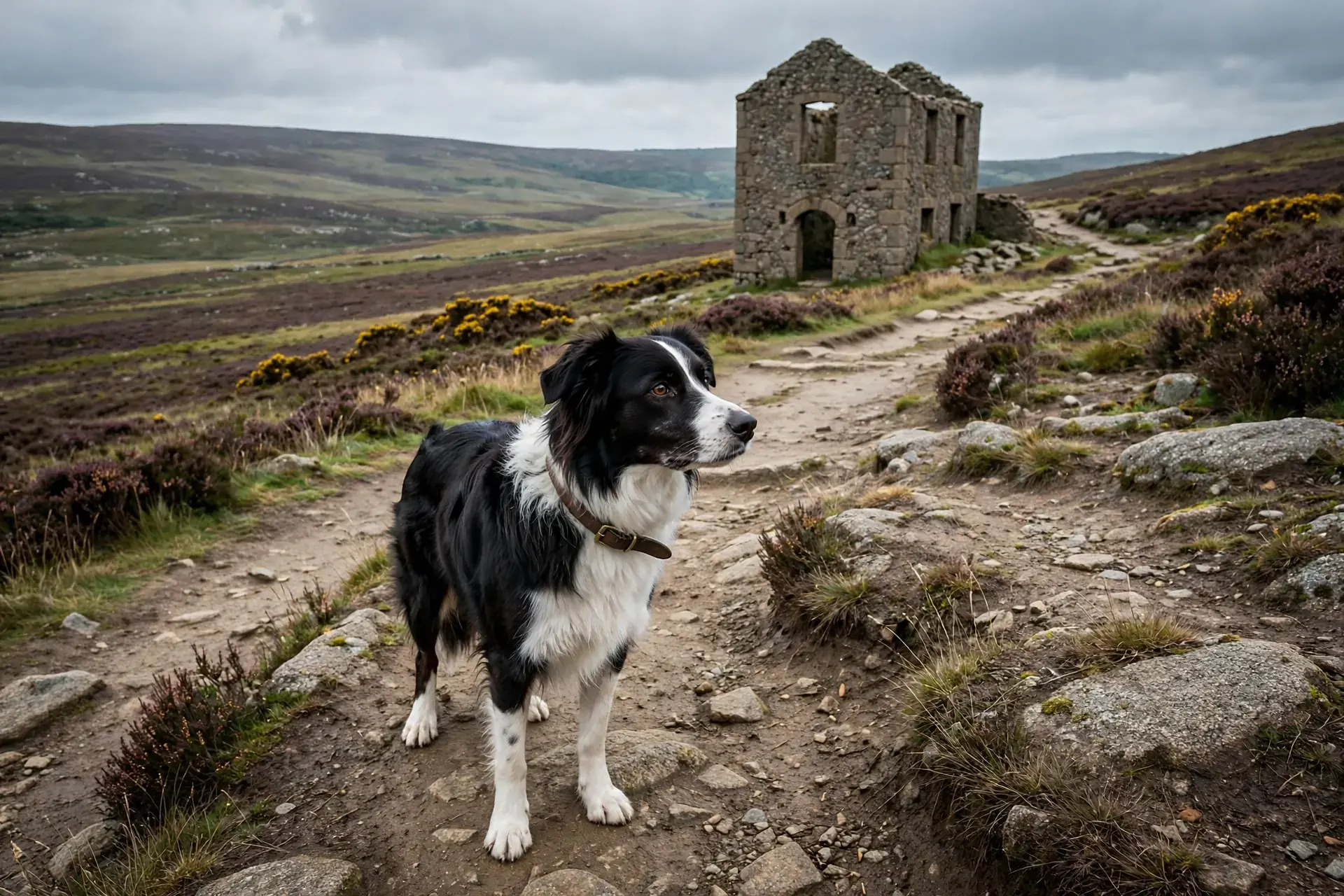
Come into Redruth from the A30 and the town announces itself before you reach it. Granite stacks rise out of the gorse on the ridges, chimneys stand where the copper and tin workings once ran, and the roofs below sit in a hollow between Carn Brea and the high ground towards Camborne. At the peak of the nineteenth century this district was among the richest mining country on earth, and the stone shells left behind still set the shape of every walk here. For a dog owner they double as waymarks: pick out the nearest engine house and you can usually work out which slope you are on, which valley you have just crossed, and how far you still have to climb back.
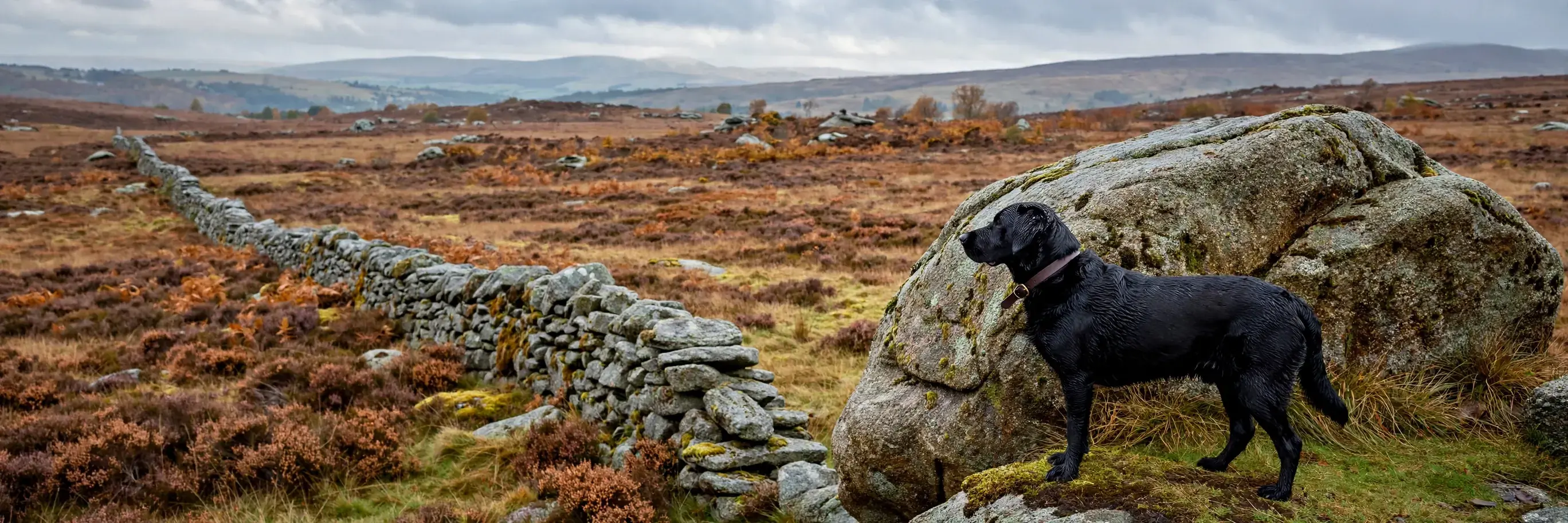
Most of that ground now belongs to the Cornwall and West Devon Mining Landscape, recognised by UNESCO, and it feels worked rather than wild. Spoil heaps have grassed over, leats cut shallow channels across the heath, and the beds of old mineral tramways run level where the wagons once hauled ore down to the coast. Underfoot you get a mix of short turf, heather, gorse roots and bare granite, with paths that appear, fade and reappear. Shafts are the one hazard that needs real respect: some are capped or railed, others sit half-hidden in bracken, so keep your dog close and on a short lead wherever the ground is broken, and never let it scramble over a ruined wall or a crumbling chimney base.
The walk that stitches all of this together is the Great Flat Lode, a roughly seven-and-a-half-mile circuit round Carn Brea that follows the old tramway lines between the mines. Its name comes from the shallow, near-horizontal seam the mines chased underground, and the trail keeps to the same gentle gradients the tramways needed, which makes the long distance more forgiving than the mileage suggests. You can join it at Carn Brea, at Pool, or from the lanes above Tolgus, and you can walk a single stretch and turn back instead of doing the whole loop. Information boards at the main entry points name the engine houses you are passing — the Basset workings to the south, Robinson's Shaft and East Pool towards Camborne — and give the lie of the land a story to go with it.
A full circuit is a three- to four-hour outing, so treat it as a day's walk rather than a quick loop. Build your dog up to that distance first, carry water for both of you because there is none to be had on the open heath, and stop in the lee of a wall or a spoil heap when the wind picks up. Cattle and sheep graze several stretches, and the same lead that keeps a dog out of a shaft keeps it out of trouble with livestock. Loose stone, rabbit holes and boggy patches after rain make the going uneven, so a dog with stiff joints will be happier on the flatter tramway section between Pool and Carn Brea than on the rougher ground above the town.
The heath changes its mood with the year, and the same walk can feel like four different places. Spring brings gorse in flower and lambs in the fields below the trail, summer turns the open ridges into a sun trap with almost no shade — set off early, carry extra water and watch for a dog that starts lagging or panting hard. Autumn is the kindest season here, bracken turning copper, the paths quieter and the light low across the engine houses. Winter is the most exposed: driving rain, a wind that cuts straight across Carn Brea, and short days that demand an early start and a finish well before dark. Whatever the month, look at the forecast, save an offline map, and treat the high ground as weather of its own.
The town: markets, Fore Street and the old streets
Fore Street climbs steeply through Redruth from West End to the top of town, and a slow walk up it with a dog is the quickest way to get the place. The pavements are narrow in places, the shopfronts are a mix of granite, brick and painted timber, and the street holds the things a working town needs every week: butchers and bakers, a library, cafes, pubs, independent shops and the market. It is a short street and a stiff one, so an older dog will feel the gradient on the way up and be glad of the gentler lanes at the top. Keep to the pavement side, hold the lead short at the junctions, and take the street at a looking pace rather than a marching one.
Market day turns Fore Street and the market hall into the town's living room. Stalls sell vegetables from Cornish growers, meat, cheese, bread, cakes, plants and crafts, and a dog on a lead is simply part of the crowd rather than a problem to be solved. Arrive early if your dog dislikes being jostled, because the stalls are busiest by mid-morning, and steer well clear of the food counters — a spaniel that helps itself to a sample will be remembered by the stallholder. The market is also the best place to gather a trail lunch: a pasty, a wedge of Cornish cheese, bread and fruit travel better than anything bought in a hurry on the road, and the stalls will tell you what is in season. Days and hours shift with the calendar and with town events, so look at the boards outside the hall before you plan round a particular morning.
Look above the shopfronts and the town's prosperous century is still there to read. The town hall and the old bank buildings carry the scale of a place that once handled mining wealth, the miners' cottages climb the slopes in tight rows, and street names remember the mines and the men who worked them. St Uny's church stands at the top of town with a quiet churchyard that makes a calm pause with a dog on a lead. Down in the old brewery quarter, Kresen Kernow now holds Cornwall's archives, and Murdoch House, where the engineer William Murdoch once lived, marks the town's part in the steam age. The back lanes behind Fore Street show the other Redruth: washing lines, chapels, garden walls and a town that is lived in rather than displayed.
Redruth's brass bands and choirs are part of the same story. The town has kept a strong tradition of community music — band rehearsals spilling out of halls, male voice choirs in the chapels — and on a concert evening you may hear a band warming up as you walk the dog through the back streets. This is not a performance laid on for visitors; it is the town entertaining itself, and that is what makes it worth noticing. Local listings change through the year, so check what is on before you time an evening walk to catch a rehearsal or a concert.
Shopping with a dog here works best as a short, shared job. Some shops welcome a dog inside, others will expect it to wait at the door, and with one person to hold the lead and one to browse you can do a proper shop without either of you rushing. On your own, keep the list small, tie the dog only where you can see it and where it cannot block the pavement, and never leave it tied for long. The centre is compact enough that a loop from Fore Street to the lanes behind and back takes half an hour, and that is usually enough shopping for one dog's patience.
Carn Brea and the Great Flat Lode
Carn Brea is the hill that rules the view from Redruth, a granite ridge topped by a castle — an eighteenth-century hunting lodge that now serves food — and by the tall monument to Francis Basset, Lord de Dunstanville, the mine owner who is said to have watched his workings from the summit. The climb from the town takes about half an hour and is steep enough that a fit dog will enjoy it and an older one will not; driving to the car park near the top and walking the last stretch is the sensible choice for puppies, stiff-legged dogs and hot days. From the summit the whole mining district opens out: engine houses and spoil heaps in every direction, the coast to the north and the moor to the south, and on a clear day a view that runs for miles.
The summit has been occupied far longer than the mines. A Neolithic settlement and an Iron Age hill fort once stood here, and the granite outcrops, ramparts and old walls are still visible among the turf and the gorse. Your dog will not care about the archaeology, but the same open ground that holds it is what makes the hill so good for a walk: long sightlines, a dozen different scents on the wind, and room to move without meeting traffic. The ground is a scheduled monument in places, and livestock graze it, so keep the dog under close control, stay on the worn paths where they exist, and do not let it dig or chase.
The finest stretch of the Great Flat Lode runs round the southern side of the hill, past the Basset mines. Here the engine houses, chimneys and dressing floors — the yards where ore was crushed and sorted — survive in unusual completeness, and the trail gives you time to look at each one rather than hurrying past. The path is well marked and the information boards explain which building did what, which turns a pile of granite into a working mine in your head. The ground is rough in places, with loose stone and rabbit holes, and sheep graze the slopes, so a lead is the rule here rather than the exception. A confident dog on rough ground will love this section; a dog with joint trouble is better off on the level tramway bed lower down.
Wildlife is part of the hill's draw. Buzzards ride the thermals above the ridge, ravens call from the crags, and the heathland holds skylarks, stonechats and a host of insects in summer. A dog that can settle and watch is a better companion here than one that lunges at every bird, so this is a walk to do after the dog has already had a run, not before. The hill is fully exposed to the weather, and a bright morning in town can turn to rain and thick mist on the top within half an hour. A coat for a short-coated dog and a check of the forecast before you set out are not over-cautious here; they are the difference between a good walk and a miserable one.
Come early or come late. The car parks near the top fill on sunny weekends, and the hill is at its best in the evening, when the crowds have gone and the light drops across the engine houses. The castle's outdoor seating welcomes dogs, and it makes a good resting stop for coffee and cake while the dog sleeps off the climb — hours change with the season, so check before you rely on it. A dusk walk back down towards Redruth, with the town lights coming on below and the Basset monument dark against the sky, is one of the most atmospheric finishes to a day in Cornwall.
Heartlands and the mining landscape
Heartlands sits at Pool, in the gap between Redruth and Camborne, where Robinson's Shaft once hauled ore from one of the district's great mines. The site is now a free public park, and it is the gentlest mining walk in the area: level paths winding through planting and open grass, benches to rest on, and the old engine house and chimney still standing over everything. A dog that has already done the rough heath can wander here, sniff and sleep without climbing a thing, and the cafe puts its tables outside for exactly that kind of lunch. Children have room to run, families can spread out, and the dog is one of the party rather than an afterthought.
Inside, the exhibitions tell the story of the whole district: the geology that put tin and copper under Carn Brea, the engines that pumped the mines dry, the lives of the miners and their families, and the Cornish diaspora — the men and women who carried their mining skill to Australia, the Americas and South Africa when the Cornish mines closed. Dogs cannot go into the exhibition rooms, so take turns with a companion or save the indoor part for a visit without the dog. An hour or two covers the site properly, and the outdoor ground — the gardens, the viewpoints and the walk round the old workings — is the part that matters most on a dog day anyway.
The gardens are the quiet surprise of the place. They were planted as a sequence of themed spaces, including a sensory garden and a Cornish garden, and on a hot day their shade and planting make a cool contrast to the bare heath of Carn Brea. Keep the dog on the paths, keep it out of the planting, and let it enjoy the one part of the mining landscape that was designed to be gentle. Through the year Heartlands also hosts a farmers' market and community events, and a dog that is comfortable in a crowd will enjoy the bustle; a nervous dog will be happier first thing in the morning, when the site is quiet and the light is soft.
Pool itself is worth a slow look on the way back. The village grew up round the mines, and its streets are a mix of miners' cottages, chapels, pubs and small shops that still read as a mining community rather than a suburb. A pub lunch in Pool after a morning at Heartlands is a natural finish, and the lanes from the village link back to the Great Flat Lode and the paths towards Redruth. If your stay runs longer, the clay country east of here is the natural next step — St Austell with a dog covers Eden, Charlestown harbour and the trails through the clay pits.
World Heritage status protects this landscape, and the rules for dogs are short and worth following: keep the lead on near shafts, spoil heaps and livestock, stay on the marked paths where they exist, and never let a dog climb a ruined building or dig into old mine waste. The ground around the workings can be unstable, and the stonework is fragile. That is the whole bargain — the engine houses stay standing and the paths stay open, and in return visitors treat the place as the industrial monument it is rather than as an adventure playground.
Coast and woodland: Portreath, Devoran and Tehidy
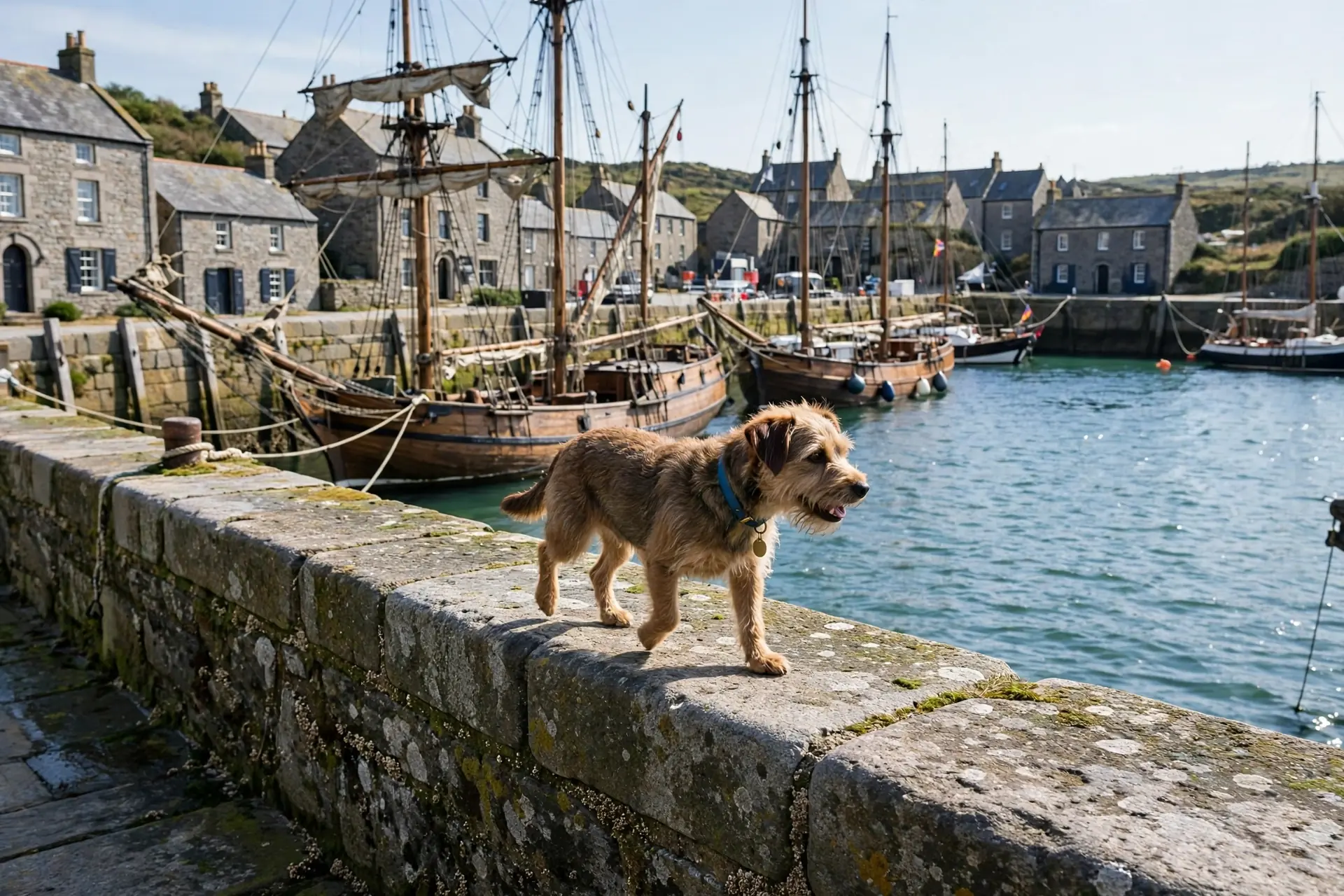
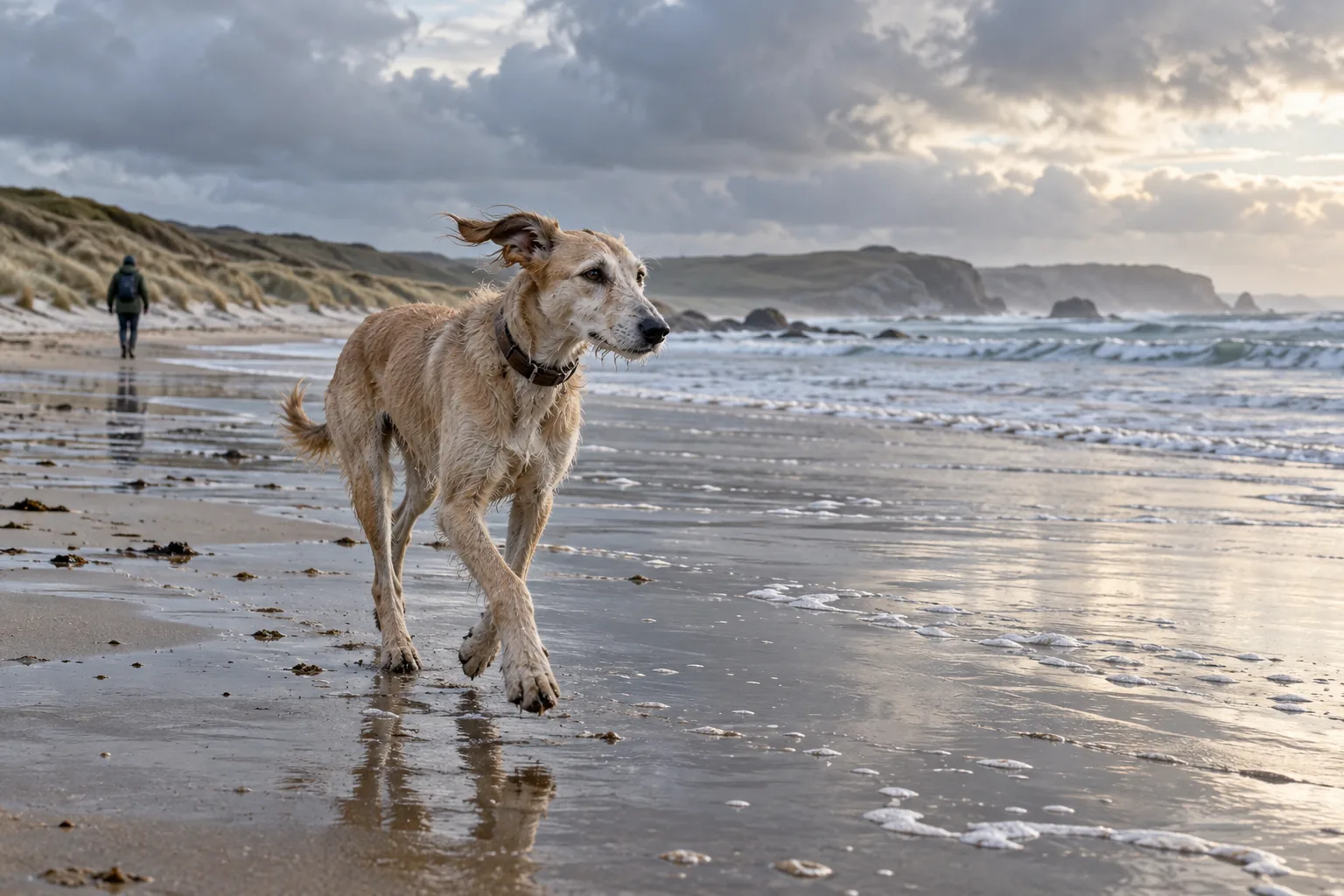
Redruth is five miles from the sea, and Portreath is the beach that belongs to it. The run out follows the coast road north past the old mine workings, and the same journey can be walked or cycled on the Coast to Coast trail, the old mineral tramway that runs from Portreath harbour all the way through the mining country to Devoran on the south coast. Portreath itself is a small harbour village with a sandy beach, a harbour wall, a pub, cafes and a car park, and it works as a beach day and a village day in one. The main beach carries seasonal dog restrictions through the summer, so dogs are kept off the central sand in the daytime in peak season — read the signs at the slipway and the car park, because the dates and the marked area shift from year to year. Out of season the beach opens up, and a winter or autumn morning at Portreath, with the surf running and the harbour quiet, is a very different and often better dog day than a crowded August afternoon.
From Portreath the coast path runs east along the cliffs towards Porthtowan and St Agnes, a proper cliff walk with steep climbs, narrow stretches and long views across the bay towards St Ives. Westward it runs towards Hayle and Godrevy, longer and wilder, a full-day outing for a strong dog. Both directions are exposed, with unfenced drops and paths that narrow to a single file, so keep the dog on a lead on the cliff sections and well back from the edge even where the ground looks flat. The reward is some of the finest cliff scenery in Cornwall, and on a clear day the view runs from St Ives in one direction to the Lizard in the other.
Tehidy Country Park, between Redruth and Camborne, is the woodland counterweight to all that open coast and heath. The park wraps round the old Tehidy House estate — lakes, mature trees, open grass and a network of paths that let you pick a short lakeside loop or a longer woodland circuit to suit the dog you have. Shade, damp earth and the smell of leaf litter make it the walk most local dog owners reach for first, and in wet weather the tree cover keeps the rain off while the surfaced stretches stay passable. Dogs are welcome on a lead throughout, and the car park fills on sunny weekends, so an early start pays off here as surely as it does on Carn Brea.
Devoran, on the River Fal to the south, is the quietest of the three days out and often the best with a dog that dislikes crowds or surf. The village has a quay, a cafe and the start of the waterside path that runs round the Carrick Roads towards Falmouth, a gentle wooded walk rather than an exposed cliff one. The Fal is tidal here, and the mud beside the quay is deep and soft, so keep the dog off the mudflats unless you know the tide and the ground. The Coast to Coast trail ends — or begins — at Devoran, so a walk from the village along the old tramway towards Bissoe and the mining country gives you a flat, traffic-free route with the river on one side and woodland on the other. The rules themselves are set out in our guide to dog-friendly beaches in the UK, which covers seasonal bans, protection orders and how to check a particular beach — worth a look before a summer trip, since the rules change from beach to beach and the fines are real.
Wind and tide decide whether a coast day works, and both can differ from the weather in town. Portreath at high water is a thin strip of sand against the harbour wall; at low water it spreads wide, with rock pools showing at the edges, so aim to arrive two or three hours before low tide and you get the longest stretch of open sand. A north-coast gale can be blowing while Redruth sits calm, and a gusty beach is hard work for a small dog, so look at the wind forecast as well as the rain. Pack drinking water for the dog — seawater makes dogs sick — plus a towel and a drying coat for the drive home.
Portreath deserves respect as well as enthusiasm. The waves here can run strong even on a day that looks gentle from the car park, so keep the dog out of heavy surf and away from the rocks, and well back from the foot of the cliffs, where stone falls without warning. In summer lifeguards watch the main beach — swim only where they are on duty and the flags are up. Scan the sand for hooks and broken glass, and keep the dog from eating dead fish, seaweed and storm debris. Too much swallowed seawater shows up as vomiting, diarrhoea or a dog that suddenly goes flat, and that needs a vet rather than a wait at home. Before the drive back, hose the salt off, look between the toes for cuts, shake the sand out of the ears, and towel the dog dry. If it sleeps all the way to Redruth, the day did its job.
Eating and drinking in a mining town
Redruth eats better than its size suggests, and that is the second reason to base yourself here after the mining walks. The town is compact enough to cross on foot in fifteen minutes, yet it holds a dense scattering of cafes, bakeries, delis, pubs and restaurants, and a surprising number of them are genuinely glad to see a dog. The practical upshot is that you can eat properly, find a decent coffee and wander the shops without once leaving the dog in the car or tying it to a railing. Not every Cornish town offers that, and it is worth noticing when you find it.
The cafes set the tone. A bowl of water by the door, biscuits on the counter, staff who say hello to the dog before they say hello to you — those are the signs of a place that means it. If you are unsure, ask before you take a seat. Outside tables are the simple option on a warm day; inside, pick a spot out of the main walkway, lay the dog's own blanket down, and order straight away so the animal has something to settle for. Walk first and eat second: a dog fresh off the Flat Lode will usually doze through lunch, while one that has spent the morning shut in the car will fidget through every course.
The pubs carry the mining-town side of the story. Redruth's older pubs — low ceilings, slate floors, a bar that has poured for miners for generations — are often glad of a dog, and lunch in one after a morning on the heath is about as Cornish a dog day as there is. A big dog is happiest in a garden or on a terrace; when the weather turns, the bar is usually where dogs belong and the dining room is where they do not, though the boundary shifts between lunch and dinner and from pub to pub. Lay the dog's blanket down, keep the lead tucked under your chair, and let the food come at its own pace. House rules change, especially in high season, so ring ahead if a particular pub is the plan for dinner.
Routine matters more than the choice of venue. If the dog is having a bad day — barking at strangers, whining, hauling on the lead — do not force a sit-down meal; take the food away or eat on a bench and the dog will thank you for it. Otherwise feed the animal before you go, or bring some of its own food for under the table, and carry a collapsible bowl and water of your own, since a busy cafe may have none to spare. A blanket gives the dog a place of its own, a chew keeps a puppy occupied, and a lead kept short and under your chair keeps it out of everyone else's way.
Over a longer stay the food becomes a reason to stay put rather than pass through. You can walk to the shops, cook with market produce, and eat out when you feel like it, all without starting the car. Restaurants in town are worth booking ahead on Friday and Saturday nights in summer, and some welcome dogs in certain areas — say honestly when you book how big your dog is and how it behaves, because a quiet spaniel and a large excitable dog are not the same proposition in a small dining room.
Staying over, parking and vets
Redruth works as a base because it is practical before it is pretty. The town has a supermarket, a pharmacy, cash machines, pet supplies and places to eat, all within a short walk of the centre, so a self-catering stay here runs without a car in a way a stay in a small coastal village does not. Arrive, park, walk to the shops, cook dinner, take the dog out in the evening, and do it all again the next day. For a dog owner that ease is worth as much as any view, and it is the reason many people return to the same streets year after year.
Dog-friendly beds in Redruth come in most shapes: a small hotel or bed and breakfast in town, a terraced cottage above Fore Street, a holiday park out on the mining ground, a farm stay a short drive towards the coast. What varies is the small print, so read it before you book rather than after. Confirm the dog is welcome in the exact room or cottage, not just somewhere on the property, and how many animals, what the charge covers, and whether size or breed limits apply. Walk the outside space in your head: is the yard properly enclosed, does the gate latch, could a determined dog push through it. Ask whether the dog may be left alone, and for how long — that decides whether dinner out is possible at all. And look at the floor: hard surfaces forgive a muddy Flat Lode walk, pale carpet does not, and a ground-floor room spares an older dog a narrow staircase every time it needs the garden.
For most dog owners, a self-catering cottage is the easiest fit: you cook when you like, the dog keeps its own hours, and muddy boots and wet coats have somewhere to live. A plain cottage on the edge of town with a footpath straight to Carn Brea beats a prettier one that needs the car for every walk, and a washing machine for muddy towels beats a view. Holiday parks and campsites round Redruth suit families well, but the same small print applies — how many dogs, what it costs, whether the outside space is enclosed, and what happens if the dog is left alone. In a caravan or lodge, test the steps and the decking in your mind: a dog that cannot manage them will face them every time it needs to go out.
Parking in Redruth is straightforward if you think a day ahead. The town car parks near Fore Street put you within a short walk of the shops and the centre; charges and time limits on them change, so read the boards or the council listings before you count on a particular stay. For Carn Brea and the Flat Lode, the small car parks at the trail entry points are the obvious starts, and they fill on sunny weekends — arrive early or come in the evening. Portreath and Tehidy are the same in summer: small car parks, quick to fill, and the easy windows are before ten in the morning or after four in the afternoon. On a warm day a car interior heats in minutes, so the dog comes with you; there is no safe short wait in a parked car.
Know where the vet is before you need one. Redruth has practices in town, with more in Camborne and Truro and an out-of-hours service covering the area, so a weekend problem is manageable if the number is saved on arrival. Pet shops and the supermarket cover food and the usual supplies, so running out is not a crisis. Mobile signal holds up in town but thins out on the remoter mining trails, so keep the route saved on your phone before you leave the town behind. In winter, check that the cafes, pubs and places you want are actually open — hours shrink outside summer, and the trails turn bleak and muddy after heavy rain. Plan the days round the mines first, the town second and the coast third, and Redruth falls into place.
One bag has to cover heath and beach together. Two leads — a short one for town and cliffs, a long one for open ground — plus a spare, since mud and salt water ruin a lead fast. A harness that fits, a water bottle and a bowl that folds flat, because the open Flat Lode has no drinking water for dogs. A towel, a drying coat and a blanket for the car, and a generous supply of poo bags with something to carry them in. A coat for a short-coated dog against wind and rain, sunscreen for a pale nose in summer, the dog's own food and medicine, and the vet's number and insurance details tucked in your phone. Above all, allow more time than the plan needs: livestock share the trails, the coast crowds in summer, and the best days here are never the hurried ones.
A weekend can run like this. Friday evening: park in town, climb Carn Brea as the light drops, and let the dog learn the smells of the place before dark. Saturday: an early start on the Flat Lode round the Basset mines, lunch in a town pub, and the afternoon at Heartlands while the dog sleeps off the morning. Sunday: Portreath at low tide for a beach morning, then Tehidy for a woodland walk and a cafe lunch on the way home. Mining, beach and woodland in three days, never more than twenty minutes in the car, and nothing ruined if the weather turns — the beach wants a calm dry morning, Tehidy is the best wet-weather walk for miles, and the town's cafes and shops are a proper fallback rather than a consolation prize. That is the real advantage of staying here: nothing is far, and no single plan has to work perfectly. For a longer trip east, Bodmin with a dog covers the moor gateway town and its steam railway.
Practical questions
Before you go
Can dogs walk the Great Flat Lode trail?
Yes. The Flat Lode is a roughly seven-and-a-half-mile circuit round Carn Brea along old mineral tramways, past engine houses and mine buildings, and dogs are welcome on a lead. Keep the dog close by shafts, ruined walls and grazing animals, carry water for the walk, and take a shorter stretch if the whole loop is more than your dog can manage.
Is Heartlands in Pool dog-friendly?
Yes. Heartlands is a free park at Pool built round Robinson's Shaft, with planted gardens, lawns, play areas and a cafe, and dogs on a lead are welcome all over the outdoor ground, including the cafe's tables outside. The exhibition rooms are indoors and dogs cannot go in, so take turns with a companion for that part.
Which beaches near Redruth allow dogs all year?
Portreath is the closest beach, five miles north by the coast road, but its main sand has seasonal dog restrictions in summer — read the signs at the slipway before letting the dog off. Outside the restricted months the beach is far more open, and the coast path runs east to Porthtowan and west towards Hayle from the village.
Can I take my dog into pubs and cafes in Redruth?
Many of Redruth's cafes and older pubs welcome dogs, above all on terraces, in gardens and in bar areas, and quite a few allow dogs inside too. House rules vary from place to place and shift in high season, so look for the water bowl by the door, ask before sitting down, or ring ahead if a particular pub is the plan for dinner — and give the dog its own blanket under the table.
Where is the best place to park in Redruth with a dog?
The town car parks near Fore Street are the handiest for the shops and the centre, a short walk from everything. For Carn Brea and the Flat Lode, use the small car parks at the trail entry points and get there early on sunny weekends. Charges and limits change, so read the boards or council listings before you travel, and on a warm day take the dog with you rather than leaving it in the car.