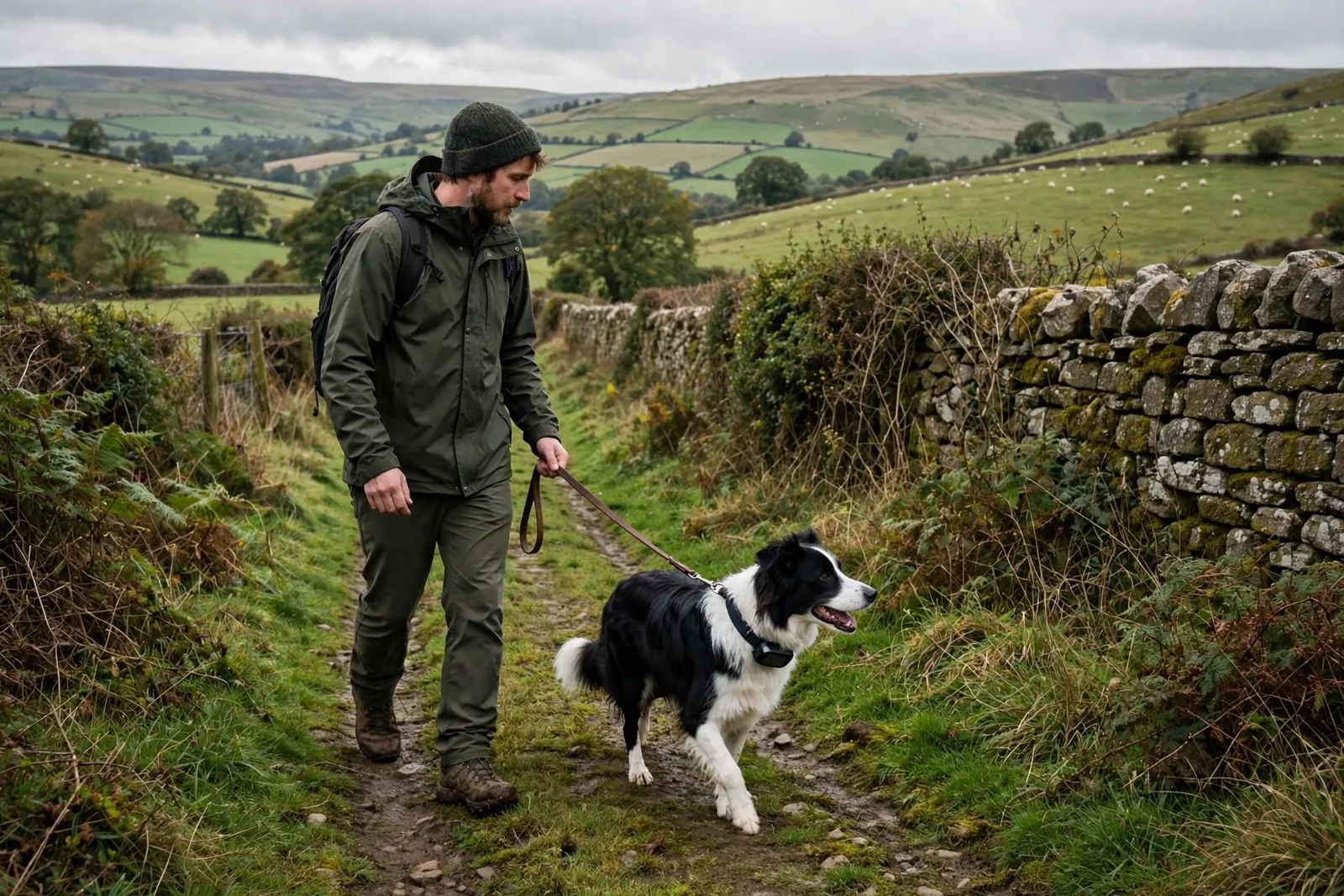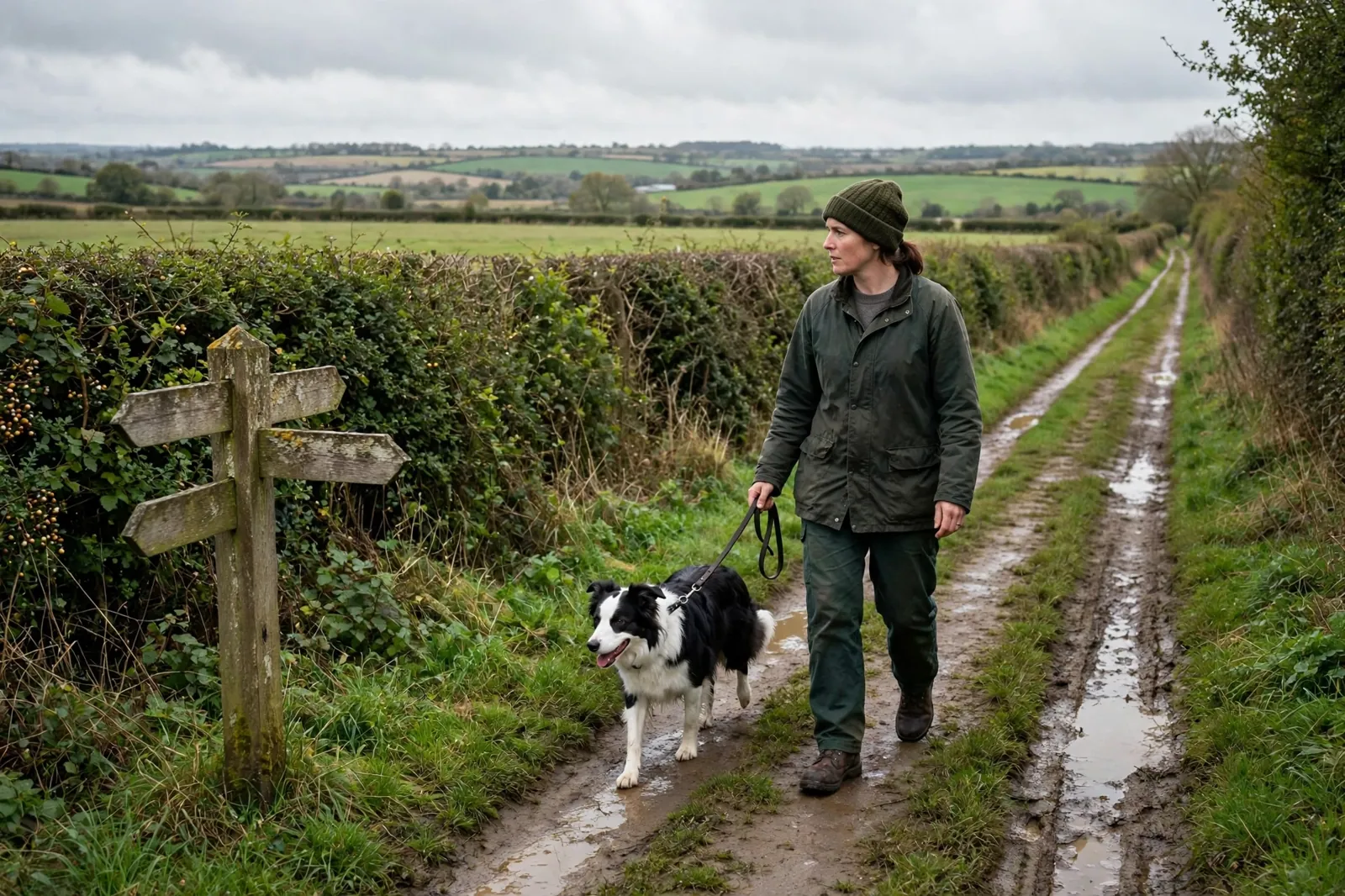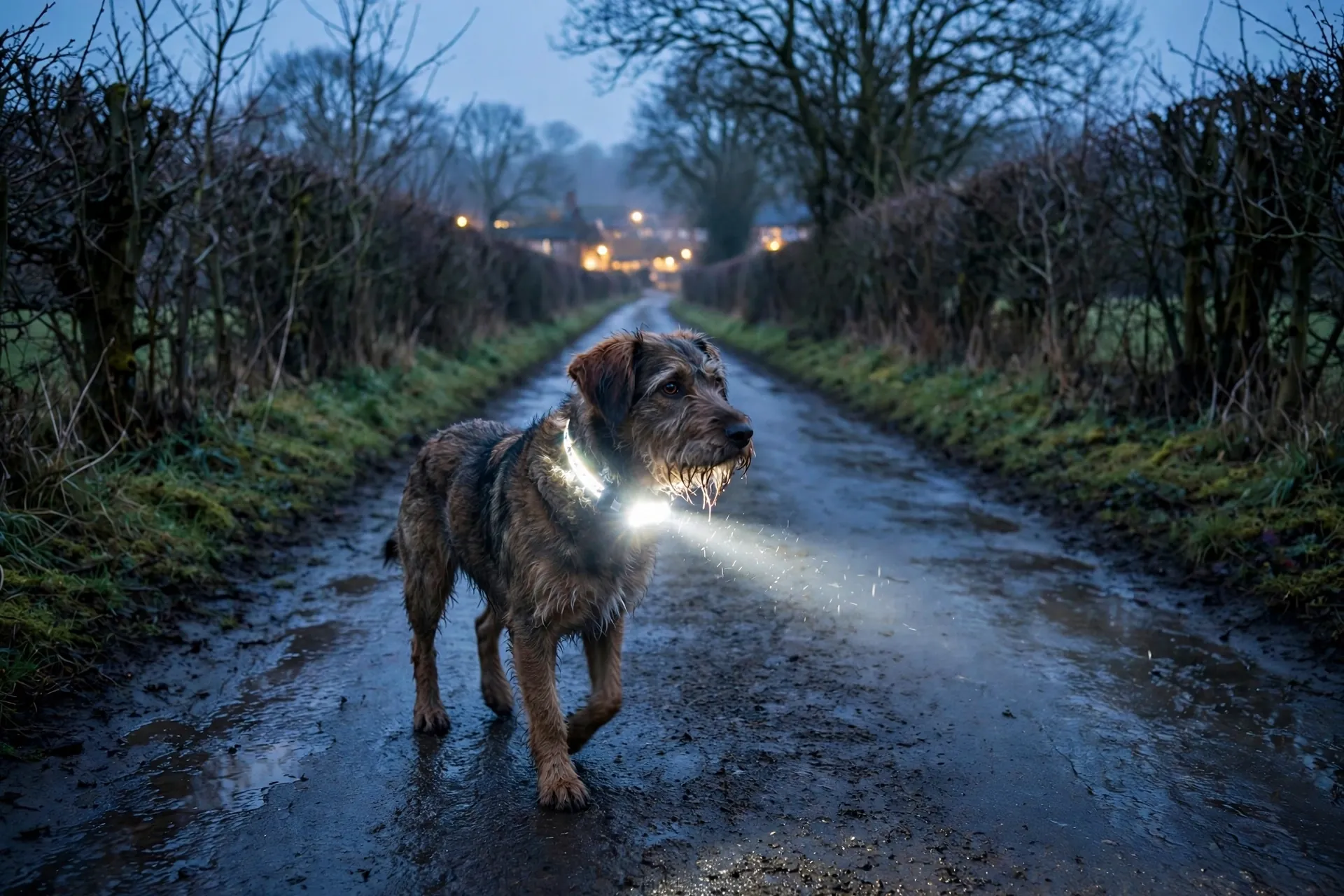
We name no brands here as recommendations and publish no lab tests. The comparisons below are general knowledge about how visibility gear works, so you can judge any product on its own merits — check each claim on the packaging before you buy.
On a dark British lane, a reflective collar makes your dog show up when light hits it, while an LED collar makes your dog visible even when nothing is aimed at it. The safest routine is both together, a short lead near any road, a route you have walked in daylight first, and something reflective on you too.
Why British nights demand visibility kit
Britain's winter does something unusual to dog walking: it moves the whole routine into the dark. From late October the clocks go back and sunset in London arrives before 5pm; by December, Edinburgh loses daylight around 3:40pm. A walk that felt like a pleasant late-afternoon loop in September becomes a genuinely dark outing by November, and most owners underestimate the change because it happens gradually, a few minutes each evening. Add rain, low cloud and the reflective glare of wet tarmac, and human eyes adapt slowly — a driver coming over a rise on an unlit lane has perhaps two seconds to pick your dog out of the hedgerow shadows.
Dogs are worse at being seen than their size suggests. A black labrador on an unlit road is effectively invisible beyond a few metres, but even a pale-coated dog disappears against wet grass or mist. Height matters too: most dogs stand well below the sweep of a car's dipped headlights on a rising bend, so the beam passes over them. Then there is movement. A dog quartering the verge, crossing from one side of a lane to the other or dashing after a scent is much harder for a driver to track than a steady walker. None of this is the dog's fault — it is simply the physics of a small, low, moving shape in the dark.
The risk is not only on country roads. Urban and suburban walks have their own after-dark hazards: cyclists without lights cutting across paths, delivery scooters on pavements, unlit stretches of canal towpath, and dogs off lead in parks where a lost dog in the dark becomes a long night. Walkers also collide with each other. A glowing collar tells an approaching jogger or cyclist where your dog's head is, which matters when leads tangle. Visibility gear is not just about cars; it is about every other user of the dark space you share.
Think of night visibility as a system with three layers: your dog must be findable, your dog must be identifiable as a dog on a lead, and you must be visible yourself. A single glowing point achieves the first layer only. Drivers judge speed and distance partly from size and shape, so a bare light floating in the dark can read as a phone torch or a distant cyclist until it resolves. That is why the best night setups combine a light source with something that shows the dog's outline — a reflective collar, a light-up harness or a reflective vest. The rest of this guide builds that system piece by piece.
Reflective strips vs LED lights: what each actually does
These are the two families of visibility kit, and they work in opposite ways. Reflective material is passive: it bounces incoming light back toward its source, so a reflective collar flares brilliantly when a headlight hits it and does almost nothing the rest of the time. An LED collar is active: it emits its own light continuously, so your dog glows whether or not anyone is shining anything at them. Understanding this difference is the whole buying decision, because each family fails in the situation where the other shines.
Reflective kit excels on roads. Headlights are bright, aimed forward and aimed low — exactly the conditions reflective strips exploit. A wide reflective band on a collar can return a beam so brightly that the dog is visible from several hundred metres down a straight lane, far beyond the range of any collar LED. Reflective kit is also simple and permanent: no batteries, no charging, nothing to switch on, and it works the day you buy it and the day it wears out. The weakness is timing. Before the car arrives, on the stretch of path between the lane and the field, around a bend the beam has not reached yet, or when the approaching vehicle is a bicycle, reflective kit is just webbing. It also degrades: mud, abrasion and washing reduce reflectivity over time, so a two-year-old reflective collar that looks grey in daylight is performing far below its new state.
LED kit excels everywhere else. A light-up collar makes your dog a moving point of colour that you can follow with your eyes across a dark field, which is exactly what you need for off-lead stretches, recall practice and spotting the dog before they spot the rabbit. It also helps the dog stand out to cyclists, runners and other walkers whose lights are dim or absent. The weaknesses are range and reliability. Collar LEDs are small and run on small batteries, so their brightness is modest compared with a headlight-struck reflective strip, and they fail silently: a flat battery or a loose contact leaves you walking a dog you believe is lit. Water ingress is the common killer — look at the charging port cover with suspicion, because it is usually the first thing to fail.
The honest conclusion is that these are complementary, not competing. A reflective collar plus an LED light covers both failure modes: the LED keeps the dog findable when nothing is shining at them, and the reflective strip makes them unmistakable when headlights arrive. If budget forces a choice, choose by your most common terrain. Mostly lanes with traffic: reflective first. Mostly parks, fields and towpaths: an LED collar first. Then add the other as soon as you can, because the night walks you least expect to go wrong are the ones that do.
The gear, compared honestly
Within the two families there are several form factors, and they suit different dogs and different walks. What follows is a plain comparison of what each type is good for and where it lets you down, without brand rankings — judge any specific product against the checklist in the next section.
Reflective collars are the default and usually the right first purchase. They replace the everyday collar, so there is nothing extra to remember, and a wide reflective band gives a large surface for headlights to hit. Look for stitching rather than printed coating: sewn-in reflective thread or tape survives washing and abrasion far better than a printed reflective layer, which flakes within a season. The limitation is that the collar is the smallest reflective surface you can fit, and on a long-coated dog the fur can swallow it entirely. If your dog's ruff covers the collar, the reflectivity is theoretical.
Reflective harnesses solve the long-coat problem by spreading reflective material across the chest, shoulders and back — a much bigger target that stays visible even under fur. They also suit dogs that pull, since the lead attaches to the harness rather than the neck. The trade-off is bulk and faff: a harness takes longer to put on in a dark hallway, wet straps chafe more than a simple collar, and cheap ones have reflective piping so narrow it might as well be decoration. Measure the reflective area with your eyes, not the marketing copy.
LED collars are collars with a light strip or tube running through them, usually USB-rechargeable with steady and flashing modes. They are the best single purchase for off-road night walking because the dog is continuously lit from all sides. Check the cut of the light: a full 360-degree tube is visible from every angle, while a flat strip on one side disappears when the dog turns. Check the clasp and the charging cover too — on budget models these are the failure points, and a collar that charges through an unsealed port will not survive a wet British winter.
Light-up harnesses and vests combine both families in one garment: LED strips plus reflective panels across a large area. They are the most visible option you can buy and a strong choice for small dogs, nervous dogs and dogs walked near fast roads. The cost is money and maintenance — more electronics to charge, more fabric to wash, more straps to adjust — and some dogs find vests hot or restrictive. They also make lead attachment slightly more awkward, so try one on the dog before committing.
Clip-on lights are small LED tags that fasten to a collar, harness or lead. They are cheap, weigh nothing and are excellent as a second light — one on the collar and one on the lead near your hand makes the connection between you and the dog visible, which helps drivers read the scene. As a primary light they are weak: they twist, they dangle, they fall off, and a light pointing at the sky helps nobody. Buy them as spares and supplements, never as the plan.
A word on hi-vis for humans: the most common gap in a dog owner's night setup is the owner. A driver who sees your glowing dog but not you may still misjudge the situation, and you are the one stepping into the road to shorten the lead. A reflective sash, a hi-vis tabard or even a cheap reflective slap band costs little and closes the loop. Walkers who would never cycle without lights happily walk an unlit lane in dark clothing — apply your own standards to yourself.
What to check before you buy
Ignore the packaging adjectives and check these five things in the shop or on the product page. They are the difference between kit that works on a wet February night and kit that worked once in the showroom.
1. Brightness, judged honestly. LED collars are rarely sold with a lumen figure, so test in the shop with the lights dimmed if you can, or read the return reviews for words like dim and faded. For reflective kit, shine your phone torch at it from a few metres: a good reflective band throws the light back so hard it hurts to look at; a poor one gives a dull grey shimmer. If it looks unimpressive under a phone torch at arm's length, it will be invisible under headlights at fifty metres. For LEDs, steady mode should be clearly visible across a dark room, and the light should be even along the whole strip with no dark patches that signal dying segments.
2. Battery life and how you recharge. Ask two questions: how long does it run, and what happens when it dies mid-walk? Rechargeable collars typically manage 8 to 20 hours depending on mode; flashing modes usually last longer than steady ones but are harder for drivers to judge distance from. Prefer USB-C charging with a properly sealing cover over fiddly proprietary cables you will lose, and over coin-cell models whose screws corrode. Build a routine: charge on the same evening each week, and carry a spare clip-on light as the backup for the night the main collar dies ten minutes from home. Never trust a collar you charged "a while ago".
3. Waterproofing that survives Britain. "Water-resistant" on packaging often means it survived a light spray in a test lab. For British winter walking you want something that survives driving rain, a shake-off, and a dog that finds every puddle. Look for a stated IP rating — IPX4 handles splashing, IPX5 to IPX7 handle proper downpours and brief submersion — and treat unrated products as fair-weather only. The weak points are always the same: the charging port cover, the switch, and the seam where the light tube meets the clasp. After wet walks, dry the collar and leave the charging cover open for an hour so trapped moisture can escape rather than corrode the contacts.
4. Fit and sizing, measured on your dog. Measure the neck with a soft tape, snug but not tight, and buy to the measurement — not to the breed label, which varies wildly between makers. You should be able to slide two fingers under a fitted collar; tighter risks chafing under the light strip, looser lets the collar rotate so the LED faces the dog's chest instead of outward. For long-coated breeds, part the fur and check the collar sits against the coat rather than buried in it, or accept that a harness will carry the visibility instead. Re-check the fit monthly: winter weight changes and wet coats alter how collars sit.
5. Durability of the details. Flex the collar and watch the light strip: it should bend smoothly with no flicker, because flicker means a failing connection that will die in the cold. Tug the clasp firmly; if it feels like it could pop under a lunge, it will. Look at the stitching around reflective tape — loose threads unravel fast once wet. And check the warranty and returns policy before you buy, because a meaningful share of budget LED collars fail within the first winter; a seller that stands behind the product is telling you something about its failure rate.
On price: expect to pay more for a good LED collar than a reflective one, and treat anything suspiciously cheap with suspicion — the savings usually come out of the battery, the seals or the switch, which are exactly the parts that matter in the dark and wet. Buy the reflective collar first if money is tight; it has no running costs and cannot run flat.
How drivers actually see you
Visibility kit only works if you understand what a driver is dealing with. On dipped headlights, a driver on an unlit road sees perhaps 25 to 30 metres ahead clearly; at 60mph that is about one second of travel. Anything that buys the driver an extra second — earlier detection, clearer identification — is doing its job. Your whole night-walking strategy should be aimed at those extra seconds.
Position matters as much as kit. Walk facing oncoming traffic where there is no pavement, as the Highway Code advises, so you see the car and the car sees your front, where your reflective gear and your dog's collar face the beam. Keep the dog on the side away from the road — the field side, not the tarmac side — on a short lead, with no slack for a sudden lunge into the carriageway. On bends and brows, assume the driver cannot see you at all until you are in the beam: hug the verge, and if you hear a car approaching fast, step fully off the road with the dog behind you and wait. Being right is no consolation when the physics are against you.
Watch for the blind-spot moments that catch walkers out. Cresting a hill, a driver's headlights point at the sky and the road beyond the brow is dark — your dog is invisible until the car is on top of you. The same happens at the bottom of a dip, where the beam overshoots. Wet roads make it worse: reflections and spray scatter the beam and dazzle, while a rain-streaked windscreen halves what the driver can pick out. Parked cars, hedges and gateways create shadows that swallow a small dog entirely. In all of these spots, an active LED is worth more than reflective kit, because there is no beam to reflect yet — the dog must generate its own signal.
Do not rely on drivers doing the right thing. Some will be dazzled by oncoming traffic and effectively blind for a second or two; some will be looking at the satnav; some simply drive lanes too fast. Your kit should assume the worst driver, not the best. That means the dog is lit before the car arrives, the lead is short before the car arrives, and you are off the carriageway before the car arrives. If your routine depends on the driver slowing down, redesign the routine.
One more driver behaviour worth knowing: flashing LED modes can be harder to judge than steady ones. A flashing light is more attention-grabbing, which is useful on a path, but drivers estimate distance from a steady light more accurately. Near roads, steady mode is the safer choice; save flashing for open ground where grabbing attention matters more than distance judgement. Our guide to dog car safety covers the other side of the road relationship — how the Highway Code treats dogs in and around vehicles.
Planning the night walk itself
The safest night walk is planned in daylight. Walk any new route in daytime first and note the hazards you will not see later: the unguarded ditch, the stile the dog cannot manage, the stretch where the path runs inches from a fast road, the field that holds livestock after dark. Mark where the lit sections end — the transition from streetlights to unlit lane is where most walkers relax exactly when they should be most alert. A route you know by heart is a route you can walk while watching the dog instead of the ground.
Favour loops over out-and-back walks where you can. Loops keep you moving through changing scenery, which holds a dog's attention and reduces the temptation to range far; out-and-back routes double your exposure to the same hazards and bore dogs into wandering. Choose surfaces deliberately: pavements and lit park paths for the road sections, and save the unlit field for the middle of the walk when the dog has burned off the first energy and is more likely to stay close. Avoid canal towpaths and riverside paths with steep unguarded drops after dark unless you know them intimately — a dog chasing a duck off a dark towpath is an emergency, not an adventure.
Time your walk with the light you have. In deep winter, a 4pm walk still has dusk to work with; by 6pm it is fully dark. Walking at dusk lets the dog's eyes — and yours — adjust gradually, and the low light is when reflective kit starts working while you can still see the terrain. Late-evening walks after 9pm mean quieter roads, which is a genuine safety gain, but also mean fewer people around if something goes wrong. Tell someone your route on late walks, carry your phone charged, and consider a GPS tracker for dogs that range — in the dark, a lost dog search starts from a much worse position than in daylight.
Build the walk around a toilet routine too. Dogs need a last outing before bed, and the temptation is to make it a quick pavement shuffle in the dark. A short, well-lit, familiar loop that the dog knows is far better than a rushed improvisation: the dog relaxes, toilets faster, and you are home sooner. Keep the night-time route boring on purpose. Excitement is for daylight.
Etiquette after dark
Darkness changes the social contract of shared paths. In daylight, other walkers can read your dog's body language from twenty metres and adjust; at night, all they see is a light and a shape. Your job is to make your dog's intentions legible early. Call the dog in and shorten the lead well before you reach another walker, and say something early — a friendly "evening, dog on lead here" carries further than any collar light and stops the anxious shuffle of someone who cannot tell if the approaching glow is friendly.
Give way generously. Step aside with the dog on the verge side and let runners, cyclists and nervous walkers pass on the path. Cyclists in particular need the warning: a fast bike with a weak light meets a dark dog on a narrow towpath badly, so make your light visible by turning slightly toward them rather than away. If your dog barks at lights or movement, own it — warn people, keep distance, and do not let embarrassment keep you on a collision course. A barking dog in the dark frightens people far more than the same dog at noon.
Respect the nocturnal countryside. Keep dogs out of fields with livestock after dark even where daytime access is tolerated — you cannot see sheep until you are among them, and a dog's prey drive does not switch off at sunset. Stick to paths through woods at night rather than letting the dog range; deer, badgers and foxes are all active, and a dog that bolts after a deer in the dark may not come back to a whistle it cannot hear you give. Take litter and bagged waste home rather than trusting a dark bin you cannot find — the countryside you walk at night is the same one you photograph in the morning.
Finally, mind the neighbours. A dog barking in a dark garden at 10pm carries across a village in a way daytime barking does not, and late-night garden toilet breaks are the single biggest source of neighbourhood friction for dog owners. Keep last-outings short, quiet and on the lead, and bring the dog in as soon as the job is done. Your neighbours cannot see that the barking is harmless; they can only hear it.
Fitting and keeping it working
A visibility collar that does not fit is decoration. Fit the collar in daylight, on a dry dog, and check three things: the two-finger rule under the strap, the LED strip sitting centred on the outside of the neck rather than twisted underneath, and the clasp holding under a firm tug. Then take the dog into a dark room and look at the effect from the angles that matter — front, side and rear — because a collar that looks bright from the front can be hidden by the dog's own jaw from the side. For harnesses, adjust every strap, then watch the dog move: straps that migrate as the dog walks will end up with the reflective panels under the belly.
Introduce any light-up kit gradually. Most dogs accept it without a second glance, but light-sensitive or anxious dogs can find a flashing collar genuinely distressing — start with steady mode on the dimmest setting indoors, reward calm behaviour, and only then take it outside. Never force a frightened dog to wear flashing kit "until they get used to it"; switch to reflective-only gear for that dog and revisit the LED another week. A dog that is stressed by its collar walks worse, not better.
Maintenance is unglamorous and non-negotiable. Rinse mud off reflective webbing after dirty walks — dried mud is the fastest way to kill reflectivity — and wash according to the label, never with fabric softener, which coats reflective fibres. For LED collars, dry the charging port after wet walks and store the collar with the port cover closed in a dry place, not in the damp boot of the car. Check the light before every walk, not when you are already on the dark lane: a five-second press of the switch in the hallway is the whole routine. Replace batteries or recharge on a schedule, and retire any collar whose light flickers, whose strip has dark patches or whose reflective band has gone grey — it has told you it is finished.
Mistakes worth avoiding
The most common failure is not buying the wrong kit but trusting a single layer. The owner who bought an LED collar and now walks an unlit lane with the dog on a long flexi lead has solved the finding problem and kept the control problem. The owner with a reflective collar who walks the same lane assuming drivers can see them before the headlights arrive has the logic backwards. Visibility is a system: light plus reflection plus short lead plus road sense. Remove any one and the rest carry weight they were not designed for.
Second is forgetting the human. Dark clothing, no light, phone in hand — the classic silhouette of a dog walker invisible from the waist up. A driver sees your dog's glowing collar floating in the dark, cannot see you at all, and has no idea a lead connects the two until the last moment. Wear something reflective yourself, carry a torch, and keep the lead short enough that the dog stays within the pool of your own visibility.
Third is kit that worked last winter. Batteries self-discharge, seals perish, reflective coatings wear, and the collar that was brilliant in November can be decorative by February. The failure is silent and gradual, which is why the pre-walk light check matters more than the purchase. If you cannot remember the last time you charged it, it needs charging.
Fourth is walking a new route in the dark. Every unfamiliar lane has a surprise — the blind bend, the missing verge, the farm entrance with a fast exit — and darkness removes your ability to spot it in time. New routes get a daylight reconnaissance first, without exception. Your dog does not care whether the walk is novel; they care whether it is safe.
Fifth is assuming the law is on your side. If your dog runs into the road at night and is hit, the question asked afterwards is whether you took reasonable care — and "reasonable care" for a dark lane includes making the dog visible and keeping them under control. Our guide to where leads are legally required sets out the rules that apply before anything goes wrong. Visibility kit is cheap; the alternative is not.
Practical questions
Before you walk out the door
Is a reflective collar enough on its own for night walks?
It helps, but on its own it is a passive system: a reflective collar only returns light that is already aimed at it, so on an unlit lane before headlights arrive your dog is still essentially invisible. Pairing it with an active light source such as an LED collar or clip-on light, plus keeping your dog on a short lead near roads, is a far more robust setup.
How long does the battery last on an LED dog collar?
Most rechargeable LED collars run between 8 and 20 hours per charge depending on brightness setting and whether they flash or shine steadily, while replaceable-cell models typically last 40 to 100 hours in total before the cells need swapping. Treat the stated figure as best-case and recharge or replace on a fixed weekly routine rather than waiting for the light to dim mid-walk.
Does the law require my dog to wear anything reflective at night?
No specific UK law demands reflective or illuminated kit for dogs, but the law does expect you to keep your dog under control and to exercise the care of a responsible owner. The Road Traffic Act's careless-use provisions and the Dogs Act expectations around control near roads mean that if your dog is hit because a driver could not see it, poor visibility will weigh heavily against you.
Will a glowing collar unsettle or bother my dog?
Most dogs ignore a collar light within minutes, because the glow sits below their eye line and they cannot see it directly. Introduce it indoors first: let the dog wear the collar unlit, then lit on its dimmest or steady setting, with treats for calm behaviour. If the dog repeatedly paws at it or freezes, switch to a reflective-only collar for a few evenings and try again; flash modes bother noise-sensitive dogs more than steady ones.
Can I leave an LED collar switched on for the whole walk?
Yes, that is what they are designed for, but switch it off as soon as you are home to preserve the battery and the electronics. Leaving it on between walks drains the charge and wears the switch; a collar left on for days will be flat exactly when you need it most. A steady mode is better than flashing for long walks because it draws less current and is easier for drivers to judge distance from.
Are clip-on lights as good as a reflective or LED collar?
They are a useful add-on rather than a replacement. A clip-on light adds a bright point of light that helps other path users spot your dog, but it can dangle, twist round the lead and point the wrong way, and cheap ones fall off. Use one together with a reflective collar so your dog is visible from both light-emitting and light-reflecting angles, not instead of a proper collar.