This guide is independent and contains no paid placement. If affiliate links are added later, they will be clearly marked and will not change our editorial checks.
Rhossili Beach welcomes dogs all year round, but the day is ruled by two things: the tide at Worm's Head and the steep hill between the National Trust car park and the sand. Check the tide time before you leave, allow two and a half hours either side of low water for any causeway crossing, keep your dog out of the surf, carry water, and save energy for the climb back to the village.
Rhossili Bay in one look
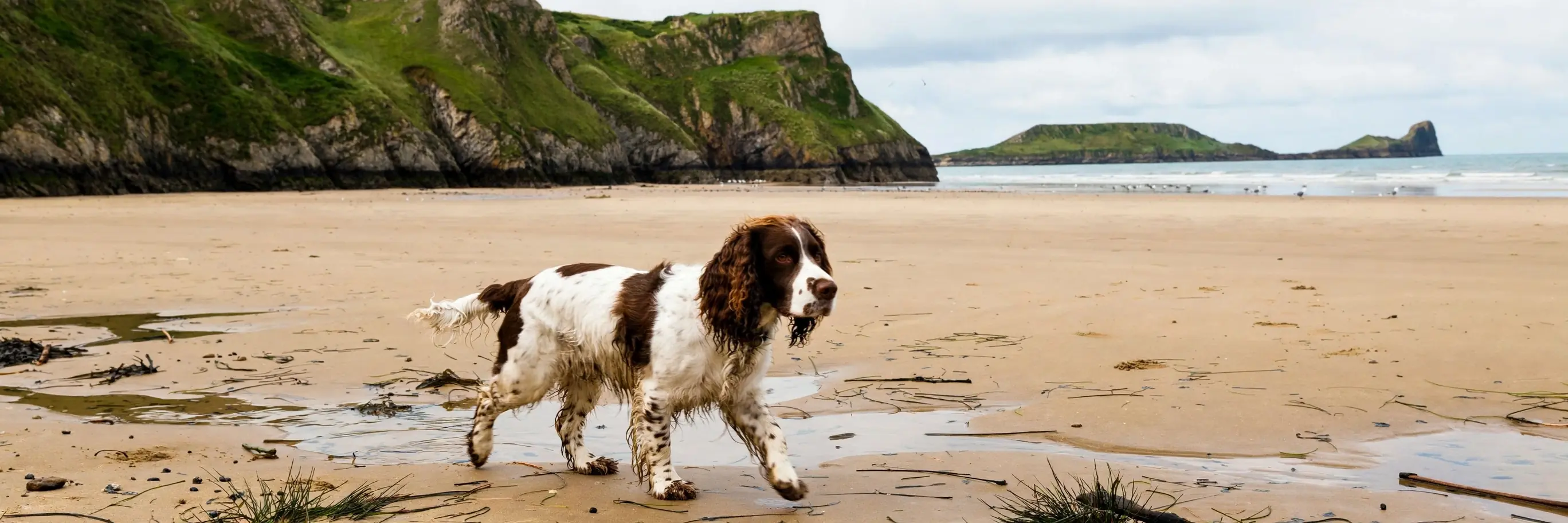
Rhossili Bay is the great sweep of sand at the western tip of the Gower Peninsula, in south-west Wales. From the village of Rhossili, high on the cliff above the southern end, the beach curves away northwards for about three miles towards Llangennith and the low dunes of Broughton Burrows. At low tide the sand is enormous: a flat, pale expanse that seems to go on until it meets the sky, with the dark shape of Worm's Head at one end and the distant hills of the Gower at the other. At high tide much of that sand disappears under the Bristol Channel, and the beach narrows to a strip at the foot of the cliffs. That change, from vast playground to narrow shoreline and back again within a few hours, is the first thing to understand about bringing a dog here.
The bay sits within the Gower Area of Outstanding Natural Beauty, the first such area designated in Britain, and much of the land around Rhossili is cared for by the National Trust. The village itself is small and quiet, a scattering of houses, a church, a hotel and a shop around a green, with the car park at its edge. There is no seaside parade at Rhossili, no row of arcades or fish-and-chip shops along the front, and no promenade. The beach is reached on foot, down a steep path from the village, and that separation is part of its character. Dogs get a proper beach, not a paved front with a patch of sand attached, but the visit needs more planning than a drive-up beach where the car is parked beside the sand.
For a dog, Rhossili offers three different experiences in one place, and a good day usually uses only one or two of them. The first is the beach itself: firm, flat sand at low tide, ideal for a long, steady walk on a lead or a long line, with room to keep well away from other groups. The second is the clifftop: short grass, sea views and the Wales Coast Path running north and south, where the ground is uneven and the drops are real. The third is Worm's Head, the tidal island at the southern end, which is a separate undertaking altogether and should never be treated as a casual extension of a beach walk. Choosing which of the three suits your dog, on the day, in the weather and at the tide state you actually have, is the whole skill of a Rhossili visit.
Rhossili is also famous, and that fame shapes the practical side of a visit. The beach has regularly appeared in lists of the best beaches in Britain and the world, and on a sunny summer weekend the car park fills early and the hill path is busy with walkers, surfers carrying boards, families with buckets and dogs of every size. Early morning and late afternoon are quieter, the light is better, and the sand is emptier. In winter the bay can feel almost deserted, with a hard wind off the Atlantic and nobody else on the sand for a mile. Both versions are Rhossili. The version you get depends on when you arrive, and dogs that dislike crowds are far happier outside the middle of a summer day.
The wider Gower context matters too. Rhossili is the western end of a peninsula full of dog-friendly beaches, each with its own seasonal rules, and it makes a natural anchor for a longer stay. Our Gower Peninsula with a dog guide sets Rhossili alongside Three Cliffs Bay, Oxwich and the Mumbles beaches, with the restriction calendar for the whole peninsula. If you are staying in the city rather than on the peninsula, our Swansea with a dog guide covers the bay, the gardens and the road out to Gower. Rhossili itself, though, deserves a full day on its own terms, and this guide goes into the detail that a peninsula overview cannot: the causeway, the hill, the village and the water.
Worm's Head and the tide window
Worm's Head is the serpent-shaped headland that gives Rhossili its drama. Seen from the village or from the beach, it looks like a great sea creature lying in the water: a long, low body of rock, a raised middle section and a head that lifts at the far end. The name comes from the Old Norse word for serpent, and on a grey day with the waves breaking over it, the shape is easy to see. The headland is made of two main parts, the Inner Head and the Outer Head, joined by a low rocky saddle, and beyond them the sea opens into the Bristol Channel. Seabirds nest on its cliffs in spring and summer, including guillemots, razorbills, kittiwakes and fulmars, and grey seals are often seen in the water around the rocks. For a dog owner, the birdlife is a reason to keep a lead on and to keep a respectful distance: nesting birds are easily disturbed, and a dog scrambling on the rocks below a colony is a problem for everyone.
The crucial fact about Worm's Head is that it is an island at high tide and a peninsula at low tide. The causeway between the mainland and the Inner Head is covered by the sea for most of the tidal cycle, and it is only passable for about two and a half hours either side of low water. That gives a window of roughly five hours in total, and the crossing itself takes time: the causeway is rocky, uneven and slippery with seaweed, and the onward walk across the Inner Head to the Outer Head involves scrambling and a narrow, exposed section. Anyone who sets out late, walks slowly, or stops for a long time on the far side risks finding the causeway already covered on the way back. People have been cut off on Worm's Head and have needed rescue, and the RNLI warning signs at the start of the causeway are there for exactly that reason. Read them before you set out, and treat them as instructions, not decoration.
The tide at Rhossili is not a gentle, predictable rise. The Bristol Channel has one of the largest tidal ranges in the world, second only to the Bay of Fundy in Canada, and the difference between high and low water at Rhossili can be more than ten metres on a spring tide. That means the sea comes in fast, covering sand and rock far more quickly than a visitor used to a small tidal range might expect. A beach that looked enormous an hour ago can narrow sharply, and a causeway that was dry underfoot can be knee-deep and then impassable within minutes. The tide timetable for Rhossili, published by the National Trust and by tide-table services, is the single most important piece of paper for the day. Check it the night before, check it again in the morning, and plan the whole visit around it. If you are unsure about any part of the crossing, check the official guidance before you travel.
For most dogs, the honest answer is that the Worm's Head viewpoint on the mainland is the better destination. From the clifftop above the causeway, the whole serpent shape is visible, the birds can be watched with binoculars, and the sea can be enjoyed without any tide pressure at all. The viewpoint is reached on a clear path from the village, with no causeway, no scrambling and no deadline. Dogs that are older, small, nervous on rock, unsteady on their feet, or strongly inclined to chase birds should stay on the mainland. Even a fit, confident dog needs a lead on the causeway: the rock is sharp, the drops are real, and a dog that slips or panics on a narrow section puts both itself and its owner in danger.
If you do decide to cross, the rules are simple and non-negotiable. Start at the beginning of the window, not the middle. Cross only in settled, dry weather, never in high wind, rain or poor visibility. Wear proper walking shoes with grip, not beach sandals. Keep the dog on a short lead at all times, with a harness rather than a collar so you can hold them steady on uneven rock. Carry water for the dog, because there is none on the headland. Watch the time constantly, and turn back well before the halfway point of the window, even if the Outer Head is in sight. The crossing is not a race, and the Outer Head will still be there on another visit, at another low tide. A dog that is tired, hot or frightened on the way out will be worse on the way back, when the light may be changing and the causeway is wet. If anything about the day feels wrong, stay on the mainland and enjoy the view.
One more practical point: the causeway crossing is not a beach walk, and it is not a place for a ball, a frisbee or an off-lead run. The rocks are home to limpets, barnacles and sharp edges that cut paws, and the pools between them can hide deep holes. Dogs that are used to charging across sand will need to be slowed down and guided step by step. Allow at least an hour each way for a careful crossing with a dog, plus time on the headland itself, and work backwards from the end of the tide window. If the arithmetic does not leave a comfortable margin, do not go.
Dogs on Rhossili Beach: the rules
Rhossili Beach has a strong dog-friendly reputation, and for good reason: dogs are welcome on the beach throughout the year, with no seasonal ban of the kind that closes many British beaches in summer. That year-round welcome is unusual on a beach this popular, and it is one of the reasons dog owners travel to Rhossili from across south Wales and beyond. It does not, however, mean that the beach is a free-for-all. Seasonal lead guidance can apply in busy summer periods, when the beach is crowded and the National Trust and the local authority ask owners to keep dogs on leads in the busiest areas. The exact wording and the exact areas change, so the signs at the car park, at the top of the hill path and at the beach access points are the authority on the day. Read them on arrival, even if you have been to Rhossili before, and check the official guidance before you travel if you are planning a summer visit.
The practical meaning of the rules is straightforward. In quiet months, and on the quieter stretches of the three-mile bay, a well-behaved dog under close control can enjoy a long off-lead walk, provided it stays away from other beach users, from the surf and from wildlife. In busy summer periods, expect to keep the dog on a lead near the main access point at the southern end, where families, surfers and other dogs are concentrated, and to use the long, empty middle of the bay for a freer walk. The middle of the bay is the key to Rhossili: walk ten minutes north from the access point and the crowds thin dramatically, even on a busy day. A long line is the best compromise for many dogs here, giving them room to run and sniff while keeping them under control near other people and near the water.
Lead rules are only part of the picture. The standard responsibilities apply with extra force on a beach this exposed: pick up after your dog, and take the bag with you, because there are no bins on the beach itself and the nearest bins are back in the village. Keep the dog away from nesting birds on the cliffs and on Worm's Head, and away from any seals hauled out on the rocks or the sand. Do not let the dog chase or disturb other wildlife, including the sheep that graze the clifftop and the dunes at the northern end of the bay. If your dog is reactive to other dogs, to children or to surfers carrying boards, keep the distance generous and use the empty middle of the bay rather than the busy southern end. Rhossili is big enough for a reactive dog to have a good day, but only if the owner chooses the empty ground rather than the crowded ground.
Summer brings two more considerations. The first is heat: Rhossili has almost no shade on the beach, and the sand can become hot underfoot on a sunny day. Dogs, especially dark-coated dogs, brachycephalic breeds and older dogs, need water, shade and rest, and a midday walk in July is a poor idea. Go early or late, carry more water than you think you need, and watch for panting, slowing down or seeking shade. The second is the sheer number of people. A dog that is happy on a quiet beach in February may be overwhelmed by a crowded beach in August, with balls, kites, barbecues and other dogs in every direction. If your dog is not comfortable in crowds, choose a weekday, arrive early, walk north, and leave before the middle of the day.
Finally, remember that Rhossili is a working landscape as well as a leisure beach. The National Trust manages the village, the car park and the surrounding land, and local farmers graze livestock on the clifftops and the dunes. Dogs must be kept under control around livestock at all times, and on a lead where livestock are present. A dog that chases sheep can cause serious harm and can put the owner in legal difficulty. The same care applies to the dunes at Broughton Burrows, at the northern end of the bay, which are a sensitive habitat for plants and ground-nesting birds. Keep to the paths through the dunes, keep the dog close, and leave the dunes as you found them.
From the car park down to the sand
Every Rhossili beach day starts in the National Trust car park at Rhossili village, at the top of the hill above the southern end of the beach. The car park is the main parking for the beach, the village and the Worm's Head viewpoint, and on a fine day it fills early. Arriving before ten in the morning in summer, or before midday in winter, is the simplest way to avoid the stress of circling for a space with a dog in a hot car. National Trust members park free on production of a valid membership card, and charges apply for non-members. The charges, the payment method and the opening arrangements can change by season, so check the current details on the National Trust website before you travel, and bring a payment card as well as coins in case the machine prefers one or the other. Do not leave a dog in a parked car at Rhossili, even for a few minutes: the car park is exposed, the sun is strong on a clear day, and the hill walk takes longer than most people expect.
The walk from the car park to the beach is the part of the day that catches people out. The path drops steeply from the village down to the sand, and the descent takes at least fifteen to twenty minutes on foot, longer with a dog that wants to sniff every tuft of grass. The surface is a mix of tarmac, gravel and steps in places, and it can be slippery when wet. Dogs that pull hard on the lead will pull harder going downhill, so a harness and a short lead give far more control than a long line on this stretch. Keep the dog close, especially where the path passes other walkers, and give way to people coming up. The views on the way down are spectacular, with the whole bay opening out below, but the path itself needs attention, and a dog that dashes ahead around a blind bend can meet a surfer carrying a board coming the other way.
The climb back is the real test. What took fifteen minutes down can take twenty-five or thirty minutes up, and it is steep enough to leave a fit adult breathless. For a dog, the climb is hard work in a different way: older dogs, dogs with arthritis or hip problems, brachycephalic breeds, overweight dogs and puppies will all struggle, and a dog that has already had an hour on the beach will be tired before the climb starts. Plan for it. Save the dog's energy on the beach, keep the walk shorter than you would on a flat beach, and bring water for the climb. Stop in the shade if there is any, and let the dog set the pace. If your dog cannot manage a steep climb, consider enjoying Rhossili from the clifftop and the village instead, where the ground is level and the views are just as good. There is no shame in that, and it is far kinder than dragging an exhausted dog up a hill.
There is an alternative route at the northern end of the bay, from Llangennith and Broughton Burrows, where the ground is flatter and the dunes give a gentler approach to the sand. That route suits some dogs better, especially older dogs, but it is a longer drive, the parking is more limited, and the walk through the dunes is longer. For most visitors, the Rhossili village route is the right choice, and the hill is simply part of the day. The practical answer is to treat the hill as a walk in its own right: go down slowly, enjoy the beach in moderation, and come back up slowly, with water and rest stops. A dog that arrives at the car park tired but happy has had a good day. A dog that arrives at the car park exhausted, overheated and lame has had too much beach and too much hill.
One more detail about the descent: the beach access point at the bottom of the hill is the busiest part of the sand, and it is also where the surf is often strongest. Do not let the dog off the lead the moment you reach the sand. Walk a few minutes north, away from the access point, before you give the dog more freedom. The same applies in reverse: put the dog back on a short lead well before you reach the hill path, so the climb starts calmly. The hill is not a place for a dog to be running ahead on a long line, and the car park is not a place for a dog to be off the lead at all. A calm arrival and a calm departure make the whole day easier, for the dog and for everyone else on the path.
The clifftop walk and the Wales Coast Path
The clifftop above Rhossili is one of the finest short walks on the Gower, and for many dogs it is a better choice than the beach itself. The path runs south from the village to the Worm's Head viewpoint, a level, well-marked walk of about a mile each way, with the sea on one side and the village and the fields on the other. From the viewpoint, the whole of Worm's Head is laid out below, the causeway visible at low tide and the Outer Head standing in the sea. Seabirds can be watched from a safe distance, seals can often be spotted in the water, and on a clear day the view stretches across the Bristol Channel to the north Devon coast. The path is suitable for most dogs on a lead, provided they are kept away from the cliff edge, and it is a good choice for dogs that find the beach hill too steep, because the ground is far more level.
The Wales Coast Path runs through Rhossili in both directions, and it is worth understanding before you set out. To the north, the path follows the clifftop above Rhossili Bay towards Hillend, Llangennith and Broughton Burrows, a long, exposed walk with big views and few places to shelter. To the south, the path runs from Rhossili towards Port Eynon and Oxwich, along high cliffs and through farmland, with stiles, gates and livestock along the way. Both directions are beautiful and both demand respect: the cliffs are high, the drops are unfenced in places, and the wind can be strong enough to unbalance a small dog. Keep the dog on a lead on the clifftop at all times, and keep well back from the edge, especially in wind or rain. A dog that chases rabbits or birds on a clifftop path is in real danger, and a long line is not a safe substitute for a short lead near a cliff edge.
The walk to Llangennith deserves a paragraph of its own, because it is the natural extension of a Rhossili beach day for a fit dog. From the northern end of Rhossili Bay, the beach continues past Hillend to Llangennith, and the dunes of Broughton Burrows lie behind the sand. The full walk from Rhossili village to Llangennith and back is a long day, too long for most dogs, and the return journey needs the same energy as the outward one. A better plan is to walk north along the beach for as far as the dog is comfortable, then turn back, or to drive to Llangennith separately on another day. The dunes themselves are a sensitive habitat, and dogs should be kept on the paths and under close control, away from ground-nesting birds and away from any livestock grazing the dune grassland.
What to wear and carry for a clifftop walk is different from what a beach day needs. The wind on the Gower clifftops is often much stronger than the wind in the village, and it can change quickly. A windproof layer for the owner, a coat for a short-coated or older dog in cold weather, and a lead that can be held securely in a gust are all worth packing. The ground can be muddy after rain, especially on the inland sections of the Wales Coast Path, and the grass on the clifftop can be slippery. Good walking shoes with grip are essential, and a dog that is used to pavements may find the uneven ground tiring. Carry water, because there is no reliable water supply on the clifftop, and carry a phone, because mobile signal can be patchy on the far side of the headland. Tell someone where you are going if you are walking alone with a dog on a remote stretch.
Finally, the clifftop is where the National Trust land and the working farmland meet, and the etiquette matters. Close gates behind you, keep to the marked path, keep the dog on a lead near sheep and cattle, and do not let the dog run through standing crops or through fields of livestock. The Wales Coast Path is a right of way, not a dog exercise area, and the farmers who maintain the land are the reason the path exists. A dog owner who follows the Country Code on the clifftop is welcome back. A dog owner who does not will find the signs getting stricter, and the beach and the clifftop are too good to lose.
Rhossili village: hotel, church and shop
Rhossili village is small, quiet and worth an unhurried look before or after the beach. The village sits on the cliff above the bay, with a green at its centre and houses that look out over the sea. The Worm's Head Hotel stands at the edge of the village, with a terrace and a garden that look straight out over the bay and the headland. The hotel welcomes dogs in its outdoor areas, and a drink or a meal on the terrace after a beach walk is one of the pleasures of a Rhossili day, provided the dog is settled, on a lead and under the table rather than wandering between tables. Check the hotel's current dog policy before you travel, because indoor areas and accommodation have separate rules, and a busy summer lunchtime is a very different proposition from a quiet weekday afternoon.
The church of St Mary stands near the hotel, a small, whitewashed building with a history that goes back centuries. The church is usually open to visitors, and its churchyard, with its old gravestones and its view over the bay, is a peaceful place to pause. Dogs are not usually taken inside the church, and the churchyard is a place for a quiet, on-lead walk rather than a run. The church is also a reminder that Rhossili is a living village, not a resort: people live here, farm here and worship here, and the village works best when visitors treat it as a community rather than a car park with a view.
The National Trust shop in the village is the practical heart of a Rhossili visit. It sells maps, tide information, guidebooks, local produce and souvenirs, and the staff can answer questions about the tide, the causeway and the walks. It is also the place to ask about the current dog guidance, the car park charges and any temporary closures or restrictions. A tide timetable bought or checked at the shop is worth more than a guess, and a conversation with a member of staff can save a wasted journey. The shop has its own dog policy, so check before taking the dog inside, and keep the dog on a short lead outside while you browse.
The old rectory, now a private house, stands near the church and is part of the village's history. Rhossili has a long connection with the sea, with shipwrecks, smuggling and the coastguard, and the village's buildings reflect that past. The National Trust cares for much of the surrounding land, including the clifftops and the dunes, and the trust's work is the reason the bay has stayed open and undeveloped. A small donation, a membership, or a purchase in the shop all help to keep it that way. The village also has a small number of holiday cottages and bed-and-breakfast accommodation, some of which welcome dogs, but book well ahead in summer, because Rhossili is small and the dog-friendly places fill quickly.
Dogs in the village need the same care as dogs on the beach, in a smaller space. Keep the dog on a lead on the village roads, because there is traffic, including farm vehicles and buses, and the roads are narrow. Do not let the dog wander into gardens or into the churchyard off the lead. Pick up after the dog, and use the bins in the village, because there are no bins on the beach. If the dog is tired after the beach, the village is a good place to rest: a quiet bench, a drink of water and a few minutes in the shade before the drive home will make the journey easier. The village is not a large place, and an hour spent there, unhurried, is enough to see it properly.
Surf, rip currents and swimming
Rhossili is a surfing beach, and the surf is the reason many people come here. The bay faces west into the Atlantic swell, and on a good day the waves roll in cleanly across the three-mile beach, with surfers spread out along the sand. The surf is also the reason dogs should not swim at Rhossili. The waves are powerful, the undertow is strong, and rip currents can run along the beach and out to sea, especially near the headlands and where the sandbars shift. A dog that swims out happily can be pulled sideways and then outwards in seconds, and a dog that panics in the surf is in serious danger. Even a strong-swimming dog, a breed built for water, is no match for a rip current on an Atlantic beach. The safest rule is simple: dogs paddle at the edge, on a lead, and they do not swim.
Rip currents are hard to see from the sand, and that is what makes them dangerous. They often look like a calm, flat patch of water between breaking waves, or a channel of discoloured water running out to sea. A dog that walks into that calm patch can be carried out quickly, and an owner who wades in after the dog can be caught by the same current. The RNLI advice for rip currents is to stay calm, to float and to swim parallel to the shore rather than against the current, but that advice is written for people, not for dogs. A dog cannot be told to swim parallel to the shore. The only reliable protection is to keep the dog out of the water beyond the shallows, and to keep the lead on near the waterline. If the dog is a keen swimmer, Rhossili is not the beach to indulge that instinct. Choose a sheltered estuary or a calm lake on another day, and let Rhossili be a walking beach.
The tidal range makes the water more dangerous still. Because the Bristol Channel rises and falls by more than ten metres on a spring tide, the water moves fast, and the sand that was dry an hour ago can be under water the next. A dog playing at the water's edge at low tide can find itself cut off from the beach by a fast-incoming tide, especially near the rocks at the southern end, where the sea comes in around the headland. Watch the tide, keep the dog close to the main beach, and do not let the dog explore the rocks at the foot of the cliffs as the tide turns. The rocks are also sharp, slippery and home to deep pools, and a dog that slips on wet rock can injure a paw or a leg. The beach itself is the safe ground. The rocks are not a playground.
Salt water brings its own problems. Dogs that drink sea water can become ill, with vomiting and diarrhoea, and dogs that swallow a lot of salt water can be seriously unwell. Carry fresh water and offer it regularly, and discourage the dog from drinking from the sea. After a beach walk, rinse the dog with fresh water if you can, and check the paws for cuts from shells and sharp sand, and the ears for sand and salt water. A dog that has been in the surf, even only paddling, will have salt in its coat, and a good rinse and a towel dry will prevent skin irritation. The sand itself can also cause problems: dogs that eat sand, often while playing with a ball, can develop a gut blockage, so use a ball that is easy to see and easy to carry, and stop the game if the dog is picking up mouthfuls of sand.
Surfers and dogs need to share the beach with care. Surfers carry long boards, move quickly across the sand, and need space to launch and land. Dogs should be kept away from the surf zone where surfers are working, and owners should watch for boards being carried at head height. A dog that runs into a surfer's path can cause an accident for both of them. The southern end of the beach, near the access point, is the busiest surfing area, and the middle of the bay is usually quieter. If the dog is nervous around boards, or inclined to chase them, use the northern half of the beach. The same care applies to other beach users: kite surfers, kayakers and horse riders all use Rhossili Bay, and a dog that is under control and on a lead near other users is a dog that is welcome back.
Sunset, seasons and Gower weather
Rhossili is famous for its sunsets, and the reputation is deserved. The beach faces west, and on a clear evening the sun drops into the Atlantic beyond Worm's Head, lighting the cliffs, the sea and the sand in gold and pink. The sunset is the busiest time of the day in summer, with photographers, walkers and dog owners gathering on the clifftop and on the beach to watch it. For a dog, a sunset visit is a lovely idea, provided the practicalities are thought through. The light fades quickly after the sun sets, the hill path is steep and unlit, and the car park is a long way up in the dark. Bring a torch, keep the dog on a lead for the walk back, and allow plenty of time. A dog that is tired after a day on the beach will be slower on the hill in the dark, and a torch that lights the path for the owner also helps the dog to see where it is going.
The seasons change Rhossili completely, and the best season for a dog depends on the dog. Spring brings nesting birds to Worm's Head and to the cliffs, and dogs need to be kept on a lead and away from the colonies. The weather in spring can be changeable, with sunshine, rain and wind in a single afternoon, and the hill path can be muddy. Summer brings the warmest weather, the busiest beach and the strongest sun, and dogs need shade, water and an early or late visit. Autumn brings quieter beaches, softer light and the first storms, and the surf can be at its biggest. Winter brings empty sand, hard wind and short days, and a dog that is happy in the cold will have the bay almost to itself. Each season has its own rules, and the signs at the car park and the beach will reflect the season you are in.
Gower weather deserves respect, and Rhossili, at the exposed western tip, gets the full force of it. The wind off the Atlantic can be strong enough to make walking difficult, and it can change the feel of a day completely. A sunny morning in Swansea can be a windy, grey afternoon at Rhossili, and the forecast for the city is not the forecast for the headland. Check a coastal forecast, not just a general forecast, and check the wind speed and direction as well as the rain. A dog that is small, light or nervous will struggle in a strong wind on the clifftop, and a dog with long ears or a long coat will be buffeted and cold. In high wind, stay on the beach, where the cliffs give some shelter, or stay in the village, and leave the clifftop for a calmer day.
Rain at Rhossili is a different experience from rain inland. The rain comes in off the sea, horizontally in a strong wind, and it soaks through quickly. A waterproof coat for the owner and a drying coat for the dog are worth packing, even on a day that starts sunny. The hill path becomes slippery in the rain, and the rocks on the causeway become treacherous. If the rain is heavy, the causeway crossing should be abandoned, and the beach walk should be shortened. The National Trust shop and the Worm's Head Hotel offer shelter, but Rhossili is an outdoor place, and a wet day is a day to be short and sensible rather than long and ambitious. A dog that is wet, cold and tired is a dog that needs to go home, not a dog that needs another hour on the sand.
The light at Rhossili is part of the appeal, and it changes with the tide as well as with the season. At low tide, the wet sand reflects the sky, and the beach seems to glow. At high tide, the sea comes up to the cliffs, and the beach narrows to a strip. Photographers love the low-tide light, and dog owners will find that the best walking is also at low tide, when the sand is firm and flat. Plan the visit around the tide, not just around the clock, and the dog will get the best of the beach. A visit timed for the wrong tide, at high water on a narrow beach, is a disappointing day for everyone, and a visit timed for low water, with the whole bay open, is the Rhossili that people remember.
Practicalities: parking, toilets and water
Parking at Rhossili is straightforward if you arrive early, and frustrating if you do not. The National Trust car park at the village is the main parking, and it is the only parking that is close to the beach access and the Worm's Head viewpoint. Charges apply for non-members, and National Trust members park free on production of a valid membership card. The charges and the payment arrangements can change, so check the current details before you travel, and do not assume that the machine will take the payment method you prefer. There is very limited on-street parking in the village, and parking on the village roads causes problems for residents, for farm vehicles and for the bus. Use the car park, arrive early, and be prepared to wait for a space on a busy day. If the car park is full, the sensible choice is to come back another day, or to drive to another Gower beach, rather than to park inconsiderately in the village.
Toilets are in the village, near the car park, and there are no toilets on the beach itself. Use the village toilets before you walk down the hill, and plan the beach walk around the fact that the nearest toilet is a steep climb away. The toilets are open during the day, but the opening hours can change by season, so do not rely on them being open late in the evening. There are no toilets at the Worm's Head viewpoint or on the clifftop, and there are no facilities at the northern end of the bay. A dog owner who is out for a long walk should plan accordingly, and should carry the usual supplies for the dog as well as for themselves.
Water is the most important practical item to carry. There is no drinking water on the beach, no tap on the clifftop, and no reliable water supply at the Worm's Head viewpoint. The village has water, but once you are down on the sand, you are on your own. Carry at least a litre of fresh water for the dog, more on a hot day, and a collapsible bowl. Offer water regularly, not just when the dog looks thirsty, because dogs on a beach often forget to drink until they are already dehydrated. The same applies to the owner: a bottle of water, a snack and a sun hat are all worth packing, because the beach has no shade and no shop. The National Trust shop in the village sells drinks and snacks, but it is at the top of the hill, and it is not open all day in winter.
Bins are another practical point that catches people out. There are bins in the village, near the car park and the shop, but there are no bins on the beach itself. That means every poo bag, every snack wrapper and every piece of litter must be carried back up the hill. Bring more poo bags than you think you need, and a small bag to carry the used bags in, because a single bag in a pocket is unpleasant on a long walk. The beach is kept clean by visitors who take their litter home, and the National Trust asks everyone to leave no trace. A dog owner who leaves a poo bag on the beach, or who hangs it on a fence, is not helping, and the next visitor will find it. Take it with you, every time.
Getting to Rhossili by bus is possible, and it is worth considering if you do not want to drive. There is a bus service from Swansea to Rhossili village, running through the Gower Peninsula, although services are less frequent than city routes and timetables change by season. Check the current timetable before you travel, and allow plenty of time for the journey, because the bus stops in several villages on the way. Dogs are usually allowed on local buses at the driver's discretion, so keep the dog on a short lead, sit where the driver directs, and be ready to move if the bus is busy or if another passenger is uncomfortable. A bus journey also changes the practicalities of the day: you will be carrying everything you need, including water, poo bags and a towel, and you will need to time the return bus carefully, because a missed bus from Rhossili can mean a long wait. Check the return time before you walk down to the beach, and leave enough time to climb the hill and catch it.
Planning a Rhossili day with your dog
A good Rhossili day is planned the night before, around the tide. Start with the tide timetable: find the time of low water, work out the two-and-a-half-hour window either side of it, and decide whether Worm's Head is part of the plan or whether the viewpoint will do. If the low tide falls in the middle of the day, the beach will be at its widest then, and the causeway will be passable for the middle of the day. If the low tide falls early in the morning or late in the evening, the beach will be narrower during the day, and the causeway window will be at an awkward time. Choose the day, not just the hour, and pick a low tide that suits the dog as well as the owner. A low tide at ten in the morning, with the beach open all day, is a far better choice than a low tide at six in the evening, when the light is fading and the hill climb is in the dark.
The packing list for Rhossili is longer than for a drive-up beach, because the hill and the lack of facilities mean you cannot pop back to the car. Pack a lead and a long line, a harness, a collapsible water bowl and at least a litre of water, poo bags and a bag to carry them in, a towel and a drying coat for the dog, a snack for the owner, a sun hat and sunscreen, a waterproof layer, a torch if you are staying for sunset, and a phone with the tide timetable saved. A first-aid kit for the dog, with tweezers for thorns and a bandage for a cut paw, is worth carrying on the clifftop and on the causeway. A spare lead is a sensible precaution, because a lead that breaks on a clifftop is a serious problem. Pack the car the night before, so the morning is calm, and leave early enough to arrive before the car park fills.
On the day, the routine is simple: arrive early, use the village toilets, check the signs at the car park for the current dog guidance and the tide, and walk down the hill slowly. Spend the first part of the beach walk near the access point, on a lead, and then walk north into the empty middle of the bay for a freer walk. Keep the dog away from the surf, offer water regularly, and watch the time. If the plan includes Worm's Head, start the crossing at the beginning of the window, not the middle, and turn back in good time. If the plan is the clifftop, walk to the viewpoint, enjoy the view, and come back the same way, keeping the dog on a short lead near the edge. If the plan is the village, have a drink on the terrace of the Worm's Head Hotel, visit the church and the shop, and enjoy the view from the green. Any one of those plans is a full day. Trying to do all three in one visit, with a tired dog, is how a good day becomes a hard day.
What to do if the weather or the tide changes is the last part of the plan, and it is the part that most people forget. If the wind picks up, stay off the clifftop and stay on the beach. If the rain sets in, shorten the walk and head back to the village. If the car park is full, drive to another Gower beach rather than parking in the village. If the dog is tired, cut the walk short and go home early, rather than pushing on to a viewpoint that the dog will not enjoy. Rhossili will still be there next week, next month and next year, and a dog that has had a short, happy visit is far more likely to enjoy the next one than a dog that has had a long, exhausting one. The best Rhossili day is not the longest day. It is the day when the tide, the weather, the hill and the dog all line up, and the owner is wise enough to notice when they do.
Rhossili Beach rewards the dog owner who plans carefully and walks sensibly. The three-mile bay, the serpent headland, the clifftop views and the quiet village are all worth the effort, and they are all best enjoyed slowly, with a dog that is comfortable, hydrated and under control. Check the tide, check the signs, carry water, save energy for the hill, and keep the dog out of the surf. Do that, and Rhossili will give you one of the great beach days in Britain, with a dog that is happy to come back. Check the official guidance before you travel, because the tide, the rules and the facilities can all change, and the information on the day is the information that matters.
Practical questions
Before you go
Is Rhossili Beach dog friendly all year round?
Yes. Dogs are welcome on Rhossili Beach throughout the year, and the beach has a long-standing dog-friendly reputation. Seasonal lead guidance can apply in busy summer periods, so keep a lead handy, follow the signs at the car park and the beach access points, and check the official guidance before you travel.
Can my dog walk out to Worm's Head?
Only with careful tide planning and only if your dog is fit, steady on rock and comfortable on a lead. The causeway is passable for about two and a half hours either side of low water, and the return journey takes the same care as the outward one. Many dogs and owners enjoy the view from the Worm's Head viewpoint on the mainland instead, which needs no tide window at all.
How long does the walk from the car park to the beach take with a dog?
Allow at least 15 to 20 minutes down the hill from the National Trust car park at Rhossili village to the sand, and longer on the way back up, because the climb is steep. The time depends on your dog's age, fitness and how often you stop for water and shade. Older dogs, puppies and dogs with joint problems will find the return climb hard work.
Is it safe for dogs to swim at Rhossili Beach?
No, swimming is not recommended for dogs at Rhossili. The beach faces the open Atlantic swell, rip currents can run strongly along this three-mile bay, and the Bristol Channel has one of the largest tidal ranges in the world. Dogs are much safer paddling at the water's edge, on a lead, well away from the surf line at low tide.
Where can I park at Rhossili with a dog?
The main parking is the National Trust car park at Rhossili village, at the top of the hill above the beach. Charges apply and National Trust members park free on production of a valid membership card, but check the current charges and opening arrangements before you travel, because they can change by season.
Can I get to Rhossili Beach by bus from Swansea?
Yes, there is a bus service from Swansea to Rhossili village, although services are less frequent than city routes and timetables change by season, so check the current timetable before you travel. Dogs are usually allowed on local buses at the driver's discretion, so keep your dog on a short lead, sit where the driver directs and be ready to move if the bus is busy.