This guide is independent and contains no paid placement. If affiliate links are added later, they will be clearly marked and will not change our editorial checks.
Rhyl suits dogs best outside the summer peak: the seasonal beach exclusion lifts, the long flat promenade is an easy walk for any age of dog, and the estuary paths give you a quieter second walk. In summer, use the designated dog-friendly stretches of sand, keep to the promenade, and plan around the tides.
A resort built for the promenade
Rhyl did not grow up around a harbour or a market square. It grew up around the idea of the seaside itself. When the railway reached the North Wales coast in the middle of the nineteenth century, Rhyl changed from a small fishing and farming settlement into a resort town, and the promenade became its main street. Everything the town is known for still lines up along that one long, flat edge between the buildings and the sea: the beach huts, the gardens, the theatre, the fairground rides, the cafes with their windows facing the water. For a dog owner, that history is practical news rather than background colour. A town designed for promenading is a town designed for slow, level walking, and Rhyl is one of the flattest seaside walks in Wales.
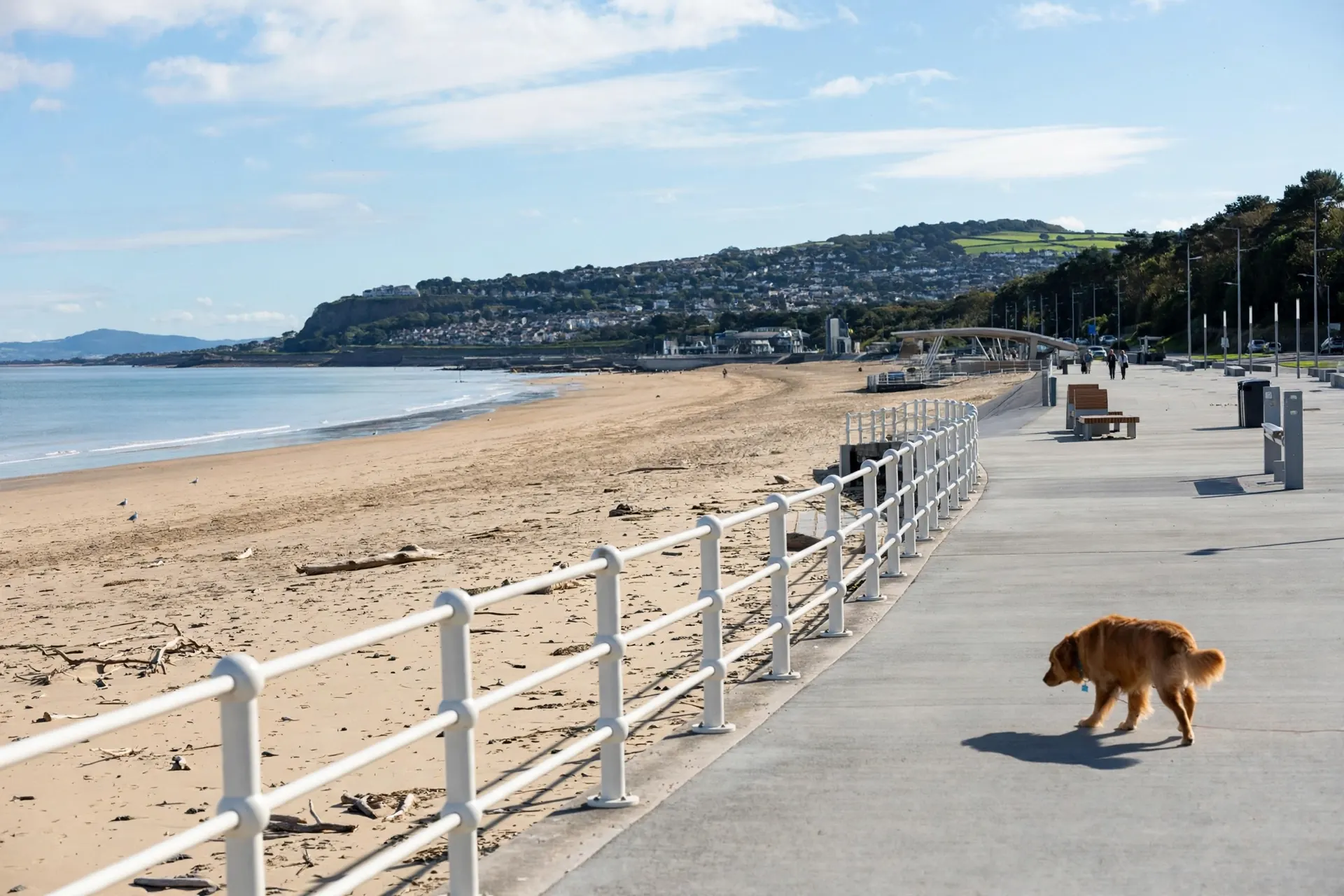
The promenade runs for roughly two miles along the front, and its character changes as you walk it. At the western end, near the harbour and the mouth of the River Clwyd, the town feels working and maritime: boats, the lifeboat station, the bridge over the river. In the middle, around the Pavilion Theatre and the main gardens, it is classic resort territory, with lawns, seating and the widest stretch of sand in front. Towards the east, past the waterpark building and the children's play areas, it turns quieter and more open, ending at Splash Point, where the coast bends away towards Prestatyn and the beach huts thin out. Walking the whole length gives you a proper sense of the place in a single outing, and because the route is paved, railed and almost entirely flat, it works for puppies, older dogs with stiff joints, and owners pushing a pushchair at the same time.
Rhyl's resort past also explains its present. Like many British seaside towns, it went through a long period when visitors drifted away to package holidays abroad, and the town has spent recent years rebuilding its seafront: new gardens and public spaces, the SC2 waterpark, refreshed beach facilities and a renewed harbour area. The result is a resort that feels lived-in rather than polished, and that matters for dog owners. Rhyl is not a town where dogs are an afterthought tolerated at the edges. The beach, the promenade, the gardens and the harbour walk are the town itself, and dogs are part of the everyday scene on all of them, within the seasonal rules that the next section sets out.
One more thing the resort tradition gives you is choice of scale. Rhyl works as a single relaxed day out, as a base for a week on the North Wales coast, or as a stop on the Wales Coast Path between Prestatyn and Colwyn Bay. The town sits between two very different neighbours: Prestatyn to the east, a quieter resort with its own long beach, and Colwyn Bay to the west, a larger promenade town with Eirias Park behind it. If you are staying for several days, our guide to Colwyn Bay with a dog pairs naturally with this one, covering the next stretch of coast in the same practical detail. Rhyl itself, though, rewards being taken on its own terms: a long flat walk, a big sky, a wide beach, and a town that was built for people — and their dogs — to stroll.
Before you go, it helps to understand what Rhyl is not. It is not a rugged cliff walk or a hidden cove. The beach is broad, open sand, the sea retreats a long way at low tide, and the wind is a constant companion. Dogs that love open running will be in their element; dogs that dislike wind, spray and crowds need a plan, especially on a bright summer weekend when the front fills up. The rest of this guide is that plan: the beach rules, the promenade walk in detail, the family activities that work with a dog in tow, the quieter estuary side of town, and the practicalities of staying and parking.
Timing your visit is the last piece of the picture. School holidays and sunny weekends bring the biggest crowds to the central beach and the promenade, and the seafront car parks fill early, so a weekday visit or an early start makes the whole day easier with a dog. Outside the summer peak, Rhyl is at its best for dog owners: the beach rules relax, the promenade empties, the light over the bay turns low and golden, and a dog can run on sand that belongs to almost nobody else. If you can choose your dates, choose the shoulder months — late spring before the exclusion starts, or early autumn just after it lifts — when the town is quiet, the weather is still kind, and the beach is yours.
Rhyl beach: the dog rules, the zones and the tides
The single most important thing to know about Rhyl beach is that the rules change with the season. Denbighshire County Council manages the beach under a Public Spaces Protection Order, and the main central beach in front of the promenade is subject to a seasonal dog exclusion, usually running from 1 May to 30 September. During those months, dogs are not allowed on the central stretch of sand, and the restriction is enforced: the council can issue fixed penalty notices, and the signs at the beach entrances spell out the exact area and the fine. The rule covers the beach itself, not the promenade above it, so you can still walk your dog along the front in summer — you just cannot take them down onto the central sand.
Outside the exclusion, the picture is much friendlier. From October through to the end of April, dogs are welcome on Rhyl beach, and the town becomes one of the easiest winter beach walks on the North Wales coast. The designated dog-friendly stretches beyond the central zone are open to dogs all year round, so even in high summer there is sand where your dog can run. The practical point is that the boundary matters more than the principle: the dog-friendly areas sit away from the main central beach, towards the quieter ends of the front, and the signs at each set of steps down to the sand show which side of the line you are on. Check the Denbighshire County Council signs at the beach entrances on the day, because the exact boundaries and dates can change, and check the official guidance before you travel if you are planning a summer visit around the beach rather than the promenade.
Our guide to dog-friendly beaches in the UK explains how these seasonal exclusions work across the country, including how PSPO fines are issued and the exceptions for assistance dogs. The Rhyl version follows the same pattern as most Welsh resorts: a summer ban on the busiest central sand, freedom on the quieter stretches, and no restriction at all in the winter half of the year. If you are comparing Rhyl with other North Wales beaches, that pattern is the thing to hold in mind. A beach that bans dogs in July is not an unfriendly beach; it is a beach with a busy season and a quiet season, and the quiet season is when dog owners get the best of it.
The second thing to know is the tide. Rhyl sits on a wide, shallow bay, and at low tide the sea retreats a long way, leaving a huge expanse of flat sand. That is wonderful for dogs: firm, open running ground with room to throw a ball in any direction. It also means the tide comes back in faster than it looks, and the flatness that makes the beach so appealing can hide the speed of the water. The golden rule on Rhyl beach is to check the tide times before you go down, keep an eye on the water line while your dog plays, and head back to the steps well before the tide turns. Never let a dog swim out after a ball in a rising tide, and keep dogs away from the harbour mouth and the river channel, where currents run stronger than on the open beach.
There are a few more beach practicalities worth building into your visit. The sand is clean and firm underfoot, which suits dogs that dislike shingle or pebbles, but it holds heat on a sunny day, so check the surface with your hand before a midday summer walk and carry water for the dog. The beach has lifeguard cover in the summer season on the central stretch, which is another reason the dog exclusion exists there: a busy bathing beach and off-lead dogs do not mix well. Jellyfish occasionally wash up after storms, and dogs that eat things they find on the sand need watching for fish hooks and discarded food near the harbour end. Bring bags, use the bins along the promenade, and remember that a dog that has been running on wet sand at low tide will come back filthy — a towel in the car is not optional.
Two points of law and etiquette are worth stating plainly. Assistance dogs are exempt from the seasonal exclusion under the rules that apply across the UK, so a registered assistance dog can accompany its owner onto the beach at any time of year; if you rely on this exemption, carry the relevant identification and be ready to show it to an enforcement officer. And the dog fouling rules apply everywhere on the beach and the promenade, all year round: bag it, bin it, and do not assume that a quiet stretch of sand at the far end of the beach is exempt. The bins along the promenade are emptied regularly in the summer season, but on a busy day they fill fast, so take a spare bag and carry the waste to the next bin rather than leaving it beside a full one.
Finally, think about timing. The best hours on Rhyl beach with a dog are early morning and late afternoon, when the light is low, the crowds are thin, and the sand is at its firmest after the tide. A summer morning walk on the dog-friendly stretch, before the central beach fills with families, can be the best part of the day. In winter, the middle of the day is often the kindest time, when the wind drops and the low sun lights up the Clwydian Range to the south. Either way, the beach rewards the dog owner who plans around the tide table rather than the clock, and the promenade is always there as the fallback when the tide or the weather turns.
Walking the promenade: from the harbour to Splash Point
The promenade walk is the heart of a dog day in Rhyl, and it is best walked as one continuous outing rather than in pieces. Start at the western end, by Rhyl Harbour, where the River Clwyd meets the sea. The harbour area has a working feel — fishing boats, the lifeboat station, the bridge — and it is a good place to let the dog settle into the walk before the busier central stretch. From here, the promenade runs east in a long, gentle line, with the sea on your left and the town on your right, and the first thing you notice is how wide and well surfaced it is. There is room for walkers, cyclists and pushchairs to pass without the squeezing and stepping aside that makes some seafront walks stressful with a dog on a lead.
The central section, around the Pavilion Theatre and the main gardens, is the liveliest part of the walk. The gardens give you somewhere to sit with the dog while the rest of the group looks at the fairground or the shops, and the lawns are a useful toilet and sniffing stop before the long open stretch ahead. This is also where the crowds are thickest on a summer day, so keep the dog close, on a short lead, and watch for dropped food, ice cream and fishing tackle near the railings. The theatre itself does not admit dogs, but the area around it is one of the most sociable parts of the front, and it is worth slowing down here rather than marching through.
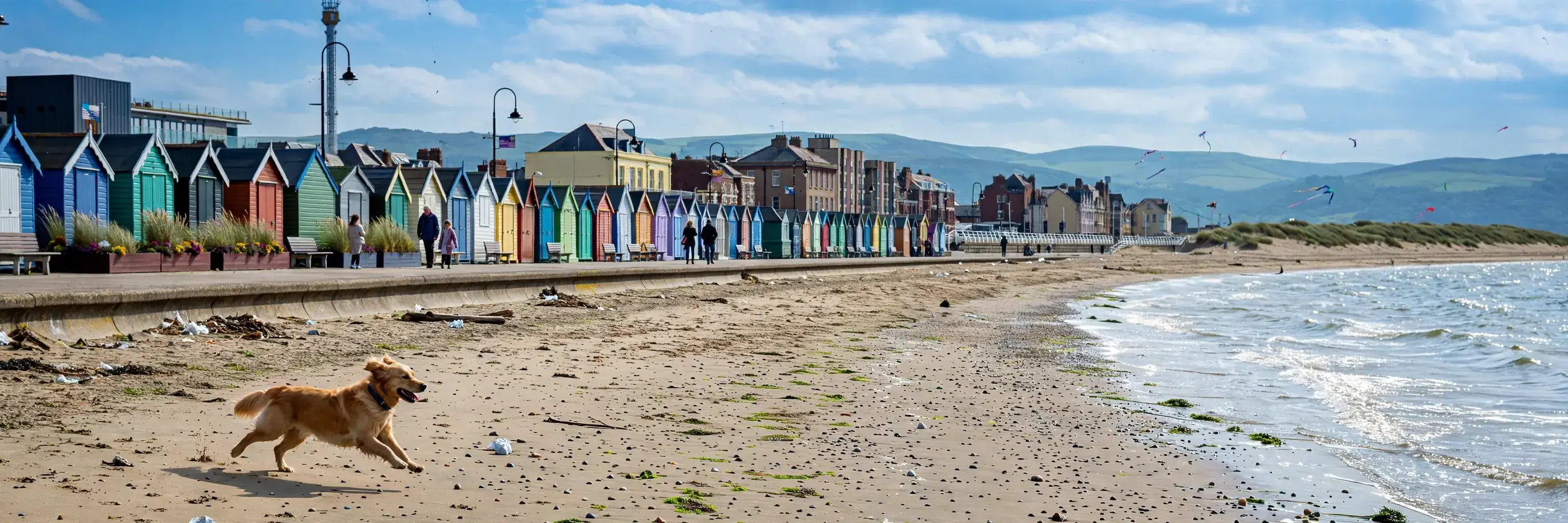
Past the gardens, the promenade opens out again. The waterpark building marks the start of the eastern stretch, and from here the walk changes character: fewer shops, more sky, the beach huts in their rows of colour, and the beach widening out below. This is the section where the dog walk really begins to feel like a walk rather than a stroll through town. The pavement stays wide and flat, the sea wall is low enough to see over, and on a clear day the view stretches along the coast towards Prestatyn and, behind you, back along the bay towards the Great Orme at Llandudno. The beach huts are a useful landmark for dog owners: they mark the quieter end of the front, and the steps down to the dog-friendly sand are nearby.
The walk ends at Splash Point, the eastern tip of the promenade, where the coast turns and the Wales Coast Path continues towards Prestatyn. There is a natural turning point here: a seat, a view back along the whole length of the front you have just walked, and the sense of having crossed the town from one end to the other. For most dogs, the out-and-back walk from the harbour to Splash Point and back is a satisfying two to three miles of flat walking, and it can be stretched or shortened at any point — there are steps and ramps down to the beach and back up to the town at regular intervals, so you are never committed to the full length.
A few practical notes make the walk easier. The promenade is a shared route, and cyclists use it, sometimes fast, so keep the dog on the landward side and a short lead through the busy sections. In strong winds, the sea can throw spray over the wall, and the pavement can be slippery with sand and salt after a storm, so wear shoes with grip and keep the dog away from the edge when waves are breaking over. There are drinking water points and bins along the front, but take your own water for the dog on a warm day, because the only shade is what the buildings provide. And if the dog is older or less mobile, remember that the walk is flat but long: the distance from the harbour to Splash Point and back is further than it looks from the car park, so build in rest stops at the gardens and the seating areas rather than discovering halfway that the dog is tired.
Access along the promenade is good by the standards of British seaside towns. The route is paved and level from end to end, with ramps and steps down to the beach at regular intervals, and the seating areas and gardens give wheelchair users and pushchair users somewhere to pause. Public toilets sit at intervals along the front, and the flat ground means that a family with a pushchair, a wheelchair and a dog on a lead can all use the same route without splitting up. That matters more than it sounds: a promenade that works for everyone in the group is a promenade the dog gets to walk in full, rather than being left behind while the rest of the family takes the accessible route.
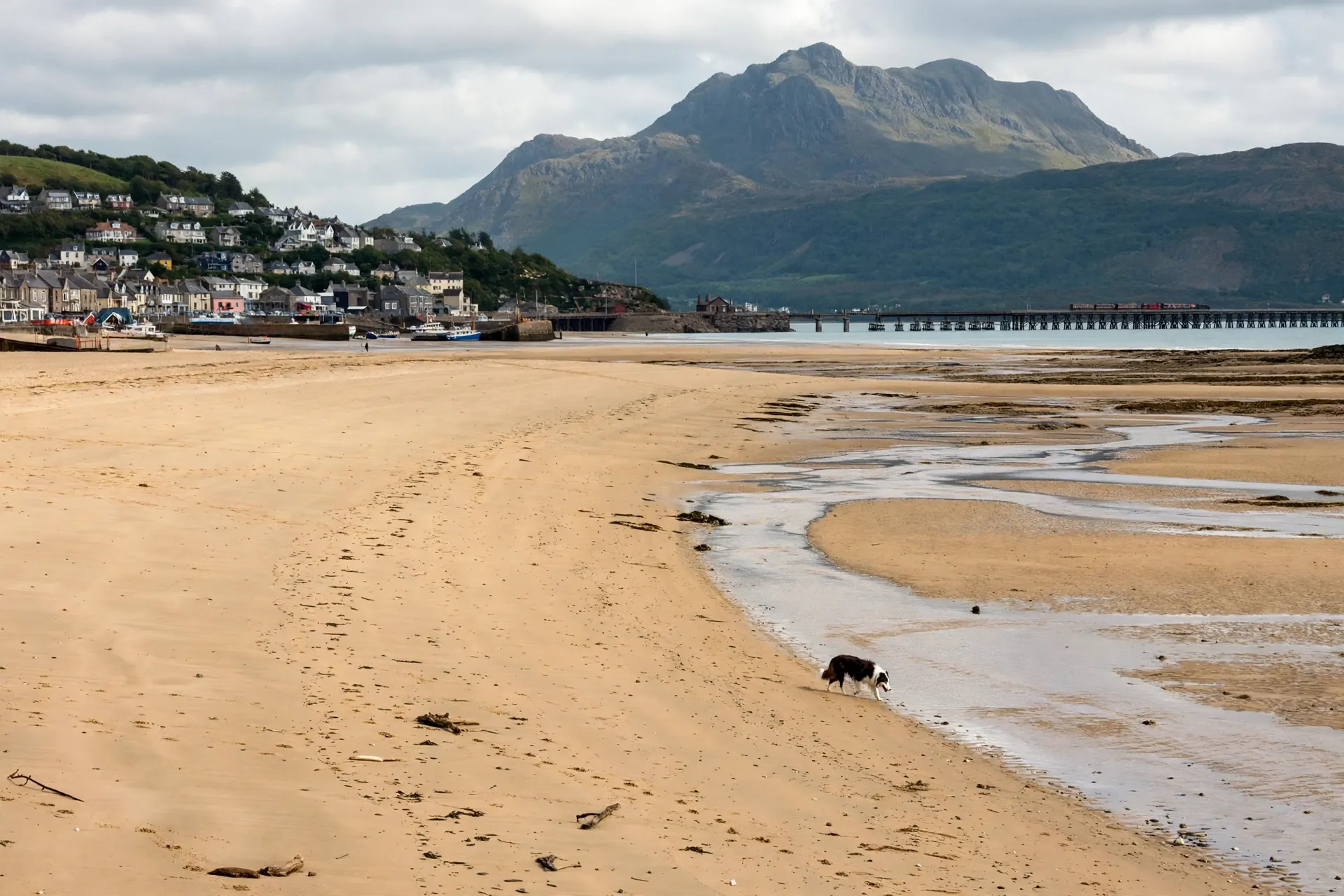
The promenade also connects Rhyl to the wider coast. The Wales Coast Path runs straight through the town along the front, and if you want a longer day, you can follow it east towards Prestatyn or west towards Colwyn Bay, with the railway stations at both ends making a linear walk possible. Our guide to Barmouth with a dog covers a very different kind of Welsh coast walk — an estuary and a long trail rather than a resort promenade — and comparing the two is a useful way to plan a week that mixes both. For a single day in Rhyl, though, the promenade itself is enough: harbour to Splash Point, a pause at the gardens, and the walk back with the wind behind you.
Family days with a dog: play, water and wheels
Rhyl is a family resort first and a dog destination second, and the trick to a good family day with a dog is to treat the two as one plan rather than two competing ones. The good news is that most of what makes Rhyl work for children also works for dogs: open space, flat ground, somewhere to run, and plenty of places to sit and watch the world go by. The bad news is that the two biggest indoor attractions — the SC2 waterpark and the Pavilion Theatre — do not admit dogs, so a family day needs a rota or a rest plan for the dog. The sections below lay out what works, and how to fit the dog around the parts that do not.
Start with the outdoor play areas. The promenade has children's playgrounds and open gardens along its length, and these are among the most dog-friendly parts of the resort in the practical sense: the dog can wait on a lead on the grass nearby while the children play, and the flat ground means nobody is climbing a hill to get there. The rule is the usual one for playgrounds: dogs stay outside the fenced play equipment, on a lead, and under control, because a dog running through a playground full of small children is a problem for everyone. Used properly, though, a playground stop is a natural rest point in the walk, giving the dog a chance to lie down in the shade while the children burn off energy.
The SC2 waterpark, on the seafront, is the town's main wet-weather attraction, and it is worth knowing exactly how it fits into a dog day. Dogs are not allowed inside, so the waterpark works best as a split activity: one adult takes the children in while the other walks the dog along the promenade, or the family visits on a day when the dog can rest at the accommodation. The building sits right on the front, so the dog walk from its door is immediate — out onto the promenade, along to the gardens, and back — and the outdoor seating areas of the nearby cafes are generally dog-friendly, which gives the waiting adult somewhere to sit with a coffee and a dog that is happy to people-watch.
Cycling is the third family activity that works well in Rhyl, and it is the one that most dog owners overlook. The promenade and the coastal cycle route are flat, surfaced and largely traffic-free, which makes them ideal for family cycling, and the town has cycle hire for visitors who have not brought their own bikes. Dogs cannot run alongside a family bike ride on a busy promenade, and nobody should try — but a dog that is used to a bike trailer or a basket, or a family that takes turns, can still make cycling part of the day. A practical approach is to cycle the promenade in the morning, when it is quieter, with the dog walked separately, or to use the cycle path as the route to the quieter eastern end of the front, where the dog can then have its run on the sand.
Beyond the promenade, Rhyl has a handful of family stops that suit dogs in different ways. Marine Lake, a short walk west of the centre, is a large open water with paths around it, popular with model boat enthusiasts and families feeding the ducks, and the paths around it make a calm, flat walk for dogs that need a break from the wind on the front. The harbour area has open ground and a waterside path that suits a slower stroll, and the town centre, a short walk inland from the front, has the usual shops and cafes, several of which welcome dogs on their outdoor seating. The key principle is the same throughout: Rhyl's family activities are mostly outdoors and mostly flat, and a dog that is happy on a lead in a busy place will fit into almost all of them.
On a rainy day, the family plan needs one adjustment: the dog still needs its walk, and the family still needs something to do. The answer is to split the day rather than cancel it. Give the dog a short, brisk walk on the promenade in a gap between showers — the flat paved route is far more forgiving in rain than a muddy inland path — and then use the waterpark, the theatre or the town centre shops for the indoor hours, with one adult staying with the dog or the dog resting at the accommodation. A wet dog dries faster than a wet family, and a dog that has had even twenty minutes outside will settle happily for an afternoon indoors, while a dog that has been shut in all day will not. Pack the drying coat and an extra towel, and treat the rain as a scheduling problem rather than a reason to stay in.
For families staying more than a day, the area around Rhyl gives you a second day without repeating the first. The Clwydian Range, visible from the promenade on a clear day, offers hill walking for older children and fit dogs, and the coast path east to Prestatyn is a natural extension of the promenade walk. But the family day in Rhyl itself does not need to be complicated: a morning on the beach or the promenade, a playground stop, a cafe lunch with the dog under the table, and an afternoon walk to Splash Point and back. That is a full day, it is flat, it is cheap, and the dog has been part of all of it except the waterpark — which is about as good as a family seaside resort gets for a dog owner.
Rhyl Harbour and the Foryd Bridge estuary walk
Most visitors to Rhyl never see the estuary side of the town, and that is a shame, because it is the quietest and most interesting walk in Rhyl with a dog. The River Clwyd reaches the sea at Rhyl Harbour, at the western end of the promenade, and the river, the harbour and the Foryd Bridge together make a completely different landscape from the open beach: still water, mudflats, wading birds, boats at rest, and a sense of a working river rather than a holiday beach. The walk around the harbour and across the bridge is short, flat and sheltered, which makes it the ideal second walk of the day — or the first walk on a windy day, when the open beach is too exposed.
Start at the harbour itself. The harbour basin, the lifeboat station and the fishing boats give the dog something to watch without the noise and crowds of the central beach, and the waterside paths are wide and surfaced. The harbour is a working place, so keep the dog on a lead and away from mooring ropes, fish boxes and the edges of the quays, but the atmosphere is calm and the ground is level. From the harbour, the path follows the river inland towards Foryd Bridge, the road bridge that crosses the Clwyd just upstream of the harbour. The bridge is a useful landmark and a turning point: from it, you can look back downstream towards the sea and upstream along the river, and the view gives you a sense of the estuary as a whole.
The estuary walk is a birdwatcher's walk as much as a dog walk. The mudflats and saltmarsh along the Clwyd attract wading birds — oystercatchers, redshank, curlew — and the open water holds ducks and gulls through the winter. Dogs that chase birds need to be kept on a lead here, and the mudflats themselves are not a place to let a dog run: the mud is deep and sticky, the channels fill fast with the tide, and a dog that gets stuck in estuary mud is a genuine emergency. The rule is simple and worth repeating to children as well as dogs: stay on the path, watch the birds from the bank, and never walk out onto the mud.
The shelter is the other reason to know this walk. The promenade is fully exposed to the wind, and on a rough day the spray and the noise can be too much for a nervous or older dog. The estuary paths, by contrast, are tucked behind the town and the harbour buildings, and the wind drops noticeably as soon as you turn inland from the front. That makes the harbour walk the right choice for a wet or windy afternoon, for a dog that has already had its run on the beach and needs a gentler second outing, or for a morning walk before the beach crowds arrive. It is also the walk to choose if your dog is reactive: there are fewer dogs, fewer children and fewer surprises than on the central promenade, and the wide paths give you room to step aside.
Connecting the two walks makes a good full day. Walk the promenade in the morning, when the light is best and the dog is fresh, then cross to the harbour in the afternoon for the estuary loop, or do it the other way round if the wind is up. The two landscapes — open beach and quiet river — are so different that the dog gets two kinds of stimulation from a single town, and the distance between them is a short, flat walk along the front. For visitors following the Wales Coast Path, the harbour is also the point where the coast path turns inland to cross the river, so it is a natural rest stop on a longer journey. However you use it, the estuary side of Rhyl is the part of town that rewards the dog owner who looks beyond the beach, and it is the walk that most day visitors miss.
The estuary also changes with the seasons in a way the beach does not. In winter, the mudflats and the open water hold the most birds, and the low light over the river makes for the best photographs of the day — a grey heron standing motionless in the shallows, a flock of oystercatchers rising from the mud as the tide turns, the boats in the harbour sitting on the bottom at low water. In summer, the paths are greener and the river is busier with boats, but the birds are fewer and the midges can be a nuisance on still evenings, so bring insect repellent if you plan a late walk. Whatever the season, the same rules apply: keep the dog on the path, keep it out of the mud, and keep it on a lead whenever birds are feeding close to the bank. The estuary rewards patience, and a dog that has learned to walk quietly along a riverbank will get far more out of it than a dog that is allowed to charge at everything that moves.
Staying and parking: the practicalities
Rhyl is an easy town to stay in with a dog, because the accommodation is concentrated along the front and the walks start at the door. The town has the usual seaside mix: guesthouses and small hotels along the promenade, self-catering flats and caravans on the outskirts, and holiday parks a short drive away. The practical rule is the same as anywhere in Britain: confirm in writing that the specific room or unit accepts dogs, how many dogs are allowed, what the pet charge is, and whether dogs can be left alone in the room. Rhyl's guesthouses vary widely in how they handle dogs — some welcome them in all rooms, others only in ground-floor rooms, and some charge a per-night fee — so the booking confirmation matters more than the listing headline.
Self-catering accommodation suits most dog owners better than a hotel room, because the dog has its own space, a door to a garden or yard, and no shared corridors to negotiate. The caravan parks and holiday parks around Rhyl and along the coast towards Prestatyn and Colwyn Bay are worth considering for a longer stay, and they usually have their own dog exercise areas and direct access to the coast path. If you are weighing up the options, our guide to dog-friendly holiday parks in the UK sets out the questions to ask before booking — pet fees, boundaries, unit location and cancellation terms — and every one of them applies to the parks around Rhyl. For a shorter stay, a promenade guesthouse with a ground-floor room and parking is hard to beat: the dog is on the beach within minutes of waking up, and the car can stay parked for the whole visit.
Parking in Rhyl is straightforward, with one warning: the seafront car parks fill early on sunny weekends and school holidays. The most useful car parks for dog owners are the ones along the promenade and by the harbour, which put you straight onto the beach or the walk without a trek through town. The larger town-centre car parks are a short walk from the front and are a better bet when the seafront is full, and they are usually cheaper for a full day. Charges and maximum stays vary by car park and by season, so check the official guidance before you travel for current prices and any seasonal restrictions, and check the signs in the car park itself before you leave the car. Blue Badge holders should check the council's information on accessible bays along the front, where the flat ground makes the promenade one of the more accessible seaside walks in Wales.
Getting to Rhyl is part of the practicality. The town has a railway station on the North Wales Coast Line, with trains to Chester, Crewe and Holyhead, and dogs travel free on most UK trains if they are kept on a lead and off the seats — a useful option for a car-free day out, since the station is a short flat walk from the front. By road, Rhyl sits just off the A55 North Wales Expressway, which makes it an easy stop on a longer coastal journey. If you are driving in for the day, aim to arrive before mid-morning in summer, when the seafront car parks are still open, and plan the beach walk around the tide times rather than the arrival time.
Finally, the practical kit for a Rhyl dog day is short but worth packing properly. Bring water and a bowl, because the promenade has little shade and the beach is a long way from the nearest shop. Bring a towel and a drying coat: a dog that has been on wet sand at low tide, or caught by sea spray on the promenade, will be damp and sandy, and the car will thank you for it. Bring bags and use the bins along the front. Pack a lead and a long line — the promenade needs a short lead, the beach needs a long line, and having both means you are ready for either. And bring a coat for a short-coated dog in winter, because the wind off the Irish Sea is the one thing about Rhyl that never takes a day off. With that kit, the town is as easy as a seaside day gets: park, walk, eat, walk again, and drive home with a tired dog asleep in the back.
One last practical point is worth sorting before you travel: knowing where the nearest vet is. Rhyl has veterinary practices in and around the town, and the larger towns along the coast have emergency cover, but opening hours vary and the nearest out-of-hours service may be a drive away. Save the number of a local practice in your phone before you leave home, along with your own vet's number, and keep the dog's vaccination record and any medication in the car rather than in the accommodation. A dog that cuts a paw on a shell, eats something suspicious on the beach or reacts badly to salt water needs a vet quickly, and the time to look one up is not when the dog is already bleeding or vomiting. The same goes for insurance details: keep the policy number where you can find it, and know whether it covers holiday incidents away from home.
A sample day in Rhyl with a dog
The easiest way to use this guide is to turn it into a single day plan, and the plan below is the one the town lends itself to most naturally. It assumes a spring or autumn visit, when the beach is open to dogs and the promenade is busy but not packed; in high summer, swap the morning beach run for the dog-friendly stretch of sand and move the promenade walk to the cooler hours, and in midwinter, start later and lean on the harbour walk when the wind picks up.
Arrive by mid-morning and park in one of the seafront or harbour car parks, so the day starts at the water rather than with a walk through town. Begin with the beach, not the promenade: check the tide times the night before and aim for a falling or low tide, so the dog gets the widest, firmest sand. An hour on the dog-friendly stretch, with a ball and a long line, is enough to take the edge off the most energetic dog, and the walk back up the steps to the promenade feels like a proper start to the day rather than a chore. Towel the dog down at the car, offer water, and then set off along the front.
Late morning is promenade time. Walk east from the harbour end towards Splash Point, taking it slowly through the gardens and the central section, where there is always something to look at. Stop for a coffee at one of the cafes with outdoor seating, with the dog settled under the table, and let the children use the playgrounds along the way. The walk to Splash Point and back is the spine of the day, and it is worth doing in full rather than cutting it short: the eastern stretch, past the beach huts, is the quietest and prettiest part of the front, and the view back along the bay is the one to remember.
Lunch belongs on the promenade as well, ideally somewhere with outdoor seating where the dog is welcome and the family can eat together rather than splitting up. After lunch, the afternoon is for the second, quieter walk: cross to the harbour and the estuary paths around Foryd Bridge, where the dog can have a slower, sniff-heavy stroll away from the crowds and the wind. This is the walk that turns a good day into a complete one, because the dog gets a different landscape, a different set of smells and a calmer pace, and the family gets the birdlife and the boats of the working river.
Finish the day with a last short outing on the beach or the gardens, depending on the tide and the light, and then drive home while the dog sleeps. The whole day is flat, the total walking distance is flexible — anything from three miles to six, depending on how much of the promenade and the estuary loop you cover — and the only things you need to have checked in advance are the tide times, the beach rules for the season, and the car park charges. That is a lot of seaside for very little planning, and it is the reason Rhyl works so well as a first North Wales beach day with a dog.
If the weather turns, the plan bends rather than breaks. Rain on the beach is no fun for anyone, but the promenade walk still works in a shower, the cafes and gardens give you somewhere to shelter, and the harbour walk is the most sheltered route in town. A genuinely wet day is the one to spend elsewhere — the hills of the Clwydian Range in a break between showers, or a drive along the coast to a covered attraction — but a day of sunshine and showers is still a Rhyl day, and the dog will not mind the rain half as much as the family will. Pack the drying coat, keep the towel in the car, and let the weather decide the order of the walks rather than cancelling them. Above all, keep the day flexible: the best Rhyl days are the ones where the tide table, the weather and the dog's energy set the pace, and the plan is only ever a starting point.
Practical questions
Before you go
Can dogs go on Rhyl beach in summer?
Only on the stretches where dogs are allowed year-round. The main central beach in front of the promenade is covered by a seasonal dog exclusion, usually from 1 May to 30 September, and breaking it can mean a fine under the council's Public Spaces Protection Order. Outside those months, and on the designated dog-friendly stretches beyond the central zone, dogs are welcome. Check the Denbighshire County Council signs at the beach entrances on the day, because the exact boundaries and dates can change, and check the official guidance before you travel.
Where can my dog go off the lead in Rhyl?
The safest off-lead running is on the wide open sand at low tide, on the dog-friendly stretches outside the seasonal exclusion zone, and on the quieter ground around Marine Lake and the estuary paths. The promenade itself is a shared space with cyclists, pushchairs and other dogs, so keep your dog on a lead there. Always recall-check before letting go: Rhyl beach is flat and open, a dog chasing a gull or another dog can cover a long distance fast, and the incoming tide can cut off the route back to the steps.
Is the Rhyl promenade good for dogs in winter?
Yes, winter is one of the best times to walk it. The seasonal beach exclusion lifts, the crowds thin out, and the whole length from the harbour end to Splash Point is open to dogs. The trade-off is weather: the promenade is fully exposed to wind and sea spray, so a short-coated dog may need a coat, and rough seas can throw spray and debris over the sea wall. Check the forecast and the tide before you set out, and keep to the landward pavement if waves are breaking over the wall.
Can dogs go into the SC2 waterpark or the Pavilion Theatre?
No, dogs are not allowed inside the SC2 waterpark or inside the Pavilion Theatre auditorium, as with most indoor leisure venues. Plan around that: one person can stay outside with the dog on the promenade or in the gardens while the rest of the group goes in, or time the visit for a day when the dog can rest at your accommodation. Dogs are generally welcome on the outdoor seating areas of nearby cafes, but ask at each one rather than assuming.
Where can I park in Rhyl with a dog?
The most useful car parks for dog owners are the seafront and harbour car parks along the promenade, which put you straight onto the beach or the walk, and the larger town-centre car parks a short walk from the front. Arrive early on sunny weekends and school holidays, when the seafront fills fast. Check the official guidance before you travel for current charges, maximum stays and any seasonal restrictions, and never leave a dog in a parked car on a warm day, even with the windows open.