This guide is independent and contains no paid placement. If affiliate links are added later, they will be clearly marked and will not change our editorial checks.
Ribblehead is a big-sky, big-structure kind of dog day: an easy valley walk under the viaduct for every dog, open moorland for fit walkers, and Whernside for a serious fell climb. Keep your dog on a lead near the railway, the road and livestock, carry water, and check the mountain weather forecast before you set out.
Why Ribblehead works with a dog
Ribblehead is not a village in the usual sense. It is a windswept meeting point in the Yorkshire Dales where the Settle to Carlisle railway crosses a high moorland valley on a great stone viaduct, where the B6255 road runs between Ingleton and Hawes, and where three famous fells stand within walking distance. There is no high street, no row of shops and no cafe on every corner. That sparseness is exactly what many dogs love: open ground, big skies, long views, and the sound of a train crossing the viaduct far overhead.
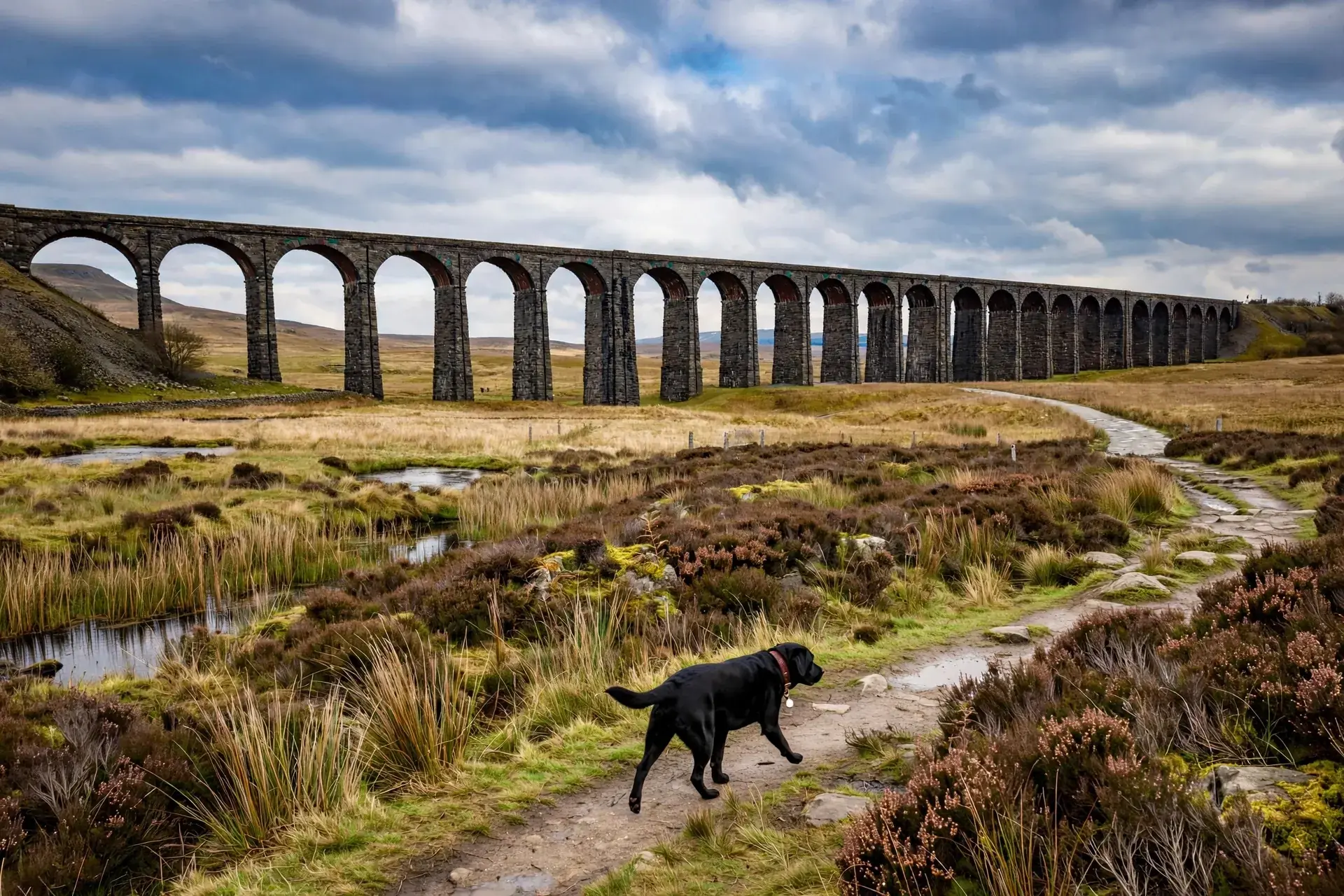
The centrepiece is the Ribblehead Viaduct, also known as the Batty Moss Viaduct. It carries the railway across the valley on 24 arches and stands about 32 metres high and roughly 400 metres long. It was built in the 1870s as part of the Settle to Carlisle line, and it remains one of the most photographed structures in northern England. For a dog walk, the important thing is that you do not need to climb anything to enjoy it. The valley floor paths bring you right underneath the arches, where the scale of the stonework is at its most impressive, and the walk is short enough for older dogs, puppies on a short outing, and anyone who wants a gentle first taste of the Dales.
Ribblehead also sits at the foot of Whernside, the highest of the Yorkshire Three Peaks at 736 metres. Ingleborough and Pen-y-ghent, the other two peaks, are both within reach by car or by a long walk. That makes Ribblehead a natural base for a serious fell day, a short viaduct stroll, or something in between. Dogs that love open running will enjoy the moorland; dogs that prefer a sniff-heavy wander will enjoy the valley becks and the rough grassland; dogs that are happiest with a pub garden at the end will find the Station Inn right beside the station.
What Ribblehead does not offer is shelter, shade or easy facilities. The moor is exposed in every direction, the wind can be strong even on a day that feels calm in the valley towns, and there is very little cover when the rain comes in. That is not a reason to stay away. It is a reason to plan properly, to carry what your dog needs, and to choose a route that matches the dog you actually have rather than the dog you wish you had on a perfect day. A fit border collie and a 13-year-old terrier can both have a good day at Ribblehead, but they will not have the same day.
This guide covers the viaduct walk in detail, the Whernside climb, shorter alternatives, the lead rules and livestock etiquette that matter on working farmland, how to get here by train or car, where to eat and stay, what to pack, and a sample day plan. Opening hours, dog policies, train times and parking arrangements can change, so check the official guidance before you travel for anything you are relying on.
The viaduct walk: the easy classic
The simplest and most rewarding walk at Ribblehead starts at the station area and heads out across the valley floor to look back at the viaduct. You do not need a map for the basic version, you do not need fell boots for dry conditions, and you do not need to be fit. What you do need is a lead, sensible footwear, and a willingness to let the dog set the pace while you look up at the arches.
Start at Ribblehead station, which sits beside the B6255 at the southern end of the viaduct. From the station area, paths and tracks lead out across the moorland edge and down towards the valley floor, where the River Ribble begins its long journey south as a small beck. The ground is a mix of grass, rough moorland turf and stone tracks. After rain it can be boggy underfoot, and the beck crossings can be wet, so waterproof boots are worth wearing even in summer. Keep your dog on a lead near the station and the road, and only let the dog off in open ground when you have a clear view and no livestock are nearby.
Walking beneath the viaduct is a different experience from seeing it from the road. From below, the 24 arches frame the sky in a repeating rhythm, and the stonework shows the marks of more than 150 years of weather. Trains still cross regularly on the Settle to Carlisle line, and the sound builds slowly before a train appears, which gives you time to move a nervous dog to a comfortable distance and keep the lead short. Some dogs barely notice the trains. Others are startled by the noise echoing under the arches, so watch your dog's body language on the first pass and do not force a close approach.
The valley floor walk works as a loop or an out-and-back, depending on how much time and energy your dog has. A gentle out-and-back of an hour or so suits most dogs and leaves time for a long sniff around the becks and a rest in the grass. If you want a longer circuit, the paths and bridleways around the viaduct connect towards the lower slopes of Whernside and towards the road to Horton-in-Ribblesdale, but the ground gets rougher and the navigation gets harder, so carry a map and a charged phone if you extend the walk. In low cloud or mist, the viaduct can disappear entirely, which is atmospheric but makes landmarks unreliable, so do not rely on sighting the arches to find your way back.
Photographs are best in the morning or late afternoon, when low light rakes across the stone and the shadows under the arches deepen. Midday in summer flattens the scene and leaves the dog with no shade, so plan the classic viewpoint for the cooler parts of the day. Whatever time you choose, keep your dog off the railway itself. The viaduct is a working railway, not a footbridge, and there is no pedestrian route across it. Admire it from below, which is where it looks best anyway.
One more practical point: the viaduct walk is popular, especially on fine weekends and bank holidays, and the small station area can feel busy. If your dog is reactive to other dogs, go early, keep to the wider valley paths rather than the narrow approach tracks, and give oncoming dogs plenty of room. An early start also means cooler ground, quieter paths and a better chance of parking close to the station.
Climbing Whernside from Ribblehead
Whernside, at 736 metres, is the highest of the Yorkshire Three Peaks and the most direct big climb from Ribblehead. The path from the station area rises steadily across the lower slopes and then climbs more steeply towards the summit ridge, where a long dry-stone wall runs along the top and walkers traditionally follow it to the summit. On a clear day the view stretches across the Dales to the Lake District fells and the Howgill Fells. On a cloudy day the summit can be cold, windy and featureless, so the climb is a fair-weather outing for most dogs.
Allow a generous half day for the round trip, and longer if your dog likes to stop and sniff or if you plan to sit at the summit. The distance and height gain are substantial for a dog: the climb is long, the ground underfoot is a mix of grass, stone steps, rocky sections and peat, and there is very little shade or shelter anywhere on the route. Fit adult dogs in good condition usually manage it well, but puppies, older dogs, overweight dogs and dogs with joint problems should not attempt the full climb. If your dog has never done a long fell walk, build up with shorter routes first and treat Whernside as a goal rather than a first outing.
Water is the main planning problem. There are becks lower down, but the upper slopes and the summit ridge have few reliable water sources, and in dry weather even the lower streams can be low. Carry at least a litre of water for the dog on a warm day, plus a collapsible bowl, and offer water little and often rather than waiting until the dog is panting hard. Carry food as well: a fell climb burns far more energy than a park walk, and a small high-energy snack at the summit helps a tired dog recover for the descent.
The descent deserves as much respect as the climb. Dogs that bounded up the fell can come down stiff and sore, especially on the stone steps and rocky sections, and a dog that is tired is more likely to slip or to pull on the lead. Keep the dog on a lead on the steep and rocky parts, slow the pace on the way down, and watch for limping, lagging or reluctance to jump down from rocks. If the dog starts to struggle, stop, rest, offer water and food, and consider a shorter return route rather than pushing on to the summit. Turning back is not a failure. It is good fell craft.
Weather can change quickly on Whernside. A clear morning can turn to driving rain and strong wind by midday, and the summit ridge is fully exposed. Check the mountain weather forecast before you set out, carry waterproofs for yourself and a drying coat for the dog, and set a turn-back time before you start. If the cloud comes down, the stone wall along the ridge is a useful handrail for navigation, but do not rely on it alone: carry a map and compass and know how to use them, because phone signal is unreliable on the fell. In winter, ice and snow can make the stone steps treacherous for dogs as well as people, so check the official guidance before you travel and choose a lower route when conditions are poor.
At the summit, give the dog a proper rest, food and water, and keep the lead on: the summit area is busy on fine days, the drop on one side is steep, and a dog chasing a scent can be over an edge before you can react. Take the photographs, enjoy the view, and then start down while the dog still has energy in reserve. The best fell days end with a dog that is tired and happy, not a dog that is exhausted and sore the next morning.
Shorter routes and gentler days
Not every Ribblehead day needs to be a fell climb, and some of the best dog days here are the shortest ones. The valley floor around the viaduct offers an hour or two of easy walking with constant views, and the lower paths towards Horton-in-Ribblesdale give a gentle riverside alternative when the high moor is too windy or too wet. A short day also leaves time for a slow lunch and a train ride, which suits older dogs and young families far better than a forced march up Whernside.
One good gentle option is to combine the viaduct walk with a slow wander along the valley becks. The ground is mostly level, the dog can sniff and paddle, and you can turn back at any point. This is the right choice for a first visit, for a dog that is recovering from an injury, or for a day when the weather forecast is uncertain. It also works well as a warm-up: walk the valley in the morning, judge how the dog is moving and how the weather is developing, and only then decide whether to add a higher route in the afternoon.
Another option is to base the day in nearby Horton-in-Ribblesdale, a village on the River Ribble with paths along the river and a well-known starting point for the Three Peaks walk. The riverside paths are flatter and more sheltered than the open moor, and the village has pubs and a cafe culture that welcomes walkers. Check the official guidance before you travel for current access and dog policies, because riverside paths can flood after heavy rain and pub rules change. Horton also gives you a useful fallback: if the wind is howling at Ribblehead, the valley at Horton is often calmer.
For a longer but still moderate day, the bridleways and tracks that run south from Ribblehead towards the lower slopes of Ingleborough offer a middle ground between the valley floor and a full summit. The views open up quickly, the walking is steady rather than steep, and you can turn back whenever the dog tires. Keep the dog on a lead where the path crosses farmland, and remember that these are working tracks used by farm vehicles, so keep to the side and keep the dog close when you hear an engine.
If you are staying in the area for more than a day, it pays to spread the effort. A big fell day followed by a gentle valley day is kinder to a dog than two hard days in a row, and the dog will enjoy the second day more for it. Our 3 day Lake District itinerary with a dog follows the same principle of balancing walk, rest and swim-stops, and the pacing ideas transfer well to a Dales break: one hard day, one easy day, and a short final morning before the drive home. Dogs, like people, recover better when the plan includes rest.
Moorland safety: livestock, birds and weather
Ribblehead is working farmland as well as a walking destination. Sheep graze the moorland and the valley fields for most of the year, and cattle may be present on lower ground. Dogs must be kept under close control around livestock at all times, and on a short lead near sheep, lambs and cattle. Chasing livestock is a serious matter: it can cause sheep to miscarry or to panic and injure themselves, and farmers have the legal right to protect their animals. If your dog has any history of chasing sheep, keep the lead on for the whole walk and choose routes where you can see a long way ahead.
Ground-nesting birds are another reason for lead control. The moorland around Ribblehead is home to birds such as curlew, lapwing and red grouse, which nest on the ground in spring and early summer. A loose dog running through nesting areas can destroy a nest in seconds without the owner ever noticing. During the breeding season, roughly March to July, keep your dog on a lead or on a short long line on the open moor, stick to established paths, and watch for birds that are calling loudly or feigning injury, which usually means a nest is nearby. Check the official guidance before you travel for current local advice on sensitive areas.
The weather is the third safety factor, and it is the one most visitors underestimate. Ribblehead sits high and exposed, and the wind can be strong enough to knock a small dog off balance on the fell. Rain can arrive horizontally, temperatures can drop several degrees between the valley and the summit, and mist can reduce visibility to a few metres in minutes. Always check the mountain weather forecast, not just a general town forecast, and carry waterproofs, warm layers and a map. If the forecast mentions high winds, heavy rain or poor visibility, choose a low valley walk or postpone the fell climb. The viaduct will still be there tomorrow.
Other moorland hazards are smaller but worth knowing. Peat bogs can be deep and soft after rain, especially off the main paths, so keep the dog on the path in wet conditions and be ready to wash muddy paws and bellies afterwards. Ticks are present in the Dales, particularly in bracken and long grass from spring to autumn, so check your dog after every walk, especially around the ears, armpits and groin, and remove any ticks promptly with a tick remover. Adders are rare but present in some moorland areas; keep the dog on the path in warm weather and seek veterinary help immediately if you suspect a bite. Carry a basic first-aid kit, including a tick remover, antiseptic wipes and a spare lead, and save the number of the nearest vet before you set out. The nearest practices are in the surrounding market towns, so check the official guidance before you travel for the closest option to your route.
Finally, respect the railway. The Settle to Carlisle line is a live railway with regular passenger and freight trains, and the tracks around Ribblehead station are not a walking route. Keep your dog on a lead near the station and the level crossing areas, keep the dog well back from the platform edge, and never let a dog onto the tracks. The same applies to the B6255, which is a fast rural road with limited pavements: keep the dog on a short lead, walk facing oncoming traffic where there is no pavement, and wear something bright in poor light.
Lead rules that actually make sense
There is no single lead rule for Ribblehead, because the ground changes every few hundred metres. The sensible approach is to think in zones: lead on near the station, the road, the railway, livestock and other walkers; lead optional on open moorland only when the view is clear, no sheep are in sight, and your dog comes back first time. A dog that needs three calls to return is not ready for off-lead moorland, however friendly it is.
A long line is the most useful piece of kit for Ribblehead. A 10-metre line gives a keen dog room to run and sniff on the open moor while keeping you in control if sheep appear over a rise or another walker comes into view. Use a harness rather than a collar with a long line, so a sudden stop does not jerk the dog's neck, and practise reeling the line in before you need to do it in a hurry. Keep the line clear of the dog's legs and your own feet on rough ground, and shorten it on narrow paths, near walls and on steep sections where a tangled line could trip either of you.
Recall matters more here than in a park. On open moorland a dog can cover a long distance in a few seconds, and a sheep, a grouse or another dog can appear from behind a wall with no warning. Only let the dog off lead if the recall is reliable in the presence of distractions, and keep a high-value treat in your pocket so the recall is worth answering. If the dog ignores a recall once, put the lead back on and do not test it again that day. A failed recall on a fell is not a training opportunity; it is a sign to manage the risk differently.
Meeting other dogs on narrow paths needs a plan. Keep your dog on a lead when another dog approaches, move to the side, and ask the other owner whether their dog is friendly before letting the dogs greet. Some dogs are on lead for a reason, and an off-lead dog rushing up to them can cause a fright or a fight. The same courtesy applies to walkers, runners and cyclists: step aside, shorten the lead, and let them pass. A dog that is under control is a dog that is welcome back.
One rule covers everything else: clean up after your dog, every time, everywhere. Bag it and carry it to a bin, or take it home with you. Leaving bags on walls, fences or paths is littering, and moorland bags left behind are a common complaint from farmers and other walkers. Carry spare bags, a small bag holder on the lead, and a sealable pouch for the walk back to the car. It is a small effort, and it is what keeps places like Ribblehead welcoming to dogs.
Getting there: train, car and parking
Ribblehead is one of the few great fell walks in England that starts at a railway station, and arriving by train is part of the pleasure. The Settle to Carlisle line runs from Leeds through Skipton and Settle to Carlisle, with Ribblehead as one of its small rural stops. The journey itself is one of the most scenic in Britain, crossing the viaduct and passing through tunnels and over the high moor, and the train drops you a few minutes' walk from the viaduct viewpoint. Dogs are generally welcome on the line, but check the official guidance before you travel for current conditions, and plan your return train carefully: Ribblehead is a request stop on some services, so you may need to signal the driver, and trains are infrequent, especially on Sundays and in winter.
If you travel by train, keep the dog on a lead on the platform, keep it off the seats, and bring a blanket or mat for the dog to lie on. The station is unstaffed with no ticket office and limited shelter, so arrive with tickets bought in advance or a payment method ready, and dress for waiting outside in all weathers. Check the timetable the day before and again on the morning of travel, because engineering works and weather can change services on rural lines. If you miss the last train, the alternatives are a long walk or a taxi booked well in advance, so treat the return time as a hard deadline and start back with plenty of margin.
By car, Ribblehead is reached on the B6255 between Ingleton and Hawes. The road is scenic but narrow in places, with sheep on the verges and limited overtaking, so drive slowly and expect walkers, cyclists and farm vehicles. Parking is available near the station, but spaces are limited and the area fills quickly on fine weekends, so arrive early or be prepared to park further away and walk in. Do not park on verges, in passing places or in front of farm gates: you will block access, damage the grass and risk a fine. Check the official guidance before you travel for current parking arrangements, because they can change with the seasons and with local works.
Satellite navigation can be unreliable on the high moor, and phone signal is patchy, so download offline maps before you leave home and carry a paper map as a backup. The nearest fuel, shops and cash machines are in Ingleton, Settle and Hawes, so fill up and buy supplies before you head for the moor. Mobile signal around the station is variable: some networks work better than others, and the signal can disappear entirely on the fell, so tell someone your route and expected return time before a long walk, especially if you are walking alone with the dog.
For a car-free break, Settle makes a good base: it has shops, pubs, a station on the same line, and bus connections, and you can take the train to Ribblehead for a day walk and return in the evening. Ingleton is another option, with its waterfalls walk and a choice of places to stay, though you will need a car or a taxi to reach Ribblehead itself. Whichever way you arrive, build in slack: rural roads and rural railways both reward unhurried travellers and punish tight schedules.
Where to eat, drink and stay
The Station Inn at Ribblehead is the obvious place for a drink or a meal after a walk, sitting right beside the station with the viaduct in view. It is a traditional Dales pub that has served railway workers and walkers for generations, and it is generally welcoming to dogs, but opening hours, food service and dog policies can change, so check the official guidance before you travel rather than assuming the dog can come inside. Even when dogs are welcome, keep the dog on a lead, settle it on a blanket under the table, and bring water and a chew to keep it occupied while you eat. A tired dog that has just walked for hours usually settles well; a wired dog that has been in the car all day may not.
Beyond Ribblehead itself, the surrounding villages offer more choice. Horton-in-Ribblesdale has pubs and a cafe culture built around walkers, Ingleton has a wider choice of pubs, cafes and takeaways, and Hawes, a short drive over the moor, has shops, cafes and pubs in the heart of Wensleydale. Dog policies vary from place to place and from season to season: some pubs welcome dogs throughout, others allow them only in a bar area or a garden, and some change their rules in busy periods. Always check before you travel, and have a backup plan, such as a picnic, so a closed pub does not spoil the day.
For staying over, the area around Ribblehead offers a mix of dog-friendly cottages, bed and breakfasts, bunkhouses and campsites, with more choice in Settle, Ingleton, Hawes and Horton-in-Ribblesdale. When you book, ask the specific questions that matter for your dog: is there a secure garden or a safe area for a last toilet trip, is there a hard floor or a washable area for a muddy dog, is there somewhere to dry a wet dog, and is there an extra charge per dog? A cottage with a tiled entrance hall and a garden is worth more than a prettier cottage with a white carpet and no outside space. Book early for weekends and school holidays, because the best dog-friendly places in the Dales fill quickly.
Camping with a dog near Ribblehead is possible, but it needs extra thought. The moor is exposed and cold at night, even in summer, so bring a warm bed and a coat for the dog, and keep the dog on a lead or a long line at the campsite at all times. Check the campsite's dog rules before booking, including whether dogs can be left in a tent or vehicle, and never leave a dog alone in a hot car or a cold tent. If you are combining Ribblehead with a longer Dales tour, our guide to Middleham with a dog covers castle ruins, gallops and Wensleydale river walks further east, and makes a good second base for a two-centre break.
Whatever you choose, pack a picnic as a backup. A flask, sandwiches, dog treats and a waterproof mat turn a closed pub or a missed train into a pleasant pause rather than a problem. The best viewpoint at Ribblehead is free, the air is free, and a dog that has walked well will be perfectly happy with a sandwich eaten on a dry stone wall while you look at the viaduct.
Seasons and weather
Spring at Ribblehead is a season of lambs, nesting birds and changeable weather. The moor greens up, curlews call over the valley, and the light is at its best, but the ground can be wet, the wind can be bitter, and the lambing season means strict lead control everywhere. Keep the dog on a lead around ewes and lambs without exception, and keep to the paths during the nesting season. Spring is a wonderful time to visit, but it is also the time when good behaviour matters most.
Summer brings the longest days and the busiest paths. The viaduct walk is at its easiest, the fell paths are at their driest, and the evenings are long enough for a late walk after the crowds have gone. But summer also brings heat, and heat is a real risk for dogs on an exposed moor with no shade. The stone and grass radiate heat, the climb to Whernside is hard work in warm weather, and there is little water on the high ground. Walk early in the morning or late in the afternoon, carry more water than you think you need, watch for heavy panting, drooling or a dog that stops and lies down, and cut the walk short if the dog is struggling. Never leave a dog in a parked car, even for a few minutes, and never rely on a stream that may have dried up.
Autumn is many regulars' favourite season at Ribblehead. The crowds thin, the light turns golden, the moorland grasses change colour, and the walking temperatures are kinder for dogs. The ground gets wetter as the season goes on, and the first frosts can make stone steps slippery, but a fit dog will enjoy autumn walking more than any other season. This is also the best time for a longer stay: a viaduct day, a Whernside day and a gentle valley day fit neatly into a long weekend, and the pubs are quieter and more welcoming.
Winter at Ribblehead is serious walking country. The wind can be fierce, the rain can be horizontal, and snow and ice can settle on the high ground while the valley towns stay clear. Daylight is short, so a Whernside climb that is comfortable in June becomes a race against darkness in December. Only attempt the high fells in winter if you have the clothing, the navigation skills and the experience to do so safely, and choose the valley walk when conditions are poor. A dog in a warm coat, walking a short valley loop in crisp winter light with the viaduct against a pale sky, can have a better day than a dog dragged up an icy fell in a gale.
Whatever the season, check the mountain weather forecast before you travel, dress for the fell rather than the car park, and set a turn-back time. The forecast for the nearest town is not the forecast for the summit of Whernside, and the difference can be ten degrees and a gale. If the weather turns while you are out, turn back early: the viaduct, the moor and the fell will all still be there on your next visit.
What to pack for a Ribblehead dog day
Packing for Ribblehead is packing for an exposed moor, not a park, and the list is longer than a town walk. Start with the basics: a lead, a harness, a long line, spare bags, water and a collapsible bowl, food and treats, a towel, a drying coat, a tick remover, and a basic first-aid kit. Add a blanket or mat for the train and the pub, and a chew or a stuffed Kong for settling the dog while you eat. If your dog wears a coat, bring it: even a hardy dog can get cold standing still on a windy summit after a sweaty climb.
Footwear and clothing matter for the dog as well as for you. Rough moorland, stone steps and peat can be hard on paws, especially after a wet spell when the ground is soft and gritty. Check paws at the end of the walk for cuts, grit between the toes and sore pads, and carry a paw balm or a spare sock and tape in case of a minor injury. In winter, ice and grit salt on paths can irritate paws, so rinse them with clean water after the walk and dry them thoroughly. A dog that is limping needs rest, not another mile.
Navigation and safety kit are not optional on the fell. Carry a paper map and compass and know how to use them, a charged phone with offline maps downloaded, a head torch, a whistle, and a small emergency shelter or bivvy bag if you are attempting Whernside. Tell someone your route and expected return time, and carry enough food and water for an extra hour in case you are delayed. Phone signal is unreliable on the moor, so do not rely on being able to call for help from the fell.
For the car, pack a dog towel, a waterproof seat cover or a crate, a spare lead, extra water, and a change of clothes for yourself. A muddy dog and a wet car are a fact of Dales walking, and a little preparation makes the drive home far more pleasant. Keep a bag of dry dog food and a spare bowl in the car as well, in case a walk runs long or a train is delayed and the dog needs feeding before you get home.
Finally, pack for the dog you have, not the dog in the brochure. A nervous dog needs a familiar blanket and a calm routine. An older dog needs a ramp or a lift into the car, joint-friendly pacing and a shorter route. A young, energetic dog needs a long line, a job to do and plenty of sniffing time. The kit list is the same, but the plan around it changes, and that is what makes the day work.
A sample day with your dog
Here is a relaxed sample day that suits most fit adult dogs, with options to shorten it at every stage. Arrive at Ribblehead by the first train or by car before the crowds, and start with the valley walk under the viaduct. Give the dog half an hour to sniff, paddle and settle into the day, and take your photographs while the light is good and the paths are quiet. This gentle start tells you how the dog is moving, how the weather is developing, and whether a bigger walk is a good idea.
By late morning, make the decision: Whernside or a longer valley circuit. If the weather is clear, the dog is moving well and you have water and food to spare, set out for the fell with a firm turn-back time. If the wind is rising, the cloud is dropping or the dog is already tired, stay low and enjoy a longer valley walk instead, perhaps heading towards the lower slopes and back along a different track. Either way, stop for a proper rest at midday: water, food, a lie-down in the grass, and a chance for the dog to sleep for twenty minutes. Dogs recover best when rest is built into the plan, not added as an afterthought.
In the afternoon, walk back to the station area slowly, letting the dog sniff and wander on a long line rather than marching. If the Station Inn is open and welcoming dogs, settle in for a drink and a bite to eat, with the dog on a blanket under the table. If not, have your picnic at a viewpoint and enjoy the last of the light. Check the train time or the drive home before you sit down, so the end of the day is relaxed rather than rushed.
For a longer break, pair Ribblehead with a gentler day nearby. The Wensleydale villages to the east offer river walks, village greens and a slower pace, and our guide to Wensley with a dog covers riverside paths, village history and dog-friendly stays in a part of the Dales that makes a calm contrast to the high moor. One big day and one gentle day is the shape of a good Dales break, and the dog will thank you for it.
End the day the way you started it: slowly. Give the dog a warm meal, a dry bed, a paw check and a good night's sleep. A dog that has walked well at Ribblehead will sleep deeply, and that is the best review any walk can get.
Practical questions
Before you go
Can my dog go off lead at Ribblehead?
Sometimes, but not everywhere and not all year. Keep your dog on a lead near the railway, the road, livestock and other walkers, and during the spring ground-nesting bird season. Use a long line on open moorland only when you have a clear view, no sheep are nearby and your dog has a reliable recall. If in doubt, keep the lead on.
Can a dog climb Whernside from Ribblehead?
Yes, fit adult dogs can climb Whernside from Ribblehead on the main paths, but it is a long, steep, exposed fell walk with no shelter and few water sources. Start early, carry water and food for the dog, watch for heat, wind and tiredness, and turn back if the dog slows or the weather changes. Puppies, older dogs and dogs with joint problems should not attempt the full climb.
Can dogs travel on the Settle to Carlisle train to Ribblehead?
Dogs are generally welcome on the Settle to Carlisle line, but conditions and fares can change, so check the official guidance before you travel. Keep your dog on a lead, keep it off seats, and bring a blanket or mat if the floor is wet. Ribblehead is a small rural station with no ticket office, so plan your return train in advance.
Is the Ribblehead Viaduct walk suitable for dogs that do not like heights?
Walking beneath the viaduct is fine for most dogs, because the path stays on the valley floor and you never cross the viaduct itself on foot. The scale of the arches and the sound of trains passing overhead can unsettle nervous dogs, so approach slowly, keep the lead short and let the dog watch a train pass from a comfortable distance before you walk closer.
Where can my dog drink and cool off around Ribblehead?
There are becks and small streams in the valley, including the headwaters of the River Ribble, but water levels vary with the weather and farm run-off can be a concern after heavy rain, so check the official guidance before you travel and carry your own water as well. Never let a dog drink from stagnant pools, and rinse muddy paws after a wet walk.
What is the best time of year to visit Ribblehead with a dog?
Late spring and early autumn usually offer the best balance: cooler walking weather, longer daylight and quieter paths than high summer. Summer can be hot on the exposed moor with little shade, and winter brings strong wind, driving rain, ice and very short days. Check the mountain weather forecast before every visit, whatever the season.