This guide is independent and contains no paid placement. If affiliate links are added later, they will be clearly marked and will not change our editorial checks.
The Ridgeway is an 87-mile National Trail from Avebury in Wiltshire to Ivinghoe Beacon in Buckinghamshire, following a chalk ridge that has been walked for around 5,000 years. It is a superb dog walk — open, dry underfoot and full of history — but it is also exposed, with long stretches between water, shade and villages. Carry water, plan your stops, and keep your dog on a lead near livestock and ancient sites.
Britain's oldest road: five thousand years under your boots
The Ridgeway is often described as Britain's oldest road, and the claim is not a marketing slogan. People have walked this chalk ridge since the Neolithic period, around 5,000 years ago, when the high, dry ground offered a safe route through the wooded valleys below. Traders, drovers, soldiers and pilgrims followed the same line for millennia, and the modern National Trail still follows it from Avebury in Wiltshire to Ivinghoe Beacon in Buckinghamshire, a distance of 87 miles. Walking it with a dog is a strange and pleasant experience: the path is broad, the views are enormous, and every few miles there is a reminder that you are walking through the deep past.
The history is not hidden away in museums. It is out on the ridge, in plain sight. The Uffington White Horse, a Bronze Age hill figure cut into the chalk more than 3,000 years ago, watches over the trail from the hillside. Wayland's Smithy, a Neolithic long barrow, sits a short detour from the path. Barbury Castle and Liddington Castle are Iron Age hillforts with ramparts you can still walk around. Avebury itself, where the trail begins, is a vast stone circle older than Stonehenge, and the whole landscape is scattered with burial mounds that show as gentle bumps in the turf. None of this needs a history degree to enjoy. It is simply there, under your feet and on the horizon, and it gives the walk a weight that few other trails can match.
For a dog, the history is mostly a backdrop of smells and open grass. The practical point is that these sites are protected, and they come with rules. Dogs should be kept on a lead around scheduled monuments, and they should not be allowed to dig or climb on the earthworks. The hillfort ramparts are tempting to a dog, but they are fragile archaeology, and a scrambling dog can do real damage. Treat the ancient sites the way you would treat a churchyard: walk through quietly, on a lead, and leave everything as you found it. Check the official guidance before you travel if you plan to visit a specific site, because access arrangements and seasonal restrictions can change.
Chalk ridge walking: what the ground feels like
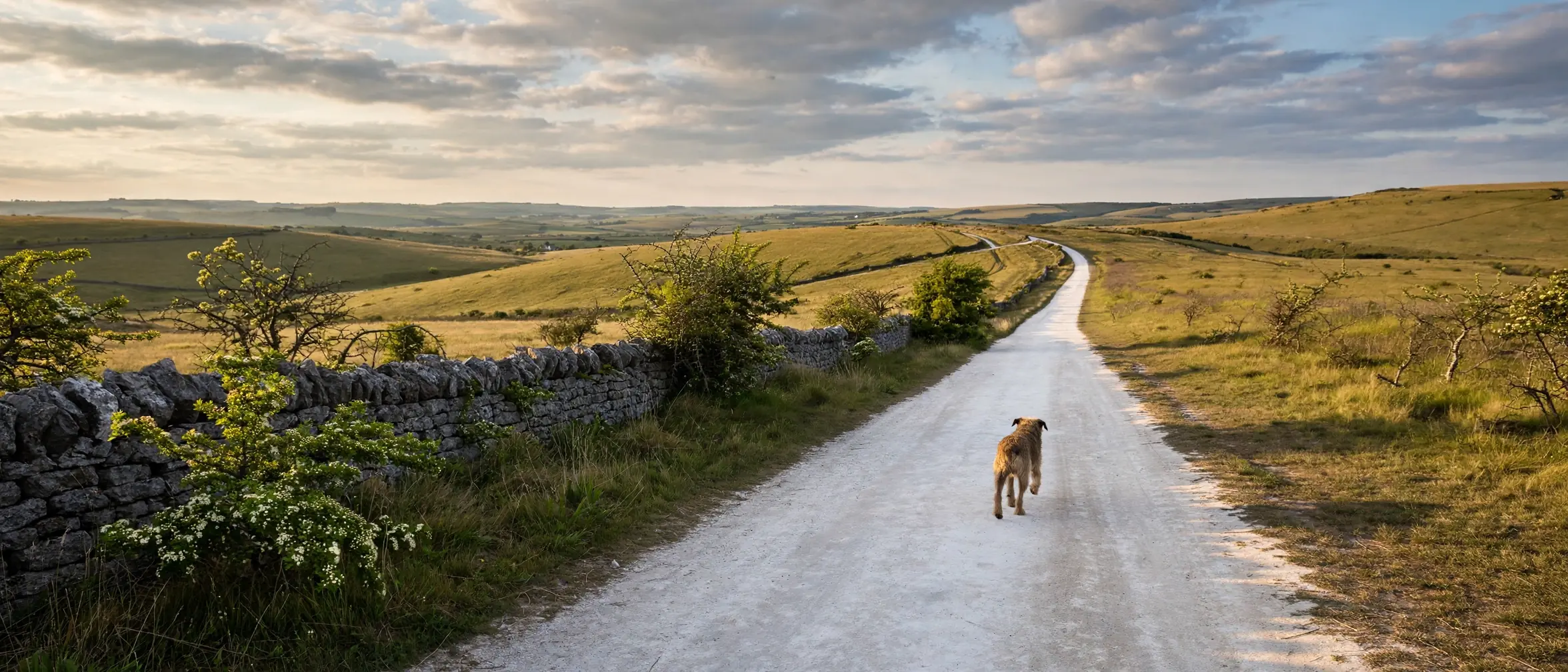
The Ridgeway is a chalk ridge walk, and the ground underfoot is the first thing a dog walker notices. The path is a broad, pale track of chalk and flint, often several metres wide, running along the top of the downs with the land falling away on both sides. Underfoot it is firm and free-draining, which is a blessing after rain: the Ridgeway dries out faster than almost any other National Trail, and mud is rarely the problem it is on the lowland paths. The trade-off is that chalk is hard and flint is sharp. A dog that is used to soft grass and woodland paths may find the hard surface tough on its pads over a long day, especially if the track is stony. Check paws at lunchtime, carry paw balm, and build up distance gradually if your dog is new to chalk.
The other defining feature of the terrain is that it is open. There are very few trees on the ridge, and the views run for miles in every direction. On a clear day you can see the whole shape of the downs, the villages in the valleys, and the weather coming from a long way off. That openness is glorious, and it is also the walk's main challenge. There is almost no shelter from wind, rain or sun, and the ridge catches the weather from every direction. A dog that is comfortable in the open will love it; a dog that needs cover and shade will need careful management, especially in summer.
Twelve to fifteen miles a day is the usual rhythm here, and on this surface it feels easier than the number suggests — until the wind gets up. The ridge rarely climbs for long; instead it rolls, dipping into a valley and rising again, so a fit dog can hold a steady trot for hours without the stop-start of a steep hill walk. Waymarking is the acorn disc, and on a clear day you can see the next one from the last, which makes navigation feel almost automatic. Fog changes everything: the downs turn blank, parallel ruts split and rejoin, and a landmark you were counting on disappears. That is when a paper map earns its place in your pack, because phone signal comes and goes along the high ground and a flat battery leaves you guessing.
Sun, wind and no shelter: walking an exposed ridge with a dog
The Ridgeway has almost no natural shelter, and that single fact shapes everything about walking it with a dog. In summer, the sun beats down on the white chalk and reflects back up, and the temperature on the ridge can feel several degrees hotter than in the valley below. There are long stretches with no trees, no walls and no shade of any kind, and a dog that overheats has nowhere to recover except the shade of your own body. Walk early in the day in hot weather, carry more water than you think you need, and plan rest stops at the few shaded spots the trail offers, such as the beech hangers near the western end and the occasional copse. Watch for the signs of heat stress — heavy panting, drooling, a bright red tongue and a dog that slows down or seeks shade — and stop immediately if you see them.
Wind is the other side of the same coin. The ridge is exposed to the prevailing south-westerlies, and a strong wind on the downs is a different animal from a strong wind in a valley. It drives rain horizontally, it chills a wet dog fast, and it can make a nervous dog reluctant to walk at all. A waterproof coat for the dog is worth its weight on a windy, wet day, not because dogs cannot cope with rain, but because wind chill on a wet coat is what makes a dog cold. In winter, the same exposure means the ridge can be bitterly cold, with frost and snow lingering long after the valleys have thawed. Check the forecast for the ridge, not just the nearest town, and be ready to cut a day short if the weather turns.
The practical answer to all of this is planning. Know where the shelter is before you start, even if the shelter is only a pub, a church porch or a belt of trees. Carry a lightweight windproof layer for the dog, a towel, and enough water for the longest dry stretch. And remember that the exposure is also the point: the big skies, the long views and the feeling of walking along the spine of the country are what make the Ridgeway special. A dog that is prepared for the weather will enjoy it as much as you do.
Ancient sites with a dog: White Horse, barrows and hillforts
The Ridgeway's ancient sites are the reason many people walk it, and they are entirely visitable with a dog, provided you follow a few simple rules. The Uffington White Horse is the star: a 110-metre-long Bronze Age figure cut into the chalk hillside, best seen from the ridge itself. The path passes close by, and the viewpoint is a good place to stop, give the dog water and take in the scale of the thing. Dogs should be kept on a lead here, both because the hillside is steep and because the chalk figure itself is fragile. The nearby Uffington Castle hillfort, with its ramparts and the mound known as Dragon Hill, is a fine place for a lead walk and a rest.
Wayland's Smithy is a Neolithic long barrow a short detour from the trail, and it is one of the most atmospheric places on the whole route. The stone chamber sits in a grove of beech trees, and the quiet of the place is striking after the open ridge. Dogs are welcome on a lead, and the trees offer welcome shade in summer. Barbury Castle, further west, is a large Iron Age hillfort with panoramic views, and the ramparts make a natural circuit for a dog walk. Liddington Castle, near the eastern half, is another hillfort worth the short climb, with views across the Vale of White Horse.
Avebury, at the western end of the trail, deserves a day of its own. The stone circle is the largest in Britain, and the village sits inside it, which makes for a wonderfully odd walk: standing stones in gardens, in fields and beside the pub. Dogs are welcome on leads around the stones and in the village, and the National Trust land around Avebury is a good place for a longer walk. The same respect applies here as on the ridge: keep the dog on a lead, do not let it climb on the stones or dig near them, and take all waste with you. These monuments have survived for thousands of years, and a little care keeps them standing for thousands more.
Water, food and the long gaps between villages
Start by counting the miles between taps, because on the Ridgeway that number decides your day. Chalk drains fast, so the ridge itself offers nothing to drink: no streams, no springs, no troughs you can rely on. Between Avebury and Goring the villages sit close enough that a careful walker can usually refill by lunchtime, but east of the Thames, across the Chilterns toward Ivinghoe Beacon, the gaps stretch out, and eight or ten miles without a tap is normal rather than exceptional. Work out the longest dry stretch on each day's route the night before, then load water for that stretch plus a margin for a hot afternoon or a missed turn. Our guide to dog hydration on long walks sets out how much a dog needs by weight and temperature, and this ridge is where those numbers stop being theory.
Pack the day's food before you leave, and pack the dog's too, because the villages along this trail cannot be counted on to feed you. Ashbury, Bishopstone, Wantage, Goring and Tring all sit a mile or two below the ridge, and reaching one means dropping off the high ground and climbing back; a pub that looked open on a website may be shut on a Tuesday, and a village shop may have closed years ago. Carry sandwiches and snacks for yourself and the dog's normal ration in its usual packaging, fed at the usual hour — a fifteen-mile chalk day is not the moment to improvise a diet out of a shared sandwich. If a village does turn out to have a dog-friendly pub serving lunch, count it as a lucky break, not as the arrangement the day was built on.
The habit that makes the dry days work is built the evening before. Spread the map out and mark every place you expect to find water — a village tap, a pub garden, a churchyard — then count the miles between the marks and load for the longest gap. A collapsible bowl weighs nothing and turns a bottle into a drink a dog can actually use; pour small amounts at every stop instead of waiting for the dog to look thirsty, because by the time a dog is visibly desperate for water it has already lost ground it will not get back before bedtime. Dogs that sip through the day keep walking through the day; dogs that arrive at a village dry spend the evening drinking and the next morning stiff, and the day after is harder for both of you.
Livestock, gallops and lead rules on the downs
The downs are farmed, not wild, and the animals on them are someone's livelihood. Sheep graze the open chalk grass for most of the year, cattle stand in the lower fields and valley bottoms, and both are used to walkers — which does not mean they are used to dogs. Clip the lead on before you enter any grazed field and leave it on until you are through the far gate; on this open ground a dog can cover a startling distance in the seconds it takes you to notice it has gone, and a farmer is within their rights to shoot a dog that is worrying sheep. Keep the dog at your side through gates rather than letting it push ahead, and if sheep are bunched near the path, give them a wide berth instead of threading the dog between them.
The Ridgeway also crosses racehorse gallops, particularly around Lambourn, which is a famous training centre. The gallops are broad, flat stretches of grass that look like ideal dog-walking ground, and they are not. Horses may be exercising on them at any time, and a loose dog near a string of racehorses is a danger to the dog, the horses and the riders. Follow the signed diversions around the gallops, keep your dog on a short lead, and do not let it onto the gallops themselves. The same applies to the stretches of the trail that run through or beside MOD land: follow the signs, keep to the path, and keep the dog close.
Skylarks nest on the ground here, and in spring the downs are full of their song — which is also the warning that the nests are under your feet. Between March and July a dog that leaves the path can put a paw through a nest before you have time to call it back, so in the breeding season keep the dog on the path and clipped on through the stretches where the signs ask for it. The restriction lasts a few months, it costs you very little, and it is the reason the skylarks are still singing when you come back next year.
Planning the Ridgeway with a dog: days, stays and transport
Six to seven days covers the 87 miles at the usual 12 to 15 miles a day, and the firm chalk makes that pace honest for a fit dog — it is the wind and the water weight, not the climbing, that slow people down. If a full week is more than you want, take a long weekend instead: Avebury to Wantage for the ancient sites, or Goring to Wendover for the Thames crossing and the Chiltern beech woods, and you will have walked the best of the ridge without a week's logistics. Getting there is easy at both ends, with trains to Swindon and Didcot in the west and Tring and Berkhamsted in the east, plus stations at Goring and Pangbourne in the middle, so a section walk can start and end at a platform.
Sleep in the valleys, not on the ridge, because that is where the rooms are — and there are not many of them. Pubs with rooms, bed and breakfasts and farm stays sit in the valley villages a short drop below the path, so expect a detour at the end of each day and plan for it rather than discovering it at dusk. Rooms that take dogs are few and they go first, especially in May and September, so book well before you set out and get the dog arrangements in an email: the charge, how many dogs are allowed, and whether the dog can join you in the bar or must stay in the bedroom. Bag transfer runs along the Ridgeway, and on a dry trail where water is the heavy thing in your pack it earns its fee twice over — an unloaded dog and a light day pack walk the chalk far better than a team loaded for a week. If the dog carries any of its own kit, keep the load small and train for it first; our dog backpack guide covers safe weights and a build-up plan, and our harness guide covers fitting for long days on hard ground.
Buses barely touch this ridge, so do not build a day around catching one. Before each morning's start, pick the bail-out point for that stretch — the nearest station, road or village — and note it on the map, because a lame dog or a turn in the weather leaves no room for improvisation on open downland. Keep the phone charged, with maps saved offline, and a small first-aid kit in the day pack; on this trail those three things are the difference between a walk cut short and a walk that turns into a problem.
Seasons on the Ridgeway: when to walk it
May, June, September and October are the months to aim for. In May and June the chalk grassland flowers, skylarks sing over the ridge and the air is cool enough for long days; in September and October the walking is cooler still, the beech hangers turn colour and the paths empty. The two windows sit either side of the two hard seasons: high summer, when the white chalk throws the sun back at you and the water runs out, and midwinter, when wind and frost own the ridge and the light goes early.
In summer, treat the sun as the main hazard. The white surface bounces light and heat back up, shade is hard to find, and a dog can overheat a long way from the next water point. Set out at first light, take more water than the map says you need, and be ready to stop early — a short day with a cool dog beats a full day with a dog in trouble. Winter asks for the opposite kind of care: wind, frost and frozen chalk underfoot, with daylight so short that fifteen miles becomes a race against dusk. A bright, still winter day on the ridge is one of the finest walks in England, but it belongs to a fit dog and a walker who has checked the forecast properly and packed for it.
Read the forecast for the high ground, not the valley town below it — the ridge makes its own weather, and a calm morning in Wantage can be a battering wind on the downs. A last check the night before, with the map and the water bottles beside it, is the single habit that separates a good day on the Ridgeway from a hard one.
If you only walk one section: the best day walks
For a single day, take the eight miles from the Uffington White Horse to Wayland's Smithy. It packs the whole trail into one walk: the chalk figure on the hillside, the hillfort above it, the long barrow in its beech grove, and views that run for miles in every direction. Start at the Horse, follow the ridge to the Smithy, then either walk back the way you came or arrange a lift from the lane below — and carry water, because even this short stretch has no reliable tap on the ridge itself.
Avebury to Barbury Castle makes a second good day, about ten miles from the standing stones to the hillfort ramparts, with a steady climb onto the ridge and views across the Marlborough Downs to finish. It suits a dog that is happy with a long pull uphill and rewards it with open grass at the top. At the other end of the trail, Wendover to Ivinghoe Beacon is the quieter choice: a shorter, wooded climb through beech to the beacon and the view over the Vale of Aylesbury, with more shelter than the western half and a gentler feel for dogs that prefer trees to open sky.
Take the trail at the dog's pace and it gives back more than the miles suggest. Start early, carry water, clip the lead on near stock and monuments, and leave time to stand and look — the Ridgeway has been walked for five thousand years, and an unhurried day on it is the best way to understand why.
Practical questions
Before you go
Can dogs walk the whole Ridgeway?
Yes — the full 87 miles from Avebury to Ivinghoe Beacon welcomes dogs, and most walkers cover it in six to seven days at 12 to 15 miles a day. The two things to get right are the lead, clipped on near livestock, gallops and monuments, and water: long stretches of the ridge have no refill, so load for the longest dry gap on each day.
How much water should I carry for my dog on the Ridgeway?
Plan for more than feels reasonable. The ridge holds no drinking water of its own and the next village can be eight or ten miles off, so fill up for the longest gap on the day, carry a collapsible bowl, and let the dog drink at every stop instead of waiting until it looks thirsty. For the latest information on water points, check the official guidance before you travel.
Are dogs allowed at the Uffington White Horse?
Yes, with the dog on a lead. The White Horse, Uffington Castle and the nearby Wayland's Smithy can all be visited with a dog, provided the dog stays on a lead and off the chalk figure and the earthworks. The slope is steep and the archaeology is fragile, so the lead protects the dog and the monuments at the same time.
Is the Ridgeway too exposed for dogs in summer?
It can be. The ridge offers almost no shade, and the pale chalk throws heat back up, so the trail often feels far hotter than the valley below. Start at first light, take extra water, rest in the shade where you find it, and watch for heavy panting or a dog that slows down. A shortened day is always the right call for a hot dog.
Do dogs have to be on a lead on the Ridgeway?
No — only in the places where it matters. A lead is needed around livestock, on the racehorse gallops, at ancient monuments, near ground-nesting birds in the breeding season and wherever the path meets a road. On quiet open stretches an off-lead walk is realistic, but only for a dog with a recall you can trust and that stays on the path.
What is the best time of year to walk the Ridgeway with a dog?
Late spring or early autumn, as a rule. May and June bring flowers, skylarks and mild air; September and October bring cooler walking and dry ground. Summer is hot and exposed on the chalk, winter brings wind, frost and short days, and the ridge forecast is the one to read, not the town forecast.