This guide is independent and contains no paid placement. If affiliate links are added later, they will be clearly marked and will not change our editorial checks.
Start beside the River Coquet, add the Simonside Hills only when your dog has the fitness and the weather allows, and use the village itself for the slow parts of the day: water, shade, a short toilet walk and a pub garden. Rothbury rewards a river-first plan, not a rushed one.
Plan from the river outwards
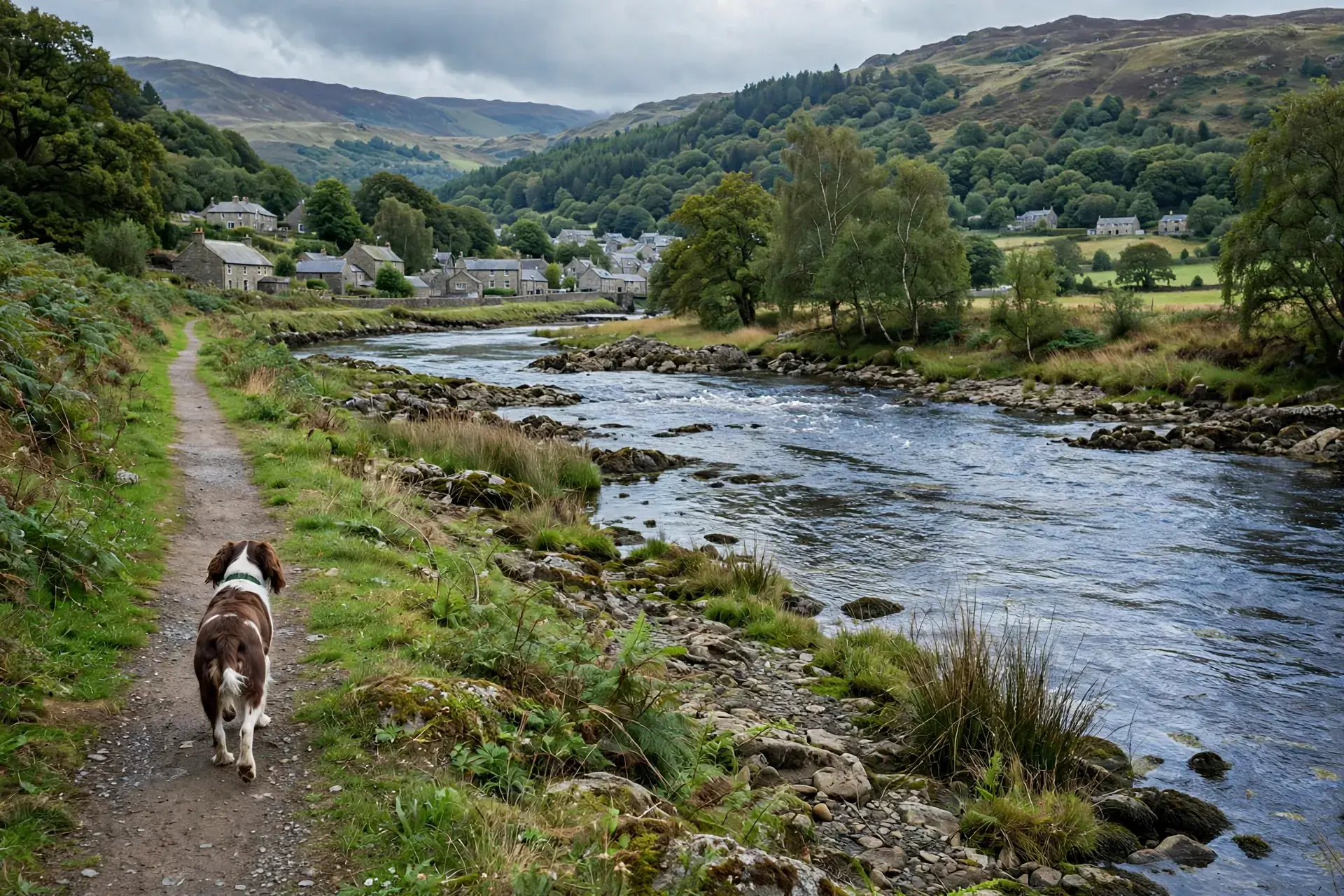
Early morning on the Coquet, before the village has properly woken, the river does most of the talking. Mist hangs low over the water, a dipper works the stones, and a dog that has spent the night in a strange bed finally relaxes into the smell of wet grass and cold, moving water. That first riverside stretch sets the tone for everything that follows in Rothbury: the walking here is not about ticking off viewpoints, it is about reading the river, the ground and the dog in front of you, and letting the day grow from there.
Rothbury sits in the Coquet valley in Northumberland, a small market town where the river, the wooded hillsides and the main street all sit within a few minutes of each other. That compact geography is exactly why it works so well with a dog. You can be on a riverside path within minutes of parking, you can be looking down on the valley from the Simonside ridge within a couple of hours, and you can be back in the village for lunch without ever needing to drive between walks. The mistake is to treat those three layers as three separate days. Plan them as one shape instead: river first, hills second, village last.
The river-first rule is practical, not poetic. A riverside walk tells you things a map cannot. It shows you how your dog is coping with the journey, the new smells and the new bed. It shows you whether the ground is firm or churned, whether the river is low and clear or high and brown after rain, and whether your dog is settling into a steady sniffing rhythm or pulling hard and over-aroused. A dog that walks calmly for forty minutes beside the Coquet is probably ready for a longer hill route later in the day. A dog that is already panting, lagging or fixating on every duck and angler is telling you to keep the day short, flat and close to the car.
Start by deciding what kind of trip this is. A single day trip from Newcastle or elsewhere in the North East needs a different shape from a two-night stay, and a puppy, an older dog and a fit working breed need different days again. For a day trip, keep it to one river walk and one village loop, with a pub or a riverside bench as the reward, and leave the Simonside ridge for a return visit. For a stay of two or three nights, use the first morning for the river, the first afternoon for the village and the shorter woodland paths, and save the hill ridge for the second day, when you know the weather, the ground and your dog's energy. If you are planning a wider Northumberland trip, our Northumberland dog guide puts Rothbury in context alongside the castles, beaches and Hadrian's Wall walks, so you can decide whether to base yourself here for the whole break or to use Rothbury as one quiet stop inside a bigger route.
Think in layers when you pack, too. The river layer needs a long line or a lead you trust near water, a towel for wet paws, and a water bottle even on a cool day, because river water is not a reliable drinking supply. The hill layer needs proper footwear for you, a harness that does not rub on a climb, extra water, and a layer for wind on the tops. The village layer needs a settle mat, a chew, and a short lead for pavements and pub gardens. One bag that covers all three layers is lighter than three separate kits, and it stops you leaving the hill gear in the car on the one morning you actually need it.
Timing matters as much as distance. The riverside paths are at their best in the early morning and the late afternoon, when the light is low, the paths are quieter and dogs are cooler. Midday in summer is better spent in the shade of the woods, in a pub garden with water, or back at your accommodation with the dog resting. In winter, the reverse applies: use the brightest middle hours for the hills, when the light lasts and the ground has had a chance to thaw, and keep the riverside walk short and close to the village as the light fades. The river is the thread that connects those choices. Check its level and colour before you commit to a long route, and check the official guidance before you travel if you are unsure about access, closures or flood conditions.
Finally, keep the plan loose enough to change. Rothbury is a place where a closed path, a flooded riverside stretch or a tired dog should change the day without ruining it. If the river is high, walk the higher woodland path instead. If the wind is up on the ridge, stay in the valley and do the longer river loop. If your dog is tired after lunch, let the afternoon be a village wander and an early finish. A good Rothbury plan is a river, a hill and a village held lightly together, with room to drop any one of them and still have a good day.
The riverside walks, step by step
The riverside walking around Rothbury is best understood as a series of short, joinable stretches rather than one fixed loop. The river runs through the town and out into farmland and woodland on both sides, and the paths that follow it change character quickly: a firm village path gives way to a grassy bank, then to a wooded stretch with roots and mud, then to open riverside meadow. That variety is a gift for dogs, because it offers sniffing, paddling, shade and open running in small doses, but it also means you should not promise yourself a neat circular distance before you have walked the first stretch and seen the ground.
Begin in the village itself. Start near the centre, cross to the riverside path, and walk out along the Coquet at a deliberately slow pace for the first ten minutes. This is the settling stretch. Let your dog sniff the bank, the bridges and the riverside trees, and use it to practise the two skills that matter most beside a river: a reliable recall away from the water's edge, and a calm wait while other dogs, walkers and anglers pass. If your dog cannot do either yet, keep the lead on and the distance generous. A riverside path is not the place to test a new recall, and a dog that lunges at ducks or chases a ball into deep water can turn a pleasant morning into a rescue in seconds.
The middle stretch, away from the village, is where the walking opens up. Here the river bends through meadow and woodland, the banks are wider, and there are shallow gravel edges where a careful dog can paddle on a long line. Look for the ground under your feet as much as the view: after rain, the riverside grass can be soft and churned, tree roots are slippery, and the path can narrow where the bank has been undercut by the river. Walk single file on narrow stretches, keep your dog on your inside away from the drop to the water, and step aside for other walkers rather than expecting them to step around a dog on a long line. If you are walking with two dogs, shorten both leads on narrow ground and give each dog its own space at gates and stiles, where tangles and sudden lunges are most likely.
Gates, stiles and bridges deserve a pause every time. Rothbury's riverside routes cross farmland as well as public paths, and a gate left open behind you can let livestock through or let your dog into a field you had not meant to enter. Close every gate, check the field beyond it for sheep or cattle before you let your dog off lead, and use bridges as a natural lead-on point: a narrow bridge with a dog pulling ahead is a fall risk for both of you. If a stile is too high or too awkward for your dog, do not lift a heavy dog over it unless you are confident you can do so safely. Turn back, or find the lower riverside alternative, and check the official guidance before you travel if a particular route's access is unclear.
The far stretch of the river walk is the place to decide whether to turn back or to make a longer loop. A good rule is to turn at the halfway point of your dog's comfortable energy, not at the halfway point of the map. A fit spaniel may happily do two hours beside the river and still want to play; an older labrador may be ready to turn after an hour, even if the path looks inviting. Watch for the small signs: a dog that stops sniffing and starts plodding, that seeks shade, that lies down at a gate, or that starts to lag behind you is asking for the shorter route home. The river will still be there tomorrow, and a dog that finishes a walk wanting more is a dog that will walk well the next day.
Paddling needs its own set of rules. Choose only a shallow gravel entry you can see right across, with slow water and a clear exit downstream, and keep your dog on a long line until you are sure of the current. Never let a dog swim below a weir, near a bridge pier, or where the water is brown and fast after rain. Do not throw a ball or a stick into the river: a dog that chases a toy will follow it into water it would never choose on its own, and a stick in a fast river is a genuine hazard. After a paddle, towel your dog down, check ears and paws for grit and cuts, and watch for the tired, cold shiver that means it is time to walk briskly back to the car and warm up.
Anglers are part of the riverside picture in Rothbury, and they deserve the same care as livestock. Give an angler a wide berth, keep your dog on a short lead and on the far side of the path, and do not let your dog sniff tackle, bait or a landing net. A hook in a paw or a nose is a vet visit, and a dog splashing through a swim a person has been fishing quietly for an hour will not make you popular. The same courtesy applies to other river users: kayakers, wild swimmers and families paddling with children all need space and warning. Call your dog in early, clip the lead on before you reach them, and pass with a friendly word rather than a silent squeeze past.
Finish the riverside walk the way you started it: slowly, in the village, with a short pavement loop that lets your dog toilet, drink and settle before the car or the pub. That last ten minutes is not wasted walking. It is the transition that stops a dog carrying river excitement into a pub garden or a car boot, and it gives you a chance to check paws, remove ticks, and spot any cuts from gravel or barbed wire before they become a problem later in the day.
Simonside Hills and fitness levels
South of Rothbury, the Simonside Hills rise as a long, heather-covered ridge above the Coquet valley, and they are the reason many walkers come here at all. From the ridge the view opens out across the valley, the forest and the Cheviots beyond, and on a clear day the sense of space is out of all proportion to the modest height of the hills. For a dog, the ridge offers something the river cannot: open moorland to run in, wind to carry scent for miles, and a proper climb that tires a fit dog in the best possible way. It also asks more of both of you than any riverside path, and it should be chosen, not drifted into.
Think of Simonside in three grades, and be honest about which grade fits the dog you have today. The gentle grade stays low: forest tracks and valley paths around the foot of the hills, with firm surfaces, shade, and easy turn-back points every few minutes. This grade suits puppies, older dogs, dogs recovering from injury, and any dog that is new to hill walking. A gentle-grade walk of an hour on forest tracks, with sniffing stops and a riverside finish, is a complete day for many dogs, and there is no need to feel that you have missed out by staying low.
The middle grade climbs steadily through woodland and onto the lower slopes, where the path becomes rougher, the ground more uneven, and the wind more noticeable. This is the right grade for a fit adult dog that walks regularly, has good recall, and is comfortable on rocky or boggy ground. Allow roughly two to three hours for a middle-grade route, including stops, and carry water for both of you: there is no reliable tap on the hill, and a dog that has climbed for an hour in warm weather will drink far more than you expect. Keep your dog on a lead through the woodland edge and onto the open hill until you can see the ground ahead, check for sheep, and confirm that the path is clear.
The full ridge grade is a proper half-day hill walk. It involves a sustained climb, exposed moorland, navigation across open ground, and a descent that is harder on joints than the way up. It suits only fit, experienced dogs with strong recall, good off-lead control and no joint, heart or breathing problems, and it should be attempted only in settled weather with a map, a charged phone and a plan for turning back. If the cloud comes down, the wind rises or your dog starts to lag, turn back at once. The ridge will still be there on a clearer day, and a dog that is pushed too far on a hill is a dog that may not want to walk the next day at all.
Sheep are the most important Simonside rule, and the one with the least room for error. The hills are grazed, and a dog that chases sheep can cause a serious incident in seconds, even if it has never shown interest before. Keep your dog on a lead whenever sheep are in sight, and keep it on a lead on any stretch where sheep could be over a rise or behind a wall. If your dog has a high chase drive, keep the lead on for the whole open-hill section and enjoy the walk that way. Farmers in this part of Northumberland are within their rights to protect their livestock, and the consequences for a dog that worries sheep can be severe. Check the official guidance before you travel if you are unsure about the current grazing or access arrangements.
Ground conditions change the grade of a walk more than distance does. After heavy rain, the lower forest tracks can be muddy but passable, while the open moorland can be boggy, with hidden wet patches that soak a dog to the belly and chill a small dog quickly. In frost or snow, the rocky sections of the ridge become slippery, and a dog that is confident on dry rock can slide badly on ice. In summer heat, the exposed ridge offers almost no shade or water, and the climb in full sun is a heat risk for thick-coated, flat-faced or older dogs. Choose the grade for the weather you have, not the weather you hoped for, and be ready to swap a ridge day for a forest day without treating it as a failure.
Descents deserve as much respect as climbs. A dog that bounded up the hill will often come down faster than its joints can manage, especially on steep, rocky or loose ground. Slow the descent deliberately: keep the dog on a lead, use zig-zag forest tracks where they exist, and stop for water and a rest halfway down. Watch for limping, stiffness or a reluctance to jump down from rocks, and carry a small first-aid kit with a bandage, tick remover and a towel. If your dog is small enough to carry over a difficult stretch, plan for it; if it is too large to carry, do not take it onto ground you could not help it across.
Navigation is part of the fitness question, too. The Simonside ridge is open country, and a wrong turn can add an hour and a steep re-climb to a walk that was already long enough. Carry a proper map or a downloaded offline map, not just a phone signal that may disappear on the far side of the hill. Tell someone your route and your expected return time if you are walking alone, and keep your dog visible: a bright harness or a bell helps you track a dog that ranges ahead in heather. If you are unsure of the route, choose the shorter, better-marked forest circuit and save the full ridge for a day when you can walk it with someone who knows it.
Village practicalities
Rothbury is a working village, not a theme park, and its practicalities are refreshingly simple once you know them. The main street has shops, cafes and pubs within a short walk of the river, the car park is close to the centre, and most of what a dog owner needs — water, shade, a toilet walk, a bin — is within a few minutes of wherever you park. The trick is to sort those things out before your dog needs them, rather than discovering at the worst moment that you have no water, no bags and no shade.
Parking is the first decision. Use the village car park or signed on-street parking, read the signs and charges at the machine or board on arrival, and park so you can unload your dog away from moving traffic. Choose a space with shade if you are staying for a walk, and never leave a dog in a parked car in warm weather, even with the windows open. Arrive early on busy weekends, in school holidays and on fine summer days, when Rothbury fills quickly and the last spaces go to the earliest arrivals. If the main car park is full, do not block a pavement, a gateway or a farm entrance to squeeze in; drive on, find a signed alternative, and walk the extra few minutes. Check the official guidance before you travel, as charges, time limits and available spaces can change.
Water is the next thing to plan. Carry your own bottle and a collapsible bowl on every walk, river or hill, and refill at your accommodation or at a cafe or pub that offers a dog bowl. Do not rely on the river as a drinking supply: it can carry runoff after rain, and a dog that drinks deeply from a fast river can take in more than you think. In summer, top the bottle up before every walk, and offer water at every stop rather than waiting for your dog to ask. A dog that is already panting hard and seeking shade is already too hot, and the walk should be shortened at once.
Toilets and bins follow the same rule: know where they are before you need them. Use the public toilets in the village for yourself, and carry more poo bags than you think you will need for your dog. Bag every deposit, even on a remote riverside path or an open hill, and carry it to the nearest bin. Leaving a bag by a path, hanging it on a fence or dropping it in a hedge is littering, and it is the single fastest way for a village to turn against dog walkers. If there is no bin on a hill route, carry the bag all the way back to the village; a small sealed pouch in your rucksack makes that a minor inconvenience rather than a reason to leave it behind.
Shops and cafes in Rothbury vary in their dog rules, and the only reliable approach is to ask. Some shops welcome a well-behaved dog on a lead, some prefer dogs to wait outside, and some have a water bowl by the door for dogs that are not coming in. Do not assume that a dog-friendly pub means a dog-friendly shop next door, and do not take a wet, muddy dog into a food shop without checking first. A quick question at the door, a short lead and a dog that can settle for two minutes while you buy supplies will get you much further than a long argument about policy.
Mobile signal and cash are worth a thought, too. Signal in the Coquet valley can be patchy, especially in the woods and on the far side of the Simonside ridge, so download your map and save your accommodation address and the nearest vet's number before you set out. Carry a little cash or a card that works offline, because a small village shop or car park machine may not always take the payment method you expect. And save the vet's details in your phone before you need them: the nearest practice may be a drive away, and a cut paw or a swallowed hook is far easier to deal with when you already know where to go.
Finally, think about the end of the walk as carefully as the start. A muddy dog needs towelling down before it goes into a car, a cafe or a holiday cottage, and a wet dog left in a cold car will chill quickly. Keep a towel, a drying coat and a spare blanket in the car, and give your dog five minutes to dry and settle before you drive. If you are staying overnight, ask your accommodation where the dog should be dried and where the muddy boots and leads should go; a cottage with a tiled utility room and an outdoor tap is a very different proposition from a carpeted bedroom with no drying space, and knowing that before you arrive saves an awkward evening.
Dog-friendly pubs and stays
A good pub after a Rothbury walk is not a luxury; it is part of the plan. A dog that has walked for two hours, paddled in the river and climbed a hill needs somewhere to settle, drink and rest while you eat, and a village pub with a dog-friendly bar or garden is the simplest way to provide it. The same is true of a stay: the right accommodation is not the prettiest cottage in the listing, it is the one where the dog can sleep, dry off and toilet without a negotiation every time.
In the village, several pubs welcome dogs, usually in the bar area or on a terrace rather than in a formal dining room. That distinction matters, so check it before you sit down. A dog that is welcome on a flagstone bar floor with a water bowl may not be welcome in a carpeted restaurant, and a pub that is happy to have dogs at lunchtime may restrict them in the evening. Check the pub's own notice or website before you set out, and if you are unsure, phone ahead or ask at the door rather than assuming. Policies can change with the season, the landlord and the time of day, so check the official guidance before you travel if a particular pub matters to your plan.
Pub manners make the difference between a welcome dog and a tolerated one. Keep your dog on a lead under the table, bring a settle mat so the dog has its own place, and bring a chew or a stuffed toy for a longer stay. Order food that can be eaten without your dog begging at every plate, and do not let your dog wander to other tables, sniff other diners' bags or finish food dropped on the floor. If your dog barks at other dogs, ask for a quiet corner away from the door, where the coming and going is less likely to trigger a reaction. And if your dog cannot settle after ten minutes, take the hint: finish your drink, pay, and take the dog for a short walk rather than hoping it will eventually calm down.
Choosing a stay follows the same logic as choosing a pub, only with higher stakes. Look first at the practical questions: is there a secure garden or a nearby toilet area, is there an outdoor tap or a place to dry a wet dog, is the floor washable, and is there somewhere the dog can sleep without blocking a doorway? Ask whether there is a limit on the number or size of dogs, whether there is a pet fee and what it covers, and whether the dog can be left alone in the property for a short time. Get the answers in writing with your booking, and check them again before you pay the balance. A cottage that welcomes one quiet dog may not welcome two large ones, and a flat that allows dogs in low season may restrict them in high season.
Location within Rothbury matters for a stay, too. A cottage on the edge of the village with direct access to a riverside path is ideal for early-morning and late-night toilet walks, while a cottage in the centre is better if you want to walk to the pub and the shops without driving. A property beside a busy road, a play area or a farm track will bring more noise, more passing dogs and more distractions than a quiet lane, so ask for the exact location and look at a map before you book. If you are staying for several nights, a base in Rothbury also makes a good starting point for wider days out: a city day in Newcastle is an easy drive away, and our Newcastle with a dog guide covers the Quayside, the Metro to the coast and the city pubs and stays if you want to pair a quiet Rothbury stay with a busier urban day.
For longer stays, think about the weekly rhythm as well as the nightly price. A dog that is happy in a cottage for two nights may become restless on the fourth if every day is a long hill walk with no rest day. Build in a slow day: a short riverside walk, a long pub lunch, an afternoon asleep by the fire, and an early night. That rest day is not a wasted day; it is what lets a dog enjoy the next hill walk rather than dreading it. And if you are booking a cottage that charges per dog per night, work out the total for the whole stay, including any cleaning charge, before you compare it with a hotel or a pub room that may include the dog for a flat fee.
Finally, leave every pub and every stay as you would wish to find it. Brush up loose hair, wipe muddy paws at the door, and report any damage honestly rather than hoping nobody notices. Dog-friendly businesses in a small village talk to each other, and a reputation for considerate owners keeps doors open for the next visitor. The best compliment a Rothbury pub or cottage can pay you is to welcome you back, and the simplest way to earn it is to leave the place cleaner than you found it.
Seasons, weather and the river in flood
Rothbury changes more with the seasons than its size suggests, and the same walk can be a gentle riverside stroll in May and a serious undertaking in January. The river is the clearest marker of that change: in a dry summer it runs low and clear over gravel, in a wet autumn it runs brown and fast, and after a winter storm it can spill over its banks and close the lower riverside paths entirely. Learning to read the season, and to change your plan with it, is the most useful Rothbury skill of all.
Late spring is often the sweet spot. The days are long, the paths are firming up after winter, the woodland is coming into leaf, and the river is usually at a comfortable level for paddling. Dogs can walk for longer without overheating, the village is busy but not crowded, and the Simonside ridge is at its best: dry underfoot, clear in the air, and still quiet before the summer holidays. This is the season to attempt the full ridge if you have been waiting for it, and the season when a two-day plan with a river day and a hill day works most smoothly.
Summer brings warmth, light and crowds in equal measure. The river is at its most inviting for paddling, the pub gardens are at their busiest, and the long evenings make a late riverside walk a genuine pleasure. It also brings the highest heat risk for dogs. Walk early in the morning and late in the evening, keep the midday hours for shade, water and rest, and never walk a thick-coated, flat-faced, older or overweight dog on the exposed ridge in full sun. Carry more water than you think you need, watch for panting that does not ease in shade, and cut the walk short at the first sign of heat stress. Summer also brings more people, more dogs and more anglers to the river, so keep leads shorter, give other users more space, and expect the village car park to fill early.
Autumn is the quiet season that many regulars prefer. The summer crowds thin, the woodland turns, the light becomes low and golden, and the river often runs higher after the first autumn rains. That higher river is a warning as much as a picture: the banks can be slippery with fallen leaves, the paths can be muddy, and a shallow paddling spot in August can be a fast, deep channel in October. Autumn is a good time for forest walks and for the lower Simonside slopes, where the shelter of the trees matters more than the view from the top. It is also the season when daylight shortens quickly, so start earlier than you think you need to and carry a torch for the walk back to the car.
Winter in Rothbury can be beautiful and very quiet, but it needs the most careful planning. Daylight is short, the river is cold and often high, and the hill paths can be icy, boggy or snow-covered. Use the brightest middle hours for walking, keep routes short and close to the village, and dress for wind as well as cold: the Simonside ridge in a winter wind feels far colder than the village street below. A wet dog chills quickly in winter, so towel down at once, keep the dog moving on the walk back, and warm up in the car or the cottage before you stop for a long pub lunch. If there is snow on the hills, check the official guidance before you travel and consider staying in the valley altogether.
Flood is the seasonal risk that deserves its own paragraph, because it is the one that can close a walk you had already planned. After heavy or prolonged rain, the Coquet can rise quickly, the lower riverside paths can be under water, and the banks can be undercut and unstable. Do not walk a flooded riverside path, do not let your dog paddle in flood water, and do not try to cross a footbridge where the water is close to the deck. If you arrive to find the river high and brown, take the higher woodland path instead, or drive to a different walk for the day. Flood water can carry debris, sewage and hidden currents, and a dog that is swept off its feet in a flooded river is in serious danger. Check local flood warnings and the official guidance before you travel after heavy rain, and be ready to change the whole day.
Weather on the hills deserves the same respect as the river. The Simonside ridge is exposed, and a forecast that promises a calm morning in the village can still mean a strong wind and low cloud on the tops. Check a mountain or hill forecast, not just a town forecast, and look at the wind speed and the cloud base as well as the chance of rain. If the cloud is down on the ridge, visibility can drop to a few metres, and a dog that ranges ahead in heather can disappear quickly. In those conditions, stay low, walk the forest, and save the ridge for a clearer day. A waterproof for you, a drying coat for the dog, and a willingness to turn back early are the three pieces of kit that matter most in a Rothbury winter.
Safety and etiquette
Most Rothbury dog days go well because the risks are small and the courtesies are simple, but the few risks that do exist are worth naming clearly. They are not there to frighten you; they are there so that you can spot them early, deal with them calmly, and enjoy the walk without a crisis. The pattern is the same for each one: see it coming, give it space, and keep your dog on a lead until you are sure.
Livestock comes first. The fields and moorland around Rothbury are working farmland, and sheep and cattle are part of the landscape, not a backdrop. Keep your dog on a lead near livestock, and keep it on a lead in any field where livestock could be present, even if you cannot see them yet. Do not let your dog chase, bark at or approach sheep or cattle, and do not let it eat animal feed, lick a mineral block or drink from a trough. If cattle approach you, keep your dog on a short lead, walk calmly and steadily away, and do not run. If a cow shows signs of agitation, let the dog off the lead only if you are in immediate danger and it is safe to do so, and get yourself to a gate or a wall. Check the official guidance before you travel if you are unsure about livestock on a particular route.
Other dogs are the second everyday risk, and the one most owners underestimate. Rothbury's paths are narrow in places, and a dog that is friendly on a wide beach can be reactive on a narrow riverside path with no room to pass. Keep your dog on a lead on narrow stretches, at gates, on bridges and in the village, and ask before you let dogs greet. A short, calm greeting on loose leads is fine when both owners agree; a head-on meeting on tight leads between two dogs that have no escape route is not. If your dog is reactive, nervous or in season, give other walkers a clear warning, step off the path, and let them pass. And if another owner's dog rushes yours, stay calm, keep your lead short, and step between the dogs rather than pulling your dog up by the collar.
Water safety has already been covered in the riverside section, but it bears repeating in one place: never let a dog swim in fast, deep or flooded water, never throw a toy into a river, and never assume that a dog that can swim in a lake can cope with a current. A dog that gets into trouble in a river needs a calm, quick response: call it to the nearest shallow bank, do not enter the water yourself unless you are trained and it is safe to do so, and get veterinary help at once if the dog has swallowed a lot of water or is coughing, lethargic or cold after a swim.
Ticks, adders and ground hazards are the quieter seasonal risks. Ticks are common in bracken, long grass and woodland in Northumberland, especially from spring to autumn. Check your dog after every walk, especially around the ears, the neck, the belly and between the toes, and remove any tick promptly with a tick remover. Adders are present in some heathland and moorland areas in Britain, and a dog that sniffs in dry stone walls or sunny banks can disturb one. Keep your dog on the path on hot days, do not let it poke its nose into walls or rock piles, and seek veterinary help immediately if you suspect a bite. Barbed wire, broken glass and discarded fishing tackle are also worth watching for on riverside paths: check paws after every walk, and carry a basic first-aid kit with a bandage, a tick remover and saline for flushing a cut.
Etiquette is the other half of safety, and in a small village it matters more than anywhere. Pick up after your dog every time, keep your dog off other people's picnics and fishing spots, and do not let it bark at passers-by from a pub garden or a cottage window. Keep the noise down in the early morning and the late evening, especially if you are staying in a cottage with neighbours. And remember that a village that welcomes dogs does so because owners behave well: the quickest way to lose that welcome is to leave mess behind, to let a dog run through a garden, or to argue about a lead rule that is there for a good reason.
Finally, plan for the things you hope will not happen. Save the nearest vet's number and address in your phone before you walk, carry a charged phone and a little cash, and know where your car is in relation to your route. If your dog is injured on a hill, you may need to carry it, so think about its weight and your own fitness before you take it onto difficult ground. If your dog goes missing, stay where you last saw it, call calmly, and ask other walkers to help rather than chasing it across open moorland. A little preparation turns a bad ten minutes into a story you can laugh about later, rather than a crisis.
A two-day Rothbury plan
Two days is the ideal length for Rothbury with a dog. It is long enough to walk the river properly and to climb the Simonside ridge, but short enough that the village never feels rushed. The plan below is a template, not a timetable: swap the days round if the weather changes, shorten either day if your dog is tired, and treat the pub and the rest as part of the walking, not as an afterthought.
Day one is the river day. Arrive in the morning, park in the village, and start with a slow riverside walk of an hour to ninety minutes, out along the Coquet and back by a different bank or woodland path. Let your dog sniff, paddle at a safe shallow edge if the river is low, and settle into the new place. Return to the village for a late lunch in a dog-friendly pub, with your dog on a settle mat and a chew. Spend the afternoon on a short village loop: the shops, the churchyard path, the riverside bench where your dog can watch the river without walking it. Finish with a short evening toilet walk, a quiet dinner, and an early night. The point of day one is not distance; it is to learn the river, the village and your dog's energy in a new place.
Day two is the hill day, if the weather and your dog allow it. Start early, after a light breakfast and a short toilet walk, and drive or walk to the Simonside forest tracks. Climb steadily through the woodland, take the middle grade first, and decide on the lower slopes whether to continue to the ridge or to turn back through the forest. Allow two to three hours for the hill walk, with water stops and a rest halfway down. Return to the village for a late lunch, a longer rest, and a final short riverside walk before you drive home. A dog that has climbed well will often sleep for most of the journey home, which is the best sign that the day was pitched right.
If the weather turns on day two, swap the days: do the hill walk on day one and the river walk on day two, or replace the ridge with a longer forest walk and a second riverside loop. If your dog is tired after day one, make day two a slow day instead: a short morning river walk, a long pub lunch, and an afternoon in the cottage. That is not a failed trip; it is a trip that listened to the dog. And if you have a third day, use it for a wider Northumberland outing — a beach, a castle or a Hadrian's Wall walk from our Northumberland dog guide — and return to Rothbury in the evening for a final riverside walk and a quiet last night.
Packing for two days is simpler than it looks if you pack by layer. One bag for the river, one for the hill, one for the village, all in the car together. River bag: long line, towel, water bottle, bowl, poo bags, tick remover. Hill bag: harness, extra water, map, phone charger, first-aid kit, drying coat. Village bag: settle mat, chew, short lead, cash and card. Add a spare towel and a blanket for the car, and a change of clothes for yourself, because a Rothbury walk in rain will soak you as surely as it soaks the dog. Check the official guidance before you travel for any closures, flood warnings or access changes that might affect either day, and leave a little slack in the plan for the things you cannot predict: a closed path, a tired dog, a pub that is full, or a river that is running too high to paddle in.
Leave Rothbury the way you found it: with a dog that has walked well, a car that is no muddier than it needs to be, and a plan to come back. The river will be there, the ridge will be there, and the village will still be running at walking pace. That is the real reason to plan from the river outwards, and to let the dog set the pace: Rothbury is not a place to conquer in a weekend, it is a place to return to, season after season, and to learn a little better each time.
Practical questions
Before you go
Can my dog swim in the River Coquet at Rothbury?
Some dogs paddle at shallow gravel banks, but the Coquet can run fast and deep after rain, and currents are not always visible from the bank. Keep your dog on a lead near fast water, choose only a calm shallow entry you can see clearly, and never let a dog swim below a weir or near anglers. Check the official guidance before you travel, and skip the swim entirely after heavy rain.
Is Rothbury a good base for a first trip to Northumberland with a dog?
Yes, for many owners. Rothbury is small enough to learn in an afternoon, yet it gives you a river walk, a hill walk and a village base in one place, with larger Northumberland days out a short drive away. It suits dogs that like varied ground and owners who want gentle days rather than a packed itinerary.
Where can I park in Rothbury with a dog?
Use the village car park or signed on-street parking, read the signs and charges at the machine or board on arrival, and park so you can unload your dog away from moving traffic. Arrive early on busy weekends and in school holidays, when the village fills quickly. Check the official guidance before you travel, as charges and time limits can change.
Are dogs allowed in pubs in Rothbury?
Several village pubs welcome dogs, usually in the bar area or on a terrace rather than in a formal dining room. Policies can change with the season, the time of day and the landlord, so check the pub's own notice or website before you set out, keep your dog on a lead under the table, and bring a mat and a chew for a longer stay.
How hard is the Simonside Hills walk with a dog?
The Simonside ridge is a proper hill walk, not a village stroll. Expect a steady climb, open moorland, uneven ground and wind that feels stronger on the tops. Fit adult dogs usually manage the shorter ridge routes well, while older dogs, puppies and dogs with joint problems are better on the lower forest and valley paths. Carry water, keep your dog on a lead near sheep and cliffs, and turn back early if the weather closes in.
When is the best time of year to visit Rothbury with a dog?
Late spring and early autumn usually give the best balance: longer daylight, firmer paths, cooler walking temperatures and fewer crowds than high summer. Summer brings the warmest river paddling but also the busiest village and the highest heat risk for dogs. Winter can be beautiful and very quiet, but daylight is short and the river and hills need extra care after rain, frost or snow.