This guide is independent and contains no paid placement. If affiliate links are added later, they will be clearly marked and will not change our editorial checks.
Dunoon is an easy, compact base for a dog break: arrive by ferry from Gourock, walk the promenade and West Bay in the morning, then drive ten minutes into forest and loch country for the afternoon. Dogs are welcome on both Clyde crossings, on the shore and on most local trails on a lead.
Why Dunoon works for dogs
Dunoon sits on the eastern shore of the Cowal Peninsula in Argyll and Bute, looking across the Firth of Clyde towards Gourock and Greenock. It is a Victorian seaside town that grew up around the steamer trade, and it still feels like a place built for arrivals by water: the pier, the promenade, the gardens and the wide bay are all within a few minutes of each other, which is exactly the scale that suits a dog holiday. You can be off the ferry, checked in, and on a proper walk within half an hour of landing.
The town's real advantage is variety without distance. In a single day you can walk a flat seafront promenade, climb into a wooded gorge at Puck's Glen, wander the open lawns and avenues of Benmore Botanic Garden, and finish beside the still water of Loch Eck. Few British seaside towns offer forest, loch and coast in the same afternoon, and fewer still do it without long drives on single-track roads. The Cowal Peninsula is rural, but Dunoon itself is a working town with supermarkets, a vet practice, cafes, pubs and a leisure centre, so a dog break here does not mean improvising every meal and every errand.
Dunoon also suits dogs that are not natural long-distance hikers. The promenade is flat, the town centre is compact, and many of the best walks are short loops with a clear start and finish. Older dogs, small dogs and dogs that tire quickly can have a full, satisfying day built from two gentle outings rather than one forced march. More energetic dogs are not short-changed either: the Argyll Forest Park and the hills above Loch Eck offer longer, rougher routes for the days when a promenade stroll is not enough.
One thing to understand before you go is that Dunoon is reached by ferry, not by a bridge, and that shapes the whole trip in a good way. The crossing from Gourock takes around twenty minutes, the car ferry from McInroy's Point takes a similar time, and both are short enough that even a nervous dog barely has time to settle into worry. The ferry also acts as a natural filter: the town never feels as crowded as the mainland resorts an hour's drive from Glasgow, even in school holidays. If your dog dislikes crowds, that matters more than any single attraction.
Seasons change the town noticeably. Summer brings the Cowal Highland Gathering at the end of August, one of Scotland's largest Highland games, when the town fills up and dogs need to be comfortable with crowds, pipe bands and noise — check the official guidance before you travel if you are visiting that weekend, and consider whether your dog will cope. Spring and autumn are the sweet spots for most dogs: quieter streets, cooler walking weather, and the autumn colour at Benmore is genuinely worth planning a trip around. Winter is mild by Scottish standards thanks to the Clyde, but daylight is short and rain is frequent, so plan shorter walks and a warm place to dry off afterwards.
Getting there: the two ferry crossings
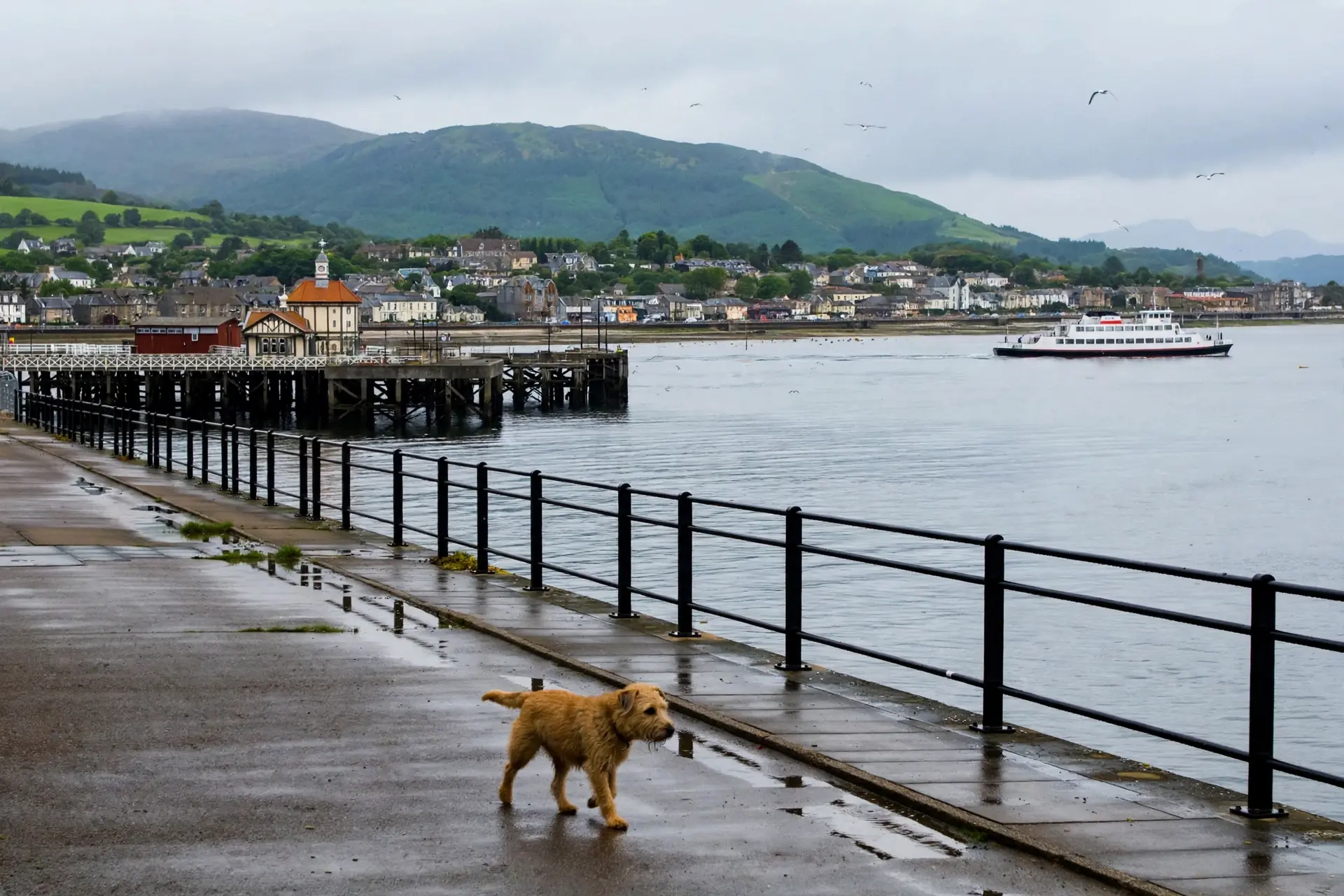
There are two ways across the Clyde to Dunoon, and choosing between them is the first practical decision of the trip. The CalMac passenger ferry runs from Gourock Pier to Dunoon Pier, carrying foot passengers only, and takes about twenty minutes. The Western Ferries crossing runs from McInroy's Point, just south of Gourock, to Hunter's Quay, just north of Dunoon town centre, and carries cars. Both are frequent, both welcome dogs, and the right choice depends on whether you are bringing a car.
Foot passengers should take the CalMac service. Gourock Pier is served by trains from Glasgow Central, so a car-free trip is entirely practical: train to Gourock, ferry to Dunoon, and walk from the pier into town. Dogs travel on the CalMac ferry, normally free of charge, and stay with their owners in the passenger areas; check the official guidance before you travel for the current rules on where dogs may sit and whether they must remain on a lead. The walk from Dunoon Pier to the town centre is a matter of minutes, and the promenade starts right there.
Drivers should take Western Ferries from McInroy's Point to Hunter's Quay. The crossing takes around twenty minutes, runs frequently through the day, and you stay with your car on the vehicle deck, which suits dogs that are calmer in their own vehicle than in a passenger lounge. Hunter's Quay is about a mile north of the town centre, so you will want the car for the onward journey unless you fancy a pleasant walk along the shore road. Booking is not usually required, but summer weekends and the Highland Gathering weekend can mean queues, so allow extra time and keep the dog exercised before you join the queue.
There is also a longer road route around the head of Loch Long and Loch Eck, via the Rest and Be Thankful pass and the A83, which takes well over an hour from Glasgow and is worth knowing about as a backup if ferries are disrupted by weather. It is a scenic drive, but it is not the route most visitors choose, and it adds a long stretch of winding road that some dogs dislike. If high winds cancel sailings, which happens occasionally in autumn and winter, the road route is your fallback — check the official guidance before you travel and keep an eye on the ferry operators' service updates on the day.
Whichever crossing you use, a little ferry preparation helps. Walk your dog before boarding so they are settled, keep the lead short in the terminal and on the car deck, and carry water for the wait. Dogs that are anxious around vehicles and engine noise do better on the passenger ferry, where they can sit with you, than on a car deck. Our guide to dogs at UK ferry terminals covers check-in timing, terminal walking spots and foot-passenger rules in more detail, and the same habits — arrive early, walk first, keep it calm — apply on the Clyde crossings too.
Once you are in Dunoon, you may find you barely need the car. The town centre, promenade and West Bay are all walkable, and the local bus service runs north towards Loch Eck and Benmore. That said, a car makes the forest walks, the garden and the loch shore much easier to reach, and it gives you a dry, familiar place for the dog to rest between outings. If you arrive as a foot passenger, plan your first day around the town and the shore, and use a taxi or bus for the one longer outing you most want.
The promenade, the pier and the beach
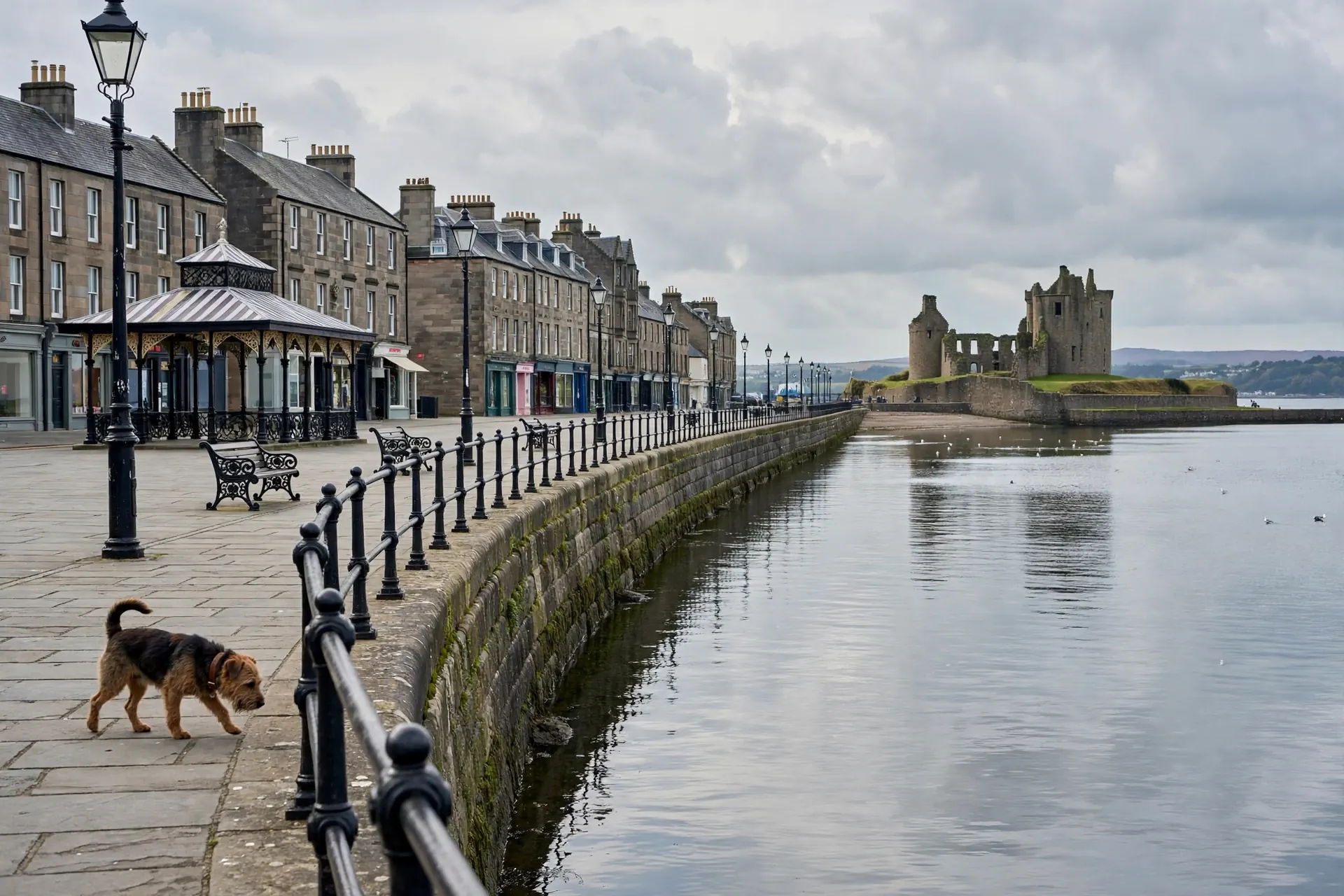
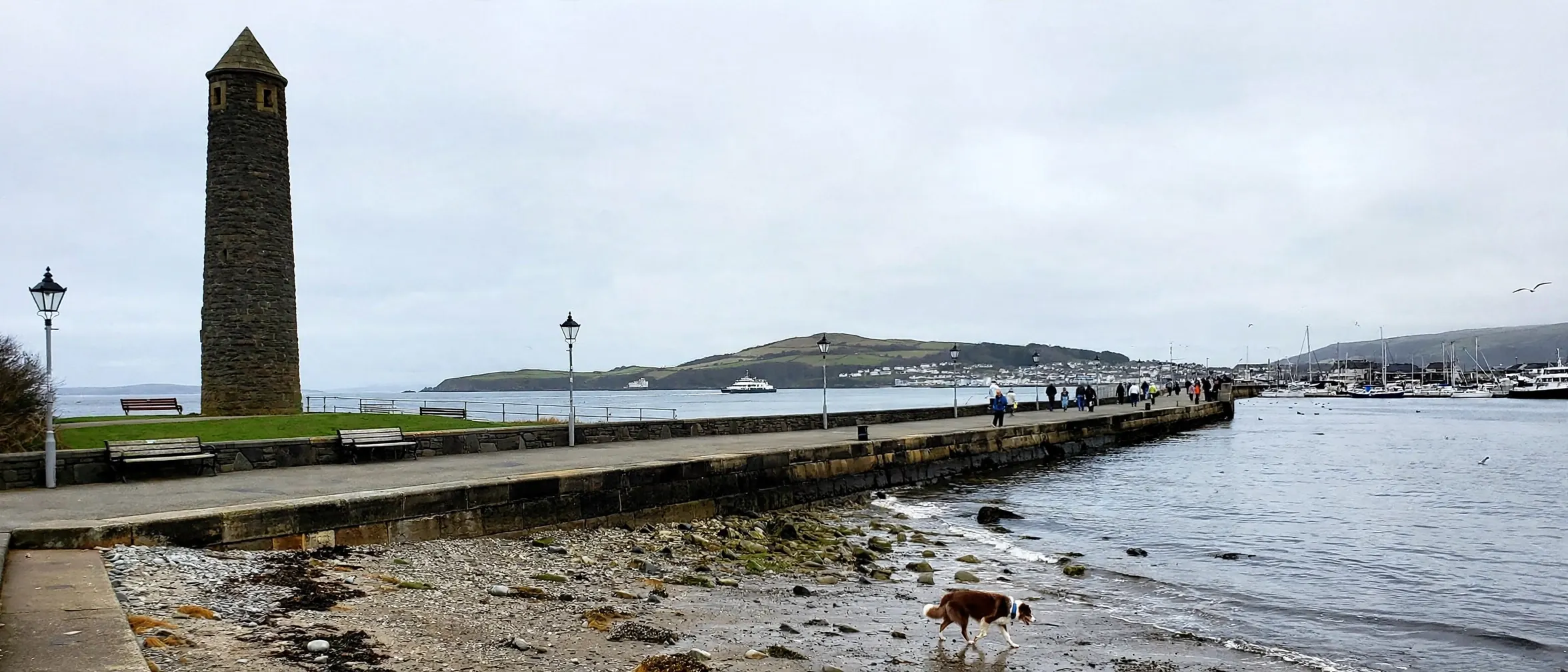
Dunoon's promenade is the natural first walk of any stay, and it is the walk you will probably repeat every morning. It runs along the seafront from the pier past the gardens and the Queen's Hall towards West Bay, flat and paved, with benches, grass and views across the Clyde to Gourock and the hills of Inverclyde. On a clear morning the water is busy with ferries, and dogs seem to enjoy the passing boats as much as their owners do. Keep the lead on along the promenade: it is a shared space with cyclists, children and other dogs, and the road runs close beside it in places.
Dunoon Pier itself is a Victorian structure and a landmark of the town. The pier building has been restored in recent years, and the area around it is a good place to start or finish a walk. Dogs are welcome on the pier and the surrounding gardens, but the pier can be busy when a ferry arrives, so if your dog is reactive, time your walk to avoid the disembarkation rush. The gardens beside the promenade — the Castle Gardens, below the site of Dunoon Castle — offer grass, shade and a gentler pace, and they are a useful option when the wind picks up along the open shore.
The beach at Dunoon is a mix of sand, shingle and rock, and the character of the shore changes with the tide. At low tide there is a good stretch of sand and firm ground for a run, while at high tide the water comes right up to the sea wall in places. Dogs are generally welcome on the main shore, and there is no widely publicised seasonal dog ban of the kind some English resorts apply, but local rules can change and some stretches near the pier or play areas may carry seasonal signage — check the official guidance before you travel, and keep your dog under control near families, picnics and wildlife. Our guide to dog-friendly beaches in Scotland explains how Scottish beach rules differ from English ones and what to check before letting a dog off the lead.
West Bay, south of the town centre, is the quieter end of the shore and often the better choice for dogs. The beach here is broader, the crowds thin out, and there is room for a proper off-lead run when the tide is out and the beach is quiet — provided your dog has reliable recall and you have checked for any local restrictions. The road along West Bay is popular with walkers, so keep an eye out for other dogs and for children on bikes. The bay is also a good spot for a sunset walk, when the light across the Clyde turns the water gold and the ferries are still crossing in the background.
Swimming needs care here. The Firth of Clyde looks inviting on a warm day, but the water is cold, the currents near the ferry piers are strong, and boats move in and out constantly. The safer swimming spots are the quieter stretches of shore north of the town and the sheltered edges of Loch Eck, where the water is calmer. Never let a dog swim near a pier or a ferry berth, watch for broken glass and fishing debris on the shingle, and rinse your dog after a swim in the sea or the loch. If your dog is not a confident swimmer, a long line and a shallow entry point are a better plan than a free run into deep water.
One practical note: the shore is tidal and the weather on the Clyde can change fast. A calm morning can turn into a wet, windy afternoon, and the promenade offers little shelter. Carry a waterproof coat for yourself and a drying coat for the dog, and be ready to cut a walk short. The town's cafes are close enough to the shore that a wet walk can always end with a warm drink and a dry seat, which is one of Dunoon's quiet advantages.
Walks: Puck's Glen, Benmore and Loch Eck
The walk most visitors remember from Dunoon is Puck's Glen, a short, steep gorge a few minutes' drive from the town centre, just off the road to Loch Eck. A burn runs through a deep, mossy ravine crossed by wooden bridges, with steps and narrow paths winding between towering conifers and ferns. It feels like a place out of a fairy tale, and it is a genuinely special walk — but it is not a walk for every dog. The route is steep, the steps are uneven, the surfaces are slippery after rain, and there is no off-lead running space in the gorge itself. Confident, fit dogs on a lead usually cope well and seem to enjoy the cool, shaded air; dogs that struggle with steps, slippery surfaces or steep climbs will not, and older or arthritic dogs should skip it. Allow about an hour for the loop, go after dry weather if your dog is unsteady, and keep the lead short on the bridges.
Benmore Botanic Garden, a few miles north of Dunoon on the road to Loch Eck, is the gentler counterpart to Puck's Glen. Dogs on leads are welcome in the outdoor areas, and the garden rewards a slow visit: the famous avenue of giant redwoods, the formal garden, the woodland trails and the views across the Holy Loch. Dogs are not admitted to the glasshouses or other indoor spaces, and owners are expected to keep them on a lead and clean up after them — check the official guidance before you travel, as admission rules and any seasonal restrictions can change. The garden is at its best in spring, when the rhododendrons flower, and in autumn, when the maples turn. It is also one of the few local walks that works well in light rain, since the tree canopy keeps much of the worst off.
Loch Eck itself, a long freshwater loch running north from the Holy Loch, is the third pillar of a Dunoon walking holiday. The road along its eastern shore is quiet, the views are wide, and there are lay-bys and short paths down to the water where a dog can paddle. The loch is popular with anglers, so keep dogs away from fishing lines and hooks, and be aware that the water is deep and cold even close to the shore. The Argyll Forest Park, which surrounds the loch, has a network of marked trails ranging from short riverside loops to longer hill routes. The trails around the Benmore and Loch Eck area are well signed, and the forestry tracks stay usable in wet weather when the gorge paths become treacherous.
Closer to town, the Bishop's Glen and the Corlarach Burn walks offer short woodland loops without the steepness of Puck's Glen. These are good options for a first-day walk or for an older dog: sheltered, close to the car, and quiet even on a busy weekend. The hills above Dunoon, including the route towards the summit of Corlarach, give longer views across the Clyde for fitter dogs, but the ground is rough and exposed, so save those for a dry day with good visibility. If you are unsure which trail suits your dog, ask at the local visitor information point or check the official guidance before you travel — staff know which paths are muddy, which are steep and which are closed for forestry work.
A word on livestock and wildlife, because the Cowal Peninsula is working countryside. Sheep graze the open hillsides, deer move through the forest at dawn and dusk, and red squirrels are present in the woodland around Benmore. Keep your dog on a lead near livestock, and be ready to recall quickly if deer appear. The Scottish Outdoor Access Code gives you the right to walk most land responsibly, but it also expects dogs to be under close control near farm animals — and a dog chasing sheep can end a holiday very badly. During lambing season in spring, extra care is essential.
Midges deserve a mention too. From late May to September, especially on still, damp evenings near water and woodland, midges can be ferocious around Loch Eck and in the forest. They bother people far more than dogs, but a dog that is already itchy or has sensitive skin will not enjoy a still evening walk. Walk earlier in the day, choose breezy shore walks over sheltered forest paths in midge season, and carry repellent for yourself. A windy day on the promenade is worth more than a still evening in the glen when the midges are out.
Where to stay with a dog
Dunoon has a good range of dog-friendly places to stay for a town of its size: self-catering cottages and flats, small hotels and guesthouses, bed and breakfasts, and caravan and camping sites on the edge of town and around the Holy Loch. Self-catering is usually the easiest option with a dog, because it gives you a kitchen, a door you can open for a late-night toilet trip, and space for a crate and a drying area. Look for properties with an enclosed garden or a fenced yard — they are worth paying a little more for, especially if your dog is a flight risk or a barker.
When you book, ask the specific questions that matter rather than relying on a "dog-friendly" label. Is there a pet fee, and how much is it per dog per stay? Is there a limit on the number or size of dogs? Are dogs allowed in all rooms or only in certain ones, and are they allowed on the furniture or only on the floor? Is there a secure place to dry a wet dog, and is there somewhere lit for a last outing after dark? The answers tell you far more than the listing does. Get the pet policy in writing with your confirmation, and keep it with your booking emails.
Hotels and guesthouses in Dunoon are generally welcoming, but rules vary. Some allow dogs in the bar and the garden but not in the restaurant; others welcome dogs throughout the ground floor. If you plan to eat in your hotel, confirm the dining rules before you book, or you may find yourself eating alone while the dog waits upstairs — and many places do not allow dogs to be left alone in the room. A property with a dog-friendly terrace or a garden you can sit in solves the problem neatly.
Caravan and camping sites around Dunoon and the Holy Loch suit dogs that are happy with a pitch and a routine. Check whether dogs must be kept on a lead on the whole site, whether there is a designated dog-walking area, and whether the site has a dog-wash or an outdoor tap. The sites closest to the shore are popular in summer and book up early, so reserve well ahead for school holidays. If you are comparing park stays more generally, our guide to dog-friendly holiday parks in the UK explains pet fees, boundaries and the questions worth asking before you pay.
One local point worth knowing: Dunoon is a popular base for walkers heading to the Cowal Way, the long-distance trail that runs the length of the peninsula. If you are walking the Cowal Way with a dog, you will want accommodation that accepts muddy boots and wet dogs without fuss, and that can hold luggage or arrange a transfer. Book each night's stay in advance, because the trail's small villages have limited dog-friendly beds, and a tired dog does not need a last-minute search for a room.
Finally, be honest about your dog when you book. A host who knows they are expecting a large, excitable spaniel can put you in the right room; a host who discovers one at check-in may not be able to. Mention the breed, the size, the number of dogs and any habits that matter, such as barking at other dogs or a habit of jumping on beds. Honesty is what keeps a place dog-friendly for the next visitor.
Eating out and dog-friendly cafes
Dunoon's town centre is compact enough that you can walk from the promenade to a cafe in a few minutes, and several of the cafes and pubs along Argyll Street and the seafront welcome dogs. The pattern is the usual Scottish one: dogs are commonly welcome in bar areas, on terraces and in the more relaxed cafes, but less often in formal dining rooms. Check the sign on the door or ask before you settle in, and do not assume that a place which welcomed a dog last year still does — policies change, and a quick question saves an awkward moment.
The best approach with a dog in a cafe is to choose your table well. A corner table near the door, away from the main thoroughfare, gives the dog a place to settle without being stepped over. Bring a mat or a blanket for the dog to lie on, and a chew or a stuffed Kong to keep them occupied while you eat. Order at the counter if you can, so you do not have to leave the dog alone at the table. A dog that can settle under a table for forty minutes is a dog that will be welcome back; a dog that barks at every passing tray will not be.
Takeaway food is a useful fallback in Dunoon. The town has fish and chip shops, bakeries and cafes that do takeaway, and a bag of chips eaten on a bench on the promenade, with the dog beside you, is often a better end to a walking day than a formal meal. Just be careful with dropped food: chips, bones and litter on the promenade are a hazard for dogs, and seagulls will compete for anything you drop. Keep the lead short and the dog's nose away from the bins.
If you are self-catering, the town's supermarkets cover the basics well, and there are local butchers and delis for better food. Stock up on dog food before you arrive if your dog eats a particular brand, because the smaller shops may not carry it — and a change of diet on holiday is a recipe for an upset stomach. Buy extra poo bags, a spare lead and a bottle of dog shampoo while you are there, because you will use all of them on a Cowal break.
Evening meals deserve a little planning. Some of Dunoon's pubs welcome dogs in the bar in the early evening but prefer a quieter atmosphere later, and a dog that has had a long day will usually settle better at six o'clock than at nine. Eat early, keep the outing short, and leave before the dog gets restless. If your dog cannot settle in a pub at all, do not force it — take a takeaway back to your accommodation and let the dog sleep. A good holiday is built from days the dog enjoys, not from meals you felt obliged to eat out.
Practical Dunoon: vets, shops and weather
Before you travel, save the details of the nearest vet practice in Dunoon and the nearest out-of-hours emergency vet, and keep them in your phone. Rural practices can be some distance away and may close early, and the ferry crossings mean that a mainland vet is not a quick option in an emergency. If your dog takes regular medication, bring more than you need for the trip, and carry the prescription details with you. A dog that needs a vet on holiday is stressful enough without a search for a phone number.
The town centre has the essentials: supermarkets, a pharmacy, a post office, outdoor shops and a handful of independent stores. There is a leisure centre with a swimming pool if the weather turns, and the Queen's Hall hosts events through the year. For dog supplies, the supermarkets carry the basics, but specialist food, a replacement lead or a particular brand of treats may need a trip to a larger pet shop on the mainland — another reason to pack carefully before you board the ferry.
Weather on the Cowal Peninsula is changeable, and the Clyde can deliver four seasons in a single afternoon. The promenade is exposed to wind from the west, the forest paths are sheltered but muddy after rain, and the hills above Loch Eck can be misty when the town is clear. Pack a waterproof coat for the dog as well as yourself, bring towels and a drying coat, and plan each day with a wet-weather alternative: Benmore's tree canopy, a cafe morning, or a short drive to a sheltered forest trail. Check the forecast each morning rather than trusting the one you read before you left home.
Parking in Dunoon is straightforward, with car parks in the town centre and along the shore, but the streets near the pier can be busy when a ferry arrives. If you are driving to a walk, arrive early on a summer weekend to get a space near the trailhead. Keep the dog in the car only for the shortest time, and never leave a dog in a parked car on a warm day — even on the Clyde coast, a car in sunshine heats up fast. A shaded parking spot and a bowl of water are the minimum if you must stop.
Mobile signal is generally good in Dunoon itself, but it can be patchy in the glens, in the forest and along the loch shore. Download offline maps for the Cowal Peninsula before you set out on a forest walk, and tell someone where you are going if you are heading into the hills alone with the dog. The paths in the Argyll Forest Park are well marked, but a phone with no signal and no offline map is a poor companion on a misty hill.
Finally, a note on the Scottish Outdoor Access Code, which governs where you can walk with a dog in Scotland. You have a right of responsible access to most land, including the shore, woodland and hills, but that right comes with responsibilities: keep dogs under close control, especially near livestock, keep them on a lead in fields with animals, and always clean up after them. Farmers, foresters and other walkers will all be more welcoming if your dog is visibly under control, and the code is worth reading before you travel — check the official guidance before you travel for the current version and any local notices.
Day trips: Bute, Arran and Loch Lomond
Dunoon's position on the Clyde makes it a good base for ferry day trips, and the two most natural ones are to the Isle of Bute and to the Isle of Arran. Bute is reached by the CalMac ferry from Colintraive, a short drive south from Dunoon down the Cowal Peninsula, to Rhubodach on Bute. The crossing takes only a few minutes, and from Rhubodach it is a short drive or bus ride to Rothesay, the island's main town. Rothesay has a Victorian promenade, a castle in the town centre, and the wide sandy beach at Ettrick Bay — and our guide to Rothesay with a dog covers the castle, the promenade and the island day-trip plan in detail.
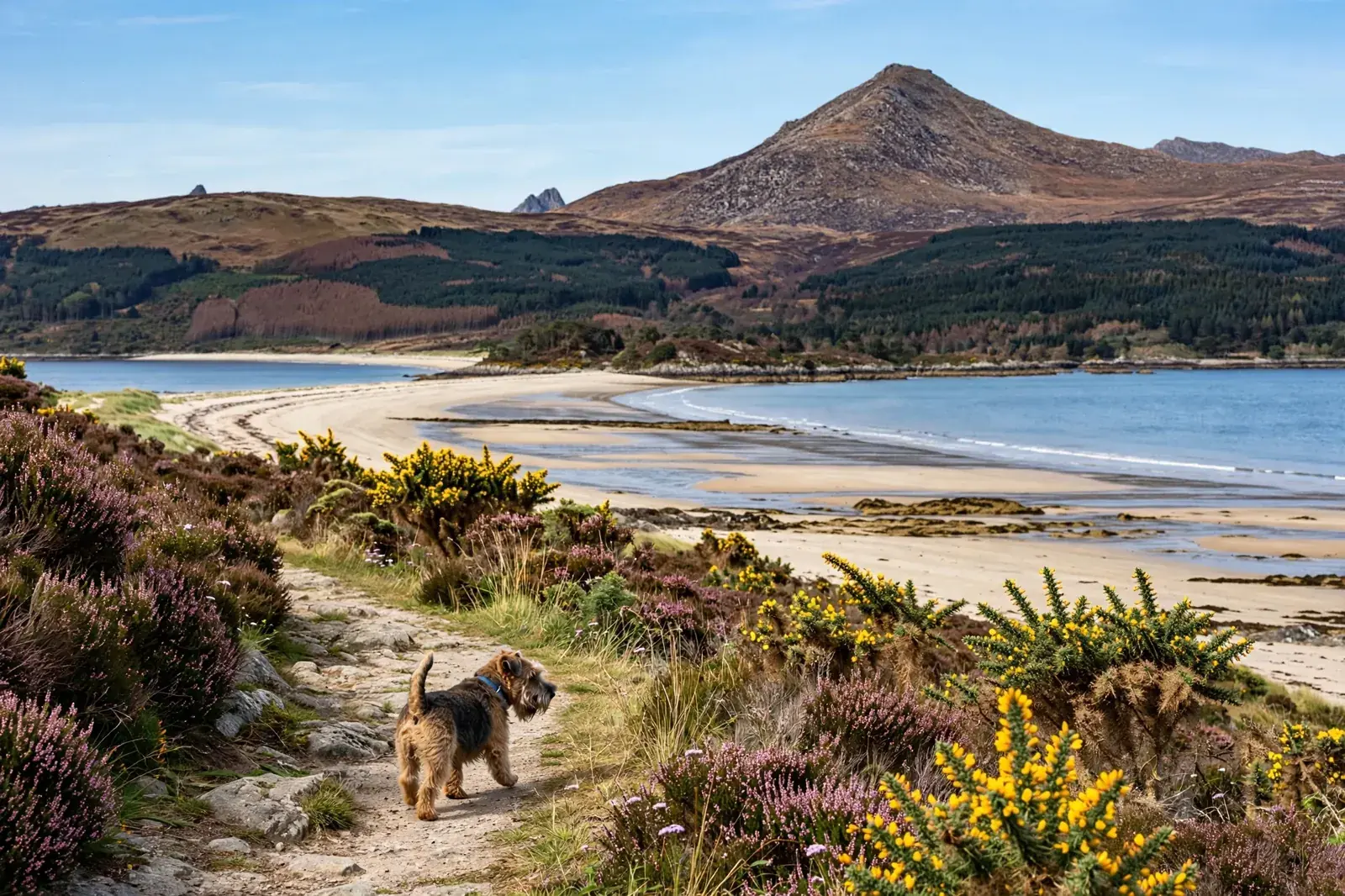
Arran is a longer day but a rewarding one. From Dunoon, drive south to Ardrossan on the Ayrshire coast, or take the ferry from Lochranza, and cross to Brodick. Arran is often called Scotland in miniature, and it earns the name: mountains, coast, forest and villages in a single small island. Dogs are welcome on the ferry, on most beaches and on the lower paths of Goat Fell, though the summit is a serious climb and not a walk to attempt with a dog on a hot day. Our guide to the Isle of Arran with a dog sets out a realistic island pace, because Arran punishes visitors who try to see it all in one day.
If you would rather stay on the mainland, the Ayrshire coast is within reach across the Clyde. Drive to Gourock, take the ferry, and you are in Ayrshire, where the beaches at Troon and Irvine, the grounds of Culzean Castle and the walks around the Heads of Ayr give you a different kind of day out. Our guide to the Ayrshire coast with a dog covers beach rules, castle grounds and the tides you need to respect. The contrast is the point: Dunoon's forested peninsula one day, Ayrshire's open sandy beaches the next.
Loch Lomond is another easy mainland day trip, about an hour's drive from Dunoon via the Rest and Be Thankful and the A82. The loch's shores offer beaches, woodland walks and boat trips, but they also need care: blue-green algae warnings appear in warm weather, camping needs a permit in the busiest areas, and the eastern shore can be crowded in summer. Our guide to Loch Lomond with a dog covers the shore walks, the boat rules and the algae warnings you should check before you let a dog near the water.
Closer to home, the Cowal Peninsula itself repays a slow day. Drive south from Dunoon towards Tighnabruaich and the Kyles of Bute, where the narrow channel between Cowal and Bute is one of the prettiest stretches of water on the Clyde. The road is single-track in places, the views are wide, and the villages are quiet — ideal for a dog that prefers a slow drive with short walks over a long hike. Stop at the viewpoints, let the dog stretch its legs on the shore, and take your time. The Kyles are also a good place to watch for seals and seabirds, which will interest the dog even if it cannot chase them.
Whatever day trip you choose, plan the ferry timings the night before. The Clyde crossings are frequent, but the last sailing back is a hard deadline, and missing it means a long drive around the head of the lochs or a night you had not planned. Keep the dog's lead, water and a snack in the car, and remember that a tired dog after a day trip needs a quiet evening, not another walk. The best day trips end early enough for a last gentle stroll on the promenade before bed.
A relaxed two-day plan
Day one is for Dunoon itself. Arrive by ferry in the morning and walk the dog before you do anything else — the promenade from the pier to West Bay is the perfect arrival walk, flat and full of new smells. Check into your accommodation, let the dog settle with water and a familiar bed, then spend the afternoon at Benmore Botanic Garden, where the redwood avenue and the woodland trails give you a gentle introduction to Cowal. Finish with an early dinner in a dog-friendly pub or a takeaway eaten on the promenade, and keep the evening quiet. The dog has had a day of new sounds, new smells and a ferry crossing; it does not need a second outing.
Day two is for the forest and the loch. Drive to Puck's Glen in the morning, while the dog is fresh and the paths are quiet, and take the gorge loop at a slow pace. Then drive on to Loch Eck, find a lay-by with a path to the shore, and let the dog paddle and sniff while you eat a picnic. If the weather turns, the Argyll Forest Park trails around Benmore are the fallback, and if the dog is tired, a short drive south to the Kyles of Bute gives you views without effort. End the day with a last promenade walk at dusk, when the ferries are still crossing and the town is settling down.
For a longer stay, add the day trips one at a time rather than stacking them. A week in Dunoon could be: day one in town, day two at Puck's Glen and Loch Eck, day three at Benmore and the Holy Loch, day four on Bute, day five on the Kyles of Bute, day six in Ayrshire or on Arran, and day seven as a rest day with a slow promenade walk and a long lunch. That pace leaves room for weather, for a tired dog and for the unplanned discoveries that make a holiday memorable — a quiet beach you find by chance, a cafe that welcomes the dog by name, a forest path that turns out to be the best walk of the week.
The plan works because it respects the dog's energy. A dog that is walked hard on day one and again on day two will be sore by day three, and a sore dog on holiday is a miserable companion. Build in a rest day, vary the surfaces — promenade one day, forest the next, shore the day after — and watch for the signs of tiredness: a dog that lags behind, that lies down on the path, or that stops sniffing is telling you it has had enough. Shorten the walk, go back to the car, and try again tomorrow.
Packing for a Cowal break
Pack for rain, mud and midges, and you will enjoy Dunoon in any weather. The essentials are a waterproof coat for the dog, a drying coat or at least two towels, a long lead and a short lead, plenty of poo bags, and a familiar bed or blanket so the dog can settle in unfamiliar accommodation. Add a collapsible water bowl and a bottle of water for every walk, because the forest trails and the loch shore do not always have a tap nearby, and a dog that has climbed Puck's Glen will be thirsty.
Foot care matters on the Cowal Peninsula. The shingle on the shore, the rocky paths in the gorge and the forest tracks can all be hard on paws, especially after rain when the ground is rough and wet. Check your dog's paws after every walk, carry a paw balm or a small first-aid kit, and consider booties if your dog has sensitive pads. A dog that is limping on day two will not enjoy day three, so a few minutes of paw care each evening is time well spent.
Bring the dog's usual food and enough of it for the whole trip, plus a few extra meals in case a ferry is cancelled and you stay an extra night. A sudden change of diet, or a day without the usual food, is the most common cause of an upset stomach on holiday. Pack any medication with the prescription, a copy of the vaccination record, and the vet's phone number. If your dog is on a special diet, a note of the exact brand and the nearest stockist on the mainland is worth having.
For the car, pack a waterproof seat cover or a crate, a spare towel for the boot, and a bowl of water for the ferry queue. For the accommodation, pack a stair gate if your dog needs one, a non-slip mat for hard floors, and a chew or a stuffed Kong for the evenings. And for yourself, pack a good waterproof jacket, sturdy walking boots with grip for the gorge steps, and a sense of humour about the weather. Dunoon rewards visitors who are prepared for rain and pleasantly surprised by sunshine, not the other way round.
One last packing tip: bring a torch. The winter evenings are dark, the forest paths have no lighting, and a last outing after dark on an unfamiliar path is much safer with a light. A head torch leaves your hands free for the lead, and a reflective collar or a light on the dog's harness makes the dog visible to cyclists and drivers on the shore road. It is a small item that makes a real difference on a November evening in Dunoon.
Practical questions
Before you go
Can dogs travel on the ferry to Dunoon?
Yes. Dogs travel on both Clyde crossings to Dunoon: the CalMac passenger ferry from Gourock Pier and the Western Ferries vehicle crossing from McInroy's Point to Hunter's Quay. Dogs are normally carried free and stay with their owners on the vehicle deck or in designated passenger areas, depending on the operator. Check the official guidance before you travel, as rules differ between the two crossings and can change.
Are dogs allowed on Dunoon beach?
Dogs are generally welcome on the main shore at Dunoon, including the West Bay and the beach beside the promenade, and there is no widely publicised seasonal dog ban of the kind some English resorts apply. That said, local rules can change and some stretches near the pier or play areas may have seasonal signage, so check the official guidance before you travel and keep your dog under control near families and wildlife.
Is Puck's Glen suitable for dogs?
Puck's Glen is a short, steep, magical gorge walk through dense woodland with wooden bridges, steps and narrow paths beside a burn. Confident, fit dogs on a lead usually cope well, but the route is not suitable for dogs that struggle with steps, slippery surfaces or steep climbs, and there is no off-lead running space in the gorge itself. Go after dry weather if your dog is unsteady, and allow about an hour for the loop.
Can dogs go into Benmore Botanic Garden?
Dogs on leads are welcome in the outdoor areas of Benmore Botanic Garden, which sits a few miles north of Dunoon on the road to Loch Eck. Dogs are not admitted to the glasshouses or other indoor spaces, and owners are expected to keep them on a lead and clean up after them. Check the official guidance before you travel, as admission rules and any seasonal restrictions can change.
Where can my dog swim safely near Dunoon?
The safest swimming spots are the quieter stretches of shore north of the town and the sheltered edges of Loch Eck, where the water is calmer than the open Firth of Clyde. Avoid fast currents near the ferry piers, watch for boats, and never let a dog swim after heavy rain when burns run high and water quality can drop. Check the official guidance before you travel, and rinse your dog after a swim in the loch or the sea.
Is Dunoon a good base for a week with a dog?
Yes, Dunoon works well as a week-long base because it combines a compact walkable town with immediate access to forest, loch and coast, plus easy ferry day trips to Bute and Arran. The town has supermarkets, vets and cafes, so you are not dependent on a car for daily needs, and the ferry crossings keep the wider Clyde within reach. Book dog-friendly accommodation early for school holidays, when the best places fill first.