This guide is independent and contains no paid placement. If affiliate links are added later, they will be clearly marked and will not change our editorial checks.
Ruthin is a compact market town where a dog does best on a lead and at a slow pace: Tudor timber-framed streets and the castle hill in the morning, a Clwydian Range walk or the Craft Centre after lunch, and a dog-friendly cafe or pub to finish. Keep your dog on a lead near sheep, check castle and gallery access before you travel, and arrive early on market days.
Start on the black-and-white streets
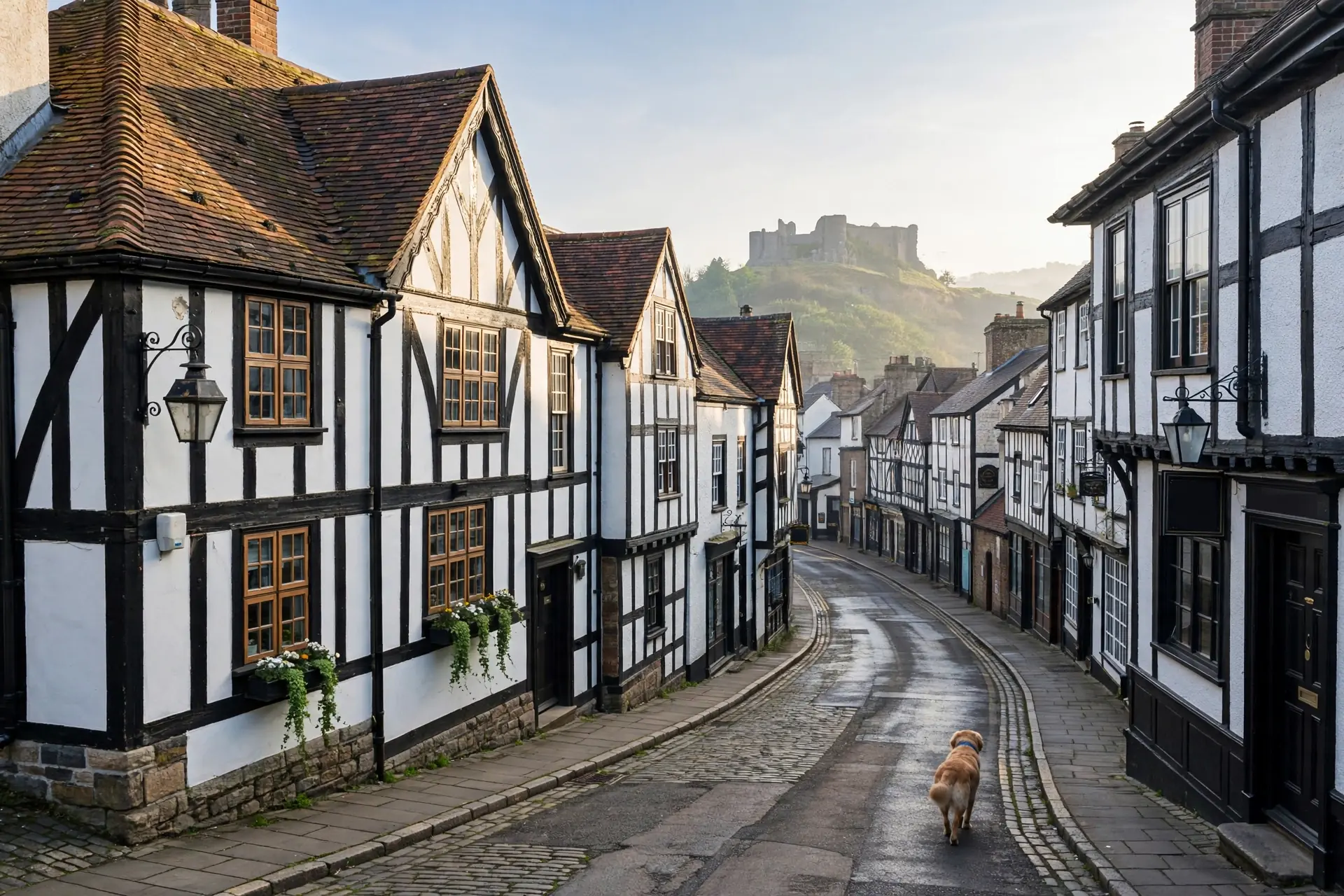
Ruthin announces itself before you have even parked. The town sits in the Vale of Clwyd, a wide green valley between the Clwydian Range to the east and the Hiraethog moors to the west, and its centre is a tight knot of medieval streets lined with black-and-white timber-framed buildings. For a dog, that matters more than it sounds: the streets are short, the pavements are narrow, and the whole centre is walkable in an hour, which makes Ruthin one of the easiest North Wales towns to explore on foot with a dog that is happy on a lead.
Begin at St Peter's Square, the small open space in front of St Peter's Church, and let the town set the pace. The church itself is one of the oldest parts of Ruthin, and the square is the natural meeting point for market days, dog walkers and people simply crossing town. From here, Clwyd Street runs downhill in a gentle curve, and it is the best street in town for a first look. The buildings along it are a mixture of genuine Tudor timber framing and later black-and-white revival work, and the effect is a street that looks like a film set but still works as a high street, with butchers, bakers, a bookshop and cafes behind the historic fronts.
The most famous single building is Nantclwyd y Dre, on Castle Street, which is described as the oldest timber-framed town house in Wales, dating from around 1435. It is easy to walk past without noticing, because it sits quietly among its neighbours, but it is worth a pause. The house has been restored and opened to visitors at certain times, and its garden is a small, enclosed surprise behind the street frontage. Check the official guidance before you travel for current opening times and dog rules, because a historic house with low doorways and a small garden is not always a comfortable place for a large or excitable dog.
Ruthin Gaol, a short walk away, tells a very different part of the story. The present gaol building dates from 1826, and it is a reminder that Ruthin was the county town of Denbighshire and an important centre of local government for centuries. The gaol is a museum today, and like most small museums it is a place to check the dog policy before you arrive rather than assume. Even if you do not go inside, the building and its position at the top of the town help you understand how Ruthin grew: the castle and the gaol on the high ground, the church and the market square in the middle, and the merchants' houses spread along the streets between them.
Keep an eye out for the building known locally as the Seven Eyes, on St Peter's Square. It is a distinctive house with seven dormer windows, and local legend ties it to a curse: a man condemned to death is said to have wished that the building would always be watched, so that its owners would never prosper. Whether or not you believe the story, it is the kind of detail that makes a slow walk with a dog worthwhile, because Ruthin rewards people who look up. Dogs, of course, look down, and the streets give them plenty to investigate: market stalls on market days, the smells from the bakeries, and the steady traffic of other dogs.
Ruthin is also a bilingual town, and the signs are part of the walk. Street names, shop signs and public notices appear in Welsh and English, and the Welsh language is a living part of daily life in Denbighshire rather than a museum piece. You do not need to speak Welsh to enjoy Ruthin, but a dog walk is a good time to notice the place names: Clwyd, the river that gives the valley its name, and the hills around it all carry names that describe the landscape in Welsh. Learning one or two local names — Moel Famau means bare hill, and the Clwydian hills are named for the river valley they overlook — adds a layer to the walk that no guidebook photograph can. If you stop to ask for directions, a friendly greeting goes a long way, and most people in Ruthin are happy to point a visitor with a dog towards the best route out of town.
A practical point about the streets themselves: they are old, and they behave like old streets. Pavements can be narrow and uneven, kerbs can be high, and some stretches have no pavement at all. Keep your dog on a short lead through the centre, keep them on the inside of the pavement away from traffic, and be ready to step into a doorway when a delivery van needs the full width of the street. Small dogs can find the cobbled and flagged surfaces hard on their paws after a long day, so plan a rest stop in a cafe or on a bench in the square. Older dogs and puppies will manage Ruthin well precisely because the distances are short: nothing in the centre is more than a few minutes from anything else, and there is always a quiet side street to duck into if your dog needs a break from people.
The best time to walk the streets with a dog is early morning, before the shops fill up, or late afternoon, when the day-trippers have left. Early light suits the black-and-white fronts, the streets are quiet enough for a nervous dog to relax, and you will often have the square almost to yourself. If you are visiting on a market day, the opposite applies: arrive early, do the street walk first, and then let the market be the second part of the morning rather than the first, so your dog is already settled and exercised before you ask them to cope with crowds, stalls and food smells.
Ruthin's market rights go back to the thirteenth century, when the town was granted its charter, and the market has been part of its identity ever since. That long history shows in the shape of the town: the square, the wide main streets and the market hall are all arranged around trade, and the buildings that line them were built by merchants who wanted to be close to the market. Walking Ruthin with a dog is, in a sense, walking through that history at pavement level. The dogs of the town's traders would have done the same walk centuries ago, past the same church and the same square, and the town still feels like a place that is used by its residents rather than staged for visitors. That is the best kind of town to visit with a dog: one where a dog on a lead is an ordinary sight, not an exception.
Ruthin Castle: ruins, gardens and the rules for dogs
The castle is the reason Ruthin exists, and it still dominates the town from its hill at the southern end of Castle Street. Ruthin Castle was built in 1277 by Dafydd ap Gruffydd, the brother of the last native Prince of Wales, and it passed soon afterwards into the hands of the de Grey family, who held it for centuries. It was besieged during the revolt of Owain Glyndwr in 1400, fought over in the Civil War, and slighted — deliberately damaged so it could not be used as a fortress again — in 1646. What stands today is a mixture of medieval remains and a later country house, and the site is now run as a hotel, the Ruthin Castle Hotel and Spa, with grounds and gardens around it.
That last fact is the one that matters most for dog owners. Ruthin Castle is not a public castle ruin with an open site and a ticket office. It is a privately run hotel, and its grounds and gardens are private hotel grounds. Dogs cannot simply wander in to explore the ruins, and the castle interior is not open to casual visitors. This is disappointing if you arrive expecting a National Trust-style castle visit, but it is much better to know it before you climb the hill than to discover it at a closed gate with a dog pulling at the lead.
What you can do is admire the castle from the public streets and footpaths around it, and it is well worth doing. Castle Street climbs gently towards the hotel, and the views back over the town and the Vale of Clwyd open up as you climb. The castle walls and towers are visible from the road, and on a clear day the view from the high ground takes in the full sweep of the valley and the Clwydian Range beyond. This is a good short walk for a dog: a steady climb, a view at the top, and a gentle descent back into town. Keep the dog on a lead throughout, because the road is used by hotel traffic and the verges are not fenced.
If you are staying at the hotel as a guest, ask the hotel directly about its dog policy before you book. Some country house hotels accept dogs in selected rooms and in parts of the grounds, and some do not, and the rules can change between seasons. Get the answer in writing with your booking, including any pet fee, which rooms accept dogs, where dogs are allowed in the grounds, and whether dogs can be left alone in the room. A hotel that welcomes dogs in principle but only in a handful of rooms is a very different booking from one that welcomes them everywhere, and the difference matters most when you arrive tired after a long drive.
There is another, quieter way to enjoy the castle's history with a dog. The medieval town walls survive in fragments around Ruthin, and the footpaths and lanes that run behind Castle Street give you a sense of the old defended town without any admission fee or opening hours. Walk slowly, look for the changes in the stonework and the sudden views between buildings, and let the dog set the pace. This is the kind of exploring that suits a dog far better than a formal tour: short distances, frequent stops, and no queues.
A word of caution about the castle hill itself. The ground can be steep in places, the grass can be slippery after rain, and the paths are not always surfaced. Dogs that are older, very small or recovering from injury may find the climb harder than it looks from the town below. There is no shame in admiring the castle from the bottom of Castle Street and saving your dog's energy for the Clwydian Range, which is the better walk in any case. Ruthin is a town that rewards patience: the castle has been on that hill for nearly 750 years, and it will still be there on your next visit.
Finally, respect the hotel's privacy. The castle grounds are someone's place of work and, for its guests, a place of rest. Do not try to enter the grounds through gaps in hedges or side gates, and do not let your dog run up to the hotel entrance or the car park. A dog on a lead on the public road, admired from a distance, is the right way to enjoy Ruthin Castle. The hill, the view and the history are all free; the grounds are not.
The castle's later history is worth knowing before you look at it from the road. After the Civil War the site passed through the hands of several owners, and in the nineteenth century the remains were rebuilt and extended as a country house, with the medieval walls and towers incorporated into a romantic, Gothic-style residence. In the twentieth century it became a hotel, and the grounds were landscaped for guests rather than for defence. That is why the castle looks the way it does today: not a bare ruin, but a lived-in building with gardens, lawns and a drive, and a place where the history is best appreciated from the outside. The view from Castle Street changes with the seasons — bare trees in winter open up the walls, while summer leaves soften the outline — and it is worth a second look on the way back down the hill, when the light has shifted and the town below has come alive.
Into the Clwydian Range: Moel Famau and the sheep country
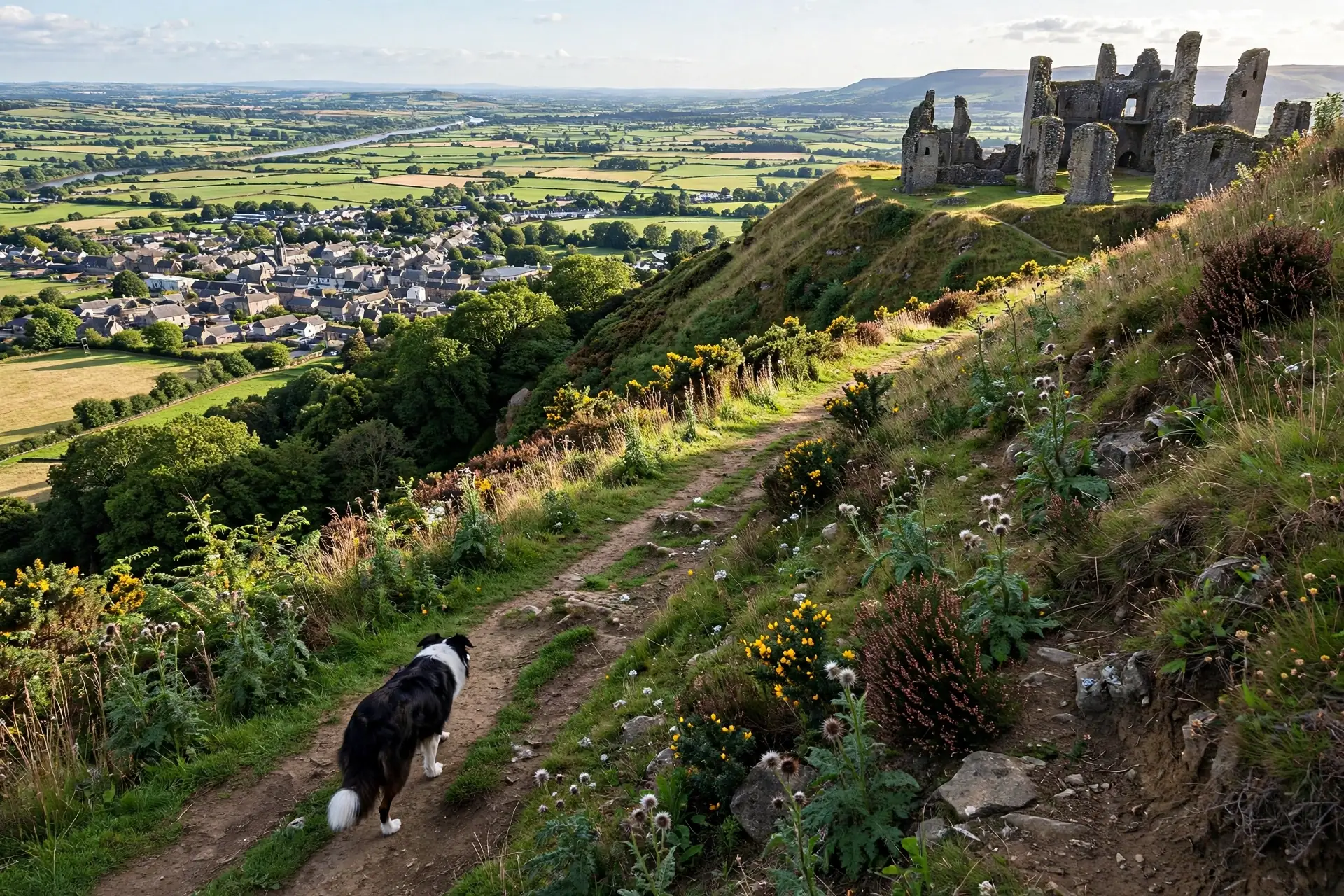
The best reason to bring a dog to Ruthin is the hill country on the town's doorstep. The Clwydian Range runs north to south to the east of the Vale of Clwyd, a chain of rounded heather-covered hills that form part of the Clwydian Range and Dee Valley National Landscape. The highest point is Moel Famau, at 554 metres, topped by the remains of the Jubilee Tower, built in 1810 to mark the golden jubilee of George III and partly destroyed by a storm in 1862. On a clear day the view from the top takes in the Vale of Clwyd, the Dee Valley, the North Wales coast and, on the very best days, the mountains of Snowdonia and the English border country.
Moel Famau is the classic dog walk from Ruthin, and it is a proper hill walk, not a stroll. The most popular starting points are the car parks at Bwlch Penbarras, on the road between Ruthin and Mold, and at Loggerheads, the country park on the River Alyn to the north-east. From Bwlch Penbarras the main path climbs steadily to the summit, a round trip of around three to four miles depending on the exact route, and most fit walkers allow two to three hours including stops. From Loggerheads the walk is longer and gentler, following the river before climbing through woodland and open moorland. Check the official guidance before you travel for current car park charges, path conditions and any temporary closures, because forestry work and path repairs can close sections without much notice.
Before you set off, be honest about your dog. Moel Famau is open moorland, exposed to wind and rain, with uneven ground, rocky sections near the summit and no shelter for much of the climb. A fit, healthy adult dog will love it. A puppy, an elderly dog, a very small dog or a dog with joint problems may struggle, and a dog that has never done a sustained climb may be exhausted halfway down. There is no cafe at the top and no water tap on the hill, so carry water for both of you, plus a bowl, and carry more than you think you need on a warm day. A long line is useful on the open hill if your dog's recall is not reliable, but a long line and sheep are a dangerous combination, so keep the lead short whenever livestock are in sight.
Sheep are the single most important thing to understand about walking in the Clwydian Range. The hills are working farmland, grazed by sheep all year round, and the rules are not optional. Keep your dog on a lead whenever sheep are present, and on a lead at all times during lambing season, which runs roughly from March to May. A dog that chases sheep can cause serious harm even without catching one: ewes can miscarry, lambs can be separated from their mothers, and a farmer is legally entitled to shoot a dog that is worrying livestock. This is not a theoretical risk in the Clwydian Range, and it is the reason the Countryside Code asks dog owners to keep dogs under close control. If your dog has a strong prey drive or has chased livestock before, choose a different walk, or keep them on a short lead for the whole route without exception.
The Offa's Dyke Path National Trail runs along the crest of the Clwydian Range, passing over Moel Famau, and it is the best long-distance option if you want a multi-day walk with your dog. The section through the range is one of the most rewarding parts of the whole trail, with long views in both directions and a sense of walking along a natural border. It is also a serious undertaking: the trail is exposed, the ascents are sustained, and accommodation along the way needs to be booked well in advance, with dog policies confirmed for every night. For a day trip from Ruthin, the out-and-back to Moel Famau is the sensible choice, and the Offa's Dyke Path can wait for a longer trip.
Loggerheads Country Park deserves a mention of its own, because it suits a very different kind of dog day. The park sits in a wooded valley on the River Alyn, with waymarked trails, a visitor centre, picnic areas and the remains of a lead mining landscape. The riverside paths are shaded and level, the woodland is cool on a hot day, and the park is a good choice for older dogs, puppies and dogs that need a shorter walk after a big day on Moel Famau. The river can be fast after rain, so keep dogs out of the water when the level is high, and check the official guidance before you travel for current parking and visitor centre arrangements.
Whatever route you choose, the practical rules are the same. Check the weather forecast before you leave Ruthin and again before you start climbing, because the summit can be in cloud when the town is in sunshine, and the temperature at the top can be several degrees colder. Wear proper walking boots, not trainers, and carry a waterproof layer even on a sunny morning. Tell someone where you are going and when you expect to be back, especially if you are walking alone with the dog. And when you get back to the car, give your dog water, a snack and a proper rest before you drive on: a dog that has just climbed 500 metres is tired, even if it is still wagging its tail.
The hill country is also a landscape to look at as well as to climb. In late summer the heather turns the open moorland purple, bilberry bushes line the lower paths, and the views from the ridge take in the patchwork of the Vale of Clwyd below. The Offa's Dyke Path is waymarked with the acorn symbol used on National Trails, so navigation is straightforward even in poor visibility, although a map and a compass are still worth carrying on a hill where the mist can come down quickly. Dogs often notice things walkers miss — a rabbit in the bracken, a curlew calling overhead, a change in the wind — and the Clwydian Range is a good place to let them use their nose. Keep the lead on, let them sniff, and accept that a hill walk with a dog takes longer than the same walk without one: that is not a delay, it is the point.
For a gentler alternative closer to town, the lanes and field paths around Ruthin itself offer shorter loops that are ideal for a morning or evening walk. The Vale of Clwyd is flat and fertile, and the field paths are a good way to see the valley's farms, hedgerows and small woods without committing to a hill climb. Keep to public rights of way, close gates behind you, and keep your dog on a lead near livestock and on the lanes, where traffic can appear suddenly around a bend. These low-level walks are the unsung part of a Ruthin trip: they are not dramatic, but they are exactly what a dog needs after a hard day on the hills.
The Jubilee Tower itself deserves a closer look once you reach the summit. The tower was built in 1810 to mark the golden jubilee of George III, and it was originally a substantial structure with a viewing platform and a statue. A storm in 1862 destroyed much of it, and what remains today is a ruined shell that has been made safe and opened as a viewpoint. Standing inside the remains with your dog at your side, looking out over the Vale of Clwyd to one side and the Dee Valley to the other, is one of the great moments of a North Wales walk — but it is also an exposed spot, and the wind at the top can be fierce even on a calm day in Ruthin. Keep a firm hold of the lead, keep the dog away from the edge of the ruined walls, and take your photographs quickly before heading back down to shelter. The summit is a place to pause, not to linger, and the best part of the walk is often the descent, when the dog finds a second wind and the valley opens up below you.
Market day, craft and the independent shops
Ruthin is a working market town, and the best way to understand it is to visit on a market day. The town's market hall and the stalls around St Peter's Square bring together local producers, food sellers and craftspeople, and the atmosphere is very different from a weekday morning. The market is a sensory overload for a dog: food smells, crowds, other dogs, children, and a constant stream of people stopping to chat. Some dogs love it. Others find it stressful. Know your dog, and plan accordingly.
If your dog is comfortable in crowds, the market is a good place to buy local food for a picnic or for the journey home. Look for Welsh cheeses, local honey, bread, cakes and seasonal produce, and ask the stallholders about their products: many of them are the people who made or grew what they are selling, and they are usually happy to talk. If your dog is nervous or reactive, visit the market briefly, keep the lead short, and move through the stalls without stopping for long. A dog that is over-aroused by crowds is not enjoying itself, however much you are, and a short visit that ends well is better than a long visit that ends in a scene.
The Ruthin Craft Centre is the town's best-known cultural attraction, and it is a different kind of shopping from the market. The centre describes itself as a national centre for applied arts, and it houses galleries, studios, a shop and a cafe in a striking modern building that was rebuilt in 2008. The shop sells work by Welsh and British makers: ceramics, glass, jewellery, textiles and woodwork, and it is one of the best places in North Wales to buy a genuinely handmade gift. Dogs and galleries are not always an easy combination, so check the official guidance before you travel and ask staff on arrival before taking your dog inside. The centre is well worth a visit even if your dog waits outside with one of your party, and the building's gardens and the walk back into town make a pleasant loop in themselves.
Between the market and the Craft Centre, Ruthin's independent shops are the town's quiet strength. The high street has held on to butchers, bakers, a bookshop, a hardware shop and a handful of gift and outdoor shops, and these are the shops that make a market town worth visiting rather than simply driving through. Small shops are generally dog-friendly in Ruthin, but the etiquette matters: ask before you bring a dog in, keep the lead short, keep the dog close to your side rather than letting it wander between shelves, and be ready to wait outside if the shop is small or crowded. A dog that knocks over a display of ceramics is not a dog that will be welcome back, and a shopkeeper who is asked politely is far more likely to say yes than one who is presented with a fait accompli.
Buying dog treats in Ruthin is easy. The butchers and the pet supplies in the outdoor shops are the obvious sources, and the market stalls often sell homemade dog biscuits and chews. If your dog has dietary restrictions or allergies, stick to treats you know and save the experiments for home. A new treat on a travel day, combined with a long walk and a car journey, is a reliable recipe for an upset stomach, and there is no pleasure in a dog that is unwell on the way home.
The Craft Centre and the shops also make Ruthin a good wet-weather option. North Wales rain is a fact of life, and a day that starts with a hill walk can easily end with an afternoon of browsing. Plan for it: keep a towel and a drying coat in the car, change into dry clothes before you go into a gallery or a cafe, and accept that a wet dog in a small shop is a test of everyone's patience. The town's covered areas are limited, so a good waterproof coat for you and a drying coat for the dog are the two most useful things you can pack for a Ruthin shopping day.
The Craft Centre's own story is part of the appeal. It was established in 1982 as a centre for the applied arts, and the present building, which opened in 2008, was designed to be a working place for makers rather than simply a gallery: studios, workshops and a shop sit alongside the exhibition spaces, and visitors can often see work being made. The building has won architectural awards, and its clean lines make an interesting contrast with the timber-framed streets a short walk away. If your dog cannot go inside, the walk to and from the centre is still worthwhile: it takes you through the quieter streets on the edge of the town centre, past gardens and houses that most visitors never see, and it is a good way to give the dog a calm walk after the busier streets.
Where to eat and drink with your dog
Ruthin eats well for a town of its size, and dogs are part of the picture rather than an afterthought. The cafes around St Peter's Square and Market Street are the natural choice for a mid-morning coffee or a lunch stop, and several of the town's pubs welcome dogs in at least part of the building. The details change often, so treat any list of dog-friendly venues as a starting point and check the current position before you travel, ideally by phone on the day. A pub that welcomed dogs last year may have changed its policy, and a cafe that allows dogs on the terrace in summer may not allow them inside in winter.
The practical pattern in Ruthin is the same as in most Welsh market towns. Cafes with outdoor seating are usually the easiest option for a dog, especially in summer, when you can sit outside with the dog settled under the table. Inside, the position varies: some cafes welcome dogs throughout, some allow them only in a specific area, and some do not allow them at all. The same applies to pubs, where the bar area is often more dog-friendly than the dining room. Ask when you arrive, and be specific: "Can my dog come in with us, and where should we sit?" is a better question than "Are you dog-friendly?", because it gives the staff something concrete to answer.
When you do sit down with a dog, the routine matters more than the venue. Bring a mat or a blanket for your dog to lie on, because a cold stone or tiled floor is uncomfortable for a dog that has just walked for two hours, and a mat also tells the dog that this is a settling-down moment rather than a new adventure. Keep the lead short and under your foot or attached to your chair, so the dog cannot wander between tables or investigate other people's food. Bring a small chew or a stuffed Kong to keep a restless dog occupied while you eat, and ask for a bowl of water as soon as you sit down. A dog that has water, a mat and something to chew is a dog that will settle, and a settled dog is a dog that gets invited back.
Food in Ruthin leans towards the local and the homemade. Expect Welsh produce, local meats, good cakes and proper coffee, and expect the menus to change with the seasons. The town's pubs serve the classic pub food that suits a hungry walker: a proper lunch after a morning on Moel Famau, a lighter meal in the evening, and a local ale or a soft drink to finish. If you are staying overnight, ask your accommodation for its recommendations as well: the people who run dog-friendly places usually know which pubs are genuinely welcoming and which merely tolerate dogs.
In summer, the gardens and terraces are the best seats in town. Several pubs and cafes in Ruthin have outdoor areas where a dog can stretch out in the shade while you eat, and these are often calmer than the indoor rooms, with fewer people passing close by. A garden table is also the best place for a dog that is still learning to settle in public: there is space to move, fresh air, and no low ceiling to amplify the noise. Bring the mat, bring the water bowl, and choose a table away from the main path to the bar, so the dog is not disturbed by every person who walks past. If the weather turns, be ready to move inside quickly or to finish up and head for the car — a wet dog on a pub terrace is nobody's idea of a relaxing lunch, and the rain in Ruthin rarely gives much warning.
Evening is a different proposition from lunch. A pub in the evening can be busy, noisy and full of food smells, and a tired dog may not cope as well as it did at lunchtime. If your dog is tired after a hill walk, consider an early dinner, a takeaway eaten back at your accommodation, or a quiet drink in a garden rather than a long evening in a crowded bar. Dogs that are overtired behave badly, and a dog that barks at strangers in a pub is a dog that will not be welcome next time. Know when to call it a day, and let the dog sleep.
One last piece of cafe etiquette: clean up after your dog, and do it without being asked. If your dog sheds heavily, brush them before you go inside. If they have muddy paws, wipe them at the door. If they have an accident, deal with it quietly and apologetically, and offer to pay for any damage. Dog-friendly businesses stay dog-friendly because dog owners behave well, and they stop being dog-friendly because a small number of owners do not. Ruthin is a small town, and its cafes and pubs remember.
Breakfast deserves a thought too, especially if you are staying overnight. An early hill walk works best on a proper breakfast, and several cafes in Ruthin open early enough to feed walkers before the shops fill up. Eat first, walk second, and let the dog settle under the table while you plan the route: a dog that has already had a calm hour in a cafe is a dog that will walk better on the hill. If you are self-catering, the town's bakers and food shops make it easy to put together a packed lunch for the summit — bread, cheese, fruit and water — and a picnic eaten on the hillside, with the dog lying beside you in the heather, is one of the simplest pleasures a Ruthin trip offers.
Staying over and parking: the practical details
Parking in Ruthin is straightforward, and that is one of the town's quiet advantages. The town centre has car parks within a short walk of St Peter's Square, the shops and the castle hill, and the streets themselves are short enough that a slightly further-out space is never a long walk. Arrive early on market days, when the town fills up, and check the signs for charges and time limits, because these vary between car parks and can change. Choose a space that leaves a short, level walk to your first stop, so a stiff or elderly dog does not have to cross the whole town, and park in the shade in summer so the car stays cool while you are out.
Never leave a dog in a car in warm weather, even for a few minutes, and never leave a dog in a car in direct sun. Ruthin is a small town and the car parks are close to the centre, so there is no reason to leave a dog waiting: take the dog with you, or leave one person with the dog while the other runs an errand. In winter, the same rule applies in reverse: a car cools down fast, and a wet dog in a cold car is a miserable dog. Plan your stops so the dog is never left alone in the vehicle.
Getting to Ruthin is part of the planning. The town has no railway station, so most visitors arrive by car or by bus. The A494 runs through the Vale of Clwyd and connects Ruthin to Mold and to the A55, the main coastal road, while the A525 links the town to Denbigh and Wrexham. Bus services connect Ruthin with Denbigh, Mold and Wrexham, but services can be infrequent, especially on Sundays and in the evening, so check the official guidance before you travel if you are relying on public transport. If you are coming from further afield, the nearest mainline stations are on the North Wales coast and at Chester and Wrexham, and a car is the most practical way to reach the town from any of them.
Staying overnight in Ruthin with a dog is well worth considering, because the town makes a good base for the whole of Denbighshire. There are hotels, bed and breakfasts and self-catering cottages in and around the town, and several accept dogs, but the details matter. Ask about the pet fee and get the all-in total in writing before you pay, including any cleaning charge or damage deposit. Ask which rooms accept dogs, whether dogs can be left alone in the room, whether there is an enclosed garden or a safe toilet area, and whether the property is near a road. A dog-friendly cottage with a garden is a very different stay from a dog-friendly hotel room on the second floor, and the right choice depends on your dog.
Ruthin Castle Hotel is the most distinctive place to stay, and it is worth asking about its dog policy if you like the idea of sleeping in a castle. Some country house hotels accept dogs in selected rooms, and the hotel's grounds and gardens are a selling point for guests. As with any hotel, confirm the policy in writing before you book, and ask about the practical details: where the dog can walk, whether dogs are allowed in the bar or the restaurant, and what happens at breakfast. A castle stay is a treat, but it is only a treat if the dog is genuinely welcome and not merely tolerated.
If you are using Ruthin as a base, the geography works in your favour. The town sits in the middle of Denbighshire, within easy reach of the Clwydian Range, the Dee Valley, the North Wales coast and the market towns of Denbigh and Llangollen. A sensible three-day plan is one hill day, one town day and one rest day: Moel Famau or the Offa's Dyke Path on the first day, Ruthin itself and the Craft Centre on the second, and a short riverside walk or a drive to the coast on the third. Dogs do not need three hard days in a row, and a rest day is not a wasted day: it is the day the dog recovers, sleeps properly and is ready for the journey home.
Before you leave home, run through the practical checklist. Pack the dog's food, medication, water bowl, lead, long line, towel, drying coat and a first aid kit, including tick removers and a phone number for the nearest vet. Save the vet's number in your phone before you need it, because rural practices can be some distance away and may close early. Check the weather forecast for both Ruthin and Moel Famau, and pack a waterproof layer and a warm layer for the dog as well as for yourself. Tell someone where you are going and when you expect to be back, especially if you are walking alone. And finally, check the official guidance before you travel for any of the details in this guide that could change: opening times, dog policies, parking charges and bus times all move, and the official source is the one to trust.
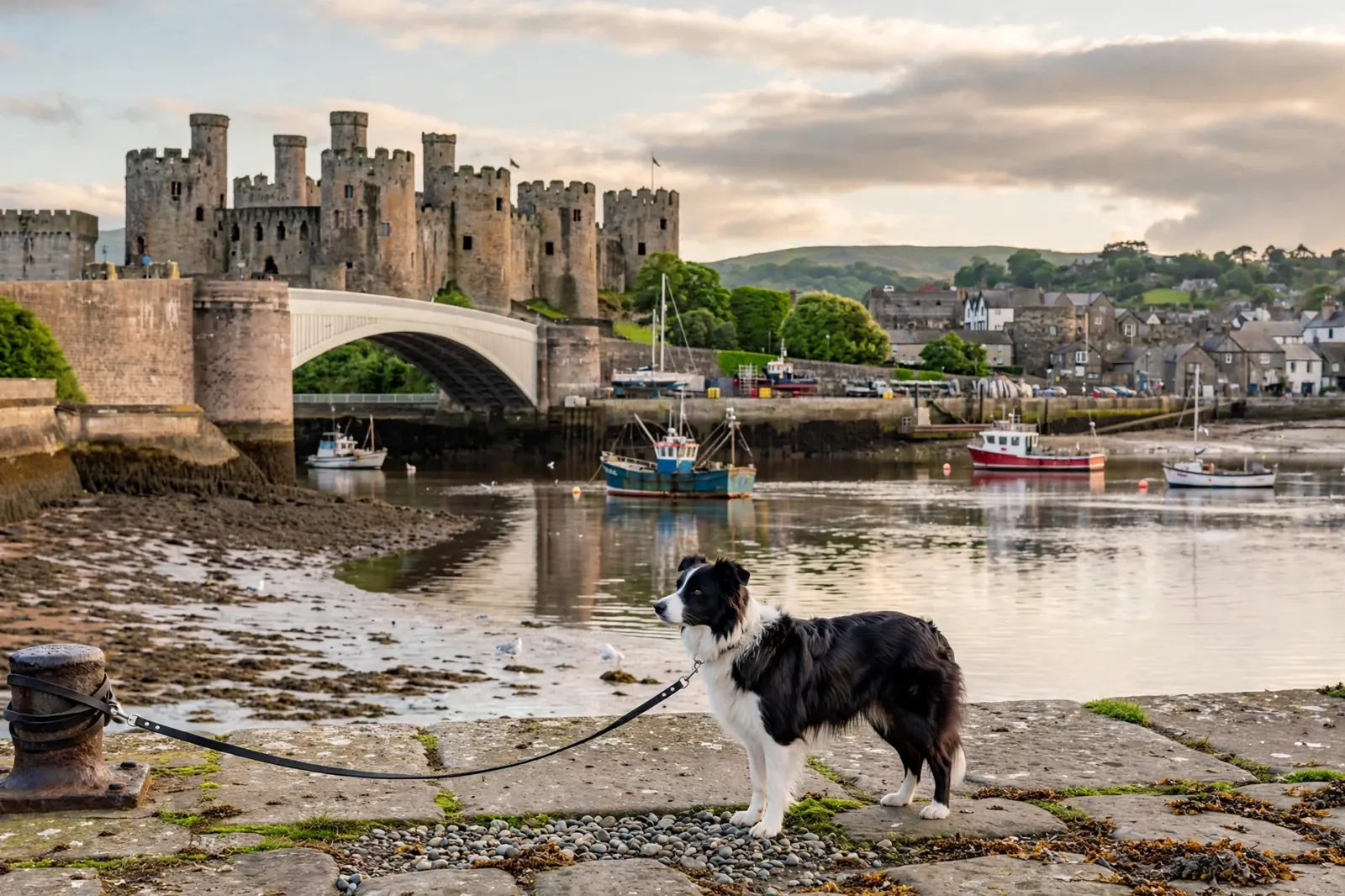
Ruthin is not the biggest town in North Wales, and it is not the most famous. That is exactly why it works so well with a dog. The streets are short, the hills are close, the food is local, and the pace is slow enough for a dog to enjoy. Give it a full day, or better still a long weekend, and it will repay you with a walk you remember. If you want to extend the trip, our guide to Conwy covers another North Wales walled town with castle rules, harbour walks and a beach, and it pairs well with a Ruthin stay as a second base on the way home.
Multi-dog households should plan a little more carefully than single-dog visitors. Some hotels and cottages accept only one or two dogs, and the pet fee is often charged per dog, so a three-dog household can face a bill that is higher than expected. Ask about the limit and the total fee before you book, and be honest about the number of dogs you are bringing: a property that discovers an extra dog on arrival is a property that may ask you to leave. On the hill, two or three dogs on leads need more management than one, especially around sheep, so consider walking them in turns or using a lead coupler only if your dogs are comfortable with it. In cafes and pubs, a well-behaved pair is welcome in most places, but a trio can overwhelm a small room — take the quieter table, keep the dogs settled, and be ready to finish quickly if they become restless.
Practical questions
Before you go
Can dogs go into the grounds of Ruthin Castle?
Ruthin Castle is a privately run hotel, so its grounds and gardens are not a public park and dogs cannot simply wander in. You can admire the castle from the surrounding streets and footpaths, and hotel guests should ask the hotel directly about its dog policy before booking. Check the official guidance before you travel, because access rules can change.
Is Moel Famau suitable for dogs?
Yes, for fit dogs that are used to hills, but keep your dog on a lead. Moel Famau is open moorland grazed by sheep, the weather changes fast, and the ground can be wet and uneven. Choose a route that matches your dog's fitness, carry water, and allow extra time for the descent.
Are dogs allowed in Ruthin Craft Centre?
Policies for galleries and craft shops vary, and they can change between exhibitions. Check the official guidance before you travel, and ask staff on arrival before taking your dog inside. The centre is well worth a visit even if your dog waits with one of your party outside, and the surrounding streets are pleasant for a short loop walk.
Where can I park in Ruthin with a dog?
Ruthin has town-centre car parks a short walk from St Peter's Square, the shops and the castle hill. Arrive early on market days, check the signs for charges and time limits, and choose a spot that leaves a short, level walk to your first stop so a stiff or elderly dog does not have to cross the whole town.
Is Ruthin a good base for a longer stay with a dog?
Yes. Ruthin sits in the middle of Denbighshire, within easy reach of the Clwydian Range, the Dee Valley, the North Wales coast and the market towns of Denbigh, Mold and Llangollen. Book dog-friendly accommodation early, confirm the pet fee and the rules in writing, and plan one hill day, one town day and one rest day so the dog does not do three hard walks in a row.