This guide is independent and contains no paid placement. Local rules on dogs, access and seasonal restrictions can change, so check the official guidance before you travel.
Use the valley gardens as the gentle middle level between cliff-top town and beach. Saltburn is best when you pick one level at a time, check the wind, and save the steepest climbs for a fit dog on a calm day.
A town on three levels
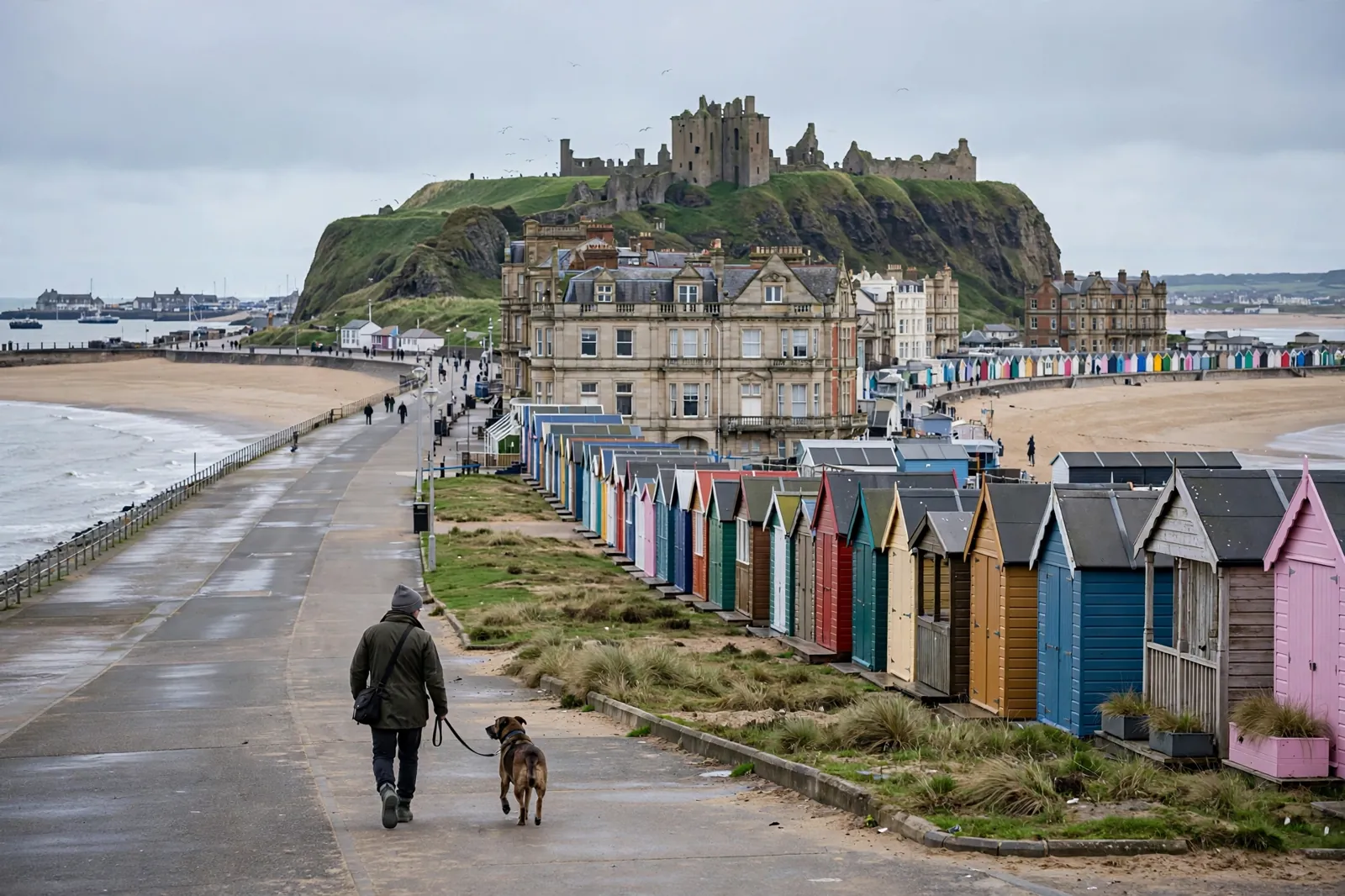
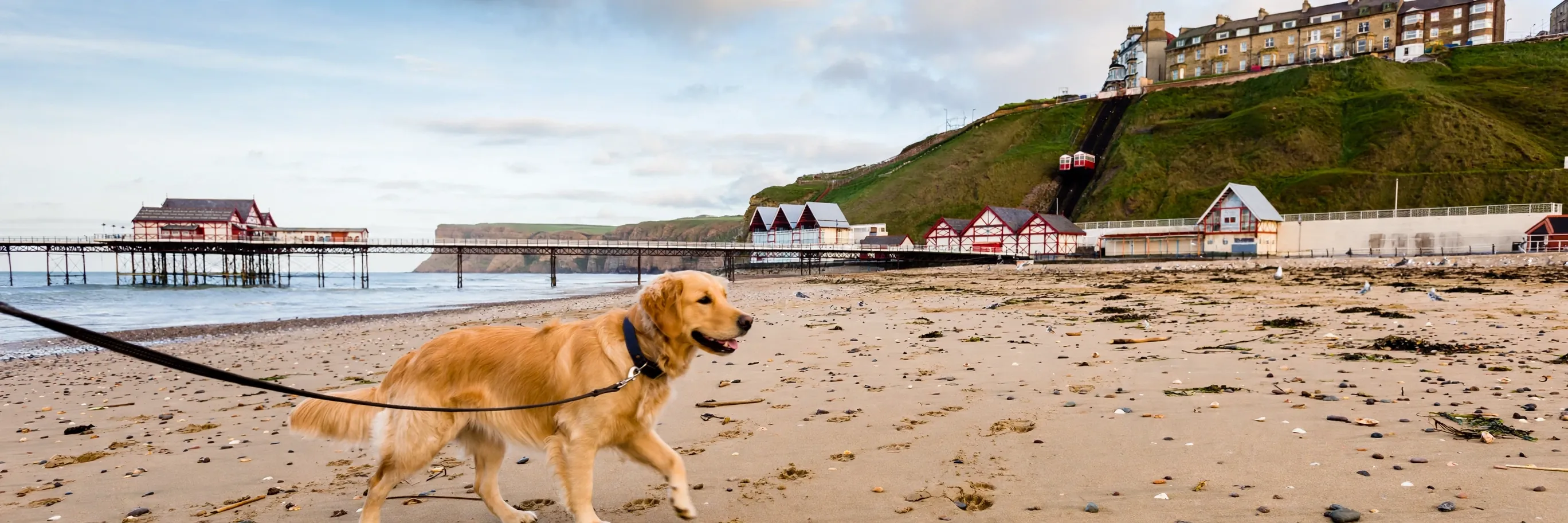
Saltburn-by-the-Sea is unusual among Yorkshire coastal towns because it is organised vertically. At the top sits the cliff-top town, with its streets, station and views. In the middle, Saltburn Valley Gardens drop through wooded slopes towards the sea. At the bottom lies the beach, the pier and the promenade. For a dog walk, that vertical layout is both the attraction and the challenge: you can have three different walks in one town, but moving between levels means gradients, steps or a cliff lift, and each dog will have a preferred level.
The sensible way to enjoy Saltburn is to treat the levels as separate walks rather than a single circuit that must include all three. Start on the level that suits the dog's morning energy: the flat cliff-top streets for a gentle start, the valley gardens for a shaded, interesting walk, or the beach for a dog that needs space. Move to another level only when the dog is ready, and use the gentlest available route for the change. A dog that has enjoyed one level properly has had a good Saltburn day; a dog that has been dragged up and down all three levels has had a tiring one.
Planning by level also helps with weather. Wind hits the cliff-top hardest, shade shelters the valley gardens, and the beach is exposed to both wind and sun. If the cliff-top is too windy, drop into the valley gardens for shelter. If the valley paths are muddy after rain, stay on the cliff-top streets or the promenade. Saltburn's three levels are not just scenery; they are a weather toolkit, and using them flexibly is what makes a Saltburn day work in changeable coastal weather.
The valley gardens: the gentle middle
Saltburn Valley Gardens are the town's secret weapon for dog owners. The gardens run down the valley towards the sea, with paths, trees, a beck and green spaces that feel sheltered even when the cliff-top is windy. For a dog, the valley offers what the beach and the cliff-top do not: shade, varied scents, a gentler gradient than the direct cliff paths, and a route that can be walked in sections. A dog that finds the beach too open and the cliff-top too exposed will often settle happily in the valley, where the walking is interesting without being overwhelming.
Walk the valley at the dog's pace, and treat it as a walk in its own right, not just a corridor to the beach. The paths wind, the ground changes from firm paths to softer woodland floor, and there are places to stop, drink and rest. Keep the dog on a lead where signs require it, respect garden beds and play areas, and step aside for other walkers, runners and families. If the valley paths are muddy after rain, they can be slippery, so wear shoes with grip and check the dog's paws afterwards. A valley walk after rain, with a towel waiting at the car, is still a good walk; it just needs a drying routine at the end.
The valley also works as a practical link. It connects the town to the seafront more gently than the steepest direct routes, and it gives an older or less fit dog a way to reach the beach area without a punishing climb. That said, the valley is not flat: it still descends and ascends, and a dog that struggles with gradients will still find it tiring. Use the valley in sections, turn back at a comfortable point, and remember that a partial valley walk with a happy dog beats a full valley traverse with an exhausted one.
The beach and the pier
At the bottom of Saltburn, the beach is a wide, sandy bay backed by cliffs, with the Victorian pier reaching out into the sea. The beach suits a dog that needs space to run, but only where rules allow and only at the right tide. Check the official guidance before you travel for current seasonal dog zones, and read the signs at each beach access point on the day, because zones and dates can change. At low tide the beach is generous, with firm sand near the water and room to run; at high tide it narrows and the walk becomes a promenade stroll.
The pier is a Saltburn landmark, and it is worth understanding before you plan around it. Piers have their own rules, surfaces and crowds, and a dog's experience on a pier depends on the day: a quiet pier walk with a view can be delightful, while a crowded pier with fishing lines, food smells and other dogs can be stressful. Check current access rules before you go, keep the dog on a lead, and be ready to skip the pier if it is busy or if the dog is uncomfortable on the surface. The beach and promenade below offer the same sea air without the pier's constraints, and there is no need to force a pier walk.
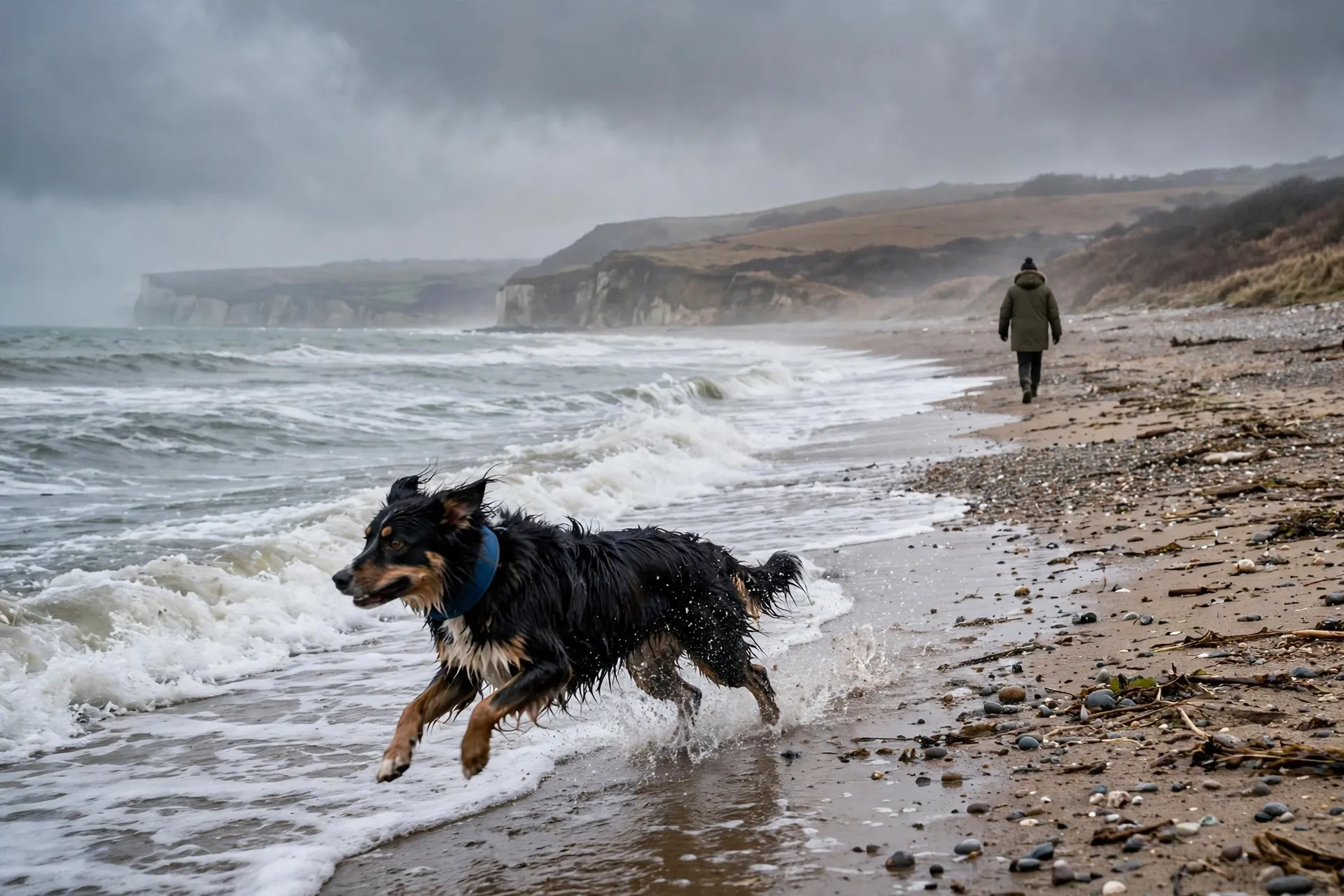
Beach basics apply with extra care here because of the cliffs. Keep the dog away from the cliff base, where falling debris is a risk, and do not let the dog scramble on rocks or climb towards the cliffs. Watch for fishing gear on the sand, keep the dog under control around other dogs, and carry water, because sand and wind dehydrate dogs faster than grass walks. After the beach, rinse paws, check between the toes, and dry the dog before the climb back up. A beach walk that ends with a calm dog and a planned ascent is a walk you can repeat.
Steep slopes and gentler alternatives
Saltburn's steepest routes are the ones that look shortest on the map and feel longest on the legs. Direct cliff paths, long flights of steps and steep road gradients all connect the levels, and they are a genuine challenge for older dogs, small dogs, dogs with joint problems and dogs that are simply not hill-fit. The alternative is to choose the gentler route even if it takes longer: the valley gardens for a graded descent, the cliff lift where it is operating and dogs are permitted, or a road route with a steadier gradient. Check the official guidance before you travel for current cliff lift access and dog rules, because operating times and policies can change.
If you do use a steep route, manage it like a hill walk, not a pavement stroll. Warm the dog up on flat ground first, keep the lead short, walk slowly, and stop on flat spots. Descents load front legs and shoulders, so a dog that rushes downhill is at risk of soreness the next day. Carry the dog on the steepest steps if the dog is small and the route is crowded, and never let a dog pull you down a steep path. If the dog hesitates repeatedly, turn back and choose the gentler alternative; the beach will still be there by the easier route, and the dog will arrive in better shape to enjoy it.
For dogs that cannot manage the levels at all on a given day, Saltburn still offers a good visit. The cliff-top town alone, with its streets, viewpoints and cafes, is a pleasant dog walk without any descent. A cliff-top day, with views over the bay and a calm pavement walk, is a legitimate Saltburn experience, not a failed one. Pair it with a flat walk elsewhere, such as a promenade in a neighbouring town, and the dog still has a full coastal day. The town's vertical layout should invite choice, not impose a test.
The cliff-top and the wind
The cliff-top at Saltburn offers long views along the coast, open sky and a firm, well-defined path, and it is the walk to choose when the beach is restricted or the tide is high. It is also the most exposed level, and wind is its defining condition. A strong onshore wind can make a cliff-top walk tiring for a small dog, carry away scent so the dog cannot settle, and push a dog sideways on open sections. Check the forecast for the coast, keep the dog on a lead and well back from the cliff edge, and be ready to drop into the sheltered valley gardens if the wind is too strong.
Safety on the high ground above Saltburn starts with accepting that the edge is not a fence line. Long stretches of cliff-top path run unfenced, with only grass and then air between a dog and a long drop, and a ball, a rabbit, or another dog sprinting toward that edge can pull a walker off balance in a single second. The rule that keeps this walk safe is positional: the dog walks on the landward side, on a short lead, with the walker between dog and drop, and no toy is ever thrown toward the sea side of the path. When a gust funnels up from the pier end or the path narrows around a viewpoint, stop where the ground is wide, let the gust pass, and only then move on — pressing forward through a narrow, gusty stretch gains nothing. The routes that link valley to cliff-top deserve the same discipline: a dog that has just bounded up a steep valley path arrives excited and less responsive, so pause at the top, re-settle the lead, and only then step out onto the open cliff-top ground.
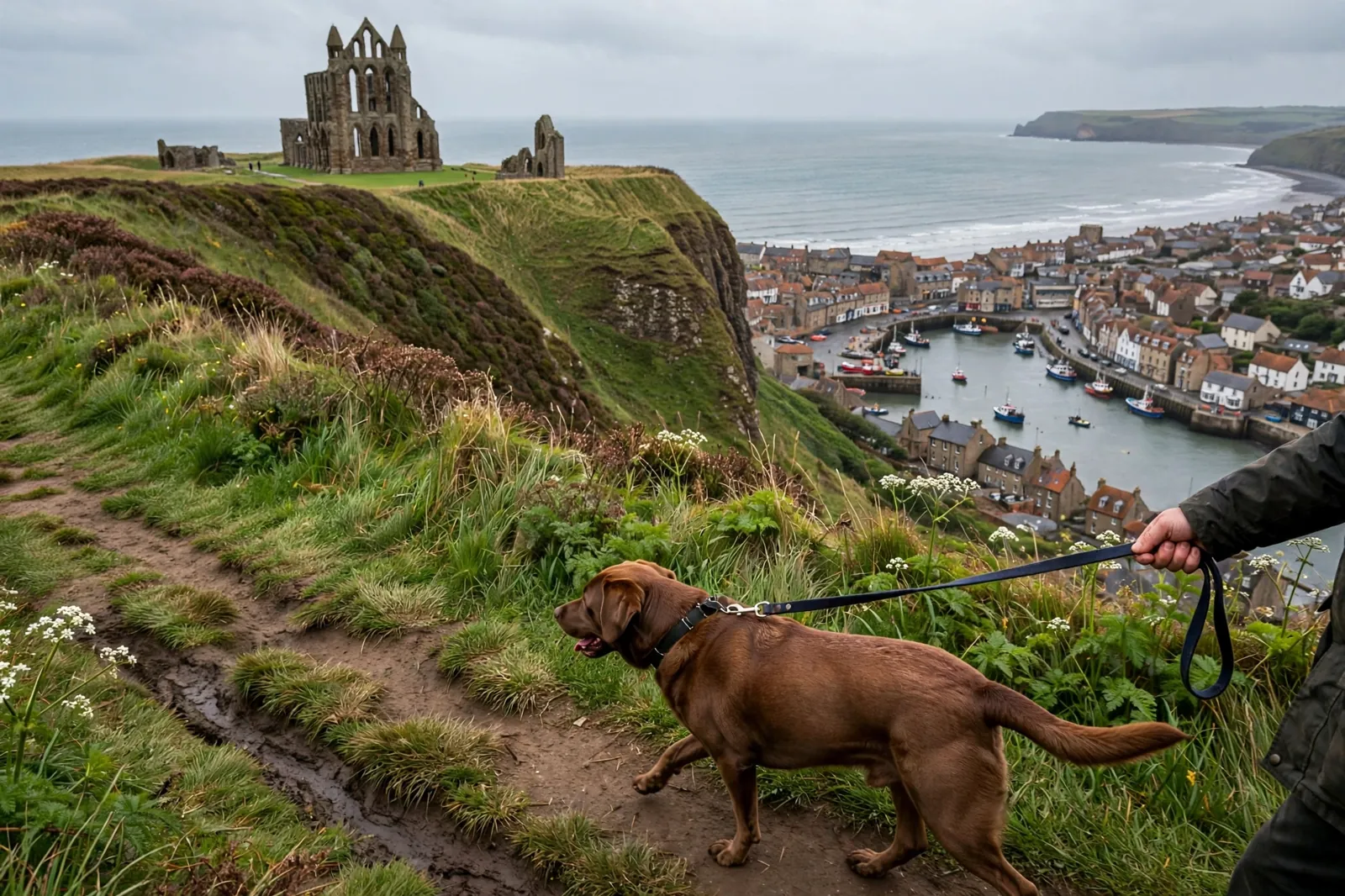
The cliff-top also connects Saltburn to the wider coast path, and that is where longer walks begin. A single, manageable section there and back is the right scale for most visitors, with a planned return rather than a long linear walk without transport. For a contrasting coastal day, Whitby to the south offers harbour life and abbey views, while Scarborough to the south-east offers two bays and a busier resort feel. Each town has a different coastal character, and visiting more than one lets you learn what your dog prefers.
The cliff-top town and eating stops
Up above the valley, Saltburn's town centre feels like a different place from the sand below: broad, level pavements, a station forecourt, small independent shops, and sudden gaps between buildings where the whole bay opens out. Dogs that found the beach too wide and noisy often relax here, because the walking is predictable — kerbs, shopfronts, benches — and the smells arrive one at a time instead of all at once. Coming up from the valley gardens or back from the shore, allow ten unhurried minutes on these upper streets before expecting a dog to lie quietly. That decompression stretch matters after a beach run: the body is still buzzing, the coat may still carry sand, and a dog that has just sprinted tends to pull, sniff frantically, or greet every passer-by. A slow loop past the viewpoints, with the lead kept close whenever another dog approaches on a narrow pavement, usually turns that buzz into a settle.
When hunger arrives, treat Saltburn's upper streets as the place to eat rather than defaulting to the seafront. Venues here differ wildly — one cafe may welcome a muddy spaniel under the table while the place next door only allows dogs on a terrace — and those house rules shift with the season and with staffing, so confirm the current position for the exact venue on the day instead of assuming last year's welcome still holds. Pick a table away from the door swing and the route to the counter, ask for a bowl of water early, and carry your own collapsible bowl as a backup. A dog that has already rested after a valley stroll, had a drink, and emptied itself will usually curl under a table within minutes; a dog hauled straight off a steep climb, still panting hard, will fidget, whine, and stare at every plate that passes. On a packed Saturday, skipping the queue altogether and carrying food to a cliff-top bench — dog on a short lead, wrapper secured against the wind — often produces a calmer, happier stop than squeezing into a noisy room.
For an overnight stay, Saltburn's slope becomes the deciding detail, and it deserves more attention than the view from the window. Many upper-town addresses sit a steep walk — sometimes a very steep walk — above the beach and the valley floor, so a late-night toilet trip can mean a long downhill in the dark followed by the same climb back, on wet pavements, with a sleepy dog. Before booking, ask precisely where the car will sit: a space at the top, near the accommodation, saves a midnight hill, whereas parking down by the seafront turns every evening outing into a two-level expedition. Ask too about the exact room's dog policy, any size or number limits, and the fee, because a general "dogs welcome" on a listing does not always cover every room. Bring the dog's own bed, its usual food measured out, and its bowl; familiar bedding does more to settle a dog in an unfamiliar room than a new blanket ever will. In the morning, a quick brush-down of mud and hair leaves the place ready for the next dog-owning guest.
Seasons across three levels
In high summer, let the three levels do the temperature control for you. The sand reflects heat and fills with families, other dogs, and the tightest seasonal zones of the year, so it belongs to the cool edges of the day: an early low-tide run before the crowds arrive, then out again only when the sun drops. Midday belongs underneath the valley canopy, where the beck, the trees, and the wooded banks keep the air several degrees cooler and the ground soft underfoot. Evening belongs back on the cliff-top, where a breeze off the sea and long light make a gentle pavement loop pleasant after the heat. Test pavements with your palm before letting a dog walk far on them, carry water on every outing rather than only on the long ones, and cut any walk short the moment panting turns heavy — a brief, cool valley loop beats a long, overheated beach session every time.
Once the holiday crowds leave, Saltburn narrows to its raw elements: a hard wind off the North Sea, grey waves breaking under the pier, and upper streets that empty by mid-afternoon. Many regular dog walkers love this stripped-back version, because the sand is free and the valley falls quiet — but winter asks for a different level strategy. The cliff-top, glorious on a calm frosty morning, becomes punishing when a northerly gusts across it, driving rain sideways and chilling a thin-coated or elderly dog within minutes. On those days, descend into the valley instead: the wooded banks break the wind, the beck keeps running beside the path, and the walk stays sheltered even while the sea roars a few hundred metres away. Shorten outings for older dogs, add a visible collar or clip-on light as daylight fades early, and keep the car warm and close for the return, since a wet, wind-chilled dog cools fast once it stops moving.
The shoulder months reward a dog walker who reads the day before choosing a level. Spring greens the valley fast — fresh leaves, a stronger beck after rain, and birds settling on the cliffs, which means leads stay on near the cliff edge and any signed nesting restrictions get respected rather than debated. Autumn colours the same valley gold and rust, while storms begin to hurl seaweed, timber, and broken shell onto the sand, so a post-storm beach walk ends with a careful paw check in good light. Neither season crowds the beach the way July does, and neither empties the town the way January does, which leaves all three levels genuinely usable: sand when the tide allows, valley when the wind picks up, cliff-top when the air is clear and still. Make the choice at the car, not at home — glance at the tide state, feel the wind on the cliff-top, look at the beach notices at the access point — and let those three observations pick the level for that hour.
A Saltburn day that works
A good Saltburn day starts with a choice, not a circuit. Pick the level that suits the morning: valley gardens for a shaded, interesting start, cliff-top streets for a gentle start, or beach at low tide for a dog that needs space. Walk that level properly, with water, rests and sniffing time, and only then decide whether to move to another level. By late morning you will know how the dog is feeling, and that feeling should decide the afternoon: a second level if the dog is keen, or a calm town walk if the dog is tired.
By midday, deliberately change down a level rather than adding another climb. If the morning was spent on the exposed cliff-top or on open sand, drop into the valley gardens for the middle of the day: tree cover instead of glare, a beck to sniff beside, and paths where the dog can amble without meeting a stream of beachgoers. Eat in the upper town if the dog has already had a proper rest and a drink, or take food to a sheltered valley bench if the dog is still settling. Either way, resist the urge to fill the middle hours with a second big walk — a dog that has already covered a full level in the morning gains nothing from a midday expedition, and will only arrive at the afternoon tired and fractious. When the late afternoon arrives and the wind often eases, a brief return to the cliff-top — firm pavements, the bay spread below, the dog now tired enough to walk without lunging — works as a gentle second act, provided the dog still wants it.
Close the day on ground you already know, at the level where the car or the bed is waiting. That last outing should be short, level, and close to home base, precisely so a tired dog does not face a steep ascent in fading light — and here the cliff lift, if it is running and dogs are allowed on it that day, becomes a real decision point rather than a novelty: using it turns a punishing final climb into a calm ride, while finding it closed means re-routing through the valley in daylight, not discovering the fact at dusk. Before settling in, work through a small end-of-day routine: rinse sand and grit from paws after a beach session, brush mud and leaf litter out of the coat after a valley session, offer fresh water, and look the dog over while the light is still good. Saltburn works best as a deliberate sequence — one level properly enjoyed, then a sheltered middle, then a calm close at the right height — with every steep link between levels chosen on purpose, never stumbled into.
Pier, promenade and seafront life
Saltburn's seafront, with its pier, promenade and beach, is the town's social centre, and it deserves a walk in its own right, separate from the valley and the cliff-top. The promenade is flat, firm and easy to follow, making it a good choice for older dogs, puppies and dogs that prefer paths to sand. It links the beach access points, the pier area and the valley exit, so it can serve as the spine of a seafront day: a promenade walk first, a beach section if conditions allow, and a promenade return when the dog is tired. Use it flexibly, and do not treat it as a route that must be walked end to end.
Down at seafront height, the variables stack up faster than they do on the cliff-top: dogs off lead on the sand, children running between the promenade benches, cyclists threading through, chip smells drifting from the kiosks, and, in summer, a queue of people funnelled toward the pier entrance. Keep the lead short enough that it never spans the promenade — a long line across a busy walkway trips cyclists and tangles with other dogs in seconds — and pull to the seaward side whenever a faster walker or bike needs to pass. Treat the pier itself as optional, not obligatory: when anglers are casting from its sides, surfboards are being carried down the steps, and the boards underfoot are slick with spray, the beach and promenade below give the same salt air with far fewer triggers. A dog that balks at the pier surface, the railings, or the press of people is telling you plainly; turn back at that point and the seafront walk stays a good one.
The seafront also changes with the tide and the time of day in ways that matter for dogs. At low tide the beach is wide and the promenade is a pleasant, uncrowded walk; at high tide the promenade carries more walkers and the beach narrows. Early morning and late afternoon are the kindest seafront hours for dogs: cooler surfaces, fewer people, and softer light. A seafront walk at those hours, with a drink for the dog and a bench for you, is Saltburn at its most pleasant, and it pairs well with a valley walk at midday when the seafront is busiest. Plan the seafront by tide and by hour, not by habit, and the dog will enjoy it far more.
Cleveland Way from Saltburn: west toward Skinningrove and east toward the coast path
Saltburn sits directly on the Cleveland Way, which means the temptation on a bright morning is to simply follow the waymarkers and see how far you get. Resist that temptation with a dog, especially a dog that has already had a valley or beach walk. The honest Saltburn approach is to pick one direction, walk out for a set time, and turn back along the same ground — a there-and-back stretch, decided before you leave, with the return built into the plan rather than improvised when the dog is already tired. Both directions reward that discipline, but they reward it in different ways, and the choice between west and east should be made on wind, legs, and how the dog copes with open cliff ground.
The westward stretch, toward Skinningrove, begins by climbing away from the seafront and quickly trades Saltburn's tidy three levels for rougher, more industrial-feeling cliff country. Old mining and ironstone traces sit alongside the path, the ground underfoot changes from smooth promenade and valley path to grass, stone, and uneven cliff-top turf, and the gradient comes in short, sharp pulls rather than one steady slope. A dog that handled the valley gardens comfortably may still find these pulls hard, because the climbs arrive after the legs are already warm from the ascent out of town, and the descents load the shoulders on the way back. Walk this direction on a calm day if the dog is hill-fit, keep the lead short wherever the path runs near the edge, and turn at a pre-agreed time — forty-five minutes out is a generous first attempt — rather than at a landmark that keeps receding.
Eastward, the coast path opens out into longer, more exposed cliff-top walking, with wide views and very little shelter between headlands. This is the direction to choose when the wind is light and the dog is steady on a lead, because there are fewer trees, fewer walls, and fewer places to duck out of a gust. The appeal is real: firm grass paths, sea on one side for mile after mile, and a sense of space that the valley gardens cannot offer. The cost is equally real: a dog that chases will be tempted by birds lifting off the cliff face, by rabbits in the rough grass, and by other dogs appearing over a rise, and every one of those temptations sits close to an unfenced edge. On this side, the lead is not a courtesy for other walkers; it is the main safety device for the whole walk, and it stays on from the moment the path leaves the town streets until it returns to them.
Lead rules on both directions deserve a plain statement before you set out. Keep the dog on a lead near every cliff edge, without exception, and keep it on wherever livestock is grazing, wherever a sign asks for it, and wherever the path passes through a narrow field gate or a farm track. A dog that is normally reliable off lead on a beach is not automatically reliable on a cliff-top path where a single chase can end at a drop, and the presence of sheep or cattle changes the calculation entirely: a loose dog around livestock is a danger to the animals, a legal risk for the owner, and a fast route to a ruined walk. If the dog needs off-lead time, give it on the beach at a suitable tide or in the valley gardens where the ground allows it, and treat the Cleveland Way sections as lead walks from start to finish.
Gradient honesty matters more here than distance bragging. Saltburn's own levels already ask a lot of a dog's legs, and adding a Cleveland Way section on top of a valley descent and a beach run can quietly double the day's climbing. Count the day's total, not just the coast-path section: the climb from seafront to cliff-top town, the valley gradients, and the coast-path pulls all draw on the same legs. Older dogs, small dogs, and dogs recovering from stiffness will feel the second half of a there-and-back walk far more than the first, because the return journey includes climbs that were descents on the way out. Watch for the early signs — a slower pace on the flat, a reluctance at the foot of a slope, repeated stopping — and treat them as the turn-back signal even if the planned time has not expired. A shorter section walked happily is worth more than a longer section finished with a limping dog.
Return transport planning is the part most visitors skip, and it is the part that causes the most trouble. A linear walk that ends somewhere else only works if the way back is certain before you start: a train time from the nearest station, a bus that actually runs on that day of the week, or a pre-booked lift that knows the dog is travelling too. Saltburn's own station sits up in the cliff-top town, so even a walk that ends back in Saltburn still finishes with a climb or a lift ride to reach it — factor that final ascent into the dog's remaining energy, and do not leave it as a surprise. If no return option is certain, the there-and-back plan is the right plan: walk out, turn, walk back, and finish at the car or the accommodation with the dog still comfortable. Carry water, a lead, and a phone with charge for the whole section, tell someone the direction and the expected return time on a longer walk, and keep the dog's energy in reserve for the climb home, because in Saltburn the walk is never quite finished until the last level has been climbed.
Surf, boards and the pier end: beach safety for dogs that chase
For a dog that chases, Saltburn beach is not one beach but several different beaches depending on where you stand, what the tide is doing, and who else is in the water. The surfers gather where the waves break best, which at Saltburn is often near the pier and the central stretch of sand; boards are carried down the steps and across the sand, wetsuited figures paddle out and pop up, and to a chase-driven dog that whole scene reads as a game in progress. A dog that will sprint after a ball will sprint after a board, a surfer, or a gull lifting off the waterline, and once that sprint starts on open sand it is very hard to stop before the dog reaches the water, another dog, or a group of people. The first safety decision, therefore, is not about the lead; it is about position. Choose the stretch of sand before you unclip anything, and choose it for the dog you actually have, not the dog you wish you had.
Start by reading the surfers the way you would read other dogs: as a trigger to be managed, not ignored. On a surfable day, the central beach near the pier will be busy with boards, lines, and people moving quickly between water and shore, and a chase-prone dog will fixate, vocalise, and pull from the moment it sees the first board. Walking that dog through the middle of the surf zone, off lead, invites a chase that ends in the shallows among boards and fins — a risk to the dog, to the surfer, and to anyone standing in the way. The calmer alternative is to walk the quieter sand away from the main surf break, where the waves are smaller, fewer boards are in play, and the dog has room to run without a target every twenty metres. Even there, keep the first ten minutes on lead while the dog takes in the new smells and settles, and only consider off-lead time if the dog is responding promptly and no new trigger has appeared.
Fishing from the pier adds a second, sharper hazard that has nothing to do with chasing. Lines drop from the pier into the water, hooks and bait sit in tackle boxes on the pier deck, and discarded line, hooks, and baited ends wash up or get dropped on the sand and the promenade below. A dog that scavenges will find a hook long before its owner spots it, and a dog that chases a cast line can tangle itself in seconds. Keep a chase-prone or scavenging dog well away from the water directly beneath the pier when anglers are fishing, check the sand around your chosen spot for line and tackle before letting the dog roam, and carry the dog past any obvious fishing gear rather than letting it investigate. If the dog does pick something up, trade it rather than wrestling it out of the mouth, and check the mouth and paws afterwards — a swallowed hook is a veterinary emergency, not a walk inconvenience.
Cliff-base debris is the third hazard, and it is easy to miss while watching the surf. The cliffs backing Saltburn beach shed rock, and after storms or heavy rain the base of the cliff can be littered with fallen stone, broken shell, and timber washed in by the tide. Dogs love to scramble and sniff along that cliff base, especially where gulls nest and where the rock pools hold smells, but a dog scrambling on loose rock under an overhang is exposed to falling debris from above and to cuts below. Keep the dog on the open sand, away from the cliff foot, and steer clear of rock piles that invite climbing. The same caution applies after a storm anywhere on the beach: walk the chosen stretch yourself first, look for sharp debris and tangled line, and only then let the dog use it. A few minutes of checking saves a cut paw, a vet visit, and a ruined holiday.
Wind funnelling at the pier end deserves its own warning, because it changes the beach in a way that is invisible from the promenade. As wind meets the pier structure and the cliff corner, it accelerates and gusts around the pier end, driving sand sideways, flattening a dog's ears, and carrying scent in confusing swirls that make a dog restless and hard to recall. A small dog can be pushed sideways by a strong gust, and a chase-prone dog, already aroused by surfers and gulls, becomes harder to call back when the wind is also battering it. On a gusty day, avoid the pier-end zone altogether and pick a stretch further along the bay where the wind runs cleanly off the sea rather than funnelling around a structure. If the dog's ears are flat, its body is low, and it is struggling to hear a recall over the wind, that is the signal to move to shelter — the valley gardens, the promenade behind a windbreak, or the car — rather than to push on.
Putting it together, the quiet-stretch strategy for a chasing dog looks like this: arrive at low tide when the sand is widest, walk past the pier and the surf break to a quieter section, check that section for fishing line and cliff debris, spend the first minutes on lead while the dog settles, and only then allow controlled off-lead time in a defined area with a clear recall plan. Keep a long line as a middle option if recall is uncertain — it gives the dog running room without giving it the freedom to reach the surf zone or the cliff base. Bring fresh water, because a chasing dog on sand dehydrates fast, and end the beach session before the dog is exhausted rather than after, so the recall still works on the walk back. Saltburn can be a wonderful beach for a dog that chases, but only when the owner picks the stretch, the tide, and the wind with that chasing instinct in mind, instead of letting the dog pick the most exciting corner of the bay and hoping for the best.
Practical questions
Before you go
Is Saltburn beach dog-friendly all year?
Zones and seasonal restrictions can apply, so read the signs at each beach access point on the day and check the official guidance before you travel. Low tide usually gives the widest, most usable beach.
Can dogs use the Saltburn cliff lift?
Access and dog rules for the cliff lift can change, so check the official guidance before you travel. The valley gardens offer a gentler alternative route between town and seafront.
Is Saltburn suitable for older dogs?
Yes, if you use the gentler levels and routes. The valley gardens, cliff-top streets and promenade suit older dogs better than steep cliff paths and long beach runs, and walks should be short with frequent rests.
Is the cliff-top path safe for dogs in wind?
Yes, with a lead and distance from the edge. Cliff edges are not fenced everywhere, and strong wind can push a small dog sideways, so drop into the sheltered valley if conditions worsen.
What is the best first walk in Saltburn with a dog?
The valley gardens are a good first walk: shaded, interesting and gentler than the steepest direct routes. They also link town and seafront without forcing a hard climb.
Can I walk from Saltburn along the coast with a dog?
The coast path offers longer sections, but choose one manageable there-and-back stretch, keep the dog on a lead near cliff edges and livestock, and plan the return before you set out.