This guide is independent and contains no paid placement. If affiliate links are added later, they will be clearly marked and will not change our editorial checks.
Winter often opens up beaches that are restricted in summer, but it also brings higher tides, stronger winds, shorter days and colder water. Check the local rules and tide times first, pick a route with an easy exit, keep the dog visible and warm, and plan the drying-off before you set out.
Why winter suits coastal dogs
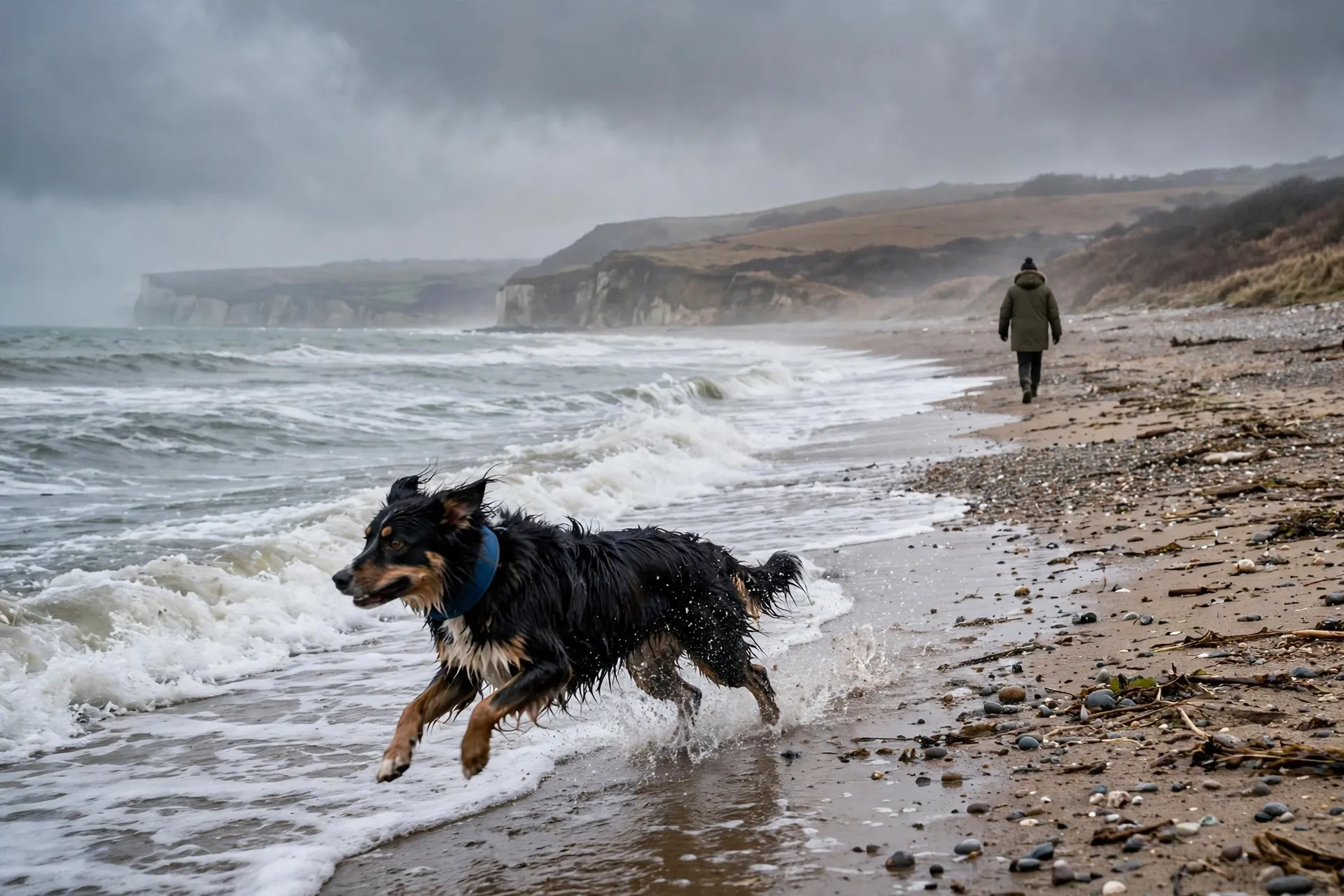
Picture a grey January morning on a wide British beach. The tide is out, the sand is firm and dark with damp, and a thin line of foam marks where the last wave broke. There are no queues for the car park, no crowds spilling from the cafes, and no long rows of windbreaks to navigate. A dog that spends summer dodging picnics, balls and other dogs can finally run in a straight line, stop to sniff the wrack line properly, and come back with sand in every crease of its coat. That emptiness is the real winter advantage, and it is why so many dog owners quietly prefer the coast between November and March to the height of summer.
Winter also changes the quality of the exercise. Cool air suits most dogs far better than summer heat, especially thick-coated breeds, brachycephalic dogs and older dogs that flag quickly on a hot beach. A brisk forty-minute walk in cold air, with bursts of running and plenty of sniffing, often tires a dog more honestly than a long, hot, overstimulating summer outing. The smells are different too: after a storm, the strandline carries seaweed, shells, driftwood and the faint scent of other animals, and a dog's nose works overtime. For owners, the appeal is simpler still. Parking is easier, cafes with dog-friendly corners feel calmer, and the walk itself becomes the main event rather than a battle for space.
None of this means winter coastal walking is automatically easy. The same emptiness that makes a beach attractive also means fewer people around if something goes wrong. Mobile signal can be patchy on remote headlands, cafes and toilets may be closed out of season, and a path that feels straightforward in August can be slippery, flooded or closed after a winter storm. The trick is to treat winter as a different season with its own planning, not as summer with a coat on. Check the forecast the night before and again in the morning, tell someone where you are going if the route is remote, and always have a shorter, flatter fallback walk in mind. If the wind is driving rain sideways across an exposed headland, the beach at the bottom of the hill is usually the better choice, even if the cliff walk looked more dramatic on the map.
Age and temperament matter as much as weather. A young, fit dog may relish a long beach run in a cold wind, while a puppy still learning recall, an arthritic older dog, or a nervous rescue may do better with a short, predictable loop near the car. Winter is a good season to build a dog's confidence gradually: start with familiar beaches, keep the first few outings short, and watch how the dog copes with wind noise, waves and the strange, loud sound of pebbles shifting underfoot. Dogs that are frightened by crashing waves are not being difficult; they are telling you the environment is too much that day. A shorter walk that ends well beats a long walk that ends in a bolt for the car park, and it keeps the coast a place the dog wants to return to.
Winter beach rules and bans
The single most useful winter fact is also the most misunderstood. Many British beaches restrict dogs during the summer season, typically from around May to the end of September, and then lift those restrictions for the winter months. That is why October through April can feel like a different coastline: beaches that were off-limits, zoned, or lead-only in August may welcome dogs across the whole sand in January. The pattern is widespread, but it is not universal, and the exact dates, zones and conditions are set locally, beach by beach, often through a Public Spaces Protection Order or a local byelaw. Some beaches keep year-round restrictions on a central section, some require leads on the promenade even when the sand is open, and some protect wildlife areas in winter precisely because migrating birds and seals need quiet. So the general rule is helpful for planning, but it never replaces the sign at the beach entrance, so check the official guidance before you travel.
Learning to read a beach on arrival is a skill worth practising. Start at the main access point, where signs usually show a map of any dog exclusion zone, the dates it applies, and whether dogs must be on a lead on the promenade, the slipway or the car park. If the sign is faded, missing or ambiguous, treat the safest interpretation as the rule: keep the dog on a lead until you are clearly past any marked zone, and ask in a nearby cafe or shop if you are unsure. Councils also publish beach rules online, and those pages are the best place to confirm dates before a longer trip. Our guide to dog-friendly beaches in the UK and the rules, bans and fines explained sets out how seasonal restrictions, fines and assistance-dog exceptions work in more detail, and it is worth reading before you rely on a winter opening that may have changed.
Winter brings its own seasonal protections that summer visitors rarely meet. Some beaches and estuaries restrict access near bird roosts, seal haul-outs and tern colonies during the colder months, and a dog running through a roost can cause serious disturbance even when no sign is visible. Keep dogs away from seals hauled out on rocks or sand, give any wildlife a wide berth, and keep the dog on a lead near estuary mudflats where wading birds feed at low tide. Fishing debris, discarded hooks and broken glass also concentrate along the strandline after storms, so a dog that scavenges needs closer supervision in winter, not less. If your dog picks up anything suspicious, swap it calmly for a high-value treat rather than chasing, which usually turns a find into a game.
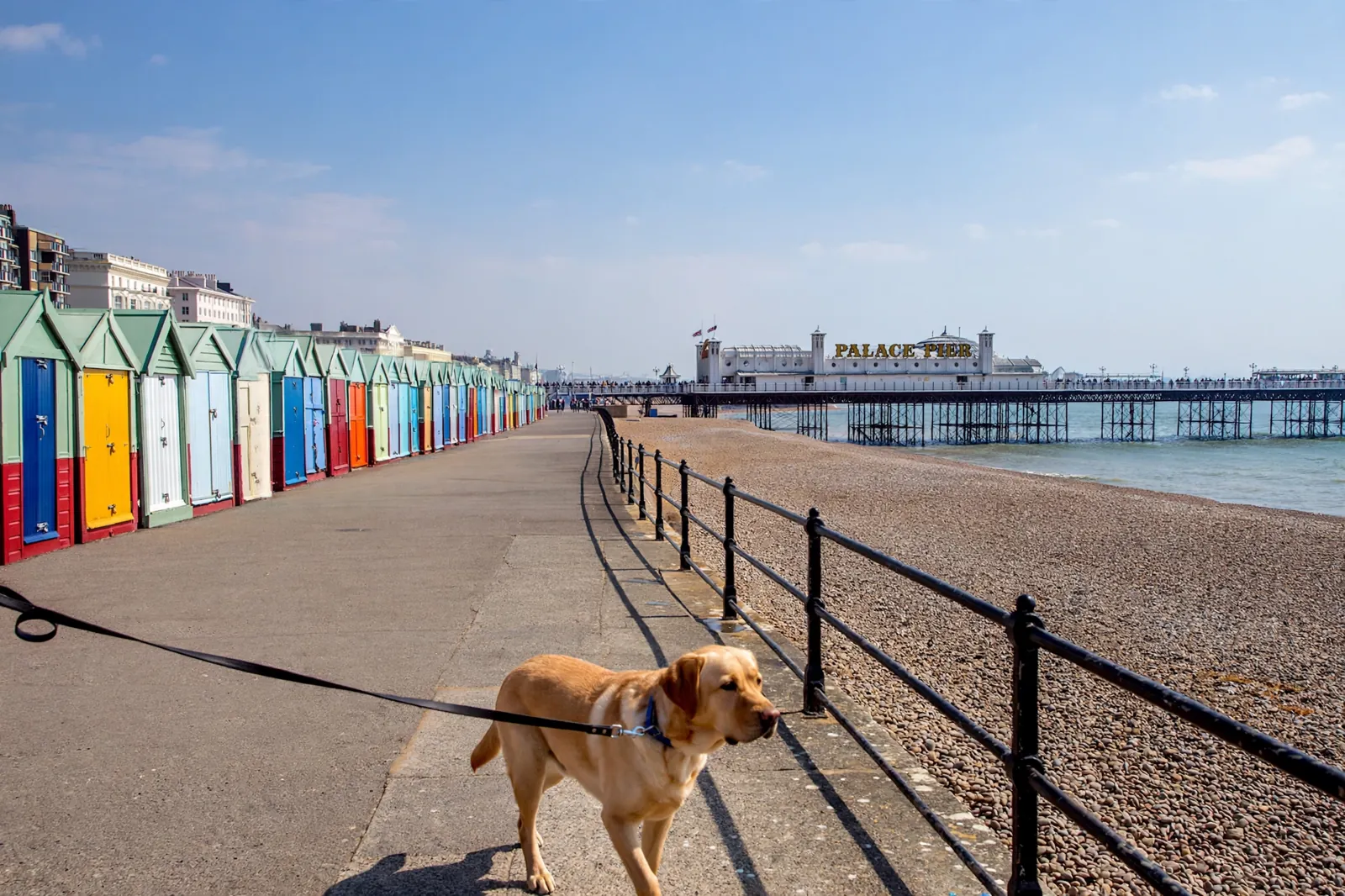
Local variation is the theme to carry through the whole winter. A beach in Cornwall may open fully to dogs in October, a beach in Brighton may keep a zoned restriction with different dates, and a beach in Scotland or Northern Ireland may work under entirely different local arrangements. Our Brighton with a dog guide shows how one busy resort beach combines seasonal bans, promenade rules and nearby South Downs walks, and it is a good example of why a single national summary can never substitute for checking the beach you are actually visiting. When in doubt, choose a beach whose rules you have confirmed, walk it on a lead first if you are uncertain, and keep a record of the council page or sign photograph on your phone so you can show what you checked if anyone asks.
Tides, storm surge and safety
If beach rules decide where you may walk, tides decide when you must leave. The British coast has some of the largest tidal ranges in the world, and a beach that looks endless at low tide can narrow to a strip, then disappear altogether, within a couple of hours. Winter adds storm surge to that picture: strong winds and low pressure can push the tide higher and earlier than the predicted time, and waves can reach the base of cliffs or sea walls that looked safely dry at the start of the walk. The safest habit is to plan the walk backwards from the tide. Look up the tide times for the exact beach and date, note when the tide starts to flood, and aim to be off any enclosed or cliff-backed section at least an hour before the water reaches it. That margin is not wasted caution; it is what allows for a slow dog, a muddy path and a wrong turn without turning into a scramble.
Know the exits before you need them. On arrival, identify the nearest steps, slipway or ramp back to the promenade, and check whether the route you plan to take has any point where a rising tide could cut you off, such as a headland, a rocky outcrop or a stretch backed by cliffs with no steps. If the only exit is a long way back, shorten the walk or walk towards the exit rather than away from it, so the return journey gets easier as the tide rises. Never let a dog run ahead around a headland you cannot see past, because the dog may be on dry sand while you are already cut off, or may be stranded on a rock as the water comes in. A long line is a good compromise on unfamiliar beaches: it gives the dog freedom to explore while keeping the pair of you on the same side of the tide.
Storms deserve separate respect. After a named storm or a night of high winds, check whether the coast path, beach access or promenade is closed, and look for fresh cliff falls, undermined steps and debris before letting a dog run free. Cliff edges can be undercut without any visible warning from above, so keep dogs on a short lead near any edge, fence line or warning sign, and do not stand on overhanging turf to take a photograph. Waves are equally deceptive in winter: a calm-looking sea can produce a sudden larger set that washes across a flat rock platform or slipway, and a dog standing in shallow water can be knocked over and dragged. Keep dogs out of the surf on rough days, keep children and dogs well back from sea walls during overtopping, and if waves are breaking over the promenade, the walk belongs somewhere inland that day.
Finally, think about what happens if the walk goes wrong. Carry a charged phone, but do not rely on signal on a remote headland; a simple whistle, a torch and a note of the nearest road name or car park help rescuers find you faster. If you or the dog are cut off by the tide, stay calm, move to the highest dry ground, keep the dog close, and call the coastguard on 999 rather than trying to wade or climb a cliff. In an emergency, the coastguard would rather be called early for a situation that resolves itself than late for one that has become dangerous. The same principle applies to a dog that has fallen or is injured on rocks: keep the dog still and warm, call for help, and do not put yourself at risk on a slippery rock face to reach an animal that may be safer waiting for trained help.
Cold, wet coats and paw care
Dogs lose heat differently from people, and winter coastal walks test that in specific ways. Wind chill strips heat from a wet coat far faster than still cold air, salt water dries on the skin and can irritate, and a dog that runs hard and then stands still in the wind can chill quickly once the exercise stops. The signs of a cold dog are usually clear if you watch for them: shivering, tucking the tail, slowing down, lifting paws, seeking shelter behind you, or refusing to go further. Puppies, older dogs, lean and short-coated breeds, and dogs recovering from illness are most at risk, but even a sturdy working breed can get cold after swimming in winter water or standing in a cutting wind. The answer is not to avoid winter walks, but to manage warmth actively: keep the walk moving, use a waterproof coat where it helps, and have a dry layer ready for the journey home.
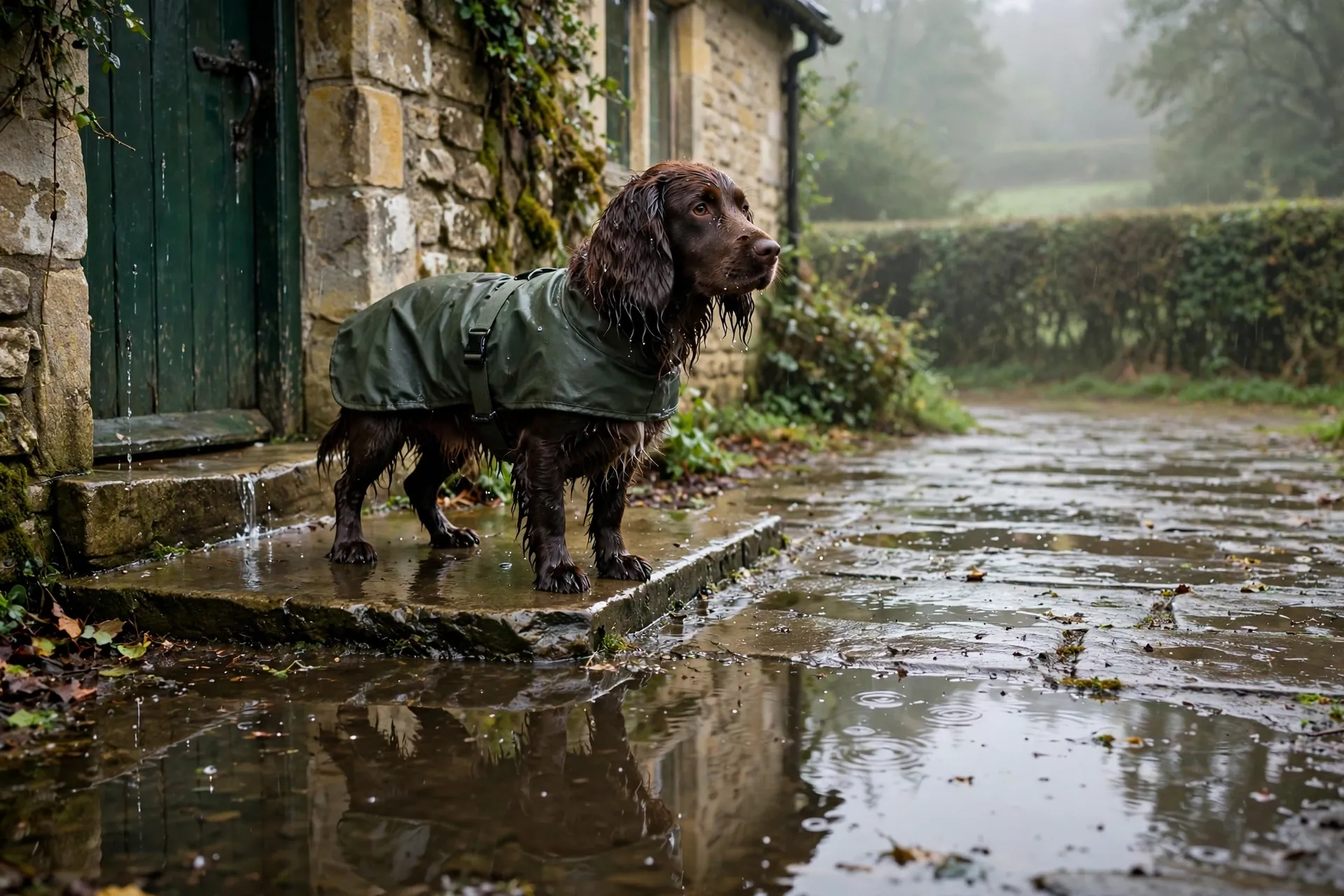
Coats divide opinion, but the practical test is simple. If the dog shivers, slows or seeks warmth, a coat helps; if the dog pants, lags or tries to roll it off on a hard run, it may be too warm or poorly fitted. A good winter coastal coat is waterproof rather than merely water-resistant, covers the chest and belly without restricting the legs, and stays in place when the dog runs and shakes. Fleece linings add warmth but soak up water if the outer layer fails, so for a beach walk a waterproof shell over a dry dog is often more useful than a heavy padded coat that becomes a wet blanket. Fit matters more than brand: you should be able to slide two fingers under the straps, the dog should be able to toilet freely, and nothing should rub the armpits or groin on a long walk. Our guide to choosing a dog drying coat in the UK explains fabrics, fit and belly coverage in detail, and the same fitting principles apply to a walking coat.
Paws deserve a check before, during and after a winter beach walk. Salt, grit and cold sand can dry and crack pads, while ice, sharp shells and fishing debris can cut them. Before the walk, check for existing cracks or soreness and consider a paw balm on dry, cracked pads, although balm is no substitute for rest if a pad is already split. During the walk, watch for limping, repeated paw lifting or a dog that suddenly sits down and chews a foot, all of which suggest something stuck between the toes, a cut, or cold discomfort. After the walk, rinse paws in lukewarm water, dry thoroughly between the toes, and check for redness, swelling or small cuts. Dogs with long hair between the toes benefit from a trim before winter, because ice balls and salt clumps form in that fur and make walking painful.
Wet coats and ears need attention too. Long-eared breeds can trap water and sand in the ear canal, so dry ears gently after a beach walk and watch for head shaking, scratching or a smell that was not there before. A dog that has swum in winter should be dried and warmed promptly, and should not be left in a cold car in a wet coat while you stop for coffee. Hypothermia in dogs is uncommon on an ordinary walk, but it becomes a real risk when a wet dog is left still in wind, so the rule is straightforward: wet dog, dry coat, warm car, and no long stationary stops until the dog is dry. If a dog is shaking violently, lethargic or unresponsive after cold exposure, wrap it in dry blankets, warm it gradually and seek veterinary advice promptly rather than trying to rewarm it rapidly with hot water.
Short days and visibility
Winter daylight is short, and that single fact reshapes coastal walking more than most people expect. In December and January, usable daylight in much of the UK can be under eight hours, and the sun sits low even at midday, casting long shadows across beaches and cliff paths. A walk that starts in bright afternoon light can end in dusk, especially if the dog finds something interesting and the return journey takes longer than planned. The practical response is to start earlier than feels necessary, to know the sunset time for the day, and to carry a light even on a walk you expect to finish in daylight. A head torch for you and a light on the dog are cheap, light and transformative, and they turn a rushed, anxious finish into a calm walk home.
Visibility is about being seen as much as seeing. On a grey beach, a dark-coated dog can vanish against wet sand, rocks and seaweed within seconds, and on a cliff path a dog ahead of you can be invisible to cyclists, runners and other walkers until they are close. Reflective gear helps enormously: a reflective harness, a hi-vis coat, a reflective collar, or a small clip-on light all make the dog visible from a distance. Choose gear that is visible from the side as well as from the front, because a dog running parallel to a path is seen side-on. For the owner, a reflective jacket or a light-coloured waterproof makes a similar difference, and it helps other people judge where the dog's owner is, which matters when a loose dog approaches. On roads and car parks near the beach, keep the dog on a lead and on the side away from traffic, because drivers in low winter sun are dazzled more easily and may not see a small dark dog until late.
Fog and sea mist deserve their own warning. Coastal fog can descend quickly, reducing visibility to a few metres and making even a familiar beach disorienting. If fog rolls in, keep the dog on a lead, stay on the beach or path you know, and head for the nearest exit rather than pushing on to a viewpoint that will not be visible anyway. A dog's recall is much less reliable when it cannot see you, and a dog that runs off in fog may end up on rocks, near a cliff edge or in the water without you knowing. A whistle carries further than a voice in wind and fog, and it is worth training a whistle recall before winter rather than discovering its limits on a foggy headland. If you walk in fog regularly, a GPS tracker on the harness can add reassurance, but it is a backup, not a substitute for a lead and a known route.
Night walks on the coast have their own pleasures, but they need stricter limits. A well-lit promenade walk after dark can be lovely, with the dog on a lead, reflective gear on, and a torch in hand. A dark beach or cliff path is a different proposition: uneven ground, hidden rocks, tide edges and cliff drops are all harder to judge, and a dog off the lead in darkness is at real risk. Save the dark beach for a moonlit, flat, familiar stretch you have walked in daylight, keep the dog close, and cut the walk short if the light fails. The winter coast is generous with daylight if you plan for it, and it punishes optimistic timing more reliably than any other season.
Choosing a route: cliffs or beach
Winter coastal routes generally fall into two families: flat beach walks and higher cliff-top paths, and each suits different dogs and different days. A flat beach walk is the more forgiving choice. The ground is level, the dog can run and sniff freely, there is no cliff edge to manage, and the walk can be shortened at any point by turning back along the sand. It suits older dogs, puppies, dogs with joint problems, and any dog whose recall is still developing. The trade-offs are tides, which set a hard deadline, and the wind, which is often stronger on an open beach than inland. A beach walk also needs a tide plan and an exit plan, as described above, and it is worth checking whether the beach has a firm, walkable surface at low tide or whether it becomes a boulder field that is hard on paws and ankles.
A cliff-top path offers views, a sense of journey and a different kind of exercise, with steady climbs and descents that tire a fit dog well. It also demands more management. Dogs should be on a short lead near any edge, on narrow sections, near livestock, and wherever the path passes close to a drop. After rain, cliff paths can be muddy, slippery and eroded, and after storms sections may be closed or diverted, so check the official guidance before you travel and look for closure signs at the start of the path. Cliff paths also expose dogs to more wind and to livestock: sheep and cattle graze many coastal headlands in winter, and a dog that chases livestock can cause serious harm and legal trouble. Keep the dog on a lead around livestock, give grazing animals a wide berth, and never let a dog approach lambs or calves, even if the dog seems friendly.
The best winter plan often combines the two. Walk the beach at low tide, climb to the cliff path only where it is broad, fenced and well away from the edge, and drop back to the beach or a surfaced promenade for the return. Circular routes are appealing, but a there-and-back walk is often wiser in winter: you know the ground, you know the exits, and you can turn back the moment conditions change without worrying about an unknown second half. If you do choose a circular route, walk it in the direction that puts the hardest or most exposed section first, while you and the dog are freshest and the light is best. A route that is easy in summer can be a different walk in winter, and the honest test is not how it looks on a map, but how it feels underfoot in wind and rain.
Surface matters more in winter than distance. A two-mile walk on firm sand, a surfaced promenade or a well-drained coastal path is kinder than a one-mile slog through deep mud, shingle that shifts underfoot, or a boulder beach that forces constant jumping. Dogs with arthritis, hip problems or recovering injuries need surfaces that are predictable, and owners with pushchairs or mobility needs should check path surfaces and gradients before setting out, because many cliff paths include steps, stiles and narrow gates that are difficult with a dog on a lead. When a path description mentions stiles, ask whether there is a dog gate or a bypass, and carry the dog over a stile only if you can do so safely for both of you. A walk that ends with a lifted, frightened dog and a strained owner is not a good walk, however scenic the middle was.
Mud, seaweed and beach hazards
Winter mud is a different substance from summer dust. After rain, coastal paths, field edges and estuary banks turn to deep, clinging mud that coats legs and bellies, fills the gaps between toes, and turns a short walk into a long clean-up. The mud itself is mostly harmless, but it hides hazards: sharp stones, broken glass, fishing hooks and uneven ground that can twist an ankle or cut a pad. It also makes dogs slip, especially older dogs and those with joint problems, and a dog that slips on a muddy slope can injure a leg or shoulder badly. Choose surfaced paths after heavy rain, slow down on descents, and keep the dog on a lead on muddy slopes where a sudden lunge could pull you both over. If the mud is ankle-deep and the dog is struggling, the kindest decision is to turn back, however close the viewpoint looked.
Seaweed deserves more attention than it usually gets. Fresh, wet seaweed is slippery underfoot for dogs and owners alike, and large kelp fronds can hide rocks, holes and debris. Some dogs love to eat seaweed, and small amounts of fresh seaweed are usually harmless, but dried seaweed can expand in the stomach after a dog drinks water, and seaweed washed up with fishing waste may carry hooks, line or pollutants. Keep scavenging dogs on a closer lead along the strandline, and teach a reliable leave-it or drop-it before winter, when the strandline is at its richest. Dead seabirds, fish and jellyfish are also more common after storms, and they can carry disease or toxins: keep dogs away, do not let them roll in or eat carrion, and if a dog does eat something dead, note what it was and watch for vomiting, diarrhoea or lethargy, seeking veterinary advice if symptoms appear. Avian influenza has affected wild birds in recent years, so keeping dogs away from dead birds is not just tidy, it is a health precaution, and you should check the official guidance before you travel if dead birds are reported in the area.
Other winter hazards are less obvious but worth knowing. Palm oil and other waxy substances sometimes wash ashore and look like harmless white or yellow lumps; they can be toxic if eaten, so keep dogs away from any unfamiliar waxy material on the beach. Discarded fishing line and hooks are a year-round risk that worsens after storms, and a hook caught in a lip or paw needs veterinary attention rather than a tug. Rock pools are tempting for dogs but can be slippery, sharp and surprisingly deep, and a dog that jumps into a pool may struggle to climb out on algae-covered rock. Finally, remember that winter water is cold enough to cause shock: a dog that falls into cold water, even briefly, should be dried and warmed promptly, and swimming in winter should be limited to dogs that choose it, are fit and healthy, and can get out easily, with the owner close by and a towel ready.
None of this should put you off the winter coast. It should simply change how you walk it: slower on the strandline, closer on the cliff edge, more attentive after storms, and quicker to turn back when the ground or the weather tells you to. The dogs that enjoy winter beaches most are not the ones given total freedom, but the ones whose owners read the beach, manage the risks, and give them freedom where it is safe and structure where it is not. That balance is the whole skill of winter coastal walking, and it improves with every walk you do.
The after-walk clean and warm-up
The walk does not end at the car park. A winter coastal walk ends with a wet, sandy, possibly muddy dog that needs to be cleaned, dried and warmed before it can settle comfortably, and the quality of that routine determines whether the next walk is eagerly anticipated or dreaded. Start at the car: keep a towel, a drying coat and a waterproof sheet or old blanket in the boot throughout winter, so you are never improvising with a single paper towel. Towel the dog down before it gets into the car, paying attention to legs, belly, ears and paws, and put on the drying coat for the journey home. A dog that travels wet in a cold car will chill, and a dog that shakes sand all over the car will make the next journey less pleasant for everyone.
At home, the routine should be calm and systematic. Rinse the dog with lukewarm water if it is very muddy or salty, using a shower attachment on low pressure or a jug of warm water in the garden, and avoid hot water on cold paws, which can be painful. Wash with a gentle dog shampoo only when needed; over-bathing strips natural oils and dries the skin, so a rinse and a thorough towel-dry is enough for most beach walks. Dry the dog completely, including between the toes, inside the ears and under the belly, and check for cuts, ticks, salt irritation or anything stuck in the coat. Ticks are less common in deep winter but can still be active on mild days, especially in coastal grassland, so a quick check after every walk is a good habit year-round.
Warmth and rest complete the routine. Give the dog a dry bed in a draught-free spot, offer water, and let it settle without demanding more activity. A dog that has run hard in cold wind may be stiff the next morning, especially older dogs, so watch for limping or reluctance to rise and shorten the next walk if needed. Feed at the usual time, and avoid feeding a large meal immediately before or after hard exercise, which can cause stomach upset. If the dog has swum or been soaked through, keep it indoors until fully dry, and do not put a wet dog straight into a cold outbuilding or kennel. The after-walk hour is also the time to clean your own kit: rinse leads and harnesses in fresh water to remove salt, dry boots and coats, and recharge torches and lights, so the next walk starts ready rather than rushed.
Finally, use the after-walk check as a health log. Note any limping, paw cuts, ear scratching, stomach upset or unusual tiredness, and whether it followed a particular beach, surface or weather condition. Patterns emerge quickly: a dog that always limps after a shingle beach, always itches after a muddy estuary walk, or always shivers on a windy headland is telling you something useful about its limits. Adjust the next walk accordingly, and seek veterinary advice if a symptom persists, worsens or follows eating something suspicious on the beach. A winter of good coastal walks is built not on one heroic outing, but on dozens of well-managed ones, each ending with a clean, dry, warm dog that is ready to go again.
A winter coast packing list
Packing for a winter coastal walk is less about carrying everything and more about carrying the right few things well. Start with the dog: a lead and a long line if the beach allows off-lead running, a harness that fits over a coat, a waterproof coat for dogs that need one, a drying coat for afterwards, and two towels rather than one, because the first towel will be soaked before the walk is over. Add poo bags, a spare bag for litter or anything the dog picks up, fresh water and a collapsible bowl, because dogs still need to drink in winter and beach water is salty, and a few high-value treats for recall and for swapping anything the dog finds. A small first-aid kit, including a bandage, antiseptic wipes and a tick remover, fits in a pocket and earns its place the first time it is needed.
For the owner, the list is similar in spirit. A waterproof jacket and trousers, warm layers that can be added or removed, gloves that allow you to handle a lead, and sturdy, waterproof footwear with good grip are the foundation. A head torch, a charged phone, a whistle and a basic map or offline route on the phone cover navigation and safety, and a small rucksack keeps hands free for the lead. Carry a plastic bag for wet towels and muddy gear, and keep a change of socks in the car, because wet feet end walks early and make driving home miserable. If you plan to stop at a cafe, check in advance whether it welcomes dogs and whether it has outdoor seating or a dog-friendly room, because many coastal cafes reduce hours or close entirely out of season, and a wet dog waiting outside in wind is not a good end to a walk.
Seasonal extras are worth adding on the coldest or stormiest days. A blanket for the car, a flask of hot water for rinsing paws, a spare lead in case one breaks or gets tangled in seaweed, and a dog lifejacket for dogs that swim or walk on slippery harbour walls can all turn a difficult walk into a manageable one. None of these items is expensive, and all of them are lighter than regret. The test of a packing list is not whether you used everything, but whether the one thing you needed was there when you needed it. Pack the night before, check the forecast in the morning, and adjust: add a coat and a torch for a late walk, drop the long line for a busy promenade, and always leave room in the boot for a muddy dog and a sandy towel.
When the walk is over and the dog is dry, the packing list pays off a second time. Clean, dry gear is ready for the next walk, wet gear is washed rather than left to smell in the boot, and the car stays a pleasant place to travel in. Winter coastal walking rewards preparation more than any other season, and the owners who enjoy it most are usually the ones whose boot looks boringly well organised: towels, coats, lights, water and a spare lead, every time, without drama. That is the real secret of a good winter walk, and it is entirely learnable, one beach at a time.
Practical questions
Before you go
Are dogs allowed on UK beaches in winter?
Many seasonal beach restrictions end in autumn, so winter often opens up beaches that ban dogs in summer, but the dates and zones vary by beach and council. Always check the signs at the beach entrance and check the official guidance before you travel, because a winter walk is only dog-friendly where the current rules say so.
How do I check tides before a winter coastal dog walk?
Check the tide times for the exact beach and date, plan to be off enclosed sections well before high tide, and know where the nearest exit steps or slipway are. In winter, high tides combined with storm surge can cover beaches faster than expected, so build in a generous margin and never rely on a single tide app without checking local warnings.
Does my dog need a coat for a winter coastal walk?
It depends on the dog. Short-coated, lean, very young, older and unwell dogs often benefit from a waterproof coat in wind and rain, while thick-coated breeds may overheat on a hard run. Watch for shivering, slowing down or seeking shelter, and carry a dry coat for the walk home even if your dog starts out warm.
Are winter beaches safe for dogs off the lead?
Wide winter beaches can be excellent for off-lead running, but only where dogs are permitted off the lead, recall is reliable, and there is no cliff edge, fast tide or livestock nearby. Use a long line near cliff paths, car parks, seal haul-outs and bird roosts, and keep your dog away from dead seabirds, fishing debris and washed-up jellyfish.
What should I do if my dog gets very muddy or soaked?
Towel the dog down as soon as you can, check paws and belly for cuts, salt and grit, and put on a drying coat for the journey home. At home, rinse with lukewarm water, dry thoroughly including between the toes, and watch for limping, cracked pads or itching over the next day.
Can I walk my dog on a cliff path in winter?
Yes, with care. Keep dogs on a short lead near cliff edges, avoid paths after heavy rain or high winds, and turn back if the ground is soft, the path is eroded or visibility is poor. Check the official guidance before you travel, and choose a lower, flatter beach route on days when the cliff path looks exposed or unstable.