This guide is independent and contains no paid placement. Samoyeds vary in age, fitness, coat condition and heat tolerance, and health material here is background reading rather than veterinary advice. Ask your vet about your own dog, and check the official guidance before you travel for beach rules, water warnings and local regulations.
Pick cooler dates and cooler hours, never shave the coat, brush the dog outside every day, and book a stay whose floors, shade and cleaning terms you have actually read. A Samoyed trip works when the heat plan, the grooming routine and the house rules are settled before departure, because on a hot day there is no spare margin to improvise with.
Start with the calendar, not the destination
Most holiday planning starts with a place: a coast, a cottage, a weekend that happens to be free. Samoyed planning works better backwards. Start with the temperature your dog can comfortably handle, then find dates and places that fit inside it, and only then choose the scenery. Britain helps here, because a Samoyed that would struggle in a Mediterranean summer can be perfectly comfortable in a British spring, a cool autumn week or a mild coastal summer, provided the hot spells are treated as the exception rather than the plan.
The practical difference is the margin. A short-coated dog on a warm day can lose heat quickly, drink, rest in shade and be ready for another walk. A Samoyed carries a thick insulating coat that slows heat loss as well as heat gain, so the same walk takes longer to recover from and the same warm room takes longer to cool down in. That does not make summer travel impossible, but it does make timing the main decision. A week in May or September, a north-facing cottage, a coastal town with sea breezes and tree shade, and a forecast checked daily will usually beat a south-facing lodge booked for the hottest week of August, however pretty the photographs look.
Think in terms of three temperature bands rather than one magic number, because humidity, sunshine, wind and your dog's condition change everything. Cool days are straightforward: normal walks, normal routines, grooming as usual. Warm days need management: early and late walks only, shade at midday, water always available, and a shorter, slower programme. Hot days need a different holiday altogether: no midday exercise, indoor or shaded rest, and a willingness to cancel a planned walk without feeling that the day has been wasted. Owners who decide these bands in advance, and agree them with everyone travelling, argue far less on the day, because the decision was made while everyone was calm.
Region matters as much as season. Inland valleys can trap warm, still air, while exposed coasts and higher ground often stay a few degrees cooler and breezier. That gap matters more for a Samoyed than for most breeds, so it is worth comparing forecasts for two or three candidate areas rather than accepting one destination as fixed. Woodland walks also deserve special attention: a shaded forest trail at dawn is one of the best Samoyed walks in Britain, while the same trail at noon in humid, still air can feel oppressive, with insects adding to the discomfort. Check the official guidance before you travel for local access rules, seasonal restrictions and any warnings that apply to the exact area you have chosen.
Finally, build slack into the calendar itself. Do not book a trip so tightly that a heatwave leaves no room to change anything: a non-refundable, non-changeable booking in a heat-prone week, a long drive on the hottest day, and a first night in an unshaded property is a chain of risks. A booking that can be moved, a drive that can be split or shifted to the evening, and a first day kept deliberately light all give you options. With a Samoyed, flexibility is not a luxury; it is the heat plan.
A Samoyed summer day, hour by hour
On a warm day, a Samoyed holiday runs on a timetable, and the timetable is the kindness. The early morning is the main event. Aim for the first walk at dawn or as early as the dog and the household can manage, while the ground is cool, the air is fresh and the light is low. This is the walk that can be long, sniffy and satisfying, the one that earns the dog a genuinely restful day afterwards. Check the ground with the back of your hand: if it feels hot to you, it is too hot for paws, and a shaded grass route beats a sun-baked pavement every time.
By late morning, the programme should change gear. This is brush-out, breakfast and settling time, not sightseeing time. A short toilet break in shade, fresh water in more than one place, and a cool resting spot with airflow matter more than another hour of walking. If the accommodation has a shaded garden, a cool tiled floor or a room that stays out of the sun, that is where the middle of the day belongs. Dogs that are allowed to flop, pant quietly and sleep through the heat will be far better company in the evening than dogs that have been dragged through the hottest hours in the name of making the most of the day.
The afternoon is the danger zone in a Samoyed household, and it should be treated as such. Car journeys, beach walks on hot sand, busy town centres and enclosed, sunlit conservatories all belong on the avoid list between late morning and early evening on warm days. If you must travel, do it with air conditioning already running, water within reach and a plan to stop in shade. If you must go out, keep it to a few minutes in shade for toileting, and watch the dog rather than the clock: heavy panting that does not ease quickly, drooling, restlessness or a reluctance to keep walking are all signals to stop, not to push on to the next landmark.
Evening is the second walk, and it should be earned by a calm afternoon. As the sun drops and the ground cools, a second, shorter walk in shade or by water can be wonderful, especially a gentle riverside or woodland route where the dog can sniff and wade. Keep it shorter than the morning walk if the day has been warm, and finish with a brush-out and a drink before bed. Night-time matters too: a room that stays warm overnight, a bed placed in direct sun through a window, or bedding that traps heat can leave a Samoyed restless and panting, so choose the coolest sleeping spot in the property, keep airflow moving, and make sure water is available all night.
This timetable also protects the humans. When everyone knows that mornings are for walking, middays are for shade and evenings are for a second outing, there is no daily negotiation, no guilt about a missed walk, and no temptation to squeeze one more attraction into the hottest hours. Write the timetable down, share it with anyone staying in the property, and treat it as the plan rather than a suggestion. A Samoyed does not need a packed itinerary; it needs a cool one.
Why the coat helps in heat, and why it still fails
A Samoyed coat is often misunderstood, and the misunderstanding causes real harm. The thick double coat, with its dense undercoat and longer guard hairs, evolved to insulate a working dog against extreme cold, and insulation works in both directions: it slows heat entering the body just as it slows heat leaving it. That is why shaving a Samoyed for summer is a mistake rather than a kindness. A shaved coat loses its insulating layer and its sun protection, the skin is exposed to direct sun, and regrowth can be patchy, coarse or permanently changed in texture. Groomers and vets regularly warn against shaving double-coated breeds except for a specific medical reason, and that advice should settle the question for holiday planning: the coat stays, and the plan adapts around it.
What the coat cannot do is create cool air. Insulation delays heat transfer; it does not remove heat from the body. A Samoyed that exercises hard, sits in a hot car, or lies in direct sun will still overheat, and will then take longer to cool down precisely because the coat that kept the cold out also slows heat escaping. Panting is the main cooling mechanism, and heavy, continuous panting is a warning rather than a normal feature of a summer walk. Humidity makes panting less effective, which is why a humid British day at a moderate temperature can feel harder for a Samoyed than a dry, breezy day a few degrees warmer. Age, weight, fitness and any heart or breathing condition narrow the margin further, so an older or overweight Samoyed needs an even more conservative timetable.
The other half of the coat story is shedding, and for Samoyeds it arrives in dramatic form. The famous coat blow, when the dense undercoat is shed in large quantities, usually happens once or twice a year and can last for weeks. Travelling during a coat blow is entirely possible, but it changes the holiday: brushing becomes a daily, outdoor job, bedding and soft furnishings collect hair at remarkable speed, and a white coat shows every speck of mud, dust and pollen. Timing a trip just after a thorough brush-out, or at least planning for daily grooming during the blow, prevents the two classic Samoyed holiday problems, which are a matted, uncomfortable dog and a furious accommodation host.
Matts deserve attention because they are not just cosmetic. Tight matts behind the ears, in the armpits, around the collar and in the feathering on the legs can pull the skin, trap moisture and hide irritation or hot spots. A damp coat that is left to dry in clumps mats far more easily, which is why swimming and rain are followed by drying and brushing rather than by a hopeful assumption that the coat will sort itself out. On holiday, the rule is simple: never let a wet Samoyed dry unbrushed, and never let a small matt become a large one because the brush was left at home. A few minutes a day prevents a painful grooming session at the end of the trip.
Sun protection is the final, often forgotten part of coat science. The pink skin on a Samoyed nose, the thin skin on the ears and the belly can sunburn, especially on pale-coated dogs spending long hours on reflective sand or water. Shade, timing and, where a vet advises it, a dog-safe sunscreen for the nose and ears are worth considering. The coat itself protects the body, which is another reason to keep it intact and well maintained rather than cutting it back. A clean, mat-free, fully brushed coat is the best summer coat a Samoyed can have, and it is achieved with a brush, not with clippers.
The grooming kit that travels with you
For most breeds, a holiday grooming kit is an afterthought. For a Samoyed, it is essential luggage, and it should be packed with the same care as the food and the lead. The core kit is small but specific: a slicker brush for daily work, a wide-toothed comb or rake for the undercoat, a pin brush for finishing, and a pair of blunt-ended scissors or thinning shears for careful tidying of feathering and paws, used cautiously and never as a shortcut to shaving. A high-velocity dryer, if you already own one, is worth its weight on a longer trip, because it blows loose undercoat out far more effectively than brushing alone, but check with the accommodation first: a noisy dryer in a quiet cottage at night is a neighbour problem, and some properties restrict noisy equipment.
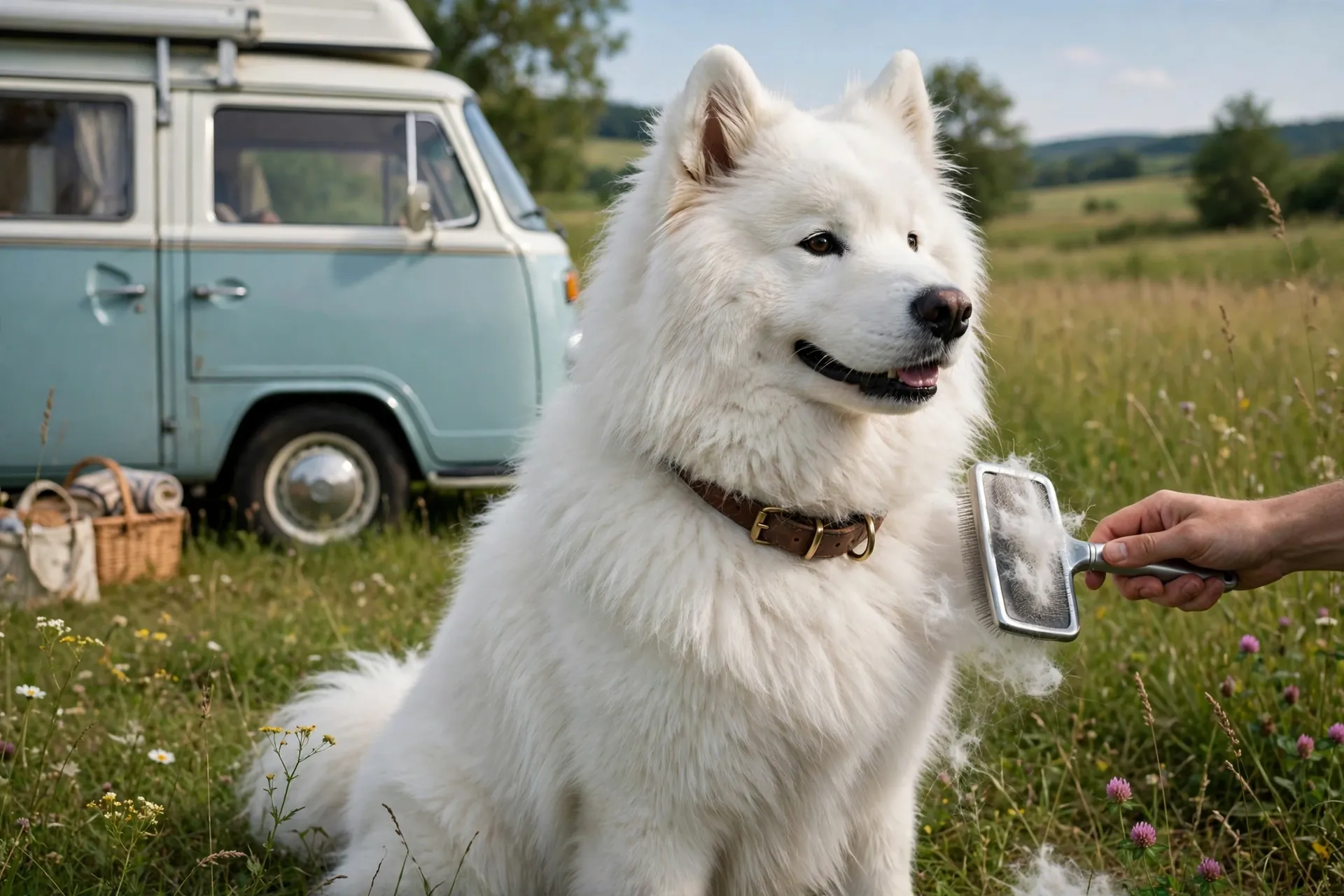
The routine matters more than the tools. Brush outside, every day, ideally in the same spot, and collect the hair rather than letting it drift into flower beds, neighbouring gardens or the property's drains. A large bag, a sheet on the ground and a few minutes of patience turn a grooming session into a manageable chore rather than a crisis. Work in sections, from the skin outward, and check the classic matt spots every time: behind the ears, under the collar, in the armpits, behind the elbows and in the long feathering on the back of the legs. If you find a matt, work it gently with fingers and a comb, and do not force a brush through it; a painful grooming session teaches a dog to dread the next one.
Timing the brush-out around the day makes the whole holiday smoother. A quick brush before the morning walk removes overnight loose coat and lets air reach the skin; a fuller brush-out in the cool of the evening, after the day's walks, deals with the hair shed during exercise and any burrs, seeds or debris picked up outdoors. During a coat blow, add a midday session in shade, and accept that the house will still collect hair: the goal is not a hair-free property, which is impossible with a blowing Samoyed, but a property where the hair is on washable covers and hard floors rather than embedded in carpets and soft furnishings. That distinction is what accommodation hosts notice, and it is what separates a normal pet stay from an extra cleaning charge.
Grooming on a campsite or in a shared holiday park needs extra etiquette. Brush well away from other pitches, away from communal washing areas and away from anyone eating outdoors, and bag the hair immediately. Never brush a dog over a shared drain or a water point, and never leave piles of loose coat behind. If the site has a designated dog-washing area, use it for rinsing muddy paws and legs, but do not treat it as a full grooming station unless the site says so. A little consideration here goes a long way: fellow guests remember the Samoyed owner who brushed tidily and bagged everything, and they remember the opposite just as clearly.
Finally, know when to hand the job to a professional. If the coat is badly matted, if the dog has a skin problem, or if a coat blow has become unmanageable, a local groomer near the holiday destination can be a better option than a stressful do-it-yourself session in an unfamiliar bathroom. Search before you travel, book early in peak season, and ask specifically whether the groomer has experience with double-coated breeds and will not shave the coat. A professional bath and blow-out mid-holiday can reset the coat, reduce shedding in the property for days afterwards, and leave the dog far more comfortable in warm weather. It is one of the best-value Samoyed holiday spends there is.
Read the cleaning clause before you pay
The cleaning clause is where Samoyed holidays are won or lost financially, and it deserves the same attention as the price. A white, heavy-shedding dog in a light-coloured holiday let is the worst-case combination for a host, and hosts know it. Some properties handle this fairly, with a clear pet cleaning fee included in the booking, a list of what is expected on departure, and a deposit returned promptly when the property is left reasonable. Others handle it vaguely, with a line about extra cleaning charges at the host's discretion, no figure given, and a bill that arrives after departure. The difference is entirely in the wording, and the time to discover it is before payment, not after checkout.
Ask four questions, in writing, and keep the replies with your booking confirmation. First, is there a pet cleaning charge, and is it included in the price or charged separately? Second, what exactly counts as extra cleaning: hair on soft furnishings, hair in carpets, mud on walls, or only damage? Third, how is the charge decided and evidenced: photographs, a cleaning invoice, or the host's judgement alone? Fourth, what is the maximum that could be charged, and is there a deposit cap? A host who answers all four clearly is usually a host who has thought about dogs properly. A host who answers vaguely, or who says not to worry about it, has not yet thought about your Samoyed at all, and that is when a large bill becomes possible.
Your own evidence protects you as much as the host's terms do. Photograph every room on arrival, including floors, sofas, beds and any existing marks or hair, and photograph the same rooms on departure after you have cleaned up. Time-stamped photographs turn a dispute about whether the hair was already there into a short conversation. Use washable covers on every sofa, chair and bed the dog will use, and bring your own throws rather than relying on the property's light-coloured bedding. A portable, washable dog bed that smells of home is better than the property's sofa for the dog and for the deposit alike, and it gives the dog a consistent sleeping place every night.
Departure cleaning for a Samoyed is a real job, so schedule time for it rather than discovering it at checkout. Vacuum thoroughly, including under furniture and along skirting boards where hair collects, lint-roll soft furnishings, wipe paw marks from hard floors and low walls, and empty the vacuum and any hair from drains and filters. If the property provides a vacuum, check that it actually picks up long white hair: some stick vacuums struggle, and a quick test on arrival saves a frantic search for a better vacuum on the last morning. Leaving the property visibly cared for, with the dog's covers folded and the hair bagged, is the single best argument against an extra charge, and it is also simple good manners.
There is a fairness point worth making plainly. A Samoyed sheds, and shedding is not damage. Hair that can be vacuumed or lint-rolled away is normal pet wear, and a property that markets itself as dog-friendly should expect it. Damage, such as chewed furniture, scratched floors or stained upholstery, is a different matter, and a deposit may fairly cover it. If a charge seems to treat ordinary shedding as damage, challenge it politely, with your photographs and the host's own written terms. If the terms were vague to begin with, that vagueness is itself the lesson for the next booking: with a Samoyed, only book properties whose cleaning terms you have read, understood and kept.
Choose the stay by its floors and shade, not its photos
Holiday photographs are designed to sell a view, a fireplace and a stylish sofa. A Samoyed owner should look past all three and read the property for floors, shade and airflow instead. Hard floors, such as wood, tile or good-quality vinyl, are the single most valuable feature of a Samoyed stay: hair can be swept and mopped away in minutes, muddy paws leave marks that wipe off, and a wet dog does not soak a carpet. Thick, light-coloured carpets, by contrast, trap white hair, hold damp, and turn every rainy walk into a cleaning project. If the listing photographs show wall-to-wall cream carpet, that property is making your holiday harder, however beautiful it looks.
Shade is the second feature that matters more than style. A garden that is sunny all day is a problem for a Samoyed in summer, while a garden with mature trees, a shaded patio, a covered veranda or a north-facing sitting area is a gift. Ask where the shade falls at midday, not just whether the garden is enclosed, because a fully enclosed but entirely sun-baked garden is still unusable at noon. A property with a cool, shaded outdoor space gives the dog a place to rest outside without overheating, gives you a place to brush the dog out of the sun, and gives the whole household a usable outdoor room during the hottest hours.
Airflow and cool rooms complete the picture. A property that stays cool naturally, with thick walls, shutters, cross-ventilation or a ground-floor room that never catches the afternoon sun, will serve a Samoyed far better than a modern glass box that heats up by noon and depends entirely on fans. Ask which room stays coolest, whether windows open securely without letting the dog out, and whether fans or portable cooling are provided. If the property has a conservatory, check whether the dog can be kept out of it during hot hours: a glass room in summer sun can become dangerously hot very quickly, and a Samoyed that wanders in and settles there may not notice the danger until it is already overheated.
Enclosure still matters, but for a Samoyed it is about shade and calm rather than escape alone. A secure garden with a gate that closes properly, a fence without gaps at ground level, and a quiet corner away from the road gives the dog safe, shaded toileting and a place to relax without constant supervision. A garden that opens directly onto a busy road, a shared courtyard with no shade, or a balcony with gaps a dog could slip through are all reasons to choose a different property, even if the interior is perfect. The garden is where the dog spends its unsupervised minutes, so it deserves the same scrutiny as the kitchen.
When comparing two properties, use a short, honest checklist rather than a feeling. Hard floors or carpet? Shade at midday or sun all day? A cool room for sleeping? A secure, shaded garden? A vacuum that handles long hair? Laundry facilities for washing dog covers and bedding? A property that scores well on four or five of these will be a better Samoyed stay than a prettier property that scores well on none, and the difference will show up every day, in less cleaning, a cooler dog and a calmer household. Book the floors and the shade, and let the view be a bonus.
Water, mud and the white coat
A Samoyed and water is a joyful combination and a grooming commitment in equal measure. Many Samoyeds love paddling, wading and swimming, and a gentle swim on a cool day is excellent low-impact exercise that does not heat the dog the way running does. But a Samoyed coat absorbs an extraordinary amount of water, takes a long time to dry, and mats readily if it is left damp. The rule that makes water work on holiday is therefore simple: water is followed by drying and brushing, every time, without exception. A dog that swims at noon and is left to dry in clumps while the family has lunch will be a matted dog by evening, and unravelling that is nobody's idea of a holiday activity.
Beaches need a specific check before the car is even loaded. Seasonal dog rules vary beach by beach, and some popular beaches restrict dogs entirely during summer months while others allow them at certain times of day or on certain sections. Check the official guidance before you travel for the exact beach, the exact dates and the exact times, because a general claim that a town is dog-friendly does not guarantee that its main beach is. Tides matter too: a beach that is generous at low tide can disappear at high tide, leaving a long walk back along a hot promenade, and sand that feels pleasant to bare feet in the morning can become uncomfortably hot by afternoon. A shaded, quieter beach with a freshwater rinse point nearby is worth more to a Samoyed than a famous beach with no shade and no water.
Open water carries risks that a white coat does nothing to reduce. Blue-green algae, which can appear in lakes, ponds and slow rivers during warm weather, can be seriously harmful to dogs, and warnings should be taken seriously: if a water body looks discoloured, scummy or unusually green, keep the dog out, and check the official guidance before you travel for local warnings. Fast currents, weirs, steep banks and cold water are separate hazards, and a dog that swims strongly in a calm lake may still struggle in a tidal river. Our guide to dog swimming safety in the UK covers algae, tides, cold water and emergency steps in detail, and it is worth reading before a water-heavy trip rather than after a scare.
Mud is the other half of the white-coat problem, and British holidays provide it in abundance. A Samoyed that walks a muddy bridleway returns as a different colour, and the journey from muddy dog to clean dog needs a system, not hope. The system is: a towel and a rinse at the door, a designated muddy-paw area with a washable mat, a drying coat for the journey home, and a full brush-out once the coat is dry, because brushing wet, muddy coat drives mud deeper and encourages matts. A dog drying coat is genuinely useful here, because it absorbs water while the dog dries, keeps the car and the property cleaner, and reduces the time a wet coat spends clumping. Pack two if you can: one to wear while the other dries.
Rain deserves the same system as swimming, because a Samoyed in British rain is a wet Samoyed, whether the water came from a lake or a cloud. A short, heavy shower can soak a coat to the skin, and a dog that comes in, shakes over the carpet and settles on the sofa will leave damp, hair and mud exactly where they are hardest to clean. Keep the drying routine by the door, every time, in every weather: towel, rinse if muddy, drying coat, settle on a washable bed, brush when dry. It sounds repetitive, and it is, but repetition is what keeps a white coat white and a holiday property clean. The Samoyeds that look immaculate on holiday are not luckier than others; they are simply dried and brushed more often.
Cars, heat and the breakdown plan
A car is the most dangerous hot place a Samoyed will meet on holiday, and the rule is absolute: never leave a Samoyed alone in a parked car on a warm day, not for a few minutes, not with a window cracked, not in the shade that will move. Cars heat up with shocking speed, even on days that do not feel extreme, and a thick-coated dog inside one has almost no margin. This is not a guideline to interpret generously; it is the rule that shapes every stop, every petrol station visit and every plan to pop into a shop while the dog waits. If the dog cannot come in, the dog does not wait in the car: someone stays with the dog, or the stop does not happen.
Travelling itself needs a heat plan too. Pre-cool the car before the dog gets in, keep air conditioning running throughout, and make sure air actually reaches the dog's space rather than just the front seats. A crate or harness that restricts airflow, a boot piled with luggage that blocks vents, or a dog travelling in direct sun through a rear window all reduce cooling exactly when it matters most. Offer water at every stop, keep a spray bottle or damp towels for cooling, and watch the dog during the journey rather than assuming that a quiet dog is a comfortable dog: a Samoyed that has stopped panting and gone very still in a hot car is not relaxed, it is in trouble.
Breakdowns are the scenario most owners never plan for, and they are the scenario that turns a warm journey into an emergency. A car that breaks down on a motorway in summer leaves a Samoyed in a hot, stationary vehicle with no air conditioning, and the hard shoulder offers no shade. Before a long journey, check that breakdown cover includes the dog, know how to get the dog out of the vehicle safely if the road allows it, and carry shade, water and a way to cool the dog that does not depend on the car's electrics: a pop-up shade, a large bottle of water, damp towels and a battery fan are cheap insurance. If you travel by motorhome, the same logic applies with extra care, because a motorhome parked in sun heats up like a greenhouse, and the living area must be shaded and ventilated before the dog settles in it.
Journey timing is the simplest and most effective control available. Travel early in the morning or in the evening on warm days, split long journeys with shaded stops where the dog can drink, toilet and cool down, and avoid the middle of the day entirely if the forecast is hot. A journey that takes an extra hour because it was shifted to the cool hours is a better journey than a faster one taken at noon. Plan fuel, food and toilet stops in advance, choosing shaded service areas and quiet lay-bys over exposed car parks, and keep the dog's water, bowl and cooling kit accessible rather than buried under luggage in the boot.
Finally, treat the return journey with the same care as the outward one. Dogs are tired at the end of a holiday, coats may be damp or muddy, and a long, hot drive home after a week of exercise is exactly when overheating risk is highest. Leave early, keep the car cool, stop often, and do not let the desire to get home quickly override the heat plan that worked all week. The holiday is not over until the dog is home, cool and settled, and a calm final journey is the proper ending to a well-planned Samoyed trip.
When to move the dates: a heatwave decision rule
Every Samoyed owner needs a heatwave rule decided in advance, because deciding during a heatwave, with bags packed and children excited, is almost impossible. A useful rule has three triggers, and any one of them is enough to act. First, the forecast for the destination shows daytime temperatures that would force you to cancel every walk except dawn and dusk for more than a day. Second, night-time temperatures stay high enough that the accommodation will not cool down overnight, leaving the dog no real recovery period. Third, any link in the chain fails: the car journey cannot be made in cool hours, the accommodation has no shade or cool room, or the dog is already unwell, older, overweight or struggling with the heat at home. If any trigger fires, the right move is to postpone, reshape or cancel, and to do it early enough that alternatives still exist.
Reshaping is often possible even when postponing is not. A coastal destination with sea breezes can replace an inland valley; a woodland cottage with shade can replace a sun-baked lodge; a shorter trip with cool mornings and shaded afternoons can replace a packed itinerary. What cannot be reshaped is physics: a Samoyed cannot be made comfortable in a hot, airless property by enthusiasm, and a heatwave cannot be walked through by determination. Owners who treat moving dates as a failure tend to push on and regret it; owners who treat it as competent planning tend to have a better holiday a week later, with a cooler dog and a calmer household.
Money is the usual reason people push on, and it deserves a frank look. A non-refundable booking feels like a sunk cost, but the cost of pushing on can be higher: an emergency vet visit far from home, a damaged relationship with a host after a difficult stay, or a dog that associates holidays with overheating and distress. Travel insurance that covers cancellation, a booking with flexible dates, and a destination that can be changed without penalty are all worth more to a Samoyed owner than a slightly cheaper fixed booking. If the booking cannot be moved, consider whether a shorter, cooler version of the trip is possible, such as travelling only for the cooler days at either end of the booked week, or leaving the dog with a trusted carer at home for the hottest days, if that is genuinely better for the dog.
Communicate the decision clearly to everyone travelling, including children, and frame it as protection rather than disappointment. A simple explanation, that the dog's thick coat means hot weather is hard work for it and that a cooler week will be more fun for everyone, is usually accepted far more readily than a vague change of plan. Children in particular cope better when they understand the reason and when an alternative is offered: a cooler destination, a woodland walk, a paddling spot in shade, or a different week with a better forecast. The dog cannot explain its discomfort, so the adults have to explain it on its behalf, and doing so is part of owning a Samoyed.
After a heatwave trip, whether it went ahead in reshaped form or was moved, take stock. Note what worked: which property stayed cool, which walk stayed shaded, which cooling kit actually got used, and which part of the timetable the dog liked best. That note becomes the starting point for the next booking, and it is far more valuable than a generic list of dog-friendly places. Samoyed holidays get easier with experience, not because the dog changes, but because the owner learns exactly how much heat, grooming and cleaning their particular dog needs, and plans for that dog rather than for dogs in general.
The packing list that prevents arguments
A Samoyed packing list is longer than most breeds need, and every item on it prevents a specific argument, mess or emergency. Start with cooling: a portable fan, a cooling mat, a spray bottle, damp towels in a sealed bag, and plenty of water plus a collapsible bowl that is actually big enough for a large dog to drink properly. Add shade: a pop-up shade or beach shelter for gardens and beaches without trees, and a light-coloured cover for the car if you will be parked in sun. These items are not optional extras for a Samoyed in summer; they are the equipment that makes shade and cool air available wherever the holiday takes you.
Grooming comes next, and it should be packed as a kit rather than as loose items that get forgotten. Slicker brush, comb, pin brush, scissors for careful tidying, bags for loose coat, a sheet for brushing outdoors, and a high-velocity dryer if you own one and the property allows it. Add a dog drying coat, ideally two, plus old towels that can get muddy without anyone minding, and washable covers for every seat and bed the dog will use. If the property provides bedding, bring your own throws to protect it; if the property provides a vacuum, bring a lint roller anyway, because lint rollers work on soft furnishings where vacuums struggle with long white hair.
Health and paperwork complete the practical kit. The dog's usual food, measured for the trip plus a day spare, any medication in its original packaging, a basic first-aid kit including a thermometer if your vet has shown you how to use it, and the details of the nearest vet and emergency vet at the destination, saved in the phone before departure. Add identification: a collar tag with a mobile number, a lead and a long line for safe exercise in open areas, and a harness that fits over a thick coat without rubbing. If the dog is microchipped, check that the registered details are current, because a holiday is exactly when a lost dog needs its chip to work.
Finally, pack for the property as well as for the dog. A washable dog bed that smells of home, a non-slip mat for hard floors, a lidded box for muddy leads and toys, and a small dustpan and brush for daily hair control all make a Samoyed stay easier for everyone sharing the property. These items signal to a host, and to fellow guests, that the dog's hair and mud have been thought about in advance, and they make the daily routine faster: brush outside, towel at the door, settle on the washable bed, vacuum once a day, and the property stays presentable without a major cleaning operation every evening.
Pack the list once, keep it as a note on the phone, and refine it after each trip. The first Samoyed holiday list is always too long or too short in the wrong places; the third one is exactly right, because it reflects your dog, your car and your preferred type of stay. That refined list, plus a cool calendar, a daily brush-out and a property whose cleaning terms you have actually read, is the whole secret of Samoyed travel in Britain. The scenery is the reward for getting those four things right, not a substitute for them, and a Samoyed that is cool, brushed, comfortable and welcome is a wonderful travelling companion in any part of the country.
Practical questions
Before you go
Can I shave my Samoyed to keep it cool in summer?
No. A Samoyed double coat insulates against heat as well as cold, and shaving can damage the coat, remove sun protection and make temperature regulation harder. Keep the coat clean, brushed out and free of mats, and manage heat with shade, timing, water and rest instead.
How hot is too hot for a Samoyed walk?
There is no single safe number, because humidity, sun, fitness, age and coat condition all matter. As a practical rule, shorten walks, stay in shade and test the ground with your hand once the day feels warm, and skip the midday walk entirely on hot days. Heavy panting, drooling, wobbliness or reluctance to move are reasons to stop, cool the dog and seek veterinary advice.
Will a holiday let charge extra cleaning for a shedding Samoyed?
It can. Some lets include a pet cleaning charge, some charge only if extra cleaning is needed, and some take a deposit. Ask before you pay what is included, what counts as extra, and how the charge is decided. Photograph the rooms on arrival and departure, use washable covers, and brush the dog outside to reduce the amount of hair left behind.
Can my Samoyed swim on a UK beach holiday?
Often yes, but the details decide it. Check the seasonal dog rules for that exact beach, watch for tides, currents and blue-green algae warnings, and rinse and dry the coat afterwards. A wet Samoyed coat takes a long time to dry and mats easily if it is left damp, so plan drying time into the day.
What should I do if my Samoyed overheats on a trip?
Stop exercise at once, move the dog into shade or a cool room, offer small amounts of cool water, and cool the body gradually with damp towels or a fan. Do not use ice-cold water or cover the dog in wet towels without airflow. If panting stays heavy, the dog vomits, staggers or collapses, seek veterinary help urgently and check the official guidance before you travel for local emergency vet details.
Should I travel with my Samoyed in a heatwave?
Postpone or reshape the trip if you cannot guarantee shade, cool resting space, water and a cool vehicle at every stage. A heatwave removes the margins a Samoyed depends on: walks shrink to dawn and dusk, cars heat up fast, and accommodation without shade or airflow becomes hard work. Moving dates is cheaper and kinder than nursing an overheated dog in an unfamiliar place.