This guide is independent and contains no paid placement. If affiliate links are added later, they will be clearly marked and will not change our editorial checks.
Saundersfoot is a small working harbour village on the Pembrokeshire coast, and it suits dogs best outside the peak summer weeks: the main beach restricts dogs from 1 May to 30 September, but the harbour, the coast path to Tenby and nearby year-round beaches stay open. Arrive early, keep the dog on a lead around the harbour, and check the official guidance before you travel for the current beach dates.
A harbour village, not a resort
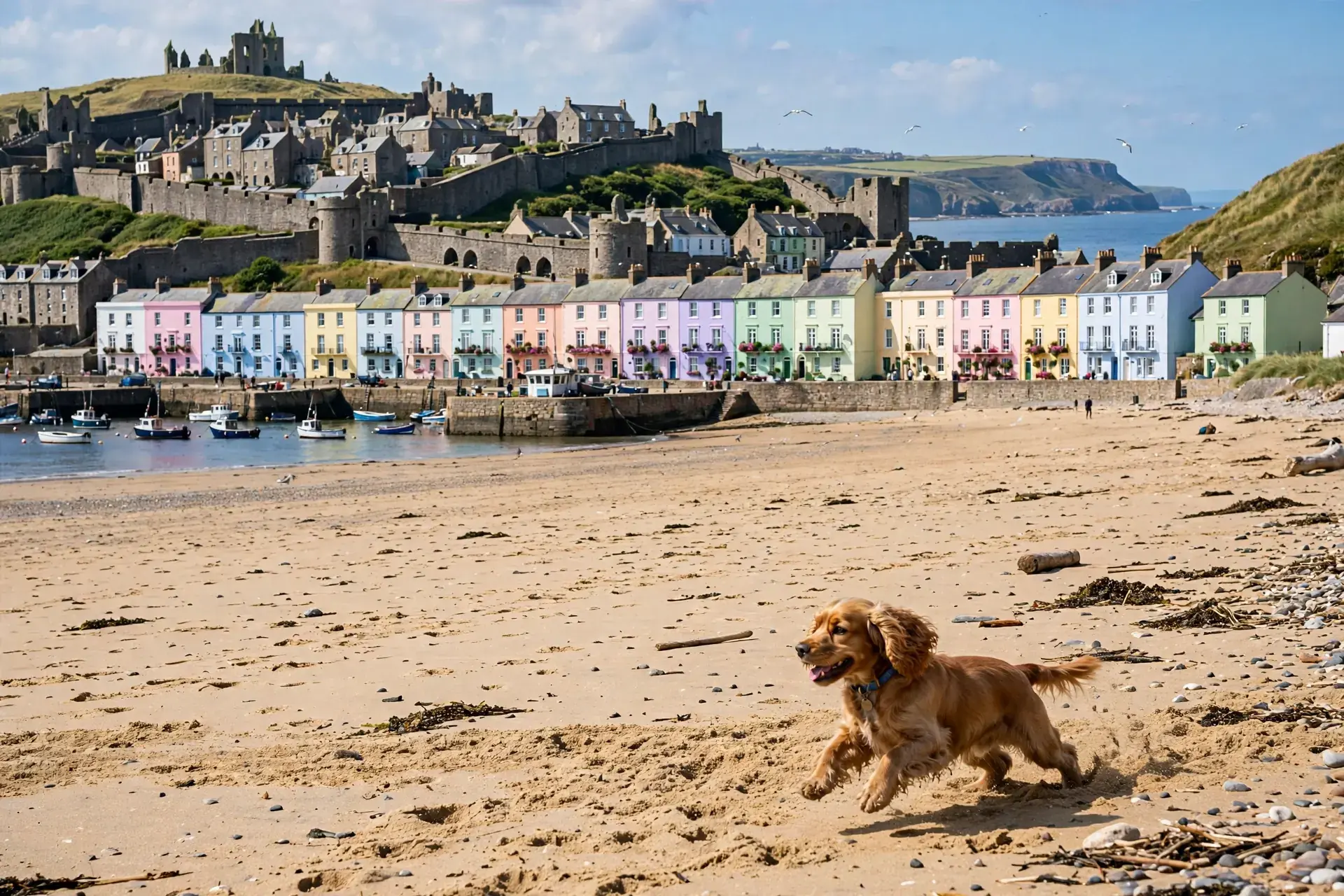
The first thing to understand about Saundersfoot is that it is still, at heart, a working harbour. The village grew up around coal: in the nineteenth century, coal from the inland valleys was carried down to the harbour on a tramway and loaded onto small ships, and the stone harbour walls, the old tramway tunnel and the rows of fishermen's cottages are still part of the everyday view. That history matters for a dog trip because it shapes the whole feel of the place. Saundersfoot is compact, walkable and low-key. There is one main beach, one harbour, a short strip of shops, cafes and pubs, and a coastline that does most of the talking. It is the kind of village where a dog on a lead fits in without a second thought, and where the best plan is usually the simplest one: a harbour wander, a beach session when the rules allow, and a long walk along the cliffs.
Arriving with a dog, the sensible first stop is the harbour itself rather than the beach. The harbour sits at the southern end of the village, sheltered by cliffs on both sides, and the flat quayside is an easy first walk for a dog that has just come out of the car. Let the dog sniff the ropes and the lobster pots, watch the boats coming and going, and get a sense of the place before heading anywhere busier. The harbour wall and the breakwater are worth a slow look, too: on a clear day the view runs across Carmarthen Bay towards the Gower, and on a grey day the light over the water has a softness that makes the whole bay feel quieter than it is. Keep the dog on a lead here at all times. The quayside is a working area with moving vehicles, mooring ropes, fishing gear and drops into the water, and a dog chasing a gull off the edge is the accident nobody wants. A short lead, a calm pace and a few minutes of standing still will settle most dogs far better than a hurried march to the sand.
Scale is Saundersfoot's great advantage for dog owners. The village is small enough that nothing is far: the beach, the harbour, the shops, the car parks and the start of the coast path are all within a few minutes' walk of each other. That means less time in the car, fewer decisions, and a trip that can be reshaped on the spot when the weather turns or the dog gets tired. It also means the village gets busy in a very concentrated way. On a sunny August weekend the harbour car park fills early, the beach is crowded, and the narrow pavements around the harbour fill with families, pushchairs and other dogs. If your dog is reactive, nervous in crowds, or simply young and excitable, the shoulder seasons — late spring before the beach restrictions bite, September and October after they lift, and the quieter winter months — will give you a much better version of the village. Saundersfoot in October, with the summer crowds gone and the beach open to dogs again, is arguably the best time to bring one.
The other thing to know before you arrive is that Saundersfoot is a village of two halves divided by the tide. At low tide the beach is wide, flat and generous, with rock pools at the southern end and firm sand for walking. At high tide the water comes right up to the sea wall in places, and the beach narrows to a strip. This matters for planning: check the tide times before you set off, especially if you are walking the coast path or planning a long beach session. A dog that loves the water will have a very different morning at low tide than at high tide, and a walk timed around the falling tide gives you the most sand and the most space. Tide tables are published by the usual sources and are worth a quick check the night before, alongside the weather forecast and the beach restriction dates.
Finally, a word about expectations. Saundersfoot is not a place for ticking off attractions. There is no pier, no amusement arcade, no long promenade of shops. What it offers instead is a very specific kind of seaside day: boats, sand, cliffs, and a village that still smells faintly of the sea rather than of candy floss. Dogs tend to love it for exactly that reason. The smells are real, the ground underfoot changes constantly — sand, stone, grass, cliff path — and there is always something to watch. Your job is mostly to manage the practical details around that: the lead on the harbour, the beach rules in summer, the tide, the parking, and a place to eat where the dog can settle. Get those right and Saundersfoot is one of the easiest and most rewarding dog days on the Welsh coast.
The harbour and boat trips
Saundersfoot harbour is the centre of the village, and it rewards a slow visit. The harbour was rebuilt and extended in the nineteenth century to serve the coal trade, and the stone piers and the harbour office still give the place a working character that a purpose-built marina never quite manages. Fishing boats still use the harbour, and on a working morning you may see creels being loaded, nets being mended and the day's catch coming ashore. For a dog, the harbour is a sensory feast: fish smells, rope, tar, salt water and gulls. Keep the lead short and the dog close, and treat the quayside as a place to look rather than a place to run. The surfaces are uneven in places, there are chains and bollards to trip over, and the water is deep beside the wall. A dog that is happy to sit and watch the boats while you have a coffee on the harbour wall is a dog that is going to have a good day here.
Boat trips are one of the main reasons people come to Saundersfoot, and they are worth considering with a dog — with some care. Several operators run trips from the harbour during the season, typically from spring through to autumn, offering wildlife-watching cruises along the coast, trips to nearby bays and, in some cases, longer excursions towards Caldey Island or the Pembrokeshire coast. The wildlife is the draw: grey seals haul out on the rocks and in the caves along this stretch of coast, and dolphins and porpoises are regularly seen in Carmarthen Bay, particularly in the summer months. Seabirds are everywhere — gulls, cormorants, guillemots and, in the right season, puffins further along the coast. A boat trip gives the dog a completely different kind of day, and many dogs settle surprisingly well on a boat once the engine note becomes familiar.
Whether your dog can actually come along depends on the operator, the boat and the day. Some operators welcome well-behaved dogs on board, others do not, and policies can change between seasons or even between trips depending on how full the boat is. The practical approach is to ask directly before booking, and to be honest about your dog: a calm dog that will lie down and stay down is a different proposition from a dog that barks at gulls or tries to climb the rails. Smaller dogs are often easier to take along, both because they take up less space and because they can sit on a lap or in a carrier. If the operator says yes, bring a lead, a non-slip mat or blanket for the dog to lie on, fresh water, and a towel for the spray. Keep the dog on the lead for the whole trip, and be ready to cut the trip short in your own mind if the dog is distressed — seasickness affects dogs too, and a miserable dog on a boat is no holiday for anyone.
If the boat trip does not work out, the harbour still offers plenty of wildlife watching from dry land. Seals are regularly seen from the coast path and from the rocks around the harbour, particularly at low tide when they haul out to rest. The best approach is patience and distance: use binoculars if you have them, keep the dog still and quiet, and never let the dog approach a seal on the beach. A seal on the sand is often resting or unwell, and a dog running at it can cause real harm — to the seal, and potentially to the dog. If you see a seal that looks injured or distressed, or a seal pup alone on the beach, keep the dog well away and report it to the local marine rescue organisation rather than approaching. The same applies to any stranded marine animal: admire from a distance, keep the dog on the lead, and let the experts handle it.
Fishing is another harbour activity that dog owners sometimes combine with a visit, and it comes with its own practical points. If you are fishing from the harbour wall or the beach, keep hooks, bait and tackle well away from the dog, and be aware that discarded fishing line and hooks are a common hazard on harbours and beaches. A dog that picks up a baited hook or swallows a piece of line can need emergency veterinary care, so scan the ground before letting the dog sniff around the quayside. The harbour area is also a good place to teach a young dog that not every exciting smell needs investigating: a short lead, a pocket of treats, and a few minutes of calm settling by the wall will do more for the rest of the day than any amount of free running.
One more harbour practicality: the water. Dogs that love to swim will be tempted by the harbour, but the harbour is not a swimming spot. The water is deep, the walls are high, the steps and ladders are not designed for dogs, and boats move in and out without much warning. If your dog wants a swim, the beach at low tide or a quiet stretch of the coast is a far better choice. Keep the dog out of the harbour water entirely, and if a dog does fall in, do not jump in after it unless you are certain you can get out again — call for help and use a rope or a ladder if one is available. This sounds dramatic, but harbour rescues happen every year, and the prevention is simply keeping the lead on and the dog away from the edge.
Saundersfoot beach and the dog rules
Saundersfoot beach is the village's main draw: a wide, sandy bay sheltered by cliffs, with the harbour at one end and the start of the coast path at the other. It is a genuinely good dog beach when the rules allow — firm sand at low tide, shallow water, rock pools at the southern end, and enough space for a proper run. The key phrase is "when the rules allow", because Saundersfoot beach has seasonal dog restrictions, and getting the dates wrong is the most common mistake dog owners make here. In recent years dogs have been excluded from the main beach area between 1 May and 30 September. The exact dates, the boundary of the restricted zone and any changes are set by Pembrokeshire County Council under a Public Spaces Protection Order, and the details can change, so check the official guidance before you travel rather than relying on a blog post or a memory of last year. Our guide to dog-friendly beaches in the UK explains how these seasonal bans and PSPO fines work in general, and it is worth reading alongside this page if you are planning a summer trip.
Outside the restricted season — roughly October to April — the beach is open to dogs, and this is when Saundersfoot really shines for dog owners. Autumn and winter bring wide empty sand, big skies and a village that has slowed down. The beach at low tide in October is one of the best dog walks in Pembrokeshire: firm sand for running, shallow pools for paddling, and a long, straight stretch that suits a ball thrower or a long-line training session. Winter brings its own character: stormy seas, dramatic light and very few people. Dress for the weather, bring a drying coat for the dog and a towel for the car, and expect to get muddy. The beach is also a good place for recall training in the quieter months, when there are fewer distractions and more space to work in. Just remember that even in winter, other beach users, other dogs and wildlife still deserve the same courtesy as in summer.
During the summer restriction period, dogs are not simply unwelcome in the village — they are welcome almost everywhere except the main beach itself. The harbour, the coast path, the village streets and the surrounding countryside all remain open, and there are good alternative beaches nearby. Coppet Hall beach, just south of Saundersfoot around the headland, is a small sandy cove that is popular with dog owners and is generally open to dogs year-round; it is reached by a short walk from the coast path or by a lane from the village, and it is a much quieter alternative to the main beach. Wisemans Bridge, a couple of miles to the north, is another sandy beach that is generally dog-friendly all year and is a favourite with local dog walkers. Both are worth knowing about before you arrive, because they turn a summer day that could have been a disappointment into a perfectly good beach day — just on a different stretch of sand. As always, check the official guidance before you travel, because beach rules can change.
Tides are the second thing to get right on Saundersfoot beach. The bay is tidal, and the difference between low and high water is dramatic: at low tide there is a broad expanse of sand, and at high tide the water can reach the sea wall and the beach can narrow to almost nothing in places. A walk timed for the falling tide gives you the most sand and the longest walk; a walk timed for a rising tide can leave you squeezed against the wall with a wet dog and nowhere to go. The tide also matters for safety. The rocks at the southern end of the beach and around the harbour are slippery and can be cut off by the incoming tide, so do not let the dog scramble over them without checking the tide times first. Rock pools are wonderful for sniffing and splashing, but they can also hide sharp shells, broken glass and, occasionally, discarded fishing gear. A quick scan of the ground before letting the dog off the lead is a habit worth building on any beach.
Beach etiquette matters more in Saundersfoot than in some places, precisely because the village is small and the beach is shared. Keep the dog under control at all times, even when off the lead: recall should be reliable before you let the dog run free on a busy beach. Pick up after your dog, every time, and use the bins provided — there are bins at the beach entrances and around the harbour. Do not let the dog chase birds, particularly the wading birds that feed on the sand at low tide, and keep the dog away from any seals hauled out on the rocks. If your dog is the type to dig, be aware that deep holes in the sand are a genuine hazard for other beach users, especially children and older people, so fill in anything substantial before you leave. And if your dog swims, watch the currents: the bay is generally gentle, but after heavy rain or in rough weather the sea can be much stronger than it looks, and a dog that is a confident swimmer in a river can still get into trouble in the sea.
Finally, a practical note on the beach in summer, when the restrictions apply. If you are staying in Saundersfoot in the summer with a dog, plan the beach around the edges of the day and around the alternative beaches. An early-morning walk on Coppet Hall or Wisemans Bridge, a harbour wander and a coast-path walk in the middle of the day, and an evening stroll around the village will give the dog a full and happy day without ever needing the main beach. If you do want the main beach in summer, consider visiting before 1 May or after 30 September, when the restrictions lift and the whole bay opens up again. The village is quieter then, the light is better, and the dog will have the run of the sand.
The coast path to Tenby
The walk from Saundersfoot to Tenby is one of the best-known stretches of the Pembrokeshire Coast Path, and it is the walk most dog owners come here to do. The route runs for roughly 4.5 miles (about 7 kilometres) one way, following the cliffs south from Saundersfoot past Monkstone Point, through the wooded valleys and open headlands, and into Tenby from the north. Most walkers with a dog allow two and a half to three and a half hours one way, including stops for photographs, water and the inevitable sniffing. It is not a flat walk: the path climbs and descends repeatedly, with some steep sections, steps and uneven ground. It suits reasonably fit dogs and owners, and it is a walk to take seriously rather than to dash off after lunch. For the full picture of the town at the other end, our guide to Tenby with a dog covers its beaches, harbour and old town in detail.
The route starts at the southern end of Saundersfoot beach, where the coast path climbs away from the sand and up onto the cliffs. The first stretch is the steepest, and it is worth taking slowly: the path rises quickly through gorse and bracken, and the views back over Saundersfoot bay open up within a few minutes. From there the path undulates along the cliff tops, dipping into wooded valleys and climbing back out again. The surface varies constantly — grass, bare earth, rock, wooden steps, and the occasional boardwalk — and after rain it can be slippery, particularly on the descents. Good footwear matters, for you and, in a different way, for the dog: check paws at the halfway point, especially if the dog is not used to long rough walks, and carry water for both of you. There is no reliable water source on the cliff tops, and on a warm day a dog can drink a surprising amount.
Dogs should be on a lead for much of this walk, and there are good reasons beyond the rules. The cliffs are unfenced in places, and a dog chasing a rabbit or a seabird near the edge is in real danger. The path passes through farmland where sheep and cattle graze, and dogs must be kept on a lead near livestock — this is both a legal requirement in many places and a matter of basic safety for the animals. Adders live in the gorse and bracken along this coast, particularly in warm weather, so keep the dog on the path and out of the deep vegetation. There are also sections where the path runs close to the cliff edge with a long drop, and a lead is the only sensible option. None of this makes the walk less enjoyable: a dog on a long lead, walking steadily and stopping to look at the view, is having just as good a time as a dog running free, and you will both be safer for it.
The viewpoints along the way are worth stopping for, and they are part of what makes this walk special. Monkstone Point, about halfway along, is a rocky headland with views in both directions and a good place for a rest and a drink. The wooded valleys — particularly the steep, green combe at Waterwynch — offer shade on a hot day and a change of scenery from the open cliffs. As you approach Tenby, the path descends towards the town, and the view of Tenby's pastel houses, the harbour and St Catherine's Island opens up suddenly and memorably. Keep the dog close on the descent into Tenby: the path narrows, the steps are steep, and the town is busy at the bottom. If you have walked one way, the return is usually by bus or taxi, and it is worth checking the bus times before you set off — services are less frequent outside the summer season, and a taxi that will take a dog needs to be booked in advance rather than assumed.
For dogs that cannot manage the full 4.5 miles, there are shorter options that still capture the flavour of the coast. Walking from Saundersfoot to Monkstone Point and back is a satisfying out-and-back of around two miles, with the best of the early views and a gentler return. The stretch from Saundersfoot to Coppet Hall and back is shorter still and mostly flat, and it suits older dogs, puppies and anyone who wants a gentler morning. Alternatively, drive or take the bus to Tenby and walk the first mile of the path northwards, then turn back — you get the Tenby views and the cliff walking without the full distance. Whatever you choose, build in more time than you think you need, carry water and a basic first-aid kit for the dog, and have a plan for getting back. A tired dog at the far end of a cliff path with no bus due for an hour is a problem that is easy to avoid and miserable to solve.
Weather deserves a paragraph of its own on this walk. The Pembrokeshire coast is famously changeable, and the weather on the cliffs can be very different from the weather in the village. Wind is the main factor: a stiff breeze on the cliff tops can be exhilarating for you and exhausting for a small dog, and in strong winds the exposed sections near the edge are best avoided. Rain turns the path slippery quickly, and fog can reduce visibility to a few metres, making the cliff edge genuinely dangerous. Check the forecast the morning of the walk, and be willing to change the plan: a shorter walk, a beach day, or a drive to a sheltered woodland walk is a better choice than pushing on into deteriorating weather. The path will still be there tomorrow.
Eating and drinking with a dog
Saundersfoot is a good village for eating out with a dog, in the particular way that small Welsh seaside villages tend to be good at it: most places are informal, many have outdoor seating, and the staff are used to dogs. The main strip around the harbour and the beach has cafes, pubs, fish and chip shops and ice cream parlours, and several of them welcome dogs. The pattern is familiar from across Britain: outdoor seating and terraces are usually fine for dogs, while indoor access varies from place to place and can change with the season or with new management. A few establishments allow dogs inside as well, particularly in the quieter months. Because policies change, check the official guidance before you travel or simply ask at the door — and take the answer gracefully if it is no. A dog that has just come off the beach, sandy and wet, is not going to be welcomed inside a cafe whatever the policy says, so build in a few minutes to dry the dog off first.
The harbour area is the natural place to start. There are cafes and pubs with outdoor seating overlooking the harbour, where a dog can settle under the table and watch the boats while you eat. Fish and chips eaten on the harbour wall is a Saundersfoot tradition, and it is also one of the easiest meals to manage with a dog: buy the food, find a spot on the wall or on the beach, and eat with the dog beside you. Bring a mat or a blanket for the dog to lie on, both for comfort and to keep the dog off the cold stone, and keep the lead short — the harbour wall is a busy place and a dog wandering underfoot will trip someone. Ice cream is another harbour staple, and most parlours are happy for a dog to wait outside with you; a small doggy ice cream or a plain biscuit from your own pocket will keep the dog occupied while you eat yours.
Pubs in Saundersfoot tend to be dog-friendly in the traditional sense: dogs are welcome in the bar area or on the terrace, water bowls appear without asking, and the staff often have treats behind the bar. The village has a handful of pubs within a short walk of each other, ranging from harbourside spots with sea views to quieter village pubs a few streets back. The quieter ones are often the better choice with a dog, particularly a nervous or reactive one: fewer people, less noise, more space to settle, and a landlord who has time to make a fuss of the dog. If you are planning a pub lunch, consider going early or late rather than at the peak of the lunch rush. A dog that can settle for an hour in a quiet corner is a dog that will be welcome back; a dog that barks at every person who walks past the table is a dog that will make the meal stressful for everyone, including the dog.
Breakfast and coffee deserve a mention, because they shape the rhythm of a dog day. A cafe breakfast before the beach, or a coffee and a cake after the coast path, is the kind of small pleasure that makes a trip feel like a holiday. Saundersfoot has cafes that open early and serve the full range of breakfasts, and several have outdoor seating where a dog can sit with you. If you are staying in self-catering accommodation, the village shops cover the basics — bread, milk, dog food and the inevitable forgotten item — and there is a small supermarket a short drive away for a bigger shop. Takeaway food is also a practical option: fish and chips, pizza and sandwiches can all be eaten on the beach or in your accommodation, which is sometimes the simplest answer when the dog is tired and the weather is kind.
A few practical points will make eating out with a dog in Saundersfoot easier. First, bring the dog's own water bowl or a collapsible bowl: not every cafe has one, and a dog that has been walking the coast path will be thirsty. Second, bring a mat. A dog that has a defined place to lie down settles far faster than a dog left to choose its own spot under a table, and a mat also keeps the dog off cold or wet floors. Third, keep the lead short and the dog close in busy places; a long lead across a cafe floor is a trip hazard. Fourth, be honest about your dog. If the dog barks, begs or steals food, a takeaway eaten on the harbour wall is a kinder choice than a sit-down meal. And finally, remember that dogs are not allowed in food preparation areas, and that some places will ask you to keep the dog outside the main dining room even when the policy is generally welcoming. None of this is a reason to avoid eating out — it is simply the small print of a good dog-friendly meal.
Staying over and parking
Saundersfoot works well as a base for a longer stay, and there is a good range of dog-friendly accommodation in and around the village. Self-catering cottages are the most common option, and many of them welcome dogs — some with enclosed gardens, some with a small pet charge, and some with a limit on the number of dogs. The cottages closest to the harbour and beach are the most convenient, but they are also the most popular and the first to book out in the summer. Cottages on the edge of the village or in the surrounding countryside are often quieter, cheaper and better for dogs that need space, and the village is small enough that a short drive or a ten-minute walk still puts you in the centre. When you book, ask the specific questions that matter for your dog: is the garden genuinely enclosed, and how high is the fence? Is there a secure place to dry a wet dog? Where is the nearest toilet walk after dark? Is there parking beside the cottage? The answers will tell you more about the stay than any number of photographs.
Hotels, guest houses and bed and breakfasts in Saundersfoot also welcome dogs, though usually in selected rooms and with a pet charge. The pattern is similar to the cottages: ask about the specific room, the charge, and where the dog is allowed within the building. Some places welcome dogs in the bar and the garden but not in the dining room; others are happy for the dog to join you everywhere except the restaurant. If you are staying in a hotel, plan the dog's routine around the building: a last walk before bed, a familiar bed or blanket, and a plan for what happens if the dog barks at the corridor noises. A dog that sleeps in its own bed at home will sleep better in its own bed on holiday, so bring it with you rather than relying on whatever the hotel provides.
Caravan and camping sites around Saundersfoot offer another option, and the area has several sites within a short drive of the village. These suit dogs that are happy outdoors and owners who want a cheaper, more flexible base. The same checks apply as for any caravan stay: is the pitch near a road, is there a dog-walking area, and what are the rules about leaving the dog in the caravan? For a fuller treatment of this kind of stay, the general principles in our holiday-parks guide apply here as they do anywhere else in Britain. Whatever kind of accommodation you choose, book early for the summer months and for school holidays: dog-friendly places in Saundersfoot are limited, and the best ones go months ahead.
Parking in Saundersfoot is straightforward if you arrive early and a source of frustration if you do not. The village has several car parks close to the harbour and the beach, including the harbour car park and car parks on the edge of the village. On a sunny summer day or a bank holiday weekend, the main car parks fill by mid-morning, and the narrow village streets are not a good place to circle looking for a space. Arrive before ten in the morning in the summer, or consider the park-and-ride options that run in the peak season, which let you leave the car outside the village and walk or ride in. Charges apply in the main car parks, and the rates and payment methods can change, so check the official guidance before you travel for current information. Some car parks offer longer-stay or weekly tickets, which are worth considering if you are staying for several days.
Parking with a dog brings a few extra considerations. In warm weather, never leave a dog in a car, even for a few minutes: cars heat up far faster than most people expect, and a dog can overheat quickly. If you are parking in the sun, use a sunshade and park in the shade where possible, and always take the dog with you. When you return to the car, give the dog a drink and a few minutes to cool down before setting off. If you are using the car as a base for the day — changing, drying the dog, storing kit — choose a car park that is close to the beach or the path you are using, so the dog is not walking far on hot tarmac. And if you are arriving by public transport, Saundersfoot is served by buses from Tenby and Pembroke, and the nearest train station is a short distance away; check the current timetables before you travel, and confirm that dogs are welcome on the services you plan to use.
One more practical point about staying in the village: the evenings. Saundersfoot in the evening, particularly outside the summer season, is quiet. The pubs and a few restaurants stay open, the harbour is peaceful, and an evening walk around the harbour with the dog is a lovely way to end the day. But the shops close early, the village has limited late-night options, and the coast path is not a place to walk after dark. Plan the evening around the dog: a last walk before dark, dinner in a dog-friendly pub or a takeaway back at the cottage, and an early night. If your dog is unsettled by fireworks or by the noise of a busy summer evening, the quieter months will suit you both better.
Planning the trip
A good Saundersfoot trip is mostly about timing, and the calendar matters more here than in many seaside towns because of the beach restrictions. The simplest way to think about it is in three seasons. Late spring, from April into early May, offers long days, mild weather and a beach that is still open to dogs until the restrictions begin. Summer, from May to September, is the busiest and the warmest, with the main beach closed to dogs but everything else open and the village at its liveliest. Autumn, from October into November, is many dog owners' favourite time: the restrictions have lifted, the crowds have gone, the light is golden, and the beach is yours again. Winter is quiet and wild, with stormy seas and empty sands, and it suits hardy dogs and owners who do not mind the rain. Choose the season that fits your dog, not the season that fits the postcards.
Packing for Saundersfoot is mostly about the weather and the beach. Bring a lead and a long line, a harness if your dog uses one, and a spare lead — leads break, and a village shop may not have the one you want. Bring water and a collapsible bowl, poo bags (more than you think you need), a towel and a drying coat, and a mat for the dog to settle on in cafes and pubs. Bring a first-aid kit for the dog: tick removers, antiseptic, bandages, and any medication the dog needs. If you are walking the coast path, bring a basic human first-aid kit too, and a charged phone. Sun protection matters in the summer, for both of you: dogs with thin coats or pale noses can sunburn, and the sand reflects the sun. In the winter, bring extra layers and a waterproof for the dog if it has one — the wind on the cliffs is colder than the temperature suggests.
Health and safety on the coast deserve a little attention. Ticks are present in the gorse and bracken along the coast path, so check the dog after every walk and remove any ticks promptly with a tick remover. Adders are present too, particularly in warm weather, so keep the dog on the path and seek veterinary help immediately if you suspect a bite. The sea is the other hazard: never let the dog swim in rough conditions, and be aware that the currents in Carmarthen Bay can be strong after heavy rain. If the dog does get into difficulty in the water, do not enter the water yourself unless you are confident you can get out — call for help. Finally, know where the nearest vet is before you need one. There are veterinary practices in Saundersfoot and in nearby Tenby, and it is worth saving the number in your phone before you arrive. A few minutes of preparation before the trip can save a great deal of stress during it.
Putting it all together, a sensible two-day Saundersfoot plan might look like this. Day one: arrive early, park near the harbour, and spend the morning on the harbour and the beach (or Coppet Hall in the summer). Have lunch on the harbour wall or in a dog-friendly cafe, then walk the first stretch of the coast path in the afternoon — as far as Monkstone Point if the dog is up to it — and finish with an evening stroll around the village. Day two: walk the full coast path to Tenby, or take the bus to Tenby and walk back, stopping for lunch in Tenby before the return journey. If the weather turns, swap the coast path for a drive to a sheltered woodland walk, a visit to a dog-friendly attraction nearby, or a quiet day in the village with the dog. The point of Saundersfoot is not to fill every hour; it is to let the harbour, the beach and the cliffs set the pace, and to give the dog a trip that is as enjoyable for them as it is for you.
Practical questions
Before you go
Can dogs go on Saundersfoot beach in summer?
Saundersfoot beach has seasonal dog restrictions during the summer months, with dogs excluded from the main beach area between 1 May and 30 September in recent years. The exact dates, the restricted zone and any changes are set by Pembrokeshire County Council, so check the official guidance before you travel. Outside the restricted season dogs can usually enjoy the beach, and nearby beaches such as Coppet Hall and Wisemans Bridge offer year-round alternatives.
Are dogs allowed on the boat trips from Saundersfoot harbour?
Some boat operators from Saundersfoot harbour welcome well-behaved dogs on board, while others restrict them, so ask the individual operator before booking. Smaller dogs are often easier to take along, and a dog that settles calmly on a moving boat is a much better candidate than one that paces or barks. Bring a lead, water and something for the dog to lie on, and check the official guidance before you travel.
How long is the Saundersfoot to Tenby coast path walk with a dog?
The Pembrokeshire Coast Path between Saundersfoot and Tenby is roughly 4.5 miles (about 7 kilometres) one way, and most walkers with a dog allow two and a half to three and a half hours including stops. The route is undulating with some steep climbs and descents, so it suits reasonably fit dogs and owners. Many people walk one way and return by bus or taxi, or walk out and back for a shorter stretch.
Where can dogs go inside cafes and pubs in Saundersfoot?
Several cafes, pubs and ice cream parlours in Saundersfoot welcome dogs, most commonly in outdoor seating areas and on terraces, with a smaller number allowing dogs inside as well. Policies change with the season and with new management, so check the official guidance before you travel or ask at the door. Bring a mat for the dog to settle on and keep the lead short in busy spots.
Is there parking in Saundersfoot that works well with a dog?
Saundersfoot has several car parks close to the harbour and beach, including the harbour car park and car parks on the edge of the village. The main car parks fill quickly on sunny summer days and bank holidays, so arrive early or use the park-and-ride options when they run. Park in the shade where possible, never leave a dog in a car on a warm day, and check the official guidance before you travel for current charges.