This guide is independent and contains no paid placement. If affiliate links are added later, they will be clearly marked and will not change our editorial checks.
Scotland gives you scale, emptiness and dramatic weather; Wales gives you compactness, milder conditions and much shorter drives. With one week and a dog that hates long car journeys, you will get more holiday per hour in Wales. If maximum open space matters more than the drive, go north. Read the tree below before you read anything else.
The 60-second decision tree
Skip the brochures. Answer these four questions in order, and the right country usually picks itself.
Question 1: How does your dog cope with the car? This is the question that eliminates one country before you have compared a single beach. From the south of England, Scotland means a full day of driving each way — seven to nine hours to the central Highlands, more to the far north coast. A dog that sleeps in the car will not care; a dog that pants, whines, drools or works itself into a state for the first two hours will arrive in Scotland already exhausted, and you will spend day one recovering instead of walking. If your dog hates the car, Wales wins by default: Cardiff is roughly three hours from London, Snowdonia four to five, and nowhere in Wales is more than a day's steady driving from anywhere else in Britain. The holiday starts sooner and ends less frazzled.
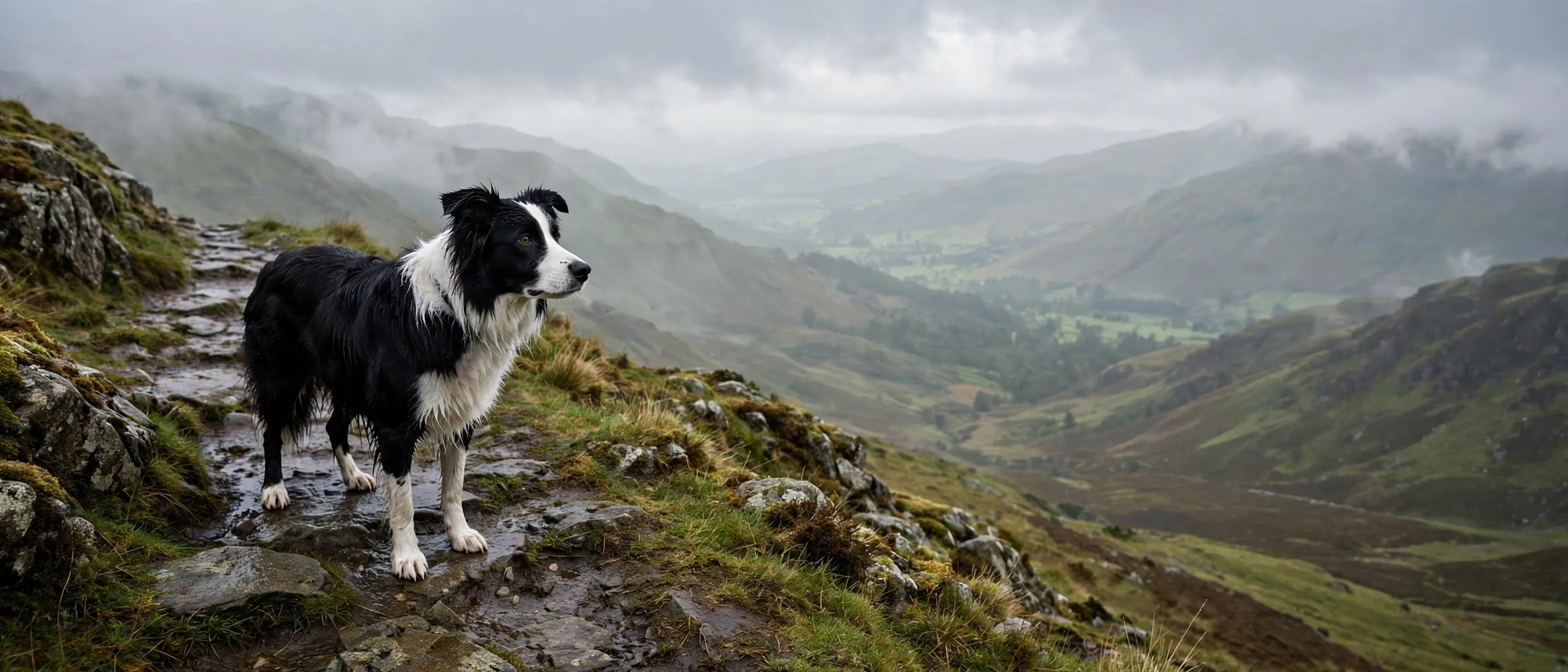
Question 2: Does your dog run cold or run hot? Scotland is, on average, several degrees cooler than Wales at any given time of year, and the wind off the Atlantic or the North Sea can make a mild day feel properly cold at height or on an exposed headland. Thick-coated breeds — collies, huskies, Newfoundlands, most spaniels in full feather — are in their element. Short-coated, elderly or very lean dogs can shiver on a Scottish beach in July. Wales, sheltered in parts and a degree or two milder, is kinder to dogs that feel the cold. Whichever you choose, pack a drying coat for a wet-weather country: both of these nations specialise in rain.
Question 3: Does your dog need space from other dogs? Reactive, nervous and newly rehomed dogs do not want a holiday full of surprise encounters at every stile. Scotland's great selling point is emptiness: once you are off the handful of honeypot routes, you can walk for an hour on open moor or along a Highland beach and meet nobody. Wales has quieter corners too, but its best-known paths — the Snowdon routes, the Pembrokeshire Coast Path honeypots, the Gower in August — funnel people and dogs together. If solitude is therapy for your dog, Scotland's advantage is real.
Question 4: When are you going? Summer sharpens every difference. In July and August, Scotland's west coast and Highlands can be magnificent — and midge-tormented, especially on still evenings near water. Wales in high summer has its own crowds and seasonal beach bans, but the weather is gentler and the insects less of a campaign. In spring and autumn, the differences soften: fewer midges in Scotland, fewer bans in Wales, and both countries at arguably their best. Winter flips it again: Scotland's Highlands can be genuinely harsh, with short days and mountain weather that rules out half your walking plans, while Wales stays walkable almost year-round at lower levels.
If your answers point in different directions — a car-hating collie, say, or a reactive dog that also hates the cold — the dog profiles below resolve the tie. The tree is the fast route; the rest of this guide is the evidence.
Eight dimensions, compared honestly
Here is what actually differs once you are on the ground, stripped of tourism-board gloss.
| Dimension | Scotland | Wales |
|---|---|---|
| Landscape and open space | Unmatched scale: the Highlands, the Cairngorms, the far north coast and the islands. You can be properly alone within an hour of leaving a town. | Compact variety: mountains, coast and valleys packed close together. Beautiful, but you rarely feel as far from people. |
| Waymarked walking | Great long-distance routes (West Highland Way, Great Glen Way) but also vast pathless moor where you navigate yourself — demanding for some dogs and owners. | The Wales Coast Path runs 870 miles around the entire country; Eryri and the Brecon Beacons have well-maintained, well-signed networks. Easier to plan day by day. |
| Beach rules | Few seasonal bans; most beaches open to dogs all year. Read local signs, but summer beach freedom is a genuine Scottish advantage. | Seasonal dog bans are common on resort beaches, typically 1 May to 30 September. Off-season Wales is a beach paradise; in August, check every beach. |
| Accommodation cost and availability | Dog-friendly cottages plentiful but scattered; the famous routes book out early in summer and prices spike along them. The far north can be surprisingly good value. | Similar cottage prices in most areas; shorter distances mean more choice within a day's drive of the big cities, and less fuel burned getting there. |
| Getting there | Long. From the Midlands or the south, allow a full driving day each way, possibly two. Trains reach Edinburgh and Glasgow; car hire with a dog is harder. | Short. Most of England is within half a day. Wales is also the easier country to reach by train with a dog. |
| Weather | Cooler, wetter in the west, with real winter at height. Summer days can be glorious; the same week can deliver four seasons. | Milder and more predictable at low level, though the west coast and the mountains get plenty of rain. Winter walking stays practical. |
| Ticks and midges | Midges from June to September on the west coast and Highlands — a serious human-comfort issue. Deer ticks in both countries; check your dog after every walk. | Midges present but far less intense. Ticks just as relevant: the same after-walk check applies everywhere sheep and deer graze. |
| Crowds | Thin outside the honeypots. Even in August you can escape people quickly — the country is simply bigger. | Busier on the famous coastlines and mountain routes in season; easy to find quiet in the hills and the far west, but you have to plan for it. |
Two footnotes matter for both columns. First, livestock: both countries are sheep country, and the rule is identical — dog on a lead or under close control near farm animals, no exceptions, no optimism. Scotland's access rights under the Scottish Outdoor Access Code give you more open ground to roam, but the code is explicit that dogs must not worry livestock, and the consequences for a chasing dog are the same everywhere. Second, water: both countries have rivers, reservoirs and sea that look inviting and can be dangerous. Cold water shock affects dogs too, reservoir edges can be steep, and estuaries have fast tides — check the official guidance before you travel anywhere unfamiliar.
The older dog: choose Wales
An older dog's holiday is won or lost on logistics, not scenery. Long car journeys stiffen arthritic joints; unfamiliar stairs in cottages become nightly ordeals; a beach ten minutes' walk from the door beats a spectacular one an hour's drive away. Wales wins on all of these. The shorter drive means your dog arrives supple rather than seized up, and because Welsh towns and villages sit closer together, you are rarely far from a vet if something goes wrong — reassuring when the dog in question is twelve and on medication.
Choose the ground, not the postcard. The Gower Peninsula and the Pembrokeshire coast offer long, level coastal walking with big views and minimal climbing; the Llyn Peninsula and the lower valleys of Eryri give you mountain scenery your dog can enjoy from a lakeside path rather than a summit. When you book, ask specifically for ground-floor accommodation with level access and a small enclosed garden or yard for midnight outings — Welsh stone cottages are charming and frequently stair-heavy, so confirm rather than assume. A non-slip mat by the door and beside the bed, plus a ramp for the car, will do more for your senior dog's holiday than any view.
Scotland is not impossible for an older dog, but it asks more of one: the drives are longer, the good cottages are more spread out, and the best walks often start with a climb. If your heart is set on the Highlands, consider basing yourself in one spot — say, around Loch Lomond or the edge of the Cairngorms — and doing short out-and-back walks from the same door every day, rather than touring. Routine is the older dog's love language.
The high-energy dog: choose Scotland
Some dogs cannot be tired by a pretty walk. Young collies, spaniels, vizslas and the rest of the perpetual-motion breeds need serious mileage, and Scotland is the only place in Britain where you can give it to them legally and safely at scale. The combination that matters is space plus year-round beach access: a ten-mile moorland circuit in the morning and an off-lead blast on an empty Highland beach in the afternoon is a routine Wales cannot match in summer, when many of its best beaches are off-limits to dogs.
Scotland's access rights are the practical engine here. Under the Scottish Outdoor Access Code you can roam open hill and moorland responsibly, which means you can design long, varied loops instead of repeating the same waymarked trail. The Cairngorms offer huge, well-drained plateaus; the far north coast has beaches where your dog may be the only one on them in June; even the islands — Skye, Mull, Arran — give you coastal and hill walking from one base. The caveat is midges: from June to September on the west coast, the still evenings that follow a big walking day can be miserable for the humans. Plan dawn and dusk walks on breezy ground, and keep a head net in the day pack — your dog will not thank you for scratching yourself raw at the campsite.
One warning that applies double to high-energy dogs: livestock. A fit young dog with a chase instinct is the classic sheep-chasing case, and both countries prosecute it the same way. In Scotland the open access that gives you freedom also puts you in sheep country constantly. Train the recall until it is boring, and put the lead on the moment sheep appear — not when the dog notices them.
The nervous or reactive dog: usually Scotland, with one exception
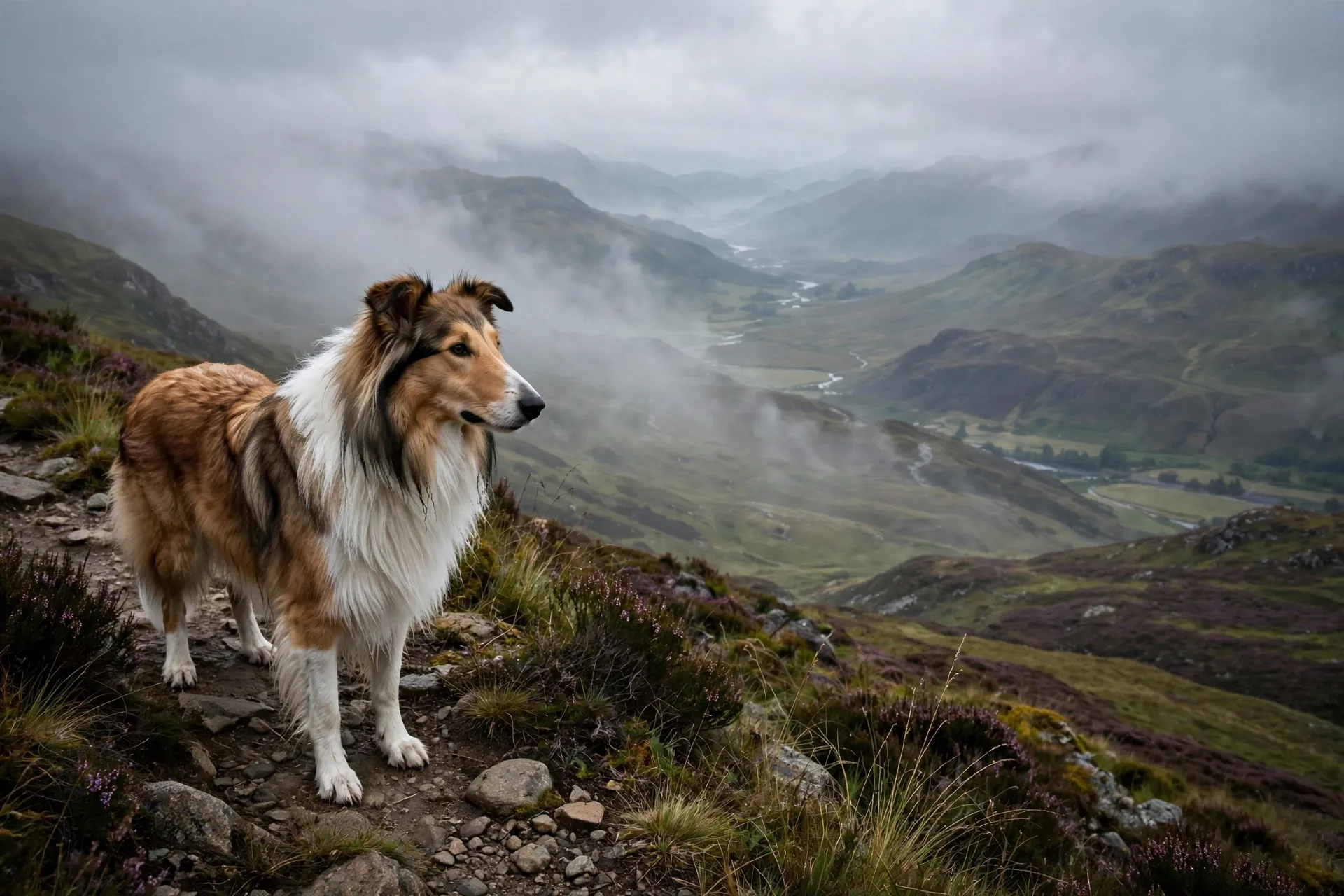
For a dog that finds other dogs stressful, the single most valuable holiday feature is the ability to see trouble coming and step aside. Scotland's open landscapes give you sightlines of hundreds of metres: you can spot the approaching off-lead Labrador while it is still a dot, and arc calmly away across the moor. Compare that with a narrow Welsh coastal path with hedges on both sides, where the next dog appears at ten paces around a bend. For genuinely reactive dogs, Scotland's space is not a luxury; it is the management strategy.
Go where the crowds are not, and go when they are not. The far north coast, the eastern Highlands, Dumfries and Galloway and the Borders all offer emptiness without the honeypot pressure of Skye or Loch Ness. Travel outside school holidays if you can: an empty Scottish beach in late September does for a nervous dog what no training plan can do in a week. Book accommodation with its own enclosed outdoor space so the dog has a safe decompression zone at the start and end of every day, and ask about neighbouring dogs before you commit — a cottage sharing a garden fence with three terriers is the wrong base whatever the county.
The exception is the car. If your reactive dog is also a terrible traveller — panting, barking, or shutting down for hours after a long drive — the journey to Scotland can sensitise the dog before the holiday even starts, and a sensitised dog does not decompress well. In that case, Wales in the off season is the better call: the Llyn Peninsula, the Cambrian Mountains and the quieter stretches of the Ceredigion coast offer real solitude within a half-day drive. A shorter journey to a quieter Wales beats a longer journey to a louder Scotland.
The first long trip: choose Wales
If this is your dog's first proper holiday — first time sleeping somewhere strange, first long drive, first week of unfamiliar walks — do not make Scotland the test case. A first trip has enough unknowns without adding a nine-hour drive, mountain weather and midge season to the list. Wales is the gentler laboratory: everything is closer together, the weather is more forgiving, vet practices and pet shops are never far, and if the whole experiment goes wrong on day two, home is half a day away instead of a full one.
Structure the week so the dog can learn the new routine gradually. Base yourself in one place for the full week — moving between cottages every two nights is hard on a dog that is still working out where it sleeps. The Snowdonia foothills or the Pembrokeshire coast both give you a week of different day walks from a single door: a lake circuit one day, a beach the next, a forest trail the day after. Our Snowdonia guide covers lead rules on Yr Wyddfa, livestock safety and the easier walks in detail if the mountains are calling. Keep the first two days deliberately easy — short familiar-feeling walks, same feeding times as home, the dog's own bed in the same spot — and build up from there. Dogs read consistency as safety, and a first holiday that feels boring in the right ways becomes the foundation for braver trips later.
One specific piece of first-trip kit for Wales: a long line. Welsh coastal paths and farmland walks alternate constantly between safe open stretches and livestock, cliff edges and road crossings. A ten-metre line gives an untrained or unpredictable dog freedom where it is safe and instant control where it is not, without the constant lead-on, lead-off negotiation that frays everyone's patience by day three.
One workable Scotland week
This skeleton assumes a high-energy or space-hungry dog, one base to keep things simple, and a summer or early-autumn trip. Adjust the geography to the Cairngorms, Argyll or the far north to taste — the rhythm is what matters.
Days 1–2: Arrive and settle. Drive up in one go if the dog travels well, or break the journey overnight around the Borders. Do nothing ambitious on arrival: a short sniff around the local lanes, the boundary check of the garden, and the same bedtime routine as home. Day two is a half-day moorland or forest walk from the door — enough to take the travel stiffness off without spending the dog's whole battery.
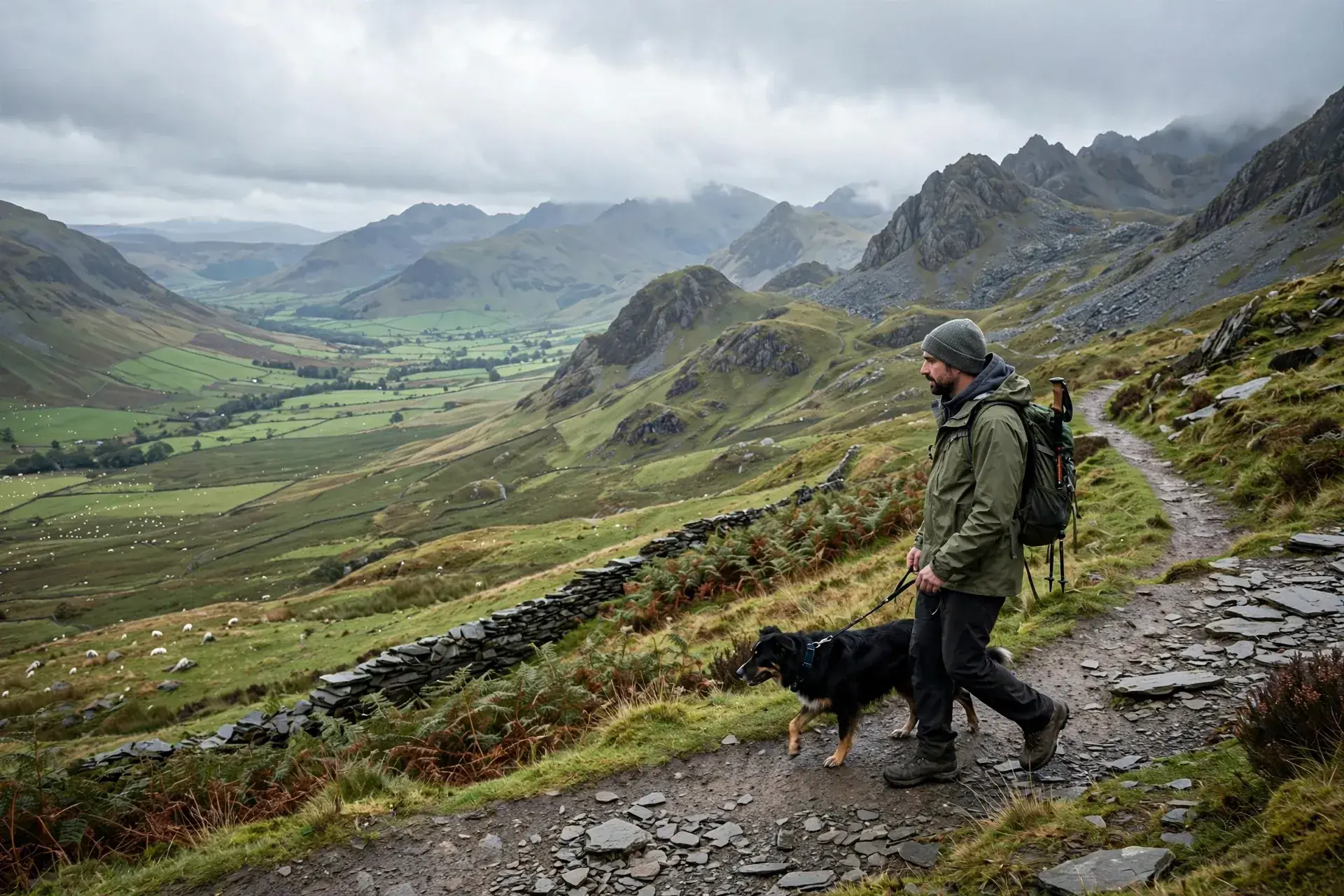
Days 3–4: The big walking days. These are your long loops: a full Cairngorm plateau circuit, a Great Glen section, or a coastal traverse with a beach finish. Start early to dodge the worst of the midges and the afternoon weather, carry more water than you think you need — Highland burns are drinkable in the hills but scarce on the moors — and have a short-cut exit planned for every long route, because Scottish weather changes its mind by lunchtime. Day four evening is for the rest the dog has earned.
Day 5: Beach day. This is Scotland's trump card: drive to one of the big empty west-coast or northern beaches — the kind that stretch for miles with nobody on them — and let the dog run. Check tide times first; some of these beaches shrink dramatically at high water. Rinse salt and sand off afterwards, because a salt-caked coat itches all evening.
Day 6: The easy day. A short forest trail, a village wander, a dog-friendly pub lunch. Older hands call this the insurance day: it keeps something in reserve if the weather has stolen one of your big days, and it stops the dog going home over-tired and grumpy.
Day 7: Travel home. Leave after the morning walk and the garden check, not before. A tired dog travels better, and you will want the cottage cleaner than you found it — muddy-paw deposits are a real thing in Highland rentals.
One workable Wales week
This skeleton suits a first trip, an older dog, or anyone who wants variety without long drives. One base in the Snowdonia foothills or on the Pembrokeshire coast; every day a different landscape within an hour.
Days 1–2: Arrive and learn the area. The short drive means you can arrive by lunchtime and still get a proper afternoon walk in — a lakeside circuit like Llyn Padarn or a gentle section of the Wales Coast Path. Use day two to recce your week's options: which car parks fill by ten, which beaches have the seasonal restrictions, where the nearest vet is. This scouting pays for itself all week.
Days 3–4: Mountains and waterfalls. A lower-level mountain day — the foothill paths around Yr Wyddfa rather than the summit unless your dog is fit and the weather is settled — and a waterfall walk in the Brecon Beacons, where the wooded gorges stay cool on warm days. Keep dogs on leads near the drops and the livestock; the gorges' paths can be narrow and the river crossings slippery.
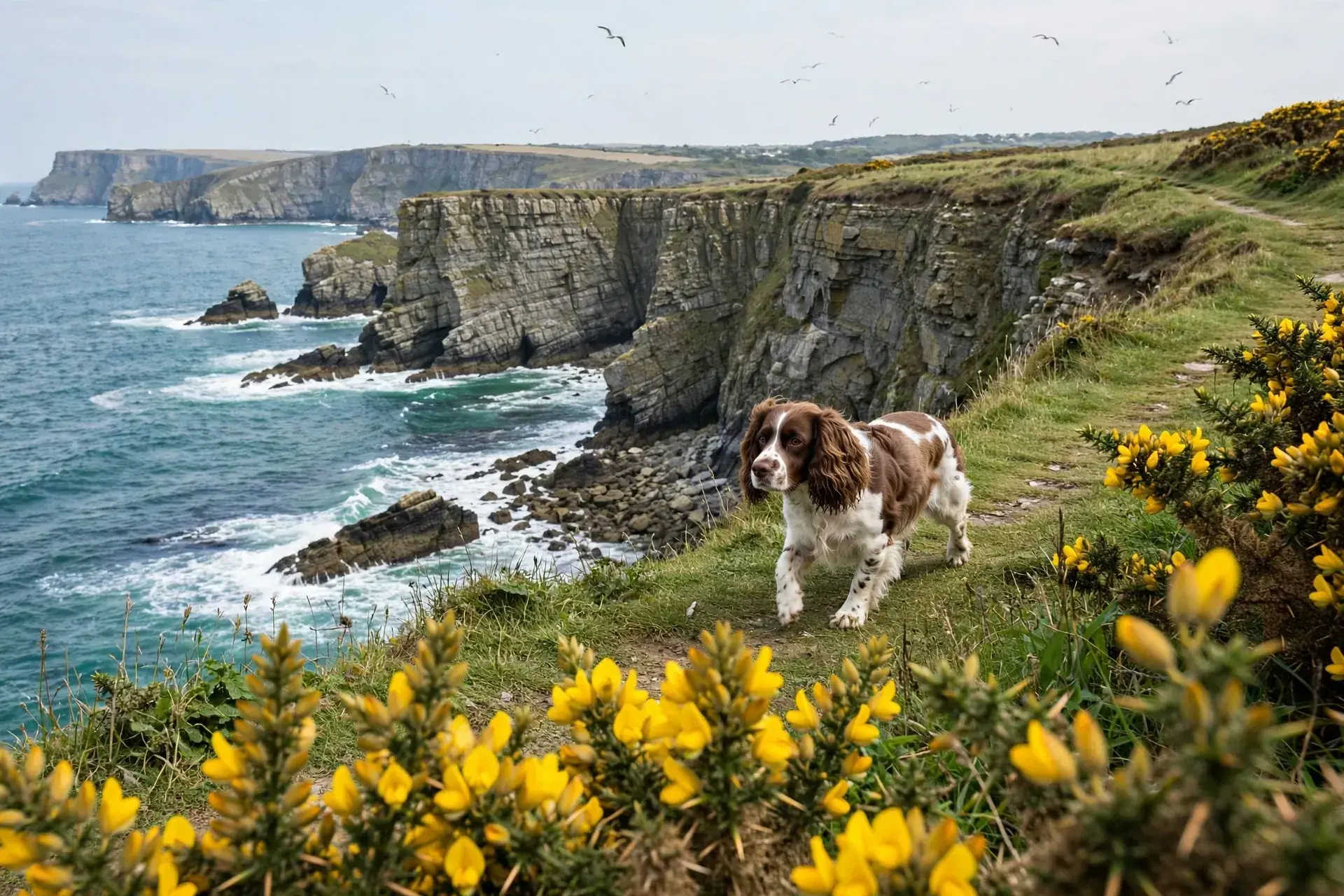
Day 5: The coast. Outside the May-to-September bans, a Welsh beach day rivals anything in Scotland: the Gower, Pembrokeshire and the Llyn Peninsula all have long sandy stretches. In high summer, target the beaches without restrictions — they exist, but you must check each one rather than assuming. Our Snowdonia guide is mountain-focused; for coastal planning, read the restriction signs at every access point and have a backup beach in mind.
Day 6: The culture day. A castle town wander, a steam railway that takes dogs, a dog-friendly pub with a proper garden — the low-effort pleasures Wales does well. This is also the day to do nothing if the dog is tired; a rest day in the cottage garden is a legitimate holiday activity.
Day 7: Travel home. The short drive home is Wales's final gift: you can do the last coastal walk in the morning and still be home for dinner, which is how a holiday should end.
Money, seasons and booking realities
Accommodation prices overlap more than the brochures suggest: a decent dog-friendly cottage in either country typically runs a few hundred pounds for a week in low season and climbs steeply in school holidays, with dog surcharges commonly £25–£75 per dog per week on top. The consistent saving in Wales is the journey: less fuel, no overnight stop each way, less wear on everyone. Scotland can be genuinely good value in the far north and the east, where demand is thinner than on the famous west-coast driving routes — but factor the travel cost honestly before declaring it cheaper.
Seasons change both countries more than the price lists do. Shoulder season — May, June, September, early October — is the sweet spot for both: in Scotland the midges are thinner and the light is superb; in Wales the beach bans have lifted or not yet started and the crowds have gone home. High summer in Scotland means booking the popular areas months ahead; high summer in Wales means checking every beach's dog rules before you promise the dog a swim. Winter is the honest divider: low-level Wales stays walkable almost all year, while the Scottish Highlands in January are a specialist trip — magnificent, but not a casual dog holiday.
Book the dog-friendly specifics, not just the cottage. Confirm the number of dogs allowed, the exact surcharge, whether the garden is genuinely enclosed, and the flooring — slate and tile are forgiving of muddy paws, cream carpet is not. And if the Scotland-versus-Wales question has made you curious about smaller-scale comparisons, our guides to the Lake District versus the Peak District and Cornwall versus Devon apply the same decision-first method to England's great rivalries.
The verdict: no better, only better for your dog
So which should you choose? If your dog travels well, runs hot, needs space from other dogs and you have a full week: Scotland, and you will not regret a mile of the drive. If your dog is older, travels badly, is taking its first long trip, or you simply have fewer days than ambitions: Wales, and you will get more actual holiday out of every one of them.
The deeper truth is that both countries reward the same thing: a plan built around the dog you actually have. The owner who picks Scotland because the photographs are dramatic, then spends the week managing a car-sick terrier through midge season, has chosen worse than the owner who picks Wales because it is closer and spends the week actually walking. Match the country to the dog — cold tolerance, car tolerance, sociability, age — and the scenery will take care of itself. There is no better country. There is only the better fit.
Practical questions
Before you go
Is Scotland or Wales cheaper for a dog-friendly holiday?
Wales is usually cheaper overall, mainly because the journey costs less: shorter drives mean less fuel, and many southern owners can skip the overnight stop that a Scottish trip needs. Accommodation prices overlap a lot between the two countries, so the real saving in Wales is travel time and mileage rather than the cottage itself. Scotland can be good value in the far north and in shoulder season, when demand on the famous driving routes drops.
Which is better for a nervous or reactive dog, Scotland or Wales?
Scotland wins on space: the Highlands and the far north coast have long stretches where you can walk for an hour without meeting another person, which is exactly what a reactive dog needs. The catch is the drive — a stressed car journey can undo the benefit. If your dog travels badly, choose quiet corners of Wales in the off season instead, such as the Llyn Peninsula or the Cambrian Mountains, where emptiness is easier to find than the guidebooks suggest.
Do Scottish beaches have seasonal dog bans like Welsh beaches?
Scotland has far fewer seasonal beach restrictions than Wales. Most Scottish beaches are open to dogs all year, and blanket summer bans are rare, though local rules can apply so you should still read the signs at the access point. In Wales, seasonal dog bans are common on resort beaches, typically running from 1 May to 30 September, which matters a lot if a summer beach holiday is the point of the trip. Check the official guidance before you travel, because individual councils change their maps.
How bad are midges in Scotland compared to Wales?
Scotland is in a different league. Biting midges swarm the west coast and Highlands roughly from June to September, worst in July and August, especially on still, damp evenings — and they will find you on a camping trip or a dawn walk. Wales has midges too, but they are less dense and less of a holiday-ruiner. They mostly torment the humans rather than the dog, but a midge-tormented owner is nobody's idea of a relaxed pack leader.
Is one country safer than the other for dogs around livestock?
Neither is meaningfully safer; both countries are full of sheep, and both expect you to keep your dog on a lead or under very close control near livestock. Scotland's access rights let you walk more open ground, but the Scottish Outdoor Access Code is explicit that dogs must not worry farm animals, and farmers can act against a dog that does. In Wales the practical rule is the same. Train a rock-solid recall and default to the lead whenever sheep are in the same field.