This guide is independent and contains no paid placement. If affiliate links are added later, they will be clearly marked and will not change our editorial checks.
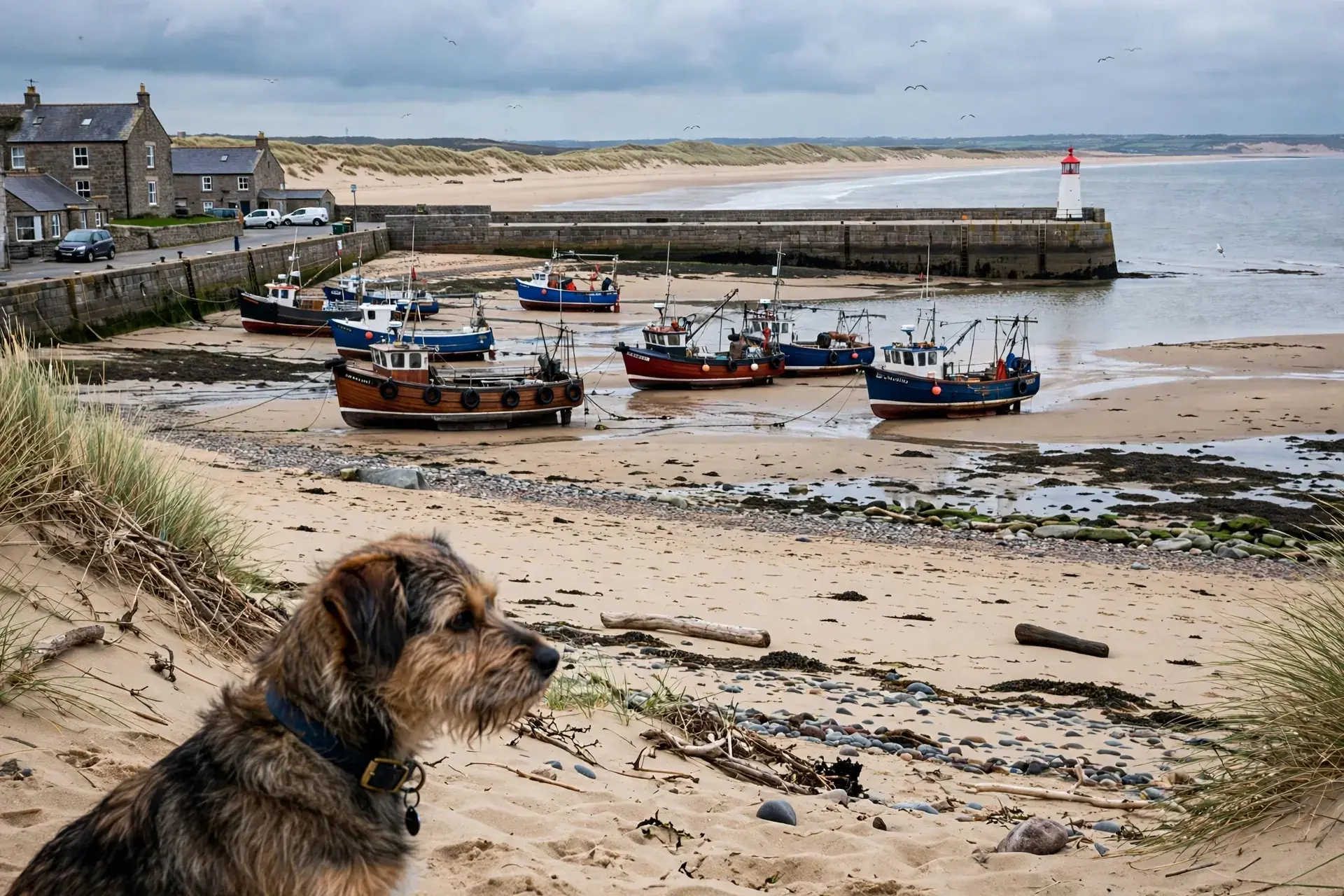
Look at the sailing board before you look at the beach. In Seahouses the boats set the shape of the day: if a Farne Islands trip runs, plan everything else around its departure and return; if it does not, use the beach, the harbour walk and the village instead. Keep the dog on a lead on the quayside, check the tide before any beach walk, and keep a wet-weather plan ready.
A harbour day, hour by hour
Seahouses works best when you treat the boat timetable as the backbone of the day and fit everything else around it. The village is small enough to walk across in a few minutes, but the harbour is a working place, not a theme park, and its rhythm changes with the tide, the weather and the fishing boats. A day that starts with a clear plan is far more relaxing for a dog than a day spent rushing between a car park, a ticket kiosk and a beach that is already cut off by the incoming tide.
Start the evening before you travel. Check the sailing times for the next day, check the tide times for Seahouses, and check the weather forecast for wind as well as rain. Wind matters more than rain for the boats: a calm-looking morning can still be cancelled if the swell is running, and a bright afternoon can be cut short if the wind rises. Save the operator's contact details and the tide times on your phone, and agree a fallback plan with everyone in your party before you set off. That single conversation prevents most of the arguments that happen on a harbour wall when a sailing is cancelled.
A practical one-day timeline looks like this. Arrive early, before the first boats leave, and give the dog a short toilet walk away from the busiest part of the harbour. Walk past the ticket kiosks and read the board rather than relying on a timetable printed weeks earlier. If you have booked a sailing, arrive at the time the operator asks for, not at the departure time, because boarding, safety briefings and finding a place for the dog all take longer than expected. After the boat returns, the dog will need water, a toilet break and a rest before a long beach walk. That pause matters: a dog that has spent two or three hours on a boat, watching seabirds and listening to an engine, is often more tired than it looks, and a second long walk straight away can leave it overstimulated and sore the next day.
The early morning is the quietest part of the harbour. Fishing boats come and go, gulls circle the quayside, and the first boat crews prepare their vessels for the day. This is a good time for a calm lead walk, a look at the sea conditions and a decision about whether the day will work as planned. Keep the dog close, because crates, ropes, hoses and vehicles are all in use, and a loose dog can get underfoot in seconds. Do not let the dog drink from puddles on the quayside, sniff fish boxes, or pick up bait and discarded line. A short lead and a steady pace are more useful here than a long line.
Mid-morning is when the harbour is busiest. Passengers gather for the boats, cars turn in the car parks, and the queue for the kiosks grows. If your dog is nervous around crowds, keep this part of the day short. Wait a little way back from the boarding point, where the dog can see what is happening without being pressed against strangers, luggage and other dogs. If your dog is reactive, this is the moment to be honest about it: a crowded quayside with several dogs in a small space is a poor place to test a new training plan. A calm dog that can settle on a mat while you wait will enjoy the day far more than a dog that is pulled through the crowd on a tight lead.
Lunchtime in Seahouses usually means fish and chips, a cafe table or a pub garden, and the dog needs a plan for that hour too. A dog that has had a proper walk and a drink will settle far better under a table than a dog that has been kept waiting without exercise. Choose a place where the dog has space to lie down without blocking a walkway, and bring a mat or a blanket so the dog has a clear place to settle. If the weather is warm, choose shade, bring water, and do not leave the dog in a car while you eat. Cars heat up quickly even on a cloudy day, and a harbour car park in summer is no place to leave a dog unattended.
The afternoon is the best time for the long beach walk, once the boats have returned and the tide allows it. The light is softer, the beach is usually quieter than at midday, and the dog has had time to rest after the morning. Walk out with the tide in mind, not against it, and leave enough time to return by the same safe route. If the tide is coming in, walk towards the harbour end of the beach rather than away from it, so the return journey gets shorter rather than longer. Keep an eye on the time as well as the water: it is easy to walk for an hour in one direction and then discover that the tide has covered the firm sand you walked out on.
Evening brings a different harbour. The boats are back, the crowds thin, and the light changes quickly. This is a good time for a short, calm walk and a final toilet break, but it is not the time to start a long coastal walk in fading light. The rocks and steps around the harbour are slippery when wet, and the paths towards Bamburgh and the north beach are uneven. If you are staying overnight, use the evening to check the next day's sailing times and tide times again, because both can change with the weather. A quiet evening, a settled dog and a plan for tomorrow are worth more than one more photograph.
That hour-by-hour shape is the key to the whole guide. Everything that follows — the boat rules, the beach zones, the food, the stays and the safety notes — makes more sense once you have decided whether the day is a boat day, a beach day or a bad-weather day, and planned the dog's rest, water and toilet breaks around that decision.
Farne Islands boats and dog rules
The Farne Islands are the reason most visitors come to Seahouses, and they are also the part of the trip that needs the most careful planning with a dog. The islands lie a short distance offshore, and the boat trip is the only practical way to see the seabird colonies, the grey seal colonies and the lighthouses up close. The crossing is exposed to wind and swell, the boats are open to the weather, and the islands themselves are a protected wildlife site with strict landing rules. None of that makes the trip impossible with a dog, but it does mean you should check the exact policy for your sailing rather than assuming that a dog can go everywhere you can.
There are two broad kinds of trip, and the dog rules are different for each. The first is a non-landing sightseeing cruise, which circles the islands without putting passengers ashore. Dogs are often welcome on these cruises, subject to the operator's policy, the size of the boat and the number of dogs already booked. The second is a landing trip, which puts passengers ashore on Inner Farne or Staple Island for an hour or two. Landing trips usually have much stricter rules, and dogs are often not allowed to land, because the islands are a breeding and nesting site for seabirds and seals, and because the landing steps, paths and boardwalks are narrow and crowded. Some operators allow a dog to stay on the boat while other passengers land, but that is not a standard arrangement and should never be assumed, so check the official guidance before you travel.
Book ahead in the breeding season and in school holidays, and tell the operator that you are bringing a dog at the time of booking, not on the morning of the sailing. Operators need to know how many dogs will be on board, whether the dog is large or small, and whether it is comfortable around other dogs, children and engine noise. A small dog that can sit on your lap or lie at your feet is a different proposition from a large, restless dog that needs floor space on a crowded boat. If the operator says no, accept the answer and plan a different day rather than turning up and hoping for a different answer at the kiosk. The crew have to think about safety, wildlife and every other passenger, and a refusal at the quayside is far worse than a refusal by phone the day before.
Prepare the dog for the boat as you would prepare it for any new experience. A dog that has never been on a boat may be unsettled by the motion, the engine noise, the spray and the smell of fuel. Bring a non-slip mat or blanket for the dog to lie on, because boat decks are hard, wet and slippery. Bring water and a bowl, because the dog cannot drink seawater and there may be no fresh water on board. Bring a lead, and keep the dog on it for the whole trip unless the crew tell you otherwise. A life jacket for the dog is worth considering, especially for a small dog, an older dog or a dog that is not a strong swimmer, and it should be fitted and tried at home before the trip, not for the first time on a moving boat.
Think carefully about whether the dog should go at all. A nervous dog, a dog that barks at seabirds, a dog that is prone to seasickness, or a dog that cannot settle for two or three hours may be happier staying ashore with one member of the party, or staying at the accommodation with a planned walk later. There is no rule that says the whole party has to do the same thing, and splitting the day — one person takes the boat while the other walks the dog on the beach — is often the kindest and most practical solution. The boat will still be there another day, and a dog that has had a calm beach walk will be in a better state for the evening than a dog that has spent the morning stressed on a boat.
On the day, arrive early, listen to the safety briefing, and follow the crew's instructions about where the dog should sit or lie. Keep the dog away from the edge of the boat, away from ropes and equipment, and away from other passengers' food and belongings. Do not let the dog bark at the birds or lean over the side to look at the seals. Seabirds on the Farne Islands are protected, and the colonies are sensitive to disturbance; a barking dog close to a nesting ledge is a welfare problem for the birds and a safety problem for everyone on board. If the dog becomes distressed, tell the crew straight away rather than waiting for the trip to end.
Seasickness is a real possibility, and it is worth planning for it. Signs include drooling, yawning, restlessness, whining and vomiting. If your dog has been sick in a car, it is more likely to be sick on a boat. Feed a light meal well before the sailing rather than a full meal just before boarding, and bring cleaning supplies and a spare towel in case of an accident. Do not give the dog medication unless a vet has advised it for this specific trip, and check the official guidance before you travel if you are unsure about the correct dose or timing.
The cost, duration and departure times of the trips vary by operator, season and tide, so this guide does not list fixed prices or times that could be out of date by the time you read them. Check the operator's current timetable on the day before you travel and again on the morning of the sailing. Cancellations are common in strong winds, and a sailing that is advertised in the morning can be cancelled by lunchtime if the weather changes. Build that uncertainty into the day, and have a beach walk or a village plan ready so a cancelled boat does not feel like a wasted day.
For a wider Northumberland plan, the county guide explains how Seahouses fits into a longer trip. Our Northumberland with a dog guide covers Bamburgh, Holy Island, Hadrian's Wall and the quieter beaches that work well as alternatives when the boats are cancelled, and it is worth reading before you book accommodation for more than one night.
Beaches, zones and the tide
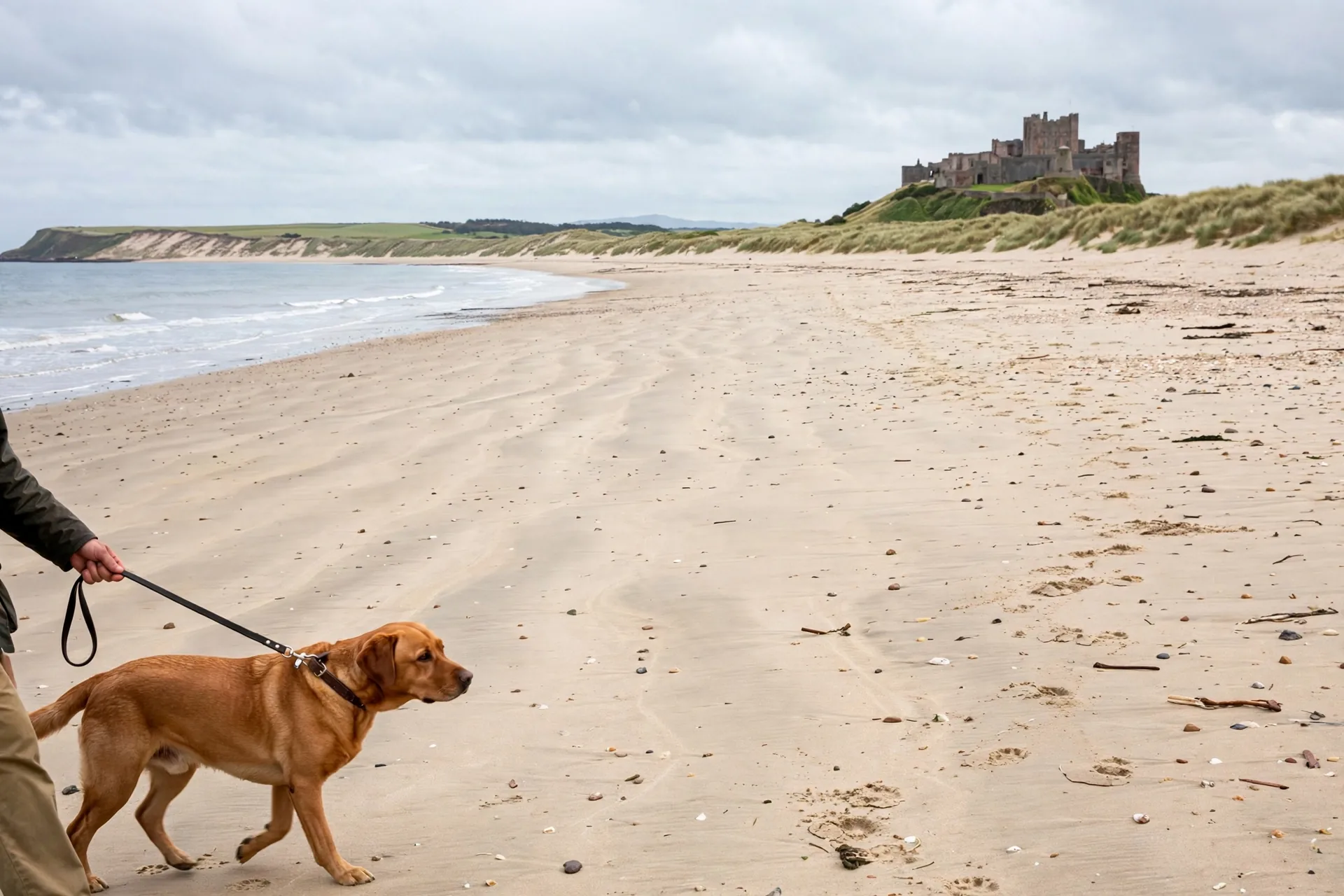
Seahouses has more than one stretch of sand, and the right choice depends on the tide, the season, the wind and the dog in front of you. The long beach that runs south from the harbour towards Bamburgh is the main dog-walking beach, and it is the one most visitors mean when they talk about walking the dog at Seahouses. It is wide, flat and sandy at low tide, with enough space to keep a sensible distance from other walkers, other dogs and families. The beach near the harbour itself is smaller and busier, and it is better used for a short paddle or a toilet stop than for a long off-lead run.
Before you step onto any beach, check three things: the tide time, the seasonal dog restrictions, and the wind direction. The tide is the most important of the three. The Northumberland coast has a large tidal range, and the sea can come in faster than it looks, especially around rocks and headlands. A beach that is wide and inviting at low tide can narrow to a strip of soft sand in an hour, and the firm sand you walked out on can be covered before you notice. Always check the tide times for Seahouses on the day, walk with the tide in mind, and leave a clear margin for the return journey. If you are unsure, ask at the harbour, at your accommodation or at a local shop, and check the official guidance before you travel.
Seasonal restrictions change the rules on some beaches during the summer. The exact dates, zones and times vary from year to year and from beach to beach, and the signs at the beach entrances are the best source of current information on the day. In general, the main summer restrictions apply to the busiest sections of beach during the busiest months, while the quieter stretches further from the car parks and the harbour remain more flexible. Do not rely on a blog post or a social media comment from a previous year; read the sign at the entrance, follow it, and keep the dog on a lead in any section where that is required. A dog that is under control and on a lead in a restricted zone is a very different matter from a dog running free through a crowded family beach.
The south beach rewards a slow, thoughtful walk rather than a fast out-and-back run. Walk along the firm sand near the waterline, where the dog can paddle without wading into deep water, and keep to the open beach rather than cutting across the dunes. The dunes are fragile, they are home to nesting birds and other wildlife, and they are difficult for a dog to navigate safely, especially in hot weather when the sand is deep and the grass is sharp. If your dog likes to chase, keep it on a long line rather than letting it run free across the dunes, because a dog that disappears over a dune ridge can be out of sight and out of recall range in seconds.
The north beach, towards Beadnell, is quieter and wilder, and it suits a dog that needs space more than it suits a dog that needs a busy social walk. It is a longer walk from the village, the terrain is more varied, and the wind is often stronger. That makes it a good choice on a calm day and a poor choice on a day when the wind is already gusting. If you walk north, plan the return journey carefully, because the path back is not always the same as the path out, and the tide can cut off the beach route. Carry water, because there is no fresh water on the beach, and carry a lead even if you plan to let the dog off, because you may need it quickly if another dog, a horse rider or a flock of birds appears.
Beach safety for dogs is mostly about the small things that add up. Do not let the dog drink seawater, because it can cause vomiting and diarrhoea, and do not let it eat dead fish, crabs, jellyfish or seaweed, because all of them can cause stomach problems. Check the dog's paws after a beach walk, because sand, salt and small stones can cause soreness, and rinse the paws with fresh water if you can. In summer, check the sand temperature with your hand before you let the dog walk on it, because hot sand can burn paws just as hot pavement can. In winter, watch for cold wind and wet fur, and dry the dog thoroughly after a beach walk before you put it in the car.
Off-lead time on the beach should be earned, not assumed. A dog with reliable recall, that comes back the first time you call, can enjoy a good off-lead run on a quiet beach. A dog with unreliable recall, that chases birds, seals or other dogs, should stay on a long line until its recall is better. The beach is not a training ground for a new recall cue; it is a place where a failure has real consequences, including a dog running towards the sea, towards a cliff, or towards a protected bird colony. Use the beach to reward good recall, not to test it for the first time.
After the beach, the dog needs fresh water, a rinse if it has been in the sea, and a chance to rest in the shade or in a sheltered spot. Salt water left on the coat can irritate the skin, and sand left between the toes can cause soreness. A quick rinse with fresh water, a towel dry and a check of the ears, eyes and paws is enough for most dogs, but a dog that has been swimming should be watched for signs of tiredness, shivering or stomach upset. If the dog has swallowed a lot of seawater, offer small amounts of fresh water at intervals rather than a large bowl all at once, and check the official guidance before you travel if you are unsure what to do.
Walking the harbour and the village
The harbour walk is short, but it is the walk you will do most often, and it is worth doing well. Start at the quayside, walk past the boats and the kiosks, and follow the path around the harbour wall to the viewpoint. The surface is uneven in places, and the steps and slopes are slippery when wet, so wear shoes with grip and keep the dog on a short lead. The view from the harbour wall is one of the best in the village, with the Farne Islands on the horizon and the beach stretching away to the south, but it is also an exposed spot, and the wind can be strong enough to unsettle a small dog.
The village itself is compact, with a main street of shops, cafes, pubs and guest houses, and a handful of side streets that lead to cottages and caravan sites. The pavements are narrow in places, and the road is busy with cars, vans and coaches in summer, so keep the dog on the pavement side, away from the traffic, and be ready to step into a doorway if a large vehicle passes. Cross the road at a clear point, not on a bend or behind a parked van, and do not let the dog wander into a shop doorway or a cafe terrace without checking that dogs are welcome there.
The coastal path towards Bamburgh is the best longer walk from Seahouses, and it is a good choice for a dog that can manage a few miles on a lead. The path follows the coast south, with views of the beach, the dunes and Bamburgh Castle in the distance. It is mostly flat, but there are stiles, gates and sections where the path runs close to the cliff edge, so keep the dog on a lead and do not let it run ahead around a blind corner. The walk to Bamburgh and back is a substantial outing for most dogs, so plan for water, a rest at the far end, and a return journey that does not rely on the tide. If the dog is tired, turn back early; the castle will still be there tomorrow.
The walk north towards Beadnell is quieter and more exposed, and it suits a confident dog on a calm day. The path crosses fields, dunes and beach, and there are fewer places to stop for water or shelter. Check the route before you set off, carry water and a phone, and tell someone where you are going if you are walking alone. The north path is also a good place to see seabirds and, in the right season, seals hauled out on the rocks, but keep the dog well away from any seals you see, and do not approach them for a photograph.
Village etiquette is simple but important. Pick up after your dog every time, including on the beach and on the coastal path, and carry enough bags for the whole walk. A dog that fouls on a pavement, a beach or a pub garden and is left uncleaned is the fastest way to make a village less welcoming to dogs. Keep the dog out of children's play areas, out of food shops unless the shop welcomes dogs, and away from other dogs unless the owner has agreed that a greeting is welcome. A polite, controlled dog is welcome in far more places than a dog that jumps up, barks or pulls towards every stranger.
Toilet breaks need planning in a small village. The dog will need a toilet stop first thing in the morning, after meals, after a boat trip and last thing at night. Identify a suitable spot near your accommodation that is not a children's play area, a food terrace or a neighbour's garden, and use it consistently. Carry bags, a torch for night-time stops, and a lead that is easy to hold in the dark. If you are staying in a cottage or a guest house, ask the owner where the best toilet spot is; they will know the local layout and will appreciate being asked.
Noise matters in a village where many people are on holiday. A dog that barks at every passer-by, at the gulls, or at the boats will quickly become a problem for neighbours and for other guests. If your dog is a barker, plan for it: choose accommodation with a garden or a quiet location, walk the dog at quieter times, and use a settle routine in the evening. Do not leave a barking dog alone in a cottage or a caravan while you go out for dinner, because the noise will carry and the dog will be stressed. Plan the evening so the dog can come with you, or stay in with the dog and eat in.
Bad weather and no-boat days
Seahouses is on an exposed North Sea coast, and bad weather is part of the trip, not an exception to it. Wind, rain, sea mist and rough seas can arrive quickly, and they can change a boat day into a beach day or a village day in the space of an hour. The best no-boat plan is made the night before, not invented on a wet quayside while the dog is getting cold. Decide in advance what you will do if the boats are cancelled, and make sure the plan includes a proper walk for the dog, a dry place to eat, and a comfortable place to rest.
On a windy day, the beach is often the worst place to be. Sand blows horizontally, the dog's eyes and coat fill with grit, and the wind chill makes a wet dog cold very quickly. A sheltered inland walk is a better choice: a woodland path, a riverside walk, or a quiet country lane with hedges that break the wind. The area around Seahouses has several such options within a short drive, including the paths around the villages inland and the sheltered routes towards Alnwick. Check the route before you set off, because a path that is sheltered in one direction can be exposed in the other, and a dog that is cold and wet will not enjoy a long walk in any direction.
On a rainy day, the dog still needs exercise, but the walk should be shorter, the route should be on firm ground, and the dog should be dried thoroughly afterwards. A waterproof coat for the dog is worth packing, especially for a short-coated or older dog, and a drying coat or a stack of towels is essential for the return to the car or the accommodation. Avoid paths that turn to deep mud after rain, because a dog that is struggling through mud is at risk of a slip or a strain, and avoid river paths that can flood quickly. A short, purposeful walk on a surfaced path, followed by a long settle indoors, is better than a long, miserable walk in the rain.
Sea mist, or haar, is a particular feature of the Northumberland coast, and it can reduce visibility to a few metres in minutes. If the mist comes down while you are on the beach or the coastal path, stop, keep the dog on a lead, and retrace your steps to a known landmark rather than pressing on. Do not rely on a phone signal or a map app in thick mist, because both can be unreliable, and do not let the dog off the lead when you cannot see where it is going. The mist usually lifts as quickly as it arrives, but a dog that is lost in mist on a beach is a serious problem.
Indoor options with a dog are limited but real. Some cafes and pubs welcome dogs indoors, and a long, calm lunch in a dog-friendly pub is a perfectly good use of a wet afternoon. Some shops welcome dogs, and a slow browse can be a useful change of pace for a dog that is used to being out and about. If the weather is very bad, the kindest plan is often to stay in, let the dog rest, and use the time to plan the next day, check the sailing times and read the local guidebooks. A dog that has had a short walk, a meal and a comfortable rest is not bored; it is recovering.
A longer no-boat plan might involve a drive to a nearby town. Alnwick, with its castle, gardens and shops, is a short drive inland, and the wider county has many dog-friendly attractions, walks and cafes that work well on a day when the sea is too rough for a boat. Our Newcastle with a dog guide is useful if you are combining Seahouses with a city day, because it covers the Quayside, the Metro to the coast and the dog-friendly pubs that make a wet-weather city visit practical. The point is not to replace Seahouses with another place, but to have a second plan that still gives the dog a good day.
Pack for bad weather as a matter of course, not as an afterthought. A waterproof jacket and trousers for you, a coat for the dog, a spare lead, a towel, a water bowl and a dry bag for the phone are the basics. A car that is prepared for a wet dog — with a boot liner, a towel and a spare blanket — is far more comfortable than a car that has to be cleaned after every walk. And a dog that is dry, warm and rested after a wet walk will be ready for the next day's boat, while a dog that is cold, wet and tired may not be.
Seafood, pubs and dog-friendly eating
Seahouses is a fishing village, and the food is part of the trip. Fish and chips, crab sandwiches, smoked fish and the daily catch are all on offer, and many of the cafes and pubs welcome dogs in at least part of the premises. The key is to check the exact policy before you sit down, because a pub that welcomes dogs in the bar may not welcome them in the restaurant, and a cafe that welcomes dogs on the terrace may not welcome them inside on a wet day. Ask when you arrive, and do not assume that a dog-friendly sign outside means the dog can go everywhere inside.
Fish and chips with a dog is best done as a takeaway eaten on a bench or on the beach, rather than as a sit-down meal in a crowded restaurant. Buy the food, find a quiet spot away from the busiest part of the harbour, and give the dog a place to lie down while you eat. Do not feed the dog chips, batter, bones or fish with bones in it, and do not let the dog pick up food from the ground. A small, plain piece of white fish with no batter, no bones and no seasoning is a safe treat for most dogs, but a whole portion of fish and chips is not a dog meal, and a dog that has eaten a large amount of fatty food is likely to have stomach problems later.
Pubs are the most reliable dog-friendly option in Seahouses, and many of them have a bar area, a garden or a terrace where dogs are welcome. Choose a table where the dog has space to lie down without blocking a walkway, and bring a mat or a blanket so the dog has a clear place to settle. Order water for the dog, and ask the staff if there is a dog bowl available; many pubs keep a supply of bowls and treats behind the bar. Keep the dog on a lead throughout the visit, and do not let it wander to other tables, beg for food, or bark at other dogs. A calm dog that settles under a table is welcome in far more pubs than a dog that pulls, jumps or barks.
Cafes are more variable. Some welcome dogs indoors, some welcome them only on the terrace, and some do not welcome them at all. A cafe that is busy at lunchtime, with tables close together and food at dog height, is a difficult place for a large dog, even if the cafe is nominally dog-friendly. Choose a quieter time, a table with space, and a short visit rather than a long lunch. If the dog cannot settle, finish the visit early and take the dog for a walk instead; a cafe visit that ends with a stressed dog is not a good use of the time.
Breakfast and evening meals need the same planning. If your accommodation does not allow dogs in the dining room, plan to eat in your room, on a terrace, or at a pub that welcomes dogs. Do not leave the dog alone in the room while you eat, because the dog may bark, scratch the door or become distressed, and the accommodation may have a rule against leaving dogs unattended. If you are staying in a self-catering cottage, cooking for yourself is often the simplest solution: the dog can settle in the kitchen or the living room, you can eat at your own pace, and there is no need to negotiate a pub policy.
Water and food for the dog should be planned as carefully as your own meals. Carry a water bottle and a collapsible bowl on every walk, because there is no guarantee of fresh water on the beach, on the boat or on the coastal path. Feed the dog at its normal times, with its normal food, and do not change the diet on holiday. A new food, a rich treat or a large amount of fish can cause stomach upset, and a dog with an upset stomach on a boat or in a cottage is a miserable companion. Bring enough of the dog's normal food for the whole trip, plus a day extra in case of a delay, and store it in a sealed container away from other food.
Finally, be a good guest in every place that welcomes dogs. Clean up after the dog, keep it off the furniture unless the staff say otherwise, and thank the staff for welcoming the dog. Pubs and cafes that welcome dogs do so because most dog owners are considerate, and a single inconsiderate visit can change a policy for everyone. If a place does not welcome dogs, accept the answer politely and move on; there are other places that do, and the dog will not mind eating its dinner in the cottage.
Where to stay and where to park
Seahouses has a good range of dog-friendly stays, from cottages and guest houses to caravan sites and small hotels, but the dog policy varies from one property to the next, and it is worth checking the exact terms before you book. Some properties welcome dogs in every room, some welcome them only in selected rooms or cottages, and some charge a fee per dog per night or per stay. Some limit the number of dogs, the size of the dog, or the breeds they accept. Ask for the dog policy in writing, with the fee itemised, and keep the reply with your booking confirmation. A verbal assurance at the time of booking is not enough if the policy changes before you arrive.
Self-catering cottages are often the best choice for a dog holiday in Seahouses, because they give you a kitchen, a garden or a yard, and a private space where the dog can settle without disturbing other guests. Check whether the cottage has an enclosed garden, and if so, how high the fence is and whether there are gaps a small dog could slip through. Check the flooring, because a cottage with hard floors is easier to clean after a beach walk than a cottage with pale carpets. Check whether the dog is allowed on the furniture, on the beds, or upstairs, and bring a dog bed, a blanket and a towel so the dog has its own place to sleep. If the cottage has a garden, check whether it is shared with other cottages, because a shared garden can mean other dogs, children and barbecues.
Guest houses and small hotels can work well, but they need more checking. Ask whether the dog is allowed in the dining room, the lounge or the garden, and whether there is a charge for the dog. Ask whether the dog can be left alone in the room for a short time, and what happens if the dog barks. Ask about the check-in time, because arriving in daylight gives you time to walk the dog, check the room and settle in before the evening. If the guest house is on a busy road, ask for a quiet room away from the traffic, and check whether there is a safe place to walk the dog last thing at night.
Caravan sites and camping sites around Seahouses are a good option for a longer stay, especially for a dog that needs outdoor space. Check whether the site has a dog exercise area, a dog wash station, and a tap for fresh water. Check the pitch size, the ground surface and the distance to the toilet block, because a pitch on soft grass after rain is a different proposition from a pitch on hard standing. Check the site rules for dogs on leads, for barking, and for leaving dogs unattended in a caravan or a tent. A site that is well run will have clear rules and staff who enforce them fairly, and that is a better place for a dog than a site with no rules at all.
Parking in Seahouses is straightforward if you arrive early, and frustrating if you arrive late on a busy summer day. The main car parks are close to the harbour and the beach, but they fill up quickly, especially on days when the boats are running. Arrive before the first sailing, park once, and walk for the rest of the day rather than driving between the harbour, the beach and the village. If you are staying overnight, check whether your accommodation has parking, and whether it is on site or in a public car park. A dog that has to be unloaded from a car in a busy car park, crossed a road and walked through a crowd to reach the accommodation is starting the holiday at a disadvantage.
Do not leave the dog in a parked car, even for a short time, and even on a cloudy day. Cars heat up quickly, and a dog left in a car in a harbour car park is at risk of heatstroke, stress and theft. If you need to go into a shop or a kiosk where dogs are not allowed, take turns with another member of the party, or leave the dog with a person outside. Plan the day so the dog is never left alone in the car, and bring a sunshade, a water bowl and a towel if you have to wait in the car for a short time in warm weather.
Packing for a stay in Seahouses is mostly about the basics, done well. Bring the dog's normal food, a water bowl, a lead and a spare lead, a long line for the beach, a towel and a drying coat, a dog bed or a blanket, poo bags, a torch, and any medication the dog needs. Bring a first-aid kit for the dog, including a tick remover, a bandage and the vet's phone number. Save the number of the nearest vet before you travel, and check the opening hours, because rural practices can be some distance away and may close early. A dog that is prepared for the coast, the boat and the beach is a dog that can enjoy all three.
Booking early matters in Seahouses, especially in the summer and in the seabird breeding season. The dog-friendly cottages and rooms are often the first to sell out, and the boats are often fully booked on fine days. Book the accommodation first, then the boat, then the travel, and keep all the confirmations in one place. If you are booking for a specific date, such as a birthday or an anniversary, book even earlier, and check the cancellation policy before you pay a deposit. A flexible booking that can be moved if the weather changes is worth more than a cheap booking that cannot be changed at all.
Safety: tides, cliffs, seals and wind
Safety on the Northumberland coast is not about fear; it is about respect for the sea, the weather and the wildlife. The coast is beautiful and open, but it is also exposed, and the conditions can change quickly. A dog that is safe on a beach in calm weather can be at risk in a strong wind, a rising tide or a rough sea. The rules in this section are simple, and they apply to every beach walk, every boat trip and every coastal path in Seahouses.
The tide is the first safety rule, and it is the one that catches most people out. The sea comes in faster than it looks, and the firm sand you walked out on can be covered in minutes. Always check the tide times before a beach walk, and plan the return journey with a clear margin. Walk with the tide, not against it, and do not walk around a headland or a rock outcrop if the tide is coming in, because the route back may be cut off. If you are unsure about the tide, ask locally, and check the official guidance before you travel. If the tide has already turned and you are on the wrong side of a headland, do not try to wade through the water; climb to higher ground, call for help if you need it, and wait for the tide to turn.
Cliffs and harbour walls are the second safety rule. The cliffs around Seahouses are not high by Northumberland standards, but they are still dangerous, especially in wet or windy weather. Keep the dog on a lead near any cliff edge, and do not let it run ahead around a blind corner where the path narrows. The harbour wall and the steps down to the boats are slippery when wet, and a dog that slips on a wet step can fall into the harbour. Keep the dog on a short lead on the harbour wall, and do not let it lean over the edge to look at the water or the boats.
Seals are a regular sight around Seahouses and the Farne Islands, and they are a protected species. Grey seals haul out on the rocks and the beaches to rest, and they are easily disturbed by a dog running towards them. A disturbed seal can be injured, a pup can be separated from its mother, and a dog that gets too close can be bitten. Keep the dog on a lead if you see seals, keep a distance of at least 100 metres if you can, and do not approach a seal for a photograph. If you see a seal pup alone on a beach, do not touch it, do not let the dog approach it, and report it to the local wildlife organisation or the coastguard if you are concerned, because the pup may be resting while its mother is at sea.
Seabirds are protected too, and the Farne Islands are one of the most important seabird colonies in Britain. During the breeding season, the birds are nesting on the cliffs and the ledges, and they are sensitive to disturbance. Keep the dog on a lead near any nesting site, do not let it chase birds, and do not let it bark at the colonies. A dog that chases a bird on a beach can cause the bird to abandon its nest, and a dog that runs through a colony can cause injury to the birds and to itself. The same rule applies on the beach and on the coastal path: if you see a bird on the ground, keep the dog away and give the bird space.
Wind is the third safety rule, and it is easy to underestimate. A strong offshore wind can blow a dog's scent away, make recall harder, and chill a wet dog very quickly. A strong onshore wind can push waves further up the beach than expected, and can make a boat trip uncomfortable or unsafe. Check the wind forecast as well as the rain forecast, and do not take the dog out in a strong wind if it is small, old or nervous. If the wind is gusting, keep the dog on a lead, because a gust can lift a small dog off its feet, blow sand into its eyes, or push it towards the water.
Other hazards are smaller but still worth knowing about. Fishing line, hooks and bait left on the beach or the harbour can injure a dog's mouth, paws or stomach. Broken glass, sharp shells and discarded food can cause cuts and stomach problems. Ticks are present in the grass and the dunes, especially in summer, so check the dog after every walk and remove any ticks promptly. Adders are present in some parts of Northumberland, although they are rare on the coast, so keep the dog on the path in long grass and heathland, and seek veterinary help immediately if you think the dog has been bitten.
Finally, know what to do in an emergency. Save the number of the nearest vet, the coastguard and the local emergency services on your phone before you travel. If the dog is cut off by the tide, do not try to swim to it; call the coastguard and follow their advice. If the dog is injured, keep it calm, keep it warm, and get veterinary help as soon as you can. If you are unsure about any safety issue, ask locally, and check the official guidance before you travel. A safe trip is a trip where everyone, including the dog, comes home well.
Seahouses rewards the visitor who plans around the boats, the tide and the weather, and who gives the dog time to rest between the excitements. A day that starts with a timetable, includes a proper beach walk, a calm lunch and a quiet evening is a day the dog will remember for the right reasons. The harbour, the islands and the beach will still be there tomorrow, and a dog that has had a good day today will be ready for another one.
Practical questions
Before you go
Can dogs go on the boat trips to the Farne Islands from Seahouses?
It depends on the operator and the type of trip. Dogs are often welcome on non-landing sightseeing cruises around the Farne Islands, but landing trips to Inner Farne or Staple Island usually have stricter rules, and dogs may not be allowed to land. Always confirm the dog policy for your exact sailing with the operator before you book, and check the official guidance before you travel.
Which beach in Seahouses is best for dogs?
The long sandy beach south of the harbour is usually the most useful choice for a proper dog walk, because it gives you space to move away from other people and to keep a lead on in busier sections. The smaller beach near the harbour is better for a short toilet stop or a quick paddle. Check the current seasonal restrictions and the tide times before you travel, because both can change what is practical on the day.
Do dogs have to stay on a lead around Seahouses harbour?
Yes, keep your dog on a lead around the harbour. The quayside is a working area with moving vehicles, fishing gear, ropes, crates and slippery surfaces, and boats can arrive or leave with little warning. A short lead gives you control near the water's edge, keeps your dog away from fish boxes and bait, and makes it easier to step aside for harbour workers.
What happens if the boat trips are cancelled because of the weather?
Sailings are cancelled when wind, swell or visibility make the trip unsafe, and the decision is usually made on the morning of the sailing. Do not plan a day that only works if a boat runs. Have an inland or coastal alternative ready, such as a walk towards Bamburgh, a visit to a dog-friendly cafe, or a drive to a sheltered woodland or town walk, and check the official guidance before you travel.
When is the best time of year to visit Seahouses with a dog?
Late spring and early autumn are often the best balance. The days are long enough for a boat trip and a beach walk, the harbour is busy but not at peak summer pressure, and the weather is usually more settled than in winter. Summer brings the most sailings and the most visitors, while winter brings quieter beaches, shorter days and a much higher chance of cancelled boats.
Are there dog-friendly places to eat and stay in Seahouses?
Yes, Seahouses has pubs, cafes and fish-and-chip shops where dogs are welcome in at least part of the premises, and a range of cottages, guest houses and caravan sites that accept dogs. Policies vary by room, season and dog size, so confirm the exact dog rules, charges and any rooms where dogs are not allowed before you book, and check the official guidance before you travel.