This guide is independent and contains no paid placement. Shop policies, opening times and hill conditions can change, so check on the day.
Enjoy Sedbergh slowly: keep bookshop visits short and controlled, use cafes as genuine rests, choose a low-level Howgills route for a first hill walk, and always have a short retreat route if the weather changes. Keep the dog on a lead in town and near livestock.
A slow town, by design
Sedbergh is known as a book town, and that identity shapes its pace. Bookshops invite browsing, pausing, reading a spine, chatting to a bookseller and changing your mind, all of which are slow activities. For a dog, that slowness can be either a gift or a strain, depending on how it is managed. A dog that is allowed to settle on a mat while its owner browses, with water nearby and a calm atmosphere, may enjoy a book town far more than a busy market town. A dog that is dragged from shop to shop, expected to stand still for long periods without rest, water or a toilet break, will quickly become restless, and that restlessness will spoil the browsing for everyone.
Design the Sedbergh day around the dog's need for movement, rest and variety, rather than around a list of shops to visit. Alternate a short bookshop visit with a street walk, a cafe rest with a lane stroll, and a hill walk with a town rest. That rhythm mirrors the way dogs naturally behave: a period of stimulation, followed by sniffing, resting and processing, followed by a new, manageable stimulation. It also mirrors the way book towns are best enjoyed by people: slowly, with time to look, think and return to a favourite shop later, rather than rushing through every doorway in a single morning.
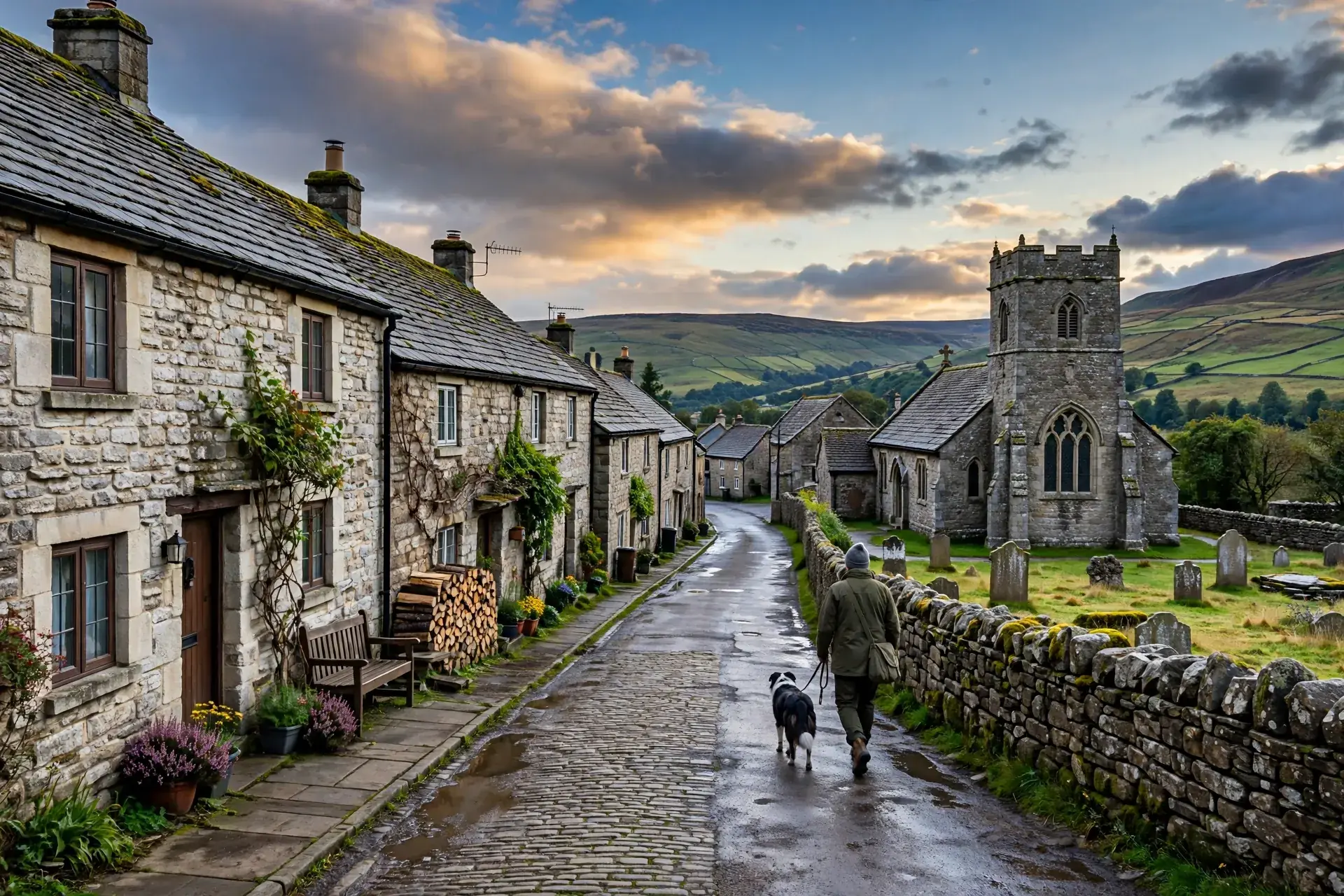
Quiet streets are part of Sedbergh's appeal. Compared with larger market towns, the town centre is compact, traffic is generally lighter, and there are quieter side streets where a dog can walk without constant close passes. Use those streets deliberately: start on a quiet street, let the dog toilet and settle, then approach the main bookshop area, rather than arriving directly into the busiest part of town. A calm arrival makes every later activity easier, because the dog begins the day settled rather than overstimulated.
Bookshops with a dog: etiquette
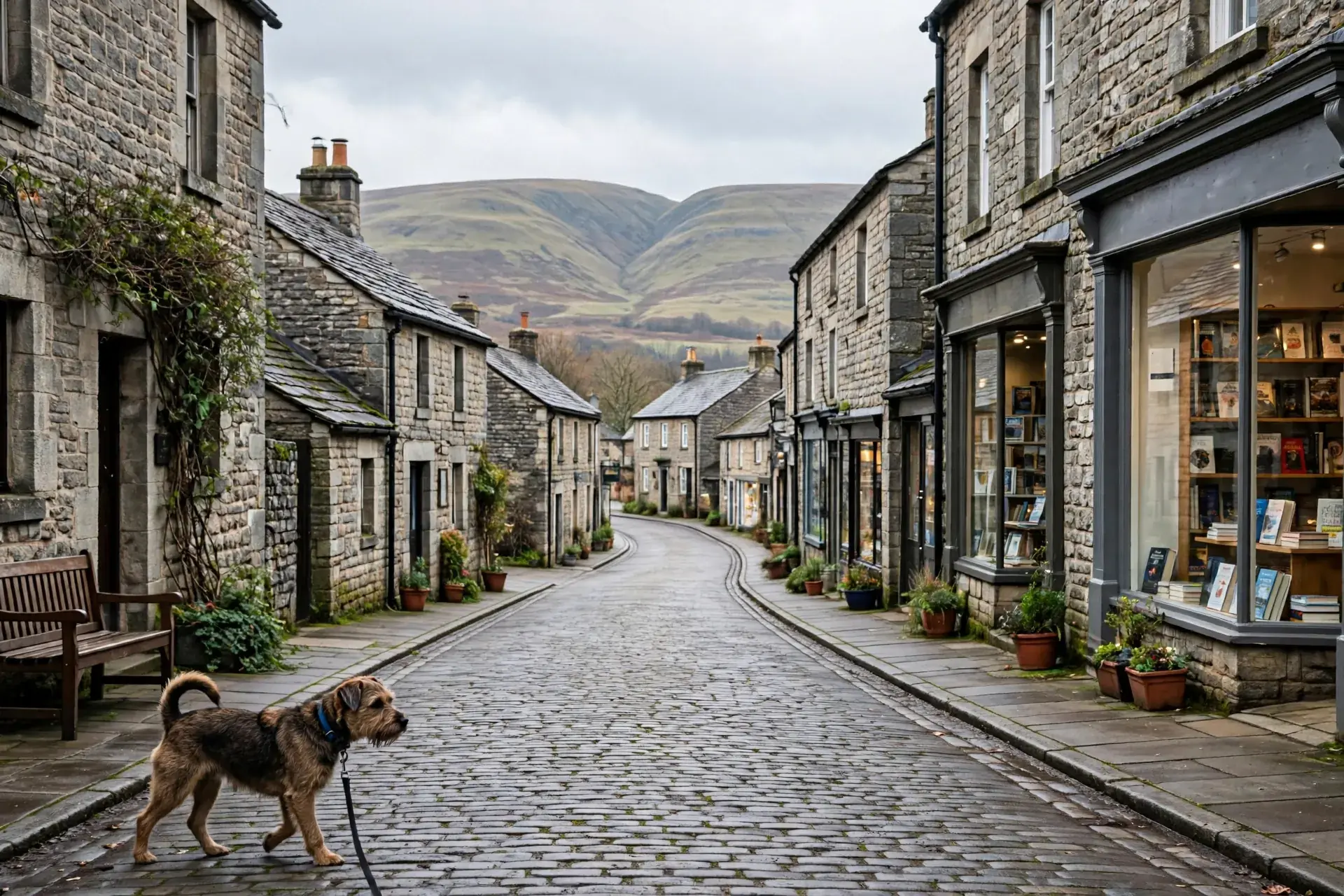
In Sedbergh the bookshop decision usually happens out on the pavement, while a window display is still doing its work. Pause there with the dog settled beside you, look for any notice about animals near the doorway, and have a brief word with someone inside when the position is unclear. One shop may have room for a dog to lie quietly by a table of local titles, the next may ask that dogs stay in a porch area, and another may have no room at all between tall cases and a narrow passage. A refusal of that kind protects low displays, second-hand stock and browsers who need space to pass, and it is best met with a simple thank you and a change of plan. When two people are travelling together, one can browse while the other takes the dog along a side street and then swap over; travelling alone, admire the window, note the title to look for later, and carry on to a shop where the dog can wait comfortably beside you.
Inside a bookshop, keep the dog on a short lead, close to you, and away from low shelves, displays and piles of books on the floor. Dogs explore with their noses and tails, and a wagging tail at shelf height can topple a display in seconds. Choose a route through the shop that leaves room to pass other browsers, avoid blocking narrow aisles while you read, and keep pauses brief and to the side. If the dog becomes excited by another customer, a child, or a dog in the shop, move calmly to a quieter corner or step outside for a short walk, rather than trying to train through the excitement in a confined space.
Settling is the most useful bookshop skill. A dog that can lie on a mat near its owner while the owner browses for a few minutes is a dog that will be welcome in many shops. Practise that skill at home and in cafes first, with short, rewarded sessions, and build up gradually. In Sedbergh, start with a very short bookshop visit, reward calm behaviour, and leave while the dog is still succeeding. Over time, the dog learns that bookshops mean a mat, quiet time and occasional treats, not constant excitement, and that learning makes future visits far easier.
Cafes as rest stops
Cafes in Sedbergh work best when they are treated as rest stops, not just as places to eat. After a bookshop visit or before a hill walk, a cafe gives the dog water, a mat, shade or shelter, and time to recover. Choose a table near a wall or corner, away from the main walkway, and settle the dog on a familiar mat from home. Keep the lead short and tucked away so staff and other customers do not trip over it, and reward the dog for lying calmly rather than for watching every person who passes. For more general cafe advice, see our guide to dog friendly cafes, which covers checking policies and settling indoors.
Food smells in cafes can be a challenge, especially for food-motivated dogs. Cakes, sandwiches and cooked food at dog nose height create a strong temptation to beg, pull or scavenge dropped crumbs. Manage this by keeping the dog on the side away from food counters, carrying treats of your own, and rewarding calm behaviour before the dog fixates on food. Do not feed cafe food to a dog without checking ingredients, and do not allow the dog to scavenge from the floor, where crumbs may include chocolate, onions or other harmful foods.
Keep cafe visits to a length the dog can manage. A short, successful cafe stop of fifteen or twenty minutes, ending while the dog is still calm, builds a positive association with cafes. A long, restless stop, where the dog becomes increasingly unsettled and the owner becomes increasingly stressed, teaches the opposite. If the dog cannot settle, take a short street walk, allow a toilet stop, and try again later, or accept that a takeaway drink enjoyed on a bench may suit the dog better on that day.
A gentle first Howgills walk
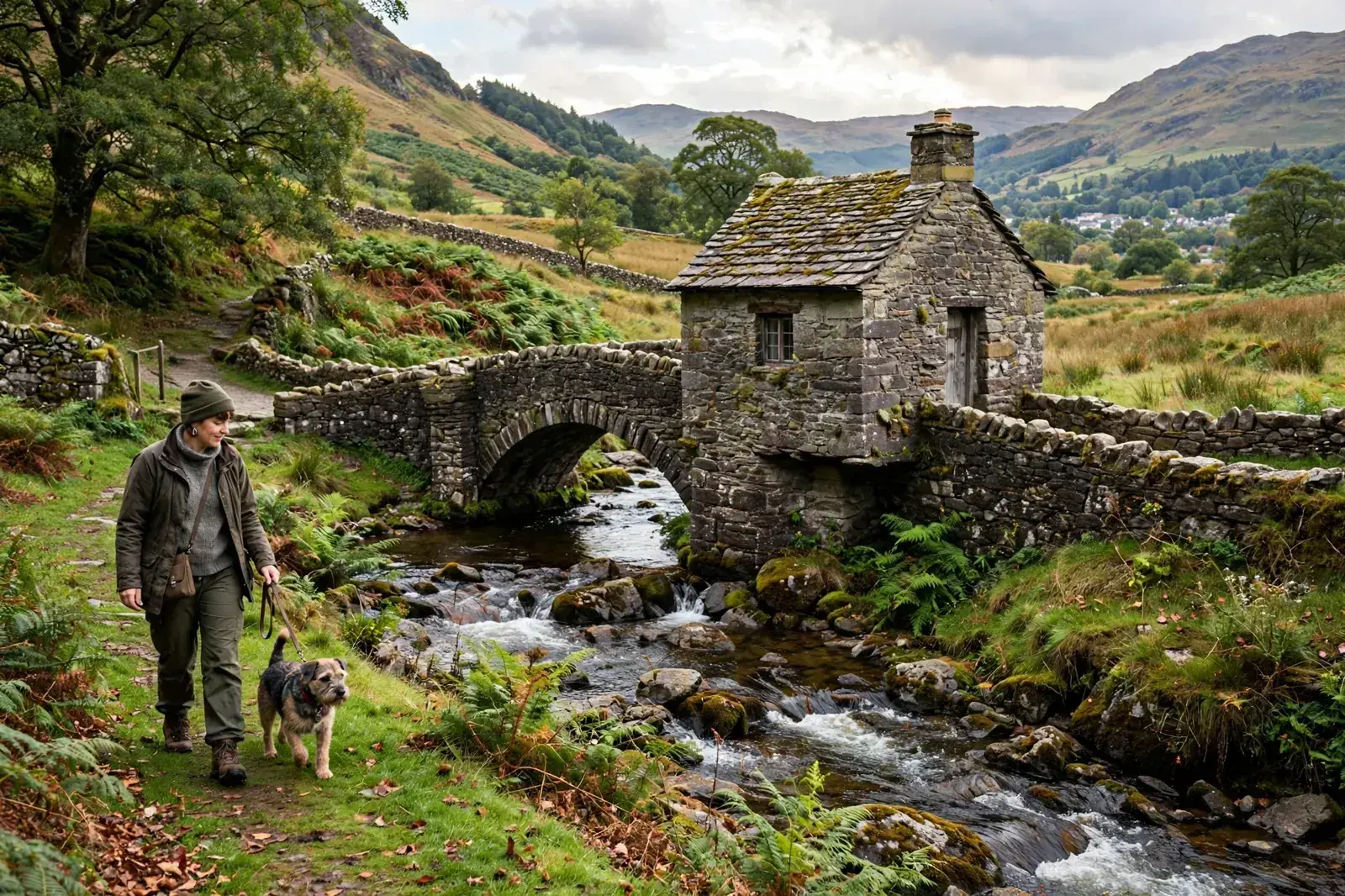
The Howgills, the smooth, grassy hills around Sedbergh, look inviting from town, and they are, provided the first walk is chosen with care. A gentle first Howgills walk should be low-level, on a clear path, with a gentle gradient and an easy return to town. Avoid steep summits, exposed ridges and long, pathless crossings on a first visit, especially with a dog that has already spent a morning in bookshops and cafes. A short, successful hill walk that ends with a settled dog is far better than an ambitious summit attempt that ends with an exhausted, muddy and possibly frightened dog.
Out on the Howgills the lead question is settled by what is grazing ahead of you, not by how obedient the dog seemed in town. Sheep wander the open fell in loose groups, often just over a rise, and a dog that bolts after them can be out of sight before a recall has time to work, with the animal, the dog and the farmer's livelihood all at risk. In the nesting months the same caution applies to ground-nesting birds on open ground, where a short lead keeps a curious dog from disturbing a nest it never noticed. A long line is a poor substitute on a fellside crossed by walls and other walkers, so a short, ordinary lead, clipped on before the first gate and left on until the town streets return, is the simplest arrangement. Notices at gates and stiles sometimes add a local condition for a particular slope, so read those before crossing, and our guide to dog on lead law in the UK explains the wider legal picture behind the habit.
Think of the Howgills bag as two decisions, not one list: what the exposed slope demands, and what the bookshop afterwards will forgive. Exposure comes first, so the route goes onto the phone while there is still signal in town, a windproof layer goes in for the walker, and a light coat for a short-coated dog earns its place before any treat pouch does. Drinking water in a bottle the walker can actually carry, with a folding bowl tucked beside it, matters more on a grassy slope than a second snack, because there may be no clean, safe place for the dog to drink until the valley is reached again. Mud is the second decision: a towel packed at the top of the bag, rather than buried underneath everything else, means wet paws can be dealt with on the pavement before a shop doorway or a cafe table is reached, and spare bags carried in a pocket keep a hillside stop tidy without a search through the main compartment. Afterwards, run a hand over paws and belly for thorns, grit and ticks picked up in long grass, and treat lagging, heavy panting or a sudden stiffness as the turning point itself — the slope will still be there another day, while a dog pushed past its limit will remember this one.
Weather changes and retreat routes
Weather in the Howgills can change with surprising speed. A clear morning in Sedbergh can become a windy, wet afternoon on the hills, with dropping visibility, stronger gusts and colder temperatures at height. That change is normal for upland Britain, and it is manageable, provided the walk includes a retreat plan from the start. Before setting out, check the forecast, choose a route with a clear, short way back to town or the car, and agree a turning point based on weather, not just distance. If visibility drops, wind strengthens, rain becomes heavy, or the dog becomes cold or reluctant, turn back early.
Retreat routes should be simple, downhill or level, and easy to follow in poor visibility. A route that relies on a faint path across open hillside, a stream crossing, or a steep descent is not a good retreat route. A lane, a track or a well-marked path back to town is far safer. Carry a map or a saved offline route, because phone signal and battery can fail in bad weather, and do not rely solely on a phone screen in rain. Tell someone where you are going and when you expect to return, especially on longer or more remote hill walks.
After a wet or windy hill walk, the dog needs drying, warming and checking. A towel, a drying coat and a warm place, such as a cafe or the car with heating, help the dog recover quickly. Check paws for cuts and irritation, check ears and coat for ticks and debris, and offer water and food at the usual times. A dog that is dried and settled after a hill walk will be ready for a calm town rest, while a dog left wet and cold in a car will become chilled and stiff. Weather retreat is not a sign of failure; it is the skill that makes hill walking with dogs safe and enjoyable over many visits.
Finally, look up the current access notices for a particular hill route before setting out if you are unsure about livestock, nesting season or right-of-way conditions there. Local signs, national park guidance and access codes change, and a few minutes of checking before you set out can prevent a difficult encounter on the hill. That habit, repeated on every hill visit, protects dogs, livestock, wildlife and the access that all walkers enjoy.
Parking, water and practical stops
Parking in Sedbergh is generally straightforward, but it still shapes the day. Arrive early on busy weekends, park in a town car park, note its location, and give the dog a toilet and water stop before exploring bookshops or hill paths. A dog that has already toileted and drunk will cope far better with a bookshop or a hill walk than a dog that is still bursting. Carry water and a portable bowl even in cool weather, because hill walking, excitement and warm coats can dehydrate a dog quickly, and water points on hills are not always safe or available.
Sedbergh's town car parks change the bookshop plan more than the hill plan, because a dog that cannot go inside a particular shop still needs somewhere pleasant to wait. Travelling as a pair solves this neatly: one person browses while the other walks the dog around a quiet block, then the pair swaps and the dog gets a second short stroll instead of a long wait. A parked car is never the answer to that problem, however quick the browse promises to be — on a warm day the interior heats far faster than the street outside suggests, and on a bright day even a shaded spot can turn quickly. Cold weather brings the opposite risk after a riverside or hillside walk: a wet coat against a cold car seat chills a small, elderly or short-coated dog surprisingly fast, so towel the dog dry at the pavement, add a drying coat if you carry one, and head for a warm indoor rest rather than sitting in the car to eat lunch. A spare blanket left in the boot is useful for exactly that journey home, not as a substitute for drying the dog first.
Bins, poo bags and clean-up matter in a small town and on hills alike. Carry spare bags, clean up promptly in streets and on paths, and carry waste to the next bin if one is full or absent. On hills, bagged waste should be carried out, not left beside a path, even if a bin is not nearby. Small courtesies like this keep book towns and hill paths welcoming for dogs, because residents, traders and other walkers notice them.
Seasons in Sedbergh
When the Howgill slopes green up in spring, the valley fills with ewes and lambs and the open fell carries nesting birds, so the lead stays short and the hill ambitions stay modest even though the light invites a longer day. That restraint suits the book town side of Sedbergh very well: daylight lasts longer, shop windows change, and a slow circuit of the streets with a dog that has already had a short lane walk feels unhurried rather than curtailed. By high summer the balance tips the other way, with more browsers in the shops, warmer pavements at midday and cafes filling early, so the dog-friendly hours move to the start of the day, shade and water matter more than distance, and flat-coated, elderly or heavy dogs in particular should be kept out of the midday heat altogether.
Autumn is often when Sedbergh feels most itself for a dog: the streets thin out, the air cools, and the hillsides turn to muted browns and golds that make even a short lane walk feel like an occasion. The trade-offs are underfoot — wet leaves on pavements and lanes, mud that clings to paws and bellies, and daylight that shortens week by week — so a torch, a towel and an earlier finish belong in the plan rather than being added as an afterthought. Winter keeps that quietness and adds a slower book-town atmosphere that nervous and elderly dogs often prefer, but the Howgills in wind and rain are a different place from the summer slopes, and the sensible walk becomes a low valley lane followed by a long, warm rest indoors. Around the festive period the town fills again, so look up what is happening locally before a December trip and, if a busy day is expected, keep the town loop early and short instead of trying to fit everything in.
Across all of that, one test sorts a good Sedbergh day from an overfull one, and it has nothing to do with how many shops were entered or how far the hills were climbed. Ask, at teatime, whether the dog is still choosing to walk forward willingly, lie down calmly and show interest in its surroundings. If the answer is yes after a single shop, a cafe rest and a gentle lane, the day has done its job; if the answer is no after a packed itinerary, no summit or rare find quite compensates. Sedbergh's book town character and its hillsides both reward the visitor who stops early, and a dog that finishes the day settled is usually the clearest sign that the pace was right.
A sample slow day
Flip the usual order and let movement come before browsing: arrive, head straight for a low valley lane or a gentle riverside stretch, and give the dog twenty unhurried minutes of sniffing, walking and loosening up before any shop doorway is attempted. Only then, with the dog already exercised and toileted, walk back into town for the first bookshop, keeping that visit deliberately brief and finishing it while the dog is still relaxed on its mat. A cafe table near a wall, water already poured and the lead tucked out of the walkway, turns the next hour into recovery rather than another test of patience, and it leaves both walker and dog in a better state for whatever the afternoon holds than a morning spent standing still in a succession of shops.
After the cafe, a gentle Howgills or lane walk, chosen for the weather and the dog's energy, provides movement and fresh air without overloading the day. A low-level route, with a clear retreat, is ideal, and the walk should end with time to dry the dog, offer water and check paws before returning to town. A second, short bookshop visit or a bench rest in the afternoon, followed by a final toilet stop and a quiet route back to the car, completes a day that feels full without feeling rushed. That rhythm, town, rest, hill, rest, is what makes Sedbergh special for dogs, because it respects both the book town and the hills, and it leaves the dog calm at the end of the day.
Which dogs enjoy Sedbergh most
A weekday morning in Sedbergh suits a dog that already knows how to lie down and watch the world go by. Between shelves, the smells are paper, wood and other browsers rather than food or farm animals, and a dog that can hold a settle on a mat while its owner turns over a few spines will move through the town without fuss. Adolescent dogs are a different proposition in the same streets: their enthusiasm outruns their self-control, so keep each shop visit to a couple of minutes, step out for a sniff along a side lane between shops, and steer clear of tight corners where another dog or a small child might appear without warning. For a very young puppy, the whole outing should stay tiny — a short pavement stroll, one calm doorway, then sleep — because a morning packed with new rooms, new people and a hillside afterwards often shows up later as restlessness that no amount of afternoon patience quite undoes.
Where a dog worries easily, Sedbergh works best as a town of escape routes rather than destinations. Pick a weekday, start before the bookshops fill, and build the route around the quiet back streets and the low riverside lanes where meeting another dog can be seen early and space can be created. A shop doorway that narrows suddenly, a pavement busy with weekend browsers, or a hillside gate where dogs bunch together will undo more progress than an hour of careful walking creates, so skip those pinch points altogether and treat a wide, empty lane as the main attraction. Watch for the small warnings — a fixed stare, a stiffened body, a refusal to move forward — and act on the first of them by turning into a side street or heading back toward the car. Cutting a visit short at that moment is not a failed day; it is the choice that keeps the next visit possible.
For a stiff or elderly dog, Sedbergh's advantage is that so much of it sits within a short, fairly level circuit. Pavements in the centre are manageable without a climb, benches give a natural reason to pause every few minutes, and a mat carried into a cafe turns a coffee stop into a genuine rest rather than another period of standing. Leave the Howgill slopes out of the plan and let a flat riverside lane or a gentle circuit of the quiet streets carry the exercise instead, keeping the total outing short enough that the dog still walks home willingly. Slowing on a slight rise, lagging behind at a junction, or choosing to lie down unprompted are all information, not disobedience, and each one is a cue to shorten the route there and then. A visit that finishes with the dog dozing beside a cafe table does more for future trips than a longer day that finishes with a dog too sore to enjoy the car ride home.
The River Rawthey and the low-level valley lanes
Not every Sedbergh walk needs to climb. Below the Howgills, the River Rawthey threads through a broad, green valley whose lanes and riverside paths offer a completely different kind of outing: level ground, hedges and field boundaries instead of open fell, water sound instead of wind, and a route that can be shortened at almost any point without a steep descent. For a dog that finds hillsides tiring, for a visitor with limited time, or for a day when cloud sits low over the tops, the valley floor is not a second-best compromise. It is the walk that lets a dog sniff, paddle, watch sheep from a safe distance and still return to town settled rather than exhausted, and it pairs naturally with a bookshop afternoon because muddy paws can be dealt with and energy already spent before any shop doorway is reached.
The shape of a valley walk is deliberately loose. From the town edge, lanes drop toward the river and then follow its general course, sometimes on a grassy bank, sometimes on a quiet tarmac lane where a car passes only occasionally. There is no single correct turning point, which is part of the appeal: a short out-and-back along the nearest riverside stretch suits a puppy or an elderly dog, while a longer lane circuit suits a fitter dog that simply does not need a summit to be happy. Junctions with farm tracks and field gates provide natural places to decide, and a walker who treats each junction as a checkpoint — dog still keen, paws clean enough, weather holding — will find the valley easy to read. Keep to the marked line of the path where one exists, close every gate behind you, and step aside for farm vehicles on narrow lanes rather than expecting them to wait for a dog that is still investigating a hedge.
Water deserves more respect in the valley than its gentle appearance suggests. After rain the Rawthey runs faster, deeper and colder than it looked on a dry morning, and a bank that was firm yesterday can be slick with mud today. A dog that loves to splash should be kept on a lead near fast or swollen water, and swimming should be a decision made from the bank, not something the dog decides by charging in after a stick thrown too far. Even on a calm day, check the entry point first: a steep, muddy bank with no easy exit is a trap for a small or elderly dog, while a shallow, gravelly edge where the dog can step in and out under its own power is a different matter entirely. Do not encourage drinking from stagnant pools beside the path, carry clean water for the dog instead, and towel off wet legs and belly before returning to town, because a dog that dries on the lane will arrive at a cafe far more welcome than one still dripping from an unplanned swim.
Livestock is a valley concern just as much as a fell concern, only closer and easier to misjudge. Sheep and cattle graze fields that the lanes and paths pass through or alongside, and a fence or hedge does not always separate dog from animal as completely as it appears to. Keep the dog on a lead through any field or lane where stock are visible, even if the animals seem uninterested, and give cattle in particular a wide berth, especially where calves are present or a path crosses a field diagonally. A dog that has behaved perfectly on town pavements may still react to the sudden movement of a flock turning together, so watch for that first stiffening or forward surge and shorten the lead before it becomes a chase. If a field feels wrong — stock clustered near the gate, a bull in a field the path must cross, or no clear line through — there is no penalty for retracing steps to the lane and choosing another route. Farmers remember courteous walkers, and a closed gate, a bagged waste parcel carried out, and a dog kept under control are the small courtesies that keep valley paths open.
Knowing where to turn back is a valley skill, and the valley makes it easy to practise. The first sensible turning point is often the first lane junction after the riverside stretch, where the path either continues into more remote fields or loops back toward town; beyond that, each farm gate and each bridge-like crossing is another chance to reassess. Turn when the dog starts to lag on level ground, when rain begins to soak through coats, when the path ahead narrows into deep mud, or when light starts to fade faster than expected — all ordinary reasons, none of them a failure. Because the valley is low and the lanes connect back to Sedbergh in several places, turning back rarely means retracing a long, exposed slope; it usually means a shorter, different lane home, with a bench or a wall to pause on and a final toilet stop before the car or a cafe. A valley walk that ends with a dog still trotting willingly is a walk that can be repeated the next weekend, and that repeatability is worth more than an extra mile pushed through on a tired dog.
Used this way, the Rawthey valley becomes the backbone of a Sedbergh day rather than an afterthought. A morning lane walk settles the dog, a midday bookshop visit benefits from that settled state, and an afternoon return to the riverside for a final short stroll gives the day a calm ending without another climb. Dogs that cannot manage the Howgills at all still get a full, varied outing here — water to watch, lanes to sniff, livestock to observe from a lead, and town to return to — and walkers who do climb on another visit will recognise the valley as the place where their dog learned the pace that makes the hills enjoyable too.
Farfield Mill and the riverside walk
A short distance from Sedbergh town centre, in a riverside setting below the hills, Farfield Mill offers a destination that suits a dog-led day in a way a summit never can. The mill buildings, yards and surrounding grounds give a visit a centre of gravity: somewhere to aim for, somewhere to pause, and somewhere to turn around, rather than a path that simply keeps going until energy runs out. That structure matters for dogs that tire easily, for visitors travelling with children or elderly relatives, and for anyone who wants a Sedbergh outing with a definite arrival and a definite return, not an open-ended hillside. The approach itself is part of the attraction, because it follows low ground beside the water instead of climbing, and the whole outing can be kept gentle without feeling as though anything has been missed.
The riverside approach rewards a slow pace from the first step. Instead of a steep track, the walker follows a lane and riverside ground that stays broadly level, with places to stop, let the dog drink from carried water, and watch the river without negotiating a slope. Benches, walls and wide verges — where they exist along the route — become natural rest points, and a dog that needs to pause every few minutes can do so without holding up a climbing party or blocking a narrow hillside path. Keep the lead short on the approach where the path narrows or other walkers, cyclists and dogs are met, and step to one side with the dog settled while others pass, rather than trying to squeeze past on a tight stretch. Arriving at the mill area with a dog that is still relaxed, rather than puffed and muddy from a climb, also makes the rest of the visit far easier, because the dog starts the destination part of the day in a state it can sustain.
For dogs that cannot do steep hills, the mill outing is a genuine alternative, not a consolation. An arthritic dog, a dog recovering its fitness, a brachycephalic breed in warm weather, or a very young puppy all benefit from level ground, frequent rests and a short total distance, and the riverside walk provides all three without requiring the walker to invent excuses for turning back early. Plan the outing around rests rather than distance: walk a little, pause in shade, offer water, walk a little more, and judge the return by the dog's willingness rather than by a predetermined endpoint. If the dog lies down unprompted, slows markedly, or loses interest in sniffing, that is the signal to head back, even if the mill buildings are still in view. A short visit that ends with a dog keen to come again is worth more than a forced march to a destination the dog was too tired to enjoy.
Inside the mill area, the character of the visit changes, and the dog's behaviour needs to change with it. Yards, passages and indoor spaces can be busier, narrower and more echoing than a riverside lane, with other visitors, displays and unfamiliar sounds competing for a dog's attention. A mat, a short lead and a settled position near the walker help a calm dog cope, while a dog that is already restless from the walk will find a crowded indoor space harder, not easier, than the lane outside. Give the dog a toilet stop and a drink before entering any building, keep to the areas where visitors are clearly expected, and avoid blocking doorways, stairways or narrow passages while looking at a display. If the dog cannot settle, step back outside to the riverside ground for a few minutes rather than persisting indoors; the walk itself remains a complete outing, and a calm return later is more likely than a stressed continuation now.
Dog access at the mill is something to confirm on the day, not something to assume from a previous visit, a photograph or a general impression. Arrangements can differ between indoor exhibition areas, workshop spaces, a cafe or tea room, and the outdoor riverside grounds, and they can change with seasons, events or building work. Before setting out, look for the most recent visitor information available and, on arrival, ask a member of staff where a dog is welcome and where it is not, rather than relying on what another visitor appears to be doing. When travelling as a pair, the taking-turns arrangement used for Sedbergh bookshops works here too: one person explores an area the dog cannot enter while the other waits with the dog on the riverside ground, then swap, so neither the dog nor the visit is rushed. If the answer on the day is that the dog cannot enter a particular building, treat the riverside walk and the outdoor setting as the visit itself, and do not leave the dog tied outside or in a car while the rest of the party goes inside.
Planned this way, Farfield Mill and its riverside walk give Sedbergh a low, level, destination-shaped day that complements the book town and the Howgills without competing with them. A morning spent walking gently to the mill, pausing by the river, and returning to town for a bookshop and a cafe covers movement, rest, interest and a clear finish, all within a distance most dogs can manage comfortably. For a first visit to Sedbergh, for a wet-weather alternative to the hills, or for a dog whose hill days are behind it, that combination is often the most satisfying version of the town available — proof that a good dog day here is measured by how settled the dog is at the end, not by how high it climbed.
Practical questions
Before you go
Are dogs welcome in Sedbergh bookshops?
Policies vary by shop and can change, so check the door sign or ask staff before entering with a dog. Keep the dog on a short lead, away from low shelves and displays, and choose a quiet time if your dog is easily excited by new smells and people.
What is a good first Howgills walk with a dog?
A short, low-level route on a clear path, with a gentle gradient and an easy return, is the best first Howgills walk. Avoid steep, exposed summits on a first visit, keep the dog on a lead near livestock, and check the official guidance before you travel if the route crosses farmland.
How do I handle sudden weather changes in the Howgills?
Check the forecast before you set out, carry waterproofs and a towel, and choose a route with a clear, short retreat to town or the car. If visibility drops, wind strengthens or rain becomes heavy, turn back early rather than pushing on to a summit.
Where can I park in Sedbergh with a dog?
Use a town car park, note its location, and give the dog a toilet and water stop before exploring bookshops or hill paths. On busy weekends parking fills early, so arrive early or accept a slightly longer walk from a quieter spot.
What cafe etiquette should dog owners follow in Sedbergh?
Ask where dogs are welcome, choose a corner table, settle the dog on a mat, keep the lead short and out of walkways, and reward calm lying. Keep visits short at first, and leave while the dog is still settled rather than waiting until it becomes restless.