This guide is independent and contains no paid placement. Village opening hours here are short and seasonal, so verify them with the business concerned on the day you plan to go.
Askrigg suits dogs that do better in quiet places: a calm village, a waterfall wood walk, and gentle lanes toward Bainbridge and Semer Water. Keep dogs on lead in the village and near livestock, and check the official guidance before you travel for current pub and parking details.
Why quiet suits so many dogs
You notice Askrigg's quietness first as a loosening, rather than as an absence, because the stone cottages stand a little further apart than you expect, the broad village street gives a dog room to walk without brushing against passers-by, and the sounds that do reach you arrive one at a time: a gate latch, a jackdaw above the church tower, wind moving through the high fields beyond the last houses, and then a long stretch of nothing that lets a nervous dog breathe out and lower its shoulders before the next sound comes along.
That unhurried quality matters most for dogs that find busy places hard to read, since a dog that meets only one other dog on a morning walk, and meets it across a wide street with time to look, sniff the air and decide how close to come, is learning something very different from a dog that is hurried past a dozen encounters before it has finished processing the first one, and in Askrigg the pauses are built into the place itself, in the verges where a dog can stop and work through a scent, in the shade of a wall where it can sit and watch the village go about its morning, and in the lanes that begin almost without announcement at the edge of the houses.
The quiet here is not emptiness, and it does not ask you to give up variety, because the same calm starting point opens onto the waterfall wood at Mill Gill, the lanes toward Bainbridge, and the still water of Semer Water beyond, and when each outing begins and ends in a village where nothing is hurrying you, a dog that rests deeply between walks wakes softer, walks further without strain, and carries that steadiness into the next day, until the whole break settles into a rhythm of wandering, resting and wandering again.
The village street and church
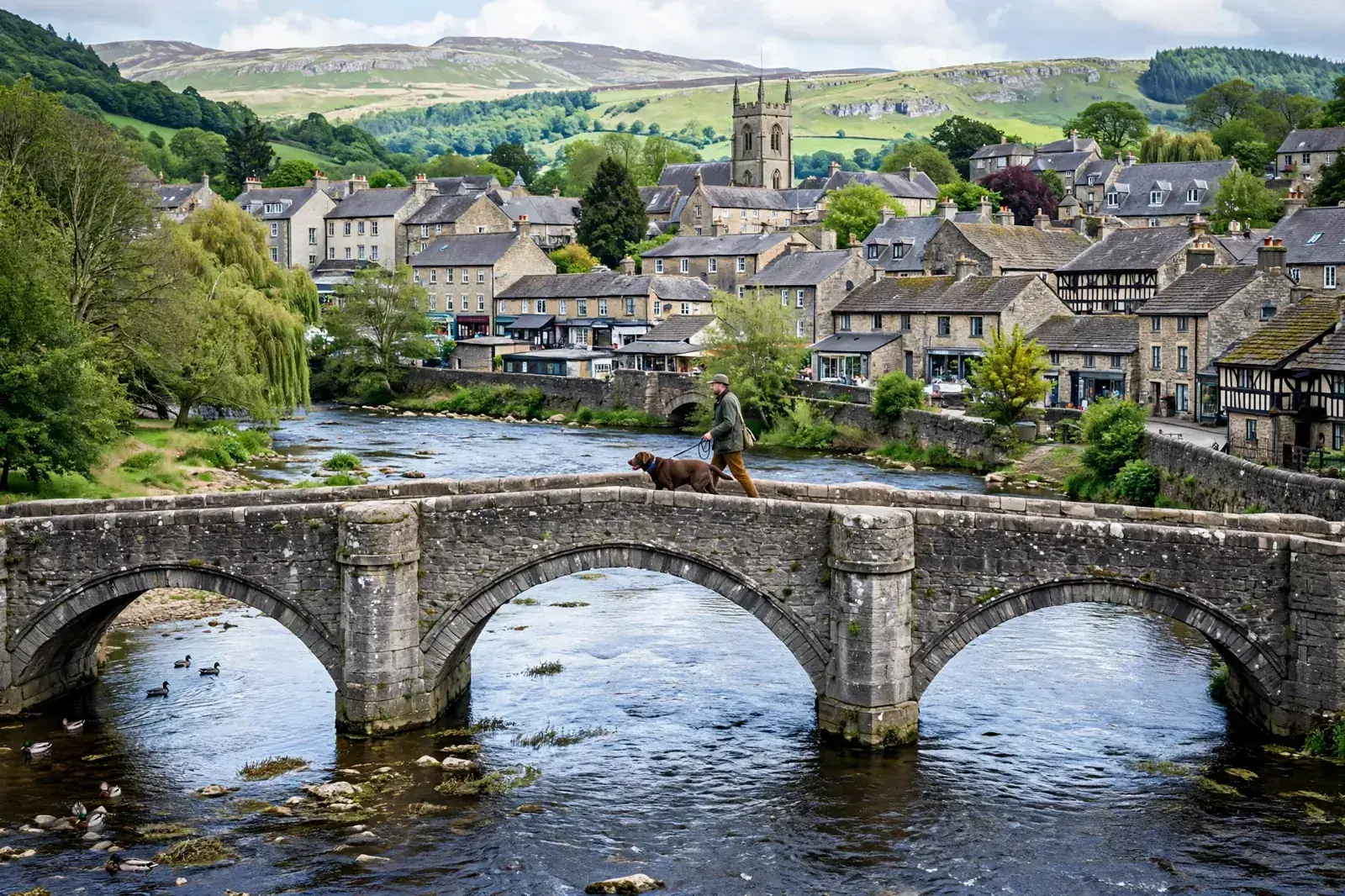
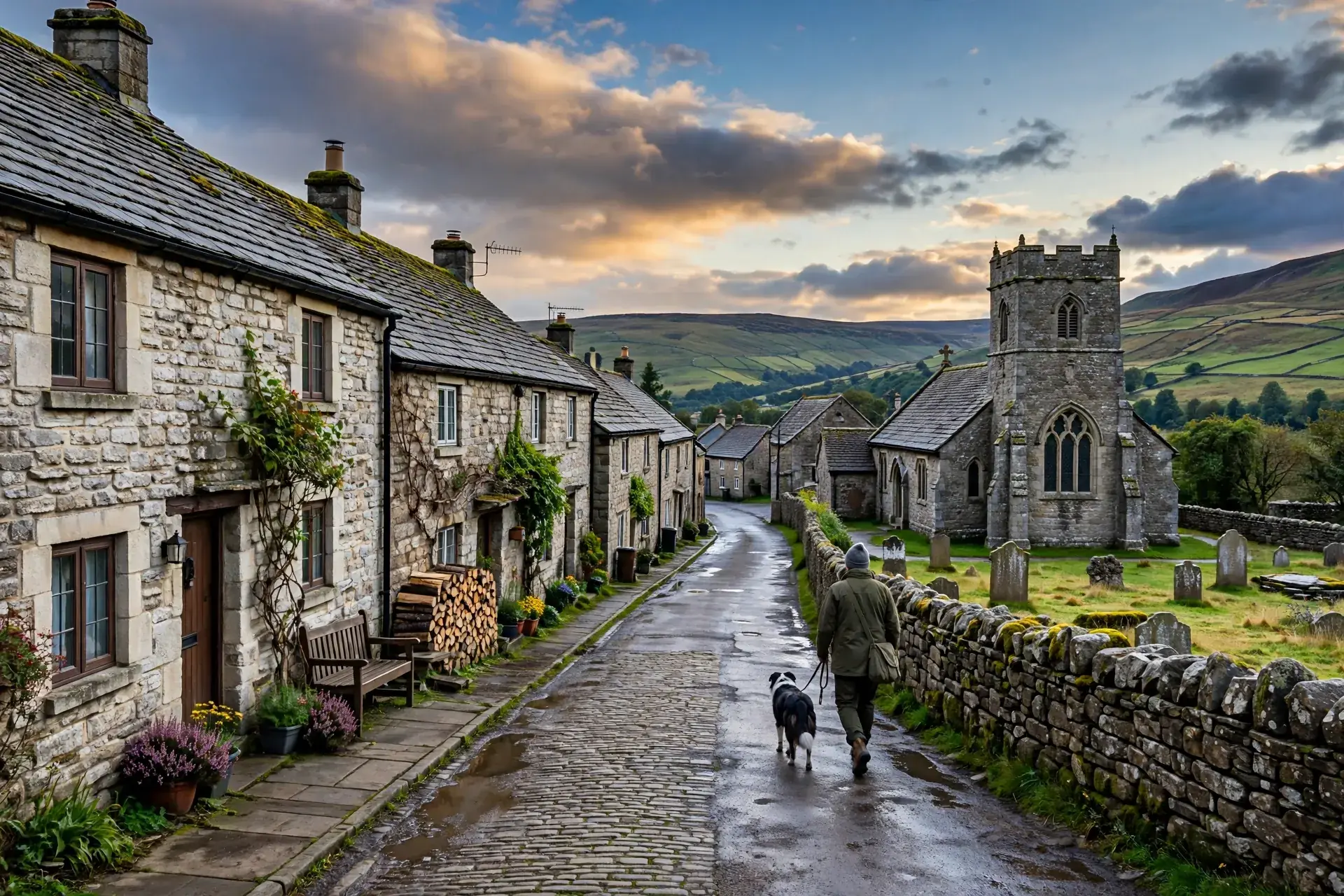
Askrigg's village street is the walk before the walk, wide enough for a dog to amble along the pavement edge and investigate the stone walls, the cottage gates and the grassy verges without being pressed into the road, and the church stands at the heart of that slow circuit, its tower visible from either end of the street and its churchyard wall offering a quiet boundary where you can pause, let your dog take in the scents of the village, and simply watch how the light moves across the stone before you decide which lane to follow out of the village.
A short lead on Askrigg's village street, past the churchyard wall and the cottage gates where neighbours come and go, gives a shy dog the reassurance of staying close while it learns the shape of the place, and the churchyard itself asks for that same gentle pace, with its paths, its tended plots and its visitors who have come for reflection, so that you pass through softly, keep to the paths, and let the stillness of the place settle over both of you before you turn back toward the street and the lanes beyond.
The small shops and houses along the street belong to a working village rather than a resort, and that ordinariness is part of the pleasure, because a brief, friendly stop with a calm dog beside you, a short exchange at a doorway, and a slow walk onward feel like participation in the village rather than sightseeing, and as the street becomes familiar over a day or two, your dog will begin to recognise the corners, the walls and the turning into the lane that leads toward the waterfall wood, and will walk them with a confidence that no amount of hurrying could have produced.
Mill Gill Force: the waterfall wood
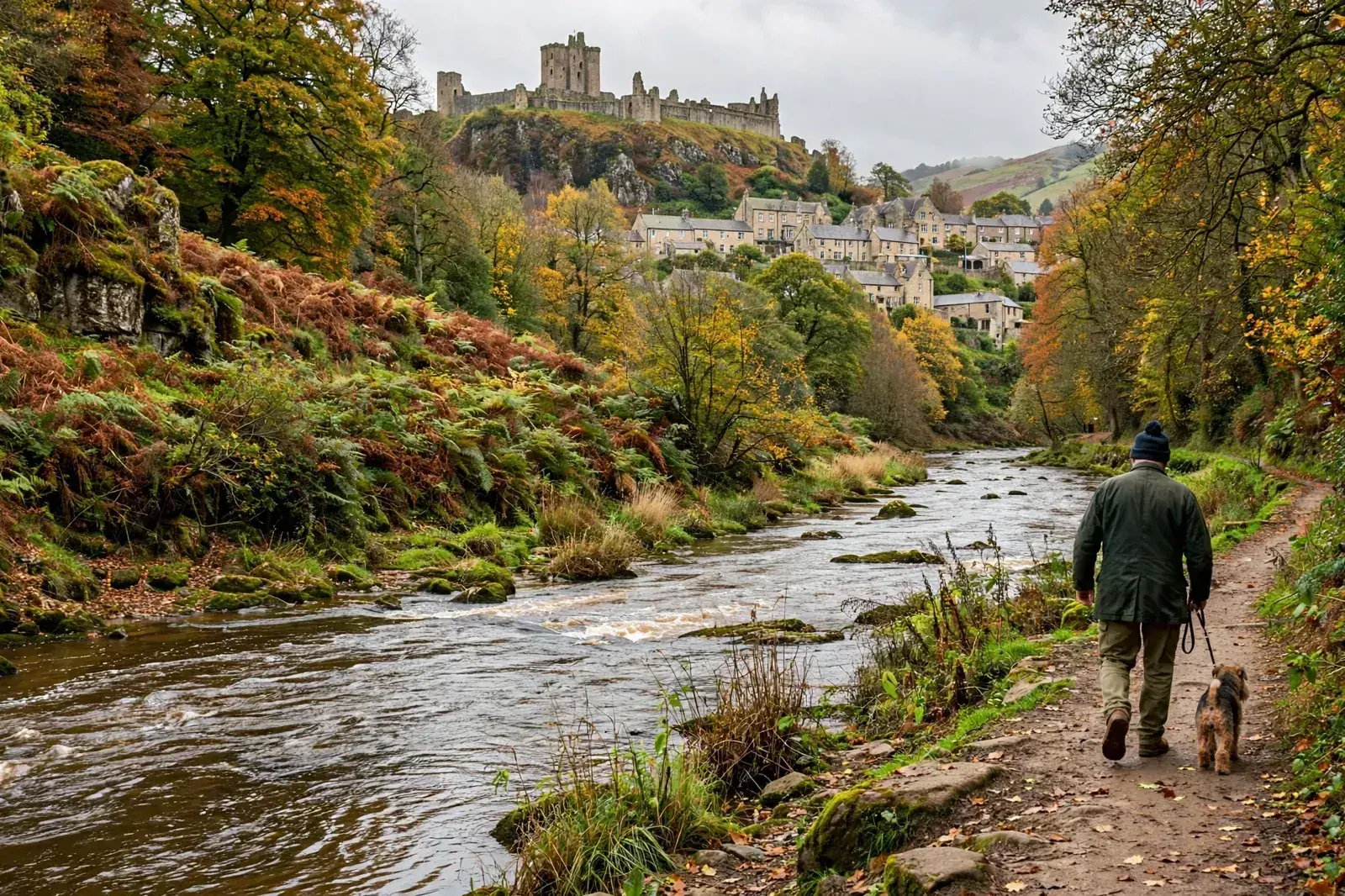
The path to Mill Gill Force begins as woodland before it becomes a waterfall walk, with trees closing overhead, the beck talking quietly beside the path, and the ground underfoot growing softer and greener as you go, until the sound of falling water gathers in the air ahead of you and your dog's pace changes, ears lifting and nose working harder, drawn forward by the damp, mineral scent of the wood and the steady rush that seems to come from somewhere just beyond the next bend in the trees.
Inside the wood the walking itself becomes the experience, because the stone steps are often wet and dark with moss, the roots cross the path in places where you need to slow and pick your footing, and the beck slips past boulders and under small bridges in a hurry that contrasts with the stillness of the trees, so that you move at the pace of the place rather than the pace of a timetable, stopping where the light falls through the canopy, letting your dog drink in the scents of wet leaf and stone, and listening to the water grow louder and then softer as the path winds on.
When you reach the falls, the reward is less a viewpoint to tick off than a place to stand still for a while, with the water dropping white against dark rock, spray cooling the air around you, and your dog pressing close against your legs as the sound fills the hollow of the wood, and the walk back through the trees, with wet paws on leaf mould and the beck now behind you, feels like a slow unwinding, especially if you pause again where the wood thins and the village lanes begin to open out toward the fields.
Bainbridge and Semer Water
From Askrigg the lanes toward Bainbridge unfold gently, without a climb that dominates the day, and the walk between the two villages has the particular pleasure of Wensleydale at its most domestic: stone barns standing in fields, dry stone walls running in long lines toward the horizon, small greens where a dog can pause in the shade, and views that open and close again as the lane dips and rises, so that the journey itself becomes a series of small discoveries rather than a distance to be covered. And as the lane rises and falls, the stone walls, the field gates and the distant sound of a farm vehicle somewhere out of sight give the walk a working-country texture that never feels arranged for visitors, only quietly lived in.
Bainbridge makes a natural turning point for such a walk, with its village green offering a place to sit and let a dog rest in the grass while you take stock of the morning, and from there the country toward Semer Water opens out into wider, quieter ground, where the lake lies still under a big sky, the shore path follows the water's edge past reeds and stones, and the wind moves across the surface in patterns that hold a dog's attention for a long while without asking anything of it. On a still morning the lake holds the sky so completely that the boundary between water and air seems to soften, and a dog standing at the shore, nose lifted to the wind coming off the water, appears to be listening to something far larger and calmer than itself.
At Semer Water the pleasure is in the margin between land and lake, in the stones underfoot, the scent of still water, the birds working the reeds at a distance, and the long view back across Wensleydale, and a dog that paddles at the very edge, explores the shore at its own pace, and then lies down on the grass above the water with its head on its paws has had an outing that suits Askrigg's tempo exactly, unhurried, open and quietly absorbing, with the walk home along the lanes feeling like a continuation rather than an ending. The walk home carries that lake stillness with it, in the slower pace of tired paws on the lane, in the longer pauses at field gates, and in the way the first roofs of Askrigg, appearing around a bend, feel less like an arrival than like a welcome back.
A gentle Wensleydale villages circuit
A circuit linking Askrigg with its neighbouring Wensleydale villages suits a dog that enjoys change without distance, because the lanes and field paths between the villages pass the same repeating beauties in different combinations: a stone barn here, a small church tower there, a green where the lane widens, and long stretches of field path where the only company is the wind in the grass and the occasional farm vehicle in the distance, and the whole route can be shortened at any lane junction, so that the walk bends to the dog rather than the dog bending to the walk.
The field paths of this circuit carry their own particular character, with gates that open onto open ground, stiles and tracks that cross working farmland, and long views back toward Askrigg that let you judge the day by how your dog is moving rather than by how far the map says you have gone, and where the path crosses ground where livestock graze, the change in your dog's attention, the sudden stillness, the lifted head, the nose toward the field, becomes a moment to slow right down, shorten the distance between you, and pass through that stretch with a calm, steady pace.
What stays with you after such a circuit is rarely a single view, but the rhythm of it: the lane out of Askrigg, the first field path, the pause at a village green, the long return with the light changing over the dale, and the way your dog, back on the familiar village street, walks a little more slowly and a little more contentedly, as if the villages themselves had taught it something about taking its time, and that softened, unhurried walk home is the truest measure of whether the circuit was the right length.
Pubs, cafes and quiet manners
In Askrigg, eating out with a dog belongs to the same slow register as everything else in the village, because the rooms where dogs are welcome tend to be quiet, low-key places where a dog that has walked to the village can settle under a table, out of the way of the door, and drift into sleep while the meal goes on around it, and the pleasure of such a meal is not in any grand occasion but in the simple rightness of a tired dog resting at your feet while you eat without hurry. There is a particular contentment in watching a dog that has walked the waterfall wood finally give in to sleep under a table, its breathing slowing to match the murmur of the room, while the evening outside the window darkens over the village street.
A dog fresh from the waterfall wood will arrive damp and full of woodland scent, and a few minutes outside with a towel, letting it shake off the wood and settle before you go in, makes the whole meal easier, for the dog as well as for everyone else in the room, and once inside, a corner away from the entrance, a blanket on the floor, and water within reach give the dog a small territory of its own, a place to return to after a glance around the room, until sleep takes over and the meal can proceed at its own pace. That small preparation, a towel, a blanket, a bowl of water placed where the dog can find it without crossing the room, turns a meal from a negotiation into a rest, and the dog, settled in its own corner, becomes part of the room's quiet rather than an interruption to it.
Evenings in the village carry a particular softness, with the street quieting outside, the light fading over the stone, and a dog that has walked well during the day lying deeply asleep, and if the evening meal is one you have planned in advance, mentioning the dog when you arrange it lets the room be chosen with the dog in mind, so that the night ends as the day began, without rush, without fuss, and with the dog already half dreaming of the lanes it will walk tomorrow. When the meal ends and you step back out into the cooling street, the dog, refreshed by its sleep and ready for a last short wander past the church and the cottage gates, walks beside you with the unhurried ease that Askrigg seems to teach every visitor.
Parking, arrival and lanes
Arriving in Askrigg feels less like reaching a destination than like slipping into a slower gear, because the village parking sits within the village itself, close enough that the walk from the car to the street is itself a beginning, a chance for a dog to stretch, to take in the stone and the air of a new place, and to settle before the first proper walk, and on a quiet weekday that arrival is effortless, while on a busier day a slightly longer walk in from the edge of the village simply extends the pleasure of the approach. That first short walk, past stone walls and cottage gardens, with the church tower ahead and the lanes opening beyond the last houses, is often the moment when a dog stops being a traveller and starts being a guest in the village.
The lanes around Askrigg ask for the same unhurried attention as the village street, since they are narrow, shared with farm vehicles and walkers, and edged with stone walls and verges that leave little room for haste, so that driving slowly, waiting patiently at passing places, and walking the lanes with time to step aside becomes part of the break rather than an obstacle to it, and a dog that travels calmly and arrives calmly will walk the village street with a steadiness that a rushed arrival could never produce. Patience on those lanes is repaid in the walk itself, because a lane walked slowly reveals what a lane driven quickly hides: the scent at a gateway, the shade under a wall, the sudden view across Wensleydale where the lane crests a rise.
Once you are settled, the village rewards staying on foot, because the waterfall wood, the lanes toward Bainbridge, and the shore path at Semer Water all begin from the same quiet centre, and the days take shape not around journeys but around walks that start at the cottage door, wander out through the lanes, and return by a different turning, until Askrigg itself, rather than any single outing, becomes the place your dog remembers. By the second day the pattern is set, and the walks no longer need planning so much as choosing, with the waterfall wood one way, Bainbridge and the lake another, and the village street itself always there for the quiet hours in between.
Stays, seasons and slow days
Staying in Askrigg means choosing a rhythm as much as a roof, because a cottage on the village street, a small guesthouse tucked among the stone houses, and a village room above a quiet bar each offer a different version of the same slow days, with mornings that begin on the village street, afternoons that drift between the waterfall wood and the lanes, and evenings when the village quiets and a dog can sleep deeply without the sounds of a town pressing in through the walls. In each of them the dog's day ends the same way, with a last slow circuit of the village street in the fading light, a pause by the churchyard wall, and a return indoors to a familiar corner where sleep comes quickly and deeply.
The seasons colour those days differently without changing their tempo, since spring fills the fields with new life and a particular freshness in the air, summer lengthens the evenings and deepens the shade of the waterfall wood, autumn brings colour to the lanes and a crispness that makes a dog step out eagerly, and winter draws everything inward, toward warm rooms, short village walks in the low light, and long sleeps by the fire, and each season, in its own way, suits a dog that prefers a quiet village to a busy resort. A dog that has spent its day between waterfall wood, lake shore and village lanes will greet each of those seasonal changes with the same steady pleasure, because the underlying shape of the day, walk, rest, walk again, never really changes.
For a longer break, the contrast between Askrigg and a busier market town makes the quiet of the village feel chosen rather than imposed, and the Bakewell town guide shows what that busier alternative looks like, with markets, riverside paths and town crowds, so that a day away can sharpen your appreciation of the village you return to, where the street is wide, the lanes are empty, and the evening walk ends, as it always does, in stillness. Returning from such a day trip, with the town's noise still faintly in your ears, the first quiet stretch of Askrigg street, the stone underfoot and the wide sky overhead, feels like a deep breath taken at exactly the right moment.
A slow Askrigg day
A slow Askrigg day begins without any need to hurry, with a first walk along the village street while the village is still waking, your dog investigating the walls and verges at its own pace, the church tower standing over the street in the morning light, and breakfast taken slowly afterwards, either where you are staying or in a quiet village room, while your dog, already content from its first outing, settles nearby and watches the day begin without any expectation of what must follow. The village at that hour belongs mostly to its residents, to dogs out for their first walk, to curtains still drawn in cottage windows, and to the soft, unhurried sounds of a place that has not yet decided to be busy.
By mid-morning the waterfall wood at Mill Gill is calling, with its damp stone steps, its moss and its rising sound of water, and the walk there and back, taken at the pace of the wood rather than the pace of a schedule, fills the middle of the day so completely that lunch in the village afterwards feels earned rather than merely convenient, and the afternoon can then belong to whatever the dog still has energy for, whether that is a lane toward Bainbridge, a quiet hour on the shore of Semer Water, or simply a long rest while the light moves across the village street outside, and if the weather turns, the rainy day days out with dogs guide offers wetter-weather ideas that keep the same unhurried spirit, before an early evening village walk, a last pause by the churchyard wall, and a night of deep, untroubled sleep bring the day to its gentle close. It is a day built from small, complete pleasures rather than from sights collected, and as the night settles over the stone street, the dog asleep beside you will already seem to be dreaming in the rhythm Askrigg taught it.
Practical questions
Before you go
Is Askrigg suitable for nervous dogs?
Yes, in the way that matters most for a nervous dog, because Askrigg's wide street, its quiet lanes and its lack of crowds give a shy dog time to look, to sniff and to decide, rather than forcing it through a press of strangers, and a morning walk along the village street, followed by a rest and then a gentle lane toward Bainbridge, will often teach you more about what your dog enjoys than any busier outing could.
Is the Mill Gill Force walk suitable for older dogs?
The waterfall wood suits an older dog that is still steady on its feet and happy to take its time, because the path is shaded and absorbing, yet the damp stone steps and the climb through the trees can tire a dog that is stiff or short of breath, so that a shorter wander into the lower wood, with long pauses to listen to the beck, may give an older dog the scent and sound of Mill Gill without asking it to reach the falls themselves.
Can dogs swim in Semer Water?
The shore of Semer Water is a lovely place for a dog to explore at the water's edge, with stones underfoot, reeds nearby and a long view across the lake, yet the open water itself deserves respect, since a dog that swims far out, or enters water it cannot easily leave, can tire quickly, so that paddling at the margin, walking the shore path, and resting on the grass above the lake give a dog the pleasure of the place without the risks of a long swim.
Where should I park in Askrigg with a dog?
The village parking in Askrigg sits close to the street and the lanes, so that you can arrive, settle your dog with a short walk along the village street, and begin the day without a long transfer, and on a busier day a walk in from a little further out simply becomes the first gentle outing, with the village, the church and the waterfall wood all within easy reach on foot from wherever you leave the car.
Are dogs welcome in Askrigg pubs?
Many village rooms in Askrigg welcome dogs, and the welcome feels most natural when the dog arrives calm from a walk, settles under a table away from the door, and sleeps through the meal, so that asking at the door, choosing a quiet corner, and letting the dog rest after its walk will usually make the evening easy for everyone in the room.
Is Askrigg a good base for a quiet Dales break with a dog?
Yes, if the break you want is built from quiet mornings, waterfall woods, lake shores and village lanes rather than from crowds and attractions, because Askrigg gives you all of those within walking distance of a single calm base, and a dog that sleeps deeply in a quiet village will wake each morning ready to wander again, which is, in the end, the whole point of the place.