This guide is independent and contains no paid placement. If affiliate links are added later, they will be clearly marked and will not change our editorial checks.
Selkirk is best walked from the top down. Climb first for the views over the Ettrick and Yarrow valleys, then drop to the rivers for flat, shady loops, and finish in the town for food and a rest. Keep dogs on a lead near sheep, cattle and nesting birds, carry water on the open hill, and check the official guidance before you travel if a route, access point or local rule is unclear.
Read Selkirk from the top down
Most town guides start in the market square. Selkirk makes more sense the other way round. The town sits in a hollow where two rivers meet the hills, and almost everything about a dog walk here — the wind, the ground underfoot, the livestock, the length of the climb back — is easier to judge once you have seen it from above. So begin, at least in your planning, on the high ground.
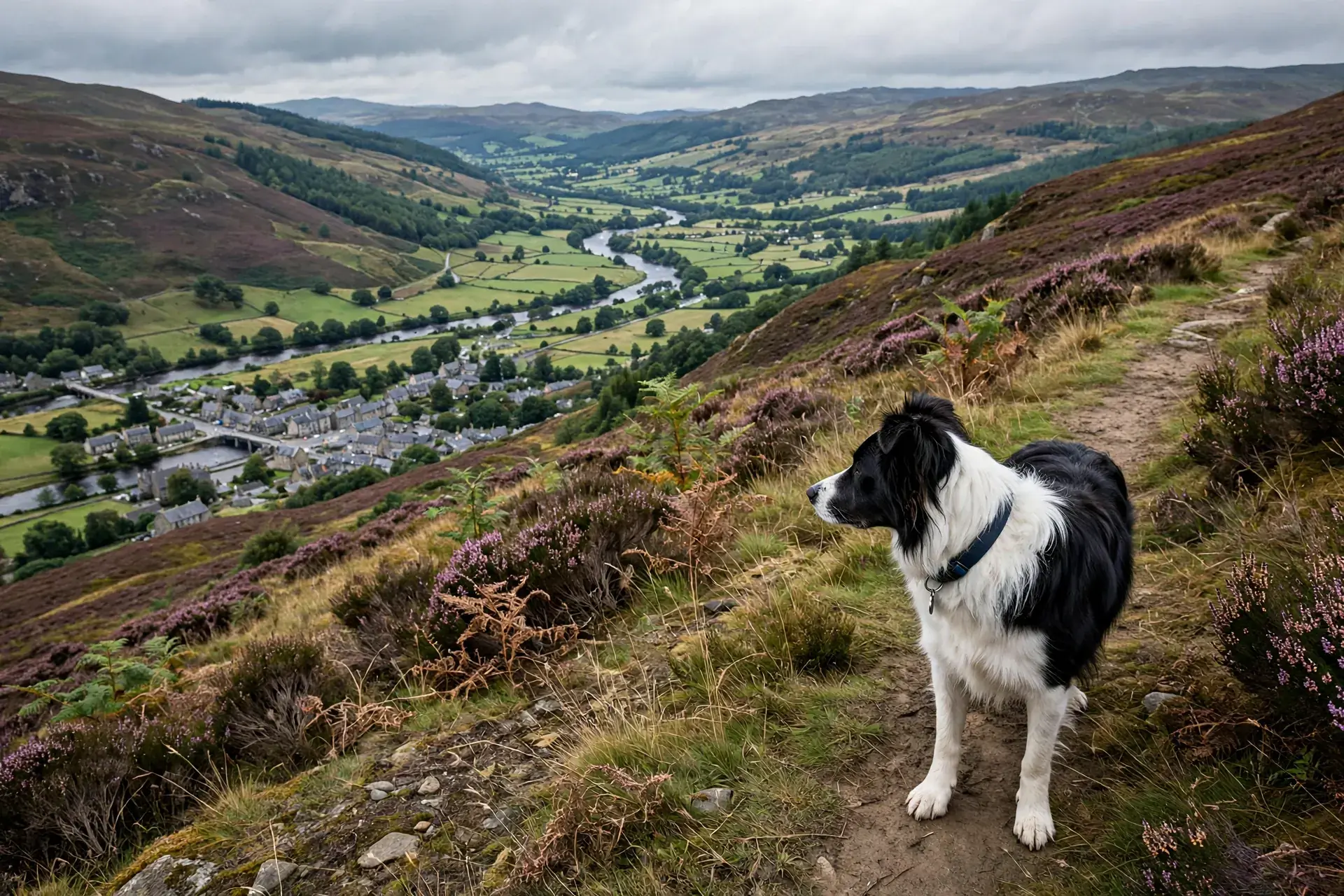
Selkirk lies in the Scottish Borders, in the historic county of Selkirkshire, south of Galashiels and west of the River Tweed. The town grew up where the Ettrick Water and the Yarrow Water run close together before joining the Tweed, and the land rises steeply on almost every side. From the hill paths above the town you can pick out the whole shape of a day: the wooded river valleys below, the long ridge lines running south towards the Ettrick Forest, the rooftops of the town in the dip, and the roads threading out towards Melrose, Kelso, Hawick and Peebles. A dog that has just climbed 150 metres will understand the map better than any leaflet, and so will you.
That top-down view also settles the most important practical question: how much effort is this walk really going to take? A route that looks short on a flat map can hide a steep, slippery bank, a fence line with no stile, or a stretch of open moor with no shade and no water. Looking down from the hill first — or at least studying the contours before you set off — tells you where the climbs are, where the flat riverside miles are, and where you can bail out to a road if the weather turns or a dog tires. In Selkirk, the bail-out points matter, because the hills are open and the weather can change in the time it takes to walk a mile.
The high ground around Selkirk is a mix of rough grass, heather moorland, conifer plantation edges and improved pasture. The heather is at its best in late summer, usually from late July into September, when the hillsides turn purple and the bees are loud enough to hear from the path. In spring the same ground is greener and softer, with lambs in the lower fields and curlews calling over the moor. In winter the hills are bleak and beautiful, but the wind is stronger, the light goes early, and the paths can be frozen, boggy or both in the same mile. Each season changes the walk, and each season changes what your dog needs from you.
Before you climb, do the simple checks that make a hill walk safe. Look at the forecast for wind as well as rain: a 30-mile-per-hour wind on an exposed ridge is a different walk from the same wind in the sheltered river valley. Tell someone where you are going if you are walking alone with a dog on the open moor. Carry a charged phone, a lead and a long line, water for the dog, and a layer for yourself, even on a warm day. The Scottish Outdoor Access Code gives everyone a right of responsible access to most land and inland water in Scotland, but it also expects dogs to be under close control, especially around livestock and wildlife. That balance — freedom to roam, responsibility to keep it safe — is the thread that runs through this whole guide, so check the official guidance before you travel if you are unsure how the code applies to a particular field or path.
One more thing the view from above teaches: Selkirk is a small town with big country attached. You do not need to drive for an hour to find a proper hill walk, and you do not need a car at all for a satisfying day if you are staying in town. The hills start at the edge of the houses. That is the town's great advantage for dog owners, and also its main demand: the dog that copes well on a flat riverside path may still need a slower pace, more water and more rest on a steep, exposed climb. Plan the day around the dog in front of you, not the dog in the guidebook.
The short town loop: an easy first hour
If you have just arrived, if your dog is older, stiff or new to hills, or if the weather is closing in, start low. A short town loop is the right first walk in Selkirk, and it is also the walk you will come back to on tired evenings, wet mornings and the last hour before you drive home.
The simplest version runs for roughly 2 to 3 kilometres, takes 30 to 50 minutes at a sniffing pace, and stays on pavements, surfaced paths and riverside tracks with very little climbing. Start in the town centre, near Market Place, and walk down towards the Ettrick Water on the southern edge of town. The riverside path here is flat, shaded in places by trees, and a good place for a dog to settle into a walk: water to sniff, grass to explore, and enough space to pass other walkers without a squeeze. Keep your dog on a lead through the built-up stretch, where pavements meet side roads and driveways, and watch for cyclists on the shared paths.
From the river, loop back through the quieter residential streets on the edge of town, or retrace your steps along the water if your dog is happier on a familiar route. A loop that goes out one way and back another is usually better than an out-and-back for a dog that gets bored, but an out-and-back is kinder if your dog is nervous, because everything on the return leg is already known. Let the dog decide: if it keeps pulling towards home, shorten the loop; if it is still bright and sniffing at the turn, extend it by a street or two.
Short does not mean thoughtless. Even on a town loop, carry a poo bag and a small bottle of water in summer, and keep your dog off other people's front gardens and out of the road at junctions. Selkirk's High Street is a working shopping street, not a pedestrianised theme park, so expect delivery vans, buses and parked cars, and keep a short lead through the busiest stretch. If your dog is reactive to other dogs, walk early in the morning or in the early evening, when the pavements are quieter and the riverside path has fewer dogs to meet head-on.
This is also the best walk for a first assessment. Watch how your dog moves on the flat: is it stiff after the car journey, is it pulling hard, is it drinking normally, is it interested in the world or just keen to get back to the car? The answers tell you whether a hill climb later in the day is sensible or whether the riverside should be the whole day. A dog that is tired after 30 flat minutes will not enjoy 300 metres of climbing, however good the view. A dog that finishes the town loop still pulling and bright is telling you it is ready for the next grade up.
For puppies, very old dogs and dogs recovering from injury, the town loop is the day. There is no rule that says a good day out must include a summit. A slow hour by the river, with time to sniff, paddle and sit in the shade, is a full and satisfying walk for many dogs. Build in a rest stop on a bench or a patch of grass, offer water, and let the dog watch the river for a while. Dogs do not measure a walk in kilometres; they measure it in smells, choices and calm.
Finally, use the short loop to learn the town. Note where the public toilets are, where the bins are, which cafes have outdoor seating, where the pavement narrows, and where the nearest vet is. That local knowledge pays off later, when you come down off the hill wet, tired and hungry, and want to get the dog settled without a second expedition. A first hour spent learning the ground is never wasted.
Mid-level hills: the half-day grade
The mid-level hills are where Selkirk earns its keep as a walking town. These are the rounded, grassy and heather-covered hills that rise directly above the houses — high enough for a proper view, low enough to climb in an hour or two, and varied enough that no two routes feel the same. A typical mid-level walk is 5 to 8 kilometres, with 150 to 250 metres of ascent, and takes two to three hours including stops. That is a half-day for most people and a full, satisfying day for many dogs.
Start by choosing your hill with the wind in mind. On a windy day, pick a sheltered slope and a route that keeps a wall, a wood edge or a ridge between you and the worst of the weather. On a hot day, pick a route with shade on the way up and water on the way down, and start early. On a wet day, pick a route with a firm track rather than a boggy moorland crossing, because wet heather and peat are hard work for short legs and older joints. The hills above Selkirk are not high by Scottish standards, but they are exposed, and exposure is what tires dogs fastest.
The climb itself deserves a plan. Walk up slowly, with the dog on a lead or a long line until you can see the ground ahead. Stop every ten or fifteen minutes on a steep section, offer water, and let the dog catch its breath. Dogs are polite about tiredness: they will keep going long after they should have stopped, especially working breeds and young dogs that do not yet know their limits. Watch for the early signs — lagging behind, panting hard, lying down on the path, or losing interest in smells — and treat them as a signal to turn back, not to push on. The view will still be there next time.
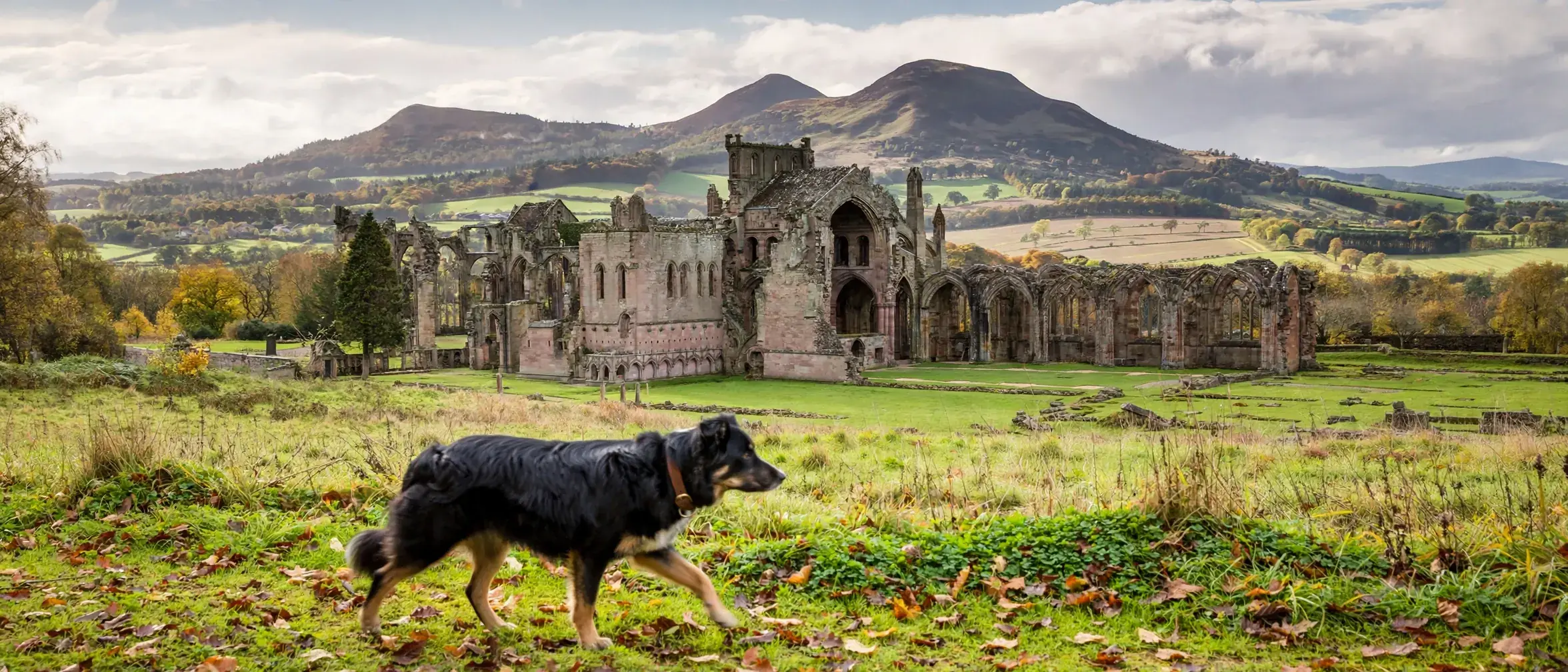
At the top, the reward is the panorama: the Ettrick valley running south-west, the Yarrow valley running west, the Tweed valley to the north, and the long line of the Southern Uplands rolling away in every direction. On a clear day you can pick out the Eildon Hills above Melrose to the north-east, a useful landmark if you are planning a longer Borders trip. Give the dog time at the top. Let it sniff the wind, lie down in the grass, and rest properly before the descent. The descent is often harder on a dog's joints than the climb, especially for older dogs and heavier breeds, so take it slowly, zig-zag on steep grass rather than plunging straight down, and use a path or track where one exists.
Ground conditions change with the seasons. In spring, the lower slopes can be soft after rain, and the paths through pasture can be churned by cattle. In summer, the heather is dry and the ground is firm, but there may be no water on the hill, so carry more than you think you need. In autumn, the bracken dies back and the views open up, but the paths can be slippery with wet leaves and the light fades fast. In winter, frost and ice make north-facing slopes treacherous, and a short day can turn into a race against the dark. Check the forecast, check the light, and carry a head torch in winter even if you plan to be back by lunch.
Navigation on the mid-level hills is straightforward but not foolproof. The paths are a mix of formal footpaths, farm tracks, forestry rides and open moorland with no path at all. A paper map or a downloaded offline map is worth carrying, because phone signal can be patchy on the far side of a ridge. Learn to read the ground: a fence line, a wall, a burn, a plantation edge and a distant mast are all useful handrails. If you lose the path, do not push through deep heather or a bog to find it; retrace your steps to the last known point and try again. Dogs do not mind a detour, but they do mind being dragged through waist-deep heather.
Two practical rules cover most mid-level walking. First, keep the dog on a lead until you are sure there is no livestock ahead, and put it back on the lead the moment you see sheep, cattle or a lambing field, even at a distance. Second, keep the dog in sight at all times. A dog that disappears over a ridge may be chasing a sheep, a deer or a ground-nesting bird, and by the time you catch up, the damage is done. A long line gives a dog freedom to explore while keeping you in control, and it is the single most useful piece of kit for Borders hill walking. If you are heading further afield after Selkirk, the same graded thinking applies in Melrose, where the Eildon Hills offer a similar climb with abbey views, and the effort grades there make a useful comparison when you are choosing your next hill.
The full moorland day: a long walk, done properly
A full moorland day is a different kind of walk from a mid-level hill. It is longer, lonelier and more committing: 12 to 18 kilometres, 400 to 600 metres of total ascent, five to seven hours on your feet, and long stretches with no shop, no shelter and no easy way back to the car. It is the walk for a fit, experienced dog and a fit, experienced walker, on a good-weather day, with a proper plan. It is not a walk to improvise.
Choose the day carefully. A full moorland day needs a stable forecast: light wind, no heavy rain, good visibility, and enough daylight to finish with an hour to spare. Check the forecast the night before and again in the morning, and be willing to cancel. The Southern Uplands are not the Highlands, but they are still open, exposed country, and a moorland plateau in thick mist or driving rain is a miserable and potentially risky place for a dog that cannot tell you it is cold. If the forecast is marginal, do the mid-level hills instead and save the moor for a better day.
Plan the route on a map before you leave, and carry that map with you. A good moorland route from Selkirk follows a ridge or a valley for most of its length, with clear landmarks at each turn: a plantation corner, a burn crossing, a fence junction, a cairn, a road. Avoid routes that cross large areas of pathless bog, especially after rain, because bog is slow, tiring and hard on paws. A route that looks like a neat loop on a small-scale map can hide a mile of deep heather or a river crossing with no bridge, so zoom in, check the contours, and ask locally if you are unsure. Check the official guidance before you travel if a right of way, a forest track or a river crossing is unclear.
Pack for a full day, not a morning. That means at least a litre of water for the dog in cool weather and more in warm weather, plus food for the dog and for you, a first-aid kit that includes a tick remover, a towel or drying coat, a spare lead, a head torch, a whistle, and a charged phone with an offline map. A dog coat is worth carrying for a short-coated or older dog, even in summer, because the wind on a moorland ridge can chill a wet dog fast. A small sit mat or folded blanket gives the dog somewhere dry to lie during a lunch stop, which makes a real difference to how it feels on the second half of the walk.
Pace the day in thirds. The first third is the warm-up: steady, unhurried, with regular water stops. The middle third is the hard work: the longest climb, the most exposed ground, the furthest point from the car. The last third is the careful return: tired legs, tired paws, and the temptation to rush. Do not rush. A dog that is tired is more likely to slip, to cut a corner through a bog, or to ignore a recall, and a tired walker is more likely to make a navigation error. Walk the last mile as slowly as the first, and give the dog a proper rest and a drink when you get back to the car before you drive anywhere.
On a moorland day, livestock and wildlife are not a brief encounter but a constant presence. You may cross several fields of sheep, pass cattle on a valley floor, and walk through ground where curlews, lapwings and skylarks are nesting in spring and early summer. Keep the dog on a lead through every field with livestock, and on a lead or under very close control on open moor in the breeding season. If you see a bird acting distressed — calling loudly, fluttering on the ground, or flying at you — you are probably near a nest, so move away calmly and keep the dog close. The Scottish Outdoor Access Code is clear that dogs should not be allowed to disturb ground-nesting birds, and a single loose dog can destroy a season's nesting in minutes.
Know when to turn back. The signs are the same as on a shorter walk, only more important: a dog that is lagging, limping, panting heavily, refusing food or water, or lying down and refusing to move is telling you the day is over. So is a dog with sore paws, a cut pad, or a tick that needs removing. Turn back early and the day is still a success — you had a good walk, the dog is safe, and you can try again. Push on, and a good day becomes a rescue. There is no summit in the Borders worth a lame dog.
After a full day, the evening matters as much as the walk. Check the dog's paws for cuts, thorns and ticks, check its coat for burrs, and dry it properly before it settles. Offer food and water, but do not be surprised if a tired dog eats less than usual; a quiet evening, a warm bed and a short last walk are the right ending. If the dog is stiff the next morning, give it a rest day. A moorland day is a big ask, and recovery is part of the plan.
Ettrick Water and Yarrow Water: the river routes
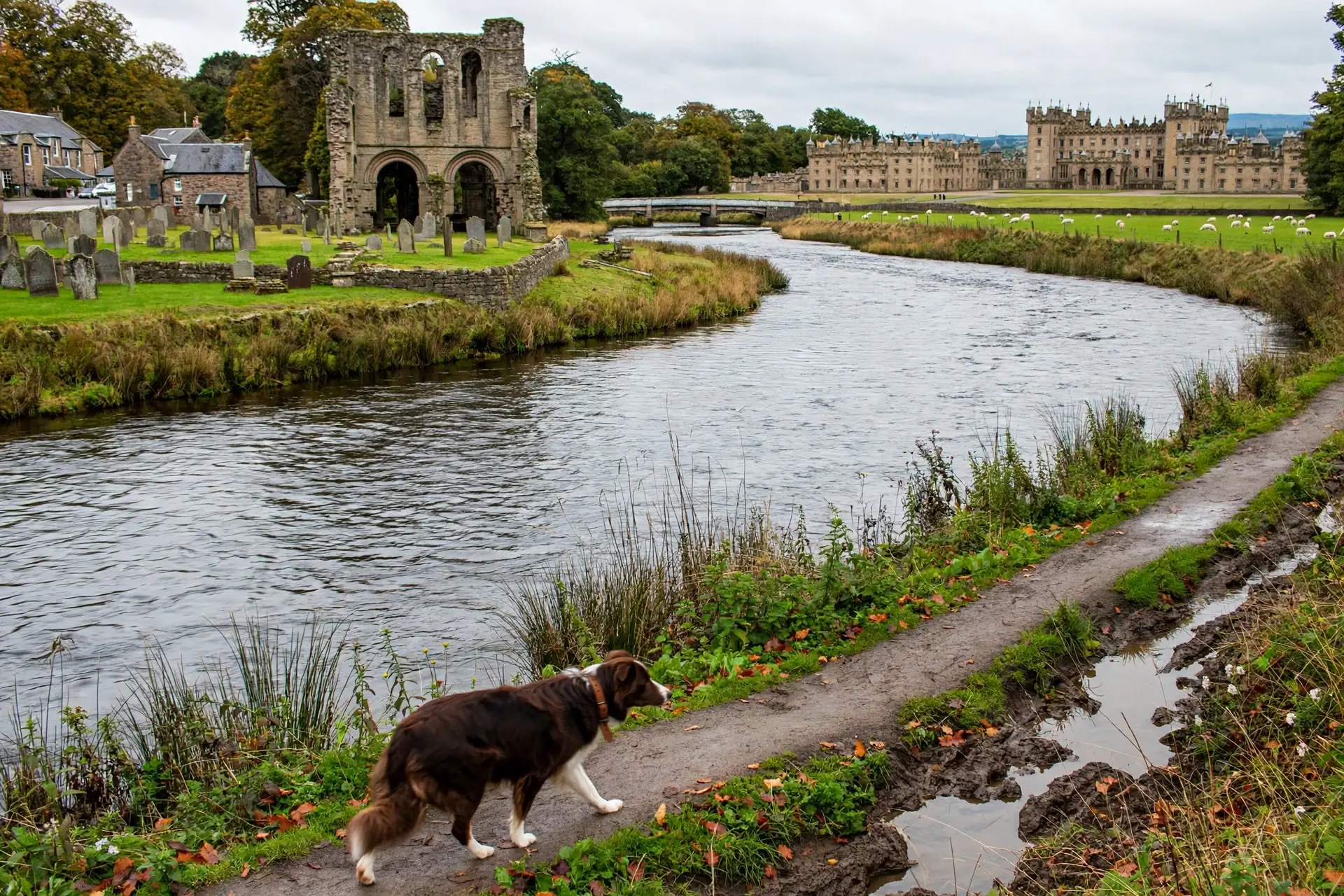
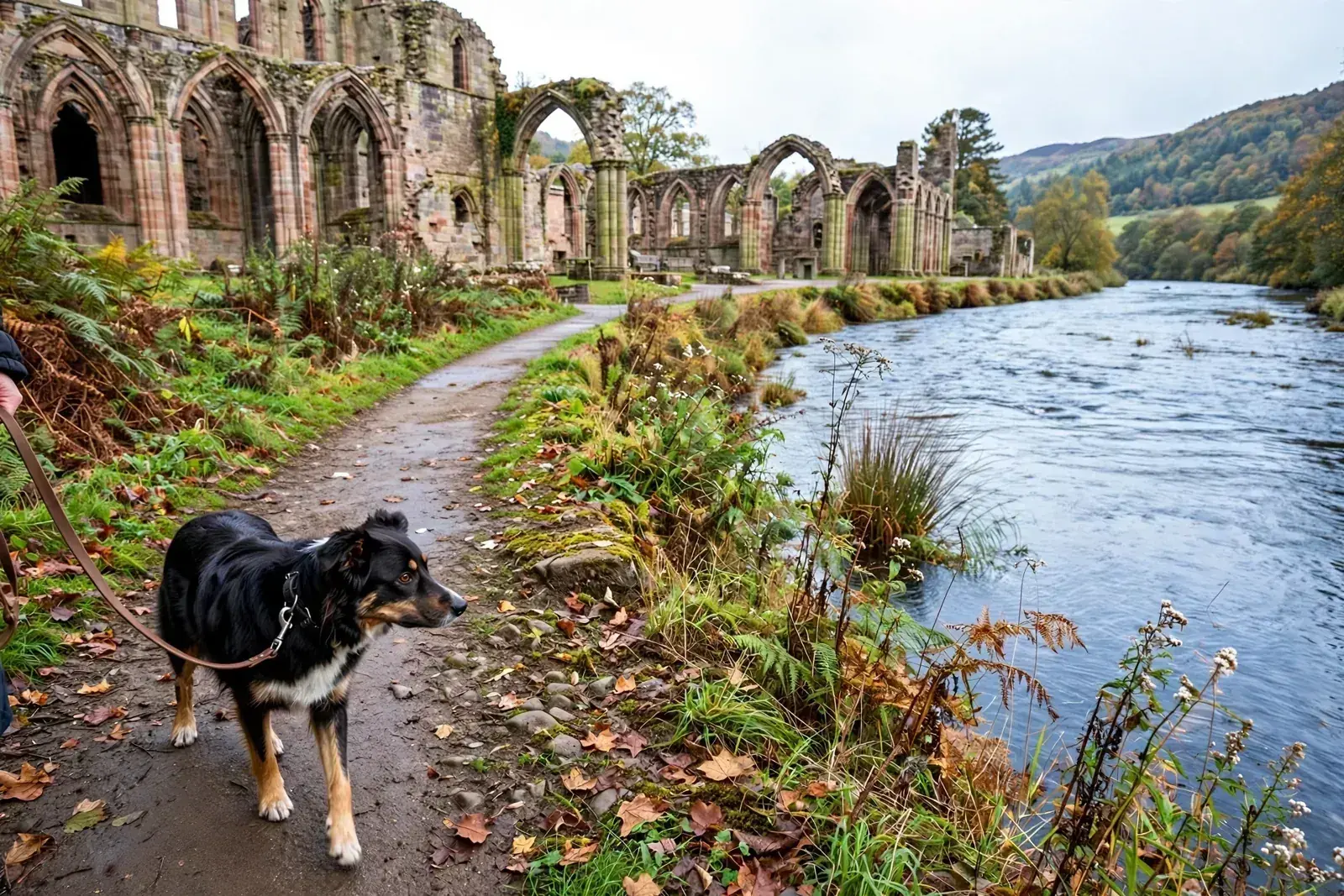
If the hills are Selkirk's lungs, the rivers are its shade and its calm. The Ettrick Water and the Yarrow Water meet near Selkirk before joining the River Tweed, and their valleys offer the flattest, shadiest and most dog-friendly walking in the area. On a hot day, on a wet day, or on a day when a dog's legs are tired from the hill, the rivers are the right choice.
The Ettrick Water runs south-west to north-east through a broad, wooded valley. The riverside paths near town are surfaced or firm, with grassy banks where a dog can sniff and paddle at the edge. Further out, the valley opens into farmland and moorland, with longer, quieter stretches where you may meet more sheep than people. The Yarrow Water runs from the west, through a narrower, more wooded valley, and joins the Ettrick near Selkirk. Its path is shadier and more enclosed, with trees overhanging the water and a cooler feel on a summer afternoon. Both rivers are spate rivers, which means they can rise fast after heavy rain, so check the water level before you let a dog in, and never let a dog swim in fast, brown water.
Walk the rivers as out-and-back routes, and you control the length exactly. Walk out for 30 minutes, turn around, and you have an hour's walk. Walk out for an hour, and you have two. That flexibility makes the river paths ideal for dogs of different fitness levels, for families with children, and for anyone who wants a walk that can be shortened without a fuss. It also makes them ideal for a second walk in the day: a hill in the morning, a river in the evening, with the dog resting in between.
Water safety deserves a careful paragraph, because rivers look friendlier than they are. Check the depth and the current before your dog goes in, and start at a shallow, slow edge rather than a deep pool. Watch for undercut banks, slippery rocks, fishing lines and broken glass near popular spots. Keep dogs away from weirs, fast channels and anywhere the water is moving too quickly to wade across yourself. After heavy rain, stay out of the water entirely: the current is stronger, the banks are slippery, and the water carries debris you cannot see. In warm, still weather, be aware of blue-green algae, which can appear as a green scum or a pea-soup colour on still pools and slow stretches. If you suspect it, keep your dog out, do not let it drink the water, and check the official guidance before you travel if you are unsure. Rinse your dog with clean water after any river swim, and check its ears and paws afterwards.
Fishing is a serious local activity on both rivers, and dogs and anglers do not always mix well. The Ettrick and the Yarrow are known for salmon and trout, and anglers may be standing in the river, casting from the bank, or wading through a pool your dog wants to swim in. Keep your dog on a lead when you see an angler, give them a wide berth, and do not let your dog disturb the water upstream of them. Fishing on these rivers is controlled by permits and seasons, and dogs should not be allowed to chase fish or disturb spawning beds. If you are visiting in the salmon season, expect more anglers, more early-morning activity on the banks, and more reason to keep a dog close.
The river valleys are also good for wildlife, and that changes how you walk them. Kingfishers, dippers, grey wagtails and goosanders all use these rivers, and otters are present in the wider Tweed catchment, though they are shy and most often seen at dawn or dusk. Keep your dog from crashing through the bankside vegetation where birds nest, and keep it out of reed beds and quiet backwaters where wildlife shelters. A dog on a lead, walking quietly along the path, will see far more wildlife than a dog charging through the undergrowth — and the wildlife will stay for the next walker too.
Finally, the rivers are the best place to cool a dog down after a hill walk. A slow paddle in a shallow, clean stretch, a drink of fresh water, and a rest in the shade will do more for a hot dog than an air-conditioned car. But cool a dog down gradually: a very hot dog should not plunge into cold water, and a dog that has just finished a hard climb should rest for a few minutes before it swims. Offer water to drink first, let the dog paddle, and only then let it swim if it wants to. Some dogs will choose to lie in the shallows rather than swim, and that is a perfectly good choice.
For a longer riverside day, Selkirk pairs well with the Tweed itself. Kelso, downstream on the Tweed, has wider riverside paths and a market square to finish in, and it makes a natural second day if you are staying in the Borders for a weekend. The contrast is instructive: Selkirk's rivers are narrow, wooded and intimate, while the Tweed at Kelso is broad and open, and a dog that loves one will often love the other for different reasons.
Town centre, Common Riding and Scott
Selkirk town centre is compact, walkable and easy to learn in an hour. The High Street runs through the middle of town, with Market Place at its heart, and most of what a visitor needs — shops, cafes, cash machines, public toilets and bus stops — is within a few minutes' walk. That compactness is a gift for dog owners: you can park once, walk the town, and be on a hill path or a river path within ten minutes, without a second drive.
Start at Market Place, where the town's history is visible in the open. The market cross and the surrounding buildings tell the story of a royal burgh that grew up around wool, weaving and the river trade. Look for the statue of Fletcher, the Selkirk man who is said to have killed a deer with a single blow at the Battle of Flodden in 1513, and for the memorials that mark the town's part in that battle. The story is told in more detail in the town's museum and heritage displays, and it is worth reading before Common Riding, because the festival makes far more sense when you know what it commemorates.
Common Riding is Selkirk's great annual event, and it is the one day of the year when the town changes completely. Held in June each year, with the main day usually falling on the Friday after the second Monday in June, it commemorates the town's history and its common land, with hundreds of riders on horseback, a procession through the town, music, and crowds filling the streets. The riders, led by the Standard Bearer, carry the town's flag through the streets and out to the common land, and the day ends with ceremonies and celebrations that run late into the evening.
For dog owners, Common Riding needs a plan, not a hope. It is a loud, crowded, horse-filled day, and most dogs will be happier at home or on a quiet hill far from the town. If you are visiting Selkirk during Common Riding week, expect road closures, diverted buses, busy pavements and limited parking, and check the official guidance before you travel for the exact dates, road closures and timings, because they can change from year to year. If you do bring a dog into town on the main day, keep it on a short lead, keep it well away from horses, avoid the busiest streets, and have a quiet route out of town ready before you go in. Never let a dog run loose near horses, and never take a nervous, reactive or very young dog into the middle of the crowd. A dog that is frightened by horses or by crowds will not enjoy the day, and a frightened dog in a crowd is a risk to itself and to others.
Sir Walter Scott is the other name that hangs over Selkirk, and his connection is worth knowing even on a dog walk. Scott was Sheriff-Depute of Selkirkshire from 1799, and he lived for a time at Ashiestiel, near the town, before moving to Abbotsford, near Melrose. His court sat in Selkirk, and the town's courthouse and his connections to the area are part of the Borders' literary landscape. The connection is not just a plaque: Scott's writing helped to shape how the whole Borders is seen, and the landscape he wrote about — the Ettrick Forest, the Yarrow valley, the moorland and the rivers — is the same landscape you will walk with your dog. If you want to follow the literary thread, Melrose, with Abbotsford nearby, is the natural next stop, and the two towns together give a fuller picture of Scott's Borders than either does alone.
In the town centre itself, the practical rules are simple. Keep dogs on a lead on the High Street and in Market Place, clean up after your dog, and keep it out of shops unless the shop is clearly dog-friendly. Many small shops will welcome a well-behaved dog, but ask first, and do not assume. If your dog is large, nervous or reactive, wait outside with it while someone else goes in, rather than squeezing it through a narrow doorway past other shoppers. The same applies to cafes and pubs: check the policy, use the outdoor seating if that is what is offered, and keep the dog settled under the table rather than blocking a walkway.
Selkirk's history is also visible in its buildings and its street names, and a slow walk through the town is a good way to learn it. Look for the old weavers' cottages, the former mills, and the churches that anchor the town. The town's textile past — wool, tweed and knitwear — is part of why the Borders looks the way it does, with mills along the rivers and workers' housing climbing the hillsides. That industrial history is fading, but the buildings remain, and they give the town a character that is different from the abbey towns of Melrose and Kelso. A dog walk through Selkirk is a walk through a working town that happens to have hills and rivers on its doorstep, not a walk through a museum, and that is part of its charm.
Livestock and ground-nesting birds: the seasons that change the rules
No part of a Selkirk dog walk matters more than this section, and no part is more often misunderstood. The hills and valleys around the town are working farmland, not a dog park, and the animals that live there set the rules for much of the year. Get this right, and you will have good walks and good relations with farmers. Get it wrong, and you risk a sheep, a lamb, a dog or a person.
Sheep are present around Selkirk all year, but lambing season, roughly from March to May, is the most sensitive time. Ewes with young lambs are easily stressed, and a dog that chases or even approaches a lamb can cause the ewe to abandon it or to injure itself in panic. During lambing, keep your dog on a lead in every field with sheep, even if the sheep are far away, and keep it on a lead on open moor where sheep may be grazing out of sight over a ridge. Farmers in Scotland have the right to shoot a dog that is worrying livestock, and that is not a theoretical risk: it happens, and it is legal. The Scottish Outdoor Access Code is explicit that dogs must be under close control around livestock, and that means on a lead or at heel, not running free within sight of sheep.
Cattle need a different kind of care. Most cattle are curious rather than aggressive, but a herd with calves, a bull, or a group of young cattle can be unpredictable, and a dog can trigger a charge. Give cattle a wide berth, keep your dog on a short lead, and walk steadily past without letting the dog stare, bark or circle. If cattle approach you, do not run, do not wave your arms, and do not hold on to your dog if it is in danger: let go of the lead and move away calmly, and the dog will usually follow you. If you are walking through a field with cattle and you feel unsafe, turn back and find another route. No walk is worth a confrontation with a herd.
Ground-nesting birds are the other seasonal constraint, and they are easy to miss because the nests are on the ground, hidden in grass and heather. Curlews, lapwings, skylarks, meadow pipits and red grouse all nest on the moorland and rough grassland around Selkirk, mainly from March to July, with the peak in April, May and June. During this period, keep your dog on a lead or under very close control on open moor, rough grass and heather, and stay on paths where they exist. A dog running free through nesting ground can destroy eggs and chicks without you ever seeing a nest, and a single disturbance can cause a bird to abandon its nest. If you see a bird calling loudly, fluttering on the ground as if injured, or flying at you, you are probably near a nest: move away, keep the dog close, and do not go back to investigate.
Other seasons bring their own hazards. In summer, adders are present in the Borders, though they are shy and bites are rare. They favour sunny banks, stone walls and dry heather, and a dog that sticks its nose into a sunny crevice is the most likely to be bitten. Keep your dog on a path in adder country, and if you suspect a bite — sudden swelling, pain, lethargy or collapse — get to a vet at once and keep the dog still and calm on the way. Ticks are common from spring to autumn, especially in bracken, long grass and woodland edges. Check your dog after every walk, remove ticks promptly with a tick remover, and ask your vet about tick prevention if you walk in the Borders regularly.
In autumn, the stalking season for deer runs from roughly August to October, and some estates may ask walkers to keep to certain routes or to avoid particular areas on certain days. The hills around Selkirk are not a major stalking ground in the Highland sense, but deer are present, and a dog that chases deer is a serious problem. Keep your dog under close control where deer are likely, and if you see a deer, put the dog on a lead at once. In winter, the main risks are cold, wind and short daylight, and the livestock rules do not relax: sheep are still in the fields, and a dog that chases a sheep in January is just as much a problem as one that does it in April.
A practical calendar helps. January and February: sheep in fields, short days, cold wind, keep to lower routes in bad weather. March to May: lambing and the start of the bird-breeding season, leads on in fields and on the moor, extra care everywhere. June and July: peak bird breeding, Common Riding, warm weather, carry water and watch for heat. August and September: heather in flower, deer stalking, ticks still active, good walking weather. October and November: autumn colours, wet ground, shorter days, fireworks around early November, which can unsettle noise-sensitive dogs. December: cold, frost, early dark, quiet hills, and a good time for short, low walks. Check the official guidance before you travel if a local lambing date, a stalking notice or a path closure is unclear, because local conditions change from year to year and from farm to farm.
The rule that covers all of this is simple: if you cannot see what is ahead, keep the dog on a lead. If you can see sheep, cattle or a nesting bird, keep the dog on a lead. If you are unsure, keep the dog on a lead. A lead is not a punishment; it is the tool that lets a dog walk safely in working country, and a dog that is used to a long line will enjoy its walk just as much as a dog that is running free — and will still be welcome the next time it comes back.
Parking, buses and getting around
Selkirk is a small town, and getting around with a dog is straightforward if you plan the car and the bus before you arrive. The town has no railway station — the nearest stations are at Galashiels and Tweedbank, on the Borders Railway from Edinburgh — so most visitors arrive by car or by bus, and the practical details of parking and public transport matter more here than in a larger town.
For parking, use the town-centre car parks around Market Place and the High Street for a short stay, and the edge-of-town parking for a hill walk. Town-centre parking puts you close to shops, cafes and toilets, but it also puts you in the busiest part of town, with more traffic and more people to negotiate with a dog on a lead. Edge-of-town parking, near the start of a hill path or a riverside walk, lets the dog start on quieter ground and avoids a walk through the town centre with a dog that is already excited. Check the signs at each car park for time limits, charges and any restrictions before you leave the car, because rules vary from one car park to another, and check the official guidance before you travel if you need accessible parking or a longer stay.
Never leave a dog in a parked car on a warm day, even with the windows open and even for a few minutes. Cars heat up fast, and a dog can overheat in the time it takes to buy a coffee. On a cool day, a dog can wait in a well-ventilated car for a short time if it is settled and you can see the car, but on a warm day, take the dog with you or do not stop. If you need to leave the dog in the car while you use a shop or a toilet, park in the shade, leave water, and keep the stop as short as possible. If you see a dog in distress in a parked car, call the police or the Scottish SPCA and follow their advice.
Buses serve Selkirk from Galashiels, Hawick, Melrose, Kelso and Peebles, and they are a practical way to arrive without a car, especially if you are coming from Edinburgh via the Borders Railway to Galashiels or Tweedbank and then by bus. Dogs are generally allowed on buses in Scotland at the driver's discretion, usually on a lead and on the floor, not on a seat, and well-behaved dogs are normally welcome. Check the operator's policy before you travel, because rules can vary, and be ready to wait for the next bus if the driver considers the bus too full or the dog too unsettled. A dog that is calm on a bus is a dog that has practised: if your dog has never been on a bus, try a short journey first before you rely on one for a day out.
Walking between towns is possible, but it needs planning. The routes from Selkirk to Galashiels, Melrose and Hawick follow a mix of roads, paths and tracks, and some stretches are on roads with no pavement, where a dog on a lead is essential and a high-visibility lead or jacket is sensible. Do not walk a dog along a busy A-road without a pavement, and do not assume that a route shown on a map is safe for a dog. If you want to walk between towns, choose a route that uses minor roads, paths and tracks, check the distance and the ascent, and carry water, because there may be no shop or tap for several miles.
For drivers, the roads around Selkirk are mostly single-carriageway A and B roads, with passing places on the minor roads and occasional farm traffic. Drive slowly on the narrow lanes, expect sheep, tractors and walkers around every bend, and give horse riders a wide, slow pass. If you are towing a trailer or driving a large vehicle, check the route in advance, because some of the minor roads are narrow and unsuitable for large vehicles. Parking at popular walk starts can be busy at weekends and during school holidays, so arrive early or choose a less popular start.
Finally, plan your return journey as carefully as your arrival. A tired dog in a hot car, a missed bus, or a walk that finishes miles from where you parked are all avoidable with a little planning. Park where you intend to finish, or arrange a pick-up, and carry enough water for the dog for the journey home. If you are staying overnight, confirm the accommodation's parking arrangements before you arrive, because some town-centre accommodation has no private parking and you may need to use a public car park.
Cafes, shops and places to stay
Selkirk has a modest but useful range of cafes, pubs, shops and places to stay, and the dog-friendly picture is better than the town's size suggests, provided you check before you go. Policies change, new owners take over, and a cafe that welcomed dogs last year may have changed its rules, so treat every recommendation as a starting point and check the official guidance before you travel — or, better, phone ahead on the day.
For food and drink, the best approach is to look for outdoor seating first. Cafes and pubs with a terrace, a courtyard or a pavement area are the most likely to welcome dogs, and a dog that can lie under a table outside is usually happier than a dog squeezed into a busy indoor room. Some cafes and pubs in Selkirk welcome dogs indoors as well, particularly in the quieter months, but do not assume: ask at the door, keep the dog on a lead, and keep it settled and out of the way. Bring a small mat or blanket for the dog to lie on, and a chew or a stuffed Kong to keep it occupied while you eat. A dog that is lying down, settled and quiet will be welcome again; a dog that is barking, begging or wandering between tables will not.
Takeaway food is a useful fallback. A pie, a sandwich or a coffee from a takeaway, eaten on a bench by the river or on a hillside with a view, is often a better dog-friendly lunch than a formal cafe meal, and it lets the dog stay outside and relaxed. Pack a picnic on a good-weather day, and you have the most dog-friendly lunch of all: a rug, a flask, sandwiches for you and a chew for the dog, on a grassy bank above the Ettrick with no one to disturb. Remember to take all litter home, and to keep the dog from scavenging other people's picnics.
For shopping, Selkirk's High Street has the essentials: a supermarket, a butcher, a baker, a pharmacy, a post office and a handful of independent shops. Most shops will not allow dogs inside, but many will serve you at the door if you ask, and some independent shops welcome a well-behaved dog. If you need dog food, treats or a spare lead, check the supermarket or the local pet supplier in advance, because a small town may not stock the specialist food your dog needs. Carry a spare lead, a spare poo bag and a small bag of the dog's usual food, so you are not relying on a shop that may be closed on a Sunday or a bank holiday.
For places to stay, Selkirk offers a mix of hotels, guest houses, bed and breakfasts and self-catering cottages in and around the town, and several accept dogs, usually by prior arrangement and sometimes for a small charge. Book the dog in as well as yourself: do not assume that a room that accepts dogs will accept your dog, your dog's size, or two dogs. Ask about the specific rules — where the dog can go in the building, whether it can be left alone in the room, where the nearest toilet area is, and whether there is a charge — and get the answers in writing with your booking. A self-catering cottage with an enclosed garden is often the best choice for a dog that needs space, while a hotel room is better for a dog that is used to settling in a small space. Check the official guidance before you travel if a property's dog policy is unclear, and read recent reviews for mentions of dogs, because they often reveal the practical details that a listing does not.
If you are staying for a few days, Selkirk makes a good base for the wider Borders. The Scottish Borders as a whole offers abbey towns, Tweed riverside walks and hill routes that pair well with a Selkirk base, and a day in Melrose or Kelso, followed by a quiet evening walk by the Ettrick, is a good rhythm for a long weekend. Book accommodation that is close to a walk, so the dog's first and last walks of the day do not need a car, and ask the host for their local recommendations: hosts often know the best quiet paths, the best dog-friendly pubs and the fields to avoid at lambing time, and that local knowledge is worth more than any guidebook.
Safety, weather and packing
A good Selkirk day is a safe day, and safety here is mostly about weather, water, paws and planning. None of it is complicated, but all of it is easier to do before you leave than after you are on the hill.
Weather is the first check. The Borders climate is changeable, with rain possible in any month, wind on the open hill, and a sharp drop in temperature when the cloud comes down. Check the forecast for Selkirk specifically, not just for Scotland in general, and check it again in the morning. Pack a waterproof jacket for yourself and a drying coat for the dog, even on a day that starts sunny. In summer, watch for heat: dogs overheat faster than people, and a hill climb on a hot, still day can be dangerous for a heavy, short-nosed or older dog. Walk early or late in hot weather, carry water, and watch for excessive panting, drooling, wobbling or collapse, which are signs of heatstroke and need immediate cooling and a vet. In winter, watch for cold and for ice: a short-coated dog may need a coat, and a dog that has been in cold water should be dried and warmed promptly.
Paws deserve a daily check. The ground around Selkirk includes rough grass, heather, bracken, stone tracks, tarmac and river banks, and each surface wears paws differently. After a long walk, check for cuts, thorns, ticks and sore pads, and clean any mud from between the toes. If your dog is not used to rough ground, build up the distance gradually over a few days, and consider dog boots for a dog with sensitive paws, though most dogs cope well without them if the distance is built up slowly. Carry a small first-aid kit with a tick remover, antiseptic wipes, a bandage and a spare lead, and know where the nearest vet is before you need one. The nearest veterinary practices are in Selkirk and in Galashiels, and an out-of-hours emergency vet may be further away, so save the number in your phone before you set off.
Packing for a Selkirk day is simple if you pack for the dog first. Water and a collapsible bowl, food and treats, poo bags, a lead and a long line, a towel or drying coat, a tick remover, a first-aid kit, a charged phone with an offline map, and a layer for yourself will cover most days. Add a dog coat in winter, sun protection and extra water in summer, and a head torch if you may be out near dark. A small rucksack that carries all of this, with the dog's water in a side pocket, is better than a bag that has to be carried in your hands, because you need your hands free for the lead, for gates and for stiles.
Gates and stiles are a practical detail that is easy to forget. The paths around Selkirk cross farmland, and you will meet gates, stiles, kissing gates and fences. Close every gate behind you, even if it was open when you arrived, unless there is a clear sign to leave it open. Lift a small dog over a stile rather than letting it jump, and help an older dog over a stile or find a gate instead. If a stile is too high or too narrow for your dog, do not force it: find another route. A dog that is lifted over a stile should be lifted calmly, with support under its chest and hindquarters, and set down gently on the other side.
Finally, leave the countryside as you found it. Take all litter home, including poo bags, even if there is a bin nearby that looks full. Do not let your dog disturb wildlife, chase livestock or damage crops, and do not pick flowers or cut branches. The Scottish Outdoor Access Code expects everyone to act responsibly, and dog owners are judged by the worst behaviour, not the best. A town that welcomes dogs today will only keep welcoming them if the dogs that visit are well behaved, well controlled and well cleaned up after. Selkirk is a good place to prove that point, one walk at a time.
A last practical note: if something goes wrong — a dog is lost, injured or has eaten something it should not have — stay calm, call the vet, and use the phone number on the dog's tag or microchip to help anyone who finds it. A dog with an up-to-date tag and microchip, a recent photo on your phone, and a lead and a familiar recall will be found faster than a dog with none of those. Check the official guidance before you travel if you are unsure about local veterinary cover, emergency numbers or the rules for dogs in the area, and keep a note of the nearest vet in your phone for the whole trip.
Practical questions
Before you go
Can dogs walk off lead on the hills above Selkirk?
Sometimes, but not as a default. Open moorland can look empty and still hold sheep, lambs, cattle or ground-nesting birds, and Scottish access law expects dogs to be under close control. Keep your dog on a lead near livestock and during the bird-breeding season, and let it off only where you can see the ground ahead, recall is reliable, and no animals are in sight.
Is Selkirk a good base for a dog-friendly day in the Scottish Borders?
Yes, for walkers who like a compact town with big country on its doorstep. Selkirk sits between the Ettrick Water and the Yarrow Water, with hill paths rising directly from the town, and Melrose and Kelso are both an easy drive away. It suits a day of one long hill walk plus a short riverside loop, rather than a day built around indoor attractions.
Can dogs swim in the Ettrick Water and the Yarrow Water?
Many dogs paddle and swim in both rivers, but neither is a supervised swimming spot. Check the depth and current before you let your dog in, avoid fast water after heavy rain, and keep dogs out of still pools in warm weather if blue-green algae is suspected. Rinse your dog after a river swim and check the official guidance before you travel if conditions are unclear.
What should I do if my dog meets sheep or cattle near Selkirk?
Put your dog on a short lead well before you reach the animals, move steadily past them without letting your dog stare, chase or circle, and give cattle with calves a wide berth. If cattle approach, let go of the lead and move away calmly rather than holding your dog between you and the herd. Report any worrying behaviour to the landowner if you can.
When is the Common Riding, and can dogs go to it?
Selkirk Common Riding is held in June each year, with the main day usually falling on the Friday after the second Monday in June. It is a busy day of horses, crowds, music and road closures, so it is not a good day for most dogs. If you do bring a dog, keep it on a short lead well away from horses, expect loud noise, and plan a quiet escape route in advance.
Where can I park in Selkirk with a dog?
Use the town-centre car parks around Market Place and the High Street for a short stay, or park at the edge of town for a hill walk so your dog starts on quieter ground. Check the signs at each car park for time limits and charges before you leave the car, and never leave a dog in a parked car on a warm day. Check the official guidance before you travel if you need accessible parking.