This guide is independent and contains no paid placement. If affiliate links are added later, they will be clearly marked and will not change our editorial checks.
Buy length first, not compactness: a ramp at least three times the height of your boot lip gives a stiff dog a slope it can walk, not climb. Check the weight rating, the grip in wet paws, and whether it folds small enough to live in your car, then train on flat ground before you ever point it at the boot.
The pause at the tailgate
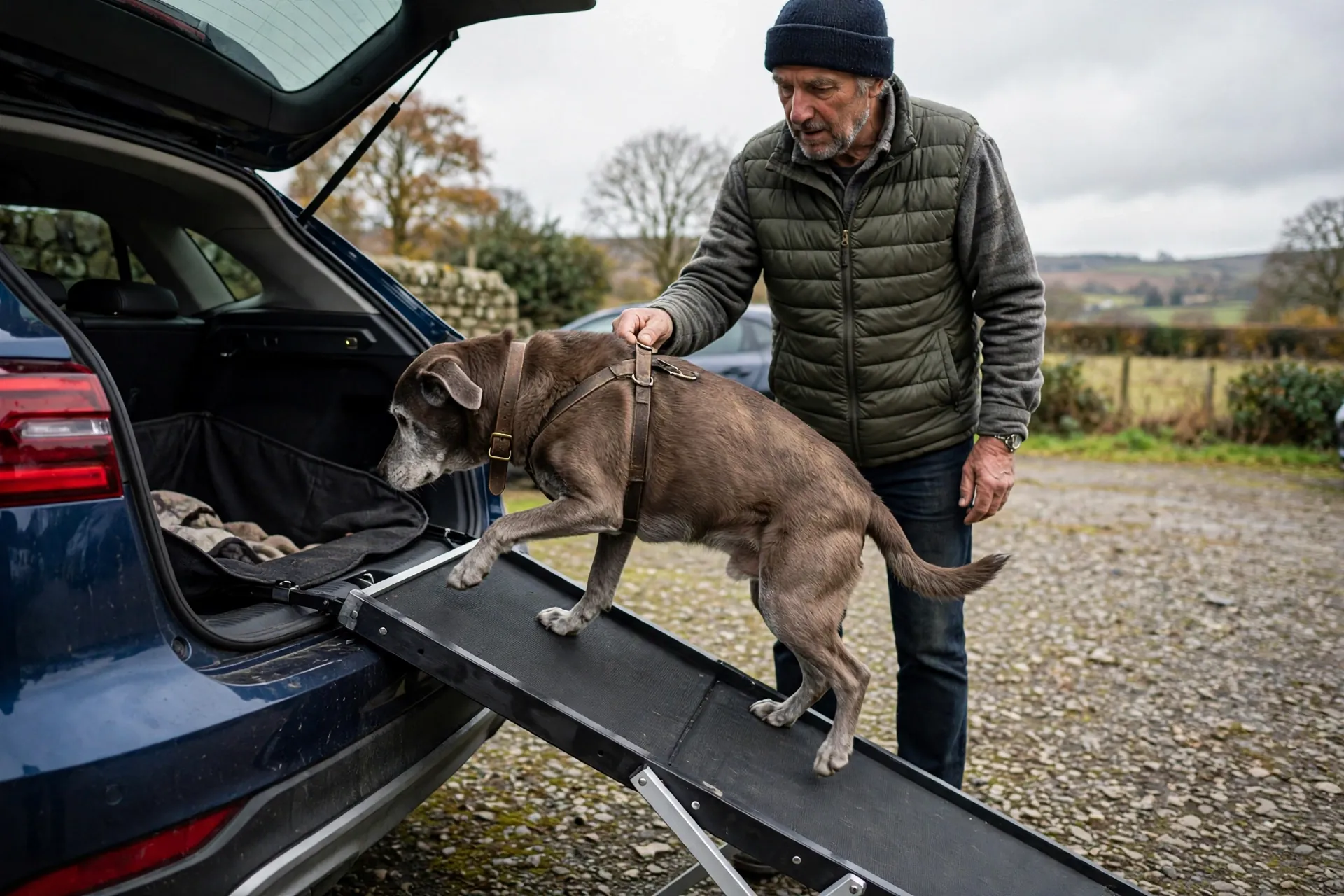
It rarely starts with a refusal. It starts with a pause. The boot opens, the older dog walks to the back of the car, looks up, shifts its weight from one back leg to the other, and waits. A year ago that same dog probably launched itself in without thinking. Now the calculation is visible: the height, the landing, the stiffness that has not quite worn off after a sleep. Some dogs solve the pause by scrambling, back legs paddling for grip on the bumper. Some solve it by simply standing there, tail low, hoping you will understand. A few turn away and wander off to sniff something unimportant, which is often embarrassment dressed up as indifference.
That pause is the whole reason for this guide. It is not a behaviour problem to be corrected with firmer encouragement, and it is not a reason to stop travelling with an older dog. It is information. The dog is telling you that the jump, which used to be free, now has a cost, and that cost is paid in joints, confidence and sometimes a bad landing that makes the next attempt harder still. A ramp does not just remove height. It changes the bargain: instead of one explosive effort and one jarring landing, the dog gets a dozen small, controlled steps. For many older dogs that is the difference between travelling happily for years and gradually refusing the car altogether.
It also helps to notice what the pause is not. A dog that hesitates at the car but still bounds up garden steps, or that jumps eagerly onto a low sofa, is probably reacting to this specific height, surface or landing, not giving up on walks. A dog that hesitates everywhere, struggles to rise after rest, or has started sleeping far more may be dealing with something broader, and that belongs in a vet conversation before any equipment purchase. Ramps are a practical answer to a physical problem, not a substitute for finding out what the problem is. If stiffness, limping or reluctance to move persists, ask your vet for advice; this guide deliberately gives no medication advice and no dosage of anything, because that decision needs the dog in front of a vet, not a webpage.
One more thing the pause teaches: timing matters. Dogs that cope fine in the middle of a walk, once they are warmed up, often struggle most with the first load of the day, straight out of the house, and with the last load home, when they are tired. If your dog only hesitates sometimes, note when. A ramp used for every single load, including the easy ones, builds a habit that is there on the stiff mornings when it matters most. Using it only on bad days teaches the dog that the ramp appears when something is already wrong, which is exactly backwards.
Why jumping gets harder with age
Jumping into a car is a demanding movement, and it is easy to underestimate because younger dogs make it look thoughtless. The dog must push off from the back legs, lift its whole body weight, tuck or extend through the air, and then land, usually on its front legs, on a surface that may be a hard boot floor or a slippery bumper strip. The landing is the expensive part. Landing forces pass through wrists, elbows, shoulders and the spine in a fraction of a second, and an older dog absorbs them with less muscle, less cartilage cushioning and joints that may already be inflamed. Repeated landings, several times a week over years, add up in a way that one jump never shows.
Getting out is often worse than getting in, and owners frequently miss this because the dog seems keen to jump down. Dogs jump down with enthusiasm and land heavily, front-first, with their head and shoulders carrying momentum. That is a particular problem for dogs with elbow or shoulder discomfort, for long-backed breeds where the spine takes the shock, and for any dog that has had surgery on a leg. A ramp used in both directions, in and out, roughly halves the daily impact load on those joints. If you only ever use the ramp for loading and let the dog leap out at the destination, you have solved the smaller half of the problem.
Age changes more than joints. Eyesight fades, so judging the distance to a boot edge in dim light gets harder. Muscle mass declines, so the push-off weakens before the dog's enthusiasm does, which produces the heartbreaking scramble where the front half arrives and the back half does not. Balance worsens, so a narrow bumper or a wet surface that a young dog corrected for without thinking becomes a genuine slip risk. Weight often creeps up as activity falls, which means the same jump now carries more load on weaker structures. None of this means the dog is finished with travelling. It means the environment needs to change to meet the dog where it now is, and a ramp is one of the cheapest and least intrusive changes available.
Breed and body shape change the detail. A heavy Labrador carries a lot of weight on its front legs when it lands. A long, low Dachshund or Basset risks its spine on every uncontrolled drop. A giant breed may simply be too heavy for an owner to lift safely as an alternative, which makes a good ramp not a luxury but the only practical option. A small terrier may cope with height but struggle with a ramp surface designed for large paws, or with a width that feels like a plank over a void. The principles in this guide are the same for all of them, but the measurements you take from your own car and your own dog are what turn a general recommendation into a ramp that actually gets used.
There is also a confidence effect that is easy to dismiss and unwise to ignore. Dogs remember bad landings. A dog that slipped off a bumper, banged a hip on a tow bar, or landed badly on a wet day may start associating the car itself with that moment. The result looks like stubbornness, but it is usually avoidance of a remembered pain. Rebuilding confidence takes longer than building it in the first place, which is another reason to introduce a ramp before the dog is already refusing, while the car is still a mostly good thing. If the dog already refuses, the training section later in this guide starts from that harder place, slowly and without pressure.
Length and angle: the maths that matters
Almost every ramp disappointment comes down to one number: the slope. Too steep, and the dog is effectively climbing a hill with sore joints, slipping backwards, or refusing at the bottom. Too long, and it will not fit in the car or the owner stops carrying it. The way to resolve that tension is to measure your car before you shop, not after the ramp arrives.
Start with the height. Park on level ground, open the boot, and measure vertically from the ground to the lip the dog must step over, or to the boot floor if that is higher. Typical family hatchbacks sit around 60 to 70 centimetres, estates and smaller SUVs around 70 to 80, and taller SUVs and four-wheel-drives can reach 85 to 95 centimetres or more. Write the number down. It is the single most useful figure in this whole guide, because every length recommendation flows from it. If you regularly load onto a back seat rather than a boot, measure to the seat edge instead, and remember that a seat is usually higher and narrower, which changes both length and width needs.
Then apply a simple ratio. For a healthy adult dog, a ramp about twice the height gives a slope of roughly 30 degrees, which most dogs manage. For a stiff, arthritic or elderly dog, aim for at least three times the height, which brings the slope down towards 20 degrees or less. So a 70-centimetre boot lip wants a ramp of about 210 centimetres for a comfortable senior slope, and an 85-centimetre SUV boot wants around 255 centimetres. Those numbers surprise people, and they are exactly why so many compact ramps fail older dogs: a 120-centimetre ramp on an 80-centimetre boot is a 34-degree slope, steeper than most household stairs. It may be sold as a dog ramp, but for a senior dog it is a steep plank with better marketing.
Telescoping and folding ramps change the trade-off. A telescoping ramp extends to a useful length and collapses much shorter for storage, which is why they suit taller cars. A bi-fold or tri-fold ramp folds into a flat panel that slides under a boot floor or behind a seat, but each fold adds weight and a hinge the dog walks over. A single-piece ramp is the most rigid and the simplest, but it needs a long car to live in. There is no universally best design, only the design that gives your dog a gentle slope and still fits in your car every single day, because a ramp left in the garage helps nobody.
Also check where the top of the ramp lands. It should rest securely on the boot floor or bumper, not balance on a narrow lip it can slide off, and it should not create a gap the dog must step across at the top. Some cars have a deep bumper or a tow bar that forces the ramp further out, which effectively increases the height and the angle; measure with the boot fully open and any load cover in its normal position. If the ramp overhangs the boot edge by a long way, the dog steps from a slope onto a drop, which defeats the purpose. A short, flat top section, or a ramp designed to sit inside the boot with its end on the floor, solves this on many cars, so look at photographs of the ramp in use rather than only its folded product shot.
Finally, think about the ground at the bottom. A ramp on a slope, a kerb, or soft grass is effectively longer or shorter than its specification, and the angle changes with it. Loading on a downhill slope towards the car helps; loading with the car nose-down on a hill makes everything steeper. Where you park is part of the ramp system, and choosing a flat bay, even if it means a slightly longer walk to the path, is a legitimate part of looking after an older dog. Check the official guidance before you travel if you are unsure about parking rules at a particular destination, because the best ramp in the world is no use in a bay you cannot legally use.
Weight limits, width and grip
Weight rating is where marketing gets slippery, so read it literally. A ramp rated to 90 kilograms sounds generous for a 30-kilogram dog, until you realise the rating may be a static load, meaning weight placed gently in the middle and left there, rather than a walking load, meaning a moving dog shifting its weight from paw to paw, sometimes pausing, sometimes hurrying. A slow older dog that stops halfway and leans is a different test from a static weight. Choose a stated limit at least 20 to 25 percent above your dog's weight as a minimum, and more if the dog is still gaining weight, if two dogs might ever use it together, or if the dog tends to bound rather than walk. If the manufacturer does not explain how the rating was measured, treat the number with caution and favour brands that state it plainly.
Rigidity matters as much as the headline number. A ramp that flexes or bows under the dog feels unstable underfoot, and older dogs notice instability immediately. They may not be able to explain it, but they will show it by freezing halfway, hugging one edge, or refusing the next time. Aluminium ramps are generally light and rigid, but can be noisy and cold underfoot. Plastic ramps are lighter and quieter but may flex at longer lengths. Wooden ramps, including some home-made options, can be excellent if properly built, but check for splinters, warping after rain, and a weight that one person can actually handle. Whichever material you choose, test it yourself first: stand on it, walk on it, and feel for bounce before the dog ever does.
Width is about confidence, not just body size. A ramp 30 centimetres wide may technically fit a dog, but a large dog walking it will feel its paws near the edges, and a nervous dog will hug the middle and walk stiffly. For medium and large dogs, look for 40 centimetres or more. For small dogs, width matters less than surface texture, because small paws need something to grip without the tread being so coarse it hurts. Side rails or raised edges help some dogs enormously by giving a visual boundary, but they also add weight and can catch a dragging paw, so they are a help for confident walkers and a possible trip hazard for dogs that drag their feet. If your dog drags its back feet, a flat, open ramp with a grippy surface is usually kinder than a railed one.
Grip is the feature you will think about most in a British winter. Look for a surface that works when wet, not just when dry in a showroom. Sandpaper-style grit grips well but can wear smooth in the middle, can be harsh on paws that are already sore, and can be slippery when coated in mud. Rubberised coatings and artificial grass coverings tend to stay grippy when damp and are kinder on paws, but they need cleaning, because mud packed into the texture removes the grip it was bought for. Grooved or ribbed plastic can work well if the grooves run across the ramp rather than along it, giving paws something to push against on the way up. Whatever the surface, the test is simple: wet it, put a paw-sized weight on it, and see. Better still, watch the dog on it in the rain during training, before you rely on it on a dark evening in a muddy car park.
The feet deserve the same attention as the walking surface. Rubber feet grip tarmac and concrete well but slide on wet grass and mud. Some ramps have adjustable or spiked feet for soft ground, which help outdoors but must not be used on a painted driveway or a campsite hardstanding where they could damage the surface. The top end matters too: a rubberised lip or a hook that catches the boot edge stops the whole ramp creeping backwards as the dog climbs. A ramp that moves under the dog is worse than no ramp at all, because it teaches the dog that the ramp itself cannot be trusted. If yours creeps, add a non-slip mat under the foot, reposition the car on flatter ground, or choose a design with a proper top anchor rather than asking the dog to be braver.
Folding, weight and fitting your car
The best ramp is the one that is actually in the car. That sounds obvious, and it is the reason so many well-reviewed ramps end up in garages. Before you fall for a long, rigid, beautifully grippy ramp, answer three practical questions: how much does it weigh, how small does it fold, and where exactly will it live in your car when the dog is also in it?
Weight matters because you will carry this ramp, unfold it, and refold it in rain, in the dark, with a lead in one hand and a dog waiting. A ramp over about 8 to 10 kilograms is a genuine burden for many owners, especially if it must be lifted into a high boot itself. Lighter ramps exist, but lightness often comes with flex, so there is a real trade-off between a ramp you can carry easily and a ramp that feels solid under a heavy dog. Telescoping aluminium ramps often strike the best balance for larger dogs, while a folding plastic ramp may be plenty for a small or medium dog and far easier to live with day to day. If you have any back or shoulder problems yourself, be honest about that too: a ramp that hurts the owner will not be used, however much the dog needs it.
Storage is the second question. Measure the space where the ramp will live, not just the boot with everything removed. A tri-fold ramp that fits under a boot floor sounds ideal until the spare wheel, the dog bed, and the walking bag are also in there. A telescoping ramp that slides along the side of the boot may work better, or a ramp that lives behind a back seat, or even on a roof box for longer trips. Check the folded dimensions against your car, including length, because a folded ramp that is 10 centimetres too long for the boot will rattle, block the load cover, or force you to leave it at home. If the ramp lives permanently in the car, also check that it does not block access to the spare wheel or the first-aid kit, and that it cannot slide forward under braking.
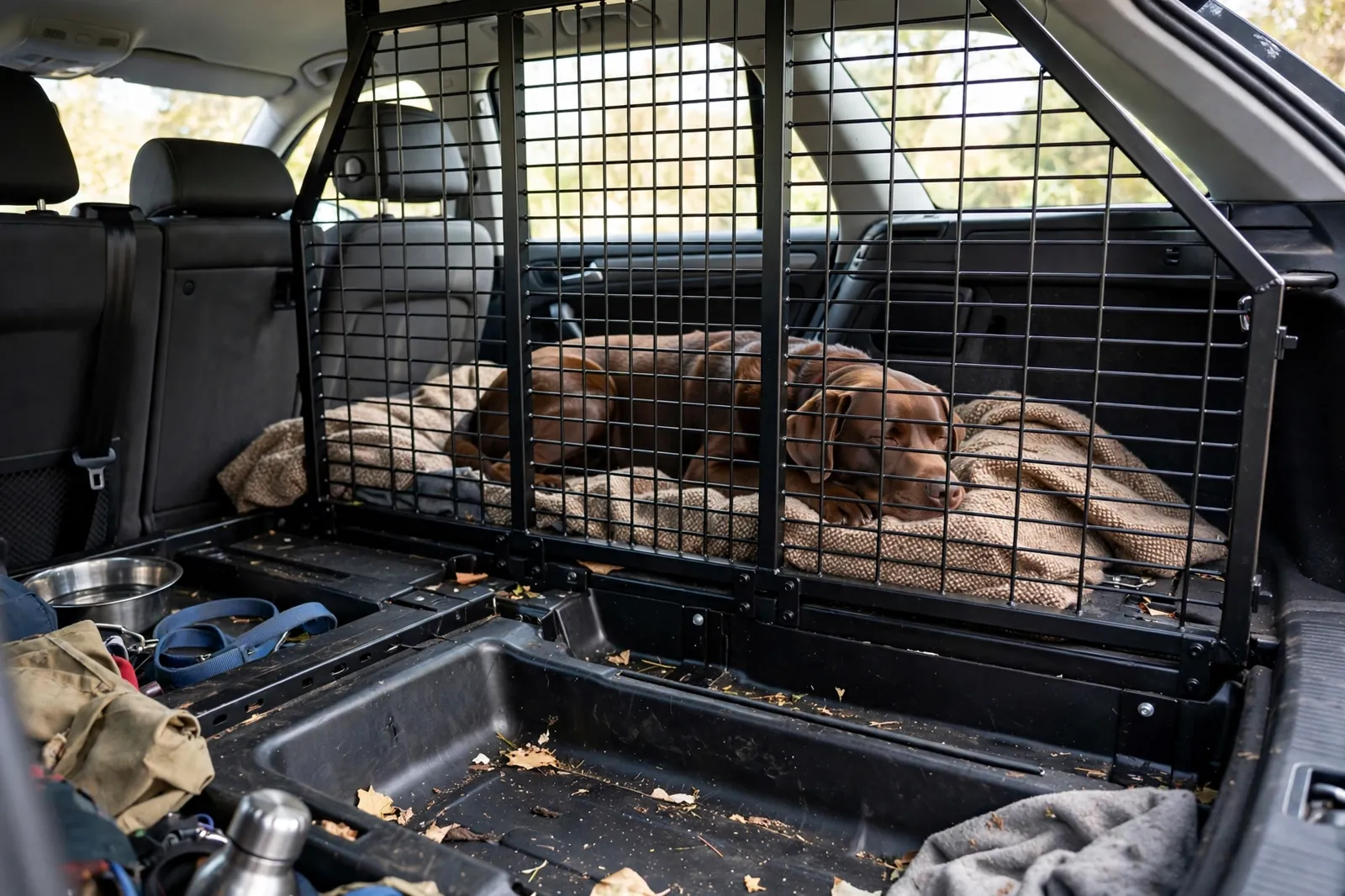
Think about the rest of the boot setup at the same time. A ramp and a dog car boot guard work well together: the guard keeps the dog safely in the boot space while the ramp gives it a calm way in and out, rather than a scramble over a guard or around it. Similarly, the surface the dog lands on matters once it is inside. A travel dog bed with a non-slip base gives an older dog a stable place to lie, so it is not sliding around on a hard boot floor on every corner, which is especially important for a dog that has just walked carefully up a ramp and deserves a settled ride. These are not extras for their own sake; they are the rest of the system that makes the ramp worthwhile.
Carrying handles, latches and locks are small details that become large annoyances. A handle in the middle of a folded ramp makes one-handed carrying possible. A latch that holds it folded stops it springing open in the boot. A locking mechanism on a telescoping ramp must be easy to operate with cold or wet hands, and must lock positively, because a ramp that collapses under a dog is a frightening event that can undo weeks of training. Test all of these in the shop or on arrival, before training starts. If a latch is fiddly, if a lock feels vague, or if the ramp pinches fingers when folding, that is information, not a minor quibble, and it is better to exchange the ramp now than to fight it for a year.
Finally, consider whether one ramp can serve more than one car. Many households have a tall SUV and a lower hatchback, or a car and a campervan. A telescoping ramp that adjusts to both is often better value than two fixed ramps, provided the shortest setting is still gentle enough for the lower car and the longest setting is stable for the taller one. If the heights differ wildly, two ramps, or a ramp plus a low step for the smaller car, may be more honest. The question is always the same: for each car, does this ramp give this dog a gentle, stable, grippy walk? If the answer is no for one of them, that car needs its own solution.
Matching the ramp to joints and health
Not all stiffness is the same, and the ramp that suits one older dog may be wrong for another. Arthritis is the most common reason owners start looking at ramps, and it rewards exactly the qualities this guide keeps returning to: a gentle slope, a grippy surface, and a slow, steady walk with no rushing. Arthritic dogs often do best with the longest ramp the car allows, because every degree of slope removed is less load on inflamed joints. They also benefit from a warm-up: a short, gentle walk before loading, rather than lifting a stiff dog straight from the house into the car, makes the ramp walk noticeably easier. In cold weather, a few minutes indoors, moving around the house, helps more than any ramp feature.
Dogs recovering from surgery need a different conversation, and it should start with the vet or physiotherapist managing the recovery, not with a shopping list. Some operations require strict rest and no ramp use at all for a period, because even a gentle slope loads the healing structure. Others benefit from a ramp immediately, provided the dog is guided slowly and never allowed to jump. The key point is that a ramp is a tool within a recovery plan, not a replacement for one. If your dog has had cruciate surgery, hip surgery, spinal surgery, or any procedure affecting mobility, ask the treating vet when ramp use should start, how steep is acceptable, and whether a harness with a handle, used alongside the ramp, would help or hinder. If ongoing symptoms such as limping, swelling, pain on touch, or reluctance to bear weight appear, ask your vet for advice promptly rather than pushing through with training.
Neurological conditions, wobbliness and general weakness change the calculation further. A dog that drags its feet, knuckles over, or loses balance on turns may trip on a raised edge, a hinge, or a coarse surface, even on a gentle slope. For these dogs, a wide, flat ramp with a smooth but grippy surface, no side rails, and a helper walking alongside with a hand lightly on a harness handle is often the safest combination. The pace should be the dog's pace, with pauses allowed. If the dog cannot walk the ramp steadily even with help, that is not a training failure; it is information that the ramp alone is not enough, and the section on alternatives later in this guide becomes the relevant one.
Weight management belongs in any honest discussion of senior mobility, because every extra kilogram is extra load on every ramp walk. This guide does not prescribe diets, but it is worth noting that a ramp works best as part of a broader picture that includes appropriate weight, regular gentle exercise, and veterinary advice about joint care. A dog that is significantly overweight will find any ramp harder, and will also be harder to lift safely if lifting becomes necessary. If weight is part of the picture, a vet can advise on a safe plan; the ramp simply makes the car part of the day easier while that longer work happens.
Vision and hearing loss deserve a mention because they affect training more than equipment. A dog that cannot see the ramp clearly may hesitate at the bottom, not from pain but from uncertainty. Contrasting the ramp edge, training in good light first, and using a consistent verbal cue and a familiar scent, such as a cloth from the dog's bed laid at the top, can help. A deaf dog needs visual cues and a gentle touch signal instead of voice encouragement. None of this requires special equipment, but it does require patience and an understanding that hesitation is not disobedience. Older dogs are often trying very hard to cooperate; they just need clearer information about what is being asked.
A shortlist check before you buy
Shopping for ramps is noisy, with dozens of similar-looking products and reviews written about puppies, not seniors. A short checklist, applied to two or three finalists, cuts through it faster than reading a hundred reviews. Work through it with your boot measurement in hand, and be prepared to reject a popular ramp that fails your specific numbers.
- Length against your car: Is it at least three times your boot height? If not, can you accept a steeper slope, and is your dog genuinely comfortable on one? Do not buy on folded size alone.
- Weight rating with headroom: Is the stated limit at least 20 to 25 percent above your dog's weight, and is it a walking load? If the basis is unclear, ask the seller or choose another model.
- Width for your dog: Is it wide enough for the dog to walk naturally without hugging the edges? For medium and large dogs, 40 centimetres is a sensible starting point.
- Grip when wet: Does the surface grip in rain and mud, and can it be cleaned without losing texture? Smooth plastic with a few grooves is not enough for a senior dog in winter.
- Stability: Does it flex, bow or creep when you walk on it? Does the top anchor securely to your boot? A moving ramp will undo training.
- Carry and store: Can you lift it, fold it and stow it one-handed in the rain, and does it fit the space it will actually live in?
- Locks and latches: Do telescoping sections lock positively? Does a folding ramp stay folded? Can you operate them with cold, wet hands?
- Cleaning: Can mud, hair and grit be washed off easily, and does the surface stay grippy afterwards? A ramp that cannot be cleaned will not stay safe.
- Returns: Can you return it if your dog refuses it after a fair training attempt? A ramp is only a good purchase if the dog uses it, and a generous returns window is worth real money here.
Price is a poor guide on its own. Very cheap ramps often fail on rigidity or grip, and very expensive ramps sometimes charge for features, such as extreme portability, that a senior dog does not need. A mid-priced ramp that meets your length, weight and grip numbers is a better purchase than a premium ramp that is too short or a bargain ramp that flexes. Budget roughly for the ramp plus a non-slip mat for the foot and a towel for drying paws, because those small additions protect the investment. If you need two ramps for two cars, buying the right one twice is still cheaper than vet bills from a bad landing, though nobody should have to learn that the expensive way.
Second-hand ramps deserve a careful look. A used ramp can be excellent value, but check the hinges, the locks, the surface wear in the middle where paws land, and any cracks or warping, especially in plastic. A ramp that has lived outdoors may have a degraded surface that looks fine dry and fails wet. If you cannot test it with your dog before buying, factor in the risk. Similarly, home-made ramps can be superb if built from proper materials with a grippy surface and solid feet, but a plank with carpet stapled to it is not automatically safe: carpet holds water, rots, and can hide a slippery board underneath. Whatever you buy or build, the test is the same: gentle, stable, grippy, and used by the dog.
Training, step by step
Training an older dog to use a ramp is less about teaching a new trick and more about building a new habit without pressure. Older dogs learn well, often better than puppies, because they are less distracted and more motivated by food and praise. What they need is more repetitions, smaller steps, and a complete absence of rushing. The plan below assumes a dog that is physically able to walk a gentle slope; if the vet has advised rest, wait, however tempting it is to start early.
Stage one: the ramp on the ground. Lay the ramp flat on the ground in a familiar place, such as the garden or hallway, and let the dog investigate it without any request. Scatter treats on and around it. Let the dog walk over it, around it, sniff it, and step off it. Do this for a few minutes, once or twice a day, for two or three days. The goal is not obedience; it is boredom. A ramp that is just another object in the house stops being scary. If the dog avoids it entirely, lay a familiar blanket over part of it, or place treats in a trail leading across it, and never lure the dog onto it by holding it in place. Choice matters: a dog that chooses to step on the ramp is learning confidence, while a dog that is placed on it is learning that the ramp is something done to it.
Stage two: a tiny slope. Raise one end of the ramp by a small amount, perhaps on a low step, a sturdy book, or a kerb, so the slope is barely noticeable. Walk the dog up and down on a loose lead, rewarding every step, and letting the dog pause whenever it wants. Keep sessions to five minutes. End on a success, even if that success is just two steps, and always end with something pleasant, such as a treat or a short game. Repeat for several days, raising the height gradually. If the dog freezes, do not pull, push, or carry it up; lower the ramp, reward calm behaviour at the bottom, and try again tomorrow. A single frightening session can cost a week of progress, while a boring session costs nothing.
Stage three: the car, engine off, ramp at full height. Only now bring the car into it. Park on flat ground, open the boot, set the ramp at its real angle, and let the dog approach it. Reward investigation. Then guide the dog up, one step at a time, with a helper at the top if possible, offering treats and calm praise. Walk the dog down again immediately, because the way down is often scarier than the way up. Repeat the up-and-down a few times, then stop. Do not drive anywhere yet. The car at this stage is just a large, familiar object with a ramp attached, and the dog should leave the session thinking that nothing bad happened and treats were involved.
Stage four: real journeys, short first. Start with a very short drive to somewhere pleasant, such as a favourite short walk, so the ramp leads to a good outcome. Load with the ramp, drive a few minutes, unload with the ramp, and enjoy the walk. Build the distance gradually. For the first weeks, use the ramp every time, even when the dog seems keen to jump, because consistency builds the habit that will carry the stiff mornings. If the dog regresses, for example after a vet visit, a bad-weather load, or a period without travelling, drop back a stage without fuss. Regression is normal in older dogs, especially after illness or a break, and it is not a sign that training has failed.
A few practical details make training smoother. Train when the dog is warmed up, not straight after a long sleep. Use high-value treats the dog does not get at other times, so the ramp has its own reward currency. Keep the lead loose; a tight lead pulls the dog off balance on a slope. Walk beside the ramp, not behind the dog, so you can steady it with a hand on a harness handle if needed, without pushing. And never train when you are in a hurry. Dogs read urgency in their owners, and a rushed owner on a ramp teaches the dog that the ramp is associated with stress. If you are late, lift the dog that once, or skip the trip, and train properly tomorrow.
For dogs that already refuse the car, go slower still. Start with treats near the car, then treats with the boot open, then treats on a flat ramp beside the car, and only combine the two when each part is comfortable alone. This can take weeks, and that is fine. An older dog that has learned to fear the car deserves that patience, and the reward is a dog that travels willingly again rather than a dog that is wrestled into the boot. If refusal is sudden, severe, or accompanied by pain, hiding, or changes in eating or toileting, ask your vet for advice before training further, because a new pain problem should not be trained through.
When a ramp is not the answer
A ramp is a good tool, but it is not the only tool, and honesty about its limits is part of looking after an older dog. There are situations where persisting with a ramp is unkind, unsafe, or simply impractical, and recognising them early saves the dog stress and the owner money.
The clearest case is a dog that cannot walk steadily even on the gentlest slope. If the dog wobbles, stumbles, drags its feet badly, or needs constant physical support to stay on the ramp, the ramp is asking it to do something its body can no longer do reliably. A supported lift, where the owner lifts with a harness handle and the dog's weight is shared, may be kinder for a small or medium dog. For a large or heavy dog, a mechanical hoist, a vehicle with a lower entry, or a purpose-built lift platform may be the realistic answer. These options cost more and take more planning, but they are not extravagances; they are the next step when a ramp has done all it can.
Height is the other hard limit. Some vehicles are simply too tall for any portable ramp to give a senior-friendly slope. A tall four-wheel-drive with a boot lip near a metre high would need a ramp three metres long for a gentle slope, which is longer than most cars can carry and unwieldy to handle. In that situation, the sensible answers are a lower vehicle for dog trips, a side entry rather than a rear entry if that is lower, or a step platform that breaks the height into two smaller stages. A two-stage solution, ramp plus a sturdy low step, can work well if the dog can manage each stage and the step itself is stable and non-slip. What does not work is pretending a steep ramp is fine because it was expensive.
There is also the owner to consider. Lifting a 35-kilogram dog into a high boot is a back injury waiting to happen for many people, and a ramp that the owner cannot carry or set up is not a solution either. If both ramp and lifting are impractical, changing the vehicle, or at least which vehicle is used for dog trips, may be the honest answer. That is a bigger decision, but it is better made deliberately than discovered on a rainy night with a distressed dog and a ramp that will not fit. Families sometimes solve this by keeping the dog's car as the lower, easier vehicle, even if it is not the newest or most comfortable one for humans.
Finally, remember that a ramp does not fix the journey itself. An older dog that travels badly because of nausea, anxiety, or pain that has nothing to do with loading will still travel badly with a perfect ramp. If the dog pants, drools, vomits, or trembles in the car, or arrives stiff and distressed after even a short drive, talk to the vet about the journey, not just the loading. The ramp solves the getting-in-and-out problem, which is a large and worthwhile problem, but it is one part of senior travel, alongside a comfortable resting place, sensible journey lengths, regular breaks, and a vet's view on any ongoing symptoms.
Rain, mud and looking after the ramp
British weather is the ramp's toughest test, and most ramp failures happen in conditions that were never tried in training. Wet paws on a wet surface, mud packed into grip texture, a foot sinking into soft ground, and a cold, stiff dog at the end of a walk all combine to make winter loading harder than summer loading. Planning for that is part of buying well, not an afterthought.
Start with cleaning. After muddy walks, brush or hose the ramp surface and let it dry before folding it away, because grit trapped in the folds wears hinges and texture alike. Check the grip regularly by running a hand over the middle section where paws land most; if it feels smooth, the surface is worn and needs replacing or recoating, depending on the design. Inspect hinges, locks and feet at the same time, looking for cracks, rust, loose screws, or rubber feet that have hardened and lost their grip. A five-minute check once a month prevents the slow decline that owners only notice when the dog suddenly refuses.
On the day, a few habits help enormously. Wipe the dog's paws before loading, not just for the car's sake but because muddy paws grip less and slip more. Set the ramp foot on the firmest ground available, even if that means moving the car a few metres to a surfaced bay. In snow or ice, clear the ramp surface and the ground beneath it, and consider a towel or mat under the foot for extra grip. Keep a small towel in the car for drying the ramp itself, because a ramp that has sat folded and wet in the boot all day will be slippery when you need it for the journey home. These are small, unglamorous habits, and they are exactly what keeps an older dog confident through a wet winter.
Storage through winter matters too. A ramp left folded and damp in a cold boot can develop mould on fabric coverings, rust on metal hinges, and a musty smell that puts a sensitive dog off. Dry it before storing, and if it lives in the car permanently, air it occasionally. If the ramp has a fabric or artificial-grass covering, check the manufacturer's cleaning advice, because harsh detergents can strip grip coatings. And if you use the ramp at the seaside, rinse off salt water afterwards, because salt corrodes metal fittings and dries out rubber feet faster than rain alone. A ramp is a piece of safety equipment, and it deserves the same occasional attention as a harness or a crate.
Mistakes that put older dogs off
Most ramp failures are not product failures. They are timing, training or setup mistakes that are easy to make and, fortunately, easy to correct once spotted. The most common is buying too short. It is understandable: short ramps are cheaper, lighter and easier to store, and they look tidier. But a short ramp on a tall car is a steep slope, and a senior dog that tries it once, slips, and refuses it afterwards has not been difficult; it has been given a bad first experience. If you have already bought too short, do not force the issue. Either exchange it for a longer model or use it only on the lowest car you own, and buy properly for the tall one.
The second mistake is rushing training, usually because a trip is booked and the ramp arrived the day before. Training compressed into one afternoon, with the dog pushed up a full-height ramp while the owner worries about departure time, teaches the dog that the ramp is stressful. It is far better to delay the ramp's first real use, lift the dog for that one trip if you safely can, and train properly over the following week. Older dogs forgive slow training; they remember rushed training.
The third mistake is inconsistent use. Using the ramp on good days and letting the dog jump on other days, or using it for loading but not unloading, sends a mixed message and, more importantly, still exposes the joints to the impacts you bought the ramp to avoid. Consistency is kinder than occasional perfection. Use it every time, in both directions, even when it feels unnecessary, so that it becomes simply how the dog gets in the car, not a special event.
The fourth mistake is ignoring the surface and the feet. A ramp that was grippy in summer can be treacherous in autumn mud, and a foot that gripped tarmac can slide on wet grass. Owners sometimes blame the dog for a refusal that is really a maintenance problem. If a previously confident dog suddenly refuses, check the ramp before blaming the dog: is it clean, is it dry, are the feet intact, has the surface worn smooth, is it set on different ground from usual? Dogs are usually right about these things before we are.
The last mistake is treating the ramp as a verdict rather than a tool. Buying a ramp does not mean the dog is old and finished, and refusing a ramp does not mean the dog is stubborn. It means something about this ramp, this car, this slope, or this day is not working, and a small adjustment, a longer ramp, a different surface, a slower training stage, or a vet conversation, will usually find the answer. Older dogs have earned that kind of careful attention. They have given years of easy, thoughtless jumping; the least we can do is give them a thoughtful way back into the car.
If you take one idea from this guide, let it be the pause at the tailgate. Notice it early, measure your car, buy length and grip before compactness, and train without hurry. Done that way, a ramp does not just protect joints. It protects the whole habit of travelling together, which, for an older dog and its owner, is worth far more than the price of any ramp. And if you are planning longer trips with a senior dog, check the official guidance before you travel for any destination-specific rules, and keep the vet's number with your travel documents, because the best ramp routine is one that is backed by good advice when it is needed.
Practical questions
Before you buy
How long should a ramp be for an older dog?
Long enough to keep the slope gentle for your own car. Measure the height from the ground to the boot or seat, then choose a ramp at least three times that height for a stiff or arthritic dog, and longer still for a high SUV boot. A short, steep ramp saves boot space but asks sore joints to do the work the ramp was bought to remove.
Can a ramp help a dog with arthritis?
Yes, if the slope is gentle, the surface grips well, and the dog is trained to walk rather than rush. A ramp removes the jump up and the landing impact, which are the two moments that most often trouble arthritic joints. If limping, stiffness or reluctance persists, or gets worse, ask your vet for advice before continuing, and check the official guidance before you travel if you are unsure about a longer journey.
What weight limit should I look for?
Choose a ramp rated for comfortably more than your dog weighs, not exactly your dog's weight. A good rule is a stated limit at least 20 to 25 percent above the dog's weight, so the ramp stays rigid and steady under a slow, shifting older dog. Check whether the limit is a static or walking load, and re-check it if a second dog will ever use the ramp at the same time.
How do I train a senior dog to use a ramp?
Start flat on the ground, reward every step, and raise the angle over several short sessions rather than in one afternoon. Keep sessions to five minutes, end on a success, and only move to the car once the dog walks the ramp confidently on a gentle slope. Older dogs learn well; they simply need more repetitions and fewer surprises than a puppy.
When should I stop using a ramp and lift my dog instead?
When the dog cannot walk the ramp steadily even on the gentlest setting, when pain, wobbling or breathlessness appears, or when the car is so high that no portable ramp gives a safe angle. In those cases a supported lift, a hoist or a lower vehicle entry is kinder than persisting with a ramp. If symptoms are ongoing, ask your vet for advice about the safest option for that dog.
Do folding ramps slip on wet ground?
They can, which is why the feet and the ground matter as much as the walking surface. Use rubber feet on hard ground, set the foot on firm, level ground rather than mud or loose gravel, and keep the surface clean and dry between trips. If the ramp still shifts, shorten the journey to a flatter parking spot or add a non-slip mat under the foot before asking the dog to use it.