This guide is independent and contains no paid placement. If affiliate links are added later, they will be clearly marked and will not change our editorial checks.
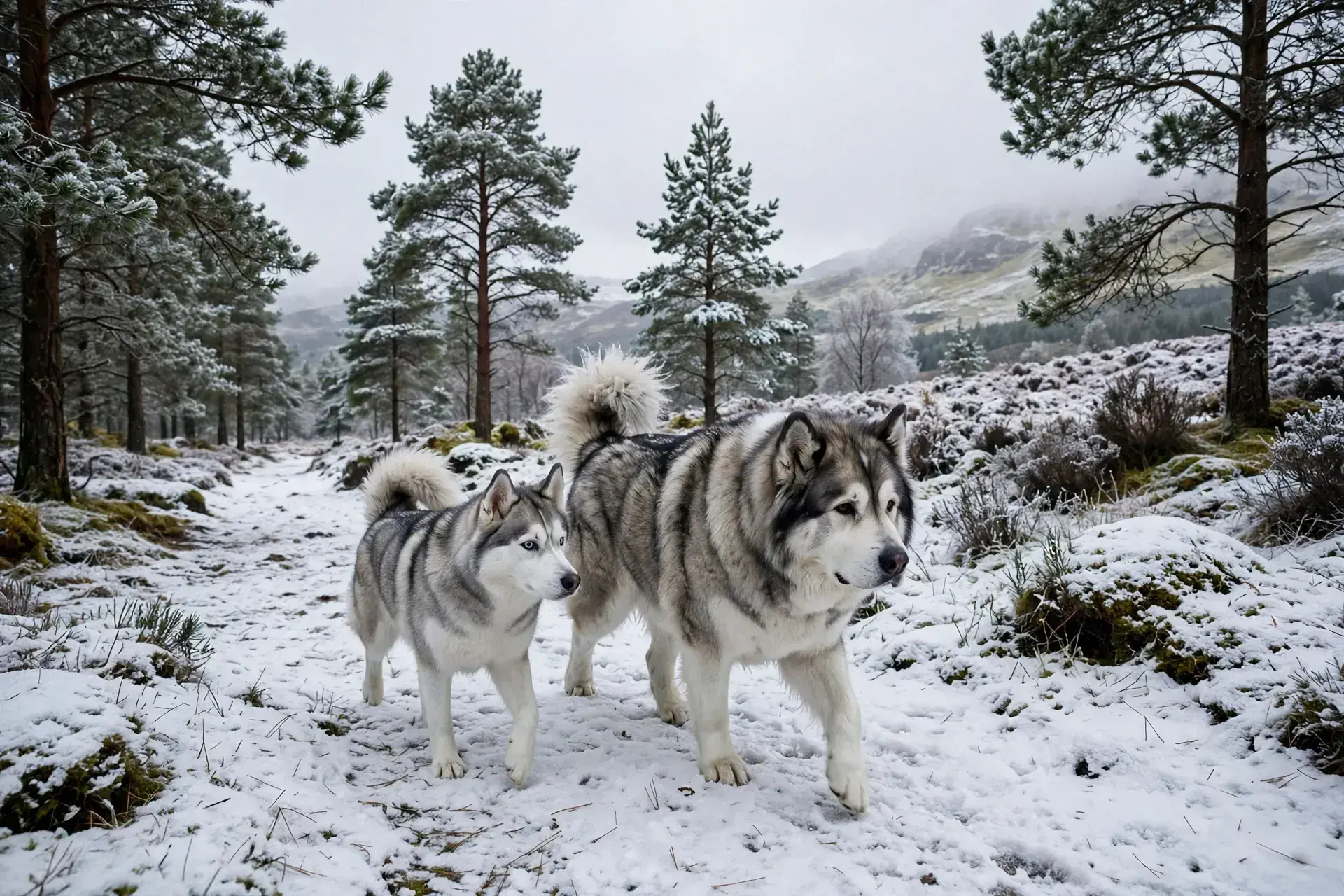
The Malamute is bigger, heavier, stronger and harder to house, groom and transport. The Husky is smaller and livelier but far more prone to roaming and escaping. Both need secure fencing, a long line, serious exercise and careful heat management. Choose the Malamute only if you genuinely want a giant; choose the Husky only if you can contain an athlete.
At a glance: the comparison
Visitors often treat Huskies and Malamutes as interchangeable fluffy dogs, but the breeds were developed for different jobs and it shows on holiday. Siberian Huskies were bred as light, fast sled dogs for long distances, built for endurance at speed with a relatively light frame. Alaskan Malamutes were bred as heavy freight dogs, built to haul substantial loads slowly over shorter distances with great power. One is a marathon runner, the other a weightlifter, and their holiday needs follow from that difference. The table below summarises the contrast, and the sections that follow explain what each line means in practice for a British break.
- Size: Husky 16 to 27 kilograms, 51 to 60 centimetres at the shoulder; Malamute 34 to 45 kilograms or more, 58 to 64 centimetres and considerably broader.
- Energy: Husky high and restless, needs running and mental work daily; Malamute high but steadier, needs pulling-style work and long walks.
- Recall: both unreliable in open countryside; Husky more likely to roam far and fast; Malamute more likely to pull hard and chase.
- Coat: Husky medium double coat, heavy seasonal shedding; Malamute thick, coarse double coat, heavier shedding and longer grooming.
- Heat tolerance: both poor in summer; Malamute worse because of coat density and body mass.
- Temperament: Husky social, vocal, mischievous and independent; Malamute loyal, dignified, strong-willed and more demanding of respect.
- Best holiday fit: Husky for active owners with secure fields and canicross-style exercise; Malamute for owners with space, strength and a calm, structured routine.
Keep this summary in mind as you read on, because many holiday problems with northern breeds come from choosing on looks alone. A Malamute puppy looks like a large Husky puppy, and a Husky adult looks manageable in a photograph, but the adult reality of each breed is a substantial commitment. If you are still deciding which breed to bring home, this comparison is more useful before purchase than after, but for owners who already have one of these dogs, the sections below focus on making the holiday you have work well.
Size and strength
Size is the clearest difference and the one with the most practical consequences. A typical adult Husky weighs between 16 and 27 kilograms, roughly the size of a large spaniel or a small Labrador, and stands 51 to 60 centimetres at the shoulder. A typical adult Malamute weighs 34 to 45 kilograms, with some males exceeding that, and stands 58 to 64 centimetres while carrying far more muscle and bone. That gap of 15 to 20 kilograms changes everything: the car, the crate, the harness rating, the accommodation weight limit, the force on the lead and the ease of lifting the dog into a bath or a vehicle.
Strength follows size. A Malamute pulling on a lead can move an adult handler, and a Malamute that decides to chase something is a serious handling challenge. A Husky pulls too, famously, but the force is lower and the dog is easier to redirect. Both breeds benefit from a well-fitted harness, lead training and, for running, a proper canicross belt and bungee line that protects both dog and handler. Neither breed should be walked on a retractable lead near roads or livestock, since the stopping power of a retractable lead is inadequate for a dog of this strength and drive.
For travel planning, measure your own dog rather than relying on breed averages, since individuals vary. Record shoulder height, lying length and weight, and use those figures for crate, boot and accommodation decisions. Our guide to travelling with a large dog in the UK applies directly to Malamutes and partly to larger Huskies, covering weight caps, boot sizing and ramp choices that matter for both breeds.
Energy and exercise
Both breeds need far more exercise than a typical pet dog, but they need it in different forms. Huskies need to run. A Husky that gets only a lead walk around the block will invent its own entertainment, usually involving digging, howling, escaping or dismantling something. On holiday, the best outlets are secure enclosed fields where the dog can sprint, canicross or bikejoring on suitable trails where permitted, and long, varied walks with sniffing and exploration. A tired Husky is a joy; an under-exercised Husky is a holiday in itself, and not a pleasant one.
Malamutes need to work. They enjoy pulling, hiking with a weighted pack where appropriate and approved by a vet, and long steady walks rather than frantic sprinting. A Malamute that pulls a tyre or a cart in a controlled setting is using its body as it was designed to, and settles far better afterwards than one that has only pottered around a garden. Both breeds need mental work too: scent games, puzzle feeders, training sessions and novel routes tire a northern breed's mind in ways that distance alone does not. On a British holiday, the practical solution is to plan one substantial outing a day plus a second shorter walk, and to fill the middle of the day with rest, shade and calm settling rather than continuous activity.
Age and health adjust the picture. Puppies of both breeds need limited forced exercise while growing, and older dogs may develop arthritis that shortens their range. Build distance gradually over the holiday rather than starting with the longest walk on day one, and watch for lagging, lying down or stiffness after rest. If the dog is struggling, cut the outing short: a northern breed will often push through tiredness out of enthusiasm, and the owner has to be the one who stops.
Recall, prey drive and roaming
Recall is where northern breed holidays most often go wrong, and the honest position is that neither breed can be trusted off the lead in open countryside. Huskies are legendary roamers: a Husky that catches an interesting scent or sees a distant animal may run for miles, cross roads and ignore recall completely, and many Husky owners never achieve reliable off-lead recall outside enclosed areas. Malamutes share the prey drive and the independence, and while some individuals recall better, the risk is the same in kind: a large, fast dog chasing sheep, deer or a small animal is dangerous for the animal, the dog and the owner legally.
The safe default for both breeds is a long line on open ground and off-lead time only in secure enclosed fields, gardens with high, dig-proof fencing, or designated dog parks with reliable boundaries. Check fences before relying on them: Huskies dig under and climb over fences that contain other breeds, and Malamutes can lean on weak gates with great force. Walk the boundary on arrival, look for gaps at the side return, and test the gate latch yourself. Around livestock, keep the dog on a lead without exception, whatever its training, because the law and the welfare consequences are both serious.
Escaping is a Husky speciality that deserves its own warning. Huskies dig, climb, squeeze through gaps and learn to open latches, and a holiday cottage garden that looks secure may not be Husky-secure. Ask the host about fence height and condition, and supervise garden time for the first days rather than assuming containment. For both breeds, a GPS tracker on the harness is a sensible holiday extra, but it is a recovery tool, not a substitute for a lead: it tells you where the dog went, not how to get it back safely.
Coats, shedding and grooming
Both breeds carry a dense double coat, but the Malamute's is thicker, coarser and longer, and it sheds accordingly. Twice a year, usually spring and autumn, both breeds blow their undercoat in spectacular quantities, and a holiday that coincides with a coat blow will fill a car, a cottage and several lint rollers with hair. Daily brushing with a slicker brush and an undercoat rake is the routine, and it should start before the trip so the dog is used to it. Never clip a double coat short: clipping damages the coat's structure, insulation and regrowth, and leaves the dog more vulnerable to heat and sun, so discuss any grooming decisions with a groomer rather than improvising.
On holiday, the grooming kit matters more than it does for short-coated breeds. Pack a slicker brush, an undercoat rake, a rubber grooming mitt, washable throws for furniture and car seats, and a handheld brush for seats. After wet walks, dry the coat thoroughly, because a damp double coat mats and smells, and check for mats behind the ears, in the armpits and around the tail. Malamutes take longer to dry and groom than Huskies, so budget that time honestly: a Malamute that is brushed properly every day is a pleasure, while one left for a week becomes a matted problem that a holiday groomer may not be able to fix.
Bathing is rarely needed on a short holiday unless the dog has rolled in something unpleasant, and over-bathing strips the coat's natural oils. If a bath is necessary, use a dog-specific shampoo, rinse thoroughly and dry completely, ideally with a high-velocity dryer introduced at home first. Check paws, ears and skin daily during the trip, since grass seeds, ticks and hot spots hide easily under a thick coat.
Heat, cold and British weather
Northern breeds are built for cold, and British summers are their hardest season. Both breeds overheat more readily than lean, short-coated dogs, and the Malamute's heavier coat and larger body make it the more vulnerable of the two. On warm days, walk early in the morning and late in the evening, choose shaded woodland or water routes, carry plenty of water and rest in the middle of the day. Warning signs of heat stress include heavy panting that does not settle, excessive drooling, a bright red tongue, wobbliness and reluctance to move. If you see them, stop, move to shade, cool gradually with wet towels on the belly and groin, and seek veterinary advice; never plunge an overheated dog into ice-cold water.
Cold and wet weather, by contrast, suits both breeds well, and a frosty Scottish morning is where they look happiest. Even so, wet coats need drying, and a dog that has been out in rain and then lies in a draughty room will chill. Give both breeds a warm, dry bed away from external doors, and dry them after wet walks. Snow is a delight for both, but check paws for ice balls between the toes and for salt or grit on treated paths, and wipe paws after winter walks. If you are unsure about any seasonal hazard, check the official guidance before you travel.
Seasonal planning helps a lot: a northern breed holiday in late spring or early autumn, when temperatures are moderate and beaches and paths are quieter, is usually far more enjoyable than a peak-summer trip. If summer is the only option, choose a cooler destination, such as the Scottish Highlands or a shaded forest area, and plan the day around the heat rather than fighting it.
Temperament on the road
Temperament is the second great difference. Huskies are social, talkative, mischievous and famously independent. They howl, they sing, they argue back when asked to do something they dislike, and they charm strangers effortlessly. That sociability makes them fun travelling companions, but their independence means they do what interests them, not necessarily what you ask, and their vocal nature can disturb neighbours in a hotel or cottage. A Husky left alone in a strange room may howl for hours, so plan for the dog to be with you or in a familiar crate routine, and warn hosts honestly about vocal tendencies.
Malamutes are loyal, dignified and strong-willed, with a deep attachment to their people and a lower tolerance for being treated as a novelty. They are typically quieter than Huskies but more demanding in their own way: a Malamute that has decided something is not open to negotiation, and handling a Malamute requires calm confidence rather than confrontation. Both breeds are generally good with people, but Malamutes can be less tolerant of other dogs, particularly of the same sex, so greetings should be controlled and brief, and dog parks should be approached with caution rather than assumed to be safe.
Children, strangers and other animals all need the same approach for both breeds: controlled introductions, supervision and respect for the dog's space. A northern breed that is tired, well exercised and settled on a mat is a wonderful pub companion; the same dog, under-exercised and over-excited, is a handful. The temperament difference is therefore less about friendliness, where both breeds score well, and more about manageability, where the Husky's mischief is easier to contain than the Malamute's determination.
Cars and crates compared
Car travel separates the breeds sharply. A Husky fits in most large boots or on a back seat with a harness, and a medium-large crate is usually manageable. A Malamute needs a giant crate or the entire boot of a large estate or SUV, and even then the fit must be measured, not assumed. Both breeds need a restraint rated for their weight under the Highway Code, and our guide to dog car harness vs crate choices explains the options. For Malamutes, the crate route is often only possible in the largest vehicles, so the harness becomes the practical choice for many owners, provided it is crash-tested and correctly fitted.
Loading matters for both: a ramp helps a Malamute and an older Husky, and practising ramp use at home avoids a struggle at a service area. Inside the car, ventilation is critical for thick-coated dogs, so test the air conditioning before a summer journey and plan stops every two hours with water and shade. Never leave either breed in a parked car in warm weather. For ferries, check kennel dimensions against your dog's measurements, since a Malamute may not fit a standard onboard kennel, and confirm vehicle-stay rules in advance.
Train travel also favours the Husky on space grounds. Both breeds travel on most trains on a lead, but a Malamute needs substantially more floor space, so off-peak travel, quieter carriages and a mat for the dog to lie on matter more. A calm, settled dog of either breed is welcomed by fellow passengers; a restless, vocal Husky in a crowded carriage is less so, so exercise before the journey and settle the dog before boarding.
Stays, fences and neighbours
Accommodation for northern breeds starts with fencing and honesty. State the breed and weight at booking, and ask about fence height, condition, gaps and gate latches, because a Husky will test every weakness and a Malamute will lean on every gate. Ground-floor rooms with direct garden access suit both breeds better than upper floors with stairs, and hard floors suit shedding coats better than carpet. Ask about extra cleaning charges for heavy shedders, and bring washable throws for furniture the dog may use.
Neighbours are the hidden risk. Huskies howl, and a howling Husky in a terraced cottage or a hotel can generate complaints quickly. Malamutes are quieter but their size and strength worry some neighbours. In both cases, the solution is the same: exercise properly, settle the dog on a familiar bed, avoid leaving the dog alone in a strange place for long, and tell the host honestly about vocal or boisterous tendencies. Hosts who know what to expect are far more accommodating than hosts who are surprised. If the dog cannot be left alone, plan dining around dog-friendly venues, as our guide to dog friendly cafes in the UK can help with, or use takeaway options.
Cancellation and flexibility matter too, since a northern breed's exercise needs make weather a bigger factor than for other dogs. A booking that allows a date change is worth a premium, and a destination with a secure field nearby is worth more than a prettier property without one. Keep the host's details if the stay works well: good northern-breed hosts are worth returning to.
Health and lifespan
Health profiles differ in emphasis. Huskies are generally hardy, living 12 to 14 years, but are prone to eye conditions such as cataracts and progressive retinal atrophy, hip dysplasia and zinc-responsive skin problems. Malamutes live typically 10 to 12 years and face hip and elbow dysplasia, polyneuropathy, a hereditary nerve condition, and hypothyroidism, as well as a higher risk of bloat because of their deep chest and size. Both breeds need vet checks before a major holiday, up-to-date vaccinations, parasite prevention and a plan for finding a vet at the destination.
Weight control is important for both, but especially for Malamutes, where extra kilograms load joints heavily. Weigh food in advance, keep treats modest and avoid sudden diet changes on holiday. Pack medication with a spare supply, keep it labelled and note doses on your phone. For any breed-specific concern, ask your own vet before travelling rather than relying on general advice, and check the official guidance before you travel if a health rule or requirement is unclear.
Emergency planning is part of health planning. Save the destination vet's details before arrival, know the signs of heatstroke and, for Malamutes, of bloat, and brief travelling companions on what to do. A calm, rehearsed response is worth more than any equipment in an emergency, and it costs nothing to prepare.
The verdict: which suits your trip
Choose the Husky trip if you are active, you enjoy running and training, you have access to secure fields, and you can laugh at a dog that argues with you and tries to escape. Your holiday will be energetic, vocal and funny, and it will work best in cooler weather, in places with enclosed exercise areas and with a daily routine that burns off energy before settling. Do not choose a Husky holiday expecting a calm dog that lies quietly all day, because that is not what the breed offers.
Choose the Malamute trip if you have space, physical strength, a structured routine and a genuine love of a powerful, dignified dog. Your holiday will be steadier, quieter and more physically demanding in a different way: the dog is heavier to handle, harder to house and slower to groom, but deeply loyal and impressive on a long, steady walk. Do not choose a Malamute trip because the puppy was cute, because the adult dog is a substantial animal that needs a substantial owner.
For either breed, the best British holiday is the same shape: a cooler season, a ground-floor stay with a secure garden, a secure field for free running, long-line walks on open ground, early and late exercise on warm days, and a calm evening routine. Book that shape, and the differences between the breeds become a matter of degree rather than disaster. Book against it, with a peak-summer cottage, an unfenced garden and long off-lead walks, and either breed will show you exactly why northern breeds are not for everyone.
Practical questions
Before you go
Which is bigger, a Husky or a Malamute?
The Malamute is substantially bigger and heavier. Huskies typically weigh 16 to 27 kilograms, while Malamutes commonly weigh 34 to 45 kilograms or more. That size gap changes car space, crate size, accommodation weight limits and how much pulling power you must manage on a lead.
Which breed is better off the lead on holiday?
Neither is reliably safe off the lead in open countryside. Both breeds have strong prey drive and a tendency to roam, and Huskies in particular are famous escape artists. A long line and secure fields are the safe default for both, whatever your dog does at home.
Do Huskies and Malamutes cope with British summer heat?
Both struggle in heat, and the Malamute's heavier coat makes it more vulnerable. Walk early and late, choose shade and water, carry plenty of water, and rest in the middle of the day. Watch for heavy panting, drooling and reluctance to move, and cool the dog gradually if you see them.
Which breed sheds more on a holiday?
Both shed heavily, especially during the spring and autumn coat blow, but the Malamute's thicker, longer coat produces more hair and needs more grooming time. Pack a slicker brush and undercoat rake, brush daily on holiday, and bring washable throws for furniture and car seats.
Can either breed travel well by train in the UK?
Yes, with planning. Dogs travel on most trains on a lead, but a Malamute needs considerably more floor space than a Husky, so off-peak travel and quieter carriages matter more. Bring a mat, keep the dog settled, and check the official guidance before you travel for any operator-specific rules.
Which northern breed suits a first-time owner on holiday?
Neither is an easy first choice, but the Husky's smaller size makes its mistakes easier to manage than the Malamute's. Both need experienced handling, secure fencing, serious exercise and coat care. If you are new to northern breeds, a quieter destination, a secure garden and professional training advice matter more than the breed choice itself.