Nothing here is sponsored and no placement has been bought. Collies range from steady hill dogs to intense sports dogs, so read the health and exercise points as general context, not instructions for yours. Your vet knows your dog; official sources carry the current rules — consult both before you go.
A border collie holiday in the UK is an energy budget, not an exercise contest. Combine hill and fell walking with deliberate thinking work — training games, scent tasks and controlled herding-style play — keep the dog on a lead anywhere sheep, deer, cyclists or traffic could trigger herding and chasing, choose quiet stays away from constant movement, and enforce rest days and rest hours even when the dog insists it is ready. Especially when the dog insists it is ready.
The energy budget: spend it, do not chase it
Every border collie holiday should start with a written budget, because this breed will happily bankrupt an unplanned one. The currency is not miles. It is a combination of physical work, mental work and novelty, and the exchange rates surprise owners: an hour of varied training and hill walking can settle a collie that three hours of flat field walking leaves scanning the horizon for tasks. Equally, novelty itself is spending — a new cottage, a ferry, a busy town and a beach in one day can exhaust a collie's processing long before its legs notice, and an overdrawn dog shows it as reactivity, herding of children and shadows, barking at cottagers, and a general inability to lie down in a house full of tired people.
Draw the budget before you book the activities. Most healthy adult collies thrive on one substantial working block a day — a proper walk with training woven through it — plus a shorter second outing, structured play and thinking games, and then long, protected stretches of nothing. Puppies, adolescents at their most intense, older dogs and any dog with an injury history or health condition need individually scaled versions, discussed with a vet where exercise is changing significantly; breed reputation is not a prescription for your particular dog. Write rest into the same document as the walks, in ink, because the collie will lobby against it daily and owners on holiday are notoriously weak negotiators at the point where the dog brings them a ball for the fortieth time.
The tell that the budget is balanced is the evening dog. A well-spent collie sighs, chooses a spot, and sleeps with the completeness of a creature that has closed its accounts. An under-spent collie invents employment: staring at the cat flap of a cat-free cottage, rounding up suitcases, reacting to every footstep in the lane. An over-spent collie does almost the same things, which is the trap — owners add more exercise to a dog whose problem is too much stimulation, and the spiral tightens. When in doubt, add thinking and rest before adding miles. It is the cheapest correction in this entire guide and the one most often needed.
Thinking work: the half of exercise owners forget
A collie brain on holiday needs employment with rules, because an unemployed one self-employs instantly and its chosen industries — herding traffic, guarding the cottage from passers-by, reorganising other dogs — are rarely the ones you would have picked. Carry a small programme of trained behaviours and use them as currency throughout the day: sits and downs at gates, waits while you open stiles, recalls rewarded like jackpots, heelwork through the busy hundred metres of a village, and the dog's best party tricks performed for its dinner. Training on walks should be short, frequent and cheerful, ending while the dog still wants more, and it converts an ordinary path into a working environment without any equipment beyond treats and attention.
Add scent and problem games, which tire collies deeply without winding them up the way endless ball-throwing can. Hide treats or a toy along a wall or in tufts on a walk and send the dog to search a defined area. Scatter part of a meal in grass at the cottage. Teach one new, simple trick across the week in five-minute sessions — a chin rest, a spin, a tidy-up of toys into a box if your dog is close to that level — because learning itself is the exercise. Reserve throwing games for short, deliberate sets with a start and a finish, insisting on calm behaviour between throws, and stop using the ball altogether if your dog becomes frantic, vocal or unable to switch off afterwards; for many collies the ball is less a toy than an unpaid overtime scheme, and the holiday improves the day it is rationed.
Rainy days prove the system. When a fell day collapses into weather, a collie still needs its budget spent: indoor searches, training refreshers, chew and lick-mat sessions, calm grooming and handling practise, and short, frequent lead walks for toileting and sniffing between showers. Owners who plan a written wet-weather programme before the holiday do not end up driving forty miles to a retail park with a vibrating dog. Our guide to reactive dog holidays in the UK covers quiet planning and arousal management more broadly, and its low-stimulation principles are useful for any intense collie, reactive or not, on the days when less is genuinely more.
Herding and chasing: sheep, bikes, cars and children
Now the safety section, and it is not optional reading. The herding instinct that makes a collie magnificent on a fell is a predatory sequence in a socially acceptable coat — eye, stalk, chase — and on holiday it can be triggered by sheep, deer, rabbits, cyclists, joggers, scooters, cars on a lane, and running children, in roughly descending order of how much trouble each causes. The management is geographical and mechanical, not hopeful: the dog is on a lead or a safely managed long line anywhere those triggers exist and recall has not been proved in that exact class of distraction, which for most pet collies means most exciting countryside, most of the time. There is no embarrassment in this. There is significant embarrassment, expense and worse in the alternative.
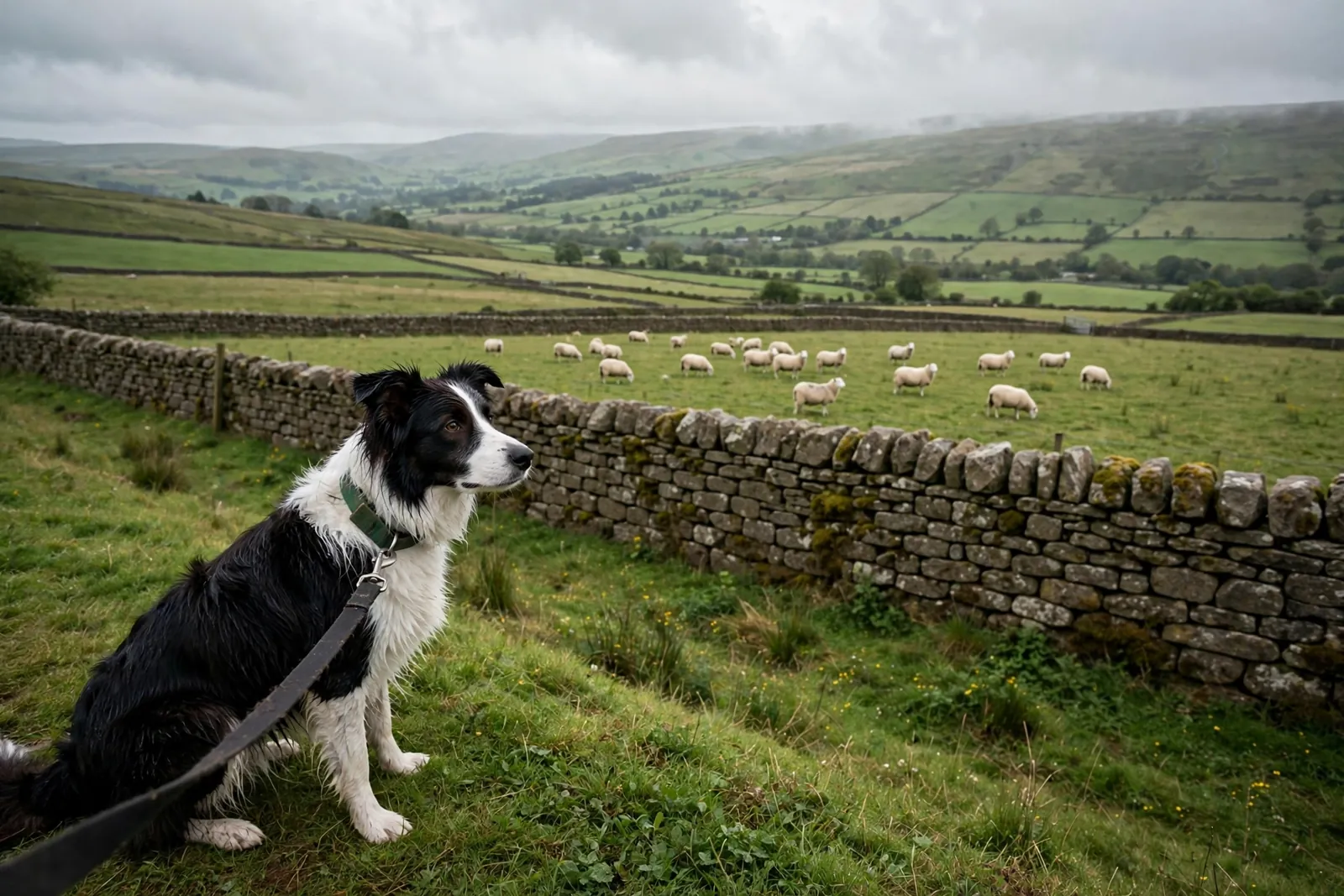
Sheep deserve the plainest language in this guide. A collie among sheep is the scenario livestock law was written for, and even a chase with no contact can be an offence, can cause sheep to miscarry or injure themselves, and entitles a farmer to protect the flock. Keep the dog on a short lead in any field with livestock or where livestock may be, walk wide and quiet, and leave if animals move towards you. Our guide to dog worrying livestock law in the UK sets out the law and penalties in full. The irony that a sheepdog breed must be kept furthest from sheep is not lost on shepherds, whose own dogs work under years of specific training and control that a holiday recall does not replicate — admire the professional version at a demonstration, and keep yours on the lead past the flock.
Traffic and wheeled triggers need their own training plan, begun at home. A collie that lunges at cars or herds cyclists at home will do it more on holiday lanes with faster surprises, so if this is your dog, build the holiday around avoiding the trigger rather than practising failure daily: quiet lanes over A-road verges, off-peak beach walks over promenade parades, fields over canal towpaths at commuting hour. Work with a qualified, reward-based trainer before the trip on distance-based calm behaviour around movement, and use distance generously on holiday — crossing the field early, waiting behind a gate while bikes pass, rewarding disengagement every time. A collie watching the world calmly from a chosen distance is doing advanced work, and the diary should credit it as such.
Fell and hill walks done properly: the collie's home ground
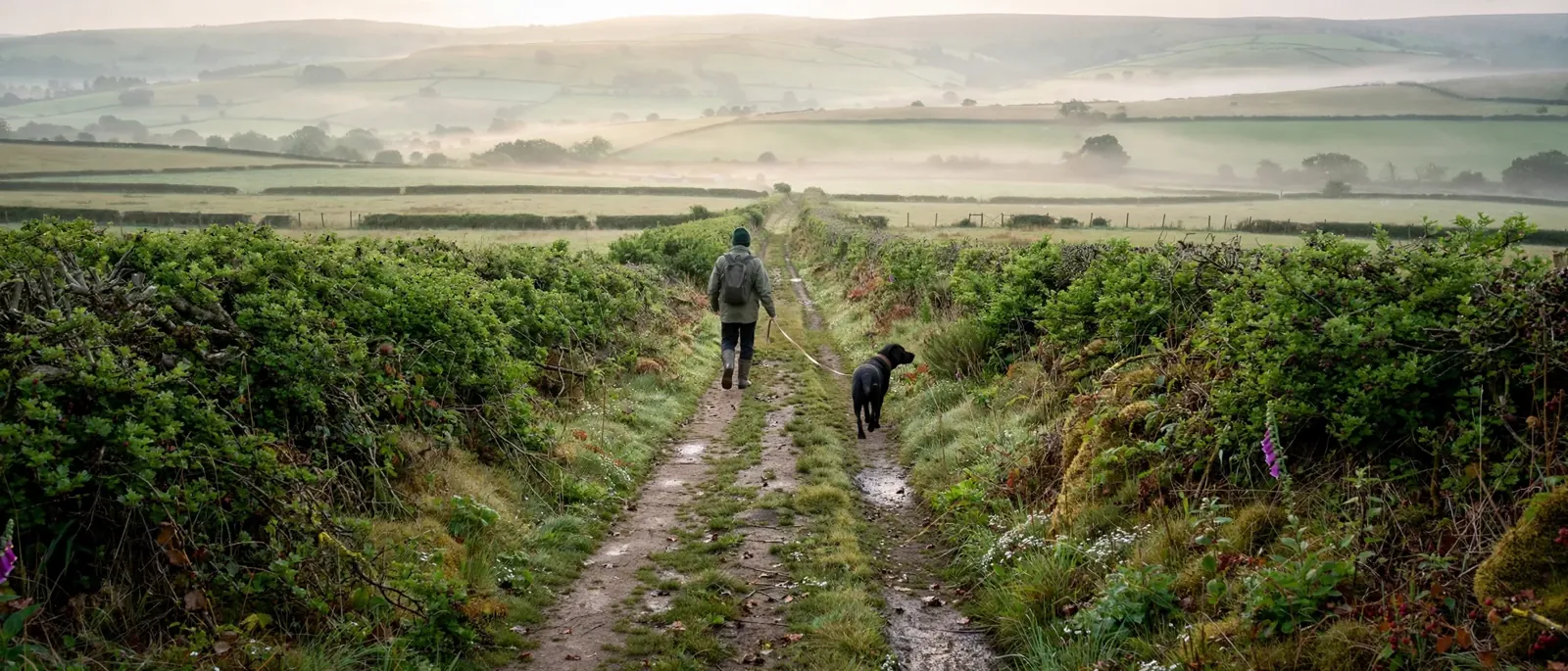
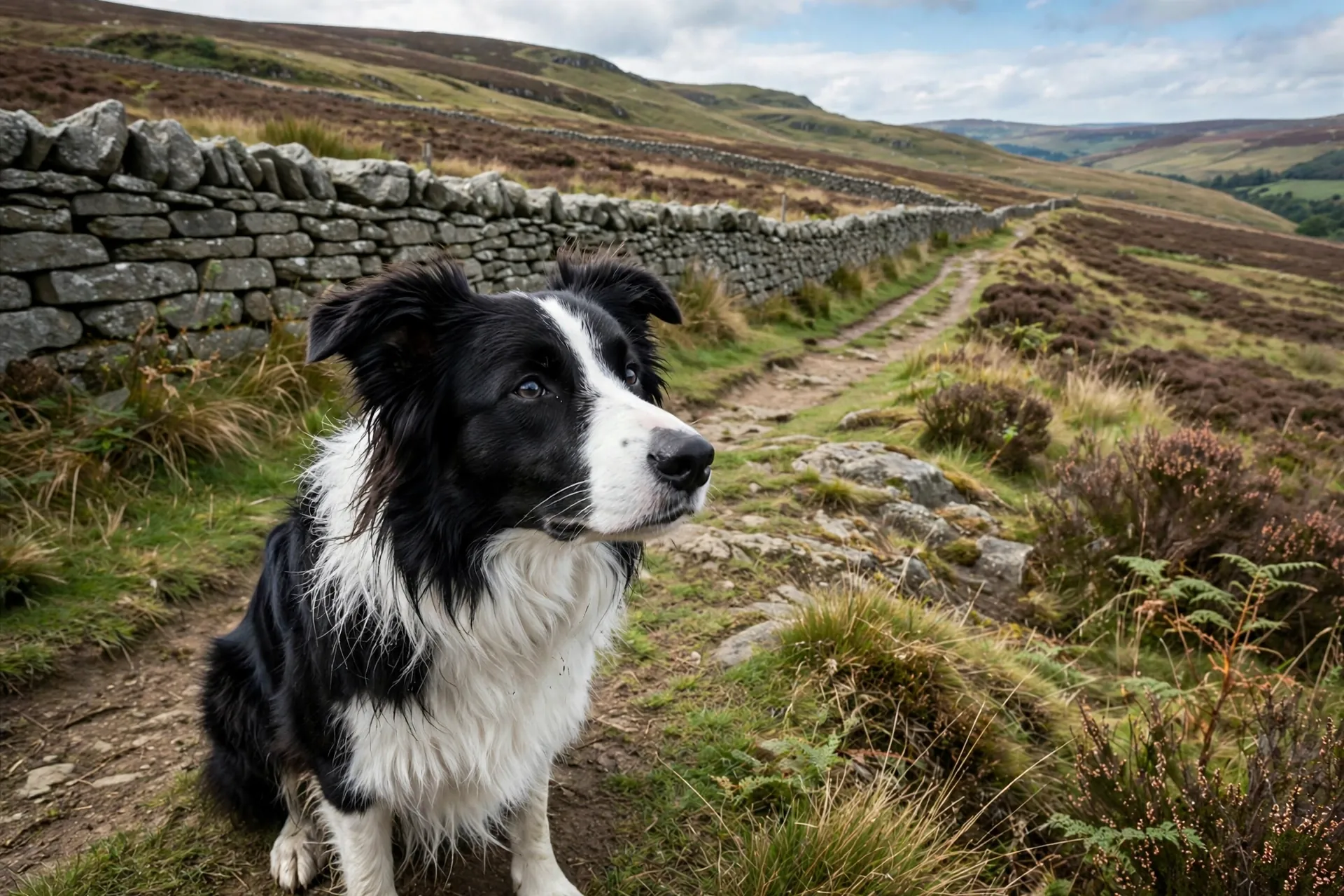
Hill country is where a holiday collie makes most sense — open slopes, working landscapes, long sightlines and weather with opinions. It is also where preparation matters most, because fells and mountains add navigation, exposure and rescue-distance to the usual dog questions. Choose routes honestly matched to the dog's fitness and experience as well as your own: build height and distance across the week, remember that a dog will follow you far beyond its sensible limit out of loyalty and drive, and treat slowing, lagging, repeated sitting, paw-lifting on rough ground or unusual quietness as instructions to descend, not as attitude. Check paws at every stop on gritty or rocky paths, carry water for the dog as well as yourself — hill streams are not guaranteed, and drinking from stagnant pools is best prevented — and keep the dog on a lead around crags, quarries, mine workings and any ground where a chasing swerve could become a fall.
Livestock rules intensify with altitude, not the reverse. Upland grazing sheep are often loose across enormous open fells, hefted to their ground and easily panicked, and ground-nesting birds make dogs-on-leads a seasonal requirement or strong request in many upland areas. Read the local signage, follow access rules for the specific land you are on, and check official latest guidance for reserves and protected sites before you travel rather than assuming open access means open rules. Weather closes the case for preparation: conditions that are merely invigorating at the car park can be serious on the ridge, a wet collie in wind chills faster than its enthusiasm admits, and a dog coat, spare lead, tick tool, head torch and fully charged phone belong in the hill bag as standard — our wider guidance on ticks on dogs in the UK is relevant here too, since bracken edges and sheep pasture are prime tick country in season.
Finish hill days like a professional. The working day ends at the valley, deliberately: lead on, water offered, a calm walk-out rather than a bonus chase game in the car park field, paws and legs checked for cuts, seeds and soreness, food after a settling period, and then rest protected from cottage excitement. A collie that learns the fell day has a shape — work, descend, eat, sleep — settles into the rhythm by midweek and gives you the finest version of the breed: bright, willing and gloriously tired in the evenings. Rush the endings and you will be negotiating with adrenaline at midnight; the dog is only following the schedule you actually taught it.
Quiet stays for a dog that notices everything
Choose the collie's accommodation the way you would choose a workplace for someone who hears every sound in the building: carefully, and biased towards boring. A quiet rural cottage at the end of a lane, with an enclosed garden, few passing dogs and no livestock pressed against the fence, will rest a collie better than a livelier stay in the middle of a holiday park's evening entertainment, however superior the park's facilities look in photographs. Ask hosts about the specific arousal geography: footpaths past the windows, neighbouring dogs, sheep in the adjoining field, delivery traffic, thin walls to a games room. A collie does not need silence; it needs a low rate of interesting events it is not allowed to attend, because every unattended event is a small withdrawal from the rest budget.
Set the cottage up as a decompression chamber on arrival. Lead-walk the boundary and garden first, establish the bed in the quietest corner away from windows and doors, put water and a chew there, and run the dog through a few easy, rewarded behaviours so the new place immediately has a known job attached to it. Close curtains against the lane parade in the evening, use household sounds at normal volume to soften outside noises, and keep visitors and excitement away from the dog's rest corner. If the stay has other guests' dogs nearby, manage greetings deliberately rather than letting a fence-line relationship develop its own noisy momentum — collies commit to fence arguments with professional dedication, and a week is long enough to build a feud.
Self-catering suits this breed best, because it puts meals, timing and quiet entirely in your hands; a genuinely enclosed garden is the feature worth paying for, assessed with the checks in our guide to a dog friendly cottage secure garden — fence integrity, gate latches and hazards, all tested before the dog is loose. Hotels and pubs with rooms can work for a settled adult collie, but corridor noise, breakfast-room negotiations and evening bar crowds spend the budget invisibly. Whatever you choose, tell the host the breed and its intensity honestly in advance. The right host for a collie is not the one who loves all dogs in the abstract; it is the one who hears border collie, nods, and offers you the quiet cottage at the far end.
Enforced rest: the rule collies vote against, unanimously
Here is the section owners skip and then re-read on day four, exhausted, while a bright-eyed dog drops a ball on their foot at eleven at night. Collies do not reliably self-regulate. The breed was selected to work until the work ended, not until the dog felt tired, and a pet collie will request activity at the exact point where more activity makes everything worse. The owner must therefore schedule rest the way a shepherd schedules it for a working dog: as part of the job, non-negotiably, with the dog settled in its place, the toys put away, the ball out of sight entirely, and the household briefed that the dog is off duty even if it is advertising vacancies. Rest means rest — not rest with intervals of fetch whenever the dog looks appealingly awake.
Build two kinds into every day. Micro-rest follows every exciting block: after the walk, after visitors, after the beach, the dog goes to its bed with a chew and the world is allowed to become dull for an hour. Macro-rest is the full quiet day, and a week-long collie holiday needs at least one — ideally midweek, before tiredness announces itself as behaviour. A rest day is not a wasted day: short sniffy lead walks, garden time, training games in small doses, a new chew, and otherwise the profound collie novelty of a day in which nothing is required. Dogs come off a proper rest day visibly reorganised — softer-eyed, more responsive, less reactive — and owners who doubt it only doubt it once.
Sleep is the metric underneath everything. Adult dogs need far more sleep than a holiday schedule naturally provides, and a collie in a novel, watchable cottage will burn sleep on surveillance unless the environment and routine defend it. Dark, quiet sleeping arrangements, a consistent bedtime sequence, no late-evening exciting play, and mornings that do not start with immediate intensity all protect the total. If your collie is consistently unable to settle despite sensible exercise and enforced rest, is losing weight, showing compulsive behaviours like shadow-chasing or flank-sucking, or seems anxious rather than merely busy, that is veterinary and qualified behaviourist territory, not a bigger walking programme — seek professional advice rather than escalating the holiday. Rest is training, and for this breed it may be the most important training of the week.
Travel days and settling in vehicles: calm is a trained behaviour
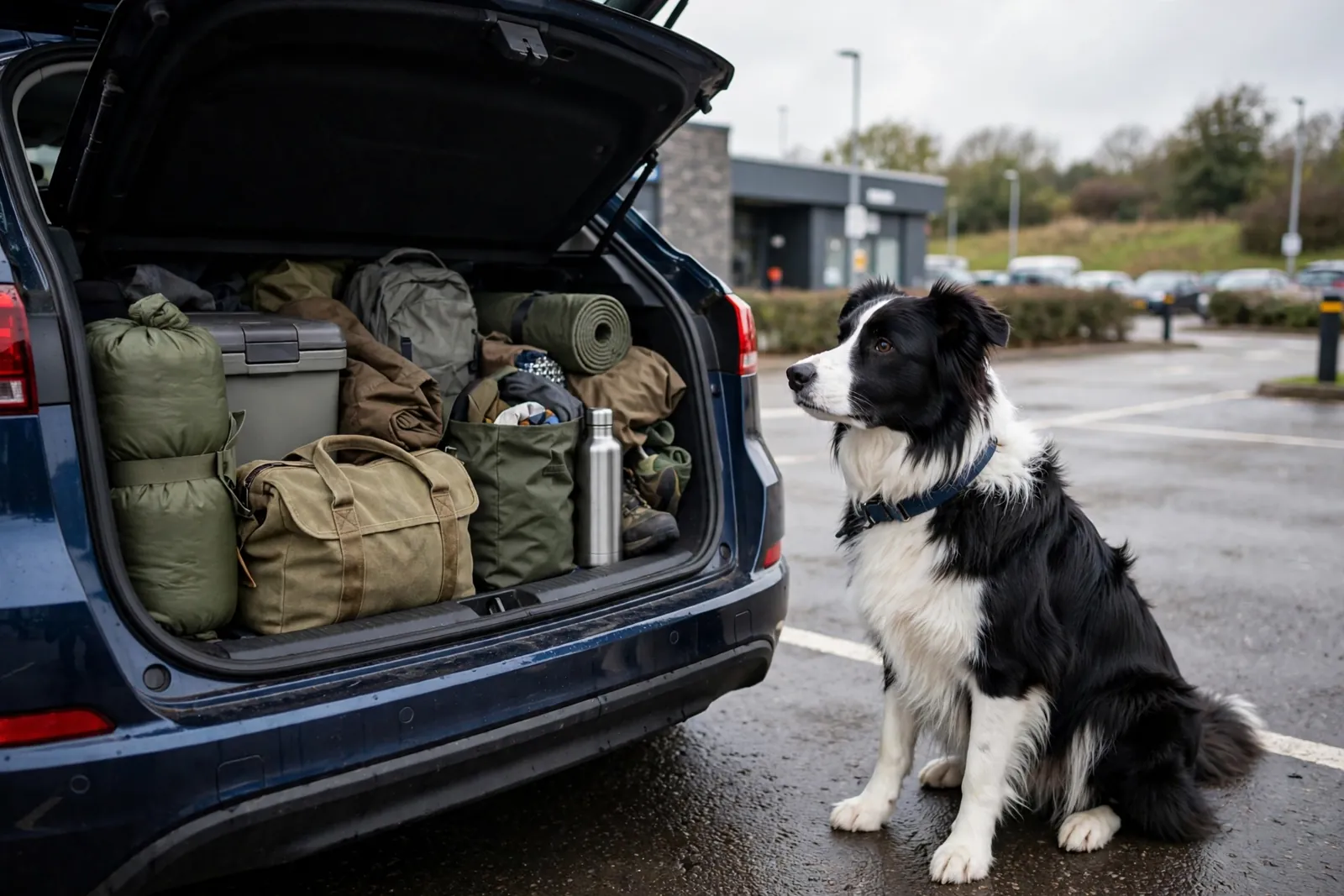
Long drives are a hidden arousal event for collies, because the car combines confinement, vibration, interesting views of sheep country scrolling past the windows, and arrival somewhere novel at the far end. Prepare for travel days as their own discipline. Walk and toilet the dog properly before departure, feed in good time rather than at the services, and settle the dog in its normal, properly restrained travelling position — crate or harness arrangement as suits your car — with familiar bedding and a cover over part of the view if window-watching winds your dog up. The restraint and safety framework in our guide to dog car safety applies in full; add to it the collie-specific point that a dog allowed to practise herding traffic through the rear window for four hours arrives at the cottage pre-loaded and must then be actively decompressed, not immediately released into a gala first evening.
Break the journey at quiet places chosen in advance, not at the busiest services forecourt available, and make breaks boring on purpose: lead on, toilet, water, a few minutes of sniffing at the quiet edge, back in the car. Boring breaks teach the dog that stops are procedural, and procedural is calming. Never leave the dog in a warm parked car, and in hot weather travel early or late with ventilation planned honestly. On arrival, resist the grand tour. One person settles the dog — lead walk around the immediate area, garden check, bed down, water, a chew — while unpacking happens around that calm centre. The collie that is installed first and excited second will sleep the first night; reverse the order and you will all be awake for the sequel.
If your collie is a poor traveller — drooling, panting, reluctant to enter the car, or sick — do not let a long holiday drive be the test. Speak to your vet well in advance about travel anxiety and sickness, practise short, pleasant car trips at home, and consider whether a nearer destination serves this dog better this year. A holiday chosen within the dog's current abilities is not a lesser holiday; it is the only kind the dog gets to vote on with its stress levels, and collies vote unmistakably. Build travel competence gradually across trips and the map reopens at the dog's pace, which for this quick-learning breed is usually faster than owners fear — provided nobody floods the dog with a six-hour debut and calls it character-building.
A balanced collie week, day by day
Assemble the budget into a week and the shape looks like this. Day one is travel and installation only: the drive, the quiet arrival routine, a short sniffy walk, an early night. Day two is the first full working day — a moderate hill or coastal route with training woven through it, a long afternoon rest, a short evening lead walk. Day three steps up slightly if the dog is bright and sound: the week's longer route, finished professionally, followed by a genuinely quiet evening. Day four is the enforced rest day, protected against all lobbying from dog and family alike — garden time, scent games, a village stroll on the lead, and the discovery by everyone that a slow day in a good cottage is not a failure of tourism. Day five spends the restored dog on the week's highlight walk, chosen for low livestock and trigger density as much as for views.
Day six tapers: a medium morning walk, packing done in stages so the cottage stays calm, a final evening routine kept identical to every other evening, because a collie that knows tomorrow's shape only by the suitcases will start spending tomorrow's energy tonight. Day seven is travel home with the same boring-break discipline, and a quiet first evening at home rather than a hero's welcome of visitors and play. Notice what the week never contains: two maximal days back to back, a ball session as the answer to restlessness, an off-lead gamble beside sheep, or an itinerary written for human sightseeing with a collie attached as an afterthought. Every good decision in it was made once, in advance, on paper.
That is the whole secret of a border collie holiday in the UK, and it is not really a secret: this breed gives you exactly the dog your structure describes. Budget the energy, employ the mind, keep the lead on where the eye could take over, choose quiet ground to sleep on, and enforce rest like a shepherd rather than negotiating like a fan. Do those five things and the collie repays you with the finest walking company in Britain — tireless when asked, still when told, and asleep by the fire while you plan tomorrow's route around the only colleague who will ever be ready before you are.
Practical questions
Before you go
How much exercise does a border collie need on holiday?
Most healthy adult border collies need a substantial daily working block — a proper walk with training and thinking games woven in — plus a shorter second outing, but total stimulation matters more than mileage. Scale plans for age and health, watch the dog rather than the itinerary, and ask your vet before a big step up in distance or climbing.
Should I let my border collie off the lead near sheep?
No. Keep a collie on a short lead anywhere sheep or other livestock are present or may appear, and in any country where recall has not been proved against that level of distraction. Even a chase without contact can be an offence under livestock law and can seriously harm sheep, and farmers are entitled to protect their flocks.
Why is my border collie more restless on holiday even after long walks?
Novelty itself is stimulation: new places, people, dogs and events spend a collie's processing budget even when its legs are tired, and over-exercise can wind the breed up further. Add thinking work in short sessions, protect afternoon and evening rest with toys put away and the dog settled on its bed, and include a full quiet day midweek.
Are border collies suited to fell and mountain walks?
Yes, with preparation: build distance and height gradually, carry water for the dog, check paws on rough ground, keep the lead on near livestock, crags and quarries, follow local access and seasonal lead rules, and turn back if the dog slows, lags or seems sore. Check official guidance for the specific area and weather before you set out.
How can I help my border collie settle in a holiday cottage?
Choose a quiet stay, set the bed in the calmest corner away from windows, lead-walk the garden first, run a consistent evening sequence, close curtains against passing activity, and brief everyone that rest time means toys away and no exciting games. A collie settles to a routine it recognises far faster than to a new place it must monitor.