This guide is independent and contains no paid placement. If affiliate links are added later, they will be clearly marked and will not change our editorial checks.
For the late-May spring bank holiday, choose countryside first, keep your dog on a short lead anywhere near lambs, stay on the path in bluebell woods, and assume the main resort beaches are already restricted — the bans mostly start on 1 May. Book pet-friendly places early, pack for rain and sun in the same bag, and travel outside the Friday-evening and Monday-afternoon peaks.
Why late May feels different
Most bank holiday advice treats every long weekend as the same problem: traffic, prices and crowds. The spring bank holiday — the last Monday in May in England, Wales and Northern Ireland, with Scotland observing its own pattern — breaks that pattern because the landscape itself has changed since Easter. Hedges are in leaf, verges are high, lambs are on their feet but still small, nesting birds are settled in scrub and ground cover, and the first warm spells arrive while the ground is still soft from spring rain. A walk that was a muddy lane in April is, by late May, a green tunnel — beautiful for people, full of scent, livestock and hidden hazards for a dog. The late May bank holiday falls in half-term week for many schools, so our half term dog holidays guide covers booking times and beach rules for that break.
That shift is why this weekend rewards a countryside-first plan rather than a dash for the coast. Daylight is generous: in much of Britain you have useful walking light well into the evening, so you can split the day into a cool morning walk and a gentle late walk instead of forcing one long midday route in the strongest sun. Pub gardens are open, farm shops are stocked, and village shows, plant sales and point-to-points fill the calendar — most of them outdoors, many of them tolerant of a well-behaved dog on a lead, and almost all of them busier than their organisers expect if the forecast is kind.
It is also a weekend with less margin for improvising. Accommodation that accepts dogs sells out earlier for late May than for any other spring date, popular woodland car parks fill by mid-morning, and a beach that welcomed your dog at Easter may have started its seasonal restriction three weeks before you arrive. None of that spoils the break; it simply moves the useful work earlier. Decide your lead rules, your beach backup and your wet-weather alternative before you leave, and the three days feel spacious instead of scrambled. If you are comparing this weekend with other long weekends, our wider guide to bank holiday weekend breaks with dogs covers pricing and traffic patterns across the year; this page stays with what is specific to late spring.
Dates, prices and when to book
The spring bank holiday falls on the last Monday in May. Schools in England and Wales usually pair it with a half-term week, which stretches demand well beyond the three days: families book the full week, grandparents join for the weekend, and the Saturday changeover becomes the busiest of the spring season. Expect peak pricing comparable to Easter, with dog-friendly cottages, lodges and pitches going first because they are a minority of total stock. A cottage that sleeps four but accepts no dogs is no use to you, however long it stays available — filter for your real options first, then compare prices within that smaller set.
For a specific place — a named cottage with an enclosed garden, a lodge near a favourite wood, a pitch with hardstanding — six to nine months ahead is realistic, which means autumn for the following May. That sounds excessive until you remember that everyone else with a dog is working to the same calendar. If you are flexible about county and can accept a Friday-morning departure or a Saturday start, three to four months ahead still leaves genuine choice, especially inland. Coastal honeypots and national park villages book out first; market towns ten miles inland, the Welsh Marches, the Shropshire hills, the Lincolnshire Wolds and the less-visited edges of the Yorkshire Dales tend to keep availability longer and cost less for the same standard.
Before you pay, confirm four things in writing: the pet fee and whether it is per dog or per stay, the maximum number and any size or breed condition, whether the garden described as enclosed really has a gate that closes and a fence your dog cannot clear or slip under, and the cancellation terms if a dog is ill. Late-May bookings are often paid in full well before arrival, so the balance date matters. Keep the confirmation with the dog explicitly listed; a verbal “dogs are fine” at enquiry stage is not the same as a booking that names your pet, and disputes in May are miserable to resolve from a car park with a tired dog in the boot.
Day visitors need a booking mindset too. Woodland trust car parks, country parks and popular reservoir circuits increasingly use advance parking booking on bank holiday weekends, and overflow fields open only in settled weather. Check the parking arrangement for your main walk the week before, save the postcode and an offline map, and have a second walk within fifteen minutes’ drive so a full car park becomes a detour rather than a ruined morning.
Lambing season: the lead rules that matter
By late May the earliest lambs are weeks old and sturdy, but lambing runs late in hill country and many lowland flocks still have very young lambs at foot. Ewes remain protective, lambs remain unpredictable, and a dog that has never chased anything can still trigger a scatter simply by appearing suddenly off a path. The legal position is blunt: worrying livestock — chasing, attacking, or being at large among sheep — is an offence, and a farmer may act to protect the flock. Our full explainer on dog worrying livestock law in the UK sets out the penalties and the farmer’s rights; the working rule for this weekend is simpler and stricter than the law’s minimum.
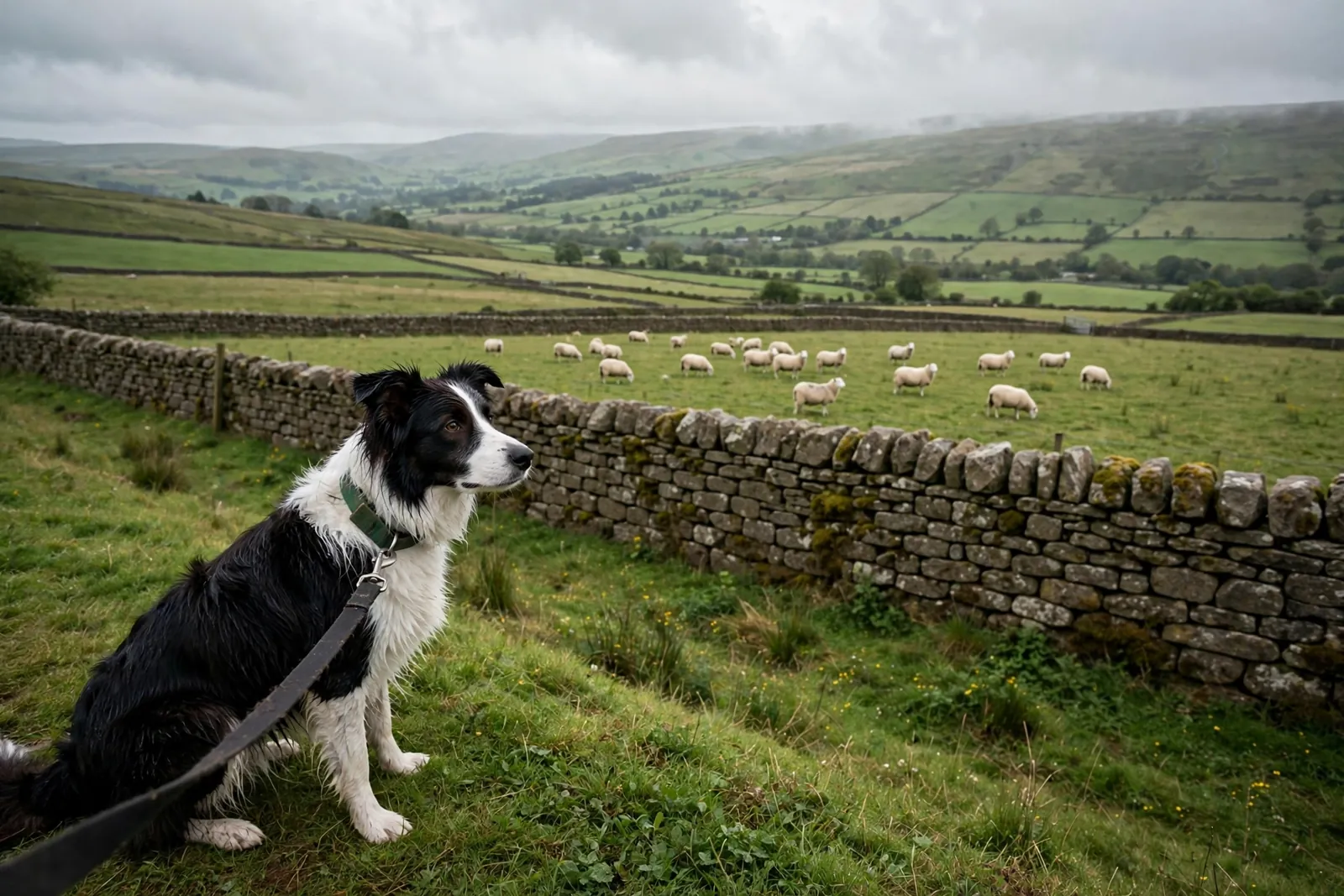
Keep your dog on a short, fixed lead in any field containing sheep, lambs, cattle, horses or goats, and in fields next to them if there is no secure boundary between. Short matters: a long line or extending lead lets a dog lunge several metres before you can react, which is exactly the distance that turns curiosity into a chase. Stay on the waymarked path, walk steadily without letting the dog weave into the flock, and give animals the widest berth the field allows — cross to the far side, wait while sheep move off the path, and never position yourself between a ewe and her lamb. If you meet cattle with calves, give them even more space; if cattle approach closely or charge, the standard countryside advice is to let go of the lead so you and the dog can reach safety separately, then recover the dog once the herd has settled.
Open access land adds a dated rule that catches people out every spring. On access land in England and Wales, dogs must be on a short lead between 1 March and 31 July to protect ground-nesting birds, and at all times near livestock. That window covers the whole spring bank holiday, so an airy moorland walk that felt like off-lead freedom in February is a lead walk in May. Scotland’s outdoor access code works differently but reaches a similar practical answer during lambing and nesting: keep the dog under close control, on a lead around livestock, and out of fields with young animals where you can. Wherever you are, check the signs at the gate — estates and farms add local restrictions during lambing, and a closed path or a “dogs on leads, lambing in progress” notice overrides whatever your app says. Always check the latest official guidance before you travel if you are unsure.
Teach the weekend’s lead behaviour before you need it. A dog used to open running at the local park may be frustrated by three days of short-lead field walking, so build in legal release valves: enclosed dog fields you can hire by the half hour, beaches with a year-round dog section, and forestry tracks away from livestock where close control is enough. Plan the satisfying run deliberately rather than hoping an opportunity appears opposite a field of lambs — it will not, and the temptation is precisely why incidents spike on sunny bank holidays.
Bluebell woods without the damage
Late May is the tail end of bluebell season in the south and the peak further north and at altitude, which makes the spring bank holiday the last reliable weekend to see them. Ancient woodland in the Chilterns, the Weald, the Forest of Dean, the Wye Valley and pockets across the Midlands and the north can be carpeted in violet-blue — and fragile in a way that is not obvious from the path. Bluebells are protected by law: it is an offence to intentionally pick, uproot or destroy wild bluebells, and landowners face separate rules on selling them. The day-to-day damage, though, is done by feet. Bulbs sit close to the surface and are crushed when people and dogs stray into the drifts; leaves trampled this year cannot feed the bulb for next year, and a flattened patch can take years to recover.
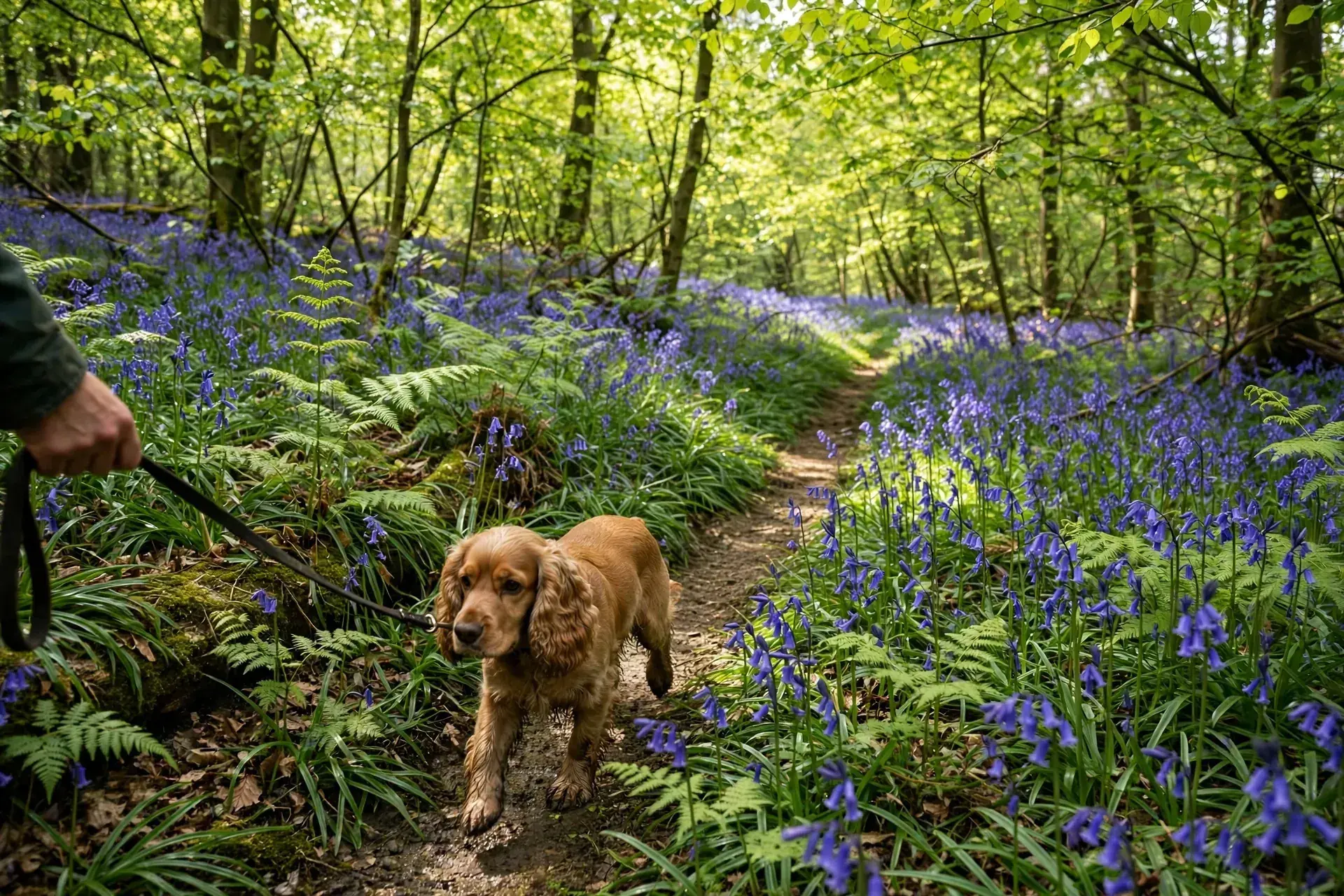
The dog-specific etiquette is straightforward. Keep to surfaced or clearly trodden paths, keep your dog beside you on a short lead or under genuinely close control, and stop the two behaviours that do the harm: digging and crashing through the drifts after a scent or a squirrel. Take photographs from the path edge — a low angle from the track gives you flowers in the foreground without a single paw in them — and resist the classic portrait of a dog sitting in the middle of a bluebell sea. It is the image everyone wants and the exact behaviour woods ask visitors to avoid. If a wood is managed by the National Trust, the Woodland Trust or a wildlife trust, follow its dog code for that site: some woods ask for leads throughout the bluebell weeks, and wardens will be out on a bank holiday Monday.
Bluebell woods bring two quieter dog hazards. The plants themselves, including bulbs, are toxic if eaten, so a dog that grazes or digs needs watching — signs of poisoning can include vomiting, diarrhoea and lethargy, and a vet should be contacted promptly if you think bulbs have been eaten. Shaded woods are also prime tick habitat in late spring, with leaf litter and deer moving through. Do a tick check after every woodland walk, paying attention to ears, armpits, groin and between the toes, and remove any tick with a proper remover rather than squeezing it. A quick check at the car, with a treat to make it a routine, beats discovering an engorged tick on the sofa on Tuesday.
Timing transforms the experience. Arrive before ten for parking, space on the paths and the best light under the canopy; by early afternoon on a fine bank holiday, narrow woodland paths become two-way queues of families, photographers and dogs, which is stressful for a nervous dog and slow for everyone. An evening walk after six is the connoisseur’s option in late May — the crowds have gone, the scent is stronger in cooler air, and your dog gets the wood almost to itself. Whichever slot you choose, bring water: woods feel cool to people walking slowly, but a dog working through spring scent at ground level still drinks more than you expect.
Beaches: the bans have just started
The single most common spring bank holiday disappointment is arriving at a favourite beach to find the dog ban already in force. Most seasonal restrictions on resort beaches in England and Wales run from 1 May to 30 September, so by the last weekend in May they have been running for nearly a month. The restriction usually covers only the main bathing section between signed points — often groynes, slipways or lifeguard zones — and most resorts keep a dog-friendly stretch year-round at one end of the promenade or on the next beach along. Breaches are enforced under local Public Spaces Protection Orders, with on-the-spot fines that commonly start around £100, so “we are only crossing the sand to the cafe” is an expensive argument. Our detailed guide to dog-friendly beaches in the UK and their rules explains how the bans, zones and fines work.
Plan the beach as a researched outing, not a default. Check the council’s beaches page for the exact map of restricted zones, note whether the rule is a full ban or a leads-only requirement (a few resorts use the latter), and check tide times: at high tide the permitted end of some beaches shrinks to a sliver of shingle, and the best dog walking is in the two hours either side of low water. Save a photograph of the beach sign on arrival — it is the definitive local statement if your app or a third-party list disagrees. Lists go out of date; signs and council pages are what enforcement officers work from. Always check the latest official information before you travel.
Late May also changes what the beach itself is like. The sea is still cold — typically in the low teens Celsius around much of the coast — so limit swimming for dogs that plunge in enthusiastically, watch for shivering, and dry them properly afterwards. Jellyfish begin to appear in warming water, and washed-up specimens on the strandline attract curious noses; keep your dog from mouthing them. On busy sand, keep leads on until you are in the permitted zone and clear of picnics, ball games and toddlers: a friendly dog stealing a sandwich is funny once, in a story, months later. Finally, remember shade. Beaches in late May can be genuinely hot at midday with no cover, so take water, a bowl and a windbreak or umbrella if you plan to sit, and build the dog a shaded spot rather than tying them in full sun beside the cool box.
Where to go: field, wood or shore
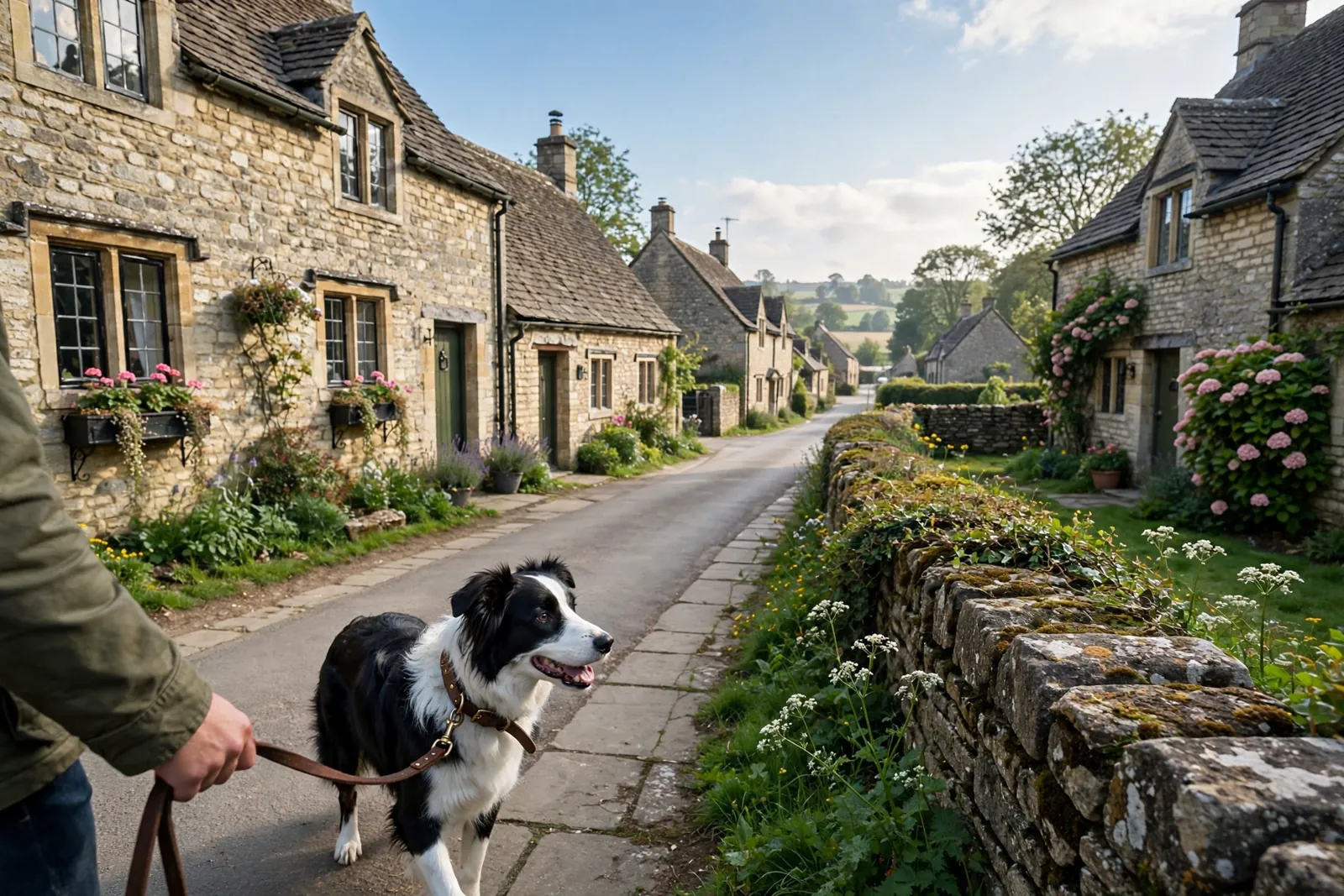
The happiest spring bank holiday bases share one feature: three different walks within twenty minutes, so weather and crowds never trap you. A small market town on the edge of farmland is ideal — a river path for early mornings, a wood for the bluebell day, and a common, heath or reservoir circuit for the day you want open ground without livestock. The Cotswolds, the South Downs villages away from the headline car parks, the Shropshire Hills, the Howardian Hills and the lower Wye Valley all fit this pattern, as do the market towns of the Welsh borders where late lambing makes lead discipline especially important.
On the coast, choose the working end of a resort over the famous end. Smaller harbours and the quieter stretches of the Northumberland, Norfolk and Pembrokeshire coasts offer long, permitted dog sections, cliff and dune paths where leads are needed near nesting birds and livestock, and pubs used to sandy dogs. The trade-off is exposure: a windy late-May day on an east coast beach can feel like March, so pair any coastal base with an inland fallback walk for the day the sea fret or the gale arrives.
For dogs that find bank holidays hard — reactive, elderly or sound-sensitive dogs — the countryside calculus changes again. Avoid festival fields, steam rallies and village fetes with public-address systems unless your dog is genuinely unbothered; choose accommodation with a private, enclosed garden so toilet breaks need no public performance; and walk early, before the lanes fill with cyclists, horse riders and other people’s off-lead dogs. Late May rewards the early riser more than any other bank holiday, because the light is there from five in the morning and almost nobody else uses it. A dog that is walked, fed and settled by nine experiences the rest of the day as a series of naps punctuated by garden time, which is most dogs’ definition of a successful holiday.
Weather planning for two seasons in one weekend
Late-May weather in Britain is famously two-faced: the same weekend can deliver a 23-degree Saturday and a Monday of driving rain on a cold northerly. Plan for both in the same bag and the forecast stops being a verdict on the break. The practical split is this: schedule your longest, most exposed walk for the best forecast day and keep it in the morning or evening if that day is warm; hold a woodland or town-based walk — pubs, cafes, a market, a garden centre circuit — for the wettest day, because trees and streets drain a dog’s energy with scent even at low mileage; and keep one short, reliable loop near the accommodation for the day nobody wants to drive anywhere.
Warm-weather rules arrive earlier than people think. Dogs overheat on humid days in the high teens, especially brachycephalic breeds, older dogs, puppies and thick-coated breeds, so carry water on any walk over half an hour, offer it little and often, and stop in shade rather than pushing to the viewpoint. Never leave a dog in a parked car in spring sunshine — interior temperatures climb fast even with windows cracked, and bank holiday car parks are exactly where well-meaning owners misjudge a “quick” hour in a visitor centre. If your plans include an attraction where dogs wait outside, restructure the plan so someone stays with the dog in shade, or leave that attraction for a dog-free day at home.
Wet-weather systems matter just as much. Late-spring rain on full vegetation means soaking legs and bellies even on short grass, and a wet dog in a cottage or caravan needs a proper drying station by the door: towels, a drying coat, a mat and somewhere ventilated to hang things. Check paw pads after walks on flinty or freshly dressed paths, rinse mud from between toes, and dry ears after any swim. If thunderstorms are forecast — a classic late-May pattern after warm days — bring the evening walk forward, keep the dog on a lead if thunder starts (startled dogs bolt), and set up a den with familiar bedding before the first rumble rather than during it.
Use forecasts at the right resolution. A national “bank holiday washout” headline often means one wet day out of three in your actual county. Check a location-specific forecast the evening before each day, look at rainfall timing rather than daily symbols, and be willing to swap the plan at breakfast. The groups that enjoy this weekend most are rarely the ones with the best weather; they are the ones whose plans bend without breaking.
Travel timing and the Monday problem
The roads follow a reliable script: Friday afternoon and evening are worst outbound, Saturday morning stays busy near the coast and the national parks, and Monday from mid-afternoon is the single heaviest return window of the weekend. With a dog, the cost of congestion is higher than boredom — a planned two-hour drive that becomes four needs a water top-up, a leg stretch and a toilet stop that a traffic jam makes awkward. Build a stop into the route at the halfway point regardless of how the traffic looks, choosing a service area with a proper dog walking area or, better, a pre-planned ten-minute detour to a village green or country park lay-by where the dog can actually relax.
Shifting departure by two hours beats any clever route. Leaving before nine on Friday, or travelling on Thursday evening if your accommodation allows, removes you from the peak entirely; coming home on Tuesday morning, if work allows, is the cheapest luxury of the weekend. If Monday travel is unavoidable, leave by ten, stop often, and accept the slower scenic road over the stationary motorway — a dog would rather be moving past hedges at forty than parked on a hard shoulder in sun. Keep the car cool, secure the dog properly with a harness or crate as the law and common sense require, and never open all the doors at a stop before the lead is on: bank holiday service areas are full of loose children, dropped food and other dogs.
Rail is a genuine alternative for this weekend if your dog travels well by train, with smaller dogs and calm larger dogs generally accepted free or cheaply on most operators — but book seats, travel outside the Friday and Monday peaks, and check the latest operator rules before you travel. Whichever mode you choose, feed the main meal well before departure if your dog is prone to travel sickness, and keep the first hour after arrival deliberately dull: water, a sniffy lead walk, a check of the garden fence, and rest. The bluebells can wait until tomorrow.
Packing for late spring
Late spring packing is two kits in one bag. The warm kit holds drinking water and a portable bowl for every outing, a spare bottle kept in the car, tick removers and your usual first-aid basics, sun protection if your vet advises it for a pale or thin-coated dog, and a light layer for people so nobody cuts a walk short. The wet kit holds a drying coat, two towels that live by the door, a spare lead (spring mud plus a chewed or lost lead is a classic), spare bedding, poo bags in every pocket and bag rather than one roll in the car, and a torch for evening toilet trips along unlit lanes — it may be light until late, but the last outing still lands in dusk.
Add the countryside specifics: a short fixed lead as your default, with any long line reserved for livestock-free open ground; ID tags with a mobile number and, ideally, your holiday address, because a dog lost from a cottage is harder to reunite than one lost from home; your vet’s number and the number of the nearest emergency vet to the accommodation, saved before you travel; and enough of your dog’s usual food for the whole break plus a day, since a sudden diet change on a bank holiday weekend, when rural shops are shut early, is a recipe for an upset stomach in an unfamiliar kitchen. Photograph vaccination and insurance details on your phone as a backup.
Finally, pack one enrichment option per day — a snuffle mat, a stuffed chew, a new ball kept in reserve. Bank holiday afternoons include waiting: for tables, for traffic, for rain to pass. A dog with a job copes with all of it better than a dog expected simply to be patient, and five minutes of scent work in the garden tires many dogs as effectively as another mile on a lead.
A calmer three-day rhythm
Saturday belongs to the wood. Walk early while the car park is quiet, give the bluebells the cool of the morning, and let the dog set a sniffing pace on the paths. Lunch in a pub garden — book it, because everyone else has the same idea — then a lazy afternoon around the base: garden time, a short lane walk at teatime away from grazing fields, and an early night for a dog that has processed a thousand new smells. If your base has an enclosed dog field nearby, Saturday late afternoon is the moment to spend it, burning off the excitement before the first full evening.
Sunday is the flexible day. If the forecast kept its promise, take the long walk: a river valley, a common with views, or the permitted stretch of beach at low tide, timed to finish before the midday crowds and warmth. If the weather turned, swap to the town plan — market, dog-friendly cafes, a garden or heritage site that welcomes dogs on leads in the grounds, checking the latest rules for each venue before you set off. Keep one hour of the afternoon unscheduled on purpose. Bank holiday weekends collapse under their own itineraries, and dogs read human rushing as a reason to be unsettled themselves.
Monday is for leaving well. A short, familiar loop first thing — repeat Saturday’s lane rather than exploring somewhere new — then pack, check the accommodation for leads, bowls and chargers, and be on the road by ten if you must travel that day. Alternatively, if Tuesday travel is possible, Monday becomes the gift day: revisit the favourite walk, now quieter, buy the farm-shop supplies, and let everyone else sit in the return traffic. Either way, resist the final-day temptation of one last big adventure with a tired dog and a boot to pack. The best spring bank holidays end the way the countryside feels in late May — unhurried, a little muddy, and already booked again for next year.
Practical questions
Before you go
Are dogs allowed off lead during lambing season in late May?
No, not near livestock. Keep your dog on a short lead in any field with sheep, lambs, cattle or horses, and on open access land between 1 March and 31 July. Lambs are still young and ewes are still protective in late May, so use a short fixed lead, stay on the path and give the flock a wide berth. If cattle charge, let go of the lead so you and the dog can get to safety separately.
Can I walk my dog through bluebell woods in spring?
Yes, on the marked paths, with your dog on a lead or under close control. Bluebells are protected and their bulbs are crushed by feet and paws straying off the path, and the damage can take years to recover. Keep to surfaced or well-trodden paths, do not let your dog dig or run through the drifts, and take photos from the path edge rather than stepping into the flowers.
Do beach dog bans apply over the spring bank holiday?
Yes. Most seasonal beach restrictions in England and Wales start on 1 May, so by the late-May bank holiday the main bathing beaches are usually already restricted. Bans apply only to signed sections, and most resorts keep a year-round dog-friendly stretch nearby. Check the council page and the signs at the slipway for the exact dates, zones and fines before you let your dog on the sand.
How far ahead should I book a spring bank holiday break with a dog?
Book dog-friendly units six to nine months ahead if you want a specific cottage, lodge or pitch for the late-May weekend, because pet-friendly stock is limited and sells first. If you are flexible on area and can travel on the Friday morning or Saturday, three to four months ahead still leaves choice. Always confirm the pet fee, dog limit and enclosed-garden claim in writing before you pay the balance.
What should I pack for changeable late-May weather with a dog?
Pack for two seasons: a light drying coat and towels for rain, drinking water and a portable bowl for warm spells, tick removal tools, and a spare lead and bedding. Late May can bring heavy showers, strong sun and cool evenings in the same weekend. Add sun protection for pale or thin-coated dogs, check paws after walks on hot paths, and never leave a dog in a parked car.