This guide is independent and contains no paid placement. If affiliate links are added later, they will be clearly marked and will not change our editorial checks.
St Mawes is one of the most rewarding small Cornish harbours to visit with a dog, and the ferry from Falmouth is the way to arrive: the crossing takes about twenty minutes, the village is compact enough to explore entirely on foot, the castle walk gives you the best view on the Roseland, and the nearest year-round dog beaches are a short drive away. Plan around ferry times, the summer crowds and the seasonal rules on the village beach.
Arrive by ferry: the view from the deck
The best introduction to St Mawes happens before you reach it, standing on the open deck of the little passenger boat out of Falmouth with a dog at your feet and the wind coming off Carrick Roads. The crossing is short — about twenty minutes from Prince of Wales Pier — but it changes the whole shape of the day. Instead of threading the narrow Roseland lanes in a car and hunting for a space at the end of them, you step off the boat straight onto the quay, in the middle of the village, with the harbour, the beach path and the castle climb all within a few minutes' walk. Dogs travel on the open deck, clipped to a lead, and most of them settle quickly once they find a spot out of the wind: against a bulkhead, between your boots, somewhere they can feel the deck steady under their paws.
What you see on the way across is the reason the boat beats the road. Ahead of you the village gathers itself into a curve of pale cottages climbing the hillside, the harbour full of moored boats, and the low grey walls of the castle guarding the mouth of the Fal. Behind you, as Falmouth drops away, Pendennis Castle stands on its headland — the twin the Tudors built across the water from St Mawes in the 1540s, so the two forts could watch the anchorage together. Between them the water is busy: sailing boats tacking across the Roads, fishing boats coming in, the occasional tall ship, and gulls trailing the ferry for the whole crossing. A first-time boat dog may stare at all of it; a seasoned one will usually just lie down and wait for the engine note to change as the boat slows for the quay.
Boarding is where a little preparation pays off. The pier at Falmouth gets crowded on sunny mornings, with luggage, pushchairs and other dogs all moving in different directions, so shorten the lead right down and keep the dog on the side away from the edge of the pier. The gangway and the deck can be slick when wet, and the boat rolls gently even on a calm day, so give a nervous dog time to find its footing rather than dragging it to the rail for a photograph. Bring water for the dog and a towel in your day bag: a dog that has paddled on the beach before the return crossing will want drying off, and there is nothing on the boat to dry it with. If your dog has never been on a boat at all, this short hop is a kind one to start with — but if the dog is plainly unhappy, shaking or trying to hide, take the road route home instead and try the boat again another day.
Timings are the one thing to get right before you leave home. The passenger service runs more often in summer than in winter, and the last boat back matters more than the first boat out: miss it and you are facing a long drive round the head of the river instead of a twenty-minute crossing. Look at the operator's own timetable page the night before, and again in the morning, because summer sailings fill up and the queue on the quay builds fast on a bright Saturday. Arriving early is not fussiness here; it is the difference between a dog that boards calmly and one that has stood in a hot queue for half an hour before the day has even started.
A second, smaller boat opens up the far side of the river. The Place Ferry carries foot passengers from St Mawes across the Fal to Place, a tiny landing on the opposite shore, and from there a path runs round the headland to St Anthony Head, where the lighthouse looks back across the water towards the village and Pendennis. It is a summer service, and it is weather-dependent, so the day you want it may not be the day it runs — the operator's own page is the only reliable source for whether it is sailing. The walk from Place to the lighthouse is an exposed coast path with no shelter and no water, so it suits a fit dog on a cool day, and the return boat drops you back in St Mawes in good time for a late lunch. Done right, it is the neatest loop on the Roseland: out by one ferry, back by another, with a lighthouse walk in between.
Drivers get their own crossing further up the river. The King Harry Ferry is a chain ferry that carries cars across the Fal between Feock, on the Falmouth side, and Philleigh, on the Roseland side, and it turns a long drive round the head of the river into a crossing of a few minutes. It is a working ferry rather than a pleasure trip: cars queue in lanes, the crossing itself is brief, and the dog stays in the car for it. Coming from Falmouth or Truro by road, it is worth weighing against the long way round — but look up its current operating hours and fares on the operator's site before you set out, and build in time for a summer queue. Whichever water you cross by, the point is the same: St Mawes is a harbour village, and meeting it from the water is how it is meant to be met.
The harbour, the quay and the village streets
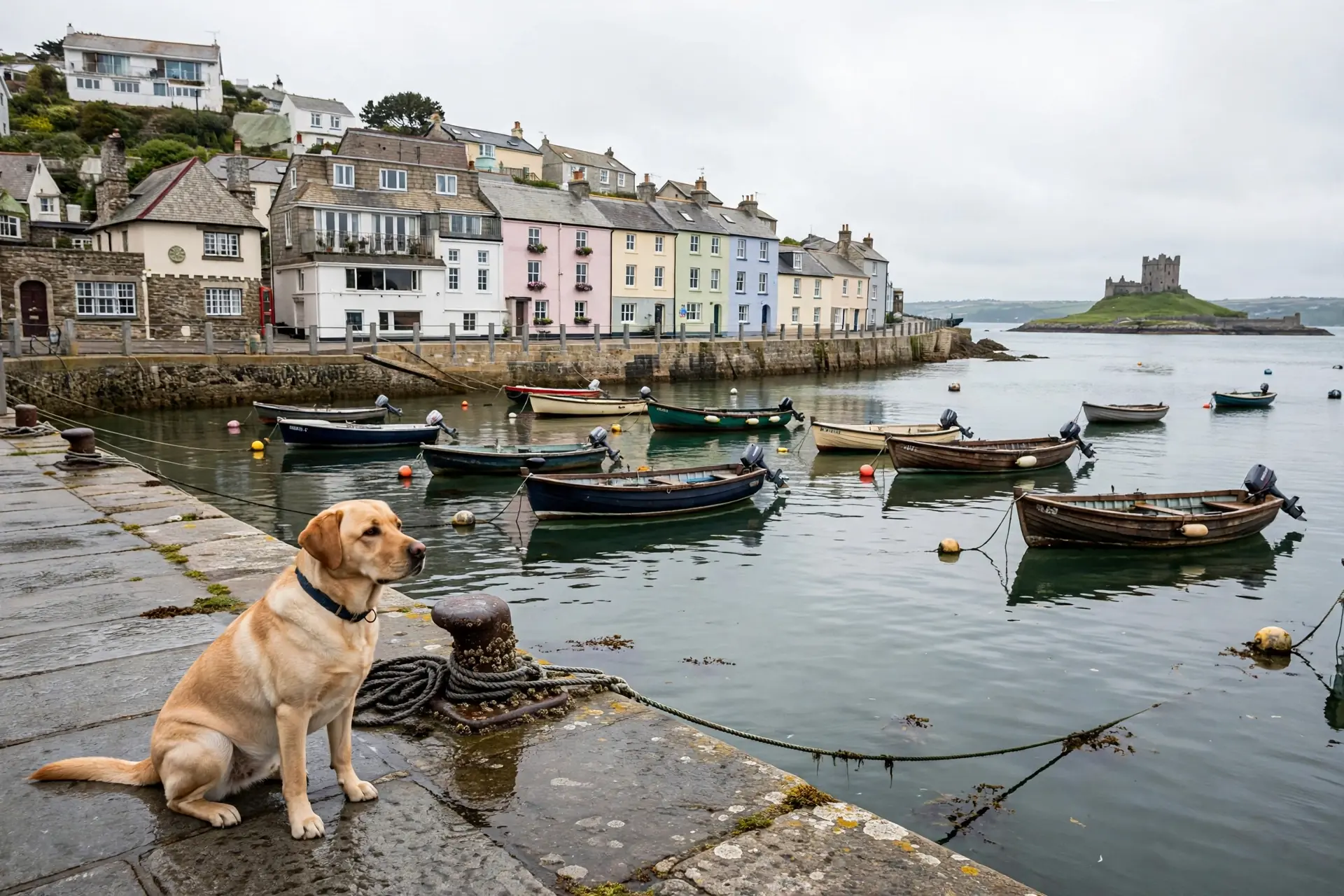
Step off the boat and the whole village is in front of you at once: the harbour basin, the cottages in pale blue and cream and terracotta, and the lanes climbing behind them. St Mawes is small enough that a walk here is less a route than a wander, and the village rewards the slow approach. Fishing boats and pleasure boats sit on the mud at low tide and float at high tide; the quay fills in the morning with people launching boats and mending nets; and by the afternoon the same quay is lined with people eating ice cream and watching the ferry come and go. A dog gets all of this at nose height, and the smells alone will keep one busy for an hour.
The quay needs a lead and a little attention. There is no fence between the walkway and the water, the harbour wall has a real drop, and a dog chasing a gull or a ball can be over the edge before you have time to react. The slipway deserves the same care: boats are launched and recovered there, and vehicles use the ramp, so keep the dog clear of it and close to your heel. None of this is difficult, and it is not a reason to hurry past. It is simply a working harbour, and a dog on a short lead is the right way to enjoy one. Early in the morning, before the day visitors arrive, the quay belongs to the fishermen and the local dog walkers, and that is the best time to let a nervous dog learn the place.
Behind the quay, the lanes climb in a tangle of steep streets, cottage gardens spilling over walls, gallery windows and small shops. St Mawes is well supplied for its size: you can buy picnic food, a pasty, dog treats, and the spare lead you left in the car. Pavements are narrow where they exist at all, and in places there is no pavement, so walk on the inside and keep the dog on the side away from the road — delivery vans and local cars use these lanes all day, and they come round blind corners faster than you would expect. In the middle of a summer day the streets are crowded, and a dog that dislikes crowds will be happier out early or in the early evening, when the village goes quiet again and the light on the harbour turns warm.
A few practical things are worth sorting before you wander too far. The public toilets are in the village but not on every corner, so bear that in mind if you are out with children. Fresh water for the dog is not guaranteed at every turn: carry a bottle and a folding bowl, and top up whenever you pass a tap or a cafe that has put a bowl outside. A bowl by a door is usually a good sign that dogs are welcome inside, but do not assume the water in it is fresh — tip it out and refill it from your own bottle if you are unsure. Keep the poo bags in your pocket, not in the car: the bins sit at intervals along the quay and the main streets, not at every junction, and you will need a bag in your hand more often than you expect.
The tide remakes the harbour twice a day, and it is worth seeing both versions. At high water the boats float level with the pavement and the water comes right up to the quay wall; at low water the basin empties to mud and sand, the boats rest on their keels, and wading birds pick over the exposed shore. The change is fast enough that a morning walk and an afternoon walk will look like two different villages. Look up the tide times before you plan anything that depends on the water — a boat trip, a beach visit, a paddle — and never let a dog wander out onto the harbour mud. It is soft, it is deep in places, and the tide comes back across it faster than it looks.
There is a rhythm to the village, and fitting into it makes the day easier. Early morning is the fishermen and the dog walkers, the water flat and the streets empty. Mid-morning brings the ferry passengers, and by lunchtime the quay is at its busiest. Late afternoon is the best hour of all: the light warms, the crowds thin, and the harbour settles back into the quiet working place it is for most of the year. If you can shape the day around that — an early arrival, a slow wander, a long lunch, a quiet evening stroll — the dog gets its walks at the times it enjoys them most, and you get the village at its best.
St Mawes Castle and the walk above the village
The walk up to the castle is the single best short walk in St Mawes, and it starts right from the village streets. The fort stands on the low headland above the harbour mouth, built in the 1540s under Henry VIII as one half of a pair — St Mawes on the Roseland side, Pendennis across the water — meant to guard the anchorage of Carrick Roads from attack by sea. It is a compact, clover-leaf-shaped fort, and it has survived in remarkably good shape, so the climb up to it feels less like visiting a ruin and more like walking into a piece of working history that still does its old job of watching the water.
The climb itself is short and steep in places, up past the cottages and gardens at the edge of the village and out onto the open headland. The view opens suddenly as you come over the rise: Pendennis Castle across the water, Falmouth and its docks beyond, the open sea to the south, and the whole curve of the Roseland coast running away to the east. For a dog it is open grass, sea air and room to move without traffic — but keep the lead on for the approach and around the walls, because the headland has unfenced drops and the path is shared with families and small children. A dog that has walked up the hill will want a drink and a rest before you set off again, and there is no tap and no shade up there, so carry water.
Dogs on leads are welcome on the grass around the castle, where the view is the whole point of the visit, but they are not allowed inside the castle buildings themselves. The site is run by English Heritage, and its own page is the place to confirm the current rules, opening days and admission prices before you go, because all of them shift with the season. If someone in your party wants to go inside and look at the gun decks and the Tudor stonework, plan for the other person to stay outside with the dog on the grass — there is plenty to watch in the meantime, and a visit with a dog is usually half an hour to an hour including the walk up and back.
The headland is also where the castle walk turns into something bigger. From the castle you can join the South West Coast Path in either direction, and the grass above the village is the natural starting point for a longer walk if your dog is up for it. Bring a coat for a short-coated dog when the wind is up, because the headland is exposed and the weather coming off the sea can be sharp even on a day that feels warm down in the village. In summer the grass dries out and the sun is strong, so a rest in the one patch of shade you can find is worth taking before you push on.
Below the castle, on the seaward side, a path drops down towards the shore and the small rocky coves at the foot of the headland. The water there is clear, and at low tide the rock pools are worth a careful look — but these are not beaches, they are uneven, weed-slick rock, and they are no place for a dog to run free. Walk them on a lead, take your time over the pools, watch the boats coming and going through the harbour entrance, and keep a sharper eye on the tide here than anywhere else in the village: the shore below the castle is cut off quickly when the water turns, and the rocks get slippery fast.
What the castle walk really gives a small village is a sense of scale. From the grass at the top you can see how St Mawes fits together — the harbour below, the village climbing the hill, the river winding away towards Truro, the open coast running east — and a visit stops being a wander round the shops and becomes an understanding of the place. It is short enough that an older dog can manage it, with pauses on the way up and a long rest on the grass at the top. Go early if you want it to yourself; go in the evening if you want the light. Either way, sit on the grass with the dog and watch the boats for a while: it is the best seat in the village, and it costs nothing.
The Roseland coast path, in both directions
St Mawes sits on the South West Coast Path, and that one fact turns a village visit into a walking holiday. The path runs through the village in both directions, and the two ways could hardly be less alike. Northwards it stays close to the water, winding through wooded creeks towards the church at St Just in Roseland. Eastwards it climbs onto the cliffs and runs along the exposed headlands towards Nare Head, with big skies and long views back to the harbour. Which one suits your dog is the most useful decision you will make after the ferry — and there is no prize for picking the harder one.
The northern walk, towards St Just in Roseland, is the gentler of the two and the better choice for most dogs. St Just is roughly a mile from St Mawes along the shore, and the path between the two villages follows the water for much of the way, past boatyards and small beaches and into the wooded creek where the church of St Just stands in its own sheltered garden, close to the water. The churchyard is a quiet, beautiful place, and the path through it is one of the prettiest short walks on the Roseland — but it is a place people come to sit quietly, so keep the dog close and on a lead there, and on the path, where the shore below is tidal. From St Just the path carries on towards Portscatho and Gerrans Bay, getting longer and more open as it goes, and you can turn back at any point: it is an out-and-back walk, so the distance is entirely yours to choose. An older dog can manage the stretch to St Just and back comfortably; a fitter dog can press on towards Portscatho and earn a proper afternoon.
The eastern walk, towards Nare Head, is the wilder one. From the castle the coast path climbs onto the cliffs and runs east past the headlands, with the sea below and open farmland inland. It is a proper cliff walk: uneven ground, steps, stiles and long stretches with no shade and no water, and it asks for a fit dog, good footwear and a careful eye on the weather. The reward is the scale of it — the view back to St Mawes and Pendennis, the open sea, the long sweep of Gerrans Bay and, on a clear day, the coast running away to the east. But the cliff edges here are unfenced and the drops are real, so keep the dog on a lead for the exposed sections and do not let it run ahead out of sight around a headland. A dog that is reactive, nervous near drops, or simply not used to cliff paths will be happier on the northern walk, and the northern walk is the better dog walk in any case.
Livestock is a practical consideration on the Roseland, because much of the coast path crosses farmland. Sheep and cattle graze the cliff-top fields, and the rule is simple: near livestock a dog stays under close control, and on the lead whenever animals are actually in the field. A dog that chases sheep is a danger to the animals and to itself, and a farmer may act if a dog is worrying his stock. Keep the lead on through any field with animals in it, even if your dog has never chased anything in its life, and read the signs at the field gates — they usually say what is grazing on the other side. The same applies in the wooded valleys and the lanes inland, where horses and cattle are common and a dog off the lead can cause a problem in seconds.
Ground conditions change with the season, and they matter more to a dog than to a person. In summer the paths are dry, dusty and hard underfoot, and with no shade on the cliff sections a dog can overheat quickly: start early, carry plenty of water — more than you reckon on needing — and watch for a dog that is panting hard, drooling, or suddenly lying down in the shade. In winter and after rain the paths are muddy and slippery, especially on the clay stretches and the steps, and a dog that slips on a wet cliff path is in real danger. Spring brings wildflowers in the hedgerows and birds everywhere; autumn brings thin crowds and soft light, which makes it one of the best times to walk the Roseland with a dog. Whatever the season, wear proper walking shoes, look at the forecast before you leave, and have a turning-back point in mind.
The small practicalities decide whether a long walk is a pleasure or a chore. There are very few places to fill a water bottle on the cliff sections, so carry a bottle and a bowl for the dog and refill whenever you pass through a village. There are few bins on the open path, so carry the poo bags and something to carry a full bag in until you reach a bin back in the village. Mobile signal is patchy on the more remote stretches, so save an offline map before you set out and tell someone where you are headed if you are walking on your own. And remember that this is a long-distance trail: the stretch out of St Mawes is a day walk, not a through-hike, and the pleasure is in picking a section that fits your dog and walking it well, rather than in covering miles for their own sake.
Beaches, tides and seasonal dog rules
St Mawes is a harbour village rather than a beach resort, and the beach question works differently here because of it. The village beach — Summers Beach, just round the headland from the harbour, a short walk from the quay — is a small, sheltered, sandy beach that is lovely at low tide and popular with families in summer. In the summer months it has seasonal dog restrictions, which means dogs are not allowed on the sand during the day in peak season — the signs at the entrance give the dates and the area covered, and they are the thing to go by, because they do get enforced.
Outside the restricted season, Summers Beach is a different place: quiet, open and very good for dogs. Autumn, winter and spring give you the sand to yourself, with room for a dog to run properly, and the low-tide beach is wide enough for a long game of fetch. Even in summer the beach is worth knowing about for the early morning and the evening, when the crowds have gone — but read the signs first every time, because the rules are the rules and a fine is a poor souvenir. For the rules behind all of this — seasonal bans, public space protection orders, and how to find out what applies where — see our guide to dog-friendly beaches in the UK. Cornwall's beaches do not all follow the same rules, so it is worth a read before any summer beach trip here.
The best year-round dog beaches near St Mawes are a short drive away, and they are worth the drive. Pendower and Carne, on the south coast of the Roseland, are two long, sandy beaches that join into one at low tide, and they are widely known as year-round dog beaches. They are bigger, wilder and more open than Summers Beach, with room for a dog to run for a long time, and they are the right choice for a proper beach day: a long walk, a swim, a picnic and a tired dog by the end of it. Look up the local information before you go, because rules can change, and look up the tide times the night before, because at high tide the beaches narrow a lot and at low tide they are vast. Time it so you arrive a couple of hours ahead of low water, and you get the widest sand and the longest before the sea comes back in.
The tide deserves a paragraph of its own, because the Roseland coast is tidal in a way that catches people out. The difference between high and low water here is several metres, and the water turns quickly: a beach that is a wide sweep of sand at midday can be mostly water by mid-afternoon, and a rocky shore that is easy to walk at low tide can be cut off in under an hour. Always look at the tide times before you set out, never walk out onto rocks or sandbanks without knowing when the tide turns, and never let a dog chase birds or a ball across wet sand towards the water's edge without a clear route back. The sea here is beautiful and it is unforgiving in equal measure, and the tide is the thing to respect first.
Swimming is a question that comes up on every beach visit, and the honest answer is to be careful. The water around St Mawes and the Roseland is clean and inviting on a warm day, and many dogs love a swim, but the currents near the harbour entrance are strong, the water is cold even in summer, and the shore can shelve steeply in places. Let a dog paddle and swim in the shallows of a sheltered beach, where you can see the bottom and the water is calm, and keep it away from the harbour entrance, the ferry routes and the rocky headlands. Do not let a dog drink much seawater: dogs that swallow a lot of it get sick, with vomiting, diarrhoea and lethargy, and a dog that has been in the sea should be rinsed with fresh water afterwards, its paws checked for cuts and its ears checked for sand. For a proper swim, Pendower and Carne are a much better choice than the harbour.
What is lying on the sand matters too. Fishing hooks, broken glass, dead fish and other things a dog will want to eat are all common on Cornish beaches, and a dog that eats a dead fish or a piece of fishing line can end up at the vet. Watch what your dog is sniffing at, especially along the high-tide line, where debris collects, and teach the dog a reliable "leave it" before you go to the beach. After a beach day, rinse the dog, dry it properly, and check its paws and ears before the drive home. If the dog falls asleep before you are out of the car park, the day went as it should.
Eating and drinking with a dog
For a village this small, St Mawes has a surprising amount to eat and drink — pubs, cafes, restaurants and takeaways tucked between the cottages — and a good share of them are happy to have a dog along. Terraces and outdoor tables are where dogs are most welcome, and some places will let a dog inside too. What that means in practice is that you can spend a whole day here — ferry in, castle walk, beach — and sit down to a real meal at the end of it without the dog having to wait in the car or be tied to a railing outside. Plenty of Cornish villages cannot offer that; St Mawes can, and it changes how the day feels.
The harbourside pubs are the natural starting point. After the climb to the castle, a pub lunch is the classic way to spend the middle of the day, and the pubs here are used to dogs arriving with muddy paws and tired legs. A terrace or a garden makes life easiest, particularly with a big dog that needs floor space, and if the weather turns, it is worth asking whether the dog can come into the bar — plenty of pubs draw the line between the bar, where dogs are fine, and the dining room, where they are not, and the boundary can shift between lunch and dinner service. Bring a blanket the dog knows, so it has somewhere of its own to settle, and keep it clipped to a short lead even when the room feels relaxed. House rules do shift, above all in high summer, so have a quick look at the pub's own page or give them a ring before you set out rather than taking anything for granted.
The cafes tell you quickly whether they mean it. In the ones that genuinely like having dogs around, you will notice the details before you sit down: water in a bowl beside the door, biscuits in a jar on the counter, someone behind the counter who says hello to the dog first. Sit outside when you can — the village has terraces and pavement tables that suit a dog far better than a crowded room — and indoors, head for a table by the door or in a corner, where the dog can tuck itself under the table on a blanket from home without anyone having to step over it. Order soon after you sit down, so the dog has something to look forward to while it waits. And time the meal around the walk, not the other way round: a dog that has just come down from the castle will generally sleep straight through lunch, while one that has been waiting in the car all morning will fidget through every course.
Takeaway food is the flexible option, and St Mawes does it well. Fish and chips eaten on the harbour wall, with the dog at your feet and the boats in front of you, is a perfectly good lunch, and it suits a dog that is restless indoors or a day when the cafes are full. Buy the food, find a bench or a stretch of wall with a view, and eat slowly: the dog gets the smells and the company, and you get the harbour. A picnic is the other flexible option. The village shops sell bread, cheese, pasties and fruit, and the grass above the castle or the shore at St Just makes a better picnic spot than any cafe table. Pack a blanket, a bowl and water for the dog, and take all your rubbish home with you: the Roseland is a beautiful place, and it stays beautiful because visitors leave nothing behind.
If you are staying for a few days, the food here stops being a convenience and becomes a reason to stay put. You can shop in the village, cook in your cottage, and eat out when you fancy it, all on foot. The restaurants are worth reserving in advance, above all for Friday and Saturday evenings in summer, and a few of them have a corner where a dog is welcome — mention the dog when you reserve, and describe it honestly, because a small, calm dog and a large, bouncy one are very different propositions in a small dining room. Across the water, Falmouth has its own harbour restaurants and cafes, and the ferry makes it a straightforward day trip with the dog along for the crossing.
A few habits make the difference between a relaxed lunch and a stressful one. Give the dog its own meal first, or keep a little of its usual food back to offer under the table. Take water and a portable bowl with you, because a cafe's spare bowls run out on a busy day. Give the dog a blanket or mat of its own so it knows where to lie, and something to chew on if it is a puppy that needs occupying. Keep the lead short and tucked under your chair leg rather than stretched across the walkway where waiters and other customers have to step over it. And read the dog: if it is barking, whining and lunging at everyone who walks past, do not force it — take the food away and eat it on a bench by the water instead. It is not a failure, and the dog will be far happier for it.
Staying over: cottages, hotels and holiday parks
St Mawes makes a good base for a longer stay, and the reason is mundane rather than scenic: everything is close. Shops, places to eat, the beach and the castle walk are all a short stroll from each other, so a self-catering week here runs on foot in a way that a stay in a remoter coastal hamlet does not. Arrive, park, walk to the shops, cook supper, take the dog along the harbour in the evening, and repeat the next day — the car can sit unused for days. For anyone travelling with a dog, that kind of ease counts for as much as any view.
The choice of places runs the usual gamut: hotels and bed and breakfasts in the village, cottages and flats to rent, holiday parks and campsites out on the Roseland, and farm stays a short drive inland. Dogs are taken in all of them, but the small print is different everywhere, and the small print is what decides whether the stay works. Before you pay anything, pin down whether the dog is allowed in the particular room or cottage you are booking, not merely somewhere on the property. How many dogs? Is there an extra charge, and is it charged per dog or per stay? Any size or breed conditions? What is the garden like — fenced all round, how high, and is there a gate a determined dog could nose open? Can the dog be left alone in the place, and for how long — because that settles whether an evening meal out is even possible. What is on the floor — hard floors are far kinder after a muddy walk than pale carpet — and is the bedroom upstairs or down, which matters for an older dog and a staircase.
Renting a cottage is often the simplest way to stay here with a dog. You get a kitchen, a garden or a terrace, and days that run on the dog's clock instead of a hotel's. The things to look for are a properly enclosed garden, a washing machine for muddy towels, and a location you can walk from — a cottage on the edge of the village with a path straight onto the coast is worth more than a prettier one you have to drive from for every walk. Holiday parks and campsites on the Roseland suit families well, but ask the same questions before you book: how many dogs, what charge, how enclosed the plot is, and what the rules say about leaving a dog on its own. Our guide to dog-friendly holiday parks in Cornwall goes through the booking checks that matter, including seasonal beach rules and August driving times, and it is worth a read before you book a park stay anywhere on the peninsula.
Hotels and bed and breakfasts in the village work well for a shorter stay, and a number of them take dogs — but the deal is usually narrower than in a cottage. As a rule the dog may sleep in the bedroom but may not come to breakfast, so you eat without the dog or have breakfast brought to the room. Ask about any charge, about size limits, and about where the dog can go first thing in the morning: somewhere near the harbour or the castle path beats somewhere on a busy road. Book direct when that is possible, and get the dog arrangements confirmed by email, because a booking site's pet-friendly filter says nothing about your particular dog.
Staying a little further out can be a smart move, especially in summer when the village itself is busy and expensive. The other Roseland villages — St Just in Roseland, Portscatho, Gerrans, Veryan and Tregony — all have dog-friendly cottages and bed and breakfasts, and they put you within a short drive of St Mawes and the beaches, with quieter lanes and easier parking. The trade-off is that you will drive for most walks rather than walking out of the door, so weigh the two against each other: a cottage in St Mawes gives you the harbour on foot, while a cottage a few miles inland gives you space, quiet and a garden. For a dog that barks at passers-by or gets over-excited by harbour crowds, the quieter village is often the better choice.
Booking ahead matters here more than in most places. Peak-season weeks in St Mawes, above all the school holidays, book out months in advance, and the best dog-friendly cottages go first — so book early and get the dog arrangements written down at the time of booking, not added as an afterthought. The shoulder months, May and June and then September and October, usually give the best balance: a calmer village, beaches where the summer dog bans have lifted, and prices that leave room in the budget for the pet fee. Winter has its own trade-offs: many places close or run shorter hours, but the village is quiet, the walks are empty, and a cottage with a fire and a dog asleep beside it is a very good holiday. Whatever the season, read the cancellation terms before you pay, keep every confirmation email until you are home, and look at the official information for the places you plan to visit before you travel, in case anything has changed.
Getting there, parking and getting around
Coming to St Mawes by road is part of the trip, and it is worth allowing for. The village sits at the very end of the Roseland Peninsula, and the lanes in are narrow, winding and single-track in places, with high hedges, passing places and the occasional tractor coming the other way. From Truro the usual way in runs south through the Roseland villages; from Falmouth the King Harry Ferry across the Fal cuts the drive a good deal, though it adds a short crossing and possibly a queue in summer. Whichever way you come, give yourself more time than the map suggests: the lanes are slow, the views pull your eyes off the road, and a dog that gets carsick on winding roads will want a stop or two. Drive gently, use the passing places as they are meant to be used, and remember that the lanes are shared with walkers, cyclists, horses and farm traffic.
Parking here is easy when you plan for it and miserable when you do not. The village car parks — down by the harbour and up at the top of the village — are the sensible choice, since they leave you a short walk from the quay, the beach and the castle path. Some streets have on-street parking, but it is scarce and the streets are narrow. The main car parks charge, and they have time limits, and both change — the council's current page is the place to find the prices and the maximum stay. In summer, on bank holidays and on sunny weekends, come early: the harbour car parks are full by mid-morning. Or skip the question altogether and take the ferry from Falmouth, leaving the car there and walking on — for a day trip it is often the simpler choice.
Once you are in the village, the best way to get around is on foot. St Mawes is compact: the harbour, the beach, the castle and the shops are all within a short walk of each other, and the lanes are pleasant to stroll with a dog on a lead. The coast path is the main exception, because it leaves the village and runs for miles in either direction, but the village itself needs no car at all. If you are staying for several days and want to explore further, the car is useful for the beaches at Pendower and Carne, for the other Roseland villages, and for the drive to Truro or to the north coast. Buses do run on the Roseland, but services are infrequent and seasonal in places, so look at the operator's current timetable before you travel if you are relying on public transport, and do not assume a bus will take a dog without checking the operator's rules first.
A few last things to sort before you set off. There is no big supermarket in St Mawes, so buy dog food and supplies before you arrive, or be ready for a drive to Truro or St Austell for a proper shop. Mobile signal is generally fine in the village but patchy on the remoter stretches of the coast path, so save an offline map before you walk. Roseland weather turns fast: a sunny morning on the harbour can be pouring rain by lunchtime, so throw a drying coat and a towel in the bag whatever the forecast says. And in winter, make sure the places you want are actually open before you set out — cafes, pubs and attractions often keep shorter hours outside the summer, and the ferry sails less often. A little planning goes a long way here, and St Mawes rewards the visitor who plans around the ferry, the tide and the village, in that order.
Vets, emergencies and practical care
There is no veterinary practice in St Mawes itself, so knowing where the nearest one is before you need it is the single most useful piece of preparation you can do. The nearest practices are in Falmouth and Truro, both a drive away, and how long the journey takes depends on the ferry, the lanes and the traffic. Put the number of the nearest practice in your phone as soon as you arrive, note its opening hours, and find out whether there is an out-of-hours emergency service and where it is based. Rural practices can be twenty minutes away or more, and they close early — do not leave this until the dog is already unwell.
Carry a small dog first-aid kit, and know how to use it. The basics cover most trips: a bandage and some tape, saline solution for flushing a cut or an eye, tweezers for ticks and thorns, a towel, and any medication your dog takes regularly. Add a tick remover and a small torch, because ticks are common on the Roseland's grassland and woodland from spring to autumn, and a tick found early is a tick removed easily. After any walk through long grass or woodland, go over the dog for ticks, and check its paws for cuts after walks on rocky shores. If your dog is bitten, stung or eats something it should not have, ring the vet first and follow their advice rather than improvising: the vet can tell you whether the dog needs to be seen now or whether you can watch and wait.
Heat is the risk most people underestimate on a Cornish coast holiday. The cliff paths above St Mawes have almost no shade, the sun bounces off the water, and a dog that was perfectly happy down in the village can overheat fast once it is out on an exposed stretch. Watch for heavy panting and drooling, a dog that flops down in the first patch of shade it finds, and a tongue gone dark or bright red. If you see any of that, stop at once, get the dog into shade, offer small amounts of cool water, and wet its paws, belly and ears. A parked car is the other heat trap: on a warm day the inside of a car climbs to dangerous temperatures in minutes, so the dog comes with you or the trip waits. If a dog collapses or shows signs of heatstroke, cool it down and get to a vet without delay.
Adders live on the Roseland, and they are most often seen on warm, sunny days in spring and summer, basking on paths and in long grass. A dog that pushes its nose into a sunny bank or a pile of rocks can be bitten, and an adder bite needs a vet urgently: keep the dog still and calm, carry it if you can instead of letting it walk, and get to the nearest practice as fast as you can. Do not try to suck out the venom, and do not put a tourniquet on. The snakes are shy and the risk is low, but it is worth knowing about — above all if your dog investigates everything nose-first. Seawater is the other everyday hazard: a dog that drinks too much of it gets sick, and a dog that swims in the strong currents near the harbour entrance can get into trouble. Keep swimming to the shallows of sheltered beaches, and rinse the dog off after every swim.
Finally, keep the emergency numbers in your phone. In the United Kingdom the emergency number is 999, and 112 works from a mobile as well. If a dog is injured on the coast path, the coastguard may be involved in a rescue, and the fastest help is often a call to 999 with a clear description of where you are. Save the number of your accommodation, the nearest vet, and your own vet at home, and keep the dog's insurance details and its medication notes in your bag. None of this is dramatic: it is simply the preparation that lets you enjoy the walks without worrying, and that turns a bad moment into a manageable one if it happens.
Packing and planning a dog-friendly day
What goes in the bag is really a list for three things at once: the ferry, the harbour and the coast path. Take two leads — one short, one long — plus a harness that fits properly and a spare lead in case one breaks or gets muddy. Water and a folding bowl are essential, because the coast path has long stretches with nowhere for a dog to drink. A towel, a drying coat and a blanket to keep in the car. Poo bags — take twice as many as you think you will need — and something to carry a full one in. A coat for a short-coated dog when the wind is up or it rains, and sunscreen for a dog with a pale nose or a thin coat if you are here in summer. The dog's usual food, any medication it needs, the vet's number and the insurance details. And patience: the ferry keeps its own timetable, the village is crowded in summer, and the days that work best here are the slow ones.
One day, done well, looks something like this. Catch an early boat from Falmouth and let the dog settle on the deck for the crossing. Step ashore, wander slowly round the harbour and the quay, and let the dog take in the smells of the place before the crowds arrive. Climb to the castle for the view, spend half an hour on the grass, then follow the coast path towards St Just in Roseland for a gentle walk beside the water. Come back through the village for lunch on a terrace, the dog settled under the table on a blanket from home. In the afternoon, drive to Pendower or Carne for a beach walk at low tide, and finish with a quiet evening stroll along the harbour as the light warms and the ferry queues thin out. That gives the dog a boat ride, a castle walk, a coast path, a beach and a pub lunch, and it gives you a different kind of scenery every few hours without ever driving far.
A weekend gives the village room to breathe. Come in on Friday afternoon, park near the harbour, and take a short evening stroll along the quay so the dog learns the village before dark. Saturday starts early, with the coast path towards Nare Head for a fit dog or towards St Just for one that is not, then lunch in the village and the afternoon on the beach at low tide. On Sunday, take the Place Ferry across the river and walk to St Anthony Head, come back to St Mawes for a late lunch, and finish with a slow wander round the shops before the boat home. That gives the dog a long cliff day, a beach day and a river-crossing day, and a different kind of walk each day, all within a short drive. If the weather turns, swap the days round: the beach is at its best on a calm, dry morning, the wooded walk to St Just is the one to pick when it rains, and the village's cafes and shops make a real fallback rather than a poor substitute.
The season you pick shapes the trip more than most visitors expect. In summer the village is at its busiest, the ferry is full, the beach has its seasonal restrictions and the car parks fill early — but the days are long, the water is warm enough for a paddle, and the village is at its liveliest. In spring the hedgerows fill with wildflowers, the birdlife picks up, and the village is quiet enough to enjoy properly. In autumn the crowds thin, the light softens, the beach restrictions lift, and the coast path is at its best for long walks. In winter the village is quiet, the walks are empty, and a cottage with a fire and a dog asleep beside it is a very good holiday, though the ferry sails less often and some places close. Whenever you go, look at the forecast, look at the ferry times, look at the tide times, and look at the official information for the places you plan to visit. Basing yourself in St Mawes works because everywhere is close and no one plan has to come off perfectly — which is the kind of slack a trip with a dog needs.
The village also changes through the day, and that is worth knowing before you set out. Early morning is the quietest time on the harbour and the castle path — dog walkers, fishermen and birds, and almost nobody else. Mid-morning brings the ferry passengers and the day visitors, and by lunchtime the quay is at its busiest, the cafes full and the harbour wall lined with people eating ice cream. Then late afternoon turns the light warm, thins the crowds out, and gives the harbour back to the people who live here. Shape the day round that rhythm — an early start, a long lunch, a slow evening walk — and you will get the best of St Mawes with the least friction, while the dog gets its favourite walks at its favourite times of day. When you leave, take the ferry home the same way you came: stand on the deck, look back at the painted cottages and the castle, and let the dog watch the gulls all the way across. It is a good way to end a good day.
St Mawes rewards the visitor who slows down. It is a small village, and its pleasures are small ones: a ferry crossing, a walk to a castle, a beach at low tide, a pub lunch with a dog asleep under the table. None of them needs a car, a booking or a plan more complicated than a tide table and a ferry timetable. For a longer Cornish trip, St Mawes pairs naturally with the rest of the Roseland and with the towns across the water: our guide to Wadebridge with a dog follows the Camel Trail, the River Camel and the beaches of the north coast, and it makes a good second stop if you are touring Cornwall with a dog. Plan around the water, the tide and the dog in front of you, and you will find the village looks after the rest.
Practical questions
Before you go
Can dogs travel on the ferry from Falmouth to St Mawes?
Yes — dogs travel on the open deck of the passenger ferry between Falmouth and St Mawes, on a lead. The crossing takes about twenty minutes from Prince of Wales Pier. Look at the operator's own timetable and dog rules before you set out, because both change with the season, and get there in good time on a sunny day: the queue builds fast, the deck can be slippery when wet, and a short lead is the right choice for boarding and for the crossing itself.
Is St Mawes Castle dog-friendly?
Dogs on leads are welcome on the grass around the castle, where the view across the harbour entrance is the whole point of the visit — but they are not allowed inside the castle buildings. The site is run by English Heritage, so confirm the current rules, opening days and admission prices on its own page before you go, because all of them shift with the season. If someone in your party wants to go inside, the other person can stay outside with the dog on the grass.
Which beaches near St Mawes allow dogs all year?
Summers Beach, the village beach, has seasonal dog restrictions in the summer months, so read the signs at the entrance before you let your dog off the lead. Pendower and Carne, a short drive away on the south coast of the Roseland, are two long sandy beaches that join at low tide and are widely known as year-round dog beaches — but look at the local information before you go, because rules can change, and check the tide times the night before.
Can I take my dog into pubs and cafes in St Mawes?
A good number of pubs and cafes in St Mawes welcome dogs, above all on terraces and in outdoor seating, and some allow dogs inside as well — in the bar area of a pub, for instance, rather than the dining room. Arrangements differ from place to place and shift with the season, so have a look at the venue's own page or ring them before you set out. Once you sit down, settle the dog on a mat or blanket under the table, keep the lead short, and pick a table near the door or in a corner indoors.
Where is the best place to park in St Mawes with a dog?
The village car parks — the ones near the harbour and the one at the top of the village — are the sensible choice, since they leave you a short walk from the quay, the beach and the castle path. Come early in summer, when St Mawes fills up quickly and the harbour car parks are full by mid-morning, and look at the council's current information before you travel for charges and time limits. A parked car on a warm day heats up fast, so bring the dog along instead of leaving it in the car.
Is the coast path from St Mawes suitable for older dogs?
Yes, in the right direction. The short, level walk along the harbour and out to the castle suits older dogs well, and the coast path towards St Just in Roseland is gentler than the cliff sections — it follows the water, it is roughly a mile to the church, and you can turn back at any point. The full path towards Nare Head is a different matter: steep climbs, steps and unfenced cliff edges, so save it for a fit dog on a good day and keep an older dog to a shorter out-and-back stretch instead.