This guide is independent and contains no paid placement. Local rules on dogs, access and seasonal restrictions can change, so check the official guidance before you travel.
Park at the top, walk down once, and plan the return climb. Staithes suits a fit dog on a lead, a careful tide window at the harbour, and a short Cleveland Way section rather than a long expedition.
A village built on a slope
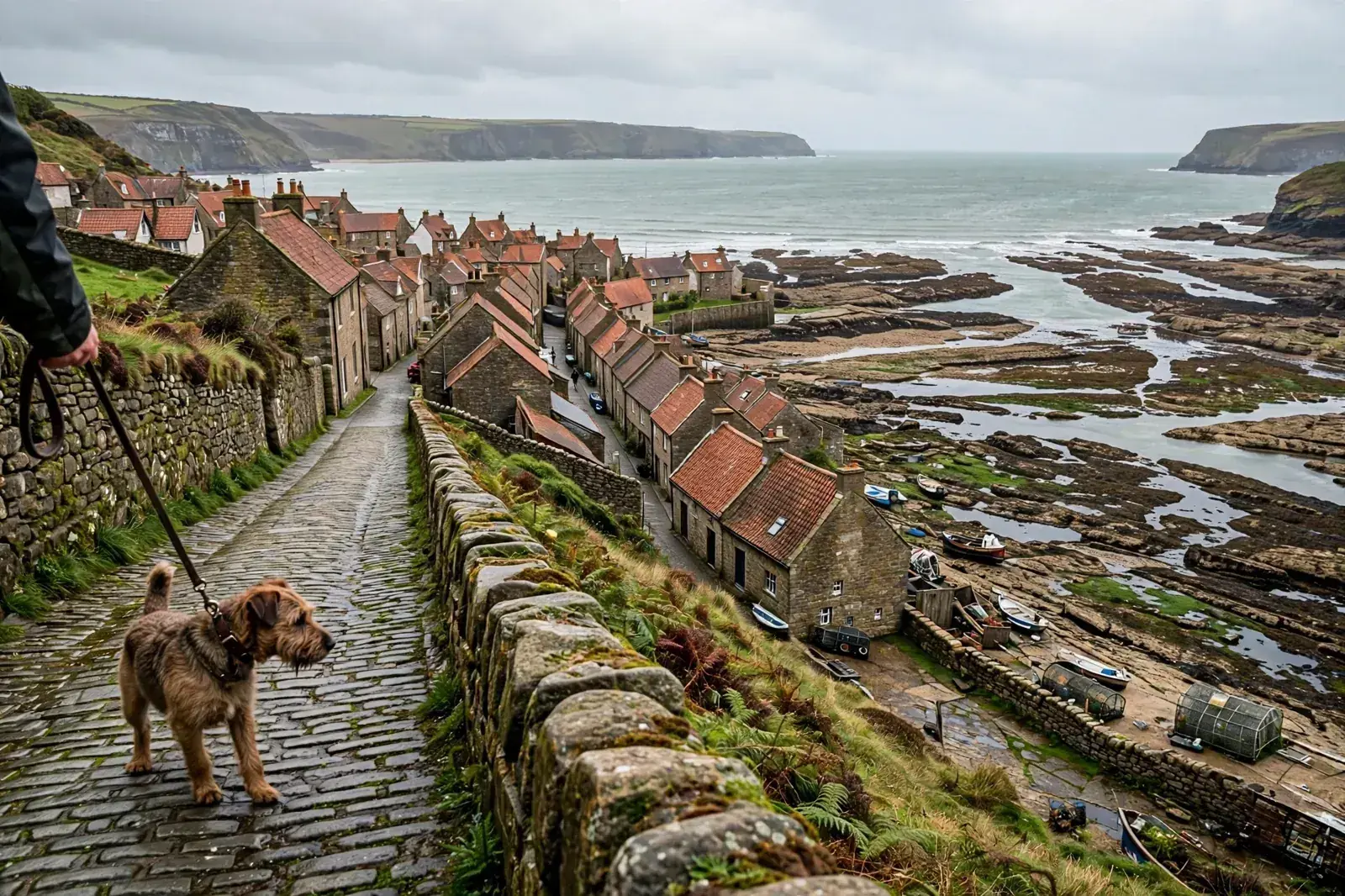
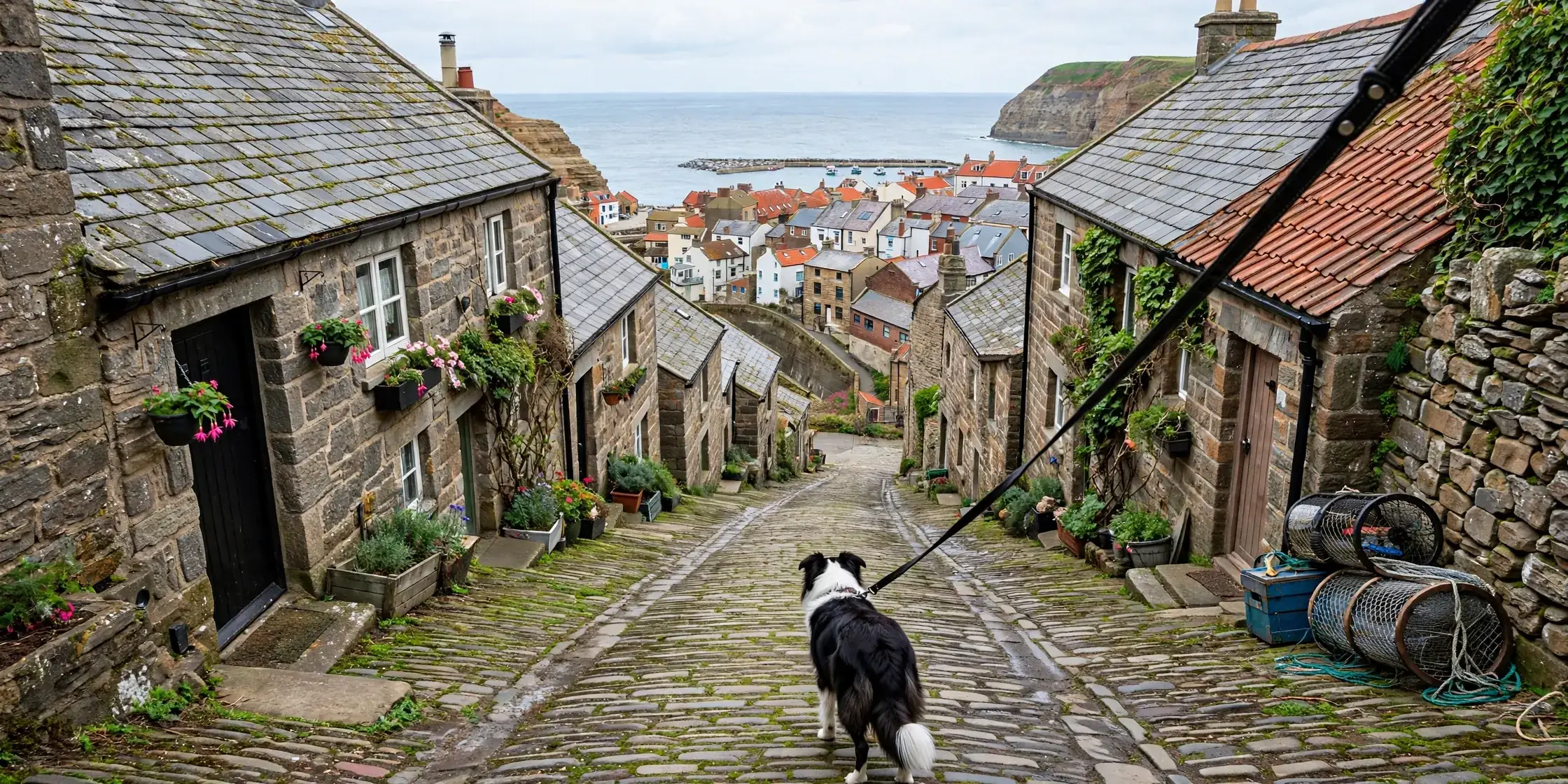
Staithes is not a flat seaside town with a hill added for interest; it is a fishing village that falls steeply from its car parks to its harbour, and every walk here is shaped by that gradient. The lanes are narrow, cobbled and uneven, the cottages crowd close to the path, and the harbour sits at the bottom of it all. For a dog walk, that means the first decision is not where to go but how the dog will cope with slopes, steps and stone. A fit, confident dog will love Staithes: new smells at every turn, a harbour full of boats, and a coast path waiting at the top. A dog that struggles with steps or steep ground will find it hard work, and that honesty matters more here than in any flat resort.
Start by watching the dog on the first slope rather than pushing on to the harbour. Steep descents are harder on a dog's front legs and shoulders than ascents, because weight shifts forward and paws slip on wet cobbles. Keep the lead short, walk slowly, and stop on flat spots rather than on the slope itself. If the dog hesitates, slips or pulls back, take that seriously: a village walk should not begin with a struggle. There is no shame in enjoying Staithes from the upper lanes and viewpoints, where the views are excellent and the gradient is gentler, rather than forcing a full descent and climb.
Footwear and footing deserve attention for both of you. Wear shoes with grip, because Staithes cobbles are slippery when wet, and check the dog's paws after the walk for soreness from rough stone. Small dogs may need to be carried on the steepest, most crowded sections, and that is a practical solution, not a failure. A dog in a carrier or in arms on a short steep stretch, then walking on the flat harbour or beach, has still had a village walk. Plan the route so the steepest sections are walked once, not repeated, and always leave energy for the climb back up.
Staithes with an older or stiff dog
Older dogs, dogs with arthritis and dogs recovering from injury need a different Staithes plan, and it is worth spelling out because the village's charm can tempt owners to overdo it. The full descent to the harbour and back is a significant climb, equivalent to several flights of stairs on uneven stone, and it can leave a stiff dog sore the next day. If your dog is older, consider a shorter visit: a gentle wander in the upper village, a viewpoint stop, and a drive or a rest rather than a full harbour descent. The dog will still have smelled the sea, seen the boats and enjoyed the outing, without paying for it afterwards.
Joint care on the day is practical, not medical advice. Warm the dog up with a flat, easy walk before any slope, keep the pace slow, and avoid letting the dog rush downhill, which loads joints hardest. A harness that supports the chest can help on slopes, and a ramp for car access avoids adding a jump to a day that already includes climbs. After the walk, check how the dog moves, offer a comfortable bed, and keep the evening walk short and flat. If the dog is limping, reluctant to move or unusually quiet the next morning, give them a rest day; a holiday is not a fitness test.
There are still good Staithes experiences for a dog that cannot manage the full village. The upper lanes and the coast path viewpoints offer sea views without the steepest drops, and a short, flat section of the harbour area at low tide, reached with care, can be enough. Talk to the dog's vet before a hilly holiday if the dog has a known joint condition, and bring any prescribed medication. The kindest Staithes day for an older dog is a short, interesting visit with plenty of rest, not a heroic descent that the dog endures rather than enjoys.
The harbour and its tide window
Staithes harbour is small, tidal and working, and its character changes with the water. At low tide, boats sit on the harbour floor, the slipway and the beach are accessible, and the dog can explore the harbour area on a lead with room to move. At high tide, the water comes right up to the harbour walls, the accessible area shrinks, and the walk becomes a viewpoint visit rather than a harbour wander. Check tide times before you go, and time your harbour visit for the falling or low tide if you want the full experience. A harbour visit timed badly is not a disaster, but it is a disappointment that a tide table would have prevented.
Safety around a tidal harbour is specific. Keep the dog on a lead near the water, away from slipways when boats are moving, and well back from harbour walls where there is no barrier. Ropes, lobster pots, fishing gear and bait are hazards for mouths and paws, so steer the dog away from working gear. Gulls are bold in a fishing village, especially where fish are landed, so keep the dog close and do not let it chase birds. If the sea is rough, stay well back from the harbour entrance and the outer walls, where waves can wash over unexpectedly.
The harbour is also where Staithes shows its fishing character most clearly. Boats, nets, cottages and the narrow beck that runs to the sea all give the dog a rich, interesting walk in a small area. Let the dog sniff, but keep moving steadily rather than stopping in bottlenecks where other walkers, residents and fishermen need to pass. A harbour walk works best as a loop: down one lane, around the harbour, and back by a different lane, so the dog sees variety without repeating the steepest section. End the harbour visit with water for the dog and a rest before the climb back up.
Joining the Cleveland Way for one section
Staithes sits on the Cleveland Way, the long-distance coast path that runs along the North Yorkshire coast, and that gives a dog walk here a natural extension. The key word is one section: choose a single, manageable stretch from Staithes, walk it there and back or to a planned stopping point, and return, rather than attempting a long linear walk without transport. The coast path from Staithes offers cliff-top views, open grass and a firm path in places, but it also includes gradients, steps and exposed sections, so check the route and the dog's fitness before committing.
Coast path manners matter. Keep the dog on a lead where livestock is present, near cliff edges and where the path is narrow, and give way to walkers coming the other way on single-file sections. The path can be muddy after rain, and some sections are close to the cliff edge without fencing, so a lead is not optional there. If your dog chases livestock or wildlife, the coast path is not the place to test recall; use a short lead and enjoy the views instead. A dog that walks calmly on a coast path is a pleasure to travel with, and Staithes is a good place to practise that calm, because the views reward slow walking.
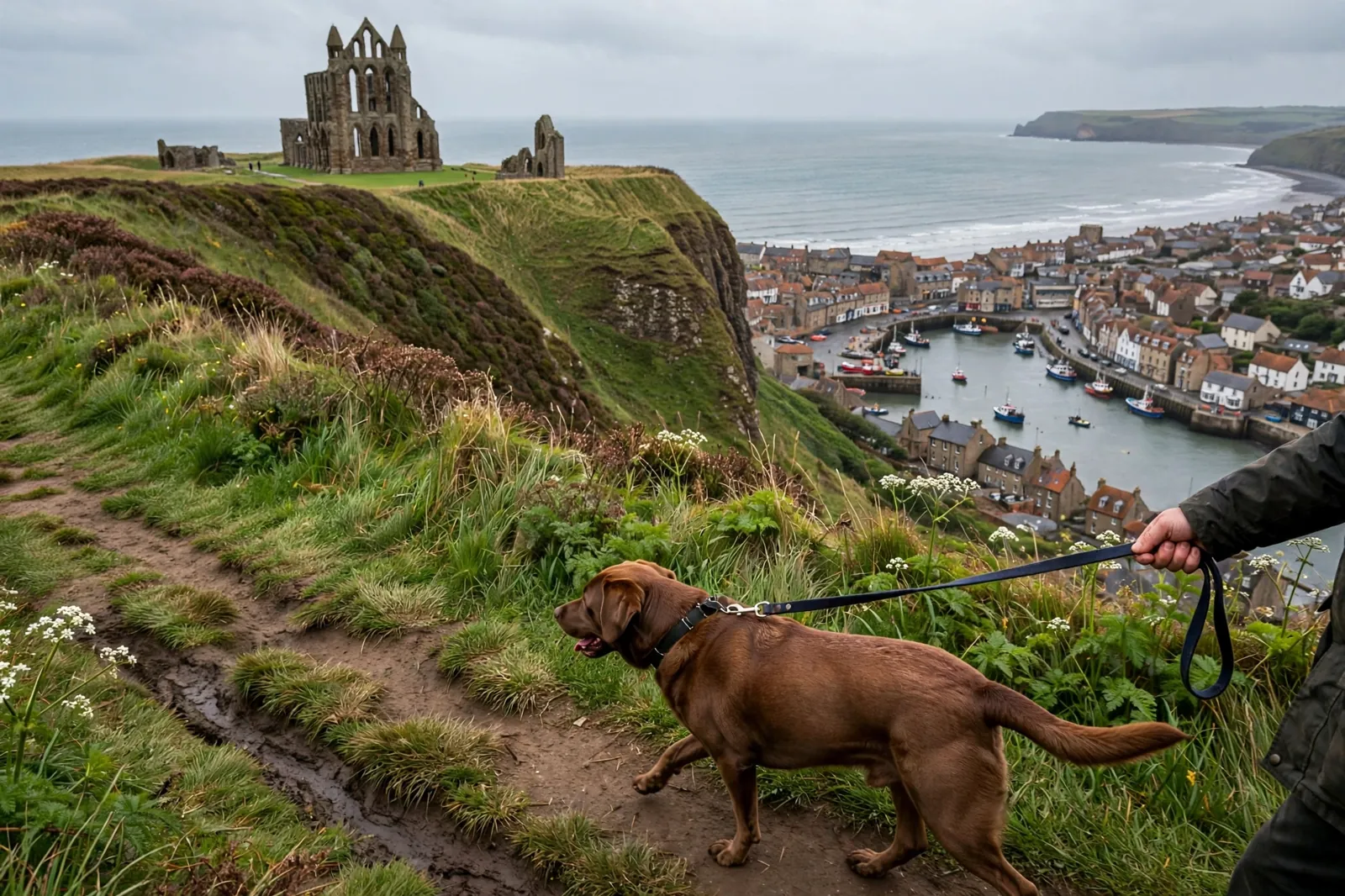
For a longer coastal day, Whitby to the south offers harbour life and a different scale of town, while Robin Hood's Bay to the south-east shares Staithes' steep-village character with its own cobbled lanes. Comparing the villages helps you learn what your dog prefers: Staithes' compact harbour, Robin Hood's Bay's longer beach, or Whitby's busier harbour. Do not stack two steep villages and a long coast path into one day; choose one village and one path section, and let the dog enjoy both properly.
Village life: lanes, cottages and quiet
Beyond the harbour and the coast path, Staithes' lanes themselves are a walk. The village is small enough to explore on foot in an hour, and the lanes offer a constantly changing sequence: a steep cobbled drop, a flat cottage terrace, a glimpse of the sea between roofs, a small beck crossing. Walk slowly, keep the dog on a short lead, and step aside for residents, deliveries and other walkers, because the lanes are also people's streets, not a theme park. A dog that walks calmly through a narrow lane, past cats, other dogs and garden gates, is a dog that is welcome in a village like Staithes.
Respect for residents is part of the walk. Keep the dog off private gardens and doorsteps, pick up immediately, and do not let the dog bark at cottage windows or chase village cats. If a lane is very narrow, wait in a wider spot for oncoming walkers rather than squeezing past with a dog on a long lead. Early morning and late afternoon are the quietest times in the lanes, and they are also the best light for the village's famous coastal views. A quiet lane walk at those hours feels like Staithes itself, rather than Staithes at its busiest.
Eating and drinking in Staithes follows the village pattern: small venues, limited space, and policies that vary by season, so check the official guidance before you travel. A pub or cafe that welcomes dogs may have only a small dog-friendly area, and a busy lunchtime may not suit a dog that needs space. Choose a quiet time, a spot out of the walkway, and bring a portable bowl. A dog that has had a harbour walk and a rest will settle far better than one that is still excited from the descent, so time the food stop after a calm stretch, not in the middle of one.
Parking, access and practical details
Parking in Staithes is at the top of the village, and that single fact shapes the whole visit. You will walk down to the harbour and climb back up to the car, so factor both directions into the plan. Park, give the dog a short flat warm-up on the upper paths, then descend. At the end of the visit, allow time for a slow climb, with rests on flat spots, and keep water for the dog at the car. A tired dog that still has a steep climb ahead is a dog that needs a slower pace, not encouragement to hurry.
Access for pushchairs, wheelchairs and dogs with mobility problems is limited in Staithes, and it is better to know that before you arrive than to discover it on a steep lane. The upper village and some viewpoints are more accessible than the harbour lanes, and a visit that stays high can still be rewarding. If you are travelling with someone who cannot manage steep ground, split the visit: one person walks down to the harbour while the other enjoys the upper village with the dog, or choose a flatter neighbouring town for the main walk and visit Staithes briefly for the views. Staithes is beautiful, but it is not the right village for every visitor on every day.
Pack for a steep village: water, a collapsible bowl, bags, a towel for wet cobbles and harbour spray, and a lead that is comfortable to hold on a slope. Check the weather for the coast, not just inland, because sea mist and wind can arrive quickly. If the forecast is for heavy rain, the cobbles will be slippery and the harbour visit less pleasant; a drier day is worth waiting for. Staithes rewards preparation: a tide table, a route plan, and a dog that is fit for the gradient you have chosen.
Seasons in a fishing village
Staithes changes with the seasons in ways that affect dogs directly. Summer brings more visitors, busier lanes and a livelier harbour, but also more dogs, more children and more temptation for a dog that pulls. Walk early or late in summer, keep the lead short in crowded lanes, and carry water, because steep climbs in heat are hard work. A summer harbour visit at low tide, followed by a shaded rest in the upper village, is a good pattern that avoids the busiest, hottest hours.
Winter gives Staithes back to its residents and its weather. The lanes are quiet, the harbour is atmospheric, and the coast path is dramatic, but wind, rain and short daylight make the village harder. Keep winter walks shorter, use a bright collar or light in poor visibility, and be ready to abandon the harbour visit if the sea is rough. A winter dog that is cold or wet on a steep lane is not enjoying the village, and a warm car at the top is part of the plan, not an afterthought.
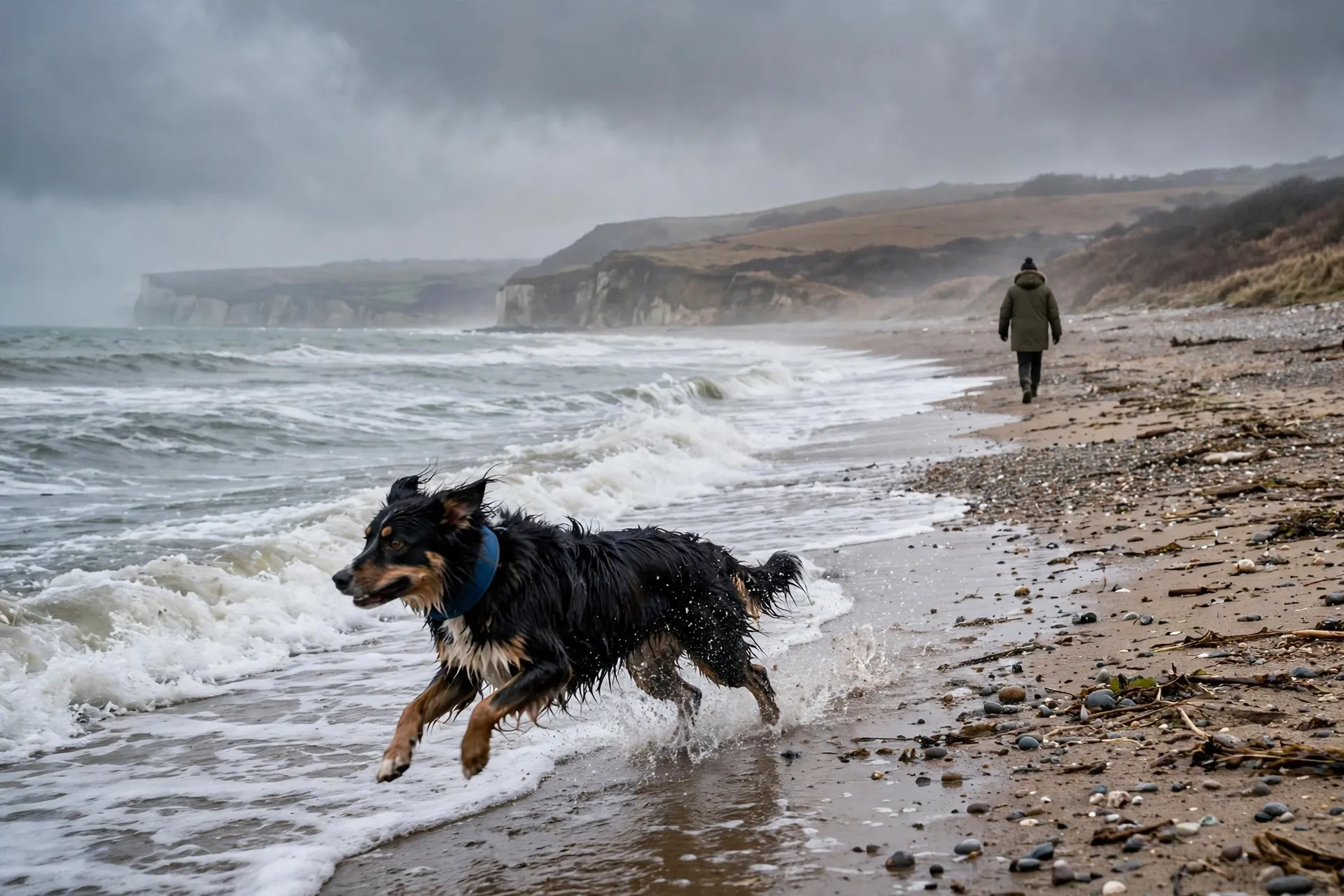
Spring and autumn are often the best Staithes seasons for dogs. The lanes are quieter, the light is beautiful, and the coast path is firm without summer crowds. Spring brings nesting birds to the cliffs, so keep the dog on a lead near cliff edges and respect any signed restrictions. Autumn storms can leave debris on the harbour and beach, so check paws after a storm walk. Whatever the season, the rule is the same: read the village on the day, check the tide, check the wind, and let the gradient decide how far you go.
A Staithes day that works
A good Staithes day starts at the top. Park, warm the dog up on a flat upper path, and descend slowly, stopping on flat spots and letting the dog sniff. Time the harbour visit for low tide if you can, walk the harbour loop, and rest with water before the climb back. By the time you return to the car, you will know how the dog coped with the gradient, and that knowledge should decide the rest of the day: a coast path section if the dog is keen and fit, or a quiet drive and a flat walk elsewhere if the dog is tired.
Midday is for rest, not for a second steep village. If you want a second walk, make it flat: a promenade, a park or a level coastal section, not another set of cobbled lanes. A dog that has climbed Staithes twice in one day is a dog that will be sore tomorrow, and a holiday is better measured in happy days than in completed villages. Use the middle of the day for a calm cafe stop, a rest in the car or the accommodation, and a chance for the dog to sleep.
Finish with a familiar, easy route. The last walk should be short, flat and close to the car or the accommodation, so the dog can toilet, settle and sleep without a steep climb in fading light. Check paws for cobble soreness, offer water, and look over the dog in good light. Staithes rewards this rhythm: down once, harbour at low tide, up slowly, and a calm finish. A dog that ends the day content is a dog that will love the Yorkshire coast's steep villages for years.
Staithes light, artists and quiet corners
Staithes is known for its light, and even a dog walk benefits from understanding why. The village faces the sea, the cliffs frame the light, and the narrow lanes create sudden contrasts between shadow and brightness. For a dog owner, the practical point is simpler: Staithes looks different at different times of day, and the best walks are often early or late, when the lanes are quiet and the light is soft. An early-morning harbour walk, before the day visitors arrive, gives the dog a calm, interesting outing, while a late-afternoon lane walk offers the same quiet with warmer light. Midday in summer, by contrast, can be crowded, hot on cobbles, and harder for a dog that dislikes crowds.
The village's artistic heritage is part of its atmosphere, but it does not change the dog walk much: galleries and studios are small, and many are not places to take a dog inside. Enjoy the village from the lanes, the harbour and the viewpoints, and do not plan a gallery visit around the dog. If you want to visit a gallery, plan it as a separate stop while the dog rests in the car or the accommodation, with shade, water and ventilation. A dog that has had a good lane walk and a rest will not mind a short wait, while a dog dragged through a crowded gallery will not enjoy it.
Quiet corners in Staithes are worth seeking out deliberately. A small garden, a viewpoint above the harbour, a flat terrace in the upper village, or a quiet stretch of the coast path can all serve as rest stops where the dog can drink, sniff and settle. Build these stops into the walk rather than walking from sight to sight without pause. A dog that rests every twenty minutes on a steep village walk will cope far better than one that is marched from car park to harbour without a break. Staithes rewards a slow pace: the lanes, the light and the harbour are all best enjoyed when the dog is allowed to stop, sniff and look, and the walk becomes a shared experience rather than a route to complete.
Practical questions
Before you go
Is Staithes suitable for older dogs?
Only with care. The village is steep with cobbled lanes, so older dogs and dogs with joint problems should enjoy the upper village and viewpoints rather than a full descent and climb. Warm up on flat ground and keep the pace slow.
When should I visit Staithes harbour with a dog?
Time the visit for low or falling tide, when the harbour area and beach are most accessible. Check tide times before you go, and avoid the harbour in rough seas or fading light.
Can dogs walk the Cleveland Way from Staithes?
Yes, for one manageable section. Keep the dog on a lead near cliff edges and livestock, check the route and distance first, and plan a there-and-back walk rather than a long linear route without transport.
Where do I park for Staithes with a dog?
Parking is at the top of the village, so every visit includes a descent and a climb back. Allow time and energy for both directions, and keep water at the car.
Are dogs welcome in Staithes pubs and cafes?
Many venues welcome dogs, but space is limited and policies vary by season. Check before you sit down, choose a quiet time, and keep the dog out of walkways.
What should I check after a Staithes walk?
Check paws for soreness from cobbles, look for limping after steep descents, and offer water and rest. If the dog is stiff the next morning, give them a flat, short day.