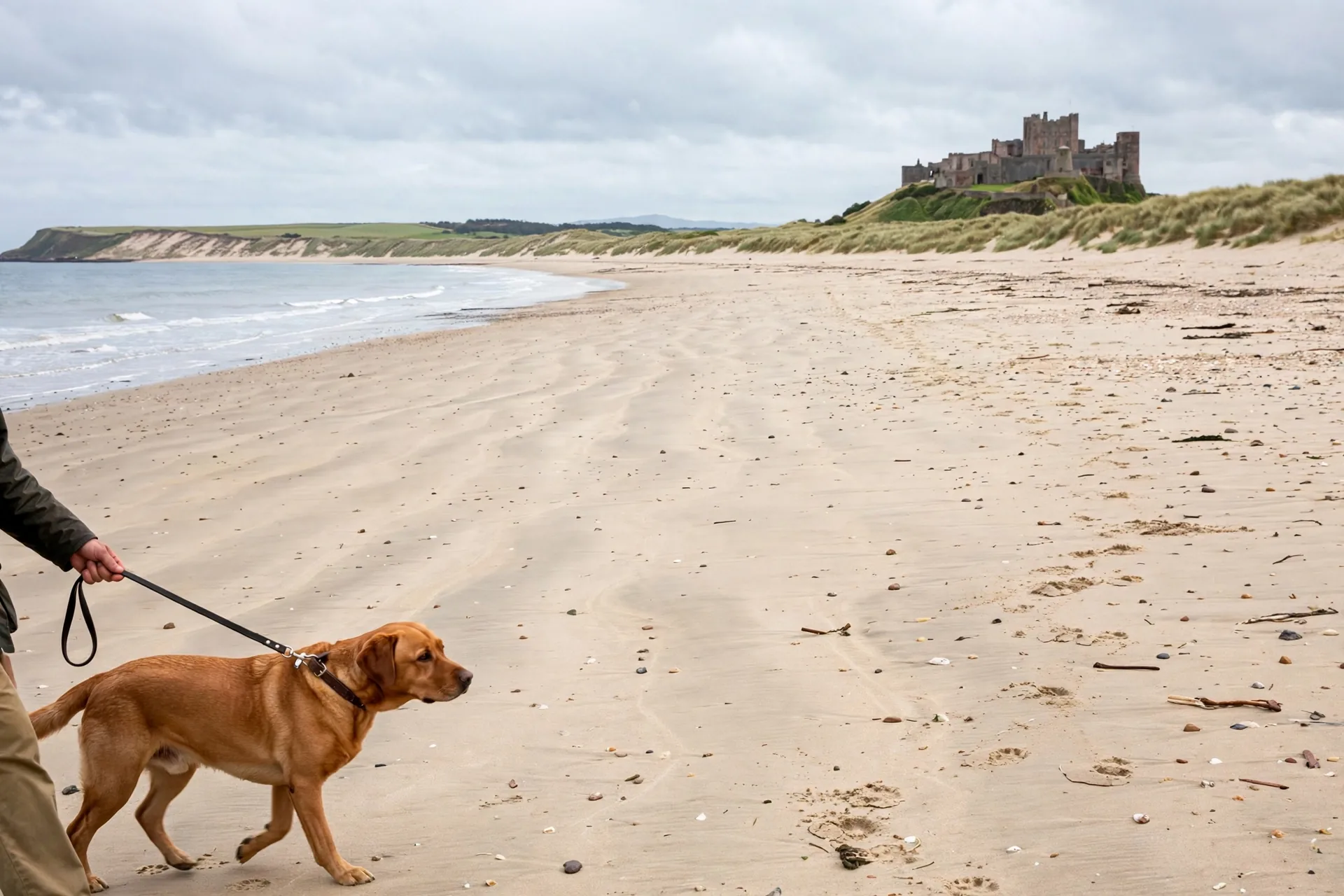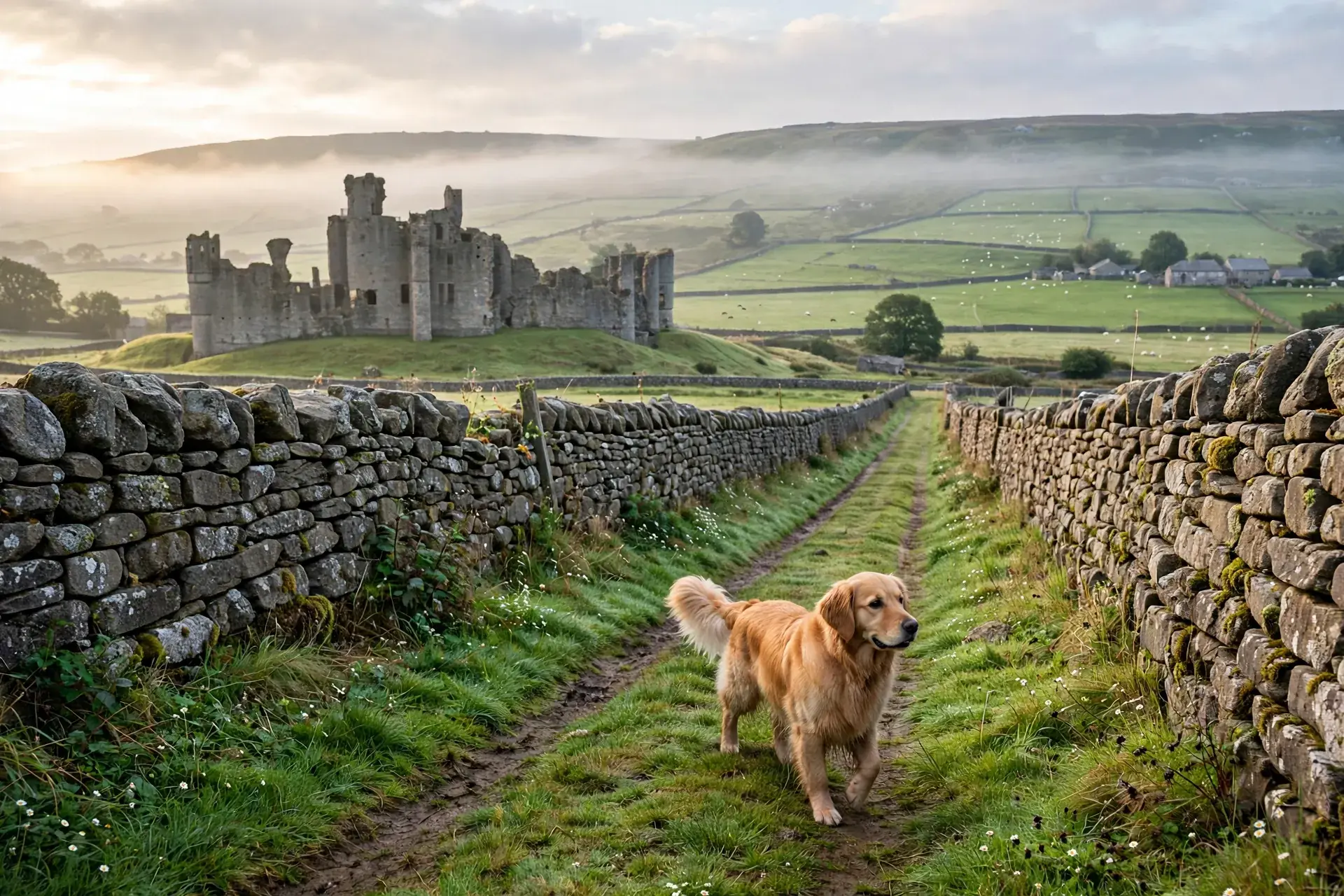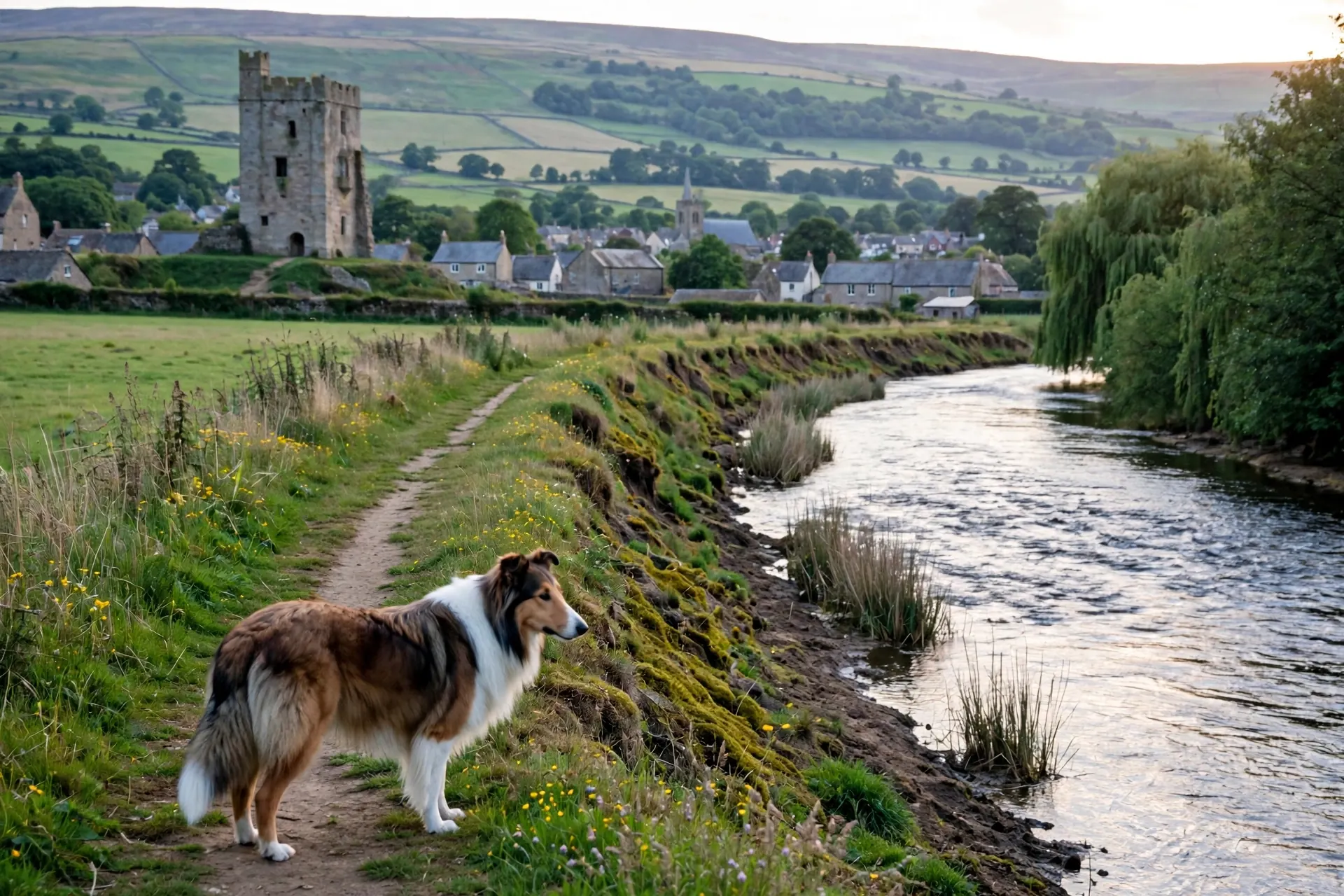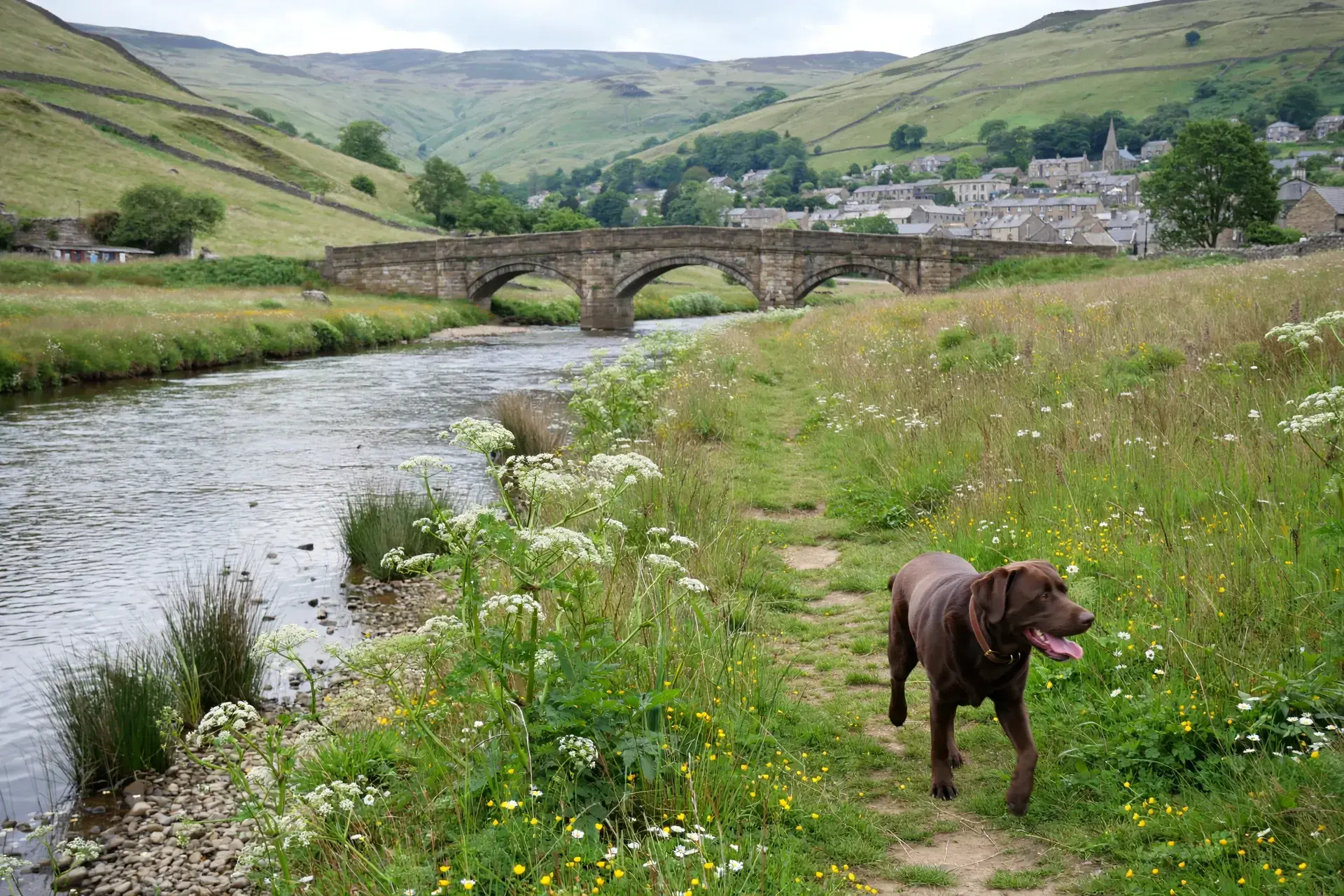
This guide is independent and contains no paid placement. If affiliate links are added later, they will be clearly marked and will not change our editorial checks.
Give Stanhope one full family day and let the river set the pace. Start early on the level meadow beside the Wear, eat in the town at midday, spend the afternoon on fossils and mining heritage, and finish with a short valley lane before dark. Use the short riverside loop for an older dog, the middle Wear walk for a normal family day, and the long valley stretch only for a fit dog on a dry day. Sheep graze the meadows and the open moor, so a lead stays close whenever livestock are in sight, and the river is for careful paddling at chosen shallow places, never for swimming near weirs or fast water.
One day in Stanhope: the family timetable
Stanhope rewards a family that arrives with a timetable rather than a list of sights. The town sits on the floor of Weardale, where the River Wear bends past stone terraces, a market place and a handful of pubs, and the valley is wide enough here for a dog to walk on level ground for most of the day. That flat valley floor is the reason this guide is organised as a day plan instead of a catalogue of walks: a family with children, a picnic, a pram or an older dog can follow the same hours in the same order and still finish the day tired in a good way, while a fitter group can stretch each block a little further without changing the shape of the day. The hours below are built around the light, the river and the town, and they assume a car parked in the centre, a lead in a pocket, water in a bag and a towel in the boot.
Before nine: the quiet river hour
Begin before nine, when the market place is still quiet, the light is low across the meadows and the river belongs to herons, ducks and the first dog walkers of the morning. Walk down one of the lanes from the centre to the Wear and follow the riverside track in either direction for twenty or thirty minutes, letting the dog sniff the morning out of the grass while the children wake up properly. This is not the moment for a long march or a swim. It is a loosening walk, a chance to check paws, test how the dog settles beside water, and learn which stretches of bank are firm and which are soft after rain. Bring a pocket of treats and a short lead, because the path runs close to the water in places, and a dog that pulls towards ducks or a moorhen can be at the bank edge before anyone has finished a sentence. Turn back at the first bridge or field gate, return to the car or the accommodation for breakfast, and let the dog drink, rest and dry off while the family plans the rest of the day with a map rather than a phone screen.
The early hour also solves the two problems that catch families later in the day. The first is parking: the small central car parks fill by late morning on market days, summer weekends and the days when the heritage railway is running, so a car already parked before nine removes a whole layer of circling and compromise. The second is the dog's energy curve: a dog that has had a calm river walk, a drink and a rest is far easier to settle under a pub table at lunchtime than a dog that has been waiting in a car or a cottage while the family faints with indecision. If the morning is frosty, keep the first walk even shorter and stay on the surfaced or firm grass rather than the shaded, icy edges of the path. If it has rained overnight, expect the low meadow to be soft underfoot, check the river colour before letting a dog near the edge, and treat brown, fast water as a sign to stay on the higher lane and save the riverside for later in the day.
Mid-morning: the meadow stretch and the first decision
Between nine and eleven, after breakfast, take the longer meadow walk that forms the backbone of the day. This is the walk described in detail in the next section, and the family should choose its length now, honestly, rather than halfway along it. A short loop suits a puppy, an older dog, a child who tires quickly or a day when the ground is wet. A middle-distance walk suits most families: far enough to feel like a proper outing, close enough to the town that a tired leg or a sore paw is never more than a short walk from a bench, a road or a cafe. The long valley stretch is for a fit dog, dry ground and a family that has already eaten well and packed water. Whatever length is chosen, walk it as an out-and-back rather than a loop when the dog is untested, because an out-and-back lets the family turn at the first sign of tiredness without having to complete a circuit. Carry a collapsible bowl and water even on the short walk, because the Wear is not a reliable drinking source for a dog: peaty moorland water, farm run-off and old mining ground all argue for carrying clean water instead of letting a dog drink from every pool and ditch.
Mid-morning is also the time to watch the dog rather than the map. A dog that is lagging, panting heavily, limping slightly or choosing shade over sunshine is telling the family something, and the right response is to shorten the walk, find a bench and let the dog rest in the grass. Children often want to keep going because the path looks inviting, so agree the turning point before setting out and make it a visible landmark, a bridge, a gate or a big tree, rather than a time or a distance that nobody can judge. The meadows are working farmland, and sheep may be grazing right down to the water, so the dog stays on a lead through the grazed fields, gates are closed behind the family, and nobody cuts across the middle of a field to save a few minutes. In spring the meadows hold lambs and ground-nesting birds, which is exactly when a loose dog can cause the most harm in the least time, so spring walks need the lead most of all, even when the fields look empty at first glance.
Midday: the town at its most useful
Come back into the town for lunch, roughly between twelve and two, and let Stanhope do what a market town does best: feed people, water dogs and give everyone a dry seat. The pubs and cafes around the market place and the main street are the subject of a later section, but the timetable matters here, because a dog that arrives at a pub after a good walk and a rest settles far more easily than a dog that arrives straight from a car journey. Choose a table in a bar area or on outside seating where dogs are expected, ask at the door about the room rules if the layout is unclear, and settle the dog on a mat or a blanket under the table with a chew. Keep the lead short enough that the dog cannot reach the next table, and keep a water bowl within reach rather than on the floor in a walkway. A family that eats early, before the lunch rush, usually finds a quieter corner and a calmer dog; a family that arrives at one o'clock on a fine Saturday should expect a wait, a busier room and a dog that needs more management.
Use the lunch hour for the practical jobs that are harder on a path. Check paws for grit, thorns and mud, especially between the toes, and dry the coat if the river walk was wet. Check the weather forecast again, because Weardale weather changes quickly and the afternoon plan depends on it: a dry, bright afternoon suits the fossil and mining ground and the higher lanes, while a grey, drizzly afternoon suits the heritage railway area, a short valley lane and an early return to the accommodation. Buy anything the family still needs, from dog treats to a spare lead, while the shops are open, because the town's range is useful but not endless, and specialist food or medicine should already have been packed from home. Save the number of the nearest vet, in Bishop Auckland or Durham, in a phone before leaving the town, and note where the car is parked, because a tired family at the end of the day does not want to hunt for a car park in the dark.
Afternoon: fossils, mines and a slower pace
After lunch, between two and four, the day slows down and turns towards the story of the dale. Stanhope is famous among fossil hunters for the fossilised tree stumps in the riverbed and for the lead-mining landscape that shaped the valley, and the afternoon is the right time for that slower, looking-and-pointing kind of walk, because the light is better for spotting stone, the dog has already had its main exercise, and the family can stop often without feeling that a long walk is slipping away. The fossil and mining section below explains where the public paths run, what the rules are for dogs around old workings, and why a dog should stay on the path and on a lead near shafts, spoil heaps and fenced ground. Treat this block as a short, curious outing rather than a second long walk: an hour or so of looking, a few photographs, a bench and a drink, and then a decision about whether the dog has another walk in it or whether the afternoon is better spent on a short lane and an early finish.
Children often enjoy the afternoon most, because fossils and old mines give them something to search for, but the search needs boundaries. Agree before setting out that nobody climbs a spoil heap, nobody enters a fenced area, nobody digs at an exposure and nobody lets the dog off the lead near a shaft or a steep drop. The dog, meanwhile, needs the opposite of excitement: a steady pace, a short lead and a clear job, which is simply to walk beside the family and sniff the verge. A dog that is allowed to range ahead on the mining ground is a dog that can be out of sight near a fence or a hole before anyone notices, so the afternoon is a long-line or short-lead block, not a free-running one. If the weather turns during the afternoon, do not push on to finish a planned route. Turn back to the town, use the rainy-day ideas later in this guide, and remember that the fossil ground and the mining paths will still be there on a drier visit.
Late afternoon and evening: the short lane home
Between four and six, take the last short walk of the day, a lane or a riverside stretch close to the centre, and then stop. This is the walk that lets the dog empty, stretch and settle for the evening, and it should be the easiest walk of the day, not a final challenge. A level lane towards Frosterley, a short stretch of the Wear, or a quiet loop around the edge of town all work, provided the route is short, familiar and close to the car or the accommodation. Keep the dog on a lead on the lanes, because traffic is light but fast, farm vehicles use the same roads, and dusk comes early in the valley, especially in autumn and winter. A high-visibility item for the dog is worth its small weight if the family is still out as the light fades, and a torch in a pocket is better than a phone torch held in a cold hand.
Evening in Stanhope is a quiet affair, and that suits a tired dog. Eat early if the family is eating out again, or cook at the accommodation and let the dog sleep by the fire or the radiator while the family plans the next day. Check the dog once more before bed: paws, ears, coat, ticks, and any stiffness after a long day. A dog that was stiff after the morning walk will be stiffer after a night of rest, so a short, gentle first walk the next morning matters more than a long one. If the family is staying for a second day, use the evening to choose between the Wolsingham and Frosterley trips described later in this guide, rather than trying to fit both into one tired afternoon. One valley trip a day, done well, beats two rushed trips, and the dog will show the difference in the morning.
The Wear in three lengths: short, middle, long
The River Wear at Stanhope is not one walk but three, and the family should pick the length that fits the dog in front of them rather than the distance they wish the dog could manage. All three use the same valley floor, the same meadow grass and the same river, but they differ in time, surface, exposure and the number of decisions the family has to make. The short walk is a town walk with a river in it. The middle walk is a proper valley outing that still stays close to help. The long walk is a half-day commitment that needs water, food, a map and a plan for getting back. None of them needs the moor, and none of them should be attempted as a first walk with an untested dog. Walk the short one first, learn the dog's pace and the river's mood, and only then stretch to the middle or the long version on another day.
The short walk: forty minutes on level meadow
The short walk is the loop the family will use most often, and it deserves to be learned well. From the town centre, drop to the river by one of the quiet lanes, follow the riverside track for twenty minutes in one direction, cross by a bridge or a firm ford-side path where one exists, and return along the opposite bank or the same track, depending on the ground. The whole outing takes about forty minutes at a dog's pace, with stops for sniffing, a drink and a photograph, and it stays on level ground throughout, which is why it suits a puppy, an older dog, a dog recovering from an injury, a child in a pushchair, or a family that simply wants a gentle start or finish to the day. The surface is a mix of worn grass, earth and, in places, a firmer track, so after rain the grass is soft and the low spots hold water; after a dry spell it is firm and fast. Wear shoes with grip, because the riverside grass is slippery even in summer, and keep a towel in the car for a dog that has found the muddiest stretch of bank.
On the short walk, the lead rules are simple and worth following exactly. Keep the dog on a lead through any grazed meadow, near the water where the bank is steep, and wherever ducks, moorhens or herons are feeding in the shallows. Let the dog off only where the ground is open, the river is far from the path, no livestock are in sight and the recall is reliable, and even then keep the dog in sight at all times, because a dog that chases a bird across a meadow can be in a sheep field before the family has crossed the first gate. Paddling belongs to the short walk only at a chosen place: a slow, shallow entry where the bank slopes gently, the water is clear enough to see the bottom, and the current is barely moving. Wade in first, check the depth with a stick or a boot, and let the dog paddle for a few minutes rather than swim. Never let a dog enter the water near a weir, a bridge pier, a fast run after rain or a place where the bank drops away suddenly, and never throw a ball or a stick into moving water, because a dog that chases a toy downstream is a dog in danger within seconds.
The short walk also teaches the family the river's wildlife calendar. In spring, ducks and moorhens nest in the reeds and along the banks, and a dog that crashes through the reeds can destroy a nest in a moment, so spring short walks need the dog on a lead for the whole riverside stretch, not just near the sheep. In summer, the meadows are hayed, the grass is long, and ticks hide in the stems, so check the dog's ears, belly and legs after every walk, and carry a tick remover in the kit. In autumn, fallen leaves carpet the path and hide holes, roots and mud, so a small dog needs watching where it steps, and a larger dog needs a lead on the leaf-covered banks. In winter, the short walk is still possible on a frosty morning, but the shaded edges stay icy, the river runs cold and clear, and the family should keep the walk short, the dog dry, and the return to the car or the accommodation prompt. The short walk is the family's home circuit, and it is worth repeating daily, because a dog that knows a route settles faster, sniffs less frantically and walks more calmly each time it follows it.
The middle walk: two hours along the valley floor
The middle walk turns the short loop into a proper outing, roughly two hours including stops, and it follows the Wear upstream or downstream from Stanhope along the valley floor, using riverside paths, meadow tracks and quiet lanes. Upstream, towards Westgate and Eastgate, the valley narrows slightly, the river runs a little faster, and the old railway line and the woodland give the walk a more enclosed feel, with the moors rising on both sides. Downstream, towards Frosterley and Wolsingham, the valley widens, the river slows, the walking is easier, and the villages give the family places to aim for, a pub, a bench or a bridge to turn at. Either direction works, and the family should choose the one that suits the wind, the light and the dog's energy: upstream into the wind in the morning and back with the wind behind, or downstream on a day when the family wants an easy return and a pub at the turning point.
The middle walk needs more planning than the short one, and the planning is what makes it enjoyable rather than tiring. Pack water and a collapsible bowl, a few treats, poo bags, a towel and a basic first-aid kit, and wear layers, because the valley floor is sheltered and warm while the open meadow is exposed to wind, and the temperature can change by several degrees between a wooded stretch and an open field. Tell someone the planned direction and the expected return time if the family is walking alone, and carry a charged phone with offline maps, because the riverside path is clear but the meadow tracks can be faint after haymaking, and a family that takes a wrong turn in a large field can add half an hour to a walk without noticing. Walk the middle distance as an out-and-back on a first attempt, turning at a bridge, a village or a clear landmark, and save a one-way walk for a day when transport back is already arranged, because a tired dog at the far end of a valley walk is a problem that is easy to prevent and hard to solve on the spot.
On the middle walk, the dog's needs change with the distance. A dog that is fit for forty minutes may not be fit for two hours, and the signs of tiredness appear gradually: a slower pace, a heavier pant, a reluctance to leave the shade, a slight limp that disappears after a rest and returns after ten minutes. Stop every half hour for water and a rest, let the dog lie in the grass, and check paws for sore pads, grit and thorns. Keep the dog on a lead through every grazed field, near every farmyard and road crossing, and wherever the path passes close to the river on a high bank. The middle walk passes other walkers, cyclists and, in places, horse riders, so a dog that chases wheels needs a short lead at every blind bend and bridge, and a dog that is nervous around other dogs needs space, a calm voice and a decision to step aside rather than to push through a narrow stretch. The reward for that care is a walk that shows the dale at its best: the river changing from fast to slow, the meadows opening and closing, the hills moving from near to far, and a dog that returns to the town tired, content and ready to settle.
The long walk: a half day for a fit dog on a dry day
The long walk is a half-day valley walk, four hours or more including stops, and it should be treated as an expedition rather than an extension of the middle walk. It follows the Wear further up or down the dale, often using the Weardale Way, the long-distance trail that runs through Stanhope, and it needs the same preparation as any long-distance section: a map, a charged phone, water and food for the dog and the family, layers, a waterproof, a first-aid kit, and a clear plan for the return, whether that is an out-and-back, a circular route, or a one-way walk with a lift or a bus at the far end. The long walk is for a fit, experienced dog, dry ground, a settled forecast and a family that has already walked the middle distance without difficulty. It is not for a puppy, an older dog, a dog with a sore paw, a day after heavy rain, or a day when the forecast promises a change in the afternoon, because the valley is long, the facilities are few, and a tired dog cannot be carried back along a riverside path.
On the long walk, the valley reveals its working character. The path passes farmyards, fields, woodland, old railway ground and villages, and the dog must be on a lead at every farmyard, road crossing, grazed field and stretch where the path runs close to the river on a steep bank. The surface varies from firm track to soft meadow to muddy gateways, and after rain some stretches hold water for days, so waterproof boots and a drying coat for the dog are not luxuries but necessities. The Weardale Way is a useful spine for the long walk, and our guides to Northumberland and Middleham describe other long-distance walking country where the same lead, livestock and water rules apply, but the family should still check the official guidance before you travel for the current condition of any long-distance section, because a path that was firm in summer can be closed, diverted or waterlogged in winter. Carry more water than the family thinks it needs, because the Wear is not a safe drinking source, moorland streams can be peaty or run through old mining ground, and a dog that drinks from a ditch can be ill for days afterwards.
Know when to turn back on a long walk, and make that decision early. If the dog is lagging, if the river is rising, if the weather is turning, if a paw is sore, or if the family is already tired at the halfway point, turn back, because the second half of a long walk is always harder than the first, and a family that pushes on to finish a planned distance often finishes with a lame dog, a tired child and a long, unhappy return. The long walk is best in late spring, summer and early autumn, when the days are long, the ground is firm and the river is low, and it is best avoided in the depths of winter, when the days are short, the ground is frozen or waterlogged, and the valley roads can be icy. A long walk done well, on a dry day, with a fit dog and a clear return plan, is the walk the family will remember; a long walk done badly, on a wet day, with an unfit dog and no plan, is the walk that puts the family off Weardale for a year.
Fossils, lead mines and the old railway
Stanhope is known far beyond Weardale for two things that sound unrelated but share the same stone: the fossilised trees in the River Wear and the lead mines that once employed the valley. The fossil story begins about 300 million years ago, when this part of England lay near the equator and was covered by swampy forests, and the trees that fell into the swamp were buried, mineralised and preserved as stone. Much later, the Wear cut down through those rocks and exposed the fossilised stumps in its bed, and Stanhope became a place where visitors could see, in the river itself, the remains of a forest that grew long before the valley existed. The mining story is more recent and more visible: for two centuries, lead was mined from the hills around Stanhope, the ore was smelted and carried down the valley, and the villages, the railways, the lime kilns and the stone terraces were built to serve that industry. The two stories meet on the same paths, because the miners' tracks, the old railway and the riverside walks all cross the same rocks, and a family that walks the fossil ground is also walking through industrial history.
The fossilised stumps are best seen when the river is low, usually in late summer or after a dry spell, when the water drops enough to reveal the dark, rounded shapes in the riverbed. They are not a museum exhibit with a fence and a label, but a natural exposure in a working river, and that is part of their interest and part of the care they need. Look from the bank or from a firm, shallow place at the edge, take photographs, and explain to children that the shapes are the remains of real trees, not carved stone. Do not let a dog wade across the exposure, do not let anyone stand on the stumps, and do not dig at the riverbed or the banks, because the exposure is fragile, the river can rise quickly, and a dog that slips on the smooth, wet stone can be in fast water before anyone can reach it. The fossil ground is a looking place, not a playing place, and the dog's job there is to sit or stand on the bank, on a lead, while the family looks. If the river is high, brown or fast, the stumps will be under water anyway, so save the visit for a low-river day and use the time instead for the mining paths on the higher ground.
Other fossil hunting in the Stanhope area needs a different kind of care. The rocks around the town contain plant fossils and, in places, marine fossils from the ancient seas that covered the region, but collecting is not a free-for-all. Some exposures are on private land, some are in quarries or cuttings where access is restricted, and some are protected, so the family should check the official guidance before you travel about where collecting is allowed, what can be taken, and what should be left in place and photographed instead. A responsible fossil hunter takes only loose material from a place where collecting is permitted, leaves the exposure itself intact, and records where a find came from rather than pocketing it without a note. Children should be told the same rule in simple terms: look, photograph, ask, and only take what an adult has checked is allowed. A dog has no part in fossil collecting, and it should not be allowed to dig at an exposure, climb a spoil heap or nose around a quarry edge, because the ground is unstable, the stones are sharp, and a dog that digs can damage a fossil and injure a paw in the same moment.
Lead mining: reading the landscape with a dog
The lead-mining landscape around Stanhope is best read as a series of clues, and the family can learn to spot them on a short walk. Look for the flat, grassy mounds of spoil heaps, softened by grass but still distinct from the natural hillside, and for the remains of engine houses, chimneys and flues, often reduced to stone walls and foundations. Look for the lime kilns on the hillsides, built to burn limestone for the farms and the mines, and for the miners' cottages in the villages, small stone houses built in rows for the men who worked the mines. Look, too, for the lines of the old tramways and miners' tracks, level paths that cut across the hillside where horses once pulled wagons of ore, and for the hedges and walls that mark the boundaries of the old mine workings. The paths that follow those tracks are often level and well graded, because they were built for horses and wagons rather than walkers, and dogs benefit from that, but the ground beside the path is not a playground, and the family should stay on the marked route.
The rules for dogs on the mining ground are stricter than on the riverside, and they exist for good reasons. Old mine shafts and adits, the horizontal entrances into the hillside, are mostly fenced or capped, but the fences are not dog-proof, the caps can be hidden by grass, and a dog that slips through a gap or over a low wall can be in danger before anyone notices. Spoil heaps look inviting to a dog that likes to climb, but they are unstable, sharp and sometimes contain old metal, glass and mine waste, so a dog should not be allowed to climb or dig on them. The streams that run through old mining ground can carry metals from the spoil, and they are not safe drinking water for a dog, so carry clean water and keep the dog from drinking from any stream that runs past a spoil heap or a mine building. Keep the dog on a lead on the whole mining walk, keep it on the path, and keep it in sight at all times. If a child wants to explore a ruin, the dog stays with an adult on the path, because a dog that follows a child into a ruined building can be cut on broken stone or trapped in a dark corner.
The mining heritage also includes the buildings and museums that tell the story indoors. Some heritage centres and museums in Weardale welcome dogs, some welcome them only in certain rooms or outside areas, and some do not admit them indoors at all, so the family should check the official guidance before you travel rather than assuming a dog can go inside. A useful pattern is to visit a heritage centre in two parts: one adult stays outside with the dog while the other looks inside, and then they swap, so the dog is never left tied outside alone and nobody misses the visit. The Weardale Railway, the heritage line that runs along the valley from Stanhope towards Bishop Auckland, is part of the same story, and dogs have been welcome on its trains in the past, although the rules can change between seasons, so check the official guidance before you travel if the family plans to ride. Keep the dog on a lead at the station, on the platform and near the running line, and do not let it wander onto the trackbed where trains operate, because a heritage railway is still a working railway, and the rules that apply on a main line apply there too.
Pubs, cafes and places to stay
Stanhope's pubs and cafes are the town's living rooms, and a family with a dog will use them more than any other indoor space in Weardale. The town has a good range for its size, with pubs around the market place and the main street, cafes that serve the food walkers need, and shops that cover the basics for a self-catering stay. Most of the pubs welcome dogs in their bar areas, usually with a water bowl and a fire in winter, and several have outside seating in summer where a dog is always welcome. The cafes are equally useful, serving hearty breakfasts, soup, sandwiches and cake, and several welcome dogs indoors, which makes a cafe stop a practical drying station as well as a meal on a rainy day: towel the dog down outside, let it warm up, and check paws for grit before the next stretch. Policies vary by room and by season, and a pub that welcomes dogs in the bar may not welcome them in a dining room, so ask at the door, respect a signed rule, and choose a table where the dog is expected rather than tolerated.
Eating out with a dog is a skill, and Stanhope is a good place to learn it, because the rooms are small, the tables are close together, and the other customers are often dog owners themselves. Bring a mat or a blanket for the dog to lie on, a chew to keep it occupied, and a lead short enough that the dog cannot reach the next table or the walkway. Settle the dog before ordering, and give it a drink before the food arrives, because a thirsty dog is a restless dog. Keep the dog on the floor, not on a chair, and never let it approach another table uninvited, however friendly it seems, because not everyone wants a dog at their elbow while they eat, and a child at the next table may be nervous. Clean up any mess immediately, and if the dog barks at every arrival, choose a quiet corner table, an off-peak time, or takeaway food eaten on a bench by the river instead. A pub that has had a bad experience with one dog can change its policy for all of them, so a family that leaves a pub clean, quiet and calm is doing every dog owner who follows a favour.
Lunchtime in Stanhope needs a little planning, especially on market days and fine weekends, when the pubs and cafes fill by late morning and a family that arrives at one o'clock may find a wait. Eat early, before twelve, if the family wants a quiet corner, or eat late, after two, if the family wants a slower room and a dog that has already had a rest. Order simply and quickly, because a dog that waits an hour for food is a dog that becomes bored, and a bored dog in a small pub is a dog that barks, paces and pulls. If the family has a reactive dog, a dog that barks at other dogs, at children or at sudden movement, choose outside seating where there is space, or takeaway food, rather than a crowded bar. If the dog is calm and settled, a pub lunch is one of the pleasures of Weardale: a fire in winter, a garden in summer, a bowl of water, a mat under the table, and a dog that sleeps through the meal while the family eats. The town's pubs also serve as useful landmarks for walkers, because a pub at the end of a walk gives the family a destination, a rest and a reason to walk a little further, and a pub at the start of a walk gives the dog a chance to settle before the car journey home.
Staying overnight with a dog in Stanhope
Stanhope suits an overnight stay with a dog, because the town is quiet at night, the river walks start from the door, and the accommodation is mostly small and personal rather than large and formal. The options include self-catering cottages, bed and breakfasts, small hotels and pubs with rooms, and the family should choose the kind that fits the dog rather than the kind that looks best in a photograph. A self-catering cottage with a garden or a yard suits a dog that needs an early-morning and late-night toilet break, because the family does not have to dress and walk to a field in the dark. A bed and breakfast suits a family that wants breakfast cooked and a host who knows the local walks, but the family should check whether the dog can be left in the room, whether there is a garden, and whether breakfast is in a room where dogs are allowed. A pub with rooms suits a family that wants to eat and sleep in the same building, but the family should check whether the dog is allowed in the bar in the evening and whether the room is quiet enough for a dog to sleep.
Book the dog in as carefully as the people, and tell the host the dog's size, breed, age and behaviour before arriving, because a host who expects a small, calm dog and meets a large, lively one will not be pleased, and a host who knows the dog in advance can prepare a suitable room, a water bowl and a place to dry a wet coat. Ask about the rules for leaving a dog alone in the room, because many places do not allow it, and a dog that is left alone in a strange room may bark, scratch a door or chew furniture. Ask about the garden or the nearest field for a toilet break, and about where to dry a wet dog, because a dog that comes back from a river walk soaking wet needs a towel and a warm place, not a carpeted bedroom. Bring the dog's own bed or blanket, its usual food, a spare lead, a towel, poo bags and any medicine, because the town's shops cover the basics but not specialist food, and a dog that eats a different food on holiday can have an upset stomach for days. On arrival, walk the dog around the garden and the nearest lane before unpacking, so the dog learns where it can toilet and where the boundaries are, and settle it in its bed with a chew while the family unpacks.
Staying in Stanhope also means living with the valley's sounds and smells, which are part of the pleasure and part of the adjustment. The river is audible from many houses in the town, farm vehicles pass early in the morning, and sheep and birds are part of the dawn chorus, so a dog that is used to a quiet suburb may be alert for the first night and settle on the second. Keep the dog's routine as close to home as possible: the same feeding times, the same walk times, the same bedtime, and the same commands, because routine is what tells a dog that a strange house is still a safe place. If the family is staying for several days, use the first day for the short river walk and the town, the second day for the middle walk and the fossil ground, and the third day for a trip down the dale, rather than trying to fit everything into the first day and leaving the dog exhausted. A dog that is tired but not exhausted, fed on time and settled in its own bed, will sleep well, and a family that sleeps well will enjoy Weardale far more than a family that tries to do too much.
Short trips down the dale: Wolsingham and Frosterley
Stanhope is a good base for short trips down the dale, because the valley road follows the Wear, the villages are close together, and each one has its own character, its own pub and its own riverside walk. The two trips in this section, to Frosterley and to Wolsingham, are the ones that work best with a dog, because they are short, level and close to the river, and they can be done as a drive, a walk or a combination of the two. Frosterley is the nearer of the two, a small village a short drive or a pleasant walk downstream from Stanhope, with a riverside setting, a pub and a quiet, village feel. Wolsingham is further down the dale, a larger village with a market place, shops, cafes and pubs, and a history that includes the old railway and the farming life of the valley. Both are worth a half day, and neither needs a long drive, a high moor road or a difficult walk, which is why they suit a family day better than a longer trip over the moors to Hexham or Durham.
Frosterley is the easiest trip from Stanhope, and the family can choose between walking and driving, or a mix of the two. The walk downstream along the Wear is level, follows the river and the meadow tracks, and takes about an hour each way at a family pace, which makes it a good middle-distance walk for a dog that has already managed the Stanhope meadow loop. The village itself is small and quiet, with stone houses, a church and a pub, and the riverside is the main attraction, with level grass, a bridge and a place to sit and watch the river. The dog should stay on a lead through the village and the grazed meadows, and the family should carry water, because the walk is longer than it looks and the river is not a drinking source. If the family drives to Frosterley, park considerately, do not block a farm gate or a residential driveway, and walk the riverside from the village rather than trying to park at the river itself. A morning walk to Frosterley, a pub lunch in the village, and a walk or a lift back to Stanhope makes a complete, unhurried day, and the dog will have had a proper valley walk without a long car journey.
Wolsingham is a bigger trip, and it repays a half day rather than a quick stop. The village has a market place, a good range of shops, cafes and pubs, and a history that is visible in its stone buildings, its church and its old railway ground. The drive from Stanhope takes about twenty minutes along the valley road, and the family should allow more time than the map suggests, because the road is single-carriageway, winding in places, and slow behind farm traffic. Once in Wolsingham, walk the riverside and the village lanes, visit the market place, and eat in one of the cafes or pubs that welcome dogs, asking at the door about the room rules as in Stanhope. The dog should stay on a lead through the village, near the river where the bank is steep, and through any grazed fields on the outskirts. Wolsingham also makes a useful wet-weather trip, because the village has more indoor options than Frosterley, and a family that has had enough of the rain can eat, shop and drive back to Stanhope without a long walk. Check the official guidance before you travel for the current opening times of any cafe, pub or heritage room, because village hours change with the season.
Further down the dale, beyond Wolsingham, the valley opens towards Crook and Bishop Auckland, and the character of the walking changes from a quiet dale to a more populated valley with larger towns, more traffic and fewer riverside paths. A family that wants a longer day can drive to Bishop Auckland for its castle, its shops and its cafes, or to Durham for its cathedral, its castle and its riverside walks, but both are better as a separate day than as an extension of a Wolsingham trip, because the roads are slow, the towns are busy, and a dog that has already walked in the morning will not enjoy a crowded city centre in the afternoon. The best rule for day trips from Stanhope is one main outing a day, done well, with a river walk near base in the morning and the evening, rather than two rushed trips that leave everyone tired. The dale rewards a family that settles into it, and the dog will show the difference in the morning: a dog that has had one good trip, a good meal and a good sleep is a dog that is ready for another day, while a dog that has had two rushed trips is a dog that limps, lags and needs a rest day.
The rainy-day and winter plan
Weardale rain is not a reason to stay indoors all day, but it is a reason to change the plan, and the family that has a rainy-day plan will enjoy Stanhope far more than the family that tries to walk the same route in the rain and gives up, wet and unhappy, by midday. The first rule is to accept that the river will rise, the meadows will soften, and the moor will become boggy and exposed, so the long walk and the high ground are off the list on a wet day. The second rule is to shorten the walks, keep them close to the town, and use the car, the cafes and the pubs as drying stations between short outings. The third rule is to dress for the rain rather than against it: waterproofs for the family, a drying coat for the dog, a towel in the car, and shoes with grip for the slippery grass and the wet stone. A family that is dry and warm will enjoy a short, wet walk; a family that is wet and cold will not enjoy any walk, however beautiful the valley looks in the rain.
A good rainy day in Stanhope has three short walks rather than one long one. The first is the early-morning river walk, shortened to twenty minutes, on the firmest ground, with the dog on a lead and the family in waterproofs. The second is a late-morning lane walk, perhaps towards Frosterley or around the edge of town, with a cafe stop in the middle, where the dog can dry off and the family can eat. The third is a late-afternoon short walk, close to the accommodation, to let the dog empty and stretch before the evening. Between the walks, use the town: a cafe for lunch, a pub for a drink, a shop for supplies, and a heritage centre or a museum where dogs are allowed in the outside areas or where one adult can look inside while the other stays with the dog. The Weardale Railway station area is a useful rainy-day stop, because the family can look at the trains, take photographs and, if the rules allow, ride a short section, but the family should check the official guidance before you travel for the current timetable and the dog rules, because heritage railways do not run every day, especially in winter.
Winter in Weardale is a different kind of challenge, and it needs a different plan. The days are short, the light fades by mid-afternoon, the frost stays on the shaded lanes all day, and the high moor roads can be icy, so the family should plan short valley walks, carry a torch, and be back in the town or the accommodation before dark. The river runs cold and clear in winter, and the valley looks beautiful in frost, but the dog needs a coat if it is short-coated or older, and the family needs to check paws for ice and grit after every walk. The A689 through Stanhope is treated more often than the high moor roads, but the side lanes and the riverside grass can stay slippery, so drive slowly, allow extra time, and do not attempt a high moor road in snow or ice unless the family is experienced and the car is equipped for it. Winter is also the quietest season in Stanhope, which suits a family that wants a peaceful break, a dog that dislikes crowds, and a walker who enjoys the valley without the summer visitors. A winter day, planned as a short river walk, a pub lunch and a short lane walk, with a fire in the evening, is a complete and satisfying day, and it does not need a long walk to be worthwhile.
Arrival, parking and the dog kit that earns its space
Stanhope is reached by the A689, which runs along the valley from Bishop Auckland and Durham in the east to Alston and the Pennines in the west, and by the A68 from the north, and the drive up the dale is one of the pleasures of the visit, with the river beside the road and the moors rising on both sides. The roads are single-carriageway, winding in places and slow behind farm traffic, so allow more time than the map suggests, and do not plan a tight schedule that depends on arriving at a particular hour. The nearest railway stations are at Bishop Auckland and Durham, with bus connections up the dale that are infrequent, especially on Sundays, so most visitors arrive by car, and a car is almost essential for a longer stay, because the moorland trailheads, the neighbouring villages and the valley walks are a drive apart, and the bus service is too infrequent to plan a walking day around. If the family arrives by bus, the stop is in the town centre, and the river and the valley walks are a short walk away, which makes a car-free day perfectly possible for a short visit, provided the walks are planned from the town and a taxi is used for the further trailheads.
Parking in Stanhope is straightforward but limited, and the family should treat it as part of the day plan rather than an afterthought. There is public parking in the town centre and on-street parking on the approach roads, and on an ordinary weekday the family will usually find a space without difficulty. Market days, summer weekends and the days when the heritage railway is running are busier, and the small car parks fill by late morning, so arrive early, park once, and walk from the car for the rest of the day rather than driving between walks. Do not block a farm gate, a passing place or a residential driveway on the lanes, because a blocked gate on a working farm is a genuine problem, not a minor inconvenience, and a farmer who cannot get a tractor through a gate will remember the car that caused the delay. Never leave a dog alone in a parked car on a warm day, even in the shade and even with a window open, because a car heats quickly in the valley sun, and a dog can become seriously ill in minutes. On a cold day, do not leave a dog in a car for long either, because the car cools quickly and the dog will be cold and bored.
The kit for a Stanhope day is the kit for the North Pennines, and every item in the bag should earn its space. Pack a lead and a long line, a harness that fits over a coat, a collapsible water bowl and clean water, a towel and a drying coat, poo bags, a tick remover, a basic first-aid kit for paws, thorns and ticks, and a charged phone with offline maps. Add footwear with grip for the riverside and moorland paths, which are slippery even in summer, and a high-visibility item for the dog if the family walks lanes at dusk. Add a torch in winter, a sunshade and extra water in summer, and a spare lead in case the first one breaks or gets muddy. The kit should be packed the night before, checked in the morning, and kept in the car rather than in the accommodation, because a family that has to return to the cottage for a forgotten bowl will lose an hour of walking. The most important item in the kit is not a thing but a habit: checking the dog's paws, ears and coat after every walk, and checking the forecast the night before and again in the morning, so the day plan matches the weather and the dog, rather than the other way round.
Sheep, birds and livestock deserve a final word, because they are the reason for the lead rules that run through this whole guide. Weardale is working farmland, with sheep grazing the valley meadows and the open moor, cattle in some fields, and ground-nesting birds in spring and summer, and a dog that chases livestock can cause injury, stress and financial loss in a few seconds, and can itself be in danger from a protective ewe or a startled cow. Keep the dog on a lead near sheep, cattle and birds at all times, stick to marked paths, close gates behind the family, and do not let the dog enter a field with livestock even if the animals look calm. In spring and summer, dogs should be on leads on open access land near livestock and nesting birds, and the family should check the official guidance before you travel if it is unsure about the access rules for a particular route. The Countryside Code applies in full in Weardale, and it is worth reading before the visit, because it explains the rights and the responsibilities of walkers, dogs and farmers in a way that a single guide cannot. A family that follows the code, keeps the dog on a lead, and closes every gate will be welcomed back to Weardale, and the dog will have had a safe, happy and memorable day in the valley.
Practical questions
Before you go
Can my dog paddle in the River Wear at Stanhope?
Paddling is possible at a few slow, shallow places where the bank slopes gently into the water, but the Wear is not a swimming river for dogs at Stanhope. Avoid weirs, fast water after rain, steep banks and any place where you cannot see the riverbed. Use a lead until you have checked the depth and the current, keep the dog close, and dry its ears and coat afterwards.
Are dogs allowed at the fossil and mining heritage sites around Stanhope?
Dogs can usually walk the public paths that pass mining remains, spoil heaps and old railway ground around Stanhope, on a lead and on the marked route. Do not let a dog climb spoil heaps, enter fenced shafts or adits, or dig at fossil exposures. Some indoor heritage rooms do not admit dogs, so check the official guidance before you travel.
What happens to the valley roads and paths in winter?
Winter in Weardale brings frost, ice on shaded lanes, short daylight and a river that can rise quickly after rain or snowmelt. The A689 through Stanhope is treated more often than the high moor roads, but side lanes and riverside grass can stay slippery all day. Plan short valley walks, carry a torch, and check the official guidance before you travel.
Where can a family with a dog eat in Stanhope at lunchtime?
Several pubs and cafes in the town centre welcome dogs in bar areas or on outside seating, usually with a water bowl. Arrive early on market days and fine weekends, ask at the door about the room rules, settle the dog on a mat under the table, and keep it on a lead indoors. Takeaway food eaten on a riverside bench is a useful fallback when the dining rooms are full.
Is Stanhope suitable for a dog that cannot manage steep moorland climbs?
Yes. The best Stanhope walks for a stiff, older or very young dog are the level riverside meadows, the short town loop and the flat lanes to Frosterley, all of which avoid the moorland climbs. Save the high ground for a dry day and a fit dog, and use the car to reach a higher trailhead rather than climbing from the valley floor.
Can we walk from Stanhope to Frosterley or Wolsingham with a dog?
Yes, both are practical out-and-back or one-way valley walks from Stanhope along the Wear, with Frosterley the shorter and easier of the two. The routes use riverside paths, meadow tracks and quiet lanes, so keep the dog on a lead near livestock, roads and farmyards, carry water, and arrange a lift or a bus back before setting out on a one-way walk.