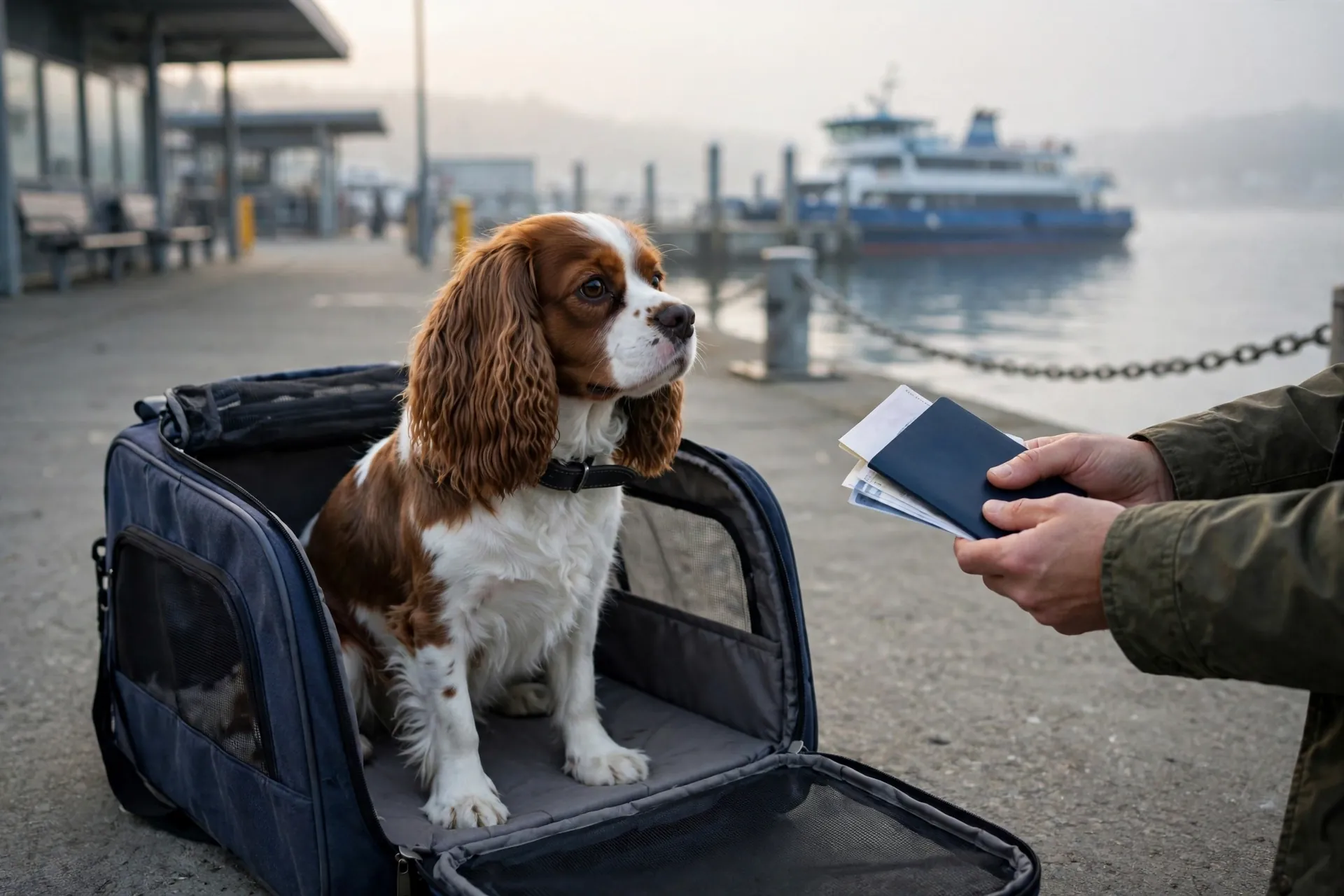
This guide is independent and contains no paid placement. Rules change, so check the official guidance before you travel and confirm every date with your vet and carrier.
Work backwards. If the dog is not already travel-ready and you have less than a month, the staycation usually wins. If you have three months, a confirmed vet timeline and a return journey that fits every treatment window, abroad becomes a realistic choice rather than a gamble.
Start with the calendar, not the map
Most staycation-versus-abroad articles begin with a comparison of places. That order is backwards for dog owners in the United Kingdom after Brexit, because the border now imposes a sequence that does not care how attractive a destination looks. A dog travelling from Great Britain to the European Union needs a microchip, a rabies vaccination record that meets the rules, an animal health certificate issued within a set period before travel, and, for the return to Great Britain, a tapeworm treatment given inside a specific window. Each item has its own timing, and the items must overlap correctly. If any one of them slips, the trip does not become slightly worse; it becomes impossible on that date. That is why this guide organises the decision as a timeline running backwards from departure, with the staycation shown on the same dates as a control case. The contrast is what makes the choice clear.
The change since Brexit is not only that there is more paperwork. It is that the paperwork is time-sensitive in both directions. The old pet passport route for most British travellers ended, and the replacement certificate is a single-trip document with a limited validity period. A vet cannot simply issue it months in advance and file it away. The certificate must be issued close enough to departure to still be valid when you travel, yet early enough that you can correct an error, rebook an appointment or change a carrier if something goes wrong. The return treatment adds a second clock running in the opposite direction: it must not be given too early or too late relative to your arrival back in Great Britain. Owners who plan only the outward journey often discover, halfway through a holiday, that the return clock is the harder one to satisfy. A vet near a holiday resort may be closed on the day you need, fully booked, or unfamiliar with the exact timing and recording requirements. That risk should be priced into the decision before you book anything.
There is also a carrier clock that many owners underestimate. Not every ferry, tunnel service, airline or train accepts dogs, and those that do often have different rules for where the dog travels, how far ahead you must book, and what documents are checked at what point. A dog that travels in a car on a ferry faces a different routine from a dog that must use a kennel on board, a pet cabin or a separate pet lounge. A dog travelling as cargo on a flight faces a different set of deadlines again, including veterinary checks, crate requirements and cut-off times that can be hours before departure. The tunnel service for cars has its own check-in and pet-check process. If you are travelling without a car, the options narrow sharply, and some routes that look straightforward on a map are simply not available to pet dogs at all. The carrier choice therefore belongs in the early stage of planning, not as an afterthought once the holiday home is booked. A beautiful house in a region with no suitable return route is a trap, not a holiday.
None of this means that travelling abroad with a dog is unwise. Many owners do it every year and enjoy it thoroughly, especially when the dog is calm in a car, settled in new rooms and already up to date with vaccinations. The point is narrower: abroad is a project with a critical path, while a staycation is a booking with a packing list. Projects reward early starts, written confirmations and slack in the schedule. Bookings reward flexibility, late changes and a short drive home if the weather turns or the dog is unwell. When you compare the two options honestly, you are comparing two different kinds of risk, not two different kinds of scenery. The rest of this guide makes that comparison concrete, month by month, so that you can see where your own dates fall and which option your calendar actually supports.
A useful first step is to write down three dates before you look at any destination. First, the earliest date you could realistically travel. Second, the latest date you must be home, for work, school, childcare or a vet appointment. Third, the date by which you must decide, because after that date the cost of changing your mind rises sharply. Deposit deadlines, cancellation terms and ferry prices all create a decision deadline, and owners who ignore it tend to drift into the more expensive option by default. If your decision deadline is tomorrow and the dog has no current travel documentation, the timeline has already answered the question. If your decision deadline is three months away, you have room to gather facts without committing money. Put those three dates on paper, then read the timeline sections against them. Every section below ends with the question that date raises, because a decision made from dates is easier to defend than a decision made from photographs.
Three months before: the abroad clock starts
Three months before departure is the moment when an abroad trip stops being an idea and starts being a schedule. The first job is not booking; it is a vet conversation. Ask the practice to confirm, for your specific dog, what is already in place and what is missing. Microchip details must match the dog and the records, and any mismatch between a chip number, a vaccination booklet and a certificate can cause a delay that no amount of pleading at a port will fix. If a rabies vaccination is needed or a booster is due, the waiting period after vaccination before travel may apply, so this is the appointment that cannot be left to the final month. Ask the vet to write down the earliest safe travel date and the latest date by which a certificate could still be issued, and keep that note with your travel papers. If the practice cannot offer an appointment in the certificate window, that is a planning fact, not a minor inconvenience, and it may change the whole trip.
At the same time, research the destination country and the return route as a pair. Entry rules for the destination and re-entry rules for Great Britain are different documents, and satisfying one does not satisfy the other. Some countries add requirements beyond the general European Union rules, such as additional treatments, waiting periods or restrictions on certain breeds. Some regions have seasonal disease risks, heat restrictions or local rules about dogs on beaches, in restaurants or on public transport that affect whether the holiday will actually be enjoyable once you arrive. Check the official guidance before you travel, and check it again closer to departure, because rules and disease situations can change. A destination that was straightforward last year may have a new local requirement this year, and a carrier that accepted dogs last summer may have changed its pet policy, capacity or booking window. Do not rely on a forum post from two years ago when a government page and a carrier page can settle the question in minutes.
The third job at three months is to test the dog, not just the paperwork. A dog that has never spent more than an hour in a car is not ready for a six-hour drive plus a crossing plus another drive, however good the documents are. A dog that barks through the night in a new house will not magically settle in a foreign apartment. Use the three-month window for short, deliberate tests: a longer drive with planned stops, an overnight stay in a rented cottage or a friend's house, a visit to a busy place where the dog must settle under a table. These tests cost little and reveal a great deal. They also give you time to work on the specific problem, whether that is car sickness, toilet training in a new garden, or settling on a mat in a restaurant. If the tests go badly, you still have time to choose a staycation without losing a deposit. If they go well, your confidence in the abroad plan is based on evidence rather than hope, and that matters when the journey itself becomes stressful.
Finally, at three months, price the abroad trip as a complete project, not as a ferry fare plus a house rental. Add the vet appointments, the certificate fee, any additional vaccinations or treatments, the carrier pet fee, pet insurance that covers overseas veterinary treatment and repatriation, and a contingency for an extra night if a crossing is cancelled or a treatment window forces a change of plan. Compare that total with the staycation total, which usually includes fuel, accommodation, food and a smaller insurance or vet contingency. Many owners find that the gap is larger than the headline ferry price suggests, and that the gap matters more when the dog is older or needs medication. The financial comparison is not a reason to avoid abroad, but it is a reason to avoid discovering the full cost after you have already paid a non-refundable deposit. Write both totals down, with the abroad total including a realistic contingency, and let the numbers sit alongside the timeline. A trip that is affordable only if nothing goes wrong is not affordable in the sense that matters.
By the end of the three-month stage, you should be able to answer four questions without guessing. Is the dog medically ready, or is a vaccination waiting period still running? Has the vet confirmed a certificate window that fits your travel dates? Does a carrier route exist that accepts your dog in the way you want to travel, on both the outward and return legs? And have you tested the dog on a journey and an overnight stay that resemble the real trip? If the answer to any of those is no, the abroad plan is not yet a plan; it is a wish with a date attached. That is not a failure. It is exactly the information that makes a staycation a sensible, positive choice rather than a consolation prize. For more detail on the documents themselves, see our dog travel documents checklist and our guide to bringing a dog to the UK from the EU, which explains the return side from the other direction.
One month before: documents and carriers
One month before departure is when the abroad plan becomes unforgiving. The certificate window is approaching, the carrier booking is usually paid or about to be paid, and the accommodation cancellation terms are tightening. This is the stage where a small error becomes a large problem, so the work is checking, not dreaming. Confirm the vet appointment for the certificate in writing, with the dog's details, the travel dates and the destination exactly as they will appear on the document. A misspelled name, a wrong chip number or a destination country that does not match the booking can all cause a refusal at a check. Ask the practice what to bring, how long the appointment takes, and what happens if the dog is unwell on the day. A certificate appointment is not a routine booster visit; it is a document-issuing appointment with a deadline, and it deserves the same seriousness as a passport appointment.
At one month, also confirm the carrier rules in writing. Read the pet policy for the exact service you have booked, not for the carrier in general, because rules differ between routes, ships and departure times. Confirm where the dog will be during the crossing, whether you can visit the dog, what happens in rough weather or a delay, and what documents are checked at check-in versus at the pet control point. Confirm the check-in time for pet travellers, which may be earlier than for other passengers, and plan your drive to arrive with slack for traffic, toilet stops and a settling walk before check-in. A dog that arrives stressed, overheated or needing the toilet is harder to settle for a crossing, and a missed check-in time is rarely recoverable on a busy sailing. If you are travelling by tunnel, confirm the pet check process and the latest arrival time. If you are flying, confirm crate, check-in and veterinary inspection times separately, because the airline, the airport and the handling agent may each have a deadline.
The return journey deserves the same attention at one month, and ideally more. Identify a vet near your holiday base who can give the return tapeworm treatment, and contact that practice before you travel, not when you arrive. Ask about opening hours, appointment availability, language, fees and exactly how the treatment is recorded. Ask what happens if the practice is closed on the day you need, and identify a second practice as a fallback. Then work backwards from your return crossing: the treatment must fall inside the permitted window before arrival in Great Britain, and the crossing, the drive to the port and the check-in time all consume part of that window. If the window is tight, consider changing the return sailing to a later time or an earlier treatment appointment, rather than hoping traffic will be kind. This single calculation is the most common place where a well-planned outward journey fails on the way home, and it is entirely preventable with a calendar and a phone call made a month early.
Insurance and health preparation also belong in the one-month stage. Check whether your existing pet insurance covers veterinary treatment abroad, and whether it covers repatriation, cancellation or a delayed return. Many United Kingdom policies have territorial limits, trip-length limits or exclusions for pre-existing conditions, and discovering a gap during a foreign vet visit is an expensive lesson. Our guide to dog travel insurance for Europe explains the questions to ask, including overseas vet cover, trip limits and what happens if the dog needs treatment after you return home. Also prepare a health pack for the trip: any regular medication with a spare supply, a copy of the vaccination record, the vet's phone number, the insurance policy number and a note of the dog's normal temperature, appetite and toilet routine in plain language that a foreign vet can use quickly. If the dog takes medication that needs refrigeration or a specific timing, plan how that timing survives a long drive, a crossing and a time-zone change.
At one month, the staycation comparison is still useful, because it shows what you are giving up in flexibility. A staycation booked a month ahead can usually be moved, shortened or cancelled at lower cost than a cross-border trip, and the dog's usual vet remains within driving distance. If the abroad plan at one month still has an unconfirmed vet, an unconfirmed return treatment or a carrier rule you have not read, the rational move is to pause and compare the cost of fixing those gaps against the cost of switching to a staycation. That comparison is not pessimism; it is the same discipline that makes the abroad trip safe when the gaps are closed. Owners who switch at one month usually lose less money and less sleep than owners who press on hoping that a port official will be lenient. Officials are not there to be lenient; they are there to apply the rules, and the rules are written down for a reason.
Travel week: the windows that cannot move
In travel week, the abroad trip stops being a plan and becomes a sequence of appointments that cannot be rearranged. The certificate appointment, the drive to the port, the check-in, the crossing, the arrival, the holiday itself, the return treatment appointment, the drive back to the port and the return check-in are all linked. A delay in any one of them eats into the slack for the next, and the return treatment window is the least forgiving link of all. Treat travel week as a chain, not as a list. Write the whole chain down with times, addresses, phone numbers and fallback options, and share it with everyone travelling. If one person holds all the information in their head, a phone battery failure or a missed turn can break the chain. Paper copies still matter when a phone has no signal in a port car park or a vet waiting room.
The day of the certificate appointment sets the tone. Bring every document the vet asked for, plus the booking confirmations for the carrier and the accommodation, so that any discrepancy can be spotted while you are still in the practice. Check the certificate before you leave the building: names, chip number, dates, destination and the vet's signature and stamp. Photograph each page and email the photographs to yourself and to a travelling companion, so that a lost folder is an inconvenience rather than a disaster. Then store the original in a waterproof folder that stays with the person, not in a suitcase that may be in a car boot during a crossing. The same discipline applies to the return treatment record: check it before you leave the foreign vet, photograph it, and keep the original with the certificate. A treatment that is given but not correctly recorded is, for border purposes, a treatment that did not happen.
Travel days themselves need a dog routine that is boring on purpose. Feed at the usual time or slightly earlier if a long crossing follows, offer water little and often, and plan toilet stops that are safe, shaded and away from fast traffic. Do not introduce a new food, a new chew or a new calming product on travel day; any of them can cause stomach upset at the worst possible moment. If the dog travels in a car, use the restraint you have practised, keep the car cool, and never leave the dog in a parked car in warm weather while you sort out check-in. If the dog travels in a kennel or cabin on a ferry, visit at the times the operator allows, speak calmly, and do not over-exercise the dog immediately before a long confinement. The goal of travel day is not to tire the dog out completely; it is to arrive at check-in calm, hydrated and toileted, with time to spare. That calmness is worth more than any shortcut.
Delays are where the abroad plan is tested. A cancelled sailing, a traffic jam or a vet appointment that runs late can all push the return treatment outside its window or push you past a check-in time. Have a written fallback for each likely delay: the carrier's rebooking number, the next sailing, a nearby overnight stop that accepts dogs, and the phone number of the return vet in case you need to re-time treatment. If a delay makes the return window impossible, do not try to argue your way through a border check. Contact the vet and the carrier, explain the new timing, and re-plan the return. It may cost an extra night and a new treatment appointment, but that cost is smaller than a refused entry, a quarantined dog or a missed connection with no accommodation. The owners who cope best with delays are not the ones with the most luck; they are the ones who wrote the fallback down before they needed it.
Finally, travel week reveals the emotional cost that brochures never mention. An abroad trip with a dog involves more waiting, more checking and more moments when you are responsible for a document as well as a living animal. Some owners enjoy that responsibility and find it reassuring. Others find it exhausting, especially when travelling with children, elderly relatives or a dog that is already anxious. There is no shame in discovering, during travel week, that you would rather be on a coastal path in Britain than in a queue at a foreign port. That discovery is useful information for next year, and it is one reason why a first abroad trip should be short, simple and close to a familiar route. A short, successful trip teaches you more about your dog's travel tolerance than a long, stressful one, and it leaves you with the appetite to try again.
The staycation timeline: the same dates, no border
Now run the same three dates through a staycation, and the contrast becomes obvious. Three months before a staycation, the work is choosing a place, checking that it genuinely welcomes your dog, and booking a date that suits work and school. There is no vet deadline driving the decision, no certificate window to fit, and no return treatment to book abroad. You can still use the three-month window well: book early for school holidays, choose a cottage with an enclosed garden if your dog needs one, and test the dog on a shorter trip if you have never stayed away with them. But the consequences of delay are different. Booking a staycation a month later usually means fewer choices or a higher price, not a cancelled trip. That difference in consequence is the core advantage of staying in the United Kingdom, and it is worth stating plainly rather than treating a staycation as merely the cheaper fallback.
One month before a staycation, the work is practical rather than procedural. Confirm the accommodation rules in writing: how many dogs are allowed, whether there is a pet fee, where the dog can go in the house or park, and what happens if the dog barks. Confirm the nearest vet and emergency vet, save their numbers, and check whether your pet insurance covers the stay. Pack for the dog in the same way you would for abroad, but without the border folder: food, medication, bedding, a long lead, towels, a drying coat and a first-aid kit. The key difference is that a forgotten item can usually be bought locally or fetched from home, and a vet appointment can usually be booked at short notice with your usual practice by phone. The staycation does not remove preparation; it removes the kind of preparation where a single missing signature cancels the journey. That is a meaningful reduction in risk, especially for owners travelling with a nervous dog or a tight schedule.
In travel week for a staycation, the timeline is a drive, not a chain of border appointments. You still plan stops, shade, water and toilet breaks, and you still avoid leaving a dog in a hot car. But a traffic delay does not invalidate a document, a late arrival does not mean a missed treatment window, and a change of plan does not require a foreign vet. If the dog is unwell on the morning of departure, you can postpone by a day and call your usual vet, rather than losing a certificate, a sailing and a holiday home in one move. If the weather turns, you can choose a different walk, a different beach or a different day, without rebooking a crossing. That flexibility is particularly valuable for older dogs, dogs on medication, and households where work or childcare can change at short notice. A staycation is not a lesser holiday; it is a holiday whose risks are ordinary and manageable, rather than concentrated into a few high-stakes appointments.
The staycation timeline also allows a different kind of spontaneity that abroad trips cannot offer. A last-minute weekend, a weekday break when a cottage drops in price, or an extra night because the dog has finally settled and the weather has improved are all possible when the only border is a county boundary. For owners who enjoy deciding late, or who need to work around unpredictable rotas, that spontaneity is not a minor perk; it is the reason the holiday happens at all. Our guide to cheap dog-friendly holidays in the UK shows how off-season timing, weekday breaks and lower pet fees can make a staycation both flexible and affordable. The saving is not only money; it is the ability to change your mind without penalty, which is a form of holiday quality that rarely appears in photographs but matters every day of the trip.
None of this means a staycation is automatically better. A staycation can still be ruined by a poorly chosen cottage, a noisy site, a dog-unfriendly beach in summer, or a long drive in heat. The advantage is that those problems are usually visible on arrival and often fixable by moving, changing plans or driving home. An abroad problem at a border is not fixable in the same way, because the border is not a customer service desk. When you weigh the two timelines side by side, ask yourself which kind of problem you would rather face at 8pm on a travel day: a cottage that is not quite right, or a crossing that you cannot board. Most owners, when they ask the question that bluntly, know their answer immediately, and that answer is a better guide than any list of attractions.
The dog as a timing factor
The dog is not a passive passenger in this decision; the dog's age, health, temperament and travel history change the timeline itself. A young, healthy, car-confident dog that settles quickly in new rooms can tolerate a longer chain of appointments, because the dog is unlikely to add a new problem to the chain. An older dog with arthritis, a dog on daily medication, a brachycephalic breed that struggles in heat, or a rescue dog that panics in unfamiliar places adds risk at every link. Heat is a particular concern for flat-faced breeds and for dogs travelling in summer, because a car, a port queue and a foreign apartment can all become dangerously hot. Check the official guidance before you travel, and ask your vet specifically about heat, journey length and medication timing for your dog's breed and condition. A vet's answer for a fit young collie is not transferable to a senior bulldog, and a generic article cannot replace that individual advice.
Travel history matters as much as temperament. A dog that has done several UK trips, including an overnight stay and a long drive, has a track record you can extrapolate from. A dog that has only ever travelled to the local park has no such record, and an abroad trip is a poor place to create one. The sensible test is a UK trip that mimics the abroad journey in miniature: a drive of similar length, a night in unfamiliar accommodation, a busy place where the dog must settle, and a return drive the next day. If the dog copes well, you have evidence. If the dog struggles, you have a training and management task that is easier to work on at home than abroad. Puppies need extra care: vaccination schedules, toilet training and socialisation all interact with travel timing, and a puppy's first long journey should be short, positive and close to home. Older dogs need a different test: can they manage steps, long drives and new sleeping arrangements without pain or distress, and is there a vet near the destination who can help if a chronic condition flares?
Medication and health monitoring also affect the timeline. A dog that needs medication at a fixed time of day needs a travel plan that preserves that timing across a drive, a crossing and a possible time-zone change. A dog that needs regular blood tests, specialist food or a particular veterinary product may find that product unavailable or differently named abroad. Ask your vet what to do if a dose is missed, delayed or vomited, and carry a written plan, not just the tablets. For dogs with epilepsy, diabetes, heart disease or kidney disease, the question is not only whether travel is allowed, but whether the stress of travel is worth it for the dog. Owners sometimes focus on whether they can take the dog, when the kinder question is whether the dog will enjoy the trip. A dog that spends the holiday stressed, panting and unable to settle is not having a holiday, even if the paperwork is perfect. A staycation closer to the usual vet, with familiar food, familiar routines and a shorter journey, may be the more caring choice, and caring is a legitimate reason to choose it.
Behavioural factors deserve the same honesty. A dog that guards resources, reacts to other dogs, or barks at strangers will meet more triggers abroad, in smaller spaces, with less room to retreat. A ferry kennel, a tunnel car queue and a foreign restaurant are not good places to test a new behaviour plan. If you are working on reactivity or anxiety, discuss the trip with your vet or behaviourist before booking, and consider whether a quiet UK cottage with a private garden is a better setting for the dog's current stage. The goal is not to limit the dog's life; it is to choose trips that build confidence rather than overwhelm it. A successful staycation that ends with a relaxed dog is a better foundation for a future abroad trip than a stressful abroad trip that ends with a dog who is wary of the car for months afterwards. The timeline for behaviour, like the timeline for paperwork, rewards patience.
What failure costs in each option
Failure looks different in the two options, and the difference should influence the decision. If a staycation fails, the usual costs are a lost deposit or a curtailed trip, a drive home, and a disappointed household. Those costs are real, but they are bounded and familiar. If an abroad trip fails at the border, the costs can include a missed sailing, an extra night's accommodation, a new vet appointment, a new treatment, a rebooked crossing, and in the worst case, a dog that cannot travel and a household split between travelling and staying behind. The financial cost is higher, the emotional cost is higher, and the practical cost of solving the problem in a foreign language, far from your usual vet, is higher still. That asymmetry does not make abroad trips reckless; it makes them trips where the preparation must be proportionate to the cost of failure. A short, cheap staycation can tolerate a casual approach. A cross-border trip cannot.
The cost of failure also includes time. A staycation that goes wrong on day one can often be salvaged on day two by moving accommodation, changing the itinerary or simply going home and trying again another weekend. An abroad trip that goes wrong on the outward journey may lose several days to rebooking, and an abroad trip that goes wrong on the return journey may extend the holiday involuntarily, with work, school and pet care at home all affected. Owners with fixed return dates, such as a return to work or a school term, should weigh this time risk heavily. If you cannot afford an extra two days abroad, you cannot afford the risk of a return delay, however unlikely it seems. Build slack into the return plan: a later sailing than the earliest possible, a treatment appointment that is not on the last possible day, and accommodation that can be extended by a night without penalty if possible. Slack is not wasted money; it is insurance against the most expensive kind of delay.
There is also a hidden cost that rarely appears in budgets: the cost of a dog's distress. A dog that is refused boarding, held in an unfamiliar kennel, or subjected to a long, hot wait at a port may associate travel with stress for a long time afterwards. That association can affect future UK trips as well, which means a failed abroad trip can damage the very holidays you were trying to enjoy. A failed staycation, by contrast, usually ends with the dog back in its own bed the same night, and the association fades quickly. This is not an argument against ever travelling abroad; it is an argument for making the first abroad trip short, well-planned and low-pressure, so that the dog's association with travel remains positive. If the first abroad trip is already long, complex and high-stakes, the risk to the dog's future travel confidence is part of the price, and it should be counted.
Finally, consider the cost of indecision. Owners who cannot decide often drift into the abroad option by booking a house, then discover the paperwork late, then pay rush fees, change sailings and stress over treatment windows that could have been planned calmly months earlier. Indecision is not neutral; it converts a manageable project into a rushed one. The decision tree in the next sections is designed to force a decision at the right time: three months ahead if abroad is possible, one month ahead if abroad is still unconfirmed, and travel week only for execution, not for deciding. If you are reading this guide less than a month before your intended departure and the dog is not already travel-ready, the kindest and cheapest decision is usually to book a staycation now, enjoy it properly, and plan abroad properly for next time. That is not giving up; it is choosing the trip you can actually do well.
Two households, two different answers
Consider two hypothetical households, invented to illustrate the timeline, not described as real people visited or interviewed. Household A has a four-year-old Labrador who travels happily in the car, has slept in rented cottages before, and is up to date with vaccinations and microchip records. The household has three months before a planned trip, a vet practice that offers certificate appointments, and a ferry route that accepts dogs in the car. The return journey can be timed so that a vet near the holiday base can give the tapeworm treatment inside the required window, with a fallback practice identified. For Household A, abroad is a realistic project. The work is real, but the timeline fits, the dog is a good candidate, and the household can absorb an extra night if a sailing is delayed. The decision for Household A is not whether abroad is possible, but whether the extra cost and preparation are worth it compared with a staycation they would also enjoy. That is a preference decision, and either answer is defensible.
Household B has a nine-year-old terrier mix who is anxious in the car, needs daily medication, and has never stayed overnight away from home. The household is thinking about a trip six weeks ahead, the vet practice is fully booked for certificate appointments in the relevant window, and the only suitable return route requires a long drive to a port after a treatment appointment that falls on a day the local foreign vet is closed. For Household B, the timeline has already answered the question, even though the household would love to travel abroad. The staycation is not a second-best option; it is the option that fits the dog, the vet availability and the calendar. A quiet cottage within two hours of home, with an enclosed garden, a nearby vet and a flexible cancellation policy, gives Household B a holiday that the dog can actually enjoy, without the risk of a border refusal or a stressed return journey. Household B can use the staycation to test the dog on a longer drive and an overnight stay, and if those tests go well, plan abroad properly for the following year with three months of lead time.
The point of the two households is not that one is adventurous and the other is cautious. It is that the same destination can be a good decision for one household and a poor decision for another, because the decision is made from the dog, the vet, the carrier and the calendar, not from the destination alone. Owners often compare themselves with friends who travelled abroad successfully and conclude that they should do the same, without checking whether their dog, their vet availability and their return route match. That comparison is misleading. A friend's successful trip proves that abroad is possible in general; it does not prove that it is possible for your dog on your dates with your carrier. Your own timeline is the only evidence that matters, and it is available to you before you spend any money. Use it, and let the two households remind you that a staycation chosen for the right reasons is a success, not a compromise.
There is a third pattern worth naming: the household that could do either trip, but prefers one for reasons that have nothing to do with paperwork. Some owners simply prefer the familiarity of Britain, the ability to drive home, and the freedom to change plans. Others have family abroad, a language they speak, or a place they return to every year, and the paperwork feels like a small price for a familiar reunion. Those preferences are valid, and they should be allowed to tip a close decision. The timeline method does not remove preference; it prevents preference from overriding a timeline that does not fit. If the timeline fits, choose by preference. If the timeline does not fit, preference cannot rescue it, and a staycation chosen now leaves the abroad dream intact for a year when the timeline does fit. That is a better outcome than a rushed abroad trip that ends badly and puts the owner off travelling with the dog altogether.
A five-question decision tree
If you want a fast answer, work through these five questions in order, and stop at the first question that points to a staycation. First, is the dog already travel-ready, or can the vet confirm a timeline that fits your dates with slack? If not, choose a staycation. Second, is there a carrier route that accepts your dog, on both legs, in a way you are comfortable with? If not, choose a staycation. Third, can the return treatment be booked with a fallback, inside the required window, without relying on a single vet being open on a single day? If not, choose a staycation. Fourth, can you absorb the full cost of abroad, including a contingency for an extra night and a rebooked crossing, without it ruining the holiday if it happens? If not, choose a staycation or a shorter, cheaper abroad trip. Fifth, has the dog passed a UK test that resembles the real journey, including a long drive and an overnight stay? If not, choose a staycation this time and use it as the test for next time. If you pass all five, abroad is a genuine option, and you can choose by preference.
The order matters. Owners often start with the fifth question, about whether the dog will enjoy the destination, and only later discover that the first question fails. That order wastes time and money, because a dog that would love a French beach still cannot travel if the certificate window does not fit. Starting with the vet timeline, the carrier and the return treatment is less romantic but more honest, and it protects the holiday you actually take. It also protects the dog, because a dog that is travel-ready on paper but has never been tested on a long journey is still a risk, and the test should come before the booking, not after it. If you are short of time, ask the vet first, the carrier second, and the destination last. That sequence alone will prevent most of the common failures described in this guide.
Write your answers down, with dates and names, rather than holding them in your head. A note that says "vet confirmed certificate window 12 to 18 May, return treatment booked 24 May at 10am with fallback practice, ferry booked 25 May 14:00" is a plan. A feeling that "it should be fine" is not a plan, and it will not help you at a port check. Share the note with everyone travelling, and keep a copy in the travel folder. If any answer changes, revisit the decision: a vet appointment that moves, a sailing that is cancelled, or a dog that becomes unwell can all change the answer, and changing your mind at one month is cheaper than changing it in travel week. The decision tree is not a one-time test; it is a check you repeat whenever a date moves, because the timeline is the decision.
If abroad wins: lock the sequence
If abroad wins, the next step is to lock the sequence in writing, in the order it will happen. Start with the vet: confirm the certificate appointment, the return treatment plan and the fallback practice, and get those confirmations by email. Then lock the carrier: book the exact sailings or flights that fit the certificate and treatment windows, and read the pet policy for those services, not for the carrier in general. Then lock the accommodation: confirm that it accepts your dog, the number of dogs, any pet fee, and the cancellation terms if a border delay forces a change. Then lock the insurance: confirm overseas vet cover, trip limits and repatriation, and carry the policy number and emergency number in the travel folder. Finally, lock the driving plan: route, stops, shade, water, fuel and an overnight fallback if a delay occurs. Each lock should be a written confirmation, not a verbal assurance, because written confirmations can be shown at a check, quoted in a phone call, and relied on when plans change.
Packing for abroad should follow the same sequence logic. Pack the border folder first: certificate, vaccination record, microchip details, insurance, carrier booking and vet contacts, with photographs of each document emailed to yourself. Then pack the dog's health kit: medication with a spare supply, a written medication plan, a first-aid kit and the name of the return vet. Then pack the journey kit: water, a bowl, a long lead, towels, a drying coat, waste bags and a familiar bed or mat. Then pack the holiday kit: food, a spare lead, a torch for night walks and a note of local rules about dogs on beaches, in restaurants and on transport. The order matters because the border folder is the only kit that cannot be replaced locally, while food and towels usually can. If you are travelling by train or ferry without a car, check the rules for dogs on the specific service you will use, because a general rule about trains does not apply to every cross-border service. For example, pet dogs are not accepted on Eurostar except assistance dogs, so a rail-based abroad trip needs a different route, and our guide to dogs on Eurostar explains the alternatives.
During the holiday, keep the return plan visible. Do not leave the return treatment booking until the last day, and do not assume that a vet who was available when you booked will still be available when you need them. Confirm the appointment a few days ahead, confirm the treatment recording, and plan the drive to the port with slack for traffic and a toilet stop. If the holiday is going well and you are tempted to extend it by a day, check the treatment window and the certificate validity before you extend, not after. An extra day that pushes the return outside the window is not a free day; it is a day that requires a new plan. The owners who enjoy abroad trips most are often the ones who treat the return plan as part of the holiday, not as an interruption to it, because they return home relaxed rather than rushing to a port with a clock ticking.
If the staycation wins: spend the saving well
If the staycation wins, spend the saving well, because a staycation chosen deliberately can be a better holiday than an abroad trip chosen reluctantly. Use part of the money saved on vet certificates, carrier pet fees and overseas insurance to upgrade the stay in ways that matter to the dog: a cottage with a larger enclosed garden, a quieter location, an extra night, or a place closer to the walks your dog loves. Use part of the time saved on paperwork to plan the walks, check beach and countryside rules for your dates, and book a vet check before departure if the dog is due one. A staycation is not a holiday without preparation; it is a holiday where preparation goes into the experience rather than the border. That shift in spending and planning is what turns a staycation from a fallback into a first choice.
Use the staycation as a test for the future if abroad is still a dream. Plan a drive of similar length to a future abroad journey, an overnight stay in unfamiliar accommodation, and a busy day where the dog must settle in a new place. Note what went well and what needs work, and share those notes with your vet or behaviourist if you plan to travel abroad later. A staycation that tests the dog honestly is more valuable than a staycation that avoids every challenge, because it gives you evidence for next year's decision. If the dog copes well, you can plan abroad with confidence and a three-month lead time. If the dog struggles, you have a clear training task and a reason to choose a quieter staycation next time. Either way, the staycation has done work that a rushed abroad trip cannot do, because it has taught you about your dog without putting the dog through a border process.
Finally, enjoy the flexibility that a staycation offers. Book a weekday break if you can, when cottages are cheaper and walks are quieter. Choose a region you have not explored, rather than repeating the same place out of habit. Leave a day unplanned, so that a good walk, a dog-friendly cafe or a sudden change in weather can shape the day without breaking a schedule. The staycation timeline allows that freedom because there is no border appointment to protect. Owners who embrace that freedom often report that the staycation felt longer and more restful than a more expensive trip, not because Britain is better than abroad in any absolute sense, but because the holiday fitted the dog, the calendar and the household. That fit is the real prize, and it is available in both options when the decision is made from the timeline rather than from a photograph.
The decision, in the end, is simple to state and hard to rush: if the paperwork timeline fits, the carrier fits, the return treatment fits and the dog has been tested, abroad is a wonderful option. If any of those do not fit, a staycation is not a lesser holiday; it is the holiday that fits. Check the official guidance before you travel, confirm every date in writing, and let the calendar, not the destination, make the first decision. Your dog will thank you for a trip that ends calmly, whether that trip ends in a British cottage or a foreign apartment, because a calm ending is what turns a trip into a memory worth repeating.
Practical questions
Before you go
How far ahead should we start the paperwork for taking a dog abroad?
Start three months ahead if you can. That leaves time for a vet check, a rabies vaccination waiting period if one applies, a certificate appointment and a correction if a document is wrong. A staycation needs none of that lead time, which is why the calendar often decides the trip before any destination does.
What is the single most common reason a dog trip abroad goes wrong?
Timing, not paperwork knowledge. The return-leg treatment window, the certificate validity window and the ferry or tunnel check-in time all have to line up. If one window closes while you are still travelling to the port, the rest of the plan cannot rescue the crossing, so plan the return journey first.
Can we decide late and still take a dog abroad?
Sometimes, but only if the dog already meets every requirement and the vet and carrier can fit you in. If a new vaccination, a new certificate or a treatment window is still outstanding, a late decision usually points to a staycation. Do not book non-refundable travel until the vet has confirmed the timeline in writing.
Does a staycation really avoid all dog paperwork?
It avoids cross-border paperwork, but not sensible preparation. You still need vaccination records if a kennel or sitter asks for them, a vet contact near your stay, insurance details and a plan for heat, water and rest stops. The difference is that a missing item at home can usually be fixed the same day.
Which dog is a poor fit for a first trip abroad?
A dog that panics in a car, cannot settle in unfamiliar rooms, needs frequent vet care or is recovering from illness is a poor first candidate. Test the dog on a long UK drive and an overnight stay first. If either test is difficult, the same difficulty abroad will be harder, more expensive and further from your usual vet.
Should we book the ferry or the vet first?
Book the vet conversation first, then hold transport only once the timeline is confirmed. A cheap sailing on the wrong date is not a saving if the certificate expires before it or the return treatment cannot be fitted in. Ask the vet for the earliest and latest safe dates, then choose travel inside that window.