This guide is independent and contains no paid placement. If affiliate links are added later, they will be clearly marked and will not change our editorial checks.
Stornoway works best as a practical base, not a resort: arrive by ferry from Ullapool, walk the harbour and the Lews Castle grounds on your first day, then drive out to the wide Lewis beaches. Book the ferry and your stay early, pack for wind and rain, and check the official guidance before you travel for ferry rules, beach restrictions and vet opening hours.
Getting to Stornoway with a dog
Stornoway sits on the east coast of the Isle of Lewis, in the Outer Hebrides off the north-west coast of Scotland. For most visitors with a dog, the journey is part of the trip, and it pays to plan it as carefully as the holiday itself. The usual route is to drive to Ullapool on the mainland, then take the ferry across the Minch to Stornoway. The crossing takes around two and a half hours, and the ferry is a working lifeline service as well as a tourist route, so it carries cars, lorries, foot passengers and dogs all year round. Sailings are more frequent in summer and reduced in winter, and the most popular crossings — Friday evenings and Saturday mornings in the school holidays — can sell out well ahead, especially for vehicles. Book as early as you can, and build slack into the day either side of the crossing.
Before you book, read the ferry operator's current dog policy in full, because the details matter more than the headline that dogs are welcome. Rules can cover whether dogs may stay in the car on the vehicle deck, whether there is a designated pet area or kennel, whether dogs are allowed in lounges and on outside decks, and what happens on rough-weather sailings. These arrangements can vary by vessel and by sailing, so check the official guidance before you travel rather than relying on a general summary. The practical kit for the crossing is simple: a lead and harness, water and a bowl, a familiar blanket, poo bags, and something to keep the dog settled. Feed a light meal well before sailing if your dog is prone to travel sickness, and give them a good walk and a toilet break at Ullapool before you board.
If you are travelling without a car, the ferry still works, but the onward journey needs more thought. Stornoway has bus services connecting the town with villages around Lewis, and the ferry terminal is close to the town centre, so a car-free stay based in Stornoway is possible. That said, the best beaches and the quietest walks are spread around the island, and buses are infrequent outside the main routes, so a car-free trip suits a short, town-based break far better than a week of exploring. If you do bring a car, remember that fuel, food and dog supplies are all easiest to buy in Stornoway itself, so stock up on arrival rather than assuming every village will have what you need.
There is also a flight option. Stornoway Airport lies a short drive from the town and has scheduled flights to and from the Scottish mainland. Flying with a dog is a very different proposition from taking the ferry: airline pet policies are strict, small dogs may travel in the cabin only under specific conditions, and larger dogs travel as cargo where the airline offers it at all. For most dog owners the ferry is the simpler, calmer and more predictable choice, and the drive to Ullapool is itself a scenic part of the holiday, running through the Highlands and past lochs and glens. Our guide to Ullapool with a dog covers the harbour town where the ferry departs, including where to walk a dog before boarding and what to expect at the terminal.
Driving to Ullapool deserves its own plan. The road from Inverness runs through some of the most beautiful and least forgiving driving in Britain: single-carriageway stretches, slow lorries, sheep on the verge and very few places to overtake safely. Allow far more time than the satnav suggests, plan fuel stops, and stop every couple of hours so the dog can stretch, drink and toilet. If you are coming from further south, consider breaking the journey overnight in the Highlands rather than attempting the whole drive and a ferry crossing in a single day. A tired driver, a restless dog and a fixed sailing time is a combination that invites stress, and the ferry will not wait. Arrive at Ullapool with time to spare, walk the dog along the harbour, and board calmly.
Once you step off the ferry in Stornoway, the change of pace is immediate. The town is compact, the harbour is busy with fishing boats and the ferry itself, and the air smells of the sea. The terminal is close to the town centre, so most accommodation is a short drive away. Resist the urge to rush straight to the nearest beach. Give the dog water, a short on-lead walk and a chance to settle first. Island weather can turn in minutes, and a dog that arrives calm and dry will enjoy the first evening far more than one that has been dragged straight into a Hebridean gale.
First walks in town: harbour and castle grounds
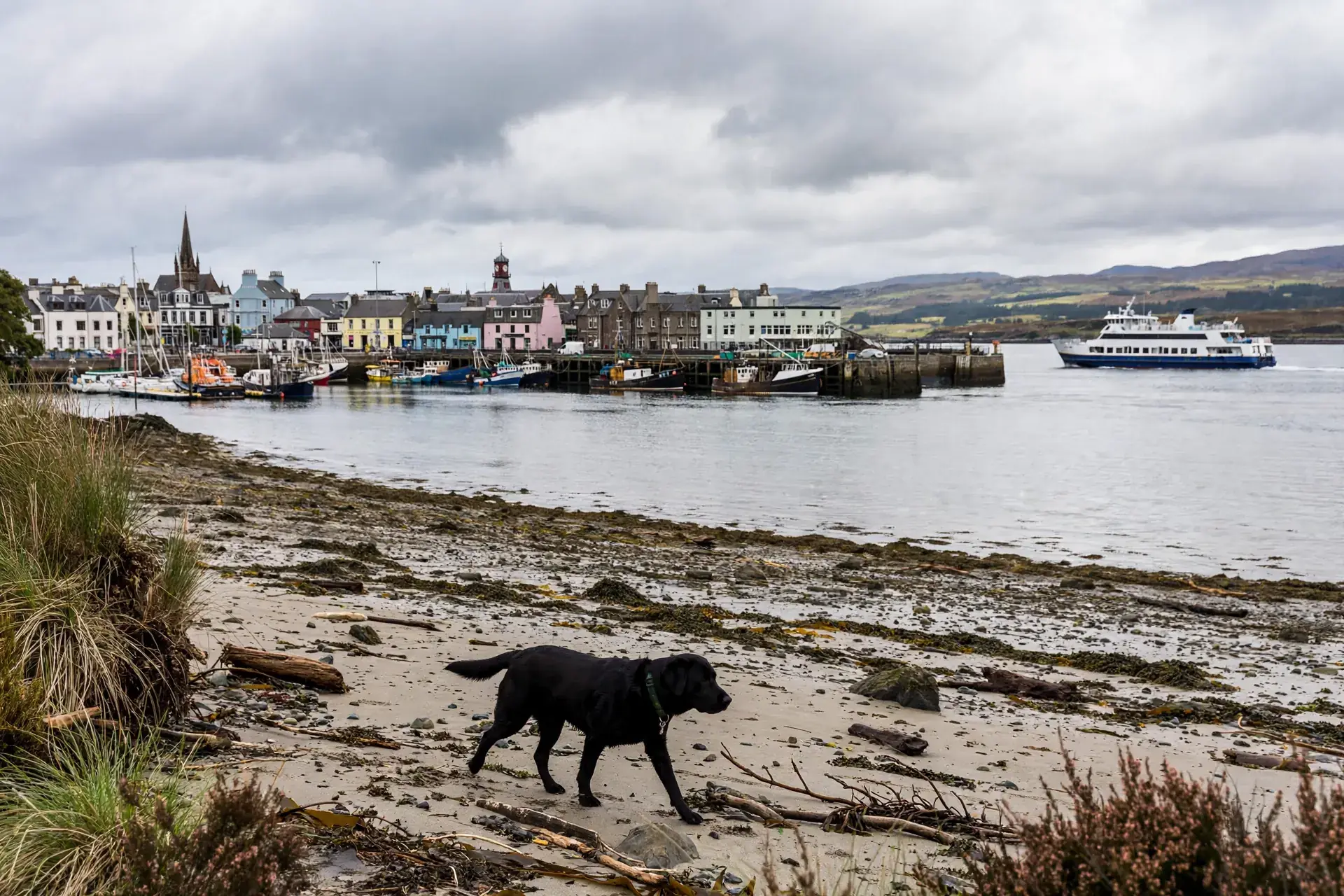
The two walks that anchor any dog stay in Stornoway are the harbour front and the Lews Castle grounds, and they suit very different moods. The harbour is a short, flat, on-lead stroll past fishing boats, the ferry terminal and the working waterfront. It is the walk to do on arrival, before breakfast, or when the weather is too rough for anything longer. Keep the dog close: there is traffic, there are vehicles turning into the ferry terminal, and there are ropes, fish boxes and other harbour clutter that a curious dog will investigate given half a chance. The reward is the sense of a town that still works for a living, with gulls overhead, boats coming and going, and views across the harbour to the far shore.
The Lews Castle grounds are the green lung of the town and the best place for a longer in-town walk. The grounds wrap around Lews Castle on the edge of Stornoway, with wooded paths, open grass and views over the harbour and the Minch. The woodland is unusual for Lewis, which is largely treeless moorland, and on a still day it feels sheltered in a way the open coast rarely does. Paths vary from surfaced tracks to softer woodland trails, so a dog that is unsteady on rough ground will still find comfortable routes, while a fitter dog can cover a good loop. Keep your dog under control throughout: the grounds are shared with walkers, runners, families and other dogs, and some areas are more formal than others. Check the signs at entrances and around the castle itself, and check the official guidance before you travel if you want to know the current rules for dogs in particular parts of the grounds.
Beyond those two anchors, Stornoway rewards slow exploration on foot. The town centre is compact enough to walk end to end, with shops, cafes and the harbour within easy reach of each other. Pavements are generally good, but side streets can be narrow and traffic can be brisk around the ferry arrival times, so a short lead is the right choice in town. Early mornings are the quietest time to walk a reactive dog: the streets are empty, the harbour is just waking up, and you can cover the town centre before the day's traffic builds. Evenings are similar, though in winter it gets dark early and the street lighting on the quieter lanes is limited, so carry a torch and something reflective for the dog.
Toilet stops in town need a little planning. Stornoway is a small town, not a city with a dog bin on every corner, so carry more poo bags than you think you will need and take them with you until you find a bin. The castle grounds and the harbour front both have bins, but the lanes between them may not. This is a small detail that makes a real difference to how welcome dogs remain in a town: visitors who pick up reliably keep the harbour front and the castle paths pleasant for everyone, and visitors who do not are noticed quickly in a community this size.
Beaches around Stornoway
The beaches are the main reason many dog owners come to Lewis, and the ones near Stornoway set the tone: wide, pale sand, clear water, and far fewer people than any mainland beach of comparable size. Within a short drive of the town you can reach long sandy bays that face the Atlantic or the Minch, backed by dunes, machair and low cliffs. On a calm summer evening, with the light low over the water, they are among the most beautiful dog walks in Britain. On a wet, windy winter day they are a different experience entirely — exhilarating for a hardy dog, miserable for one that hates the cold — and that contrast is worth respecting when you plan each day.
Dog rules on beaches are not uniform, so treat every beach as a fresh check. Some beaches welcome dogs year-round with no restrictions; others have seasonal rules, lead requirements near car parks and access points, or restrictions during the bird nesting season in spring and early summer. Livestock may graze on the machair behind the beach, and sheep and cattle are a common sight on Lewis, so a dog that chases stock must stay on a lead near the dunes and the fields behind them. Read the signs at the car park and the beach entrance before you let the dog off the lead, and check the official guidance before you travel if you are planning around a particular beach. The general pattern is generous — Lewis is not a place of blanket beach bans — but the exceptions matter, and a sign at the entrance is worth more than any guidebook claim.
North of Stornoway, the coast runs towards the Butt of Lewis, the northern tip of the island, with a string of beaches and rocky coves along the way. The sands here tend to be quieter the further you go from town, and the light and the sea conditions change with every headland. South of town, the coast towards the Harris border has its own beaches, including the long sands that draw walkers from across the island. Both directions reward a car: the distances look short on a map, but the roads are single-track in places, passing places need patience, and a beach that is ten miles away can take half an hour to reach. Build that into the day rather than trying to tick off three beaches before lunch.
On the beach itself, the practical rules are the same as anywhere in the Hebrides, with a few island twists. The tide can come in fast across a flat beach, so watch the waterline and keep an eye on the dog if they swim. The sea is cold all year, and even a keen swimmer can tire quickly; a dog that charges into the Atlantic in January needs a towel and a warm car waiting. Sand gets everywhere — in ears, between toes and into the car — so a drying coat, a towel and a brush are essential kit. Check paws after a beach walk for cuts from shells and sharp stones, and rinse off salt water if the dog has been swimming. Finally, remember that some beaches have no facilities at all: no cafe, no toilets, no shop, and sometimes no phone signal. Carry water for the dog, and do not rely on finding anything at the far end.
If you only have time for one beach walk from Stornoway, choose a long, open stretch and walk it properly rather than rushing between several. Let the dog run, let them sniff the seaweed line, and give them time to settle into the rhythm of the place. Lewis beaches are at their best when you slow down: the space is the point, and a dog that has had an hour on a Hebridean beach will sleep soundly for the rest of the day. Keep the lead in your pocket for the return to the car park, where other dogs, children and livestock are most likely to appear.
Town practicalities: food, shops and vets
Stornoway is the largest town in the Outer Hebrides, and that matters for dog owners in very practical ways. It has supermarkets, a range of independent shops, cafes, pubs and restaurants, and the island's main services — which means you can buy dog food, replace a broken lead, find a vet and eat out without a long drive. That sounds obvious, but on an island where the next town of any size is hours away, it is the single biggest reason to base yourself here rather than in a remote village. Do your main shop on arrival day, and top up as you go.
For dog food and supplies, the supermarkets in Stornoway stock the usual ranges, and there are pet supplies available in town, but the choice is narrower than on the mainland. If your dog eats a specific brand, has a prescription diet, or needs a particular size of food, bring enough for the whole trip rather than hoping to find it on the island. The same applies to medication: bring the full course plus a spare few days, keep it in its original packaging, and carry the prescription details. If your dog is on regular medication, ask your own vet before you travel what to do if a dose is missed or a supply runs short, and save the number of a Stornoway vet in your phone before you leave home.
Veterinary care is available in Stornoway, with practices serving Lewis and the wider island, but island cover works differently from mainland cover. Opening hours may be shorter, emergency cover may be shared or on call, and the nearest out-of-hours help may involve a drive. Save the practice number and address before you arrive, and check the official guidance before you travel for current opening hours and emergency arrangements. If your dog develops a problem, call ahead: the practice can advise whether to come straight in, what to do in the meantime, and whether the case needs referral. Do not wait until a minor issue becomes an emergency on a Sunday evening in a place where the next vet is a ferry ride away.
Eating out with a dog in Stornoway is possible but needs the same approach as anywhere in the Hebrides: ask first, and do not assume. Some cafes and pubs welcome dogs inside, some welcome them in a porch or on an outside terrace, and some do not allow dogs at all. Policies can change with the season, the time of day and how busy the place is, so a cafe that welcomed dogs in February may be stricter in August when every table is full. The practical approach is to phone or pop in without the dog first, ask where dogs are welcome, and choose places that are genuinely comfortable with a dog under the table rather than merely tolerant. A dog that settles quietly is welcome back; a dog that barks at every passer-by is not, however friendly the staff.
Takeaway food is a useful fallback on wet or windy evenings. Stornoway has takeaways and shops where you can buy food to eat back at your accommodation, which suits dogs that find pubs and cafes stressful. If your stay has a kitchen, cooking a simple meal and eating it with the dog settled beside you is often the most relaxing end to a day of island walking. Stock the fridge on arrival, keep a few easy meals in reserve for bad-weather days, and remember that shops may close earlier than you expect, especially on Sundays. Sunday opening in the Hebrides is more limited than on the mainland, and some businesses close entirely, so check the official guidance before you travel and plan your Sunday food and fuel accordingly.
Other practical points: cash machines and banks are available in town, but card payment is widely accepted. Mobile phone signal is generally good in Stornoway itself but patchy in rural Lewis, so download offline maps before you drive out. Fuel stations are in town, but fill up before a long day out rather than assuming a village will have fuel. And if you need anything specialist — a particular dog coat, a replacement harness, a vet-recommended product — order it before you travel. Stornoway is well stocked for everyday needs, but it is still a small island town, and the next-day delivery you rely on at home may take considerably longer here.
Where to stay with a dog
Stornoway has the widest choice of dog-friendly accommodation on Lewis, from hotels and guest houses to self-catering cottages, flats and bed and breakfasts. The right choice depends less on the star rating than on how it fits your dog. A ground-floor room with direct access to a garden suits a dog that needs frequent toilet breaks; a first-floor flat with a shared stairwell suits a calm dog that settles anywhere but is a poor fit for a nervous one. A cottage with an enclosed garden is worth paying extra for if your dog needs safe off-lead time, while a hotel that welcomes dogs in the bar but not in the restaurant changes how you plan your evenings.
Ask the specific questions before you book, and get the answers in writing. How many dogs are allowed, and is there a charge per dog or per stay? Which rooms or units accept dogs, and are they the ones you actually want? Is there an enclosed garden, and how high and secure is the fence? Where is the nearest place for a late-night toilet walk, and is it lit? Can the dog be left alone in the room, and if so, for how long and under what conditions? What happens if the dog barks and another guest complains? A host who answers all of these clearly is a host who has thought about dogs properly. A host who answers with a vague reassurance may be lovely, but you will discover the real rules on arrival, when it is too late to change them.
Self-catering is often the easiest option for dog owners in Stornoway. It gives you a kitchen, a living space the dog can settle in, and the freedom to eat when you like rather than fitting around restaurant hours. Look for a property with hard floors or washable rugs in the main living area, a secure garden, and parking close to the door so you are not carrying a wet dog across a car park in the rain. Ask about the heating: Hebridean weather can be cold even in summer, and a damp dog in a cold cottage is a miserable combination. Check whether bedding and towels are provided for the dog as well as for you, and bring your own dog bed and blanket regardless — a familiar smell helps a dog settle in a strange place on the first night.
Hotels and guest houses can work well too, especially for short stays. The trade-off is less space and less freedom: the dog may need to stay in the room while you eat, the garden may be shared, and the rules about leaving the dog alone are usually stricter. If you choose a hotel, ask whether dogs are welcome in the bar or lounge, whether there is a garden or a quiet corner for toilet breaks, and whether breakfast can be taken with the dog nearby. A hotel near the harbour is convenient for the ferry and for town walks, but it may also be noisier at night, with early ferry traffic and delivery vehicles. A quieter property a short walk from the centre may suit a noise-sensitive dog better, even if it means a longer walk to the shops.
Book early, especially for summer and for the school holidays. Stornoway has more accommodation than anywhere else on Lewis, but the genuinely dog-friendly properties — the ones with enclosed gardens, ground-floor access and hosts who understand dogs — are a small subset, and they sell out first. If you are travelling in peak season, book months ahead, and confirm the dog arrangements again a week before arrival. If you are travelling out of season, you will have more choice and lower prices, but check what is actually open: some smaller properties close in winter, and a listing that looks available may in practice be shut. A quick email or phone call before you book avoids that disappointment.
Finally, think about the first and last nights. Arriving after a long drive and a ferry crossing, you want a place that is easy to find, easy to park at, and easy to settle into in the dark. Leaving on ferry day, you want a checkout time that fits the sailing and a place to walk the dog before boarding. Mention your ferry times when you book: a good host will help you plan around them, and some will offer an early check-in or a late checkout that makes the whole trip smoother. The best stays are the ones where the host has already thought about the ferry, the weather and the dog before you arrive.
Day trips from Stornoway
Stornoway's greatest strength as a base is its position: from here, the whole of Lewis is within a day's drive, and the border with Harris is close enough for a day trip south as well. The island is larger than many visitors expect — Lewis and Harris together form the largest island in Scotland — so day trips need realistic planning. A single destination, done properly, beats a rushed circuit of three. Choose one area per day, allow time for the single-track roads, and leave room for the weather to change the plan.
The Calanais Standing Stones, usually spelled Callanish in English, are the most famous day trip from Stornoway, and they are worth the drive. The stones stand on a ridge above Loch Roag, about half an hour's drive from town, and the site is open and atmospheric in a way that photographs rarely capture. Dogs are generally welcome on the site on a lead, but this is a place to check the official guidance before you travel, as access arrangements and any seasonal rules can change. Keep the dog on a lead around the stones and on the paths, respect other visitors, and remember that the ground can be wet and uneven. The visitor centre nearby is a useful stop for information and refreshments, but check whether dogs are allowed inside before you assume they are.
North to the Butt of Lewis is a different kind of day: wilder, quieter and more exposed. The drive takes you through crofting townships and along the north coast to the lighthouse at the northern tip of the island. The landscape here is open moorland and cliff, with beaches and coves along the way. It is a wonderful drive for a dog that loves the car and the wind, but it is not a place to let a dog off the lead near cliff edges, and the weather at the Butt can be dramatically worse than in Stornoway, even on the same day. Check the forecast, carry warm layers, and have a plan for cutting the day short if the wind picks up.
South towards Harris is the third classic day trip, and the one that rewards the most planning. The road south crosses the moor to the Harris border, where the landscape changes to mountains and then to the famous west-coast beaches of Harris. The drive itself is an experience, and the beaches at the far end are among the finest in Scotland. But it is a long day from Stornoway, and the return drive in the dark on single-track roads is not something to undertake lightly. If you go, leave early, plan your fuel and food stops, and consider whether your dog will cope with a long day in the car. For many dogs, a shorter day on Lewis, with a long beach walk and an early return, is a better holiday than a heroic round trip to Harris and back.
Closer to home, the west coast of Lewis offers a string of beaches, villages and historic sites within an easy drive of Stornoway. The beaches here face the Atlantic and catch the full force of the weather, so they are at their most dramatic on a windy day and at their most inviting on a calm one. Villages along the west coast have small shops, cafes and craft studios, but opening hours are variable and some places close out of season, so check before you set off. The general rule for day trips on Lewis is to have a main plan and a weather plan: a beach walk for a fine day, and a shorter walk plus a cafe and a drive for a wet one. Our guide to Isle of Skye with a dog covers a different island with similar driving, ferry and weather challenges, and is useful reading if you are combining Lewis with Skye on a longer Hebridean trip.
Whatever you choose, drive like an islander: slowly, patiently, and with the dog's comfort in mind. Single-track roads need a calm approach, passing places are for passing, and sheep have right of way in practice if not in law. Stop often, let the dog out, and do not try to cover the whole island in a day. Lewis rewards the visitor who takes their time, and a dog that has had a good walk, a swim and a sleep in the car will enjoy the holiday far more than one that has been driven from viewpoint to viewpoint without a break.
Weather, wind and midges
Hebridean weather is the single biggest factor in a Stornoway dog holiday, and it is also the hardest to predict. The saying that you can experience four seasons in a day is not an exaggeration on Lewis: sunshine, rain, wind and a sudden cold snap can all arrive within an hour. The wind is the defining feature. It blows most days, sometimes gently and sometimes hard enough to make walking uncomfortable, and it comes from the Atlantic with very little land to slow it down. A dog that loves the wind will be in heaven; a small or short-coated dog may need a coat, and a nervous dog may find a gale genuinely frightening. Watch your dog's body language on a windy day, and be ready to cut a walk short.
Rain is frequent and often horizontal. It rarely rains all day, but showers can be heavy and persistent, and the ground stays wet long after the rain stops. This matters for paws, for drying and for your own comfort. A drying coat for the dog, a waterproof jacket for you, and towels in the car are not optional extras on Lewis; they are daily essentials. After a wet walk, dry the dog thoroughly, check between the toes for grit and salt, and let the coat and the bedding air out. A dog that is dried properly after every walk stays warm, comfortable and free of the skin irritation that dampness can cause over a week.
Midges are the other seasonal reality, and they deserve honest attention. On Lewis, midges are at their worst on calm, damp evenings from late spring to early autumn, particularly near still water and sheltered ground. They are less of a problem on a windy beach or a breezy headland, which is one more reason to favour exposed coastal walks on a still evening. For the dog, midges are mostly an irritation rather than a danger, but they can cluster around ears, eyes and the belly, and a dog that is bothered by them will be miserable. A light dog coat can help, and a breeze is the best repellent of all. For yourself, carry midge repellent and a head net if you plan evening walks in summer. If you are travelling in June, July or August, ask locally about current midge conditions — they vary from year to year and from week to week, and local advice is worth more than any general forecast.
Seasons change the character of a Stornoway trip completely. Summer brings the longest days, the warmest weather and the most visitors, with the ferry and the accommodation at their busiest. It also brings the best chance of calm, sunny beach days, and the long northern evenings mean you can walk the dog at nine in the evening in daylight. Autumn brings colour, quieter beaches and often the most settled weather of the year, with crisp days and dramatic light. Winter is the quietest season: short days, cold wind, and the town at its most local, with few visitors and a strong sense of community. Spring brings nesting birds, lambs in the fields and the first green on the moor, but also the strictest need to keep dogs on leads near livestock and wildlife.
Whatever the season, check the forecast every morning and plan the day around it rather than against it. The Met Office forecast for Stornoway is a good starting point, but the local weather can differ from the forecast within a few miles, so look out of the window, feel the wind, and be ready to change the plan. A flexible day — beach in the morning if it is fine, castle grounds and a cafe if it turns — is a happier day than a rigid itinerary that fights the weather. And remember that bad weather on Lewis is not wasted weather: a stormy sea from a sheltered viewpoint, a rainbow over the harbour, and a warm pub afterwards are all part of the experience, for you and for a dog that is dry, fed and settled.
Lead rules, livestock and wildlife
Lewis is a working landscape of crofting, sheep and wildlife, and the rules for dogs reflect that. The most important rule is the simplest: keep your dog under control at all times, and on a lead whenever livestock, wildlife or other people make it necessary. Sheep are everywhere on Lewis, including on the moor, on the machair behind the beaches, and sometimes on the road itself. A dog that chases sheep is not being naughty in a way that can be laughed off: worrying livestock is a serious matter, and a farmer is entitled to protect their animals. If your dog has any history of chasing sheep, keep them on a lead on all open ground, not just near visible flocks.
Ground-nesting birds are the other seasonal concern. In spring and early summer, many birds nest on the ground on the moor and in the dunes, and a loose dog can destroy a nest in seconds without the owner ever noticing. This is why some beaches and coastal paths ask for dogs on leads during the nesting season, and why the Scottish Outdoor Access Code asks dog owners to keep dogs under close control in the breeding season. The dates vary by species and by year, but the principle is simple: from spring into early summer, keep the dog close on open ground, stick to paths, and respect any signs asking for leads. Check the official guidance before you travel for the current advice on nesting birds on Lewis.
The Scottish Outdoor Access Code is the framework that governs walking with dogs in Scotland, and it is worth understanding before you arrive. It gives a right of responsible access to most land and inland water, but it also places duties on the walker: to keep dogs under control, to pick up after them, and to respect livestock, wildlife and other people. On farmland, dogs should be on a lead or under close control; in fields with young livestock, a lead is the right choice. On beaches and in the castle grounds, the code still applies, and local signs add detail for particular places. A dog that is under control — on a lead or reliably responsive to recall — is welcome almost everywhere. A dog that is not is a problem for everyone, including its owner.
Other dogs are a factor too. Lewis has a small, close-knit dog-owning community, and you will meet local dogs on the same walks you use. Most are friendly and well socialised, but not all are, and a dog on a long line or a flexi-lead can cause a tangle in seconds. On narrow paths and in the castle grounds, shorten the lead, give other walkers space, and ask before letting your dog greet another dog. If your dog is reactive, walk early or late, choose the quieter beaches, and use the wide open spaces where you can see other dogs coming from a distance. Lewis has space for reactive dogs — more space than almost anywhere in Britain — but only if you use it thoughtfully.
Finally, pick up after your dog everywhere, every time, including on remote beaches and on the moor. There is no excuse on an island where the environment is the attraction, and there is no one else to do it. Carry bags, take them with you, and dispose of them in a bin in town. A beach that is clean is a beach that stays welcoming to dogs, and in a small community the behaviour of visitors is noticed and remembered. Being a considerate dog owner is not just good manners on Lewis; it is what keeps the island open to the next dog that comes after yours.
Packing for the Outer Hebrides
Packing for Lewis is packing for change: changeable weather, long drives, wet beaches and a town where you cannot always buy what you forgot. The list below covers the essentials, and it is worth working through it before you leave rather than discovering a gap on the ferry. Start with the dog's basics: their usual food for the whole trip plus a spare day, any medication in original packaging, a water bottle and a collapsible bowl, a lead and a spare, a harness, a long line for beach walks, and plenty of poo bags. Add a dog bed or blanket that smells of home, a drying coat and at least two towels, and a brush for sand and salt.
For the dog's comfort in the car, pack a non-slip mat or a familiar blanket for their seat, a seatbelt harness or a crate if that is what they normally travel in, and a sunshade for the rear window if you are travelling in summer. The drive to Ullapool is long, and the ferry crossing adds hours, so the dog will spend a significant part of the travel day in the car. Make that space comfortable, stop regularly, and never leave a dog in a parked car in warm weather or in direct sun. On the ferry, follow the operator's rules for dogs in vehicles and on decks, and check the official guidance before you travel for the arrangements on your sailing.
For walking, the essentials are a short lead for town and harbours, a long line for beaches and open ground, a harness that fits well and does not rub when wet, and a torch with spare batteries for dark lanes and winter evenings. A reflective collar or a light for the dog is worth its weight on a dark Hebridean lane. For you, a waterproof jacket and trousers, sturdy walking boots with good grip for wet grass and sand, and warm layers even in summer. The wind on Lewis cuts through a thin jacket in minutes, and a walk that starts in sunshine can end in a shower.
For health and safety, carry a basic dog first-aid kit: tweezers for ticks, a tick remover, antiseptic wipes, bandages, and any medication your vet has recommended. Ticks are present on Lewis, particularly in long grass and bracken, so check the dog after every walk and remove any ticks promptly. Add a small supply of the dog's usual treats for recall and settling, and a chew or a puzzle feeder for quiet time in the accommodation. A dog that has something to do in the evening settles faster than one that is simply tired, and a familiar chew can make the difference between a relaxed first night and a restless one.
For the accommodation, bring the dog's bed, a blanket, and a familiar toy. If your stay has a garden, bring a long line so the dog can explore safely while you unpack. If you are staying in a hotel, bring a crate if the dog normally uses one, and check with the hotel whether a crate is expected. A door sign or a note asking housekeeping not to enter while the dog is in the room is a sensible precaution. Finally, pack for the return journey as carefully as the outward one: the ferry day is long, the dog will be tired, and a calm, unhurried departure is worth more than an extra hour on the beach. Our guide to Inverness with a dog is useful if you are breaking the mainland drive in the Highland capital on the way home, with riverside walks and practical stops for a tired dog and driver.
A practical three-day plan
A three-day stay in Stornoway gives you enough time to settle in, see the town, walk the beaches and make one longer day trip, without rushing. The plan below is a starting point, not a prescription: swap days around for the weather, and cut any day short if the dog is tired. Day one is arrival day. Take the morning ferry from Ullapool, arrive in Stornoway around lunchtime, and check into your accommodation. Spend the afternoon on the harbour front and in the town centre, stocking up on food and supplies, and let the dog settle with a short walk rather than a long one. In the evening, walk the Lews Castle grounds if the weather allows, or keep it to a short harbour stroll if it is wet and windy. Eat in, or try a dog-friendly cafe or pub, and get an early night.
Day two is beach day. Choose one beach north or south of Stornoway, drive out after breakfast, and give the dog a long, unhurried walk. Take water, towels and a drying coat, and plan to spend the morning on the sand rather than trying to visit two beaches. After lunch, drive back slowly, stopping at a viewpoint or a village shop on the way, and spend the afternoon in the castle grounds or on a second, shorter walk near town. This is the day to let the dog run, swim and sniff to their heart's content, and then to let them sleep it off in the afternoon. A tired dog is a happy dog, and a beach day done properly is the highlight of most Lewis holidays.
Day three is the day trip. Choose Callanish, the Butt of Lewis or the Harris border, and leave early. Take a packed lunch and plenty of water, allow time for the drive and for stops, and keep the dog's comfort at the centre of the plan: regular breaks, shade or shelter from the wind, and a chance to stretch at every stop. Arrive back in Stornoway in the late afternoon, walk the harbour one last time, and have a relaxed final evening. If your ferry is the next morning, pack the car the night before, lay out the dog's travel kit, and set an early alarm. A calm departure is the last gift you give the dog on a holiday, and it is worth planning for.
If you have longer, add a second beach day on a different stretch of coast, a slower day in the castle grounds and the town, and a day exploring the west coast villages. If you have less time, cut the day trip and keep the beach day and the town day: Stornoway and its nearest beaches are enough for a short break, and a rushed trip to the far end of the island is not worth the stress. The best Lewis holidays are the ones where the dog sets the pace, the weather sets the agenda, and the humans are willing to change the plan. Stornoway makes that easy, because the town, the beaches and the castle grounds are all close at hand, and the island beyond is there whenever you are ready for it.
Practical questions
Before you go
Can dogs travel on the Ullapool to Stornoway ferry?
Yes, dogs can travel on the Ullapool to Stornoway ferry, but the arrangements for where they wait and whether they can stay with you vary by sailing and vessel, so check the official guidance before you travel. Book well ahead in summer, arrive early, and carry water, a lead and something familiar for your dog. Never leave a dog in a car on a vehicle deck without checking the operator's rules for that sailing.
Are the beaches near Stornoway dog-friendly?
Many beaches around Lewis are open to dogs, but rules can change by season and by beach, and some stretches have livestock nearby or nesting birds in spring and summer. Read the signs at every beach entrance, keep your dog on a lead where asked, and check the official guidance before you travel. Out of season, the wide sands north and south of town are usually the easiest places for a long off-lead run.
Is Stornoway a good base for a dog holiday on Lewis?
Yes. Stornoway is the largest town on Lewis and the most practical base: it has the ferry terminal, the most accommodation, supermarkets, pet supplies, vets and cafes, and day trips to Callanish, the Butt of Lewis and the Harris border are all driveable. If your dog prefers quiet lanes and empty beaches, use Stornoway for supplies and sleep, and drive out each day.
Where can I walk my dog in Stornoway itself?
The harbour and the Lews Castle grounds are the two most useful in-town walks. The harbour front is a short, flat, on-lead stroll with boats and sea air, while the castle grounds offer longer wooded paths and open grass. Both are busy at times, so keep your dog on a lead, pick up after them, and go early or late if your dog dislikes crowds.
What should I pack for a dog trip to the Outer Hebrides?
Pack for wind, rain and changeable weather: a drying coat and towels, a long lead, a short lead, a harness, poo bags, a water bowl and bottle, your dog's usual food, any medication, and a first-aid kit. Add a warm layer for the dog if they feel the cold, a torch for dark lanes, and a blanket or bed that smells of home for the ferry and the accommodation.
Are there vets in Stornoway if my dog needs help?
Stornoway has veterinary practices serving Lewis, but opening hours and emergency cover on an island can differ from the mainland, and the nearest out-of-hours help may be some distance away. Save the number of a local vet before you arrive, know where the practice is, and check the official guidance before you travel. For anything serious, call ahead so the practice can advise you before you set off.